
Guiding Questions Why is the periodic table so
Guiding Questions Why is the periodic table so important? Why is the periodic table shaped the way it's shaped? Why do elements combine? Why do elements react? What other patterns are there in the world and how do they help us?
Atomic Structure and Periodicity You should be able to ØPredict the Chemical and Physical properties of an element on the periodic table. ØClassify elements as metals, nonmetals, metalloids or noble gases. ØDescribe various Physical properties of elements. ØDescribe Chemical reactivity in groups or by the number of valence electrons. ØWrite shorthand electron configurations for an atom or ion of an element. ØIdentify the number and location of the valence electrons in an atom. ØApply the trends in atomic properties such as atomic radii, ionization energy, electronegativity, electron affinity, and ionic size.

Introduction to the Periodic Table • Elements are arranged in seven horizontal rows, in order of increasing atomic number from left to right and from top to bottom. • Rows are called periods and are numbered from 1 to 7. • Elements with similar chemical properties form vertical columns, called groups, which are numbered from 1 to 18. • Groups 1, 2, and 13 through 18 are the main group elements. • Groups 3 through 12 are in the middle of the periodic table and are the transition elements. • The two rows of 14 elements at the bottom of the periodic are the lanthanides and actinides.
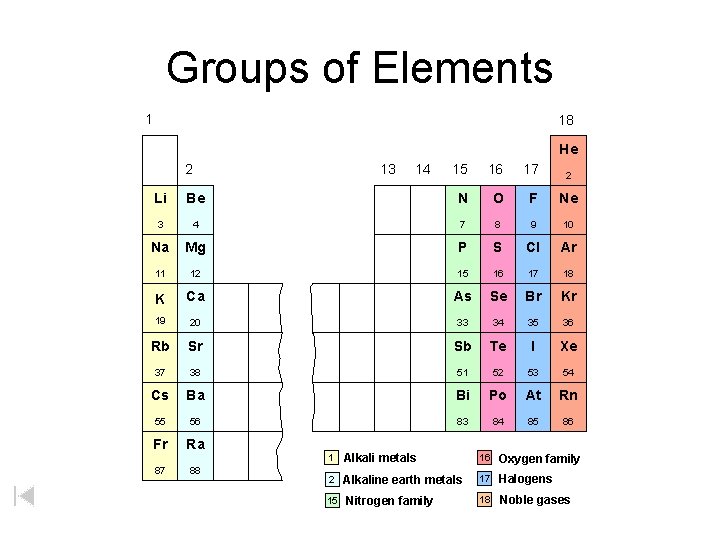
Groups of Elements 1 18 He 2 13 14 15 16 17 2 Li Be N O F Ne 3 4 7 8 9 10 Na Mg P S Cl Ar 11 12 15 16 17 18 K Ca As Se Br Kr 19 20 33 34 35 36 Rb Sr Sb Te I Xe 37 38 51 52 53 54 Cs Ba Bi Po At Rn 55 56 83 84 85 86 Fr Ra 87 88 1 Alkali metals 16 Oxygen family 2 Alkaline earth metals 17 Halogens 18 Noble gases 15 Nitrogen family
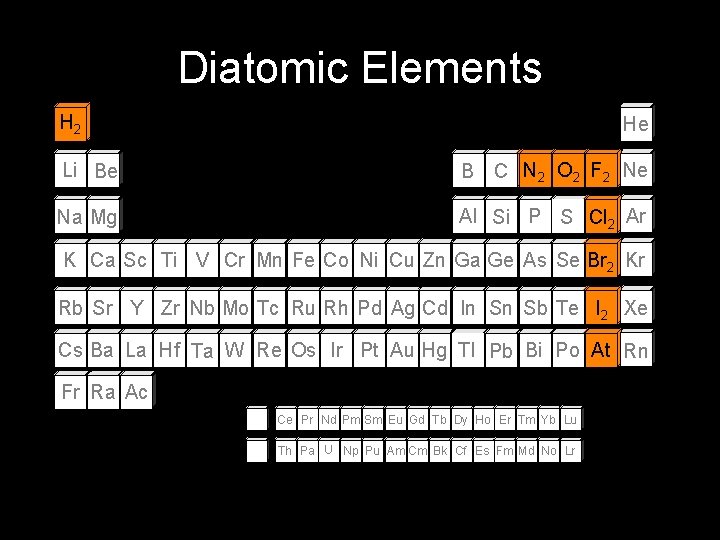
Diatomic Elements H 2 He Li Be B C N 2 O 2 F 2 Ne Na Mg Al Si P S Cl 2 Ar K Ca Sc Ti V Cr Mn Fe Co Ni Cu Zn Ga Ge As Se Br 2 Kr Rb Sr Y Zr Nb Mo Tc Ru Rh Pd Ag Cd In Sn Sb Te I 2 Xe Cs Ba La Hf Ta W Re Os Ir Pt Au Hg Tl Pb Bi Po At Rn Fr Ra Ac Ce Pr Nd Pm Sm Eu Gd Tb Dy Ho Er Tm Yb Lu Th Pa U Np Pu Am Cm Bk Cf Es Fm Md No Lr
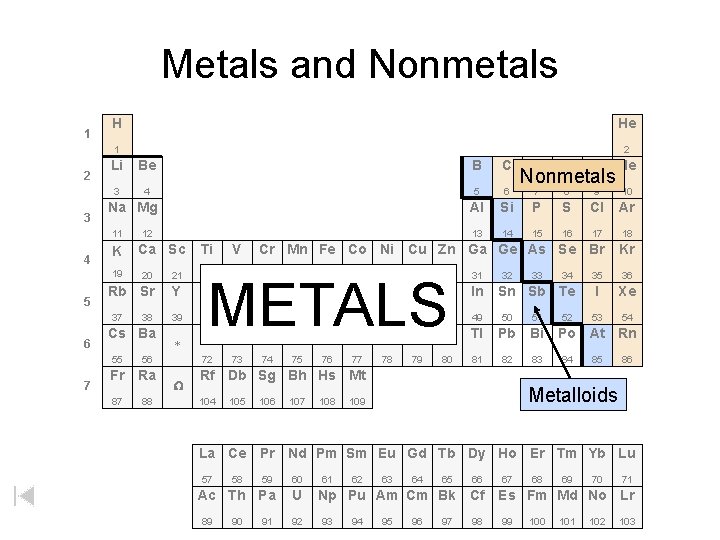
Metals and Nonmetals 1 2 3 H He 1 2 Li Be B C 3 4 5 6 Al 13 Na Mg 11 4 K 19 5 7 Ca Sc O F Ne 7 8 9 10 Si P S Cl Ar 14 15 16 17 18 Ti V Cr Mn Fe Co Ni Cu Zn Ga Ge As Se Br Kr 23 24 35 36 I Xe 53 54 20 21 22 Rb Sr Y Zr Nb Mo Tc Ru Rh Pd Ag Cd In 39 40 41 42 49 50 51 Hf Ta W 72 73 74 37 6 12 N Nonmetals 38 Cs Ba 55 56 Fr Ra 87 88 * W 25 26 27 28 29 30 METALS 43 44 Re Os 75 76 47 32 33 46 Ir Pt Au Hg Tl Pb Bi 77 78 81 82 83 80 34 Sn Sb Te 45 79 48 31 52 Po At Rn 84 85 86 Rf Db Sg Bh Hs Mt 104 105 106 107 108 Metalloids 109 La Ce Pr Nd Pm Sm Eu Gd Tb Dy Ho Er Tm Yb Lu 57 59 60 Ac Th Pa U 89 58 90 91 92 61 62 63 64 65 66 Np Pu Am Cm Bk Cf 93 94 95 96 97 98 67 68 69 70 71 Es Fm Md No Lr 99 100 101 102 103
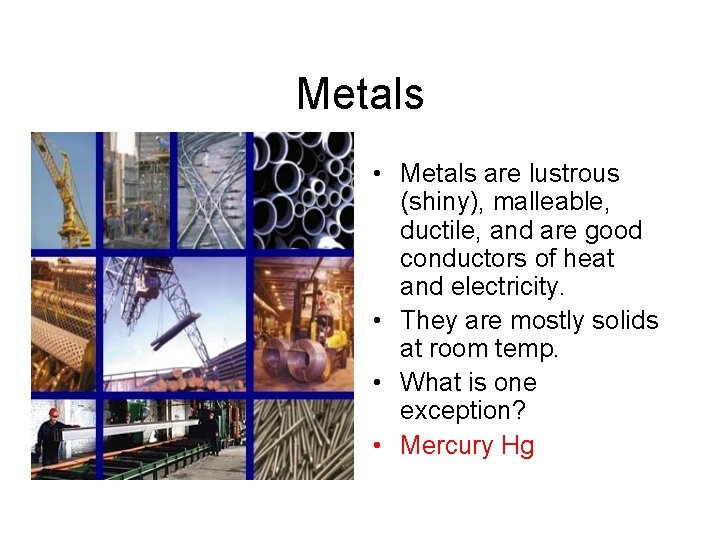
Metals • Metals are lustrous (shiny), malleable, ductile, and are good conductors of heat and electricity. • They are mostly solids at room temp. • What is one exception? • Mercury Hg
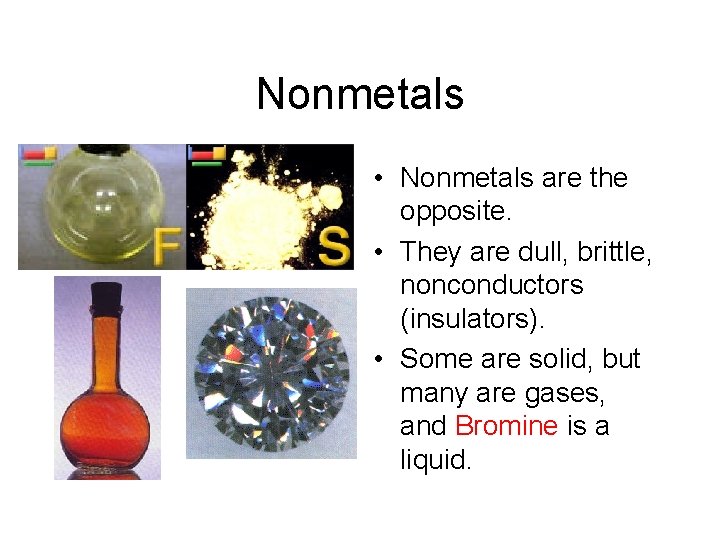
Nonmetals • Nonmetals are the opposite. • They are dull, brittle, nonconductors (insulators). • Some are solid, but many are gases, and Bromine is a liquid.
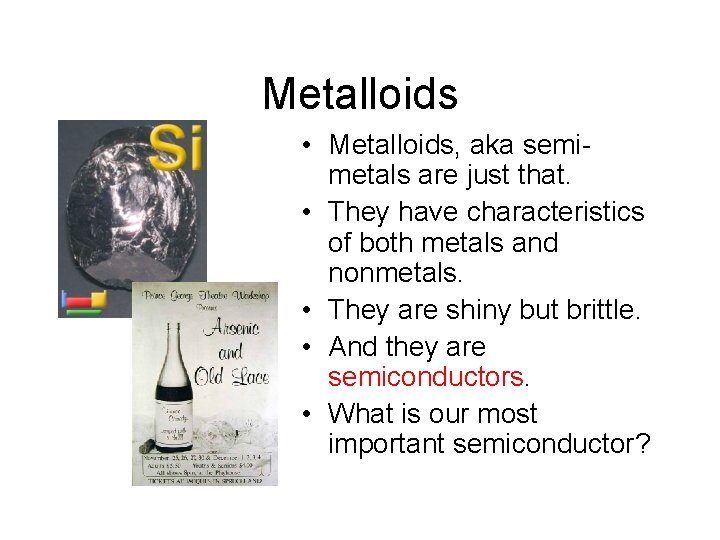
Metalloids • Metalloids, aka semimetals are just that. • They have characteristics of both metals and nonmetals. • They are shiny but brittle. • And they are semiconductors. • What is our most important semiconductor?

Nobelium (No) Element 102 Inventor: dynamite (TNT) blasting gelatin Trinitrotoluene Nobel Prize Alfred Nobel “Merchant of Death”

12 Mg Magnesium Atomic Mass 24 amu melting point = 650 o. C silver gray metal 24. 305 (1202 o. F) used in flash bulbs, bombs, and flares 8 th most abundant element (2. 2% of Earth’s crust) lack of Mg produces same biological effect as alcoholism (delirium tremens)
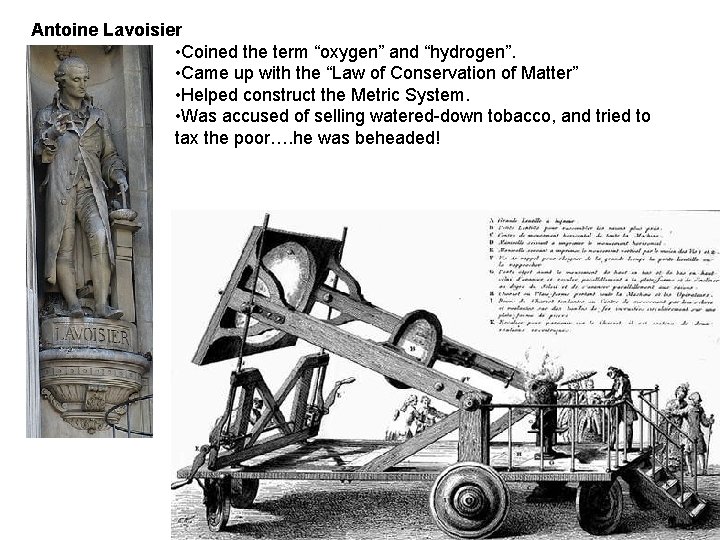
Antoine Lavoisier • Coined the term “oxygen” and “hydrogen”. • Came up with the “Law of Conservation of Matter” • Helped construct the Metric System. • Was accused of selling watered-down tobacco, and tried to tax the poor…. he was beheaded!
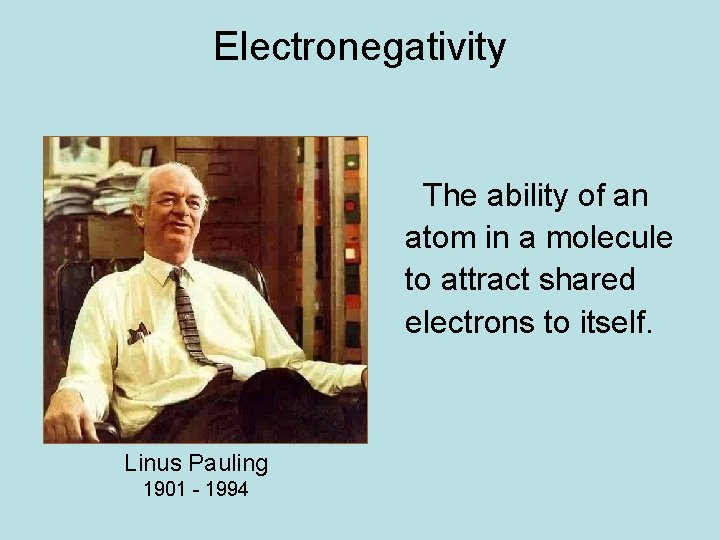
Electronegativity The ability of an atom in a molecule to attract shared electrons to itself. Linus Pauling 1901 - 1994
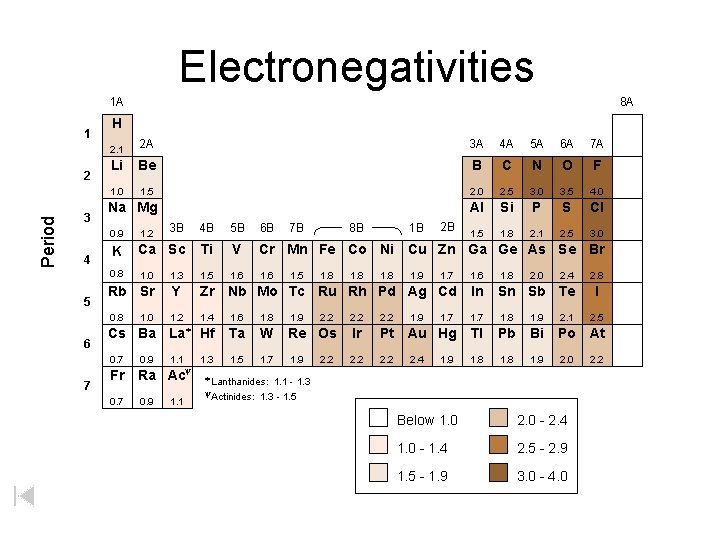
Electronegativities 1 A 1 Period 2 3 4 5 6 7 8 A H 2. 1 2 A 3 A 4 A 5 A 6 A 7 A Li Be B C N O F 1. 0 1. 5 2. 0 2. 5 3. 0 3. 5 4. 0 Al Si P S Cl 1. 5 1. 8 2. 1 2. 5 3. 0 Na Mg 1. 2 3 B 4 B 5 B 6 B K Ca Sc Ti V Cr Mn Fe Co Ni Cu Zn Ga Ge As Se Br 0. 8 1. 0 1. 3 1. 5 1. 6 1. 7 1. 6 1. 8 Rb Sr Y Zr Nb Mo Tc Ru Rh Pd Ag Cd In Sn Sb Te 0. 8 1. 2 1. 4 1. 6 1. 8 1. 9 2. 2 1. 7 1. 8 1. 9 2. 1 Cs Ba La* Hf Ta W Re Os Ir Pt Au Hg Tl Pb Bi Po At 0. 7 1. 1 1. 3 1. 5 1. 7 1. 9 2. 2 1. 8 1. 9 2. 0 1. 0 0. 9 y Fr Ra Ac 0. 7 0. 9 1. 1 8 B 7 B 1. 5 1. 8 2. 2 1. 8 1 B 2 B 0. 9 1. 8 1. 9 2. 4 1. 9 2. 0 2. 4 * Lanthanides: 1. 1 - 1. 3 y. Actinides: 1. 3 - 1. 5 Below 1. 0 2. 0 - 2. 4 1. 0 - 1. 4 2. 5 - 2. 9 1. 5 - 1. 9 3. 0 - 4. 0 2. 8 I 2. 5 2. 2
Electronegativity • Electronegativity is a measure of an atom’s attraction for another atom’s electrons. • It is an arbitrary scale that ranges from 0 to 4. • The units of electronegativity are Paulings. • Metals lose electrons and have low electronegativities. • Nonmetals gain electrons and have high electronegativities. • What about the noble gases?
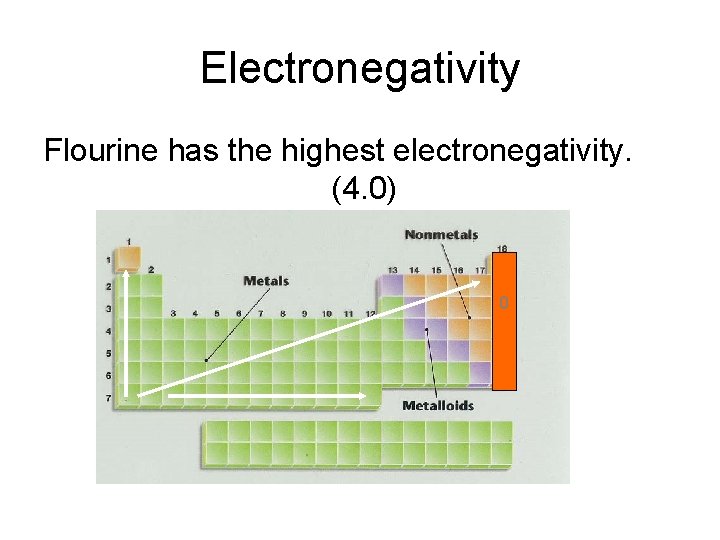
Electronegativity Flourine has the highest electronegativity. (4. 0) 0
Overall Reactivity • This ties all the previous trends together in one package. • However, we must treat metals and nonmetals separately. • The most reactive metals are the largest since they are the best electron givers. • The most reactive nonmetals are the smallest ones, the best electron takers.
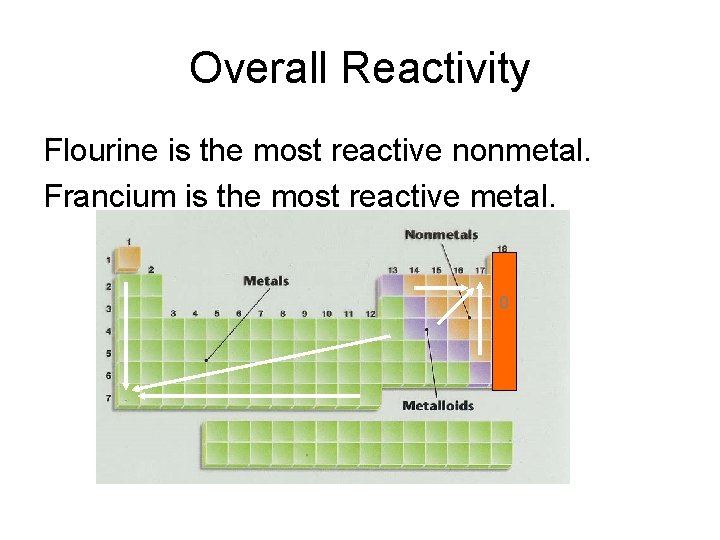
Overall Reactivity Flourine is the most reactive nonmetal. Francium is the most reactive metal. 0
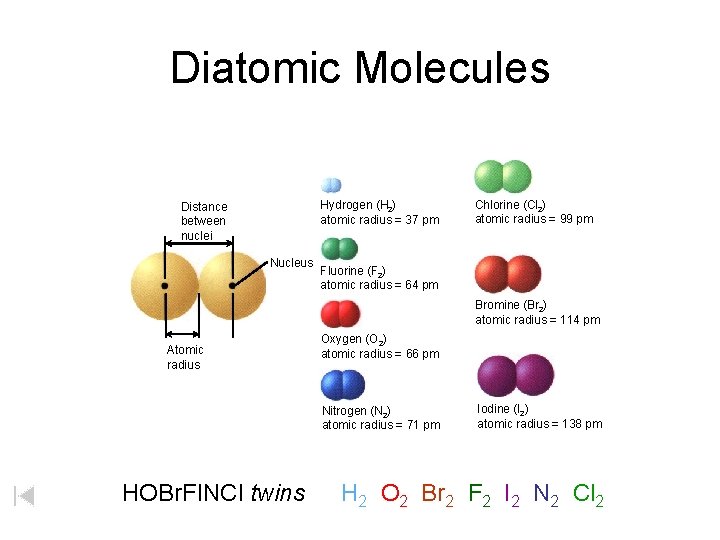
Diatomic Molecules Hydrogen (H 2) atomic radius = 37 pm Distance between nuclei Nucleus Chlorine (Cl 2) atomic radius = 99 pm Fluorine (F 2) atomic radius = 64 pm Bromine (Br 2) atomic radius = 114 pm Atomic radius Oxygen (O 2) atomic radius = 66 pm Nitrogen (N 2) atomic radius = 71 pm HOBr. FINCl twins Iodine (I 2) atomic radius = 138 pm H 2 O 2 Br 2 F 2 I 2 N 2 Cl 2

Relative Size of Atoms
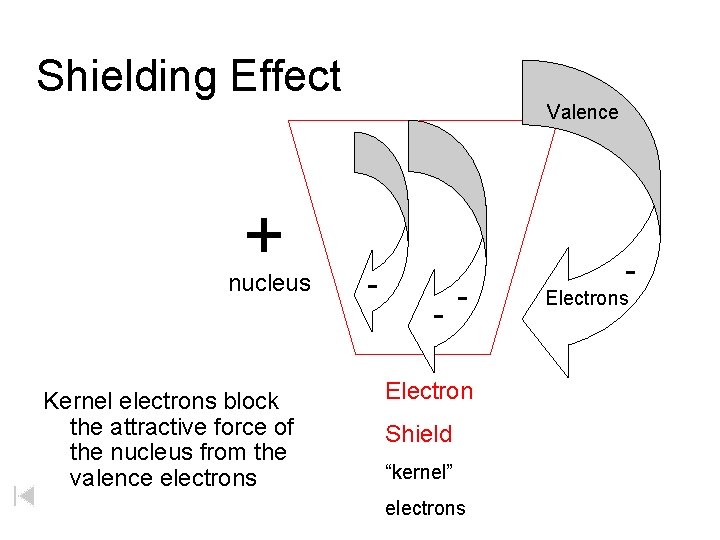
Shielding Effect Valence + nucleus Kernel electrons block the attractive force of the nucleus from the valence electrons - - - Electron Shield “kernel” electrons - Electrons
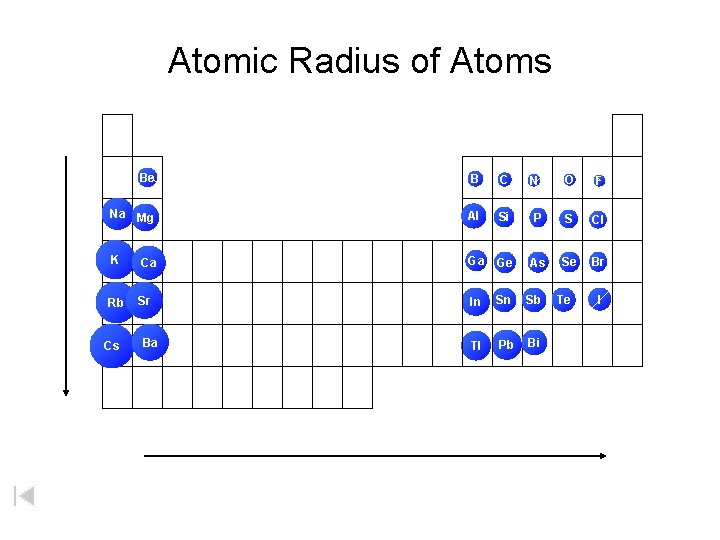
Atomic Radius of Atoms Be B C Na Mg Al Si K Ca Ga Ge Rb Sr In Sn Sb Tl Pb Bi Cs Ba O F P S Cl As Se Br N Te I
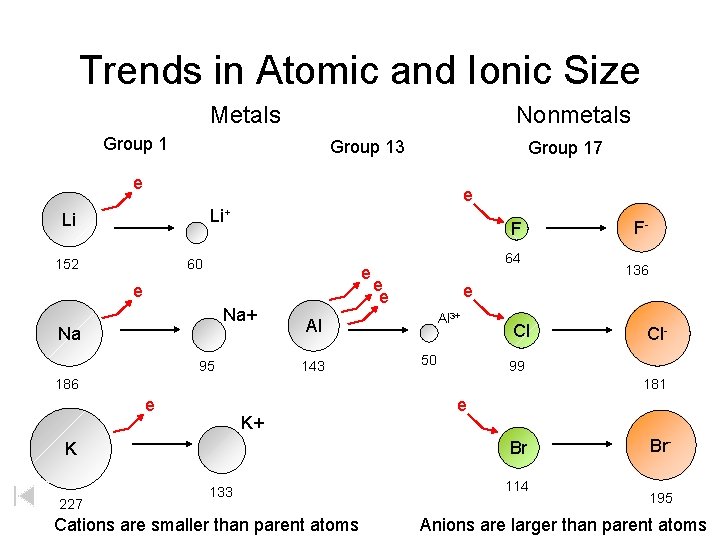
Trends in Atomic and Ionic Size Metals Nonmetals Group 13 Group 17 e e Li+ Li 152 F 60 e e Na+ Na 95 64 e e Al 3+ 50 Cl Cl- 99 181 186 e K+ e Br K 227 136 e Al 143 F- 133 Cations are smaller than parent atoms 114 Br 195 Anions are larger than parent atoms
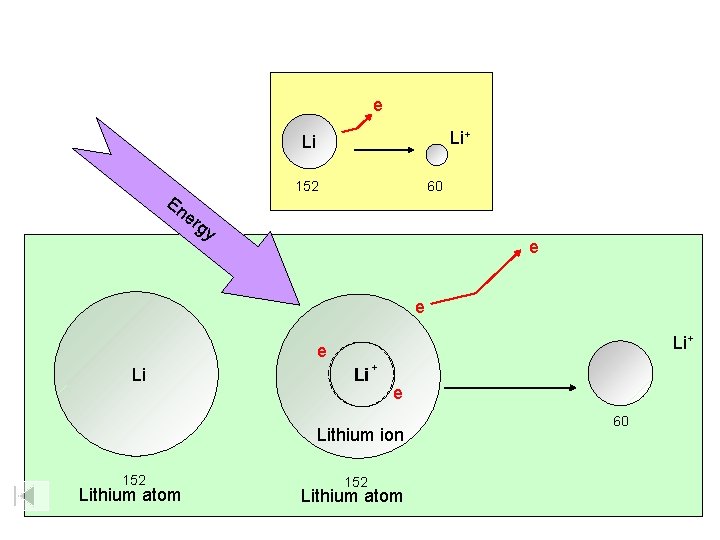
e Li+ Li En er 152 60 gy e e Li+ e Li Li + e Lithium ion 152 Lithium atom 60
Ionization Energies • It takes more energy to remove the second electron from an atom than the first, and so on. • There are two reasons for this trend: 1. The second electron is being removed from a positively charged species rather than a neutral one, so more energy is required. 2. Removing the first electron reduces the repulsive forces among the remaining electrons, so the attraction of the remaining electrons to the nucleus is stronger. • Energy required to remove electrons from a filled core is prohibitively large and simply cannot be achieved in normal chemical reactions.
Factors Affecting Ionization Energy Nuclear Charge The larger the nuclear charge, the greater the ionization energy. Shielding effect The greater the shielding effect, the less the ionization energy. Radius The greater the distance between the nucleus and the outer electrons of an atom, the less the ionization energy. Sublevel An electron from a full or half-full sublevel requires additional energy to be removed.
The Octet Rule • The “goal” of most atoms (except H, Li and Be) is to have an octet or group of 8 electrons in their valence energy level. • They may accomplish this by either giving electrons away or taking them. • Metals generally give electrons, nonmetals take them from other atoms. • Atoms that have gained or lost electrons are called ions.
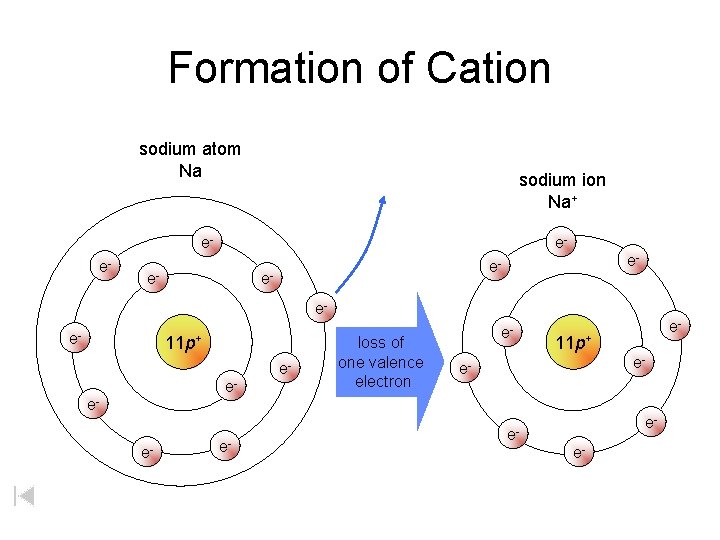
Formation of Cation sodium atom Na sodium ion Na+ e- e- e- 11 p+ ee- loss of one valence electron e- e- 11 p+ e- e- ee-
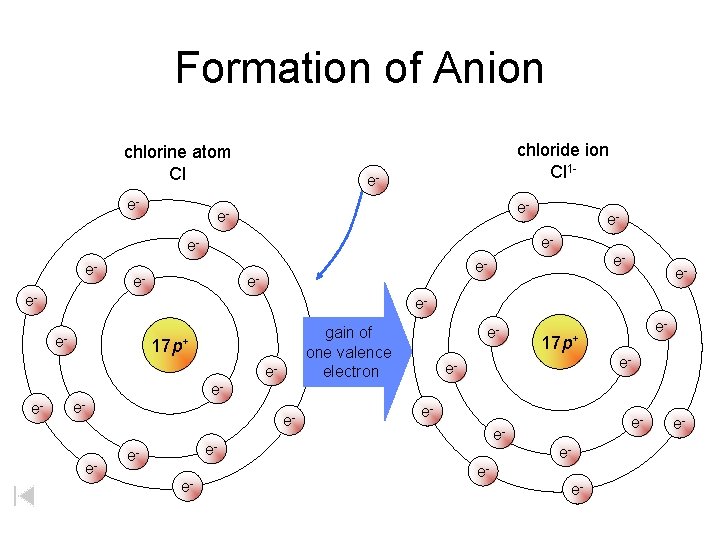
Formation of Anion chlorine atom Cl e- chloride ion Cl 1 - e- e- ee- e- gain of one valence electron 17 p+ e- e- ee- e- eeee- e-
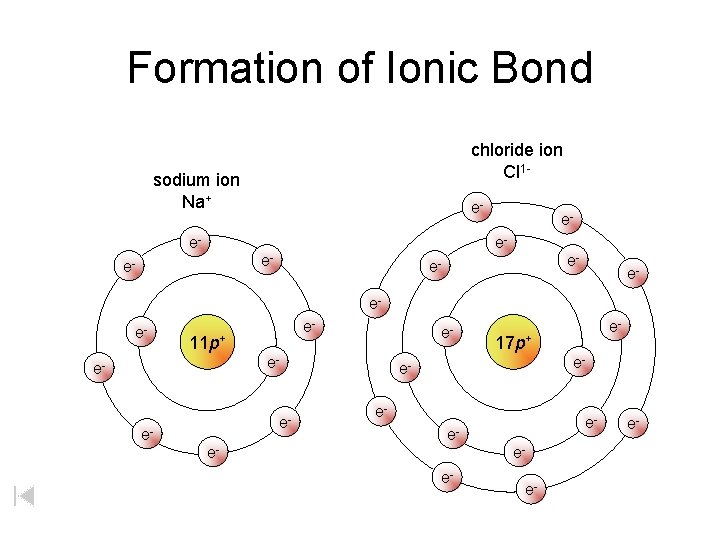
Formation of Ionic Bond chloride ion Cl 1 - sodium ion Na+ e- e- ee- e- 11 p+ e- e- e- 17 p+ e- ee- e- e-
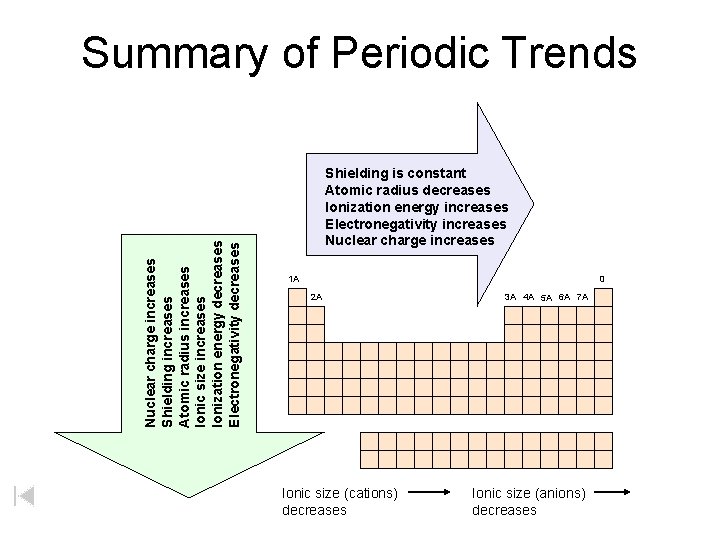
Nuclear charge increases Shielding increases Atomic radius increases Ionic size increases Ionization energy decreases Electronegativity decreases Summary of Periodic Trends Shielding is constant Atomic radius decreases Ionization energy increases Electronegativity increases Nuclear charge increases 1 A 0 2 A Ionic size (cations) decreases 3 A 4 A 5 A 6 A 7 A Ionic size (anions) decreases
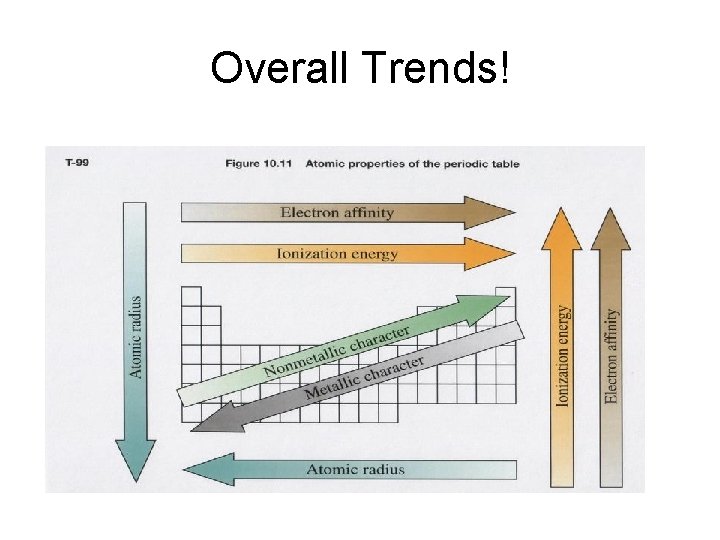
Overall Trends!
Chemical Bonding • Ionic – Metal (cation) with non-metal (anion) – Transfer of electron(s) – Strong bond…high melting point • Covalent – Non-metal with non-metal – Sharing of electron(s) • Non-polar (equal distribution of electrons) • Polar (uneven electron distribution) – Weak bonds…low melting points • Single, double and triple bonds • Metallic (nuclei in a “sea” of shared electrons)
- Slides: 33