
Guidelines or Guidance For Recording Disaster Loss Data
- Slides: 15
Guidelines (or Guidance) For Recording Disaster Loss Data V 6 EU Loss workshop- March 2015 www. jrc. europa. eu Serving society Stimulating innovation Supporting legislation
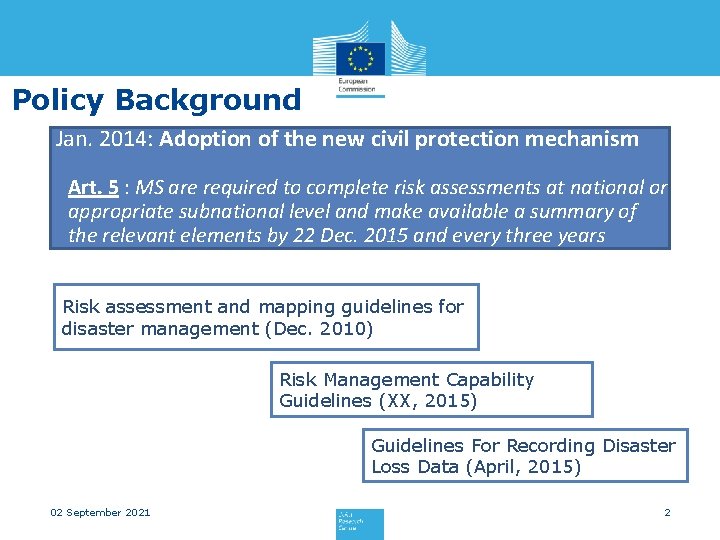
Policy Background Jan. 2014: Adoption of the new civil protection mechanism Art. 5 : MS are required to complete risk assessments at national or appropriate subnational level and make available a summary of the relevant elements by 22 Dec. 2015 and every three years thereafter. Risk assessment and mapping guidelines for disaster management (Dec. 2010) Risk Management Capability Guidelines (XX, 2015) Guidelines For Recording Disaster Loss Data (April, 2015) 02 September 2021 2
Council Conclusions on risk management capability 13375/14 of 24 September 2014 Call on the Commission to: 'Encourage the development of systems, models or methodologies for collecting and exchanging data on ways to assess the economic impact of disasters on an all-hazard basis. ' 02 September 2021 3
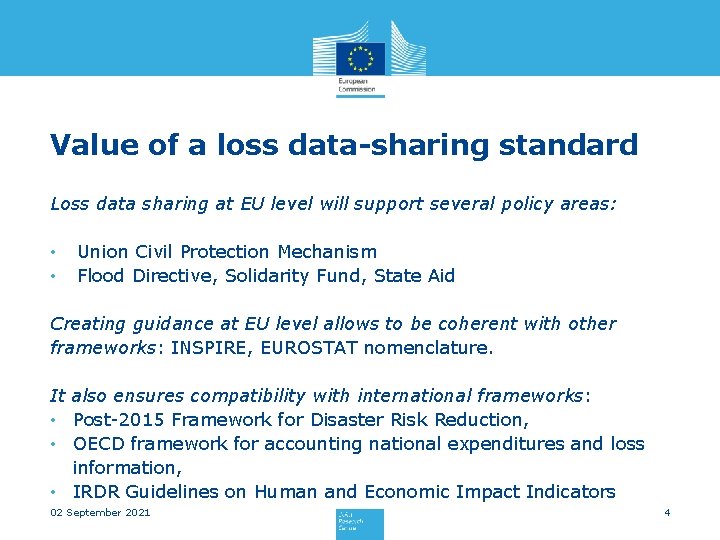
Value of a loss data-sharing standard Loss data sharing at EU level will support several policy areas: • • Union Civil Protection Mechanism Flood Directive, Solidarity Fund, State Aid Creating guidance at EU level allows to be coherent with other frameworks: INSPIRE, EUROSTAT nomenclature. It also ensures compatibility with international frameworks: • Post-2015 Framework for Disaster Risk Reduction, • OECD framework for accounting national expenditures and loss information, • IRDR Guidelines on Human and Economic Impact Indicators 02 September 2021 4
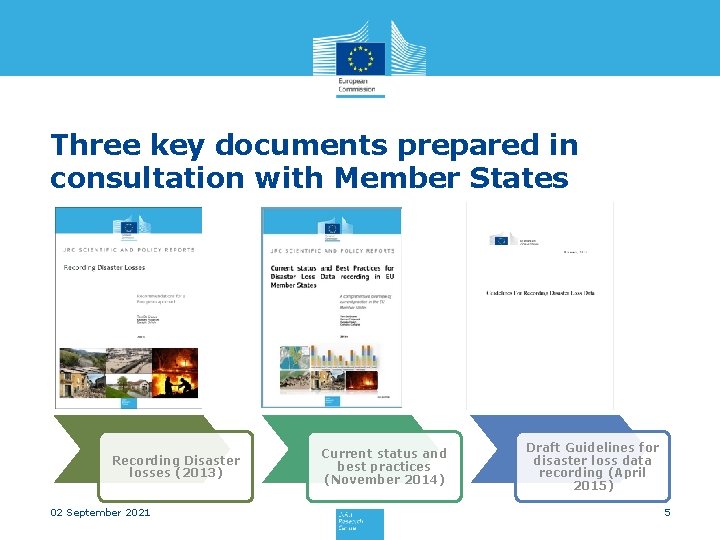
Three key documents prepared in consultation with Member States Recording Disaster losses (2013) 02 September 2021 Current status and best practices (November 2014) Draft Guidelines for disaster loss data recording (April 2015) 5
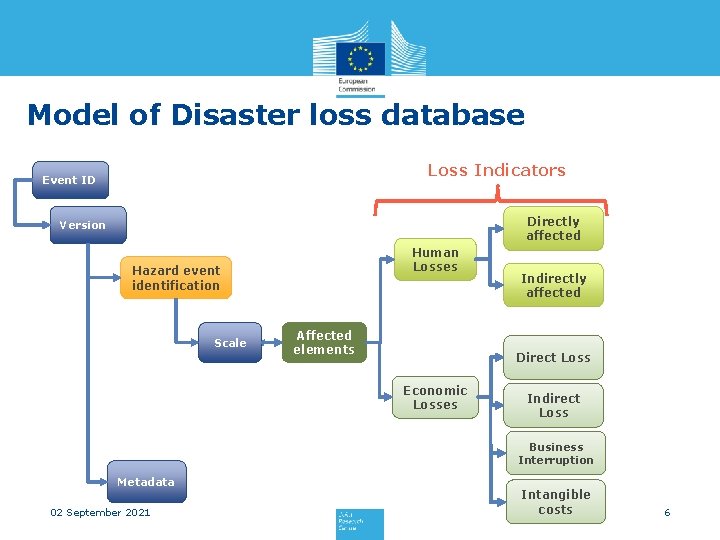
Model of Disaster loss database Loss Indicators Event ID Directly affected Version Human Losses Hazard event identification Scale Affected elements Indirectly affected Direct Loss Economic Losses Indirect Loss Business Interruption Metadata 02 September 2021 Intangible costs 6
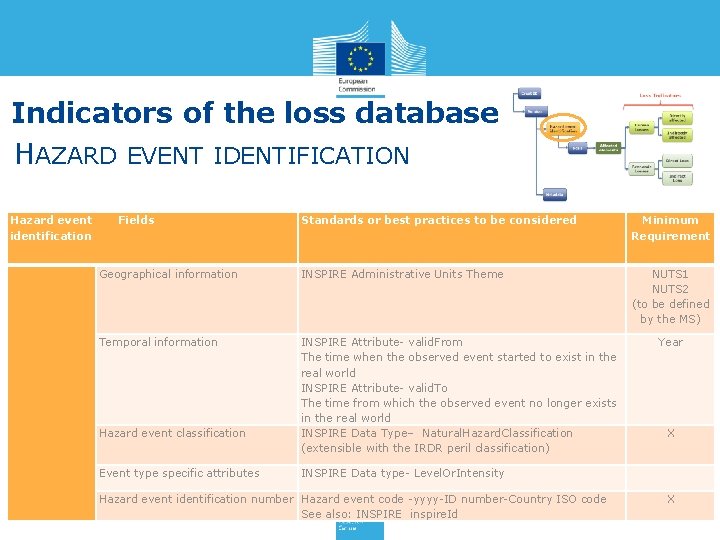
Indicators of the loss database HAZARD EVENT IDENTIFICATION Hazard event identification Fields Standards or best practices to be considered Minimum Requirement Geographical information INSPIRE Administrative Units Theme NUTS 1 NUTS 2 (to be defined by the MS) Temporal information INSPIRE Attribute- valid. From The time when the observed event started to exist in the real world INSPIRE Attribute- valid. To The time from which the observed event no longer exists in the real world INSPIRE Data Type– Natural. Hazard. Classification (extensible with the IRDR peril classification) Hazard event classification Event type specific attributes X INSPIRE Data type- Level. Or. Intensity Hazard event identification number Hazard event code -yyyy-ID number-Country ISO code See also: INSPIRE inspire. Id 02 September 2021 Year X 7
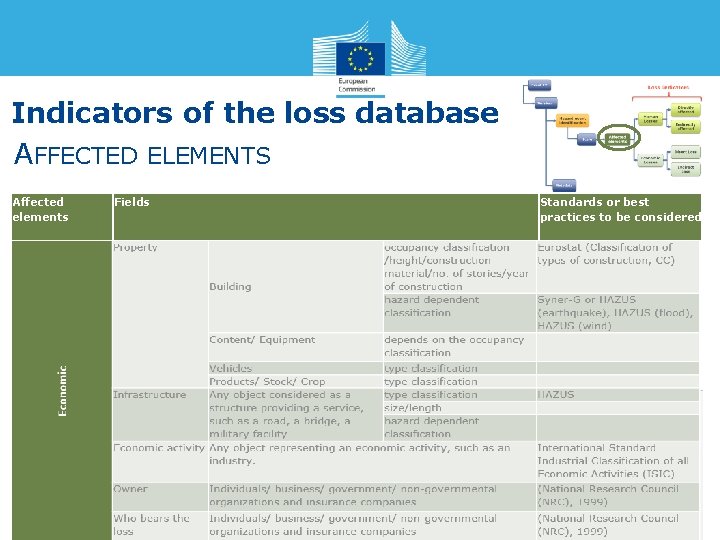
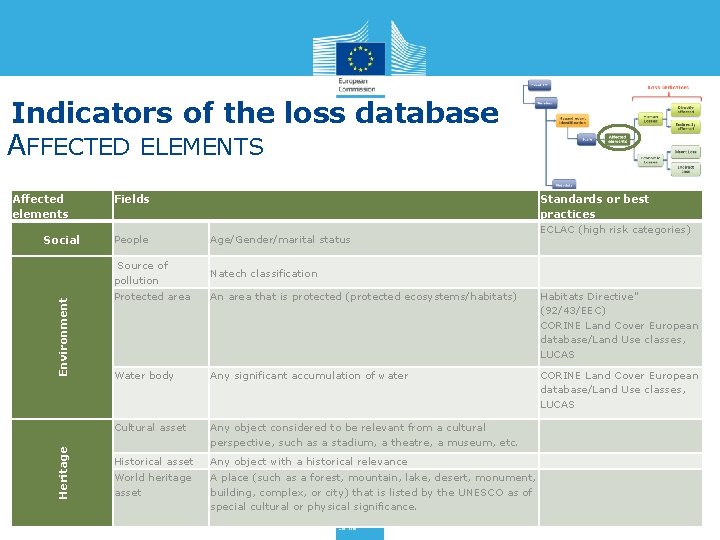
Indicators of the loss database AFFECTED ELEMENTS Affected elements Fields Standards or best practices to be considered INSPIRE Administrative Units Theme Classification of the affected element INSPIRE Data type: Exposed. Element. Classification Social Geographical information People 02 September 2021 Age/gender/marital status, etc. ECLAC based 8
Indicators of the loss database AFFECTED ELEMENTS Affected elements Heritage Environment Social Fields Standards or best practices ECLAC (high risk categories) People Age/Gender/marital status Source of pollution Natech classification Protected area An area that is protected (protected ecosystems/habitats) Habitats Directive" (92/43/EEC) CORINE Land Cover European database/Land Use classes, LUCAS Water body Any significant accumulation of water CORINE Land Cover European database/Land Use classes, LUCAS Cultural asset Any object considered to be relevant from a cultural perspective, such as a stadium, a theatre, a museum, etc. Historical asset Any object with a historical relevance World heritage asset A place (such as a forest, mountain, lake, desert, monument, building, complex, or city) that is listed by the UNESCO as of special cultural or physical significance. 02 September 2021 9
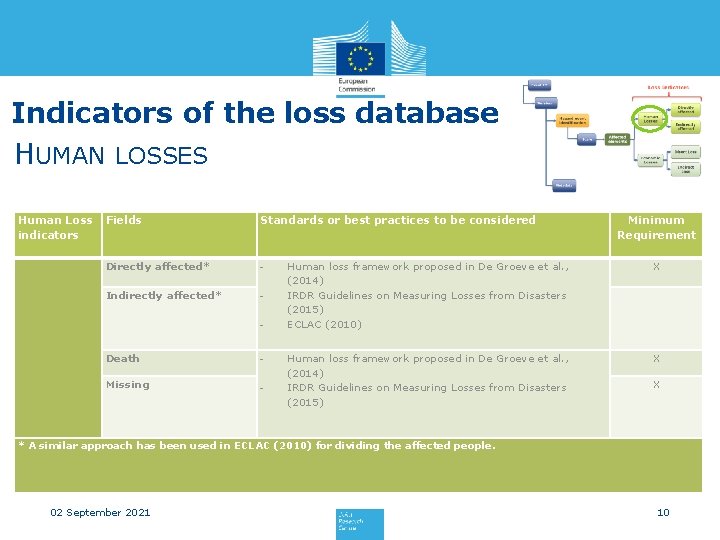
Indicators of the loss database HUMAN LOSSES Human Loss indicators Fields Standards or best practices to be considered Directly affected* - Indirectly affected* - Death - Missing - Minimum Requirement Human loss framework proposed in De Groeve et al. , (2014) IRDR Guidelines on Measuring Losses from Disasters (2015) ECLAC (2010) X Human loss framework proposed in De Groeve et al. , (2014) IRDR Guidelines on Measuring Losses from Disasters (2015) X X * A similar approach has been used in ECLAC (2010) for dividing the affected people. 02 September 2021 10
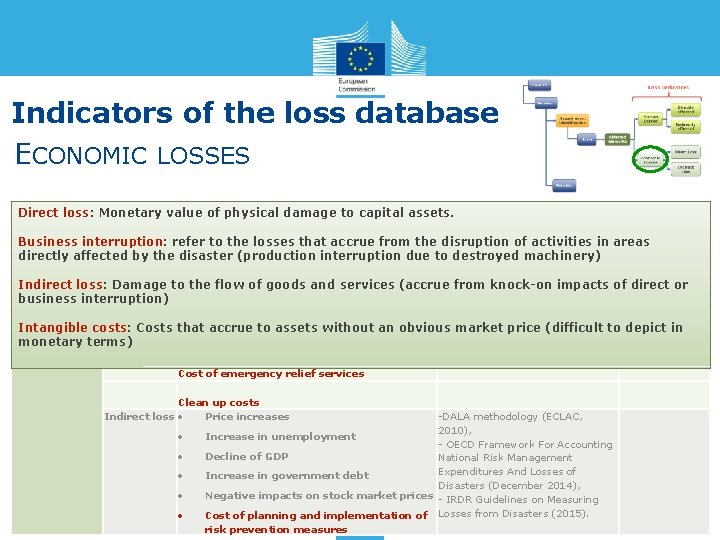
Indicators of the loss database ECONOMIC LOSSES Economic Loss Monetary Fields Direct loss: indicators Standards or best practices to value of physical damage to capital assets. be considered Minimum Requirement Business interruption: to the losses that accrue from the Industrial disruption of activities Direct loss refer Economic Sector: Classification of all in areas X Agriculture/Education/manufacturing/infrastructur Economic Activities (ISIC)version (Total of all directly affected by the disaster (production interruption due to destroyed machinery) e, etc. 4 (2008) sectors) Indirect loss: Damage to the flow of goods and services (accrue from Research knock-on impacts Owner: (National Council (NRC), of direct X or business interruption) Individuals/ business/ government/ non 1999) governmental organizations and insurance companies that accrue to assets without an Intangible costs: Costs obvious market price (difficult to depict in monetary terms) Who bears the loss: Individuals/ business/ etc. (National Research Council (NRC), X 1999) Cost of emergency relief services Clean up costs Indirect loss Price increases 02 September 2021 -DALA methodology (ECLAC, 2010), Increase in unemployment - OECD Framework For Accounting Decline of GDP National Risk Management Expenditures And Losses of Increase in government debt Disasters (December 2014), Negative impacts on stock market prices - IRDR Guidelines on Measuring Cost of planning and implementation of Losses from Disasters (2015). risk prevention measures 11
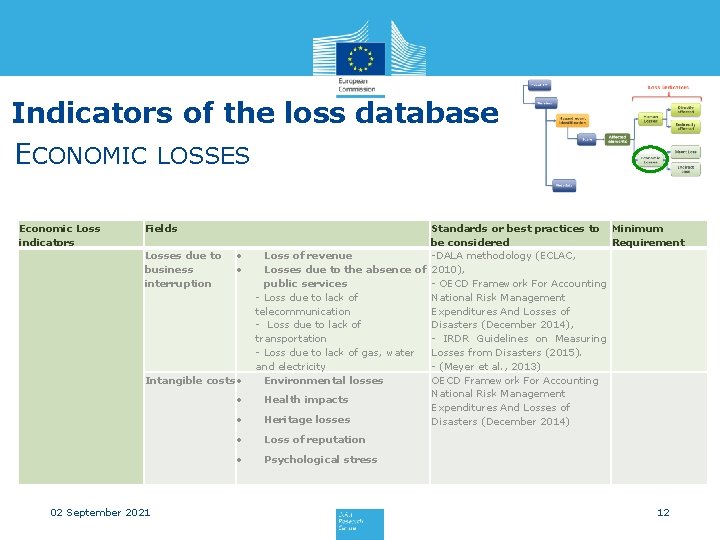
Indicators of the loss database ECONOMIC LOSSES Economic Loss indicators Fields Losses due to business interruption Intangible costs 02 September 2021 Standards or best practices to Minimum be considered Requirement Loss of revenue -DALA methodology (ECLAC, Losses due to the absence of 2010), public services - OECD Framework For Accounting - Loss due to lack of National Risk Management telecommunication Expenditures And Losses of - Loss due to lack of Disasters (December 2014), transportation - IRDR Guidelines on Measuring - Loss due to lack of gas, water Losses from Disasters (2015). and electricity - (Meyer et al. , 2013) Environmental losses OECD Framework For Accounting National Risk Management Health impacts Expenditures And Losses of Heritage losses Disasters (December 2014) Loss of reputation Psychological stress 12
Summary of main requirements for loss-data sharing standard • Loss data at asset level is not necessary; aggregation of data geographically at regional (NUTS 2) or national levels (NUTS 1) can be sufficient, • Only direct losses in national currency need to be reported ; • Recommendation: Information regarding the reliability of loss indicators such as a quality score or an uncertainty level to aid data users in their interpretation of the information. • Sharing of Summary or aggregate statistics using an open data policy in a common data standard to support transboundary and international processes (including the post-2015 Framework). 13
Points for discussion: 1) Interest of MS in sharing loss data 2) Categories of Loss Indicators : Human and Economic Losses § Deaths and Missing as part of Directly Affected? § Subdivision of economic losses into : Direct/Indirect/Business Interruption/Intangible costs § Inclusion of costs of emergency services and clean up under Direct Loss 3) § § § Standards and Classification Economic activity, economic sectors (ISIC or other? ) Occupancy classification for buildings, Owner, Who bears the loss etc. 02 September 2021 14
Points for discussion: 4) Article 4 of Decision No 1313/2013/EU: 'disaster' means any situation which has or may have a severe impact on people, the environment, or property, including cultural heritage: need to define a criteria for selecting events to be shared with the EU and with MS ? 5) Dealing with cascading effects ? 6) Utility and relevance of a terminology section (in Annex) ? 02 September 2021 15