
Guidelines for the Management of Severe Traumatic Brain
Guidelines for the Management of Severe Traumatic Brain Injury 4 th Edition R 2 Chanpitcha Khumchoei R 2 Sithee Chumthong Advisor : Ajarn. Parichat Nilyam

Introduction Traumatic brain injury (TBI) is defined as blow or jolt to the head or a penetrating head injury that disrupts the function of the brain

Severity of traumatic brain injury Mild GCS 13 -15 Moderate GCS 9 -12 Severe GCS <9

Level of Recommendation The levels were primarily based on the quality of the body of evidence as follows • Level I : high-quality • Level II A : moderate-quality • Level II B and III: low-quality
Scope of the guideline PART I: TREATMENTS PART II: MONITORING PART III: THRESHOLDS
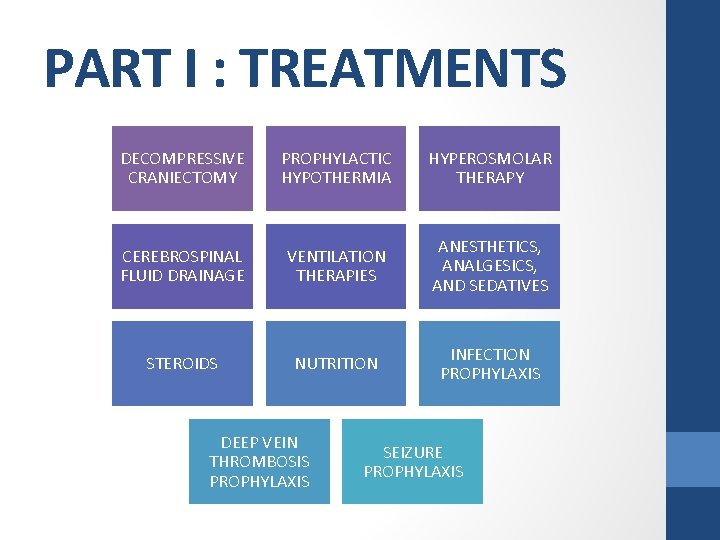
PART I : TREATMENTS DECOMPRESSIVE CRANIECTOMY PROPHYLACTIC HYPOTHERMIA HYPEROSMOLAR THERAPY CEREBROSPINAL FLUID DRAINAGE VENTILATION THERAPIES ANESTHETICS, ANALGESICS, AND SEDATIVES STEROIDS NUTRITION INFECTION PROPHYLAXIS DEEP VEIN THROMBOSIS PROPHYLAXIS SEIZURE PROPHYLAXIS

Decompressive Craniectomy • Cerebral edema • primary injury • secondary injury • DC : relieving elevated intracranial pressure • variations in • surgical techniques • timing • patient populations
Decompressive Craniectomy Recommedations Level II A Bifrontal DC is not recommended to improve outcomes as measured by the Glasgow Outcome Scale–Extended (GOS-E) score at 6 months post-injury in severe TBI patients with diffuse injury (without mass lesions) Cooper DJ, Rosenfeld JV, Murray L, et al. Decompressive craniectomy in diffuse traumatic brain injury. [Erratum appears in N Engl J Med. 2011 Nov 24
Decompressive Craniectomy Recommedations Level II A A large frontotemporoparietal DC (not less than 12 x 15 cm or 15 cm diameter) is recommended over a small frontotemporoparietal DC Jiang JY, Xu W, Li WP, et al. Efficacy of standard trauma craniectomy for refractory intracranial hypertension with severe traumatic brain injury: a multicenter, prospective, randomized controlled study. J Neurotrauma. 2005 Qiu W, Guo C, Shen H, et al. Effects of unilateral decompressive craniectomy on patients with unilateral acute post-traumatic brain swelling after severe traumatic brain injury. Crit Care. 2009
Hypothermia • Prophylactic : early after injury and prior to intracranial pressure elevation • Therapeutic : treatment for refractory intracranial pressure elevation
Prophylactic Hypothermia • Hypothermia : Preserve cells and tissue • Standard care for neuroprotection after cardiac arrest from acute coronary syndromes • Hypothermia bears risks • • Coagulopathy Immunosuppression Cardiac dysrhythmia Death
Prophylactic Hypothermia Recommendations Level II B Early (within 2. 5 hours), short-term (48 hours post-injury) prophylactic hypothermia is not recommended to improve outcomes in patients with diffuse injury Clifton GL, Valadka A, Zygun D, et al. Very early hypothermia induction in patients with severe brain injury (the National Acute Brain Injury Study: Hypothermia II): a randomised trial. Lancet Neurol. Feb 2011
Hyperosmolar Therapy • Dramatic change of the volume of the brain : administration of hypertonic or hypotonic intravenous solutions • Previous routine management : intracranial hypertension and herniation syndromes • Hypertonic saline and Mannitol : Osmotic diuretic of the brain • Hypertonic saline • Central pontine myelinolysis • Mannitol • diuretic effect is undesirable in hypotensive patient
Hyperosmolar Therapy Recommendations Recommend ations from the Prior (3 rd) Edition Mannitol is effective for control of raised intracranial pressure (ICP) at doses of 0. 25 - 1 g/kg body weight Arterial hypotension (systolic blood pressure <90 mm Hg) should be avoided Restrict manitol use prior to ICP monitoring -signs of transtentorial herniation -progressive neurological deterioration 4 th edition : no recommendation : need further study
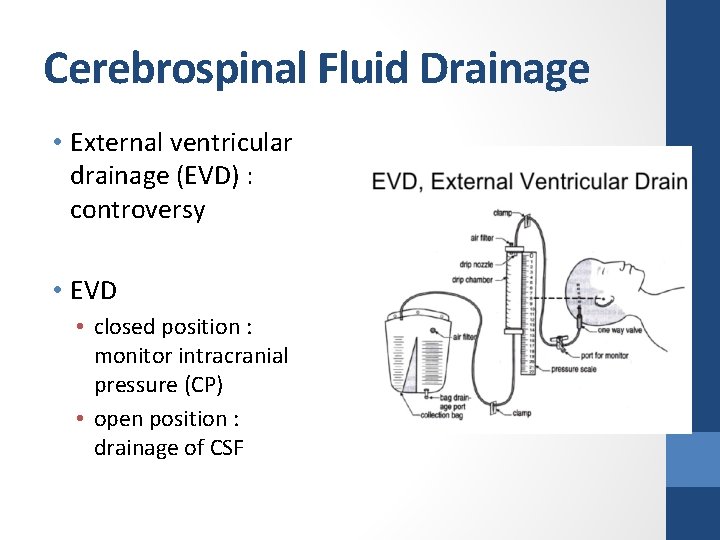
Cerebrospinal Fluid Drainage • External ventricular drainage (EVD) : controversy • EVD • closed position : monitor intracranial pressure (CP) • open position : drainage of CSF
Cerebrospinal Fluid Drainage Recommendations Level III An EVD system zeroed at the midbrain with continuous drainage of CSF may be considered to lower ICP burden more effectively than intermittent use Nwachuku EL, Puccio AM, Fetzick A, et al. Intermittent versus continuous cerebrospinal fluid drainage management in adult severe traumatic brain injury: assessment of intracranial pressure burden. Neurocrit Care. Aug 2013 Use of CSF drainage to lower ICP in patients with an initial Glasgow Coma Scale (GCS) <6 during the first 12 hours after injury may be considered Griesdale DE, Mc. Ewen J, Kurth T, Chittock DR. External ventricular drains and mortality in patients with severe traumatic brain injury. Can J Neurol Sci. 2010
Ventilation Therapies • Definitive airway protection • risk of pulmonary aspiration • compromised respiratory drive and function • transient hyperventilation • The goal for severe TBI patients • Normal ventilation and normal partial pressure of carbon dioxide in arterial blood (Pa. CO 2) ranges from 35 -45 mm Hg • Cerebral blood flow : The brain’s metabolic demands • Low Pa. CO 2 : low CBF cerebral ischemia • High Pa. CO 2 : cerebral hyperemia high intracranial pressure (ICP)
Ventilation Therapies • Older studies : cerebral hyperemia > cerebral ischemia suggest hyperventilation • Recent studies : cerebral metabolic rate is variable • Cerebral ischemia has been largely documented after severe TBI • High prevalence of cerebral ischemia suggests safety in providing normoventilation
Ventilation Therapies Recommendations Level II B Prolonged prophylactic hyperventilation with partial pressure of carbon dioxide in arterial blood (Pa. CO 2) of 25 mm Hg or less is not recommended Muizelaar JP, Marmarou A, Ward JD, et al. Adverse effects of prolonged hyperventilation in patients with severe head injury: a randomized clinical trial. J Neurosurg. Nov 1991
Anesthetics, Analgesics, and Sedatives • Important for prophylaxis or control of intracranial hypertension and seizures • Barbiturates have a long history of being used to control intracranial pressure (ICP) • Side effects : hypotension and decreased cardiac output, increased intrapulmonary shunting
Anesthetics, Analgesics, and Sedatives Recommendations Level II B Administration of barbiturates to induce burst suppression as prophylaxis against the development of intracranial hypertension is not recommended Ward JD, Becker DP, Miller JD, et al. Failure of prophylactic barbiturate coma in the treatment of severe head injury. J Neurosurg. Mar 1985
Anesthetics, Analgesics, and Sedatives Recommendations Level II B High-dose barbiturate administration is recommended to control elevated ICP refractory to maximum standard medical and surgical treatment Eisenberg HM, Frankowski RF, Contant CF, Marshall LF, Walker MD. High-dose barbiturate control of elevated intracranial pressure in patients with severe head injury. J Neurosurg. Jul 1988
Anesthetics, Analgesics, and Sedatives Recommendations Level II B Although propofol is recommended for the control of ICP, it is not recommended for improvement in mortality or 6 -month outcomes Caution is required as high-dose propofol can produce significant morbidity Kelly DF, Goodale DB, Williams J, et al. Propofol in the treatment of moderate and severe head injury: a randomized, prospective double-blinded pilot trial. J Neurosurg. Jun 1999

Steroids • Steroid use • the restoration of altered vascular permeability in brain edema • reduction of cerebrospinal fluid production • attenuation of free radical production • Glucocorticoids benefit for patients with brain tumors when administered in the perioperative period • However, studies of severe TBI patients failed to find a benefit • The Corticosteroid Randomization After Significant Head Injury Trial (CRASH) trial was designed to provide highquality evidence on the impact of steroids on TBI patients
Steroids Recommendations Level I The use of steroids is not recommended for improving outcome or reducing ICP In patients with severe TBI, high-dose methylprednisolone was associated with increased mortality and is contraindicated Edwards P, Arango M, Balica L, et al. Final results of MRC CRASH, a randomised placebocontrolled trial of intravenous corticosteroid in adults with head injury-outcomes at 6 months. Lancet. Jun 2005
Infection Prophylaxis • Severe traumatic brain injury can increase a patient’s susceptibility to infection • The use of mechanical ventilation • Invasive monitoring • Patients undergoing intracranial pressure (ICP) monitoring have related infection rates as high as 27%
Infection Prophylaxis • For external ventricular drains (EVDs) • prophylactic intravenous (IV) antibiotics • reduces infection rates or increases the risk of drugresistant organisms • Ventilator associated pneumonias (VAP) may be as high as 40%, and associated with longer exposure to mechanical ventilation • The occurrence of VAP represents a significant morbidity
Infection Prophylaxis Recommendations Level II A Early tracheostomy is recommended to reduce mechanical ventilation days No evidence early tracheostomy reduces mortality or the rate of nosocomial pneumonia Bouderka MA, Fakhir B, Bouaggad A, Hmamouchi B, Hamoudi D, Harti A. Early tracheostomy versus prolonged endotracheal intubation in severe head injury. J Trauma. Aug 2004 Sugerman HJ, Wolfe L, Pasquale MD, et al. Multicenter, randomized, prospective trial of early tracheostomy. J Trauma. Nov 1997
Infection Prophylaxis Recommendations Level II A The use of povidone-iodine (PI) oral care is not recommended to reduce VAP and may cause an increased risk of ARDS Seguin P, Tanguy M, Laviolle B, Tirel O, Malledant Y. Effect of oropharyngeal decontamination by povidone-iodine on ventilator-associated pneumonia in patients with head trauma. Crit Care Med. May 2006 Seguin P, Laviolle B, Dahyot-Fizelier C, et al. Effect of oropharyngeal povidone-iodine preventive oral care on ventilator-associated pneumonia in severely brain-injured or cerebral hemorrhage patients: a multicenter, randomized controlled trial. Crit Care Med. Jan 2014
Infection Prophylaxis Recommendations Level III Antimicrobial-impregnated catheters may be considered to prevent catheter-related infections during EVD Wang X, Dong Y, Qi XQ, Li YM, Huang CG, Hou LJ. Clinical review: Efficacy of antimicrobialimpregnated catheters in external ventricular drainage - a systematic review and meta-analysis. Crit Care. 2013 Ratilal BO, Costa J, Sampaio C, Pappamikail L. Antibiotic prophylaxis for preventing meningitis in patients with basilar skull fractures. Cochrane Databse Syst Rev. Aug 2011. PMID: 21833952.
Deep Vein Thrombosis Prophylaxis • 54% incidence of DVT without prophylactic treatment • 25% incidence in patients with isolated TBI treated with sequential compression devices
Deep Vein Thrombosis Prophylaxis • Significant risk for VTE due to • hypercoagulability resulting from the primary brain injury • prolonged periods of immobilization • focal motor deficits • Non pharmacologic Vs Pharmacologic prevention
Deep Vein Thrombosis Prophylaxis Recommendation Level III Low molecular weight heparin (LMWH) or lowdose unfractioned heparin may be used in combination with mechanical prophylaxis Increased risk for expansion of intracranial hemorrhage Kwiatt ME, Patel MS, Ross SE, et al. Is low-molecular-weight heparin safe for venous thromboembolism prophylaxis in patients with traumatic brain injury? A Western Trauma Association multicenter study. J Trauma Acute Care Surg. Sep 2012 Mohseni S, Talving P, Lam L, Chan LS, Ives C, Demetriades D. Venous thromboembolic events in isolated severe traumatic brain injury. J Emerg Trauma Shock. Jan 2012 Scudday T, Brasel K, Webb T, et al. Safety and efficacy of prophylactic anticoagulation in patients with traumatic brain injury. J Am Coll Surg. 2011 Daley MJ, Brown CV. Late venous thromboembolism prophylaxis after craniotomy in acute traumatic brain injury Am Surg 2015
Seizure Prophylaxis • Post-traumatic seizures (PTS) are classified as • Early < 7 days of injury • late > 7 days following injury • Post-traumatic epilepsy (PTE) is defined as recurrent seizures > 7 days following injury
Seizure Prophylaxis The risk factors for early PTS include: • Glasgow Coma Scale (GCS) score of ≤ 10 • immediate seizures • post-traumatic amnesia lasting longer than 30 minutes • linear or depressed skull fracture • penetrating head injury • subdural, epidural, or intracerebral hematoma • cortical contusion • age ≤ 65 years • chronic alcoholism
Seizure Prophylaxis Risk for PTE (Post-traumatic epilepsy) • severe TBI and early PTS prior to discharge • acute intracerebral hematoma or cortical contusion • posttraumatic amnesia lasting longer than 24 hours • age >65 years or premorbid history of depression
Seizure Prophylaxis • Seizure prophylaxis for PTS refers to the practice of administering anticonvulsants to patients following TBI
Seizure Prophylaxis Recommendations Level II A Prophylactic use of phenytoin or valproate is not recommended for preventing late PTS Phenytoin is recommended to decrease the incidence of early PTS (within 7 days of injury) Inaba K, Menaker J, Branco BC, et al. A prospective multicenter comparison of levetiracetam versus phenytoin for early posttraumatic seizure prophylaxis. J Trauma Acute Care Surg. Mar 2013 Dikmen SS, Machamer JE, Winn HR, Anderson GD, Temkin NR. Neuropsychological effects of valproate in traumatic brain injury: a randomized trial. Neurology. Feb 2000 Temkin NR, Dikmen SS, Wilensky AJ, Keihm J, Chabal S, Winn HR. A randomized, double-blind study of phenytoin for the prevention of post-traumatic seizures. N Engl J Med. Aug 1990
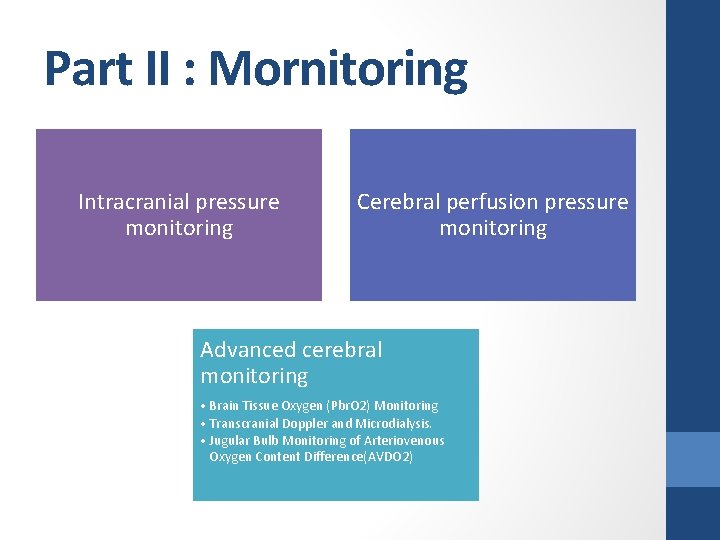
Part II : Mornitoring Intracranial pressure monitoring Cerebral perfusion pressure monitoring Advanced cerebral monitoring • Brain Tissue Oxygen (Pbr. O 2) Monitoring • Transcranial Doppler and Microdialysis. • Jugular Bulb Monitoring of Arteriovenous Oxygen Content Difference(AVDO 2)
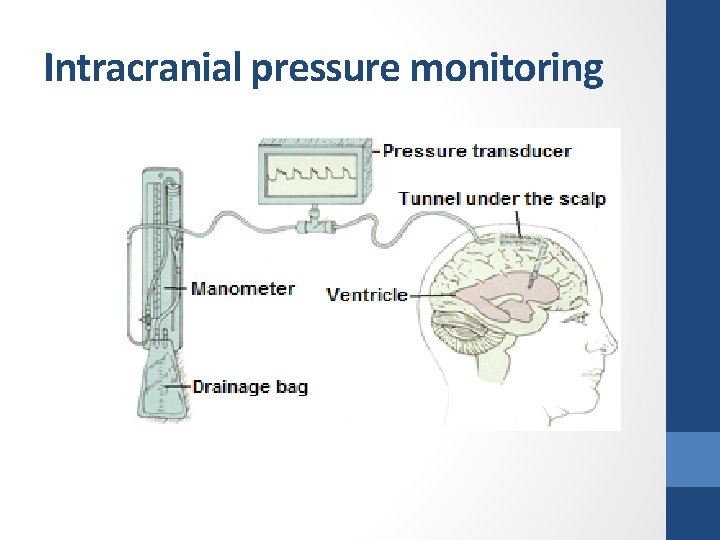
Intracranial pressure monitoring
Intracranial Pressure Monitoring Recommendations Level II B Management of severe TBI patient using information from ICP monitoring is recommended to reduce in-hospital and 2 -week post-injury mortality (Farahvar A, Gerber LM, Chiu YL, Carney N, Hartl R, Ghajar J. Increased mortality in patients with severe traumatic brain injury treated without intracranial pressure monitoring. J Neurosurg. Oct 2012; 117(4): 729 -734. PMID: 22900846. )
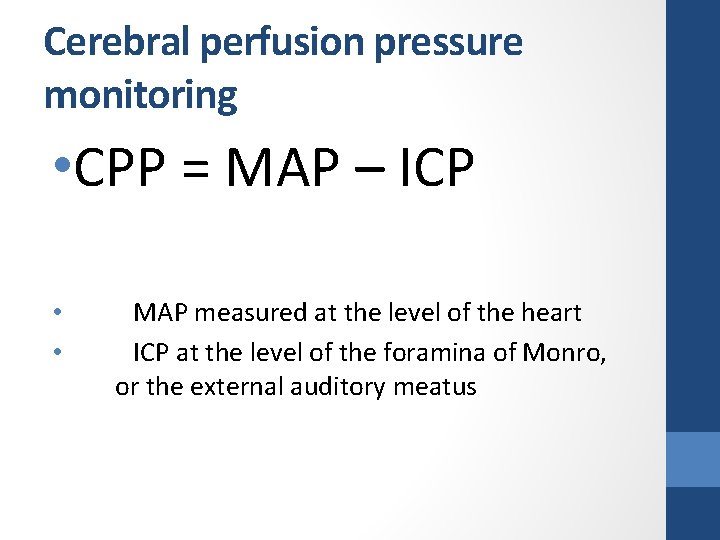
Cerebral perfusion pressure monitoring • CPP = MAP – ICP • • MAP measured at the level of the heart ICP at the level of the foramina of Monro, or the external auditory meatus
Cerebral Perfusion Pressure monitoring Recommendations Level CPP monitoring is recommended to decrease 2 -week mortality IIB Gerber LM, Chiu YL, Carney N, Hartl R, Ghajar J. Marked reduction in mortality in patients with severe traumatic brain injury. J Neurosurg. Dec 2013
Advanced Cerebral Monitoring • Brain Tissue Oxygen (Pbr. O 2) Monitoring • Transcranial Doppler and Microdialysis • Jugular Bulb Monitoring of Arteriovenous Oxygen Content Difference(AVDO 2)
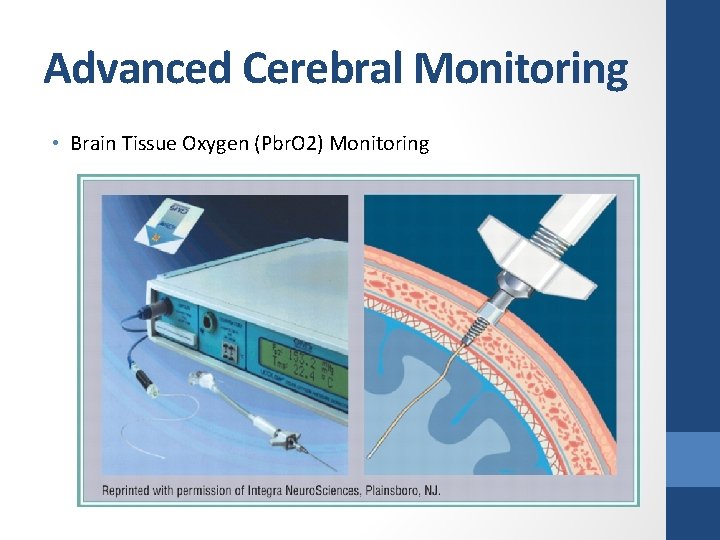
Advanced Cerebral Monitoring • Brain Tissue Oxygen (Pbr. O 2) Monitoring
Brain Tissue Oxygen (Pbr. O 2) Monitoring Recommendations No recommendation Martini RP, Deem S, Yanez ND, et al. Management guided by brain tissue oxygen monitoring and outcome following severe traumatic brain injury. J Neurosurg. Oct 2009
Advanced Cerebral Monitoring • Transcranial Doppler and Microdialysis • Transcranial Doppler uses ultrasound to examine the arteries, measure blood flow, and look for signs of vasospasm. • Microdialysis to measure brain metabolism (glucose, lactate, pyruvate, and glutamate) is not common outside of research settings.
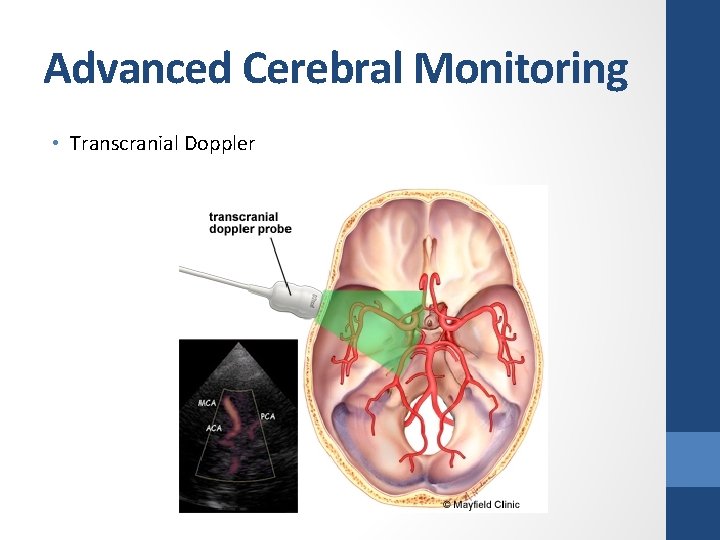
Advanced Cerebral Monitoring • Transcranial Doppler
Transcranial Doppler & Microdialysis Recommendations No recommendation Budohoski KP, Reinhard M, Aries MJH, et al. Monitoring cerebral autoregulation after head injury. Which component of transcranial Doppler flow velocity is optimal? Neurocrit Care. Oct 2012 Chamoun R, Suki D, Gopinath SP, Goodman JC, Robertson C. Role of extracellular glutamate measured by cerebral microdialysis in severe traumatic brain injury. J Neurosurg. Sep 2010
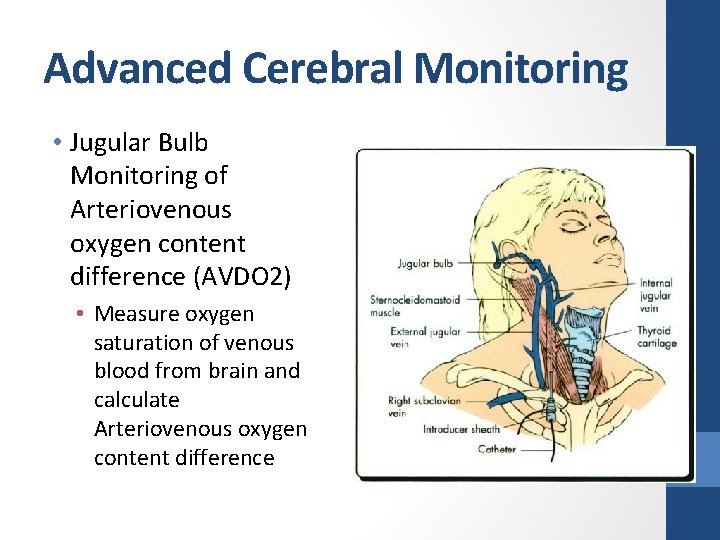
Advanced Cerebral Monitoring • Jugular Bulb Monitoring of Arteriovenous oxygen content difference (AVDO 2) • Measure oxygen saturation of venous blood from brain and calculate Arteriovenous oxygen content difference
Advanced Cerebral Monitoring Level III Jugular bulb monitoring of arteriovenous oxygen content difference (AVDO 2), as a source of information for management decisions, may be considered to reduce mortality and improve outcomes at 3 and 6 months post-injury Cruz J. The first decade of continuous monitoring of jugular bulb oxyhemoglobin saturation: management strategies and clinical outcome. Crit Care Med. Feb 1998 Le Roux PD, Newell DW, Lam AM, Grady MS, Winn HR. Cerebral arteriovenous oxygen difference: a predictor of cerebral infarction and outcome in patients with severe head injury. J Neurosurg. 1997 Robertson C. Desaturation episodes after severe head injury: influence on outcome. Acta Neurochir Suppl (Wien). 1993 Robertson CS, Gopinath SP, Goodman JC, Contant CF, Valadka AB, Narayan RK. Sjv. O 2 monitoring in head-injured patients. J Neurotrauma. Oct 1995
Part III : Thresholds Blood pressure (BP) Intracranial pressure (ICP) Cerebral perfusion pressure monitoring (CPP) Advanced cerebral monitoring (ACM).
Blood pressure Threshold Level III SBP at ≥ 100 mm Hg for patients 50 to 69 years old SBP ≥ 110 mm. Hg for patients 15 to 49 or over 70 years old to decrease mortality and improve outcomes Berry C, Ley EJ, Bukur M, et al. Redefining hypotension in traumatic brain injury. Injury. Nov 2012
Intracranial Pressure Recommendations Level II B Treating ICP above 22 mm Hg is recommended because values above this level are associated with increased mortality(Level 2 B) Sorrentino E, Diedler J, Kasprowicz M, et al. Critical thresholds for cerebrovascular reactivity after traumatic brain injury. Neurocrit Care. 2012
Intracranial Pressure Recommendations Level III A combination of ICP values and clinical and brain CT findings may be used to make management decisions Chambers IR, Treadwell L, Mendelow AD. Determination of threshold levels of cerebral operating characteristic curves: an observational study in 291 patients. J Neurosurg. Mar 2001
Cerebral perfusion pressure (CPP) Recommendations Level II B cerebral perfusion pressure (CPP) value for survival and favorable outcomes is between 60 and 70 mm Hg. Allen BB, Chiu YL, Gerber LM, Ghajar J, Greenfield JP. Age-specific cerebral perfusion pressure thresholds and survival in children and adolescents with severe traumatic brain injury. Pediatr Crit Care Med. Jan 2014
Cerebral perfusion pressure (CPP) Recommendations Level III Avoiding aggressive attempts to maintain CPP > 70 mm Hg with fluids and pressors may be considered because of the risk of adult respiratory failure Johnnson U, Nilsson P, Ronne-Engstrom E, Howells T, Enblad P. Favorable outcome in traumatic brain injury patients with impaired cerebral pressure autoregulation when treated at low cerebral perfusion pressure levels. Neurosurg. Mar 2011
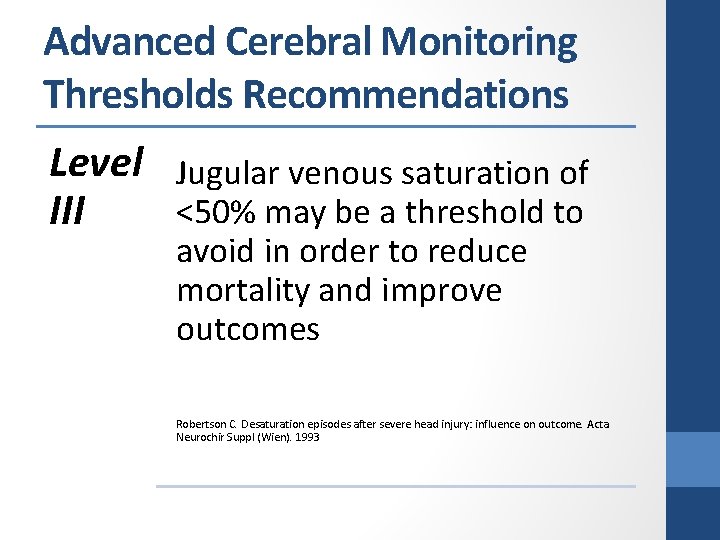
Advanced Cerebral Monitoring Thresholds Recommendations Level Jugular venous saturation of <50% may be a threshold to III avoid in order to reduce mortality and improve outcomes Robertson C. Desaturation episodes after severe head injury: influence on outcome. Acta Neurochir Suppl (Wien). 1993
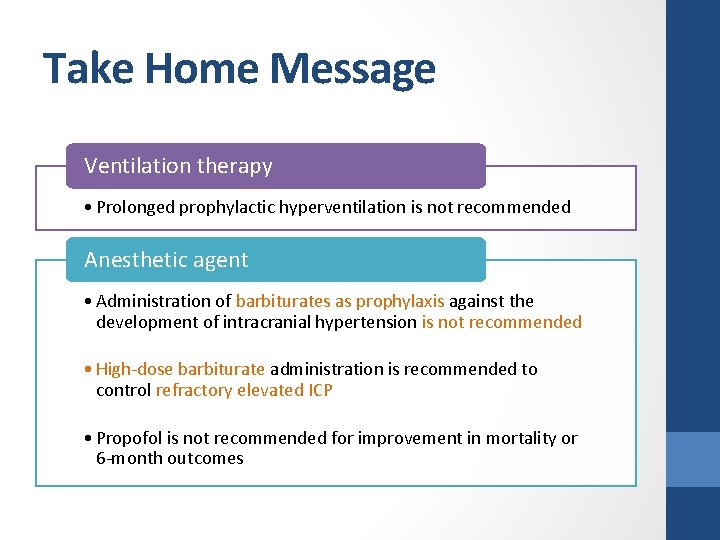
Take Home Message Ventilation therapy • Prolonged prophylactic hyperventilation is not recommended Anesthetic agent • Administration of barbiturates as prophylaxis against the development of intracranial hypertension is not recommended • High-dose barbiturate administration is recommended to control refractory elevated ICP • Propofol is not recommended for improvement in mortality or 6 -month outcomes
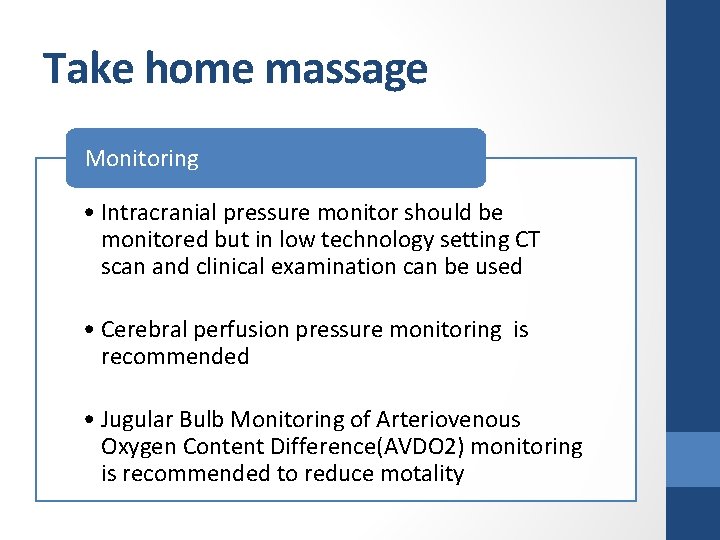
Take home massage Monitoring • Intracranial pressure monitor should be monitored but in low technology setting CT scan and clinical examination can be used • Cerebral perfusion pressure monitoring is recommended • Jugular Bulb Monitoring of Arteriovenous Oxygen Content Difference(AVDO 2) monitoring is recommended to reduce motality
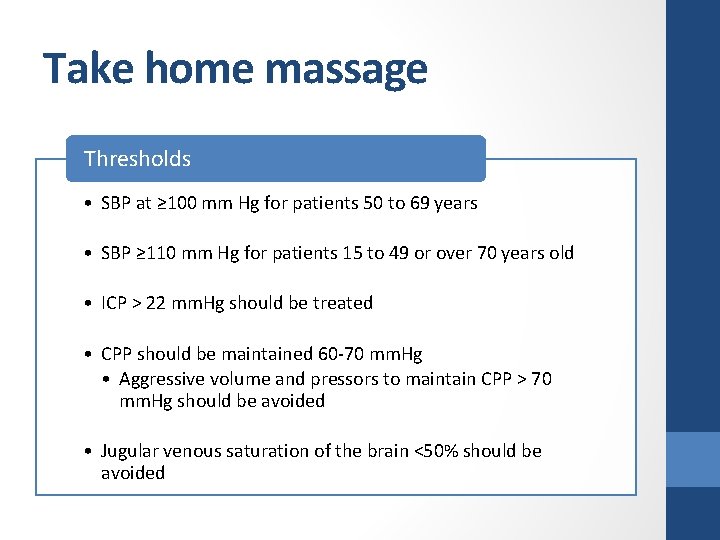
Take home massage Thresholds • SBP at ≥ 100 mm Hg for patients 50 to 69 years • SBP ≥ 110 mm Hg for patients 15 to 49 or over 70 years old • ICP > 22 mm. Hg should be treated • CPP should be maintained 60 -70 mm. Hg • Aggressive volume and pressors to maintain CPP > 70 mm. Hg should be avoided • Jugular venous saturation of the brain <50% should be avoided

Thank you for your attention
- Slides: 62