
Guidelines for the Evaluation of Radio Transmission Technologies


- Slides: 10
Guidelines for the Evaluation of Radio Transmission Technologies (RTTs) for IMT-2000 (Overview of Recommendation ITU-R M. 1225) Jose Costa Chairman, Canadian Evaluation Group (CEG) Tel. : +1 613 763 -7574 FAX: +1 613 765 -1225 E-mail: costa@nortel. ca
Scope of the Recommendation • Radio transmission technology (RTT) considerations • Technical evaluation criteria and attributes • Test environments • Evaluation procedure • Summary evaluation methodology • RTT description template • Detailed evaluation procedures
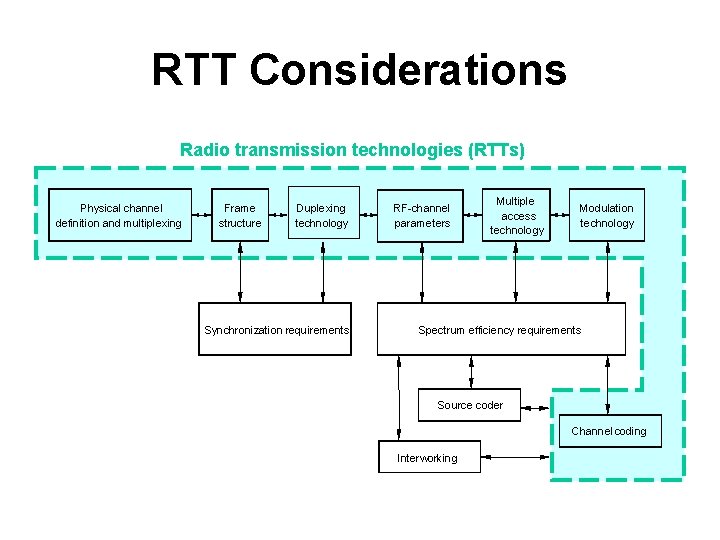
RTT Considerations Radio transmission technologies (RTTs) Physical channel definition and multiplexing Frame structure Duplexing technology Synchronization requirements RF-channel parameters Multiple access technology Modulation technology Spectrum efficiency requirements Source coder Channel coding Interworking
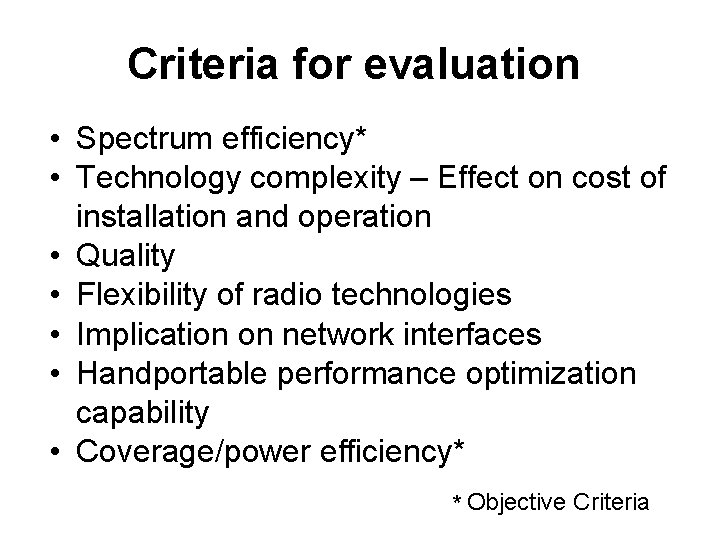
Criteria for evaluation • Spectrum efficiency* • Technology complexity – Effect on cost of installation and operation • Quality • Flexibility of radio technologies • Implication on network interfaces • Handportable performance optimization capability • Coverage/power efficiency* * Objective Criteria
Test Environments • Indoor Office • Outdoor to indoor and pedestrian • Vehicular • Mixed-cell pedestrian/vehicular • Satellite
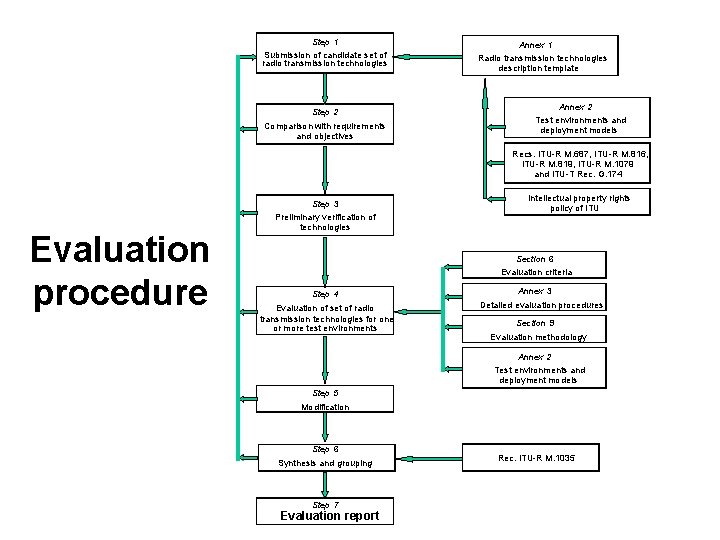
Step 1 Submission of candidate set of radio transmission technologies Step 2 Comparison with requirements and objectives Annex 1 Radio transmission technologies description template Annex 2 Test environments and deployment models Recs. ITU-R M. 687, ITU-R M. 816, ITU-R M. 819, ITU-R M. 1079 and ITU-T Rec. G. 174 Step 3 Evaluation procedure Preliminary verification of technologies Intellectual property rights policy of ITU Section 6 Evaluation criteria Step 4 Evaluation of set of radio transmission technologies for one or more test environments Annex 3 Detailed evaluation procedures Section 9 Evaluation methodology Annex 2 Test environments and deployment models Step 5 Modification Step 6 Synthesis and grouping Step 7 Evaluation report Rec. ITU-R M. 1035
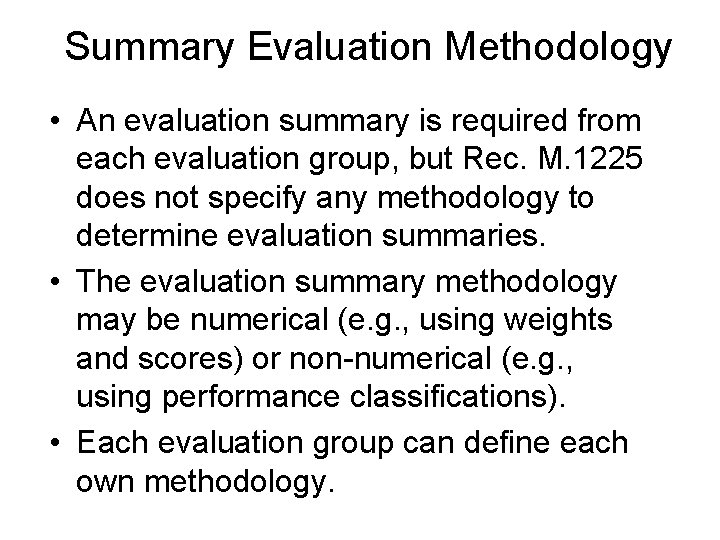
Summary Evaluation Methodology • An evaluation summary is required from each evaluation group, but Rec. M. 1225 does not specify any methodology to determine evaluation summaries. • The evaluation summary methodology may be numerical (e. g. , using weights and scores) or non-numerical (e. g. , using performance classifications). • Each evaluation group can define each own methodology.
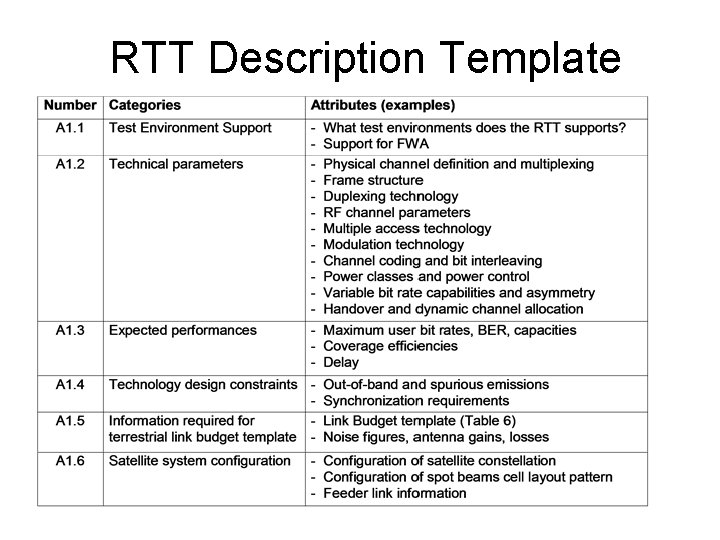
RTT Description Template
Detailed Evaluation Procedures
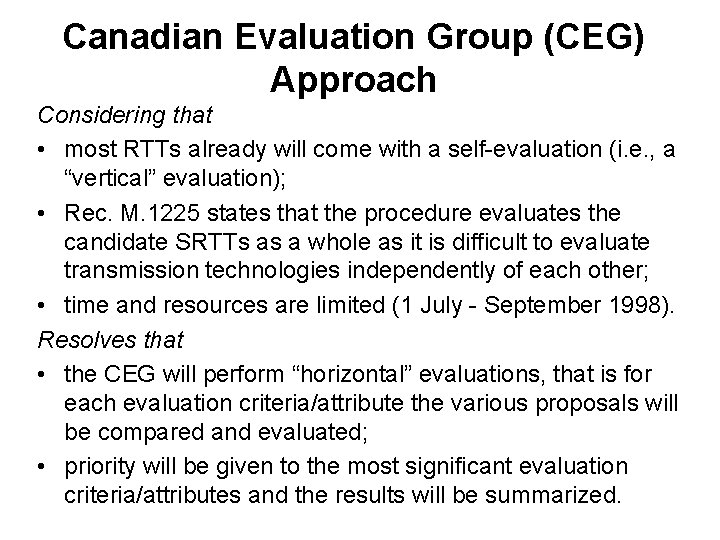
Canadian Evaluation Group (CEG) Approach Considering that • most RTTs already will come with a self-evaluation (i. e. , a “vertical” evaluation); • Rec. M. 1225 states that the procedure evaluates the candidate SRTTs as a whole as it is difficult to evaluate transmission technologies independently of each other; • time and resources are limited (1 July - September 1998). Resolves that • the CEG will perform “horizontal” evaluations, that is for each evaluation criteria/attribute the various proposals will be compared and evaluated; • priority will be given to the most significant evaluation criteria/attributes and the results will be summarized.