
Guidelines for Real Time GNSS Networks RTN Administration



- Slides: 14
Guidelines for Real Time GNSS Networks (RTN) Administration
RTN Administration o Efficiently operates the various components of the network n Receivers n Servers n Communication networks o Provides users with the information needed to utilize the network
RTN Administration o Resources n Hardware infrastructure n Communication networks n CORS o People n Users n Administration staff to provide o Helpful support to users o Partnership with IT professionals
RTN Administration o Key component of administration staff is the system administrator n Operates and maintains the RTN computer network n Distributes the GNSS information to the network’s users in an efficient manner
RTN Administration o Administrator abilities n Support and maintain computer servers and communication links n Ability to respond to service outages o User reported problems o Network problems n Helpful to have a background in geodesy and satellite positioning
RTN Administration o RTN Administration Components n System Administrator n Communication n IT Partners o IT security o Firewall issues o Lightning protection o Power system backup
RTN Administration o Latency n Bandwidth n Transmission medium n Router and switch performance n Firewall n Wireless network voice/data traffic
RTN Administration o Reference Station Datum n Benefits of using a reference datum that is consistent with the datum used by NGS: o Easy to verify o Consistent with National CORS o Can use OPUS to position RTN CORS
RTN Administration o Reference Station Datum n Ramifications of using a datum that differs from the datum utilized by NGS o OPUS and RTN solutions would be based on different reference datums: n OPUS could not be used to check RTN solutions n RTN could not be used to check OPUS solutions o Could create confusion with users
RTN Administration o Reference Station Datum n Coordinates can be determined from a variety of sources o OPUS n Rapid solution n Minimum of five (5) days of twenty-four (24) data sets n Minimum of three (3) National CORS that are within 250 km of your RTN n Review the sixty (60) day solution of each National CORS used in the solution to ensure that each CORS is stable and operating within tolerances n Carefully analyze the OPUS results
RTN Administration o Adjustments o Minimum of five (5) days of twenty-four (24) hour datasets should be used o Commercial adjustment packages o NGS ADJUST n Advantages o Distributes errors o Includes connection to NSRS n Disadvantages o Takes more time
RTN Administration o Connection to NSRS n The minimum number of National CORS sites in the RTN should be the larger of the following two figures: 3 sites or 10% of the sites n Recommend local static surveys be performed to connect RTN CORS with local NSRS passive stations o Provide information to develop local accuracies n See section on “Recommendations for Obtaining and Maintaining Station Coordinates Consistent with NAD 83 and ITRS”
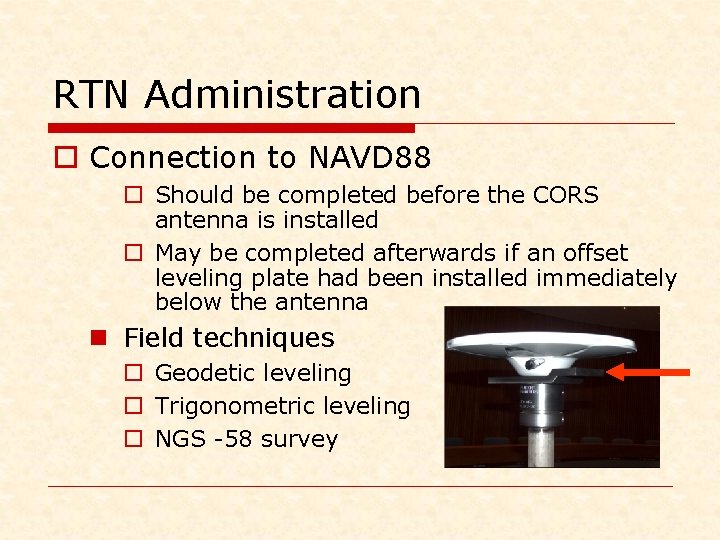
RTN Administration o Connection to NAVD 88 o Should be completed before the CORS antenna is installed o May be completed afterwards if an offset leveling plate had been installed immediately below the antenna n Field techniques o Geodetic leveling o Trigonometric leveling o NGS -58 survey
Questions?