
Guidelines for Prevention and Treatment of Opportunistic Infections





- Slides: 24
Guidelines for Prevention and Treatment of Opportunistic Infections in HIV-Infected Adults and Adolescents Disseminated Mycobacterial Infection Slide Set Resource Center based on Prepared by the AETC National Coordinating recommendations from the CDC, National Institutes of Health, and HIV Medicine Association/Infectious Diseases Society of America
About This Presentation These slides were developed using recommendations published in May 2013. The intended audience is clinicians involved in the care of patients with HIV. Users are cautioned that, because of the rapidly changing field of HIV care, this information could become out of date quickly. Finally, it is intended that these slides be used as prepared, without changes in either content or attribution. Users are asked to honor this intent. - AETC National Coordinating Resource Center http: //www. aidsetc. org May 2013 2
Disseminated Mycobacterium avium Complex (MAC) Disease § § § Epidemiology Prevention Diagnosis Treatment Clinical Manifestations Considerations in Pregnancy 3
Disseminated MAC: Epidemiology § Multiple related species of non-TB mycobacteria: M avium, M intracellulare, others § M avium is the causative agent in >95% of AIDS patients with disseminated MAC disease § MAC organisms are ubiquitous in the environment § Transmission believed to be via inhalation, ingestion, inoculation via respiratory or GI tract; person-toperson transmission unlikely § Not associated with specific environmental exposures or behaviors www. aidsetc. org May 2013 4
Disseminated MAC: Epidemiology (2) § Usually occurs in people with CD 4 count <50 cells/µL § Incidence: 20 -40% in patients with advanced AIDS who are not on effective ART or MAC prophylaxis § Other risk factors: plasma HIV RNA >100, 000 copies/m. L, previous opportunistic infections, previous colonization with MAC § 10 -fold decrease in incidence in areas with effective ART www. aidsetc. org May 2013 5
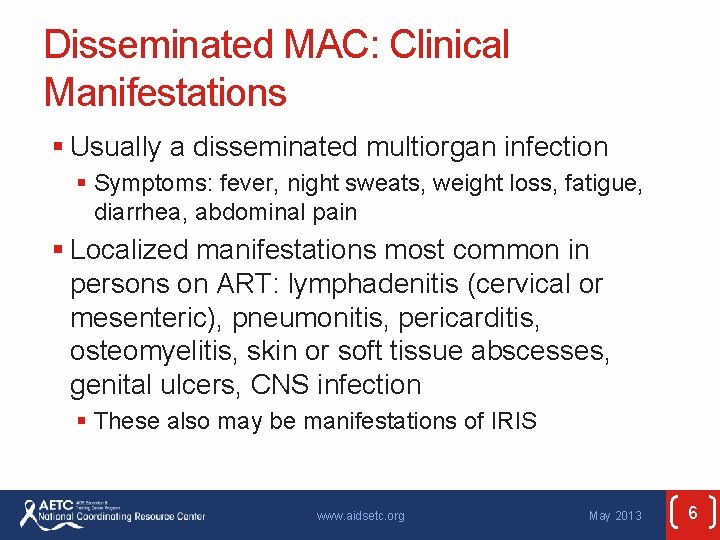
Disseminated MAC: Clinical Manifestations § Usually a disseminated multiorgan infection § Symptoms: fever, night sweats, weight loss, fatigue, diarrhea, abdominal pain § Localized manifestations most common in persons on ART: lymphadenitis (cervical or mesenteric), pneumonitis, pericarditis, osteomyelitis, skin or soft tissue abscesses, genital ulcers, CNS infection § These also may be manifestations of IRIS www. aidsetc. org May 2013 6
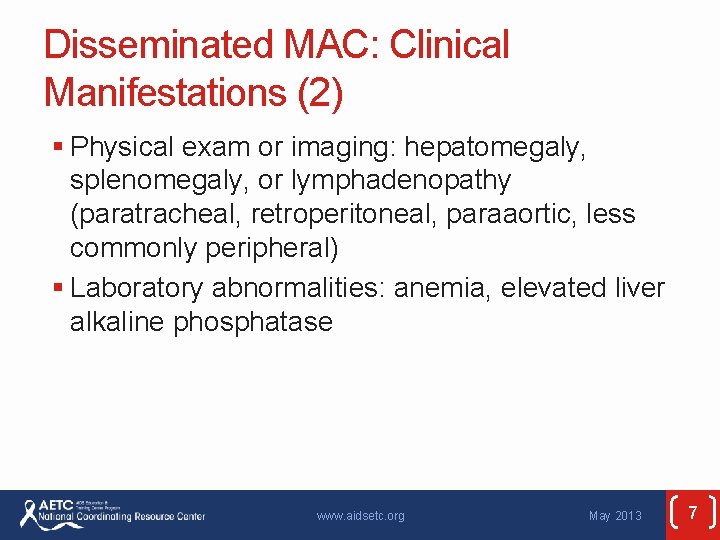
Disseminated MAC: Clinical Manifestations (2) § Physical exam or imaging: hepatomegaly, splenomegaly, or lymphadenopathy (paratracheal, retroperitoneal, paraaortic, less commonly peripheral) § Laboratory abnormalities: anemia, elevated liver alkaline phosphatase www. aidsetc. org May 2013 7
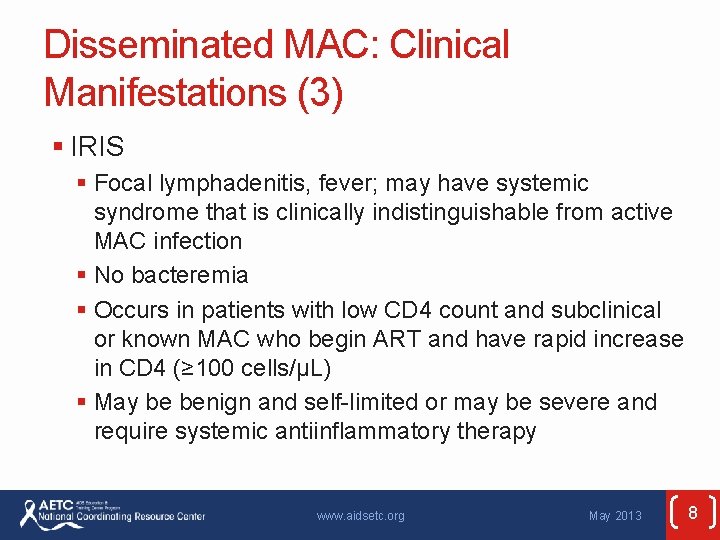
Disseminated MAC: Clinical Manifestations (3) § IRIS § Focal lymphadenitis, fever; may have systemic syndrome that is clinically indistinguishable from active MAC infection § No bacteremia § Occurs in patients with low CD 4 count and subclinical or known MAC who begin ART and have rapid increase in CD 4 (≥ 100 cells/µL) § May be benign and self-limited or may be severe and require systemic antiinflammatory therapy www. aidsetc. org May 2013 8
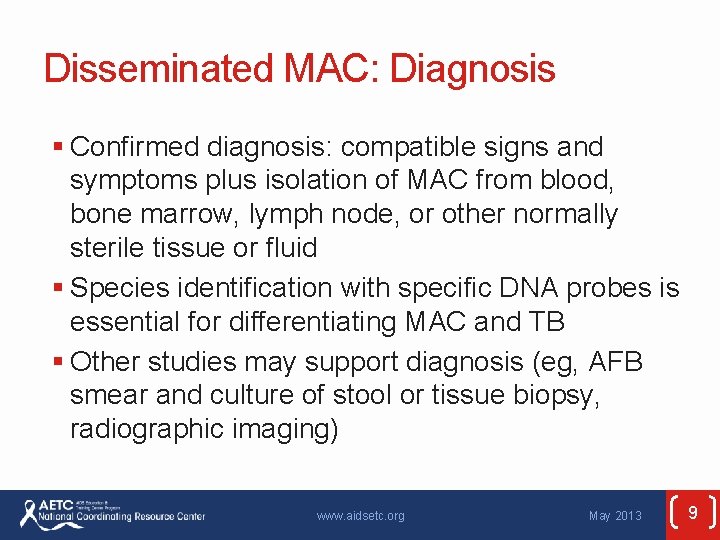
Disseminated MAC: Diagnosis § Confirmed diagnosis: compatible signs and symptoms plus isolation of MAC from blood, bone marrow, lymph node, or other normally sterile tissue or fluid § Species identification with specific DNA probes is essential for differentiating MAC and TB § Other studies may support diagnosis (eg, AFB smear and culture of stool or tissue biopsy, radiographic imaging) www. aidsetc. org May 2013 9
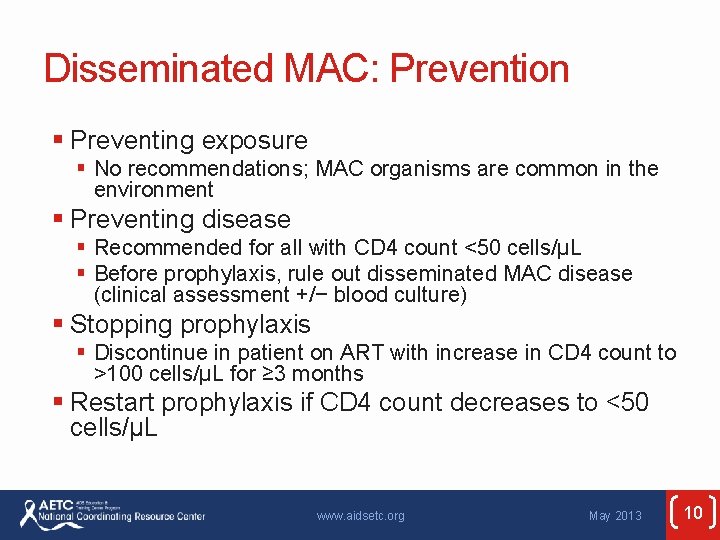
Disseminated MAC: Prevention § Preventing exposure § No recommendations; MAC organisms are common in the environment § Preventing disease § Recommended for all with CD 4 count <50 cells/µL § Before prophylaxis, rule out disseminated MAC disease (clinical assessment +/− blood culture) § Stopping prophylaxis § Discontinue in patient on ART with increase in CD 4 count to >100 cells/µL for ≥ 3 months § Restart prophylaxis if CD 4 count decreases to <50 cells/µL www. aidsetc. org May 2013 10
Disseminated MAC: Prevention (2) § Primary prophylaxis § Recommended § Azithromycin 1, 200 mg PO Q week § Clarithromycin 500 mg PO BID § Azithromycin 600 mg PO TIW § Alternative § RFB 300 mg PO QD (adjust dosage based on interactions with ARVs) § Rule out active TB before use § Significant interactions with PIs and NNRTIs www. aidsetc. org May 2013 11
Disseminated MAC: Prevention (3) § Clarithromycin + RFB not more effective than clarithromycin alone; should not be used § Azithromycin + RFB more effective than azithromycin alone but higher cost, adverse effects, risk of drug interactions, and no demonstrated survival benefit: not recommended www. aidsetc. org May 2013 12
Disseminated MAC: Treatment § Initial treatment (≥ 12 months) § At least 2 drugs, to prevent resistance § Preferred § Clarithromycin 500 mg PO BID + ethambutol 15 mg/kg PO QD § Azithromycin 500 -600 mg PO QD + ethambutol 15 mg/kg PO QD (when drug interactions or intolerance precludes use of clarithromycin) § Test MAC isolates for susceptibility to macrolides www. aidsetc. org May 2013 13
Disseminated MAC: Treatment (2) § Consider adding 3 rd or 4 th drug, if CD 4 count <50 cells/µL, high mycobacterial load, in absence of effective ART, or if drug resistance likely § Clarithromycin + ethambutol + rifabutin improved survival and reduced emergence of resistance in earlier studies; no data in context of effective ART § Alternatives to rifabutin, or possible 4 th agents: amikacin, streptomycin, levofloxacin, moxifloxacin § Rifabutin interacts with many ARVs: some combinations are contraindicated; some require dosage adjustment § Efavirenz may decrease clarithromycin levels (and increase level of active metabolite); clinical significance is unknown www. aidsetc. org May 2013 14
Disseminated MAC: Starting ART § ART and immune reconstitution are important aspects of MAC treatment § ART generally should be started (or optimized) as soon as possible after the first 2 weeks of antimycobacterial therapy § 2 -week delay may decrease risk of IRIS www. aidsetc. org May 2013 15
Disseminated MAC: Monitoring § Clinical improvement and decrease in quantity of MAC in blood or tissue are expected within 2 -4 weeks after start of appropriate therapy; may be delayed if extensive disease or advanced immunosuppression § If little or no clinical response to therapy: repeat MAC blood culture 4 -8 weeks after initiation of therapy www. aidsetc. org May 2013 16
Disseminated MAC: Adverse Events § Clarithromycin, azithromycin: nausea, vomiting, abdominal pain, abnormal taste, transaminase elevations, hypersensitivity § Clarithromycin doses >1 g per day for MAC treatment are associated with increased mortality, should not be used § Rifabutin doses ≥ 450 mg/day: higher risk of adverse interactions with clarithromycin or other inhibitors of cytochrome P 450 3 A 4; possible higher risk of uveitis, neutropenia, other adverse effects www. aidsetc. org May 2013 17
Disseminated MAC: Adverse Events (2) § IRIS: if moderate-severe symptoms of immune reconstitution reaction, consider NSAIDs; if no improvement, short-term corticosteroids (eg, prednisone 20 -40 mg QD for 4 -8 weeks) www. aidsetc. org May 2013 18
Disseminated MAC: Treatment Failure § Absence of clinical response and persistence of mycobacteremia after 4 -8 weeks of treatment § Test MAC isolates for drug susceptibility § Regimen of ≥ 2 new, active drugs, based on susceptibility testing § Optimize ART www. aidsetc. org May 2013 19
Disseminated MAC: Treatment Failure (2) § Second-line agents: § If macrolide resistance, include ethambutol, rifabutin, amikacin, streptomycin, or a fluoroquinolone § Consider use of an injectable agent (eg, amikacin, streptomycin) § Unknown whether clarithromycin or azithromycin offer benefit if resistance is present § Clofazimine: should not be used; increased mortality and limited efficacy § Other agents: limited data www. aidsetc. org May 2013 20
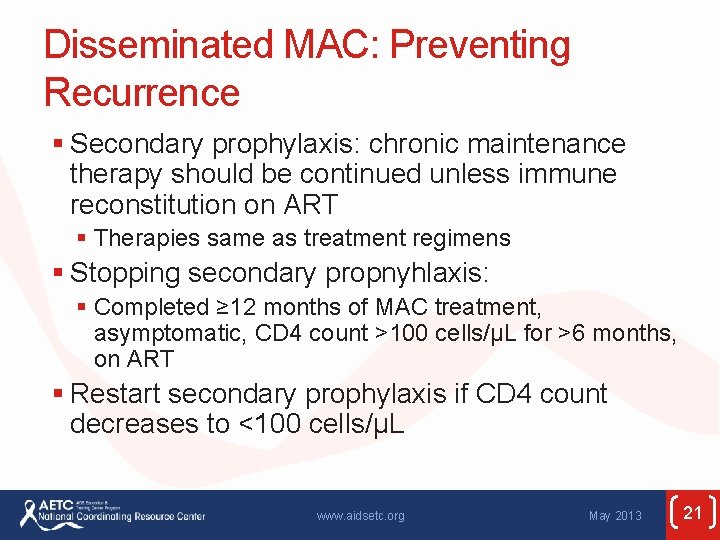
Disseminated MAC: Preventing Recurrence § Secondary prophylaxis: chronic maintenance therapy should be continued unless immune reconstitution on ART § Therapies same as treatment regimens § Stopping secondary propnyhlaxis: § Completed ≥ 12 months of MAC treatment, asymptomatic, CD 4 count >100 cells/µL for >6 months, on ART § Restart secondary prophylaxis if CD 4 count decreases to <100 cells/µL www. aidsetc. org May 2013 21
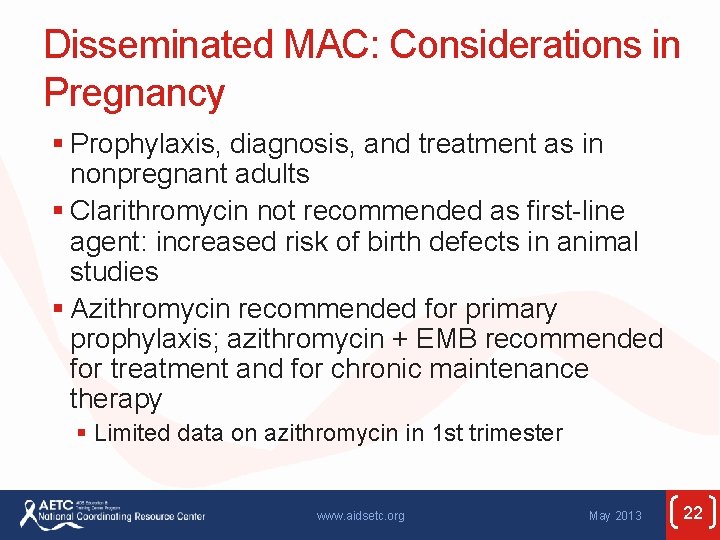
Disseminated MAC: Considerations in Pregnancy § Prophylaxis, diagnosis, and treatment as in nonpregnant adults § Clarithromycin not recommended as first-line agent: increased risk of birth defects in animal studies § Azithromycin recommended for primary prophylaxis; azithromycin + EMB recommended for treatment and for chronic maintenance therapy § Limited data on azithromycin in 1 st trimester www. aidsetc. org May 2013 22
Websites to Access the Guidelines § http: //www. aidsetc. org § http: //aidsinfo. nih. gov www. aidsetc. org May 2013 23
About This Slide Set § This presentation was prepared by Susa Coffey, MD, for the AETC National Coordinating Resource Center in May 2013 § See the AETC NCRC website for the most current version of this presentation: http: //www. aidsetc. org May 2013 24