
Guidelines for Modeling Capillary Two Phase Loops At
- Slides: 15
Guidelines for Modeling Capillary Two Phase Loops At the System Level Aerospace Thermal Control Workshop 2003 Jane Baumann jane. baumann@crtech. com
The Need for Analysis l The user’s confidence in any technology is based in part on its predictability ü ü l l The ability to model predictable behavior The ability to bound unpredictable behavior Must have compatibility with industry standard thermal analysis tools, including radiation/orbital analyzers Should be able to integrate with concurrent engineering methods such as CAD and structural/FEM
LHP Modeling l LHPs are not difficult to simulate provided the engineer ü ü l LHPs and CPLs require a sufficiently detailed twophase thermohydraulic code ü l has access to relevant performance metrics from the LHP vendor (wick properties, conductivity, etc. ) possesses a basic understanding of the technology Must contain at least rudimentary capillary modeling components Modeling of LHPs using thermal networks is inappropriate ü Accurate simulation of two-phase flow and condensation processes is critical to successful LHP performance predictions
The Unpredictable l Analyst must capture predictable behavior and bound unpredictable behavior l Bounding analyses may be necessary to capture effects of unpredictable behavior ü ü LHP core status (relative amount of back-conduction, etc. ) Temperature spike associated with the start up transient and vapor line clearing NCG and evaporator mass effects Separate detailed loop model, not system level
The Predictable l Evaporator and compensation chamber energy balance ü ü ü l Capture wick back-conduction Axial wall conduction Fluid heat transfer Wall superheat Loop pressure drop (diameters, lengths, elevation, etc. ) Detailed condenser modeling is necessary to accurately predict subcooling production ü ü Ability to capture the variable film coefficient along the length of the condenser, and flow splits in parallel legs (including static pressure recovery) Transport line environment parasitic losses/gains
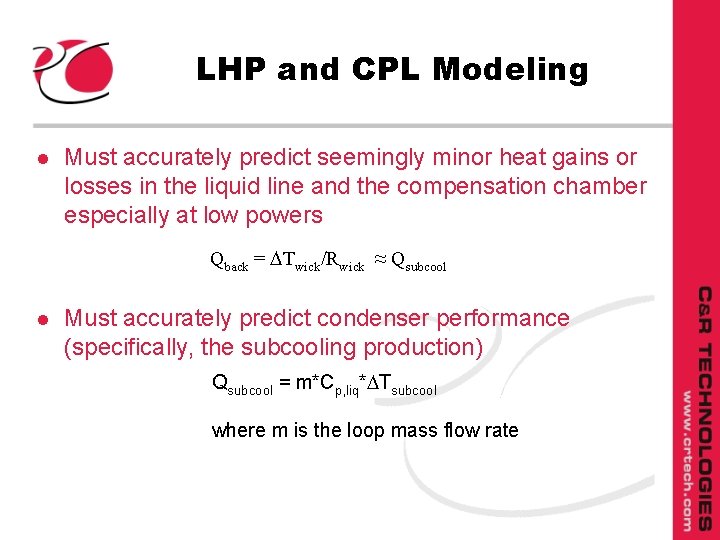
LHP and CPL Modeling l Must accurately predict seemingly minor heat gains or losses in the liquid line and the compensation chamber especially at low powers Qback = DTwick/Rwick ≈ Qsubcool l Must accurately predict condenser performance (specifically, the subcooling production) Qsubcool = m*Cp, liq*DTsubcool where m is the loop mass flow rate
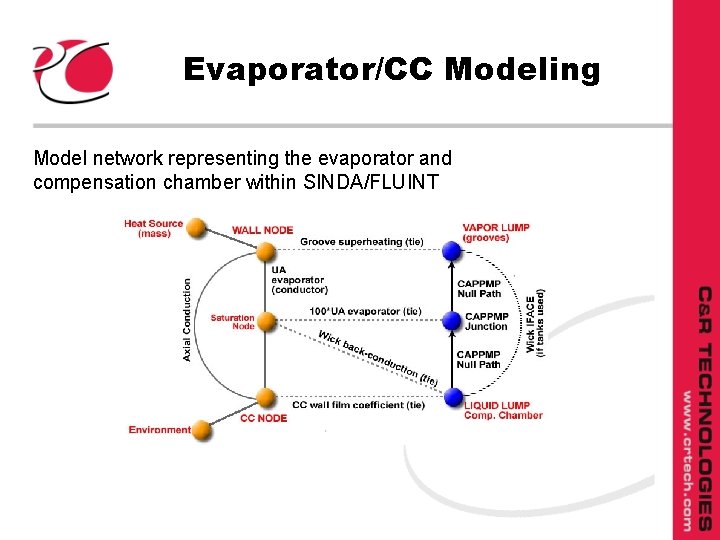
Evaporator/CC Modeling Model network representing the evaporator and compensation chamber within SINDA/FLUINT
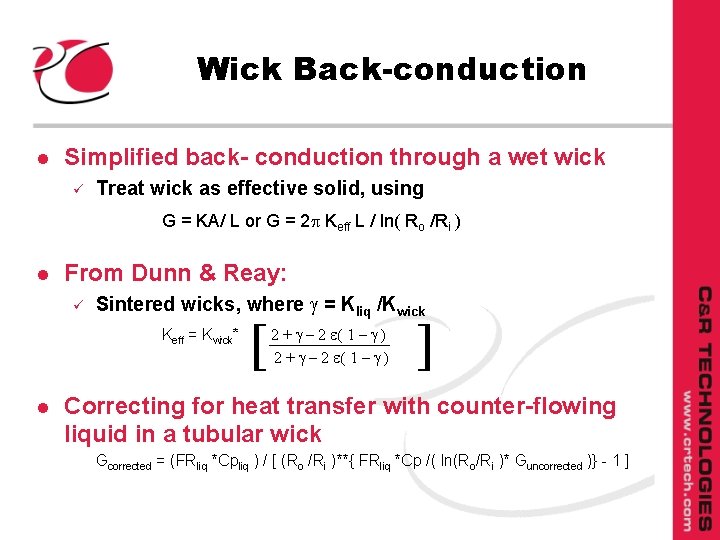
Wick Back-conduction l Simplified back- conduction through a wet wick ü Treat wick as effective solid, using G = KA/ L or G = 2 p Keff L / ln( Ro /Ri ) l From Dunn & Reay: ü Sintered wicks, where g = Kliq /Kwick Keff = Kwick* l [ 2 + g – 2 e( 1 – g ) ] Correcting for heat transfer with counter-flowing liquid in a tubular wick Gcorrected = (FRliq *Cpliq ) / [ (Ro /Ri )**{ FRliq *Cp /( ln(Ro/Ri )* Guncorrected )} - 1 ]
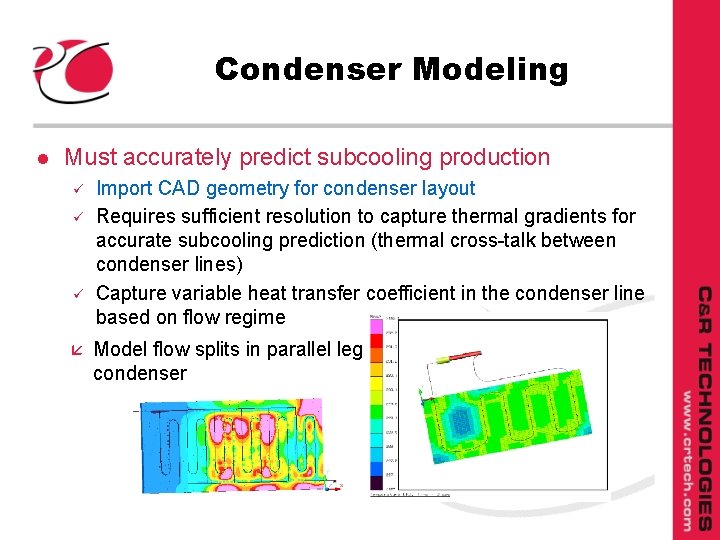
Condenser Modeling l Must accurately predict subcooling production ü ü ü Import CAD geometry for condenser layout Requires sufficient resolution to capture thermal gradients for accurate subcooling prediction (thermal cross-talk between condenser lines) Capture variable heat transfer coefficient in the condenser line based on flow regime å Model flow splits in parallel leg condenser
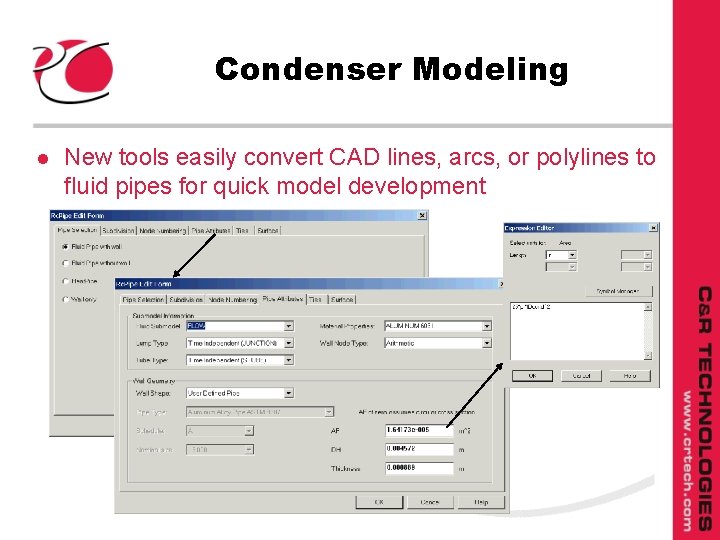
Condenser Modeling l New tools easily convert CAD lines, arcs, or polylines to fluid pipes for quick model development
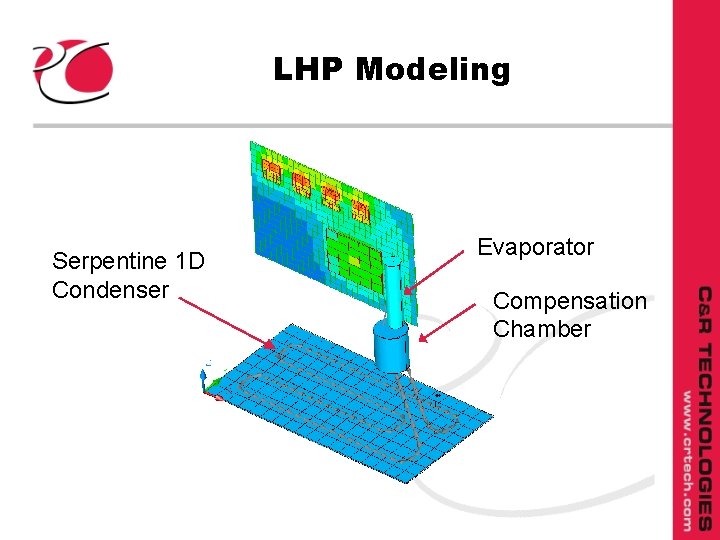
LHP Modeling Serpentine 1 D Condenser Evaporator Compensation Chamber
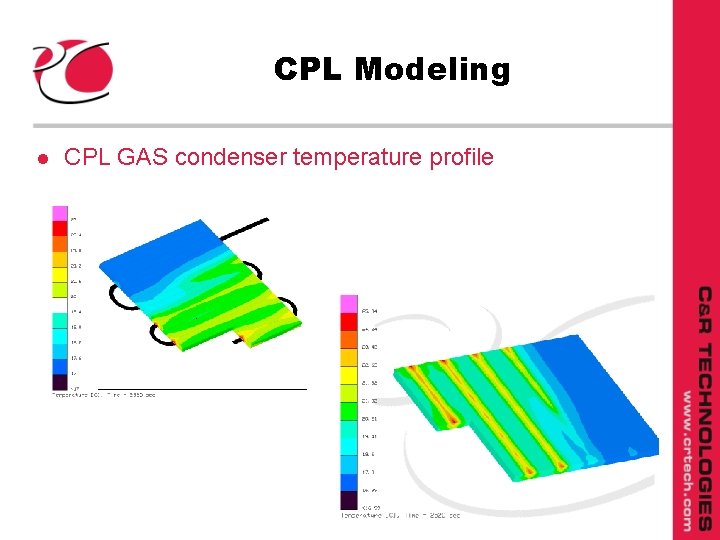
CPL Modeling l CPL GAS condenser temperature profile
Hints and Tricks l Keep fluid model simple, apply detail where necessary on thermal side ü ü ü l l Take advantage of symmetry to simplify models when feasible Fluid models require reasonable initial conditions ü l Use zero volume and time independent components (JUNCTIONS and STUBES in SINDA/FLUINT) The liquid side of the evaporator/cc should be a tank Possibly vapor side as tank with artificially high vapor volume for stability or in the presence of an IFACE Use PTEST logic and FASTIC (user control of solution) to create initial conditions for a STDSTL solution LHP Prebuilt available for C&R Technologies
Conclusions l New CAD methods are available for modeling LHPs, CPLs, and heat pipes l Focus LHP modeling on condenser/transport details and bracketing unknown behaviors ü ü ü Evaporator and compensation chamber energy balance Model condenser detail for subcooling production Bracket unpredictable behavior for core status, NCG, start up etc.
References l l l 1) D. Johnson et al, “CAD-based Methods for Thermal Modeling of Coolant Loops and Heat Pipes”, ITherm 2002 2) J. Ku, “Operating Characteristics of Loop Heat Pipes, ” SAE 1999 -01 -2007, July 1999. 3) J. Baumann et al, “Steady State and Transient Loop Heat Pipe Modeling, ” SAE 2000 -ICES-105, July 2000. 4) J. Baumann et al: “Noncondensible Gas, Mass, and Adverse Tilt Effects on the Start-up of Loop Heat Pipes, ” SAE 1999 -01 -2048. 5) J. Baumann et al, “An Analytical Methodology for Evaluating Start-up of Loop Heat Pipes, ” AIAA 2000 -2285.