
Guidelines for implementing collaborative TB and HIV programme
Guidelines for implementing collaborative TB and HIV programme activities Fabio Scano Stop TB Department World Health Organization Durban, South Africa TB/HIV WG meeting, 14 -16 June 2002
Outline of presentation • • The problem and the response The rationale for the guidelines WHO are these guidelines for? WHAT TB and HIV/AIDS programmes should implement • HOW to implement and WHO should implement joint TB/HIV activities? • Challenges • Next steps
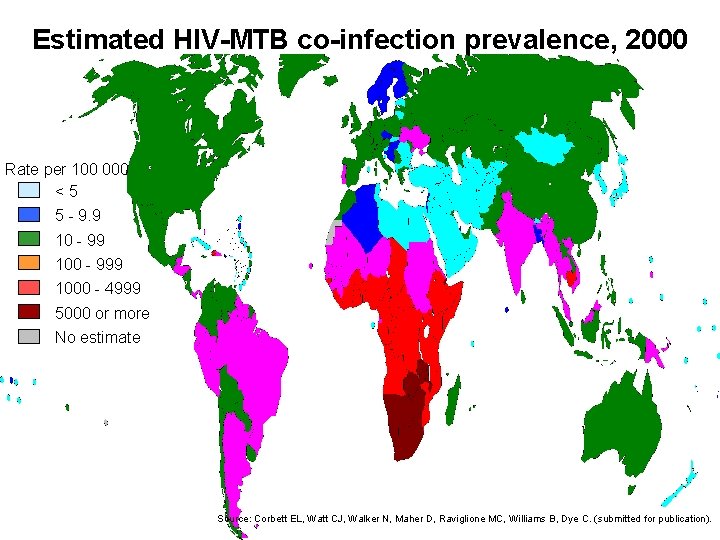
Estimated HIV-MTB co-infection prevalence, 2000 Rate per 100 000 <5 5 - 9. 9 10 - 99 100 - 999 1000 - 4999 5000 or more No estimate Source: Corbett EL, Watt CJ, Walker N, Maher D, Raviglione MC, Williams B, Dye C. (submitted for publication).
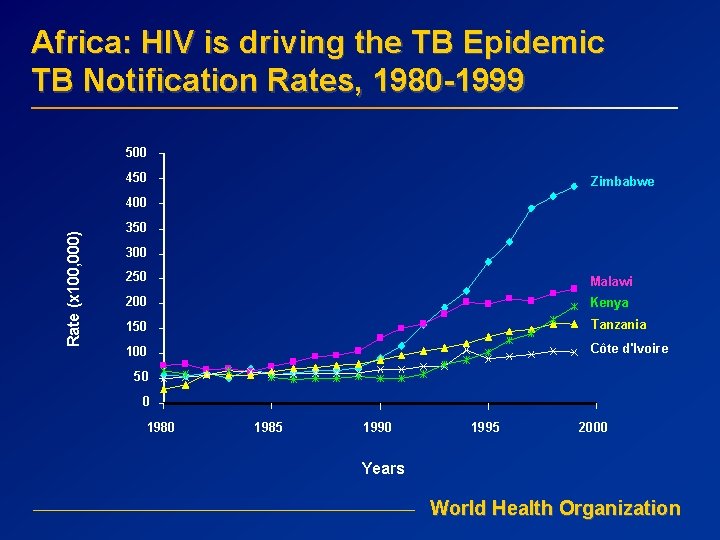
Africa: HIV is driving the TB Epidemic TB Notification Rates, 1980 -1999 500 450 Zimbabwe Rate (x 100, 000) 400 350 300 250 Malawi 200 Kenya 150 Tanzania 100 Côte d'Ivoire 50 0 1985 1990 1995 2000 Years World Health Organization
The problem (cont) • HIV is driving the TB epidemic in many countries (sub-Saharan Africa) • Tuberculosis in high HIV prevalence populations is a leading cause of morbidity and mortality among HIV-infected patients
The response The international response to TB/HIV is evolving: Previously “A dual strategy for a dual epidemic” TB and HIV/AIDS programmes have largely pursued separate courses, despite overlapping TB/HIV epidemiology. Now Strengthened unified health sector strategy to control TB/HIV as an integral part of the response to HIV/AIDS.
The response (cont) Expanded scope of new strategy to control TB in high HIV prevalence populations includes: Full implementation of the DOTS strategy Additional interventions against TB: Intensified TB case-finding and treatment, TB preventive treatment Interventions to decrease HIV transmission, e. g. condom promotion, STI treatment, safe injecting drug use and ARTs (to restore the immune system). interventions to decrease morbidity and mortality in HIVinfected TB patients e. g. cotrimoxazole preventive treatment, OI treatment
The rationale Most districts see the need for reducing the burden of the overlapping TB and HIV epidemic, but may not be aware of potential collaborative TB and HIV activities and their benefits
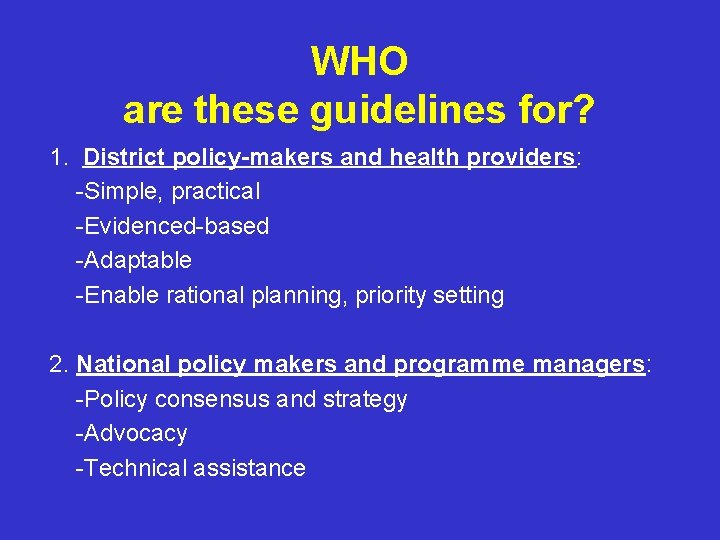
WHO are these guidelines for? 1. District policy-makers and health providers: -Simple, practical -Evidenced-based -Adaptable -Enable rational planning, priority setting 2. National policy makers and programme managers: -Policy consensus and strategy -Advocacy -Technical assistance

WHAT should TB and HIV/AIDS programmes implement? Collaborative TB and HIV programme activities: -Building on the TB and HIV interventions in the expanded scope of the new strategy for TB control -Prioritisation of TB/HIV interventions -Learning through the process of implementation
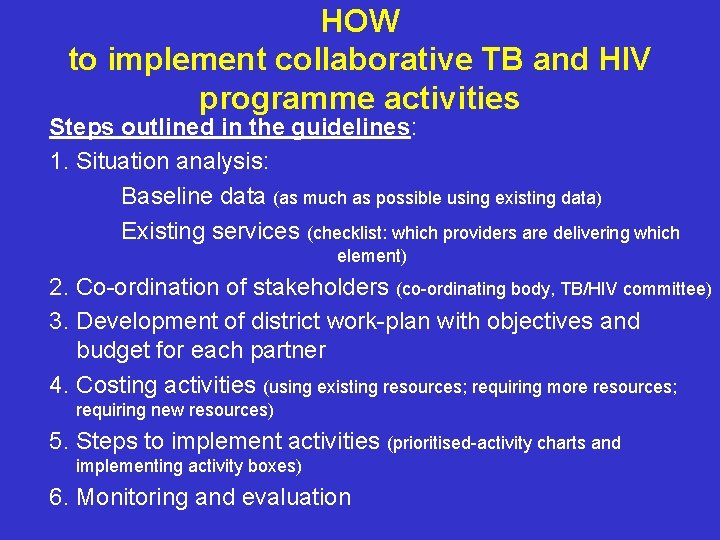
HOW to implement collaborative TB and HIV programme activities Steps outlined in the guidelines: 1. Situation analysis: Baseline data (as much as possible using existing data) Existing services (checklist: which providers are delivering which element) 2. Co-ordination of stakeholders (co-ordinating body, TB/HIV committee) 3. Development of district work-plan with objectives and budget for each partner 4. Costing activities (using existing resources; requiring more resources; requiring new resources) 5. Steps to implement activities (prioritised-activity charts and implementing activity boxes) 6. Monitoring and evaluation
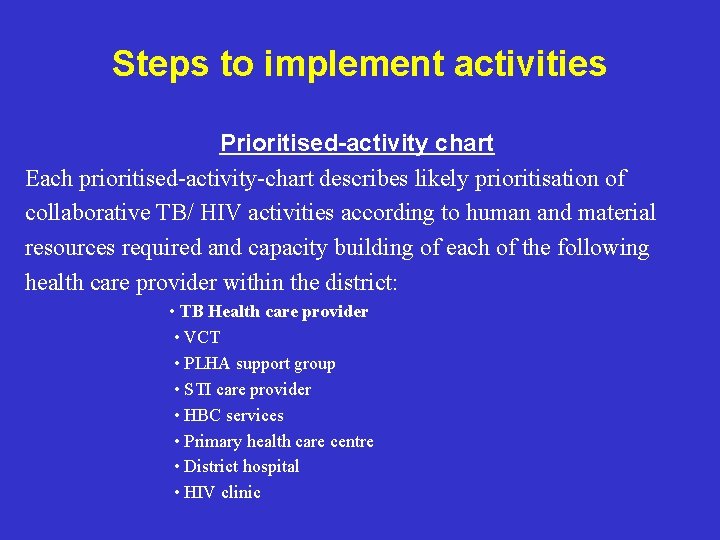
Steps to implement activities Prioritised-activity chart Each prioritised-activity-chart describes likely prioritisation of collaborative TB/ HIV activities according to human and material resources required and capacity building of each of the following health care provider within the district: • TB Health care provider • VCT • PLHA support group • STI care provider • HBC services • Primary health care centre • District hospital • HIV clinic
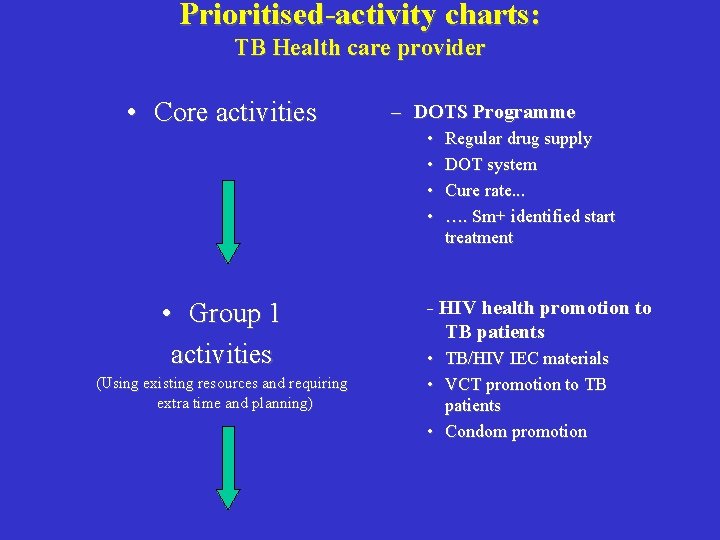
Prioritised-activity charts: TB Health care provider • Core activities • Group 1 activities (Using existing resources and requiring extra time and planning) – DOTS Programme • • Regular drug supply DOT system Cure rate. . . …. Sm+ identified start treatment - HIV health promotion to TB patients • TB/HIV IEC materials • VCT promotion to TB patients • Condom promotion
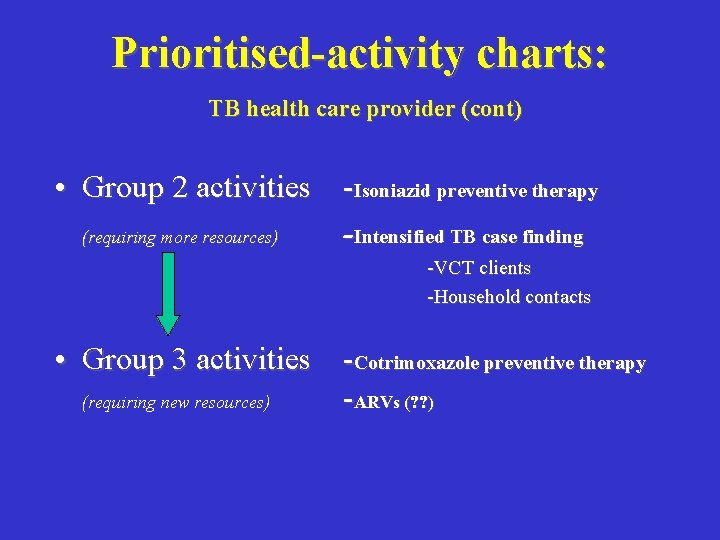
Prioritised-activity charts: TB health care provider (cont) • Group 2 activities -Isoniazid preventive therapy (requiring more resources) -Intensified TB case finding -VCT clients -Household contacts • Group 3 activities -Cotrimoxazole preventive therapy (requiring new resources) -ARVs (? ? )
Implementing-Activity Box • One-page outline which describes the policy issues and activities required at central and district level to support implementation of each of the following collaborative TB/HIV activities
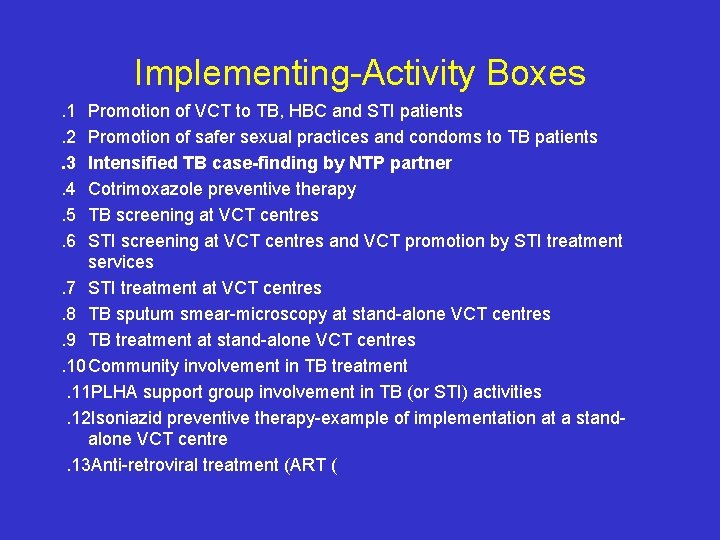
Implementing-Activity Boxes. 1. 2. 3. 4. 5. 6 Promotion of VCT to TB, HBC and STI patients Promotion of safer sexual practices and condoms to TB patients Intensified TB case-finding by NTP partner Cotrimoxazole preventive therapy TB screening at VCT centres STI screening at VCT centres and VCT promotion by STI treatment services. 7 STI treatment at VCT centres. 8 TB sputum smear-microscopy at stand-alone VCT centres. 9 TB treatment at stand-alone VCT centres. 10 Community involvement in TB treatment. 11 PLHA support group involvement in TB (or STI) activities. 12 Isoniazid preventive therapy-example of implementation at a standalone VCT centre. 13 Anti-retroviral treatment (ART (
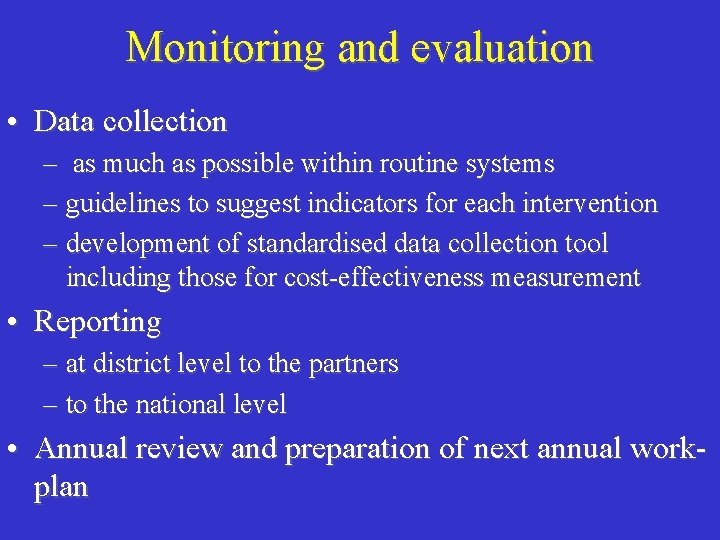
Monitoring and evaluation • Data collection – as much as possible within routine systems – guidelines to suggest indicators for each intervention – development of standardised data collection tool including those for cost-effectiveness measurement • Reporting – at district level to the partners – to the national level • Annual review and preparation of next annual workplan
Challenges To prioritise interventions: a) learning by doing b) modelling studies To develop capacity to deliver interventions Cost-sharing and resource mobilisation Effective co-ordination of many role players
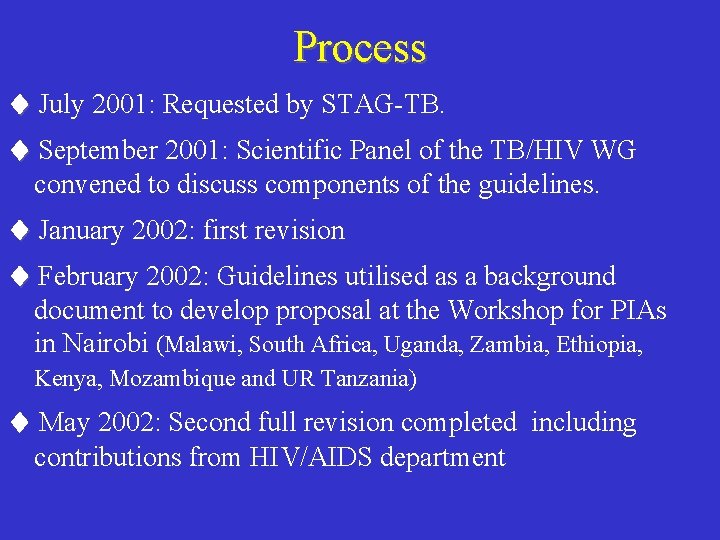
Process July 2001: Requested by STAG-TB. September 2001: Scientific Panel of the TB/HIV WG convened to discuss components of the guidelines. January 2002: first revision February 2002: Guidelines utilised as a background document to develop proposal at the Workshop for PIAs in Nairobi (Malawi, South Africa, Uganda, Zambia, Ethiopia, Kenya, Mozambique and UR Tanzania) May 2002: Second full revision completed including contributions from HIV/AIDS department
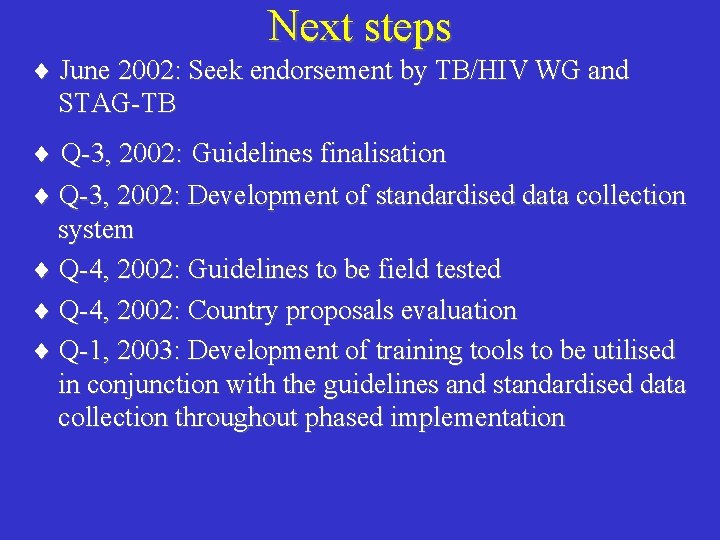
Next steps June 2002: Seek endorsement by TB/HIV WG and STAG-TB Q-3, 2002: Guidelines finalisation Q-3, 2002: Development of standardised data collection system Q-4, 2002: Guidelines to be field tested Q-4, 2002: Country proposals evaluation Q-1, 2003: Development of training tools to be utilised in conjunction with the guidelines and standardised data collection throughout phased implementation
List of contributors and reviewers Scientific Panel members: Francis Adatu-Engwau, Kenneth Chebet, Gijs Elzinga, Paula Fujiwara, Larry Gelmon, Peter Godfrey-Faussett, Nicola Hargreaves, Bess Miller, Jintana Ngamvithayapong-Yanai, Jeroen van Jorkom, Mukadi Ya Diul Co-ordinators of the TB/HIV pilot sites: Helen Ayles, Laura Campbell, Rhehab Chimzizi, Rokoya Ginwalla, Nicola Hargreaves, Harry Hausler, Rose Hegner, Barbara Karpakis, Julia Kim, Barudi Mosimaneotsile, Pren Naidoo, Paul Proynk, Carol Sheard, Jacky Sallet, Mukadi Ya Diul, Rony Zachariah. Other reviewers: Rachel Baggaley, Antony Harries, Steve Graham, Miriam Taegtmeyer
- Slides: 21