
Guidelines for Effective Lesson Planning Writing Instructional Objectives
Guidelines for Effective Lesson Planning Writing Instructional Objectives Original Power Point from: http: //www. uwsuper. edu/dl/loader. cfm? cs. Module=security/getfile&pageid=191952 Edited by Cynthia Hendricks for ECEP

Instructional Goals � Before beginning to write your instructional objective(s), consider the larger educational goal to which the objective leads.

Instructional Goals � There are certain expectations that people have for individuals who have completed twelve years of school.

Instructional Goals � We expect high school graduates to be able to solve problems, critically evaluate issues, and make decisions.
Instructional Goals � Students do not achieve these goals at one grade level or in one class.
Instructional Goals � One teacher cannot be responsible for students achieving these goals.
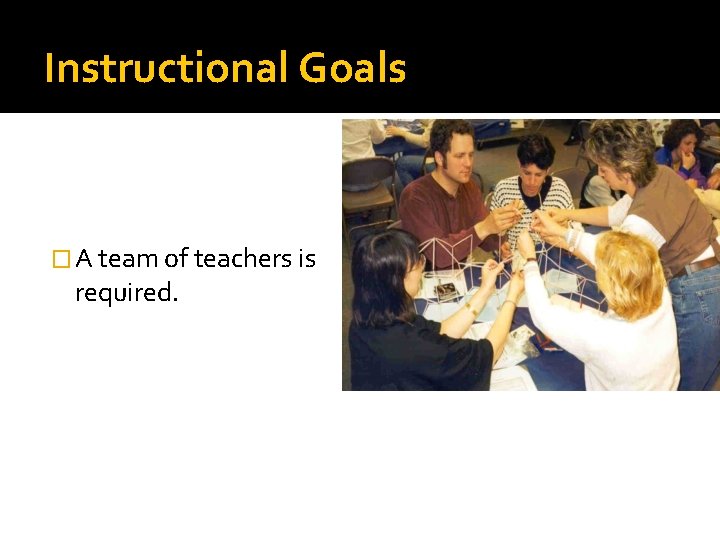
Instructional Goals � A team of teachers is required.

Instructional Goals � Begin by identifying the part of the goal to be achieved in the lesson you are teaching.
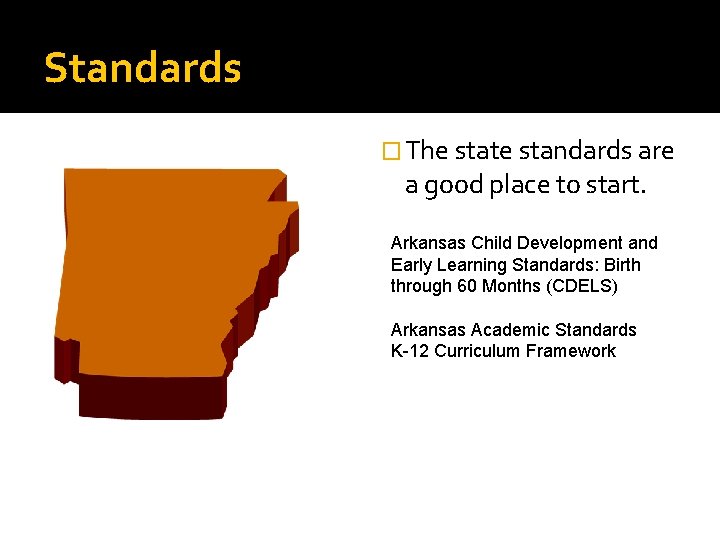
Standards � The state standards are a good place to start. Arkansas Child Development and Early Learning Standards: Birth through 60 Months (CDELS) Arkansas Academic Standards K-12 Curriculum Framework
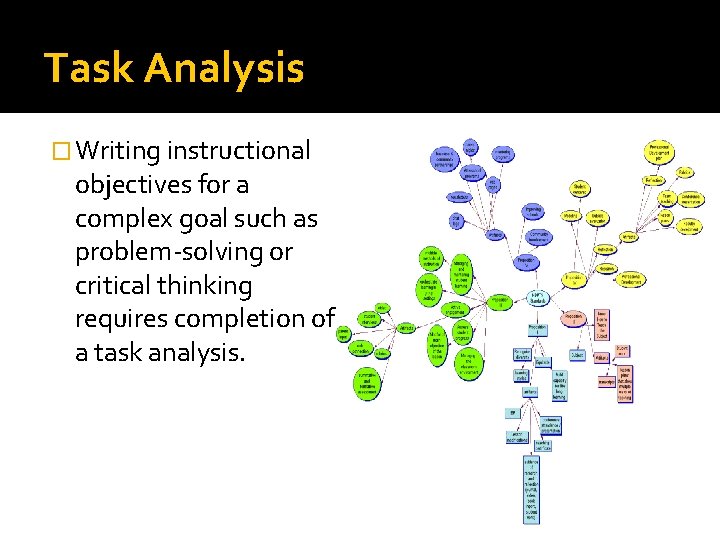
Task Analysis � Writing instructional objectives for a complex goal such as problem-solving or critical thinking requires completion of a task analysis.
Task Analysis � Consider this educational goal. � SL. K. 6. Speak audibly and express thoughts, feelings, and ideas clearly. � LD 3. 1 Communicates using social and conversational rules.
Task Analysis �What must a student be able to do to complete this task?

Task Analysis � Speak audibly and express thoughts, feelings, and ideas clearly. Students are able to distinguish parts of speech. Students are able to use sentences that are three or four words long. Students are able to distinguish a complete thought.
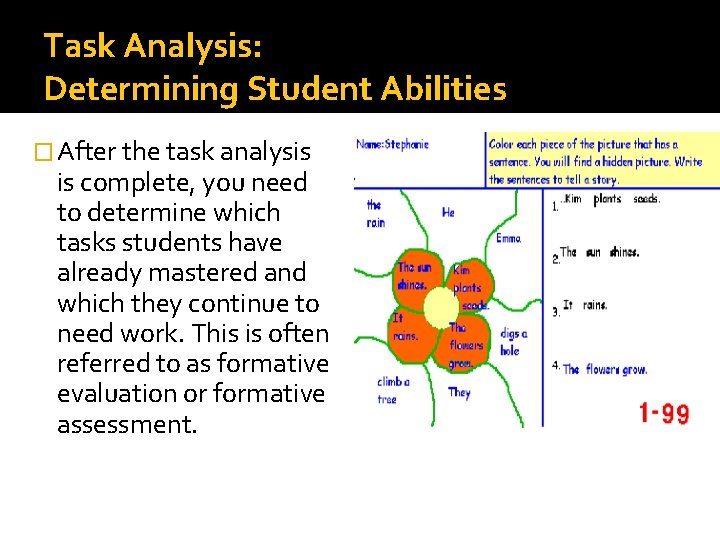
Task Analysis: Determining Student Abilities � After the task analysis is complete, you need to determine which tasks students have already mastered and which they continue to need work. This is often referred to as formative evaluation or formative assessment.
Writing Instructional Objectives � Think about what a student who achieved the objective would look like.
Writing Instructional Objectives � A student who can write a complete sentence can … Distinguish a complete thought Distinguish a phrase from a clause Express a complete thought in a sentence
Writing Instructional Objectives � Now think about what the students in your class can do.
Writing Instructional Objectives � Now you should have an idea of the learning tasks to establish for your students. � You may need to make modifications for struggling and/or advanced learners.
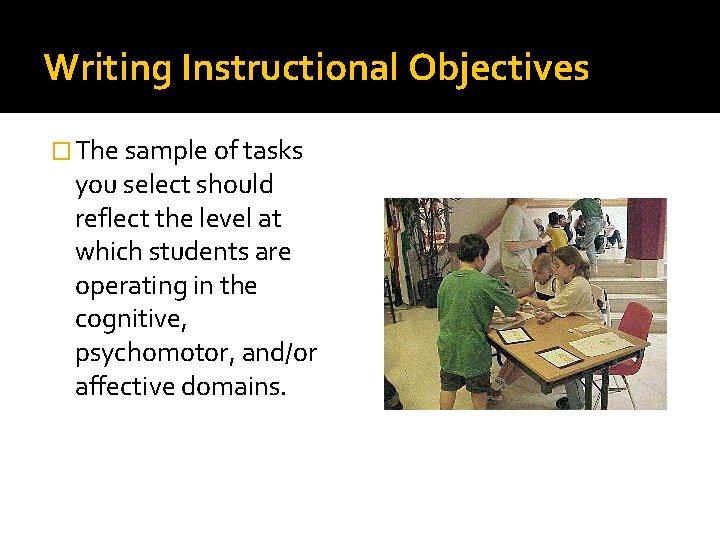
Writing Instructional Objectives � The sample of tasks you select should reflect the level at which students are operating in the cognitive, psychomotor, and/or affective domains.
Writing Instructional Objectives �As you write instructional objectives, you should remember the following :
Guidelines for Instructional Objectives � Instructional objectives guide the use of instructional activities
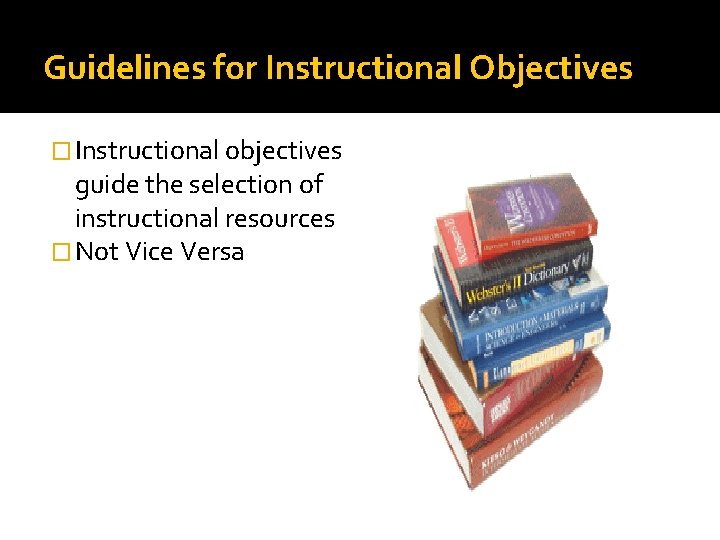
Guidelines for Instructional Objectives � Instructional objectives guide the selection of instructional resources � Not Vice Versa
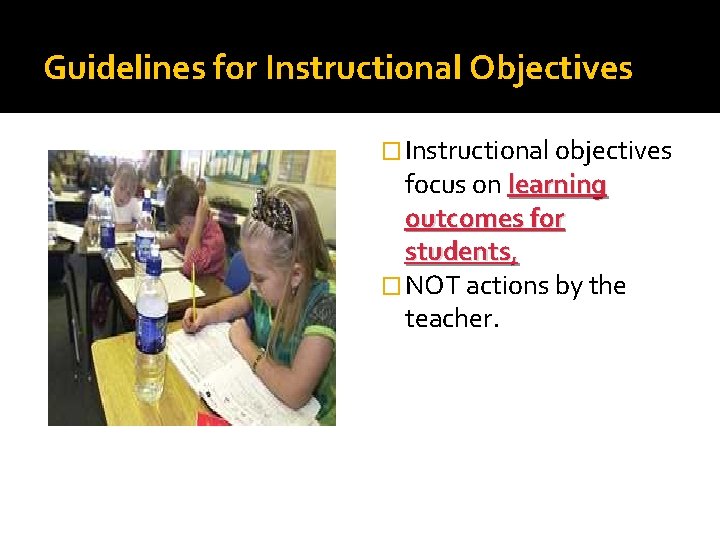
Guidelines for Instructional Objectives � Instructional objectives focus on learning outcomes for students, � NOT actions by the teacher.
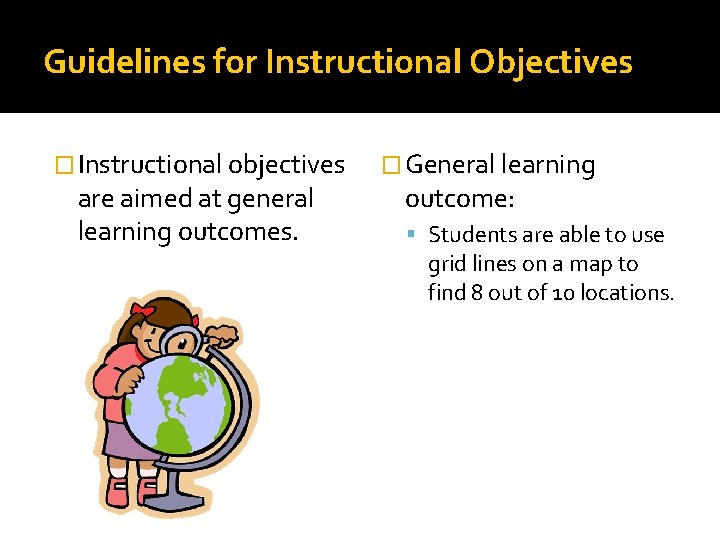
Guidelines for Instructional Objectives � Instructional objectives are aimed at general learning outcomes. � General learning outcome: Students are able to use grid lines on a map to find 8 out of 10 locations.
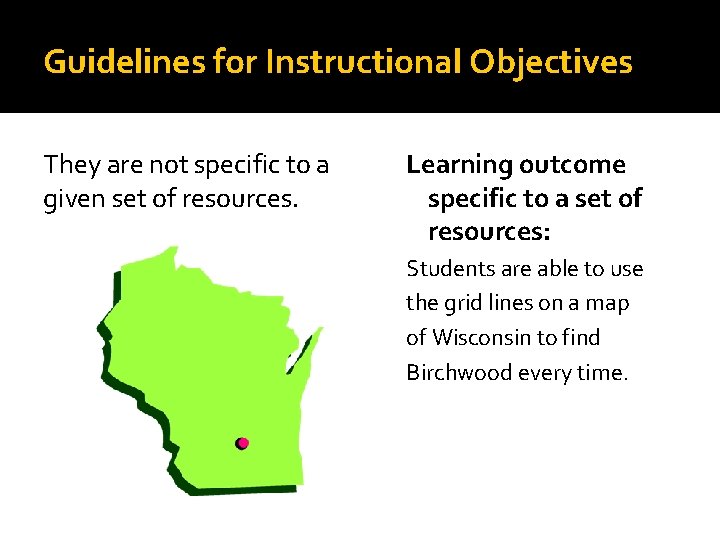
Guidelines for Instructional Objectives They are not specific to a given set of resources. Learning outcome specific to a set of resources: Students are able to use the grid lines on a map of Wisconsin to find Birchwood every time.
Guidelines for Instructional Objectives � Instructional objectives � “Students will are stated in terms of observable student outcomes. understand the law of supply and demand. ” � This is NOT a statement of an observable outcome. � “Understand” is a verb that cannot be measured objectively.
Guidelines for Instructional Objectives �Students will use the law of supply and demand to explain the pricing of consumer products with 90% accuracy. �This is a statement of an observable outcome. �Students can be asked to provide an explanation of the pricing of a consumer product.
Guidelines for Instructional Objectives Instructional objectives determine assessment and evaluation
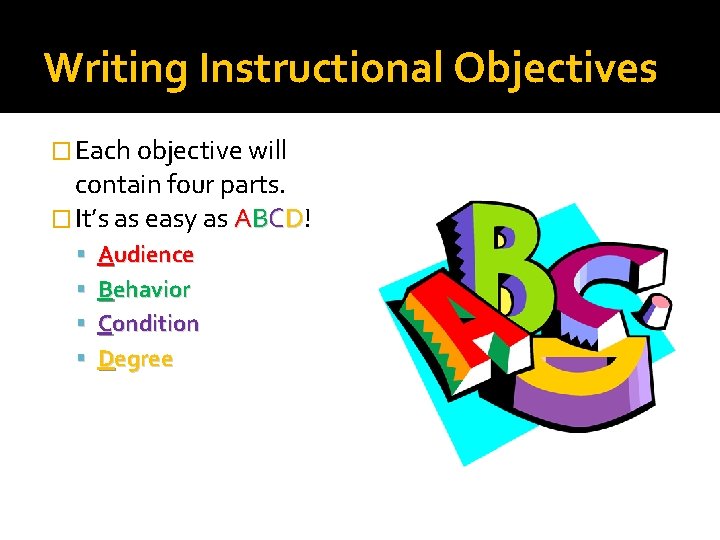
Writing Instructional Objectives � Each objective will contain four parts. � It’s as easy as ABCD! Audience Behavior Condition Degree

Audience � The audience is always the individual(s) for whom you are writing the objective. � This should be explicitly stated in your objective. � Only include one audience in each objective. � Examples: The students will… Groups will… The children will… The class will… The infant will… The toddler will. .
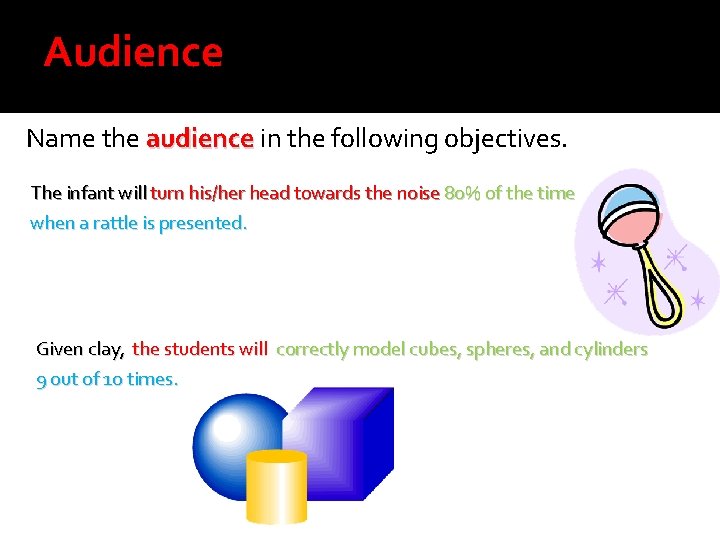
Audience Name the audience in the following objectives. The infant will turn his/her head towards the noise 80% of the time when a rattle is presented. Given clay, the students will correctly model cubes, spheres, and cylinders 9 out of 10 times.
This is the audience of the objective. It states who will demonstrate the learning outcome. Return to previous slide
Behavior � The behavior is always a verb/action that you can measure or observe objectively. � Avoid vague verbs like “learn, understand, comprehend” because they are hard to measure. � Only include one behavior in each objective. � Bloom’s Taxonomy should be used to ensure you are choosing behaviors that promote different levels of learning. � http: //cstep. csumb. edu/Obj_tutor ial/bloomwheel. html
Bloom’s Taxonomy: Knowledge �Knowledge Recalls the names of the parts of speech States the definition of ‘noun’ and ‘verb’ Knowledge Behaviors/Verbs/Actions Count Define Draw Enumerate Find Identify Label Match Name Quote Reproduce Recall Recite Record Select State Tell Sequence Write List Describe View Read
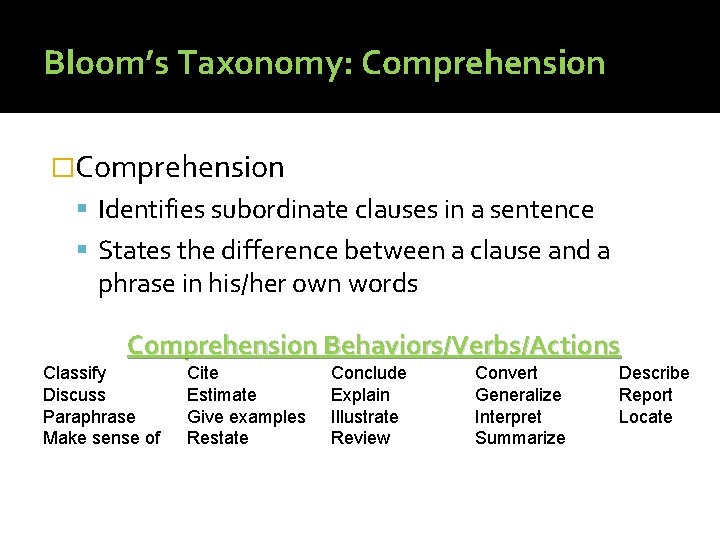
Bloom’s Taxonomy: Comprehension �Comprehension Identifies subordinate clauses in a sentence States the difference between a clause and a phrase in his/her own words Comprehension Behaviors/Verbs/Actions Classify Discuss Paraphrase Make sense of Cite Estimate Give examples Restate Conclude Explain Illustrate Review Convert Generalize Interpret Summarize Describe Report Locate
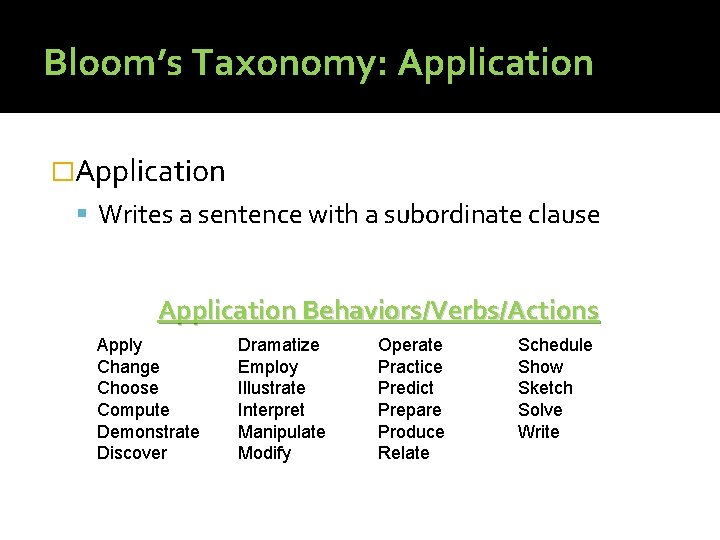
Bloom’s Taxonomy: Application �Application Writes a sentence with a subordinate clause Application Behaviors/Verbs/Actions Apply Change Choose Compute Demonstrate Discover Dramatize Employ Illustrate Interpret Manipulate Modify Operate Practice Predict Prepare Produce Relate Schedule Show Sketch Solve Write
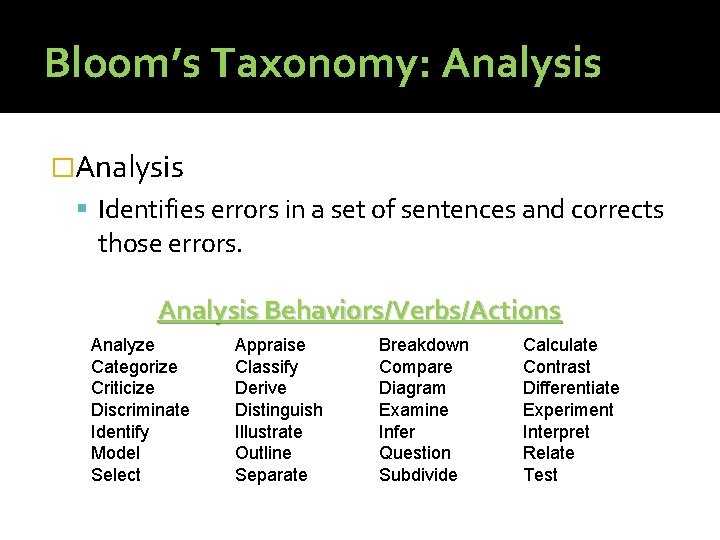
Bloom’s Taxonomy: Analysis �Analysis Identifies errors in a set of sentences and corrects those errors. Analysis Behaviors/Verbs/Actions Analyze Categorize Criticize Discriminate Identify Model Select Appraise Classify Derive Distinguish Illustrate Outline Separate Breakdown Compare Diagram Examine Infer Question Subdivide Calculate Contrast Differentiate Experiment Interpret Relate Test
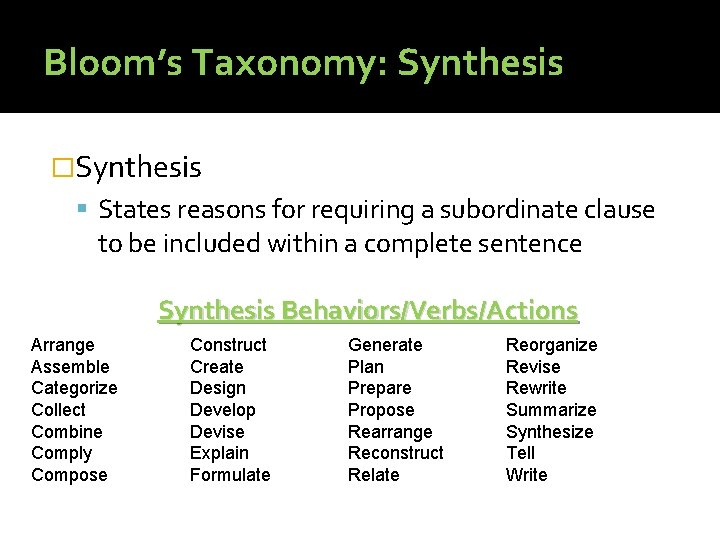
Bloom’s Taxonomy: Synthesis �Synthesis States reasons for requiring a subordinate clause to be included within a complete sentence Synthesis Behaviors/Verbs/Actions Arrange Assemble Categorize Collect Combine Comply Compose Construct Create Design Develop Devise Explain Formulate Generate Plan Prepare Propose Rearrange Reconstruct Relate Reorganize Revise Rewrite Summarize Synthesize Tell Write
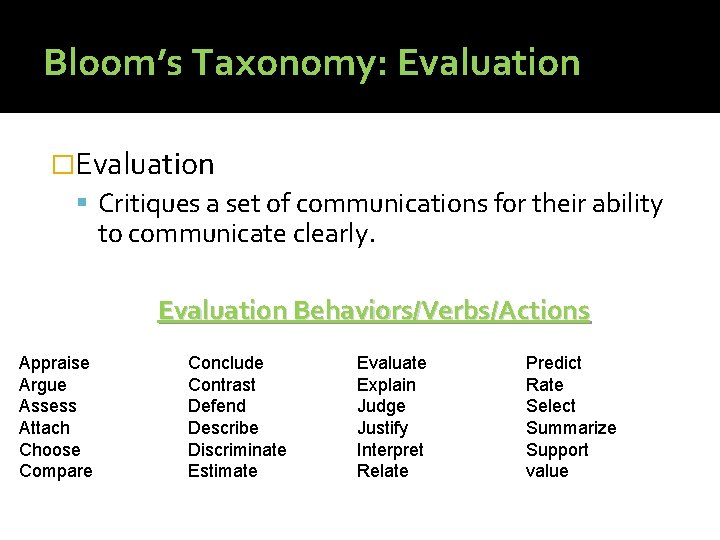
Bloom’s Taxonomy: Evaluation �Evaluation Critiques a set of communications for their ability to communicate clearly. Evaluation Behaviors/Verbs/Actions Appraise Argue Assess Attach Choose Compare Conclude Contrast Defend Describe Discriminate Estimate Evaluate Explain Judge Justify Interpret Relate Predict Rate Select Summarize Support value
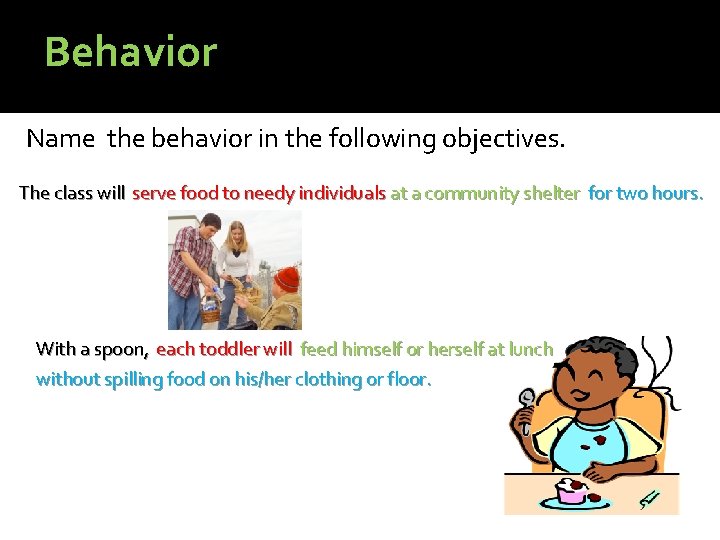
Behavior Name the behavior in the following objectives. The class will serve food to needy individuals at a community shelter for two hours. With a spoon, each toddler will feed himself or herself at lunch without spilling food on his/her clothing or floor.
This is the behavior in the objective. This is the observable action that will be measured to determine if the learning outcome has been met. Return to previous slide
Condition � The condition identifies materials and/or tools that will be accessible to the learner while his/her performance is evaluated. � This should be explicitly stated in your objective. � The condition should be assessment used to evaluate learners.
Condition Name the condition in the following objectives. The child will compute sums of single digit numbers when presented in written word problems with 80% accuracy. Given water colors, paint brushes and paper, the pupils will create secondary colors with 90% accuracy.
This is the condition for the objective. This is the criteria that will be used during the assessment of the learning outcome. The condition in the objective should be present in the evaluation.
Degree The degree is the level of proficiency required to indicate successful completion of the objective. � This should be explicitly stated in your objective. � Typically, you should not require your learners to be perfect to complete an objective, as this sets them up for failure. � Examples: � within ½ inch for 3 hours with 80% accuracy 9 out of 10 times
Degree Name the degree in the following objectives. To the nearest millimeter, lab participants will measure the height of plants with a tape measure. The students will illustrate their original narratives with colored pencils and construction paper within 30 minutes.
This is the degree of success expected to meet the objective. Stating the level of success allows you to recognize if learners are ready to move on or need remediation. Perfection is impossible because everyone makes mistakes, so the degree of success should not require 100% accuracy.
Instructional Objectives Summary �Start the process of determining instructional objectives by reviewing the subject area standards for the grade level you are teaching. �Identify the standard your lesson is focused upon.
Writing Instructional Objectives Summary �If the standard involves learning a complex concept, generalization, or skill, complete a task analysis. �Identify the steps in the task the lesson will address.
Writing Instructional Objectives Summary �The statement of an objective should reflect an appropriate level in the cognitive, affective, or psychomotor domain. �The statement identifies learning outcomes for students and not actions by the teacher
Writing Instructional Objectives Summary �The statement guides the selection of instructional resources and activities. �The statement determines the assessment or evaluation that will be used.
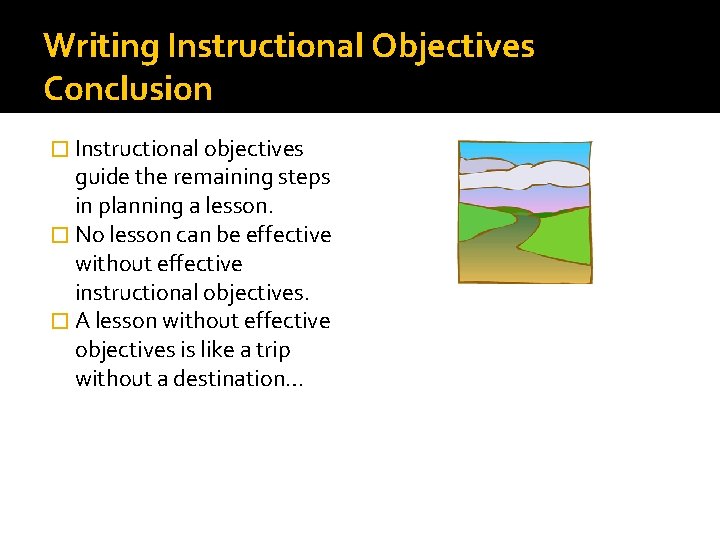
Writing Instructional Objectives Conclusion � Instructional objectives guide the remaining steps in planning a lesson. � No lesson can be effective without effective instructional objectives. � A lesson without effective objectives is like a trip without a destination…
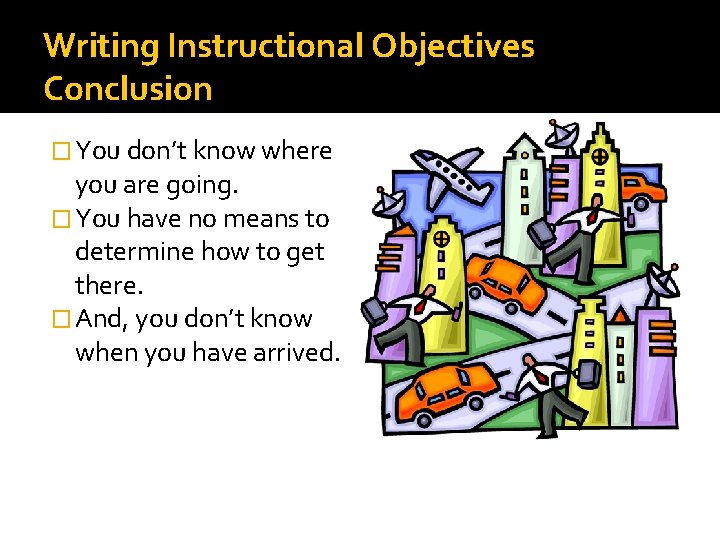
Writing Instructional Objectives Conclusion � You don’t know where you are going. � You have no means to determine how to get there. � And, you don’t know when you have arrived.
- Slides: 53