
Guidelines for Accommodating Learner Diversity In The Classroom

- Slides: 25
Guidelines for Accommodating Learner Diversity In The Classroom Through the National Curriculum Statement Intermediate Phase and Gr 11 CAPS Orientation February 2012 Presentation by Directorate: Inclusive Education, DBE
Content • Understanding inclusion – Barriers to learning • Understanding diversity in the classroom – Different learning styles and needs – Responding to diversity – some imperatives for teachers • Curriculum Differentiation – Content, teaching methods, learning environment, assessment • What is differentiated assessment? • Curriculum differentiation in context • Accessing support for curriculum differentiation
Understanding inclusion • “a process of addressing and responding to students’ diversity by increasing their participation in learning, cultures and communities, and reducing exclusion within and from education” (UNESCO, November 2008)
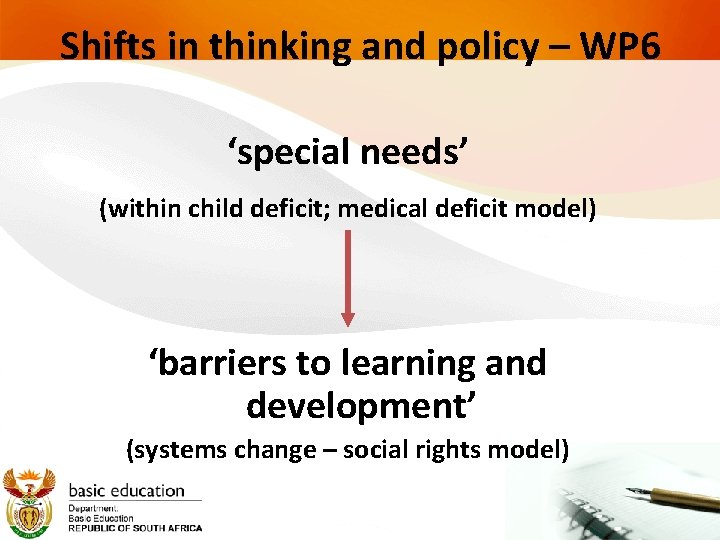
Shifts in thinking and policy – WP 6 ‘special needs’ (within child deficit; medical deficit model) ‘barriers to learning and development’ (systems change – social rights model)
Barriers to Learning • Barriers to learning - difficulties that arise within the education system as a whole , the learning site and/or within the learner, which prevent access to learning and development for some learners. § Systemic barriers e. g. overcrowded classrooms, inaccessible school buildings for the disabled, lack of basic and appropriate learning materials, exclusionary policies and practices etc. § Societal barriers e. g. poverty, safety and security, children affected and infected by HIV/AIDS, child-headed households, children living in the streets, children in conflict with the law etc.
Barriers to Learning Cont… § Pedagogical barriers e. g. inappropriate teaching methods as well as learning and teacher support material, unqualified and under-qualified teachers, inappropriate assessment procedures, lack of support for teachers etc. § Intrinsic barriers e. g. barriers experienced by learners with neurological, physical, sensory and cognitive disabilities or psychosocial and emotional difficulties etc. • Some barriers to learning requiring specialised intervention skills and high level support can be responded to in specialised settings (special schools) or in ordinary schools (in mainstream classrooms)
Barriers to Learning cont…. . • CAPS training therefore responds to and seeks to reduce PEDAGOCICAL barriers to learning (curriculum and assessment) other programmes/interventions take care of the other categories of barriers – ensuring inclusivity is “everybody’s” business and requires an integrated approach!!
Why the Guidelines? • Premise: there is learner diversity in any given classroom be it in ordinary or special school • Frame of Reference/philosophy: inclusivity • Response/approach: Curriculum Differentiation
Background • Curriculum is one of significant barriers to learning – – content, language, classroom organisation, teaching methodologies, pacing, LTSM and assessment • Guidelines were developed to facilitate and support curriculum differentiation in the classroom • Guidelines are critical and integral component of the NCS • Through experimentation teachers will find the guidelines less overwhelming to an extent of creating their own strategies • Guidelines provides framework for innovation – they will keep evolving and developing
Understanding Diversity in the Classroom • Learners come from different backgrounds • Differences to be embraced, valued, respected and be used positively • Every classroom has inherent differences along: § § § Socio-economics Language Culture Ethnicity Race Ability etc
Different Learning Styles and Needs • Multiple intelligences and styles of learning • Learners with hearing, speech, visual and coordination difficulties • Learners living in poverty • Learners with health, emotional and behaviour difficulties • Learners struggling to remember what has been taught • Learners requiring assistive devices and adapted materials • Learners with difficulty in reading and writing
Responding To Diversity – Some Imperatives for Teachers • • Recognising bias and or stereotypes against certain learners Treating and respecting each learner as an individual Avoiding use of biased language that undermines certain groups Refraining from remarking and making of assumptions about learner experiences Considering unique needs of learners during lesson / programme design Constantly re-evaluating methods of teaching and assessing Always varying approaches, methodologies and strategies Creating opportunities for all learners to participate in the learning process
Curriculum Differentiation • A key strategy for responding to diversity • Takes into account differences in learners’ ability levels, interests, background etc. • Modification, changing, adapting, extending and varying aspects of the curriculum • Aspects of the curriculum to be Differentiated: § Content § Teaching methodologies § Learning environment § Assessment
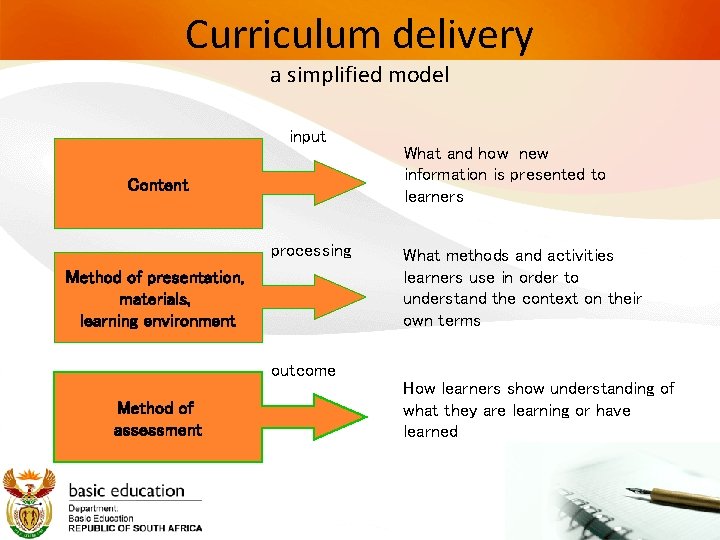
Curriculum delivery a simplified model input Content processing Method of presentation, materials, learning environment What and how new information is presented to learners What methods and activities learners use in order to understand the context on their own terms outcome Method of assessment How learners show understanding of what they are learning or have learned
Differentiating Content • Modifying content and presenting it at varying degrees of complexity • Why Differentiate content? § § To provide access to learning To provide success experiences to all learners To motivate learners and build their self esteem To promote effective learning for all learners • Levels of Differentiating content (Multi-level teaching – p 11): § Abstractness § Complexity § Variety
Differentiating the Learning Environment • Purpose: § To ensure that the learning environment is as conducive and as stimulating as possible for all learners • The learning environment is two-dimensional and differentiation should happen sometimes simultaneously in each: § Psychosocial – psychological and social factors with a bearing to satisfaction, wellbeing, and ability to perform effectively § Physical – classroom space, arrangement of furniture, noise level, class size, classroom displays, resources etc. • Differentiating the learning environment means paying attention to psychological, social and physical factors p. 1314
Differentiating Teaching Methods • Purpose: § To ensure responsiveness to different levels at which learners operate § To maximise participation of learners in learning activities • Aspects of teaching methodologies that we Differentiate: § § Learning materials Methods of presentation Learning activities Lesson organisations (p. 15 -21)
Differentiating Assessment • As with Differentiated teaching, differentiated assessment is premised on the notion that needs of different learners cannot be met in only one way • Purpose of assessment: § § § To inform instructional planning To inform instruction To evaluate effectiveness of teaching for all learners To assess learning To identify learner needs and strengths To evaluate achievement against predetermined criteria for grading and reporting
Principles for Assessment in a Diverse Classroom • Having high expectations about every learner • Every learner having access to standard of assessment suited to their needs • No learner to be disadvantaged by assessment strategy • Teachers are accountable for learners’ achievements • Assessment integral in the teaching and learning process • Assessment to be authentic and provide for multiple abilities, styles and needs • All learners can be accommodated within the flexible NCS framework • Learner’s ability determines what’s to be expected of him/her
What is Differentiated Assessment? • Rethinking the conservative practice of assessing all learners using same assessment tasks at the same time • Using assessment approach and plan that’s flexible and accommodative of a range of learner needs • How to assess in a Differentiated way (p. 23 -25): § § § Allow for different styles or intelligences Allow for oral and written assessment tasks Give multiple choice options Allow questions requiring short answers for certain learners Focus on positive aspects or talents of the learner Apply concessions – Braille, extra time, reader, audio-visual equipment § Chapter 9 of the Assessment Protocol makes provision for learners functioning at different levels
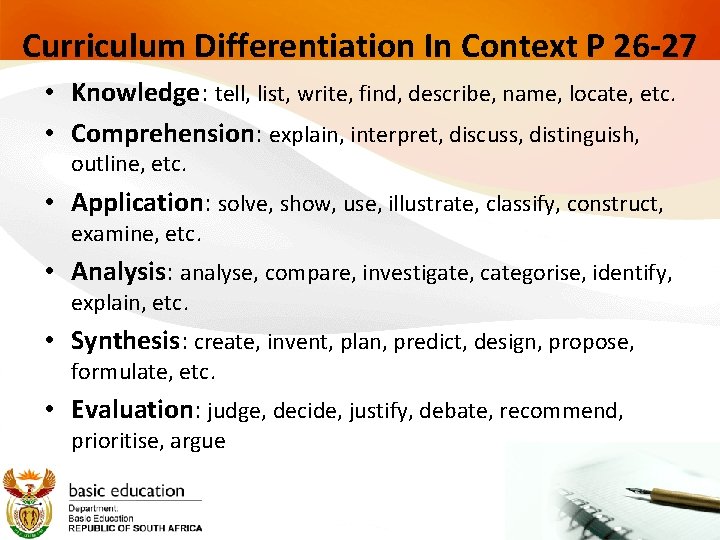
Curriculum Differentiation In Context P 26 -27 • Knowledge: tell, list, write, find, describe, name, locate, etc. • Comprehension: explain, interpret, discuss, distinguish, outline, etc. • Application: solve, show, use, illustrate, classify, construct, examine, etc. • Analysis: analyse, compare, investigate, categorise, identify, explain, etc. • Synthesis: create, invent, plan, predict, design, propose, formulate, etc. • Evaluation: judge, decide, justify, debate, recommend, prioritise, argue
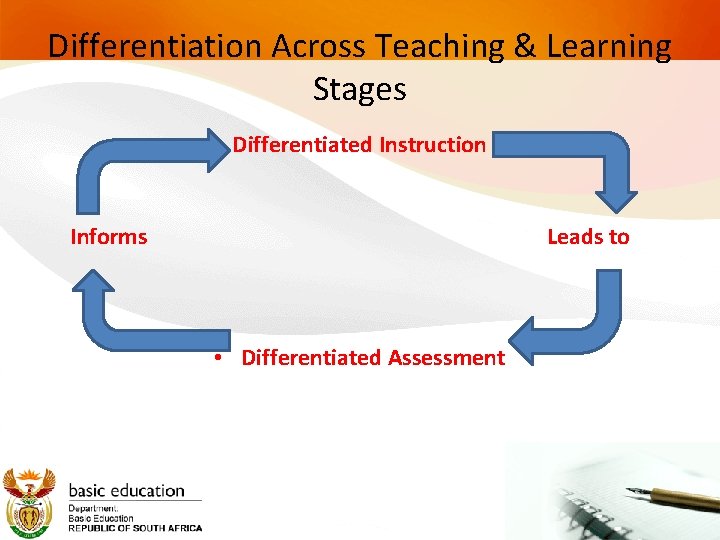
Differentiation Across Teaching & Learning Stages Differentiated Instruction Informs Leads to • Differentiated Assessment
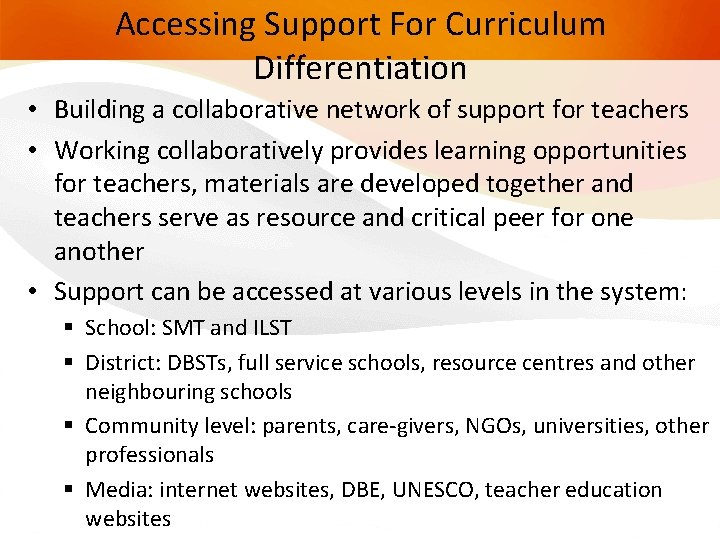
Accessing Support For Curriculum Differentiation • Building a collaborative network of support for teachers • Working collaboratively provides learning opportunities for teachers, materials are developed together and teachers serve as resource and critical peer for one another • Support can be accessed at various levels in the system: § School: SMT and ILST § District: DBSTs, full service schools, resource centres and other neighbouring schools § Community level: parents, care-givers, NGOs, universities, other professionals § Media: internet websites, DBE, UNESCO, teacher education websites
Conclusion • “… many of the world’s poorest countries are not on track to meet the 2015 targets. Failure to reach the marginalized has denied many people their right to education. … Education is at risk, and countries must develop more inclusive approaches, linked to wider strategies for protecting vulnerable populations and overcoming inequality. ” (Education For All Global Monitoring Report 2010)
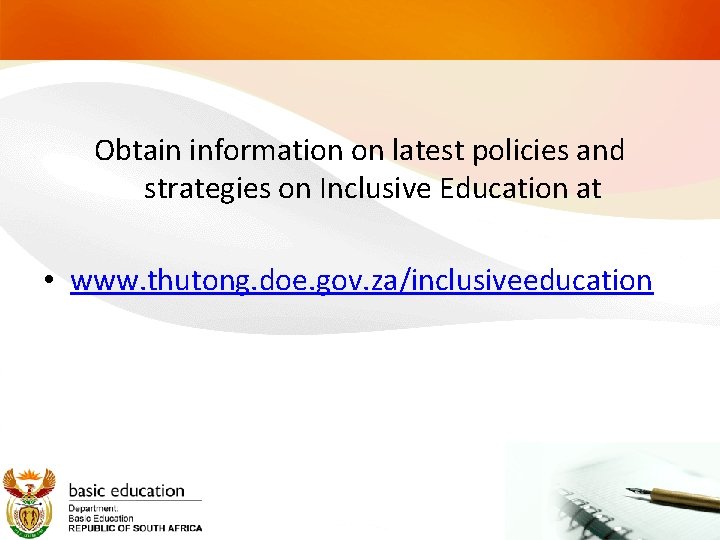
Obtain information on latest policies and strategies on Inclusive Education at • www. thutong. doe. gov. za/inclusiveeducation