
Guidelines and Injection Instructions for Duo Dote AutoInjector


- Slides: 17
Guidelines and Injection Instructions for Duo. Dote™ Auto-Injector
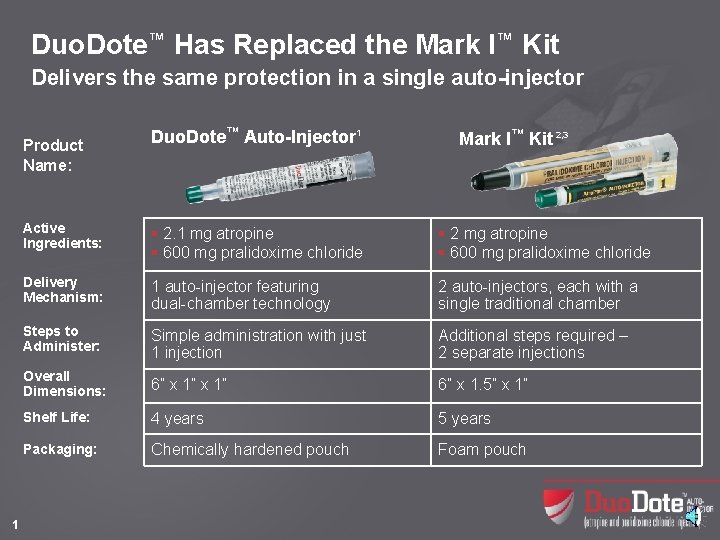
Duo. Dote™ Has Replaced the Mark I™ Kit Delivers the same protection in a single auto-injector Product Name: 1 Duo. Dote™ Auto-Injector 1 Mark I™ Kit 2, 3 Active Ingredients: § 2. 1 mg atropine § 600 mg pralidoxime chloride § 2 mg atropine § 600 mg pralidoxime chloride Delivery Mechanism: 1 auto-injector featuring dual-chamber technology 2 auto-injectors, each with a single traditional chamber Steps to Administer: Simple administration with just 1 injection Additional steps required – 2 separate injections Overall Dimensions: 6” x 1” 6” x 1. 5” x 1” Shelf Life: 4 years 5 years Packaging: Chemically hardened pouch Foam pouch
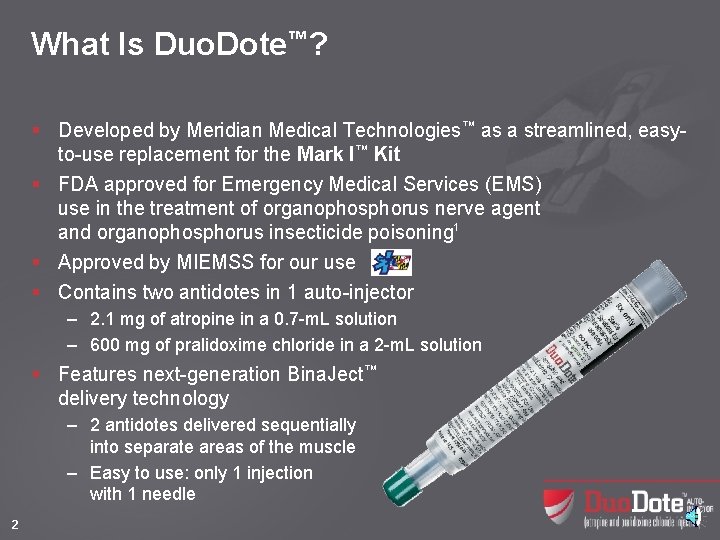
What Is Duo. Dote™? § Developed by Meridian Medical Technologies™ as a streamlined, easyto-use replacement for the Mark I™ Kit § FDA approved for Emergency Medical Services (EMS) use in the treatment of organophosphorus nerve agent and organophosphorus insecticide poisoning 1 § Approved by MIEMSS for our use § Contains two antidotes in 1 auto-injector – 2. 1 mg of atropine in a 0. 7 -m. L solution – 600 mg of pralidoxime chloride in a 2 -m. L solution § Features next-generation Bina. Ject™ delivery technology – 2 antidotes delivered sequentially into separate areas of the muscle – Easy to use: only 1 injection with 1 needle 2
What Is Duo. Dote™? (contd) § Indications – The Duo. Dote™ Auto-Injector (atropine and pralidoxime chloride injection) is indicated for the treatment of poisoning by organophosphorus nerve agents as well as organophosphorus insecticides – The Duo. Dote™ Auto-Injector should be administered by Emergency Medical Services personnel who have had adequate training in the recognition and treatment of nerve agent or insecticide intoxication – The Duo. Dote™ Auto-Injector is intended as an initial treatment of the symptoms of organophosphorus insecticide or nerve agent poisoning; definitive medical care should be sought immediately – The Duo. Dote™ Auto-Injector should be administered as soon as symptoms of organophosphorus poisoning appear 3
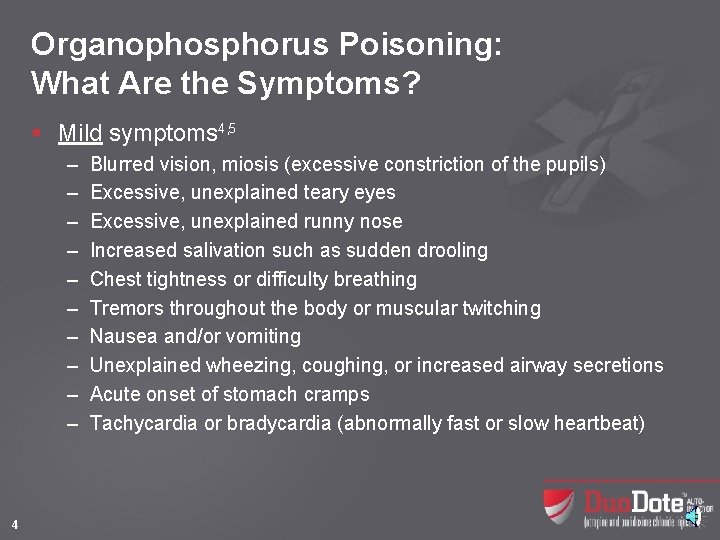
Organophosphorus Poisoning: What Are the Symptoms? § Mild symptoms 4, 5 – – – – – 4 Blurred vision, miosis (excessive constriction of the pupils) Excessive, unexplained teary eyes Excessive, unexplained runny nose Increased salivation such as sudden drooling Chest tightness or difficulty breathing Tremors throughout the body or muscular twitching Nausea and/or vomiting Unexplained wheezing, coughing, or increased airway secretions Acute onset of stomach cramps Tachycardia or bradycardia (abnormally fast or slow heartbeat)
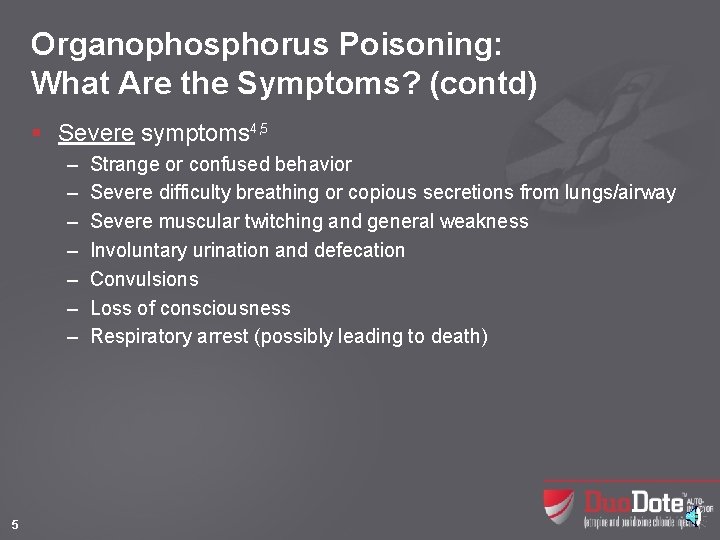
Organophosphorus Poisoning: What Are the Symptoms? (contd) § Severe symptoms 4, 5 – – – – 5 Strange or confused behavior Severe difficulty breathing or copious secretions from lungs/airway Severe muscular twitching and general weakness Involuntary urination and defecation Convulsions Loss of consciousness Respiratory arrest (possibly leading to death)
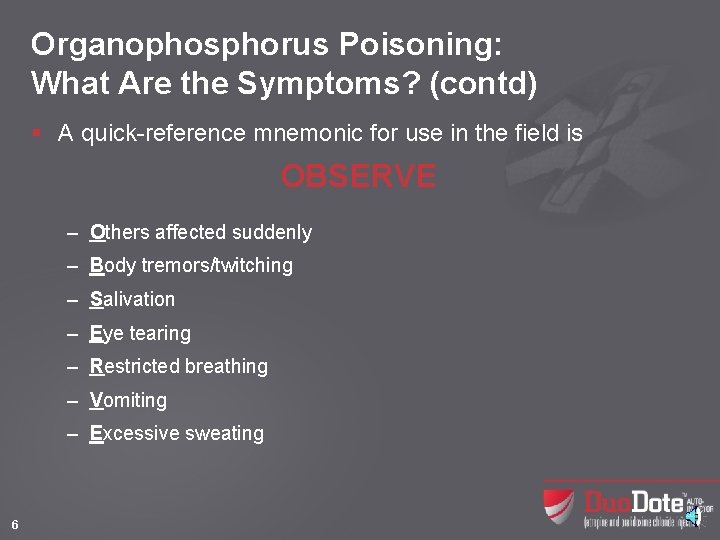
Organophosphorus Poisoning: What Are the Symptoms? (contd) § A quick-reference mnemonic for use in the field is OBSERVE – Others affected suddenly – Body tremors/twitching – Salivation – Eye tearing – Restricted breathing – Vomiting – Excessive sweating 6
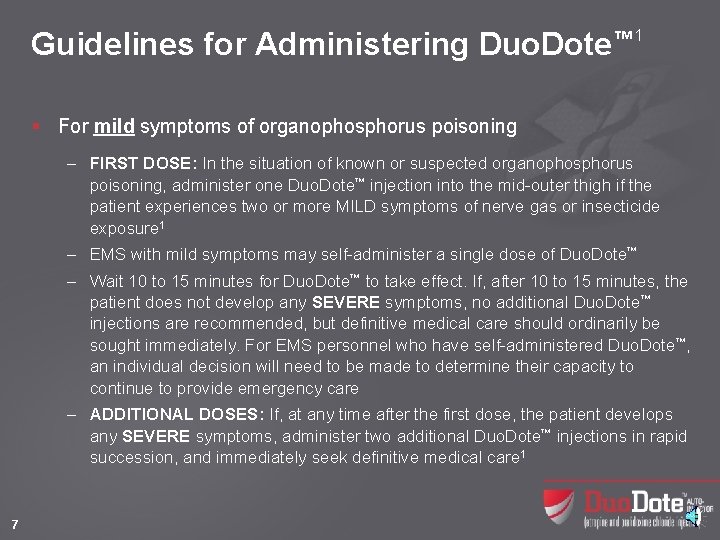
Guidelines for Administering Duo. Dote™ 1 § For mild symptoms of organophosphorus poisoning – FIRST DOSE: In the situation of known or suspected organophosphorus poisoning, administer one Duo. Dote™ injection into the mid-outer thigh if the patient experiences two or more MILD symptoms of nerve gas or insecticide exposure 1 – EMS with mild symptoms may self-administer a single dose of Duo. Dote™ – Wait 10 to 15 minutes for Duo. Dote™ to take effect. If, after 10 to 15 minutes, the patient does not develop any SEVERE symptoms, no additional Duo. Dote™ injections are recommended, but definitive medical care should ordinarily be sought immediately. For EMS personnel who have self-administered Duo. Dote™, an individual decision will need to be made to determine their capacity to continue to provide emergency care – ADDITIONAL DOSES: If, at any time after the first dose, the patient develops any SEVERE symptoms, administer two additional Duo. Dote™ injections in rapid succession, and immediately seek definitive medical care 1 7
Guidelines for Administering Duo. Dote™ 1 (contd) § For severe symptoms of organophosphorus poisoning – If a patient has any SEVERE symptoms of organophosphorus poisoning, immediately administer three Duo. Dote™ injections into the patient’s midouter thigh in rapid succession, 1 and immediately seek definitive medical carea – No more than 3 doses of Duo. Dote™ should be administered unless definitive medical care (eg, hospitalization, respiratory support) is available 1 – Emergency care of the severely poisoned individual should include removal of oral and bronchial secretions, maintenance of a patent airway, supplemental oxygen, and, if necessary, artificial ventilation – An anticonvulsant, such as diazepam, 6 may be administered to treat convulsions if suspected in the unconscious individual. b The effects of nerve agents and some insecticides can mask the motor signs of a seizure – Close supervision of all severely poisoned patients is indicated for at least 48 to 72 hours a Limit of 3 doses is specific to the pralidoxime component of Duo. Dote™. If necessary, additional doses of Atro. Pen® Auto-Injector (atropine) can be administered if the 3 doses of Duo. Dote™ do not produce an adequate response. 2 b Diazepam is recommended in addition to Duo. Dote™ if symptoms include convulsions. 8 Please see full Prescribing Information for Diazepam Auto-Injector (C-IV). 6 [http: //www. meridianmeds. com/pdf/Diazepam_Pack_Insert. pdf]
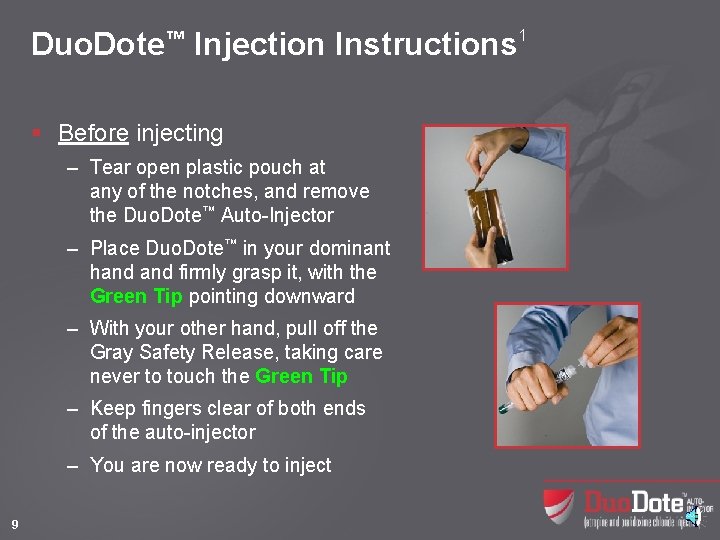
Duo. Dote™ Injection Instructions 1 § Before injecting – Tear open plastic pouch at any of the notches, and remove the Duo. Dote™ Auto-Injector – Place Duo. Dote™ in your dominant hand firmly grasp it, with the Green Tip pointing downward – With your other hand, pull off the Gray Safety Release, taking care never to touch the Green Tip – Keep fingers clear of both ends of the auto-injector – You are now ready to inject 9
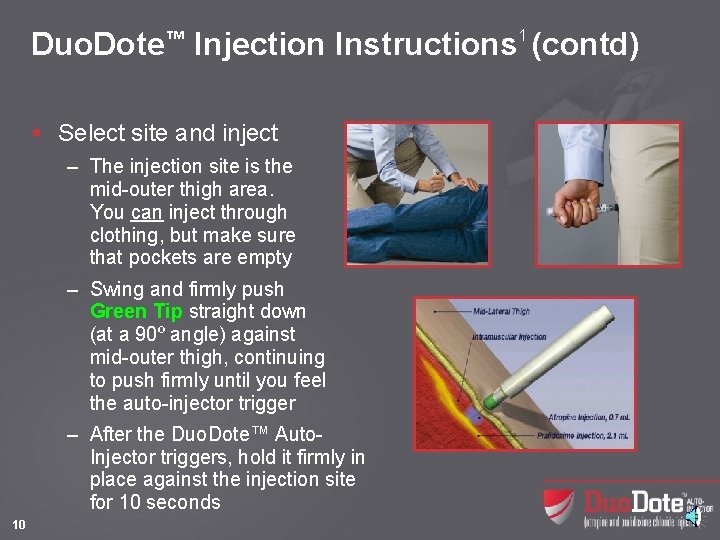
Duo. Dote™ Injection Instructions 1 (contd) § Select site and inject – The injection site is the mid-outer thigh area. You can inject through clothing, but make sure that pockets are empty – Swing and firmly push Green Tip straight down (at a 90º angle) against mid-outer thigh, continuing to push firmly until you feel the auto-injector trigger – After the Duo. Dote™ Auto. Injector triggers, hold it firmly in place against the injection site for 10 seconds 10
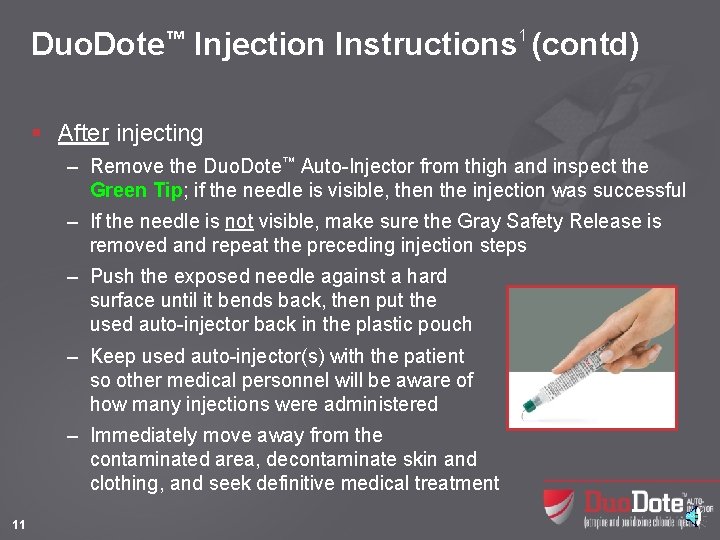
Duo. Dote™ Injection Instructions 1 (contd) § After injecting – Remove the Duo. Dote™ Auto-Injector from thigh and inspect the Green Tip; if the needle is visible, then the injection was successful – If the needle is not visible, make sure the Gray Safety Release is removed and repeat the preceding injection steps – Push the exposed needle against a hard surface until it bends back, then put the used auto-injector back in the plastic pouch – Keep used auto-injector(s) with the patient so other medical personnel will be aware of how many injections were administered – Immediately move away from the contaminated area, decontaminate skin and clothing, and seek definitive medical treatment 11
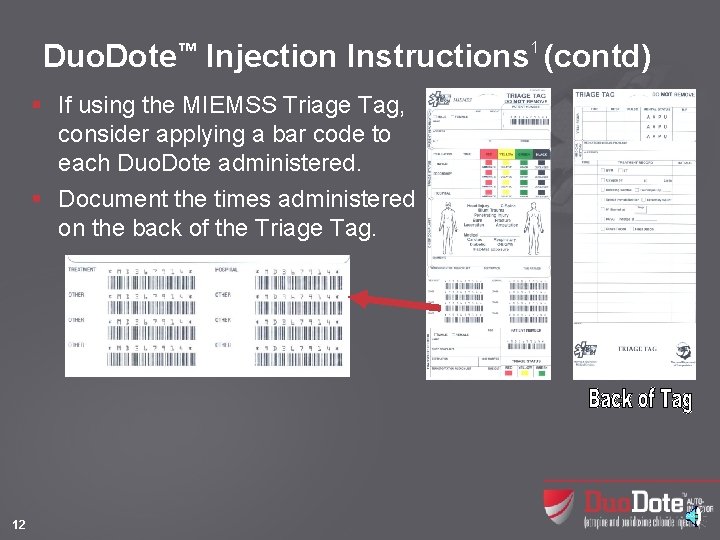
Duo. Dote™ Injection Instructions 1 (contd) § If using the MIEMSS Triage Tag, consider applying a bar code to each Duo. Dote administered. § Document the times administered on the back of the Triage Tag. 12
Additional Information Contact the On-Duty EMS Duty Officer or EMS Medical Director 13
Important Safety Information The Duo. Dote™ Auto-Injector is intended as an initial treatment of the symptoms of organophosphorus insecticide or nerve agent poisonings; definitive medical care should be sought immediately. The Duo. Dote™ Auto-Injector should be administered by EMS personnel who have had adequate training in the recognition and treatment of nerve agent or insecticide intoxication. Individuals should not rely solely upon agents such as atropine and pralidoxime to provide complete protection from chemical nerve agents and insecticide poisoning. Primary protection against exposure to chemical nerve agents and insecticide poisoning is the wearing of protective garments, including masks designed specifically for this use. Evacuation and decontamination procedures should be undertaken as soon as possible. Medical Personnel assisting evacuated victims of nerve agent poisoning should avoid contaminating themselves by exposure to the victim’s clothing. In the presence of life-threatening poisoning by organophosphorus nerve agents or insecticides, there are no absolute contraindications to the use of the Duo. Dote™ Auto-Injector. When symptoms of poisoning are not severe, Duo. Dote™ Auto-Injector should be used with extreme caution in people with heart disease, arrhythmias, recent myocardial infarction, severe narrow angle glaucoma, pyloric stenosis, prostatic hypertrophy, significant renal insufficiency, chronic pulmonary disease, or hypersensitivity to any component of the product. PLEASE CLICK HERE TO VIEW FULL PRESCRIBING INFORMATION. [ http: //www. meridianmeds. com/pdf/Duodote_Pack_Insert. pdf ] or click here to launch accompanying Acrobat PDF document 14
For More Information § To request additional educational materials, or to order Duo. Dote™, please contact Meridian Medical Technologies™ – Via toll free call at 1 -800 -638 -8093 – Via e-mail at customerservice@meridianmt. com – On the Web at www. Duo. Dote. com ™ Duo. Dote Auto-Injector, the Duo. Dote Logo, Mark I Kit, and Bina. Ject are trademarks of Meridian Medical Technologies™, Inc. , a wholly owned subsidiary of King Pharmaceuticals®, Inc. Copyright © 2009 Meridian Medical Technologies™, Inc. , a wholly owned subsidiary of King Pharmaceuticals®, Inc. All rights reserved. MMT 6153 06/2009 References: 1. Duo. Dote Auto-Injector [package insert]. Columbia, MD: Meridian Medical Technologies, Inc; 2007. http: //www. meridianmeds. com/pdf/Duodote_Pack_Insert. pdf. Accessed September 7, 2007. 2. Atro. Pen Auto-Injector [package insert]. Columbia, MD: Meridian Medical Technologies, Inc; 2007. http: //www. meridianmeds. com/pdf/Atro. Pen_Pack_Insert. pdf. Accessed September 7, 2007. 3. Pralidoxime Chloride Injection (Auto-Injector) [package insert]. Columbia, MD: Meridian Medical Technologies, Inc; 2007. http: //www. meridianmeds. com/pdf/2 Pam_Cl_Pack_Insert. pdf. Accessed September 7, 2007. 4. Sidell FR. Nerve agents. In: Sidell FR, Takafuji ET, Franz DR, eds. Textbook of Military Medicine: Medical Aspects of Chemical and Biological Warfare. Washington, DC: Office of The Surgeon General at TMM Publications Borden Institute; 1997: 129 -181. 5. Agency for Toxic Substances and Disease Registry. Medical Management Guidelines (MMGs) for nerve agents: tabun (GA); sarin (GB); soman (GD); and VX. http: //www. atsdr. cdc. gov/MHMI/mmg 166. html. Accessed September 7, 2007. 6. Diazepam Auto. Injector (C-IV) [package insert]. Columbia, MD: Meridian Medical Technologies, Inc; 2007. http: //www. meridianmeds. com/pdf/Diazepam_Pack_Insert. pdf. Accessed September 7, 2007. 15
16