
Guided reading Day 2 My Mind by Ros
Guided reading Day 2 ‘My Mind’ by Ros Asquith • To be able to use skim and scan techniques. • To be able to analyse poems and recognise similes and metaphors. • To be able to recognise and answers questions from a range of reading domains. Play this Power. Point in slideshow mode and click on the speakers to listen to your teacher! Read the extract on the following page and answer the three questions that go with it. You can mark these straight afterwards.
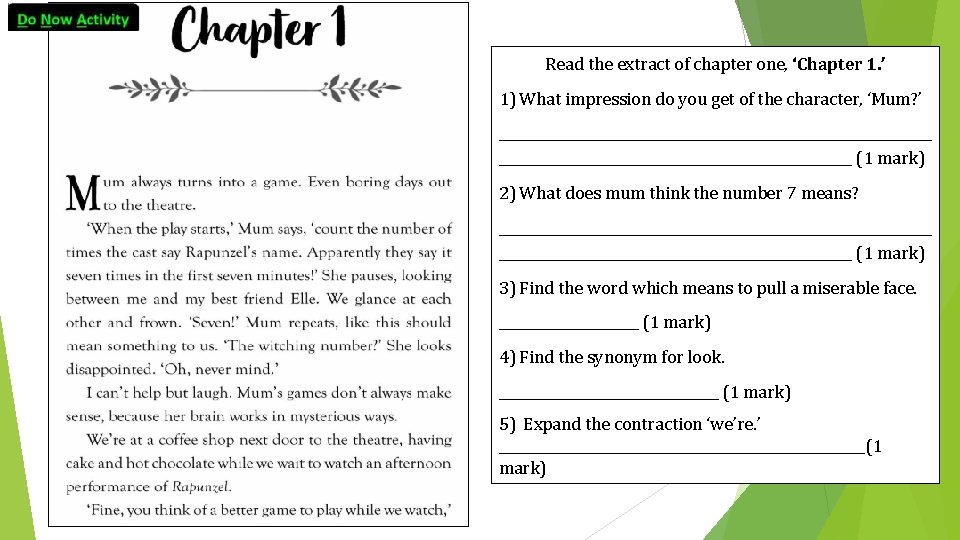
Read the extract of chapter one, ‘Chapter 1. ’ 1) What impression do you get of the character, ‘Mum? ’ _________________________________ (1 mark) 2) What does mum think the number 7 means? _________________________________ (1 mark) 3) Find the word which means to pull a miserable face. ___________ (1 mark) 4) Find the synonym for look. _________________ (1 mark) 5) Expand the contraction ‘we’re. ’ ____________________________(1 mark)
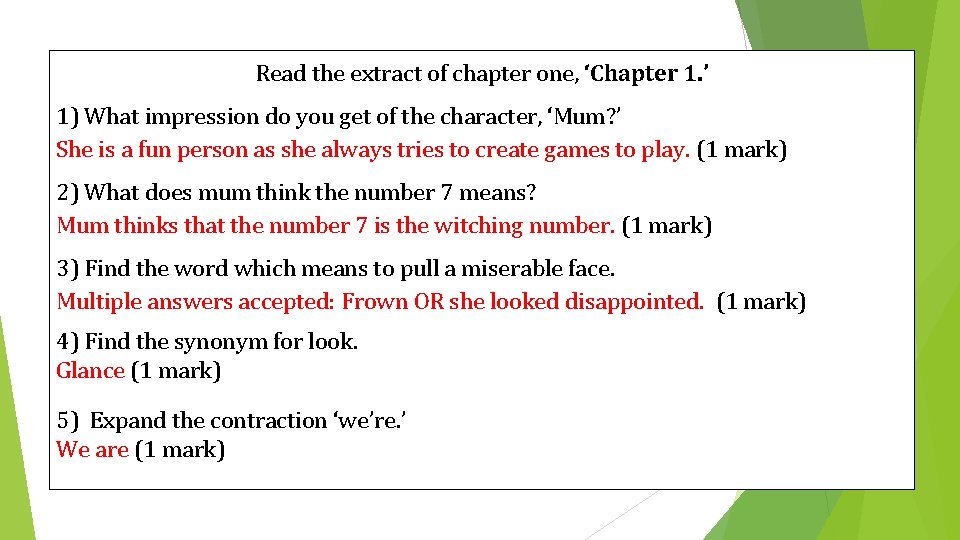
Read the extract of chapter one, ‘Chapter 1. ’ 1) What impression do you get of the character, ‘Mum? ’ She is a fun person as she always tries to create games to play. (1 mark) 2) What does mum think the number 7 means? Mum thinks that the number 7 is the witching number. (1 mark) 3) Find the word which means to pull a miserable face. Multiple answers accepted: Frown OR she looked disappointed. (1 mark) 4) Find the synonym for look. Glance (1 mark) 5) Expand the contraction ‘we’re. ’ We are (1 mark)
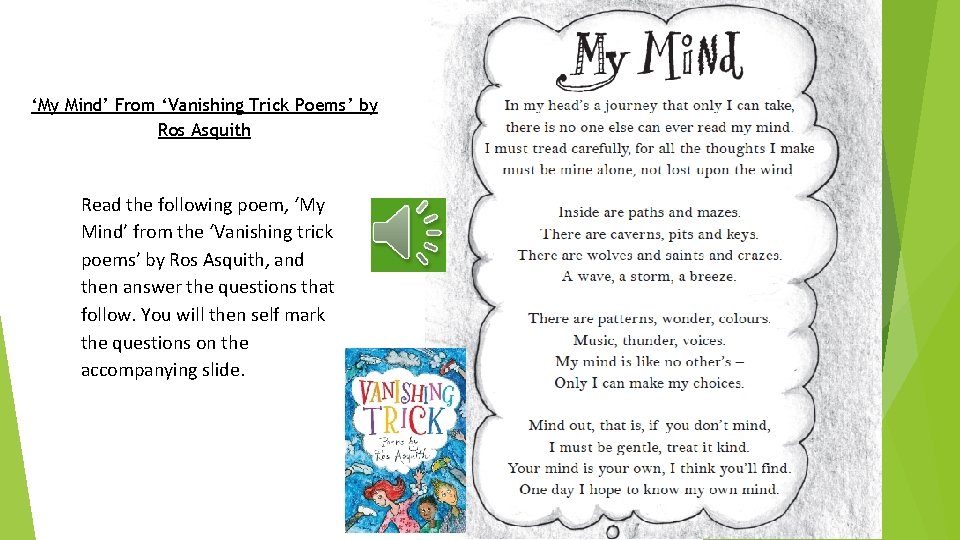
‘My Mind’ From ‘Vanishing Trick Poems’ by Ros Asquith Read the following poem, ‘My Mind’ from the ‘Vanishing trick poems’ by Ros Asquith, and then answer the questions that follow. You will then self mark the questions on the accompanying slide.
Vocabulary 1) What word does the poet use as a synonym for ‘hole’? 2) The poet uses the word ‘mind’ in different ways so that it has different meanings. Give two examples from the poem. Retrieval 3) How does the poet say she must behave towards her mind? 4) Name five things that the poet says is in her mind. Making Inference 5) Do you think the poet is a young person or an older person? Explain why using evidence from the text. 6) Why do you think the poet wants their thoughts to “be mine alone”? Writer’s choices 7) Why do you think the writer compares her mind to “paths and mazes”? Challenge question (extended question) 8) Do you think the poet’s mind is a happy, sad or angry place? Support your answer with examples from the text. Try to answer these questions in 15 minutes. If you finish before 15 minutes, use the time to check your answers.
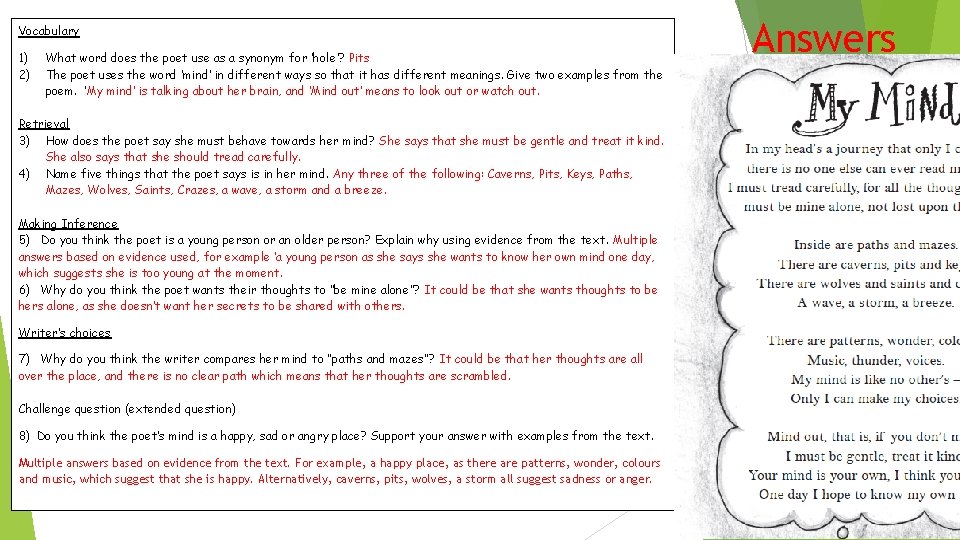
Vocabulary 1) 2) What word does the poet use as a synonym for ‘hole’? Pits The poet uses the word ‘mind’ in different ways so that it has different meanings. Give two examples from the poem. ‘My mind’ is talking about her brain, and ‘Mind out’ means to look out or watch out. Retrieval 3) How does the poet say she must behave towards her mind? She says that she must be gentle and treat it kind. She also says that she should tread carefully. 4) Name five things that the poet says is in her mind. Any three of the following: Caverns, Pits, Keys, Paths, Mazes, Wolves, Saints, Crazes, a wave, a storm and a breeze. Making Inference 5) Do you think the poet is a young person or an older person? Explain why using evidence from the text. Multiple answers based on evidence used, for example ‘a young person as she says she wants to know her own mind one day, which suggests she is too young at the moment. 6) Why do you think the poet wants their thoughts to “be mine alone”? It could be that she wants thoughts to be hers alone, as she doesn’t want her secrets to be shared with others. Writer’s choices 7) Why do you think the writer compares her mind to “paths and mazes”? It could be that her thoughts are all over the place, and there is no clear path which means that her thoughts are scrambled. Challenge question (extended question) 8) Do you think the poet’s mind is a happy, sad or angry place? Support your answer with examples from the text. Multiple answers based on evidence from the text. For example, a happy place, as there are patterns, wonder, colours and music, which suggest that she is happy. Alternatively, caverns, pits, wolves, a storm all suggest sadness or anger. Answers
Extension Create a poem about your own mind, using metaphors to talk about what happens in your mind. Talk about the different emotions and how they have an impact on your thoughts. Send any poems made to the Year 6 email address: year 6@gordonchildrensacademy. org. uk
- Slides: 7