
Guided Pathways A Student Services Perspective Randy Beach
Guided Pathways: A Student Services Perspective Randy Beach, ASCCC South Representative La. Tonya Parker, ASCCC Representative At Large
Breakout Description The principles of guided pathways require a strong partnership between the student services areas and all other areas on campus to work together to improve achievement and learning outcomes, regardless of where your college is in the creation and design of a guided pathways framework. In this breakout, we will discuss the role of student services faculty in designing a guided pathways framework. 2

What Brings You Here? What do you hope to learn today? What are you struggling with locally? 3
The Pathways Projects ● American Association of Community Colleges Project (nationwide-Mt. Sac, Irvine Valley, Bakersfield and now Santa Monica) ● CA Foundation Project (20 colleges were selected) ● CCCCO Award program (all colleges eligible) ● Major push from the California Community Colleges Chancellor’s Office to advocate and fund Guided Pathways-style reforms ● Recent legislation and system changes supportive of reforms associated with Guided Pathways (AB 705, CAI, AB 19, BSI/Equity/SSSP integration) 4

The ASCCC Position on Guided Pathways ● F 15 9. 12 Support Local Development of Curricular Pathways ● To “urge local academic senates and colleges to create formal processes and policies that require the local academic senate, in consultation with its curriculum committee, to evaluate and endorse any proposed curricular pathways offered by an external organization before such a program is institutionalized” ● Be mindful of the potential, but insistent on the purview of faculty ● Governance structures should be respected and utilized 5
Which Student Services Are Involved? ● Easier question is “Which ones are NOT? ” Counseling Admissions and Application Process Assessment Financial Aid Outreach Transfer Centers Tutoring and Supplemental Learning Others? 6
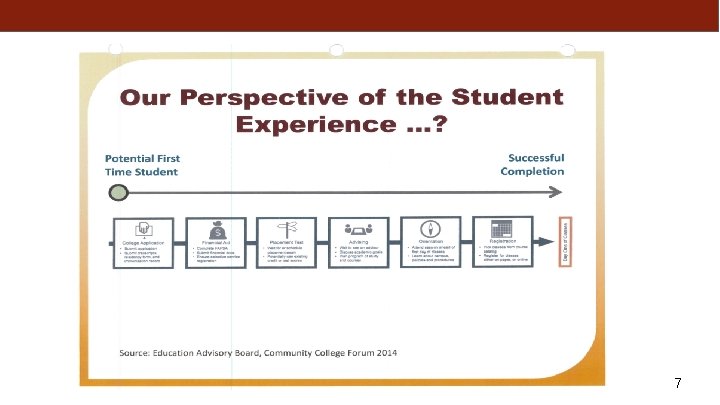
7
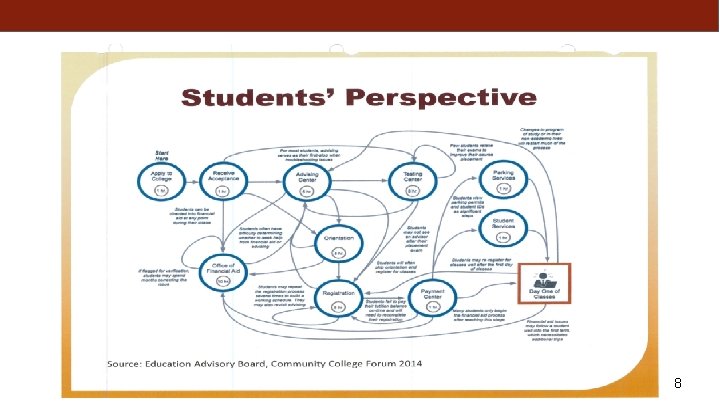
8

The Four Pillars of GP and Student Services 9
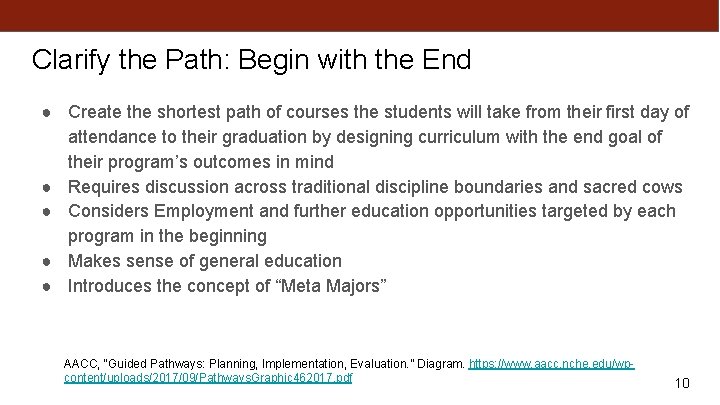
Clarify the Path: Begin with the End ● Create the shortest path of courses the students will take from their first day of attendance to their graduation by designing curriculum with the end goal of their program’s outcomes in mind ● Requires discussion across traditional discipline boundaries and sacred cows ● Considers Employment and further education opportunities targeted by each program in the beginning ● Makes sense of general education ● Introduces the concept of “Meta Majors” AACC, “Guided Pathways: Planning, Implementation, Evaluation. ” Diagram. https: //www. aacc. nche. edu/wpcontent/uploads/2017/09/Pathways. Graphic 462017. pdf 10
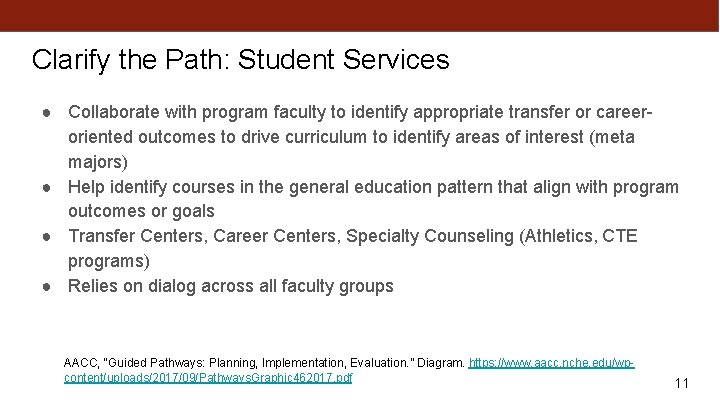
Clarify the Path: Student Services ● Collaborate with program faculty to identify appropriate transfer or careeroriented outcomes to drive curriculum to identify areas of interest (meta majors) ● Help identify courses in the general education pattern that align with program outcomes or goals ● Transfer Centers, Career Centers, Specialty Counseling (Athletics, CTE programs) ● Relies on dialog across all faculty groups AACC, “Guided Pathways: Planning, Implementation, Evaluation. ” Diagram. https: //www. aacc. nche. edu/wpcontent/uploads/2017/09/Pathways. Graphic 462017. pdf 11
Enter the Path: Choosing and Entering ● Helping students choose and enter a pathway ● Established where students enter the pathway in the most effective ways possible ● Requires alignment and cooperation with high schools ● Thoughtful planning early on; Asking different questions around “What do you want to be when you grow up” ● Dual Enrollment, Multiple Methods Assessment Project (MMAP), Acceleration, Noncredit, non-academic foundation skills AACC, “Guided Pathways: Planning, Implementation, Evaluation. ” Diagram. https: //www. aacc. nche. edu/wpcontent/uploads/2017/09/Pathways. Graphic 462017. pdf 12

Enter the Path: Student Services ● ● ● Expanded and early Career Counseling Career counseling coursework linked to areas of interest Use of multiple measures to assess students’ needs First-year experiences to help students explore the field and choose a major Full program plans based on required career/transfer exploration Contextualized, integrated academic support to help students pass program gateway courses ● K– 12 partnerships focused on career/college program exploration (Outreach) AACC, “Guided Pathways: Planning, Implementation, Evaluation. ” Diagram. https: //www. aacc. nche. edu/wpcontent/uploads/2017/09/Pathways. Graphic 462017. pdf 13
Stay on the Path: What To Do When Life Happens ● Intentional monitoring of students progress along the pathway and intrusive interventions that redirect the students back onto the pathway when “life happens” (SSSP, Equity, BSI) ● Counseling and Advising ● Technology (EPI, Early Alert, e-SEP, Degree Works, Starfish, Grades. First) ● Scheduling to ensure students can find the courses they need when they need them AACC, “Guided Pathways: Planning, Implementation, Evaluation. ” Diagram. https: //www. aacc. nche. edu/wpcontent/uploads/2017/09/Pathways. Graphic 462017. pdf 14
Stay on the Path: Student Services ● Work with discipline faculty to identify student habits relevant to their coursetaking habits ● Ongoing, intrusive counseling intervention strategies ● Systems for students to easily track their progress ● Systems/procedures to identify students at risk and provide needed supports ● Capacity to help students redirect and change their goals without amassing significant numbers of units. AACC, “Guided Pathways: Planning, Implementation, Evaluation. ” Diagram. https: //www. aacc. nche. edu/wpcontent/uploads/2017/09/Pathways. Graphic 462017. pdf 15
Ensure Learning ● Learning outcomes are clearly defined for each of the college’s programs and for the courses in those programs ● Outcomes designed to prepare students for employment and further education ● Outcomes are clear, measurable, and assessed regularly and results used to improve instruction and program/institutional effectiveness ● Students internalize the content they’ve learned in their courses by participating in group projects, internships and other applied learning experiences AACC, “Guided Pathways: Planning, Implementation, Evaluation. ” Diagram. https: //www. aacc. nche. edu/wpcontent/uploads/2017/09/Pathways. Graphic 462017. pdf 16
Ensure Learning: Student Services ● Enhanced or supplemental instruction practices to support project-based learning, collaborative learning, and other applied learning experiences ● Embedded counseling-counselors developing stronger relationships with program faculty to bring students across the finish line ● Collaboration with library faculty, faculty involved in tutoring and supplemental instruction to maximize meta-cognitive skills ● Systems/procedures for the college and students to track mastery of learning outcomes that lead to credentials, transfer, and/or employment AACC, “Guided Pathways: Planning, Implementation, Evaluation. ” Diagram. https: //www. aacc. nche. edu/wpcontent/uploads/2017/09/Pathways. Graphic 462017. pdf 17
Student Services and Pathways Funding ● Currently colleges require to integrate planning ● Separate requirements in CEC and title 5 regulations must be build into single plan (BSI/Equity/SSSP) ● Plans developed in consultation with students, staff, administrators, faculty, Academic Senate, and members of the community as appropriate. ● Plans must be adopted by your local governing board of the community college district and submitted to the CCCCO by December 1, 2017. ● Guided Pathways grant language calls for integration of BSI/Equity/SSSP/AEBG, other grant programs 18
Next Steps ● Assert faculty leadership and purview in 10 + 1 areas ● Determine planning and design structures that put faculty heavily involved in decision-making ● Talk to students; find out where they need help ● Look to GP for inspiration, not an off-the-shelf model ● Be cautious of faculty taking sides and pointing fingers ● Keep students’ needs at the forefront 19
Contact Us ●Randy Beach, ASCCC South Representative, rbeach@swccd. edu ●La. Tonya Parker, ASCCC Representative at Large, La. Tonya. Parker@mvc. edu 20
Thank you! Questions 21
- Slides: 21