
Guided Instruction Part 1 November 2015 How do
Guided Instruction- Part 1 November 2015
How do I describe the purpose of guided instruction?
Purpose • Begin to shift the cognitive load from the teacher to student • Teacher follows the lead of the learner ▫ Students are challenged to apply the skill or strategy presented in a new situation • Students apply what they have learned from focused instruction and collaborative learning with varying degrees of support from the teacher
Purpose • Provide temporary supports (scaffolds) which offer learners a bridge toward a skill or concept they have been taught but are not ready to “know” or “do” on their own • Provides the teacher evidence for shifting back into focused instruction • Provides an opportunity to collect individual student evidence to plan future instruction
What does guided instruction look like in the classroom?
Walkthrough Look Fors… Teacher focuses on scaffolding students’ developing skill or knowledge through questioning, prompting, and cuing while others engage in collaborative or independent learning ▫ Dialogue between the teacher and learners is carefully crafted following the principles of scaffolding ▫ Effective scaffolding requires that the teacher possess expert content knowledge about the cues themselves and the level of knowledge they likely represent
Walkthrough Look Fors… • Temporary, flexible, and responsive • Not the same for every group ▫ Is for all students ▫ Struggling, on grade level, and advanced • Students are grouped and regrouped based on their performance (changes frequently) ▫ Is not ability grouping
Walkthrough Look Fors… • Altered size of groups based on student need • Predicated on what students “say” and “do” • Does not necessarily happen every day for every student
What is the connection to checks for understanding?
Connection to Checks for Understanding • Checking for understanding is foundational to guided instruction, as the student's response provides the teacher with a decision-making point: do I need to further scaffold this learner's understanding?
Connection to Checks for Understanding At various places throughout a lesson, the teacher should check for understanding so they can plan for future instruction. • What does the learner know • What the learner does not know • The extent to which a learner is linking background knowledge with newer concepts • Whethere are fundamental misconceptions that are getting in the way of understanding
How can I describe three major types of scaffolds?
Asking Questions What does this child’s answer tell me about what s/he knows and does not know?
Asking Questions • Should be designed to uncover errors and misconceptions • Should provide an opportunity for students to elaborate or to clarify their answers so additional scaffolds can be determined • Teachers should not correct students ▫ Eliminates the opportunity to determine why the error was made
Prompts • Get the students to do some thinking • Hints or reminders that encourage the students to do the work when they have forgotten to use a known strategy or skill in an unfamiliar situation • Can be phrased as statements or questions • Designed to guide students’ thinking
Types of Prompts Background Knowledge • Related to the content that the student knows Reflective • Redirects students to think about their thinking Process or Procedure • Related to rules or guidelines the student has been taught Heuristic • Informal problem solving procedures such as a creating a visual
Cues Used when prompts are not sufficient or there is not a clear way to prompt the student • Shifts the learner’s attention • More specific and direct than prompts The teacher bears more cognitive responsibility • Commonly used during initial introduction of content (focused instruction)
Types of Cues Visual • Graphic organizer or visual representation Gestural • Body movements or motions Verbal • Using “attention getters” • Variation in speech and intonation Environmental • Use of classroom surrounding or physical objects to influence understanding
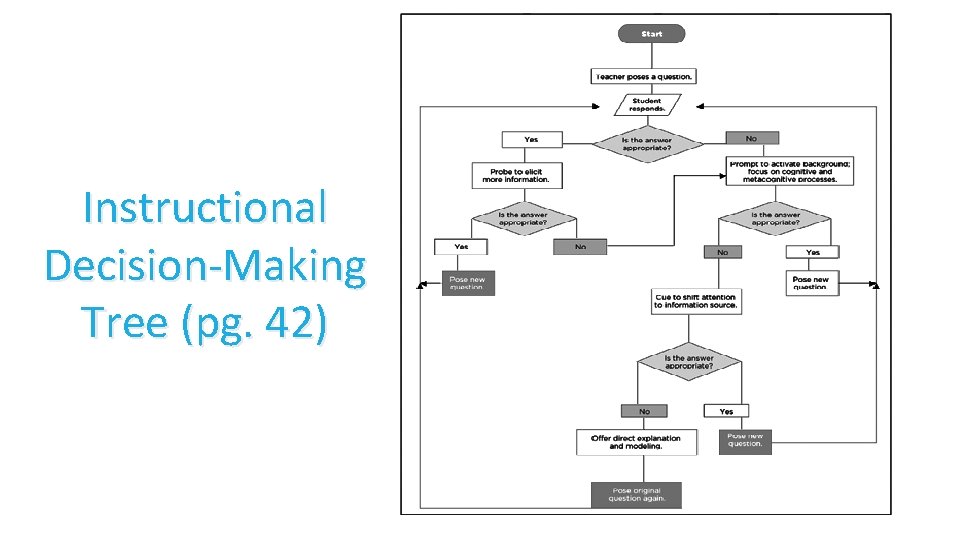
Instructional Decision-Making Tree (pg. 42)
What happens when prompts and cues are not enough to resolve errors and misconceptions?
Direct Explanations • Teachers should not correct students and tell them what they have missed • Teacher should shift back to focused instruction ▫ Re-establish the learning purpose ▫ Provide an explanation with modeling and think-aloud ▫ Ask questions or set small challenge to monitor understanding
• Students may still need additional guided instruction at this point ▫ Teachers need to establish a more modest goal at this point to allow the student to experience some success
Questions?
How can I access our session materials?
Academic Coaches https: //muscogee 1. sharepoint. com/si tes/Academic. Coaches/_layouts/15/st art. aspx#/
LEAS https: //muscogee 1. sharepoint. com/si tes/LEA/_layouts/15/start. aspx#/
- Slides: 26