
Guided deescalation of antiplatelet treatment in ACS patients

- Slides: 24
Guided de-escalation of antiplatelet treatment in ACS patients undergoing PCI Results of the TROPICAL-ACS study: a randomised, investigator-initiated, open-label, multicentre-trial D. Sibbing, D. Aradi, C. Jacobshagen, L. Gross, D. Trenk, F. J. Neumann, K. Huber, Z. Huczek, J. Mehilli and S. Massberg, on behalf of the TROPICAL-ACS Investigators
-Research contracts (Daiichi Sankyol Roche Diagnostics) -Consulting/Royalties/Owner/ Stockholder of a healthcare company (Bayer AGl Roche Diagnostics, Eli Lillyl Daiichi Sankyol Pfizer),
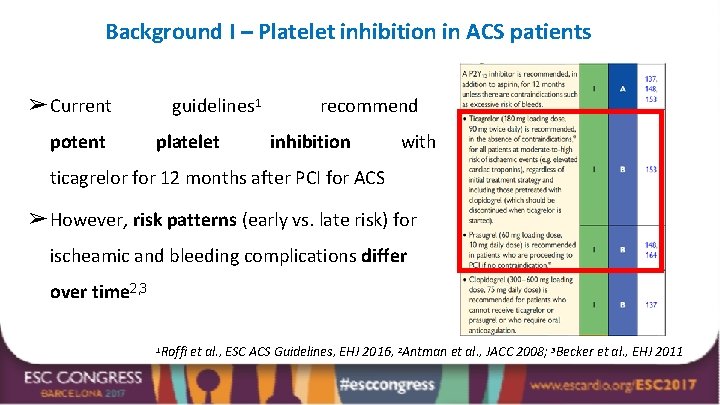
Background I – Platelet inhibition in ACS patients ➢ Current potent guidelines 1 platelet recommend inhibition with uniform prasugrel & or ticagrelor for 12 months after PCI for ACS ➢ However, risk patterns (early vs. late risk) for ischeamic and bleeding complications differ over time 2, 3 1 Roffi et al. , ESC ACS Guidelines, EHJ 2016, 2 Antman et al. , JACC 2008; 3 Becker et al. , EHJ 2011
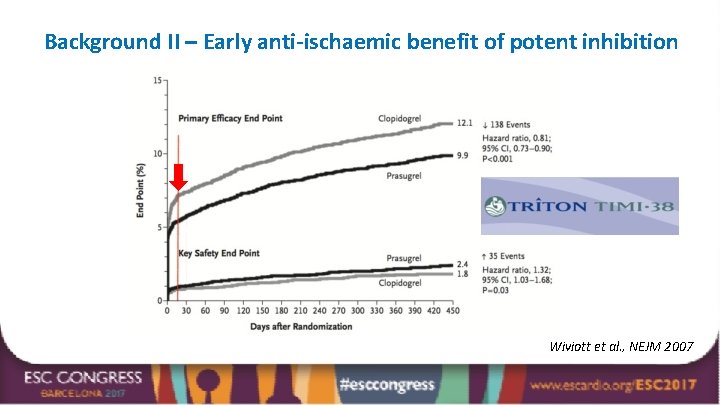
Background II – Early anti-ischaemic benefit of potent inhibition Wiviott et al. , NEJM 2007
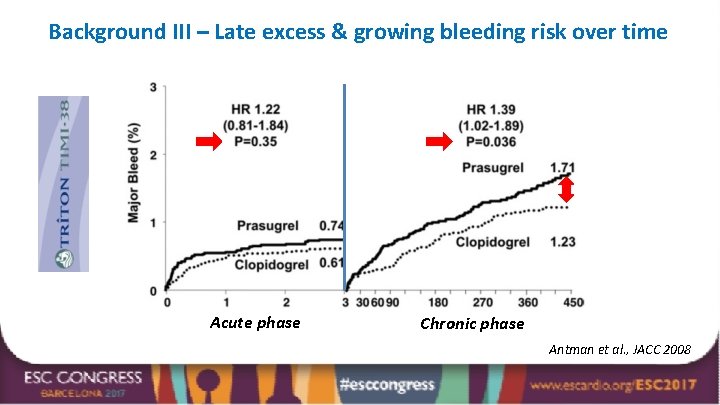
Background III – Late excess & growing bleeding risk over time Acute phase Chronic phase Antman et al. , JACC 2008
Background IV – Concept of de-escalation ➢ Conceptually, a stage-adapted treatment with de-escalation from potent drugs to the less potent clopidogrel early after an ACS may be beneficial. ➢ To date, solid evidence showing safety of de-escalation is lacking. ➢ Despite of this, DAPT de-escalation is commonly done for clinical (e. g. bleeding, side-effects) and economic (generic clopidogrel) reasons (TRANSLATE-ACS 1). ➢ A potential obstacle for de-escalation could be clopidogrel´s large response variability 2 - any de-escalation regimen should account for this issue Zettler et al. , AHJ 2017, 2 Gurbel et al. , Circulation 2003 1
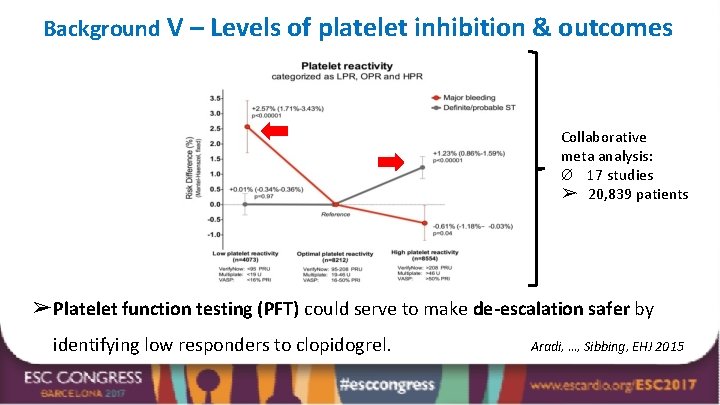
Background V – Levels of platelet inhibition & outcomes Collaborative meta analysis: Ø 17 studies ➢ 20, 839 patients ➢ Platelet function testing (PFT) could serve to make de-escalation safer by identifying low responders to clopidogrel. Aradi, …, Sibbing, EHJ 2015
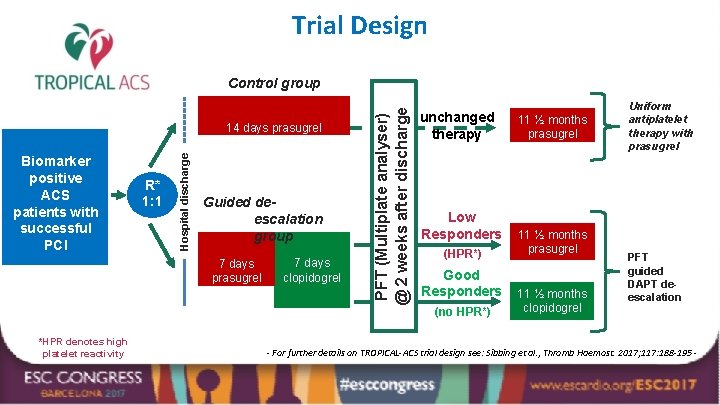
Trial Objective In the TROPICAL-ACS* trial we aimed to investigate the safety and efficacy of early de-escalation of antiplatelet treatment from prasugrel to clopidogrel guided by platelet function testing (PFT). * TROPICAL-ACS: Testing Responsiveness To Platelet Inhibition On Chronic Antiplatelet Treatment For Acute Coronary Syndromes
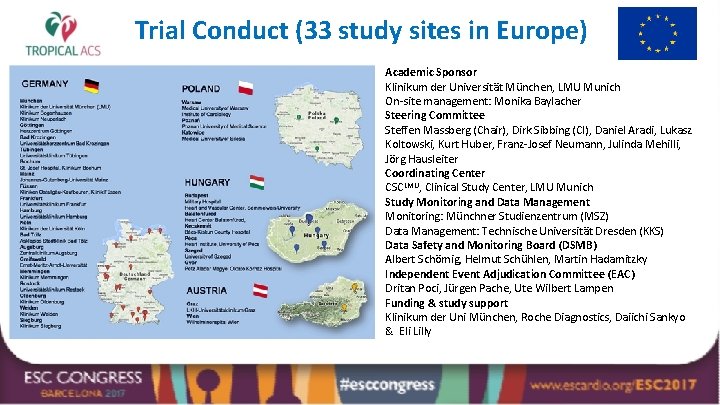
Trial Conduct (33 study sites in Europe) Academic Sponsor Klinikum der Universität München, LMU Munich On-site management: Monika Baylacher Steering Committee Steffen Massberg (Chair), Dirk Sibbing (CI), Daniel Aradi, Lukasz Koltowski, Kurt Huber, Franz-Josef Neumann, Julinda Mehilli, Jörg Hausleiter Coordinating Center CSCLMU, Clinical Study Center, LMU Munich Study Monitoring and Data Management Monitoring: Münchner Studienzentrum (MSZ) Data Management: Technische Universität Dresden (KKS) Data Safety and Monitoring Board (DSMB) Albert Schömig, Helmut Schühlen, Martin Hadamitzky Independent Event Adjudication Committee (EAC) Dritan Poci, Jürgen Pache, Ute Wilbert Lampen Funding & study support Klinikum der Uni München, Roche Diagnostics, Daiichi Sankyo & Eli Lilly
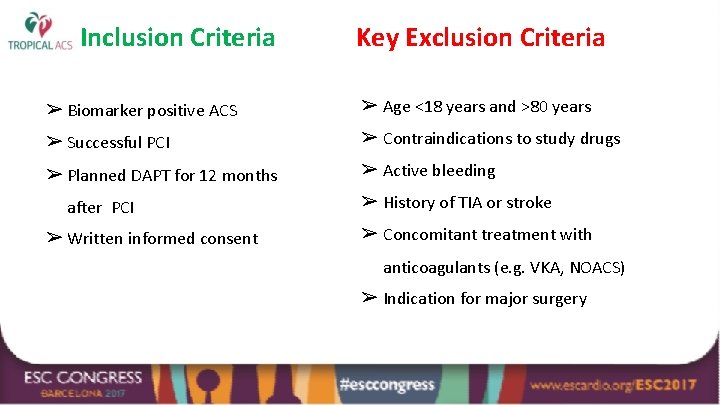
Inclusion Criteria Key Exclusion Criteria ➢ Biomarker positive ACS ➢ Age <18 years and >80 years ➢ Successful PCI ➢ Contraindications to study drugs ➢ Planned DAPT for 12 months ➢ Active bleeding after PCI ➢ Written informed consent ➢ History of TIA or stroke ➢ Concomitant treatment with anticoagulants (e. g. VKA, NOACS) ➢ Indication for major surgery
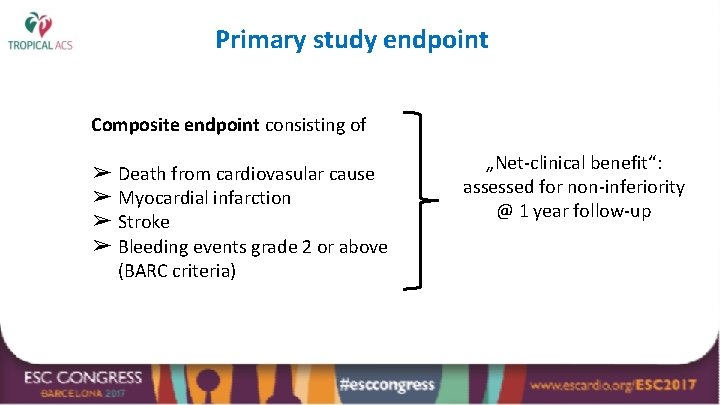
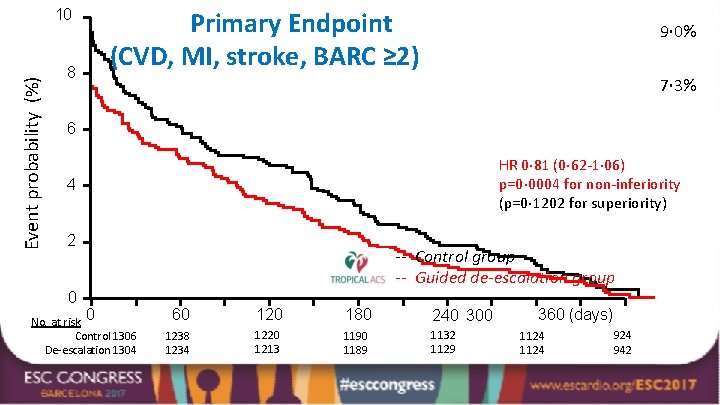
Primary study endpoint Composite endpoint consisting of ➢ Death from cardiovasular cause ➢ Myocardial infarction ➢ Stroke ➢ Bleeding events grade 2 or above (BARC criteria) „Net-clinical benefit“: assessed for non-inferiority @ 1 year follow-up
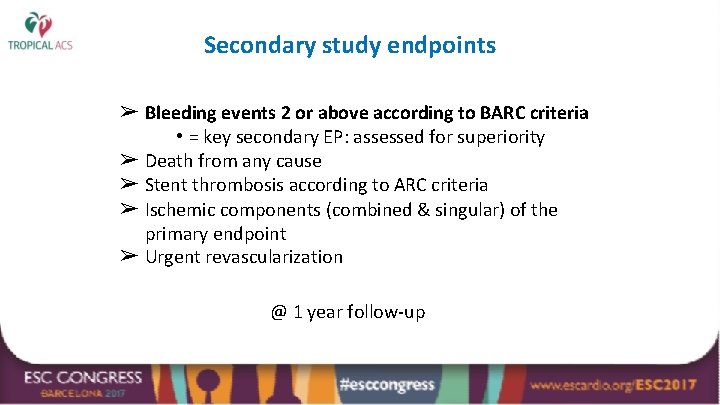
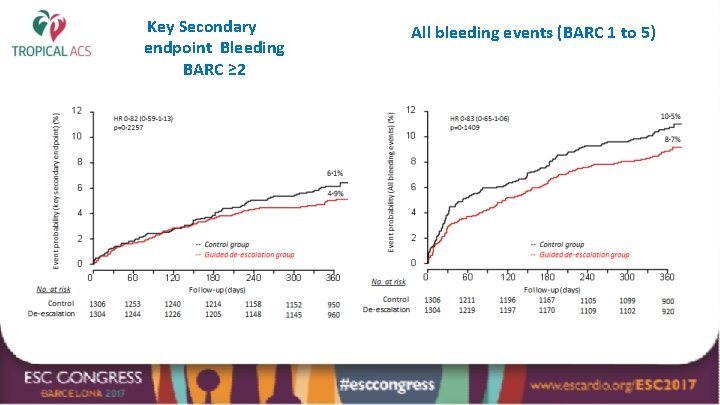
Secondary study endpoints ➢ Bleeding events 2 or above according to BARC criteria • = key secondary EP: assessed for superiority ➢ Death from any cause ➢ Stent thrombosis according to ARC criteria ➢ Ischemic components (combined & singular) of the primary endpoint ➢ Urgent revascularization @ 1 year follow-up
Trial Design Biomarker positive ACS patients with successful PCI R* 1: 1 Hospital discharge 14 days prasugrel Guided deescalation group 7 days prasugrel *HPR denotes high platelet reactivity 7 days clopidogrel PFT (Multiplate analyser) @ 2 weeks after discharge Control group unchanged therapy Low Responders (HPR*) Good Responders (no HPR*) 11 ½ months prasugrel 11 ½ months clopidogrel Uniform antiplatelet therapy with prasugrel PFT guided DAPT deescalation - For further details on TROPICAL-ACS trial design see: Sibbing et al. , Thromb Haemost. 2017; 117: 188 -195 -
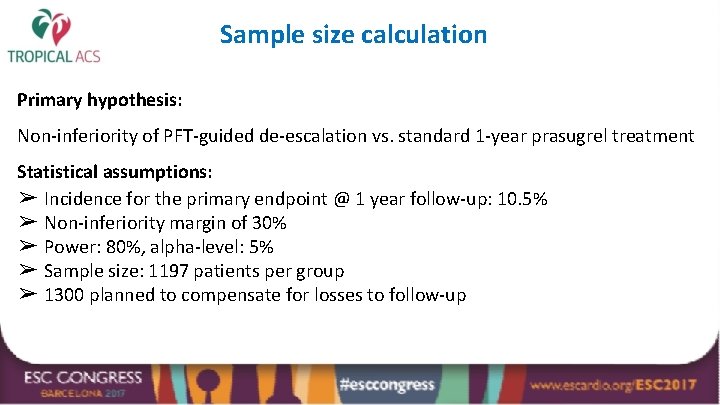
Sample size calculation Primary hypothesis: Non-inferiority of PFT-guided de-escalation vs. standard 1 -year prasugrel treatment Statistical assumptions: ➢ Incidence for the primary endpoint @ 1 year follow-up: 10. 5% ➢ Non-inferiority margin of 30% ➢ Power: 80%, alpha-level: 5% ➢ Sample size: 1197 patients per group ➢ 1300 planned to compensate for losses to follow-up
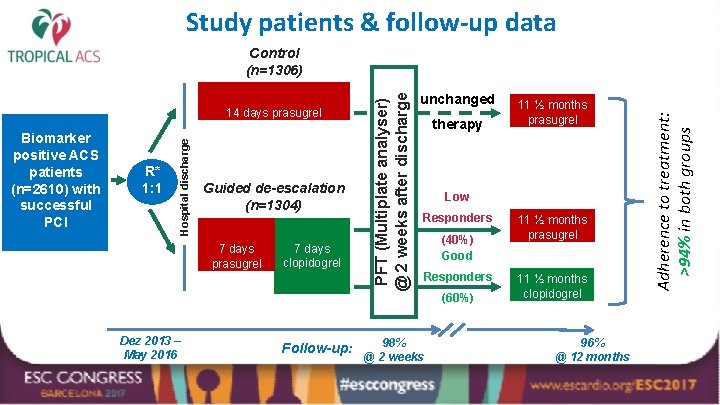
Study patients & follow-up data R* 1: 1 Guided de-escalation (n=1304) 7 days prasugrel Dez 2013 – May 2016 7 days clopidogrel Follow-up: unchanged therapy 11 ½ months prasugrel Low Responders (40%) Good Responders 98% @ 2 weeks (60%) 11 ½ months prasugrel 11 ½ months clopidogrel 96% @ 12 months Adherence to treatment: >94% in both groups Biomarker positive ACS patients (n=2610) with successful PCI Hospital discharge 14 days prasugrel PFT (Multiplate analyser) @ 2 weeks after discharge Control (n=1306)
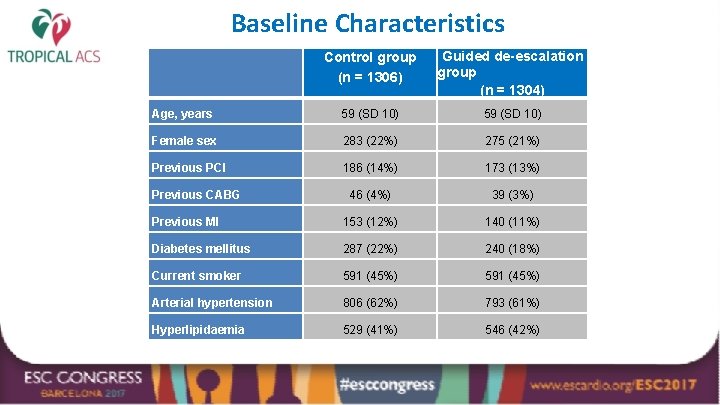
Baseline Characteristics Control group (n = 1306) Guided de-escalation group (n = 1304) Age, years 59 (SD 10) Female sex 283 (22%) 275 (21%) Previous PCI 186 (14%) 173 (13%) 46 (4%) 39 (3%) Previous MI 153 (12%) 140 (11%) Diabetes mellitus 287 (22%) 240 (18%) Current smoker 591 (45%) Arterial hypertension 806 (62%) 793 (61%) Hyperlipidaemia 529 (41%) 546 (42%) Previous CABG
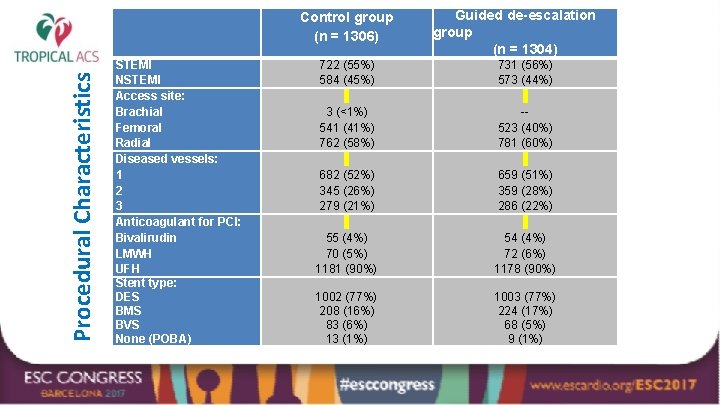
Procedural Characteristics Control group (n = 1306) STEMI NSTEMI Access site: Brachial Femoral Radial Diseased vessels: 1 2 3 Anticoagulant for PCI: Bivalirudin LMWH UFH Stent type: DES BMS BVS None (POBA) Guided de-escalation group (n = 1304) 722 (55%) 584 (45%) 731 (56%) 573 (44%) 3 (<1%) 541 (41%) 762 (58%) -523 (40%) 781 (60%) 682 (52%) 345 (26%) 279 (21%) 659 (51%) 359 (28%) 286 (22%) 55 (4%) 70 (5%) 1181 (90%) 54 (4%) 72 (6%) 1178 (90%) 1002 (77%) 208 (16%) 83 (6%) 13 (1%) 1003 (77%) 224 (17%) 68 (5%) 9 (1%)
Event probability (%) 10 8 Primary Endpoint (CVD, MI, stroke, BARC ≥ 2) 9· 0% 7· 3% 6 HR 0· 81 (0· 62 -1· 06) p=0· 0004 for non-inferiority (p=0· 1202 for superiority) 4 2 0 No. at risk 0 Control 1306 De-escalation 1304 -- Control group -- Guided de-escalation group 60 120 180 240 300 1238 1234 1220 1213 1190 1189 1132 1129 360 (days) 1124 924 942
Key Secondary endpoint Bleeding BARC ≥ 2 All bleeding events (BARC 1 to 5)
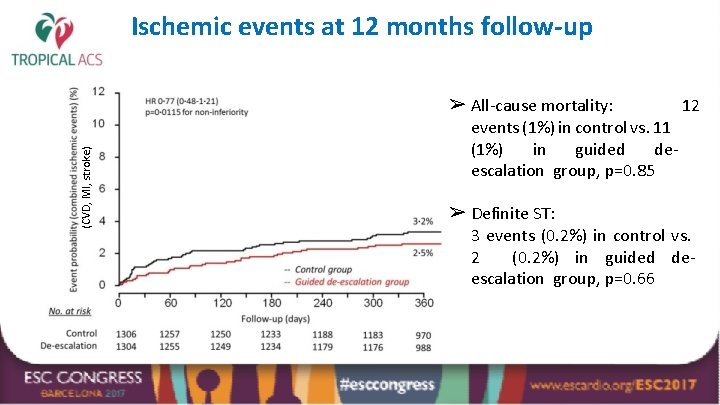
Ischemic events at 12 months follow-up (CVD, MI, stroke) ➢ All-cause mortality: 12 events (1%) in control vs. 11 (1%) in guided deescalation group, p=0. 85 ➢ Definite ST: 3 events (0. 2%) in control vs. 2 (0. 2%) in guided deescalation group, p=0. 66
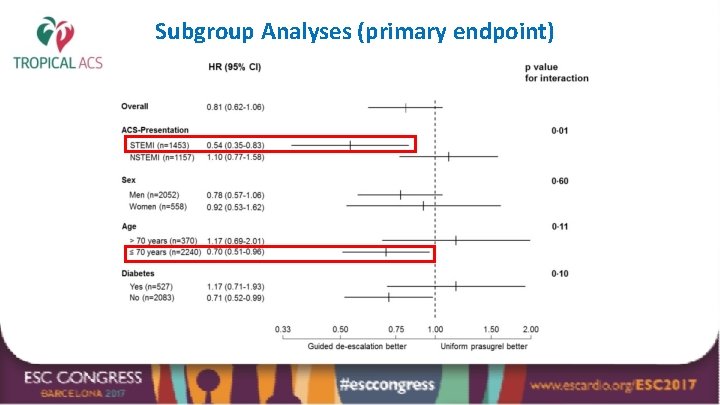
Subgroup Analyses (primary endpoint)
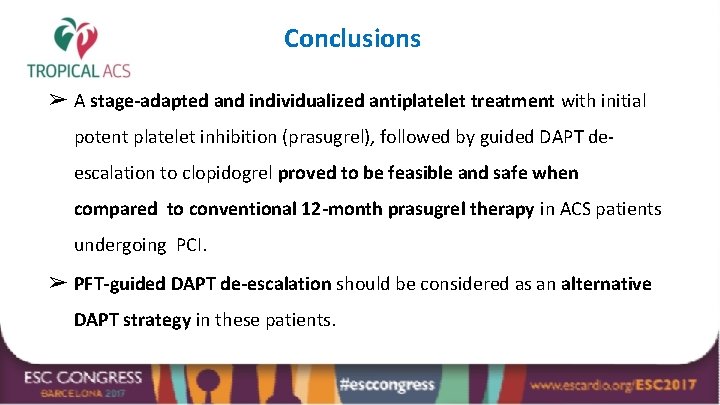
Conclusions ➢ A stage-adapted and individualized antiplatelet treatment with initial potent platelet inhibition (prasugrel), followed by guided DAPT deescalation to clopidogrel proved to be feasible and safe when compared to conventional 12 -month prasugrel therapy in ACS patients undergoing PCI. ➢ PFT-guided DAPT de-escalation should be considered as an alternative DAPT strategy in these patients.
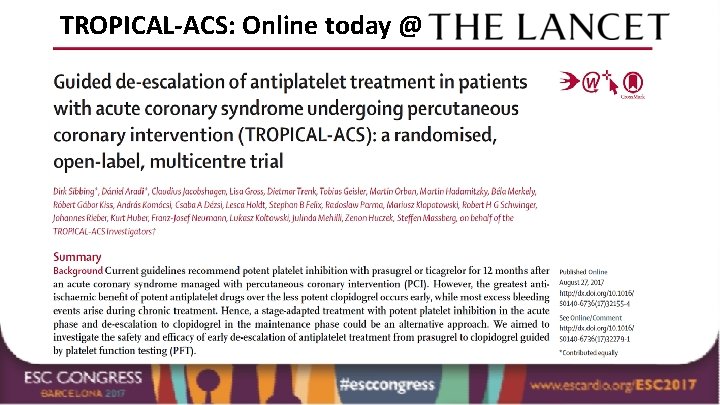
TROPICAL-ACS: Online today @
Thanks for your attention!