
Guide to Using Patient Reported Outcome Measures PROMs
- Slides: 22
Guide to Using Patient Reported Outcome Measures (PROMs) More Inclusively START This research-based guide provides an overview of PROMs. It also aims to help prevent the exclusion of people with low literacy skills and/or learning disabilities from PROM administration.
2 Preamble This guide is the product of a two year research project involving Healthcare Improvement Scotland the Universities of Glasgow and Dundee It is aimed at health professionals who are: 1. Considering implementing PROMs in their practice 2. Reflecting on their current use of PROMs 3. Looking to increase their understanding of PROMs This resource is available online: http: //www. knowledge. scot. nhs. uk/home/learn ing-and-cpd/learning-spaces/his-knowledgetransfer. aspx Back Table of Contents Next Guide to Using PROMs Inclusively
3 Table of Contents 1. 2. 3. 4. 5. Summary Background A problem with PROMs Practical guidance to use PROMs Resources Back Table of Contents Next Guide to Using PROMs Inclusively
4 Summary • Patient reported outcome measures (PROMs) are questionnaires patients complete on their health and quality of life. The information collected from PROMs can help to monitor patient progress, facilitate communication between professionals and patients and/or help to improve the quality of health services. • Patients are meant to be involved in the development of PROMs to ensure they make sense but people with low literacy skills and/or learning disabilities are generally excluded from the process. This exclusion means that people with low literacy skills and/or learning disabilities may not be able to complete PROMs. • To address this issue, we consulted patients and professionals about their views on making PROMs accessible and easy to use. We did this as part of a 2 year project with Healthcare Improvement Scotland the Universities of Glasgow and Dundee. • The results suggested practical adjustments to PROMs including larger font sizes and the opportunity for patients to choose where they would like to complete the measures. • This guide presents these results along with resources for health professionals administering PROMs to support the inclusion of people with low literacy skills and/or learning disabilities in PROMs initiatives. Back Table of Contents Next Guide to Using PROMs Inclusively
5 Background 1. What are PROMs? 2. How are PROMs used? 3. How are PROMs developed? Back Table of Contents Next Guide to Using PROMs Inclusively
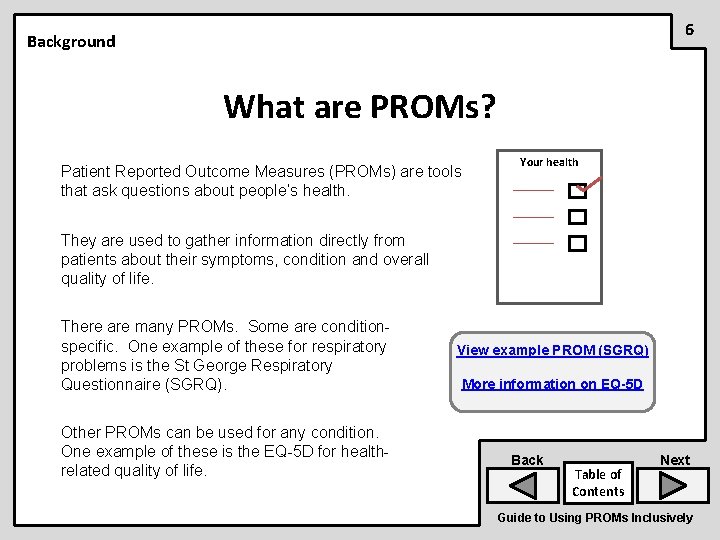
6 Background What are PROMs? Patient Reported Outcome Measures (PROMs) are tools that ask questions about people’s health. Your health They are used to gather information directly from patients about their symptoms, condition and overall quality of life. There are many PROMs. Some are conditionspecific. One example of these for respiratory problems is the St George Respiratory Questionnaire (SGRQ). Other PROMs can be used for any condition. One example of these is the EQ-5 D for healthrelated quality of life. View example PROM (SGRQ) More information on EQ-5 D Back Table of Contents Next Guide to Using PROMs Inclusively
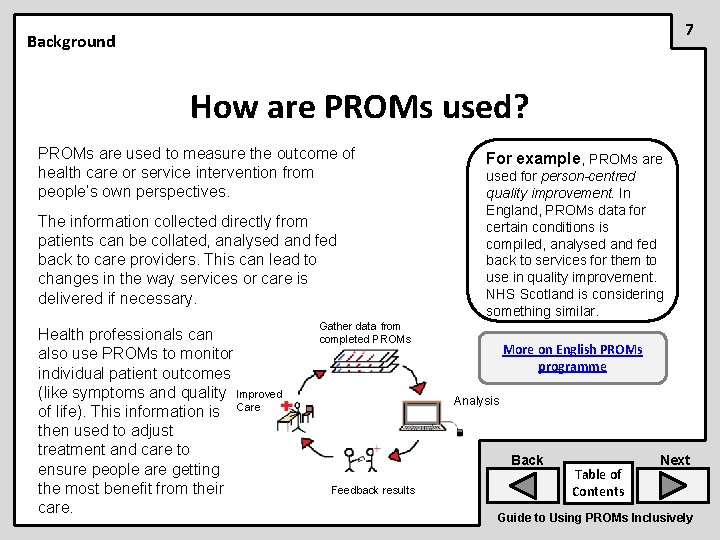
7 Background How are PROMs used? PROMs are used to measure the outcome of health care or service intervention from people’s own perspectives. The information collected directly from patients can be collated, analysed and fed back to care providers. This can lead to changes in the way services or care is delivered if necessary. Health professionals can also use PROMs to monitor individual patient outcomes (like symptoms and quality Improved of life). This information is Care then used to adjust treatment and care to ensure people are getting the most benefit from their care. For example, PROMs are used for person-centred quality improvement. In England, PROMs data for certain conditions is compiled, analysed and fed back to services for them to use in quality improvement. NHS Scotland is considering something similar. Gather data from completed PROMs More on English PROMs programme Analysis Back Feedback results Table of Contents Next Guide to Using PROMs Inclusively
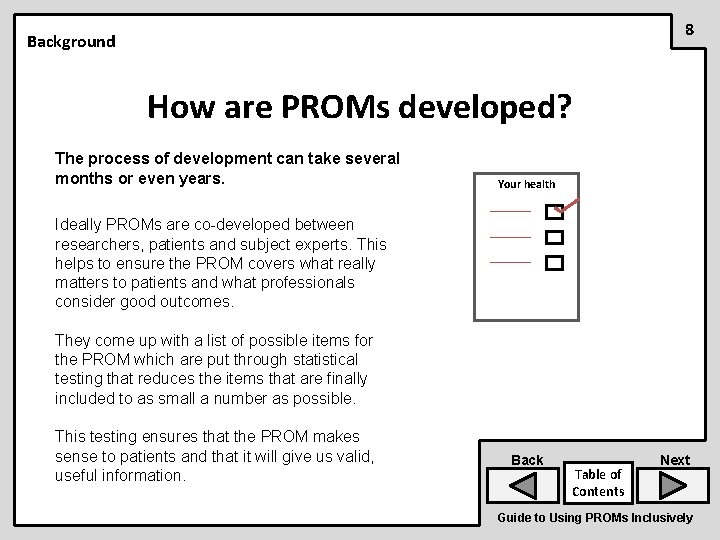
8 Background How are PROMs developed? The process of development can take several months or even years. Your health Ideally PROMs are co-developed between researchers, patients and subject experts. This helps to ensure the PROM covers what really matters to patients and what professionals consider good outcomes. They come up with a list of possible items for the PROM which are put through statistical testing that reduces the items that are finally included to as small a number as possible. This testing ensures that the PROM makes sense to patients and that it will give us valid, useful information. Back Table of Contents Next Guide to Using PROMs Inclusively
9 A problem with PROMs 1. Who might be not be able to use PROMs? 2. Why is this exclusion an important problem? 3. What is being done to overcome this problem? Back Table of Contents Next Guide to Using PROMs Inclusively
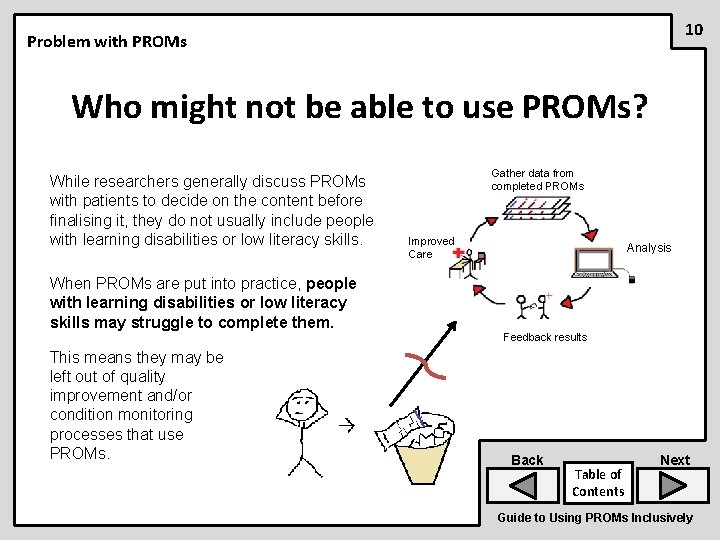
10 Problem with PROMs Who might not be able to use PROMs? While researchers generally discuss PROMs with patients to decide on the content before finalising it, they do not usually include people with learning disabilities or low literacy skills. When PROMs are put into practice, people with learning disabilities or low literacy skills may struggle to complete them. This means they may be left out of quality improvement and/or condition monitoring processes that use PROMs. Gather data from completed PROMs Improved Care Analysis Feedback results Back Table of Contents Next Guide to Using PROMs Inclusively
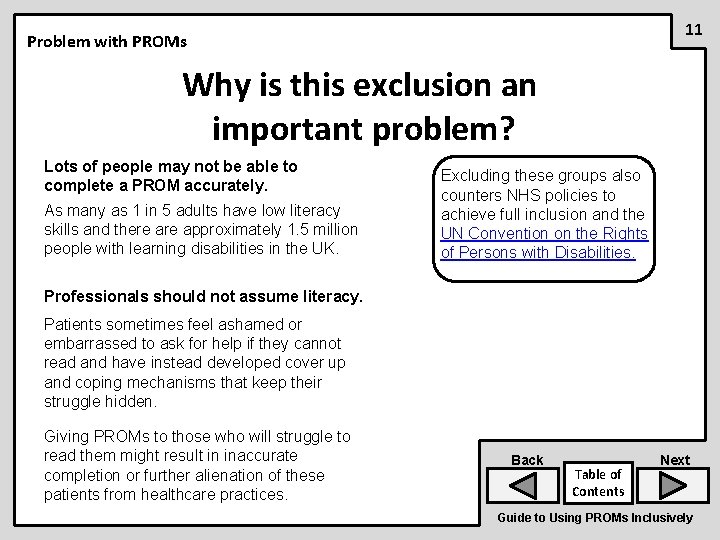
11 Problem with PROMs Why is this exclusion an important problem? Lots of people may not be able to complete a PROM accurately. As many as 1 in 5 adults have low literacy skills and there approximately 1. 5 million people with learning disabilities in the UK. Excluding these groups also counters NHS policies to achieve full inclusion and the UN Convention on the Rights of Persons with Disabilities. Professionals should not assume literacy. Patients sometimes feel ashamed or embarrassed to ask for help if they cannot read and have instead developed cover up and coping mechanisms that keep their struggle hidden. Giving PROMs to those who will struggle to read them might result in inaccurate completion or further alienation of these patients from healthcare practices. Back Table of Contents Next Guide to Using PROMs Inclusively
12 Problem with PROMs What is being done to overcome this problem? Professionals can consult this guide to improve inclusivity in their PROMs practice. This can help to collectively address exclusion and maximise PROMs’ potential. Over a two year research project between the University of Glasgow, University of Dundee and Healthcare Improvement Scotland, we spoke to people with low literacy skills, learning disabilities, other patients and health professionals. We gathered their views on how to make PROMs more accessible and easy to use. The team also looked at other case studies where organisations have made health information accessible. This guide is the product of university and NHS research. It is geared towards those already using or planning on using PROMs in NHSScotland. Back Table of Contents Next Guide to Using PROMs Inclusively
13 Practical Guidance to Use PROMs 1. Challenges & Suggestions a. Identifying people with low literacy b. Understanding PROMs c. Reading PROMs d. Format of PROMs 2. Other Considerations a. Help to complete PROMs b. Modifying PROMs(1) c. Modifying PROMs(2) Back Table of Contents Next Guide to Using PROMs Inclusively
14 Practical Guidance Challenges & Suggestions Identifying people with low literacy Challenges People with low literacy often feel embarrassed which can make it difficult for them to admit problems with reading. This can also make it hard for clinicians to ask patients if they can read. Suggestions Without asking a patient it is hard to know whether someone can read, but look for signs of low literacy: -Patients may have excuses when asked to read or complete a form. They might ask to take written material home or say they have forgotten their glasses. -Patients’ condition may not improve, for example, if selfmanagement or prescription instructions were provided in writing -Forms are completed incorrectly, do not make sense compared to what the practitioner observes, or the patient hands written material to someone else to read for them Offer help if you are not sure whether someone wants it. For example, ask, “would you like to read this together” and go over it together. See Resources for more suggestions Back Table of Contents Next Guide to Using PROMs Inclusively
15 Practical Guidance Challenges & Suggestions Understanding PROMs Challenges Certain question types and phrasing in PROMs are particularly difficult: -questions requiring long memory -questions with too many response options -questions that try to address many things at once -scales with a large number of options, like the visual analogue scale on the EQ 5 D which has a 1 -100 scale Suggestions Select questionnaires without too many of the above question types, and with consistent questions and response options. It can be difficult to find the ‘perfect’ PROM and if you cannot find a PROM that addresses these challenges and meets your needs, consider the suggestions offered under ‘Reading’. A good example of a PROM with consistency in questions and response types is the Chronic Respiratory Questionnaire. The SGRQ has questions addressing lots of activities at once and requiring long memory, which could make the PROM hard to understand. More information on selecting PROMs Back Table of Contents Next Guide to Using PROMs Inclusively
16 Practical Guidance Challenges & Suggestions Reading PROMs Challenges People may not be able to read a PROM, particularly if it is handed to them unexpectedly. It is not easy to judge who will have struggle because reading issues are often hidden. PROMs with more detail and harder words are also intimidating. It may be difficult to complete such PROMs accurately. Asking a few patients for their thoughts on a PROM before using it with all patients can also help make sure it is not particularly difficult. Suggestions After explaining the purpose of a PROM, offer the patient a choice of whether to complete it with the health professional or take it away. This choice allows s/he to decide whether they want the professional’s help, a family member/care taker’s help at home, or to complete it alone. Read through PROMs to gauge their complexity and level of detail before you decide on one to use with all patients. Back Table of Contents Next Guide to Using PROMs Inclusively
17 Practical Guidance Challenges & Suggestions Format of PROMs Challenges The ‘look’ of a PROM can make it seem intimidating and hard to use. Key points from Mencap’s accessible information guidelines applicable to PROMs include: Complicated formatting includes text that is inconsistently aligned , unclear fonts, small font sizes, a lack of white space, and non prominent headings. -text is straight across a page rather than in columns Suggestions -Arial is a clear font Selecting a PROM that most closely adheres to these guidelines or working with someone with experience in accessible information to adjust the PROM can help to prevent difficulties associated with formatting. Resources to help to gauge or design clear information is under Resources. -pictures, if any, should be on the left, words on the right -font size should be at least 16 pt -important words (like headings) should be bold Back Table of Contents Next Guide to Using PROMs Inclusively
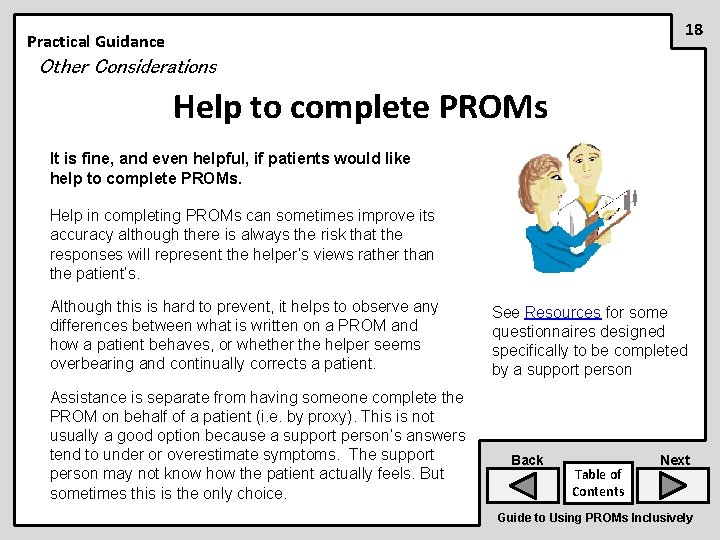
18 Practical Guidance Other Considerations Help to complete PROMs It is fine, and even helpful, if patients would like help to complete PROMs. Help in completing PROMs can sometimes improve its accuracy although there is always the risk that the responses will represent the helper’s views rather than the patient’s. Although this is hard to prevent, it helps to observe any differences between what is written on a PROM and how a patient behaves, or whether the helper seems overbearing and continually corrects a patient. Assistance is separate from having someone complete the PROM on behalf of a patient (i. e. by proxy). This is not usually a good option because a support person’s answers tend to under or overestimate symptoms. The support person may not know how the patient actually feels. But sometimes this is the only choice. See Resources for some questionnaires designed specifically to be completed by a support person Back Table of Contents Next Guide to Using PROMs Inclusively
19 Practical Guidance Other Considerations Modifying PROMs (1) Modifying a substantial part of the PROM itself like wording, content or adding pictures, or only using some of the questions, can affect its meaning. It is not recommended. This is because PROMs are developed rigorously so that every item has been tested as it stands. We cannot give specific examples regarding what changes are ‘allowed’ because, strictly speaking, changes require more research to ensure the tool is still valid. See Modifications (2) for practical suggestions. Back Table of Contents Next Guide to Using PROMs Inclusively
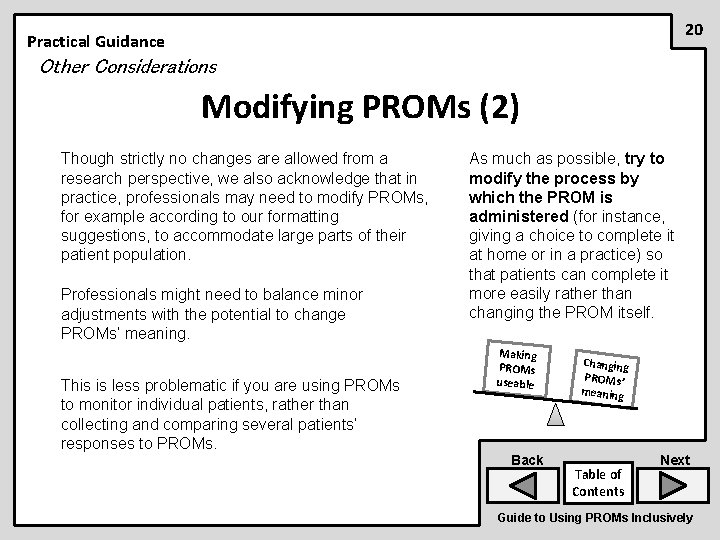
20 Practical Guidance Other Considerations Modifying PROMs (2) Though strictly no changes are allowed from a research perspective, we also acknowledge that in practice, professionals may need to modify PROMs, for example according to our formatting suggestions, to accommodate large parts of their patient population. Professionals might need to balance minor adjustments with the potential to change PROMs’ meaning. This is less problematic if you are using PROMs to monitor individual patients, rather than collecting and comparing several patients’ responses to PROMs. As much as possible, try to modify the process by which the PROM is administered (for instance, giving a choice to complete it at home or in a practice) so that patients can complete it more easily rather than changing the PROM itself. Making PROMs useable Back Changing PROMs’ meaning Table of Contents Next Guide to Using PROMs Inclusively
21 Resources (1) 1. More information on PROMs Guide to using PROMs in your clinical practice: http: //www. isoqol. org/User. Files/file/Users. Guide. pdf Overview of PROMs’ potential by the King’s Fund: www. kingsfund. org. uk/document. rm? id=8607 NHS England programme: http: //www. ic. nhs. uk/proms Instrument Selection: http: //phi. uhce. ox. ac. uk/instruments. php 2. Help to judge the accessibility of PROMs Mencap Guidelines: http: //www. mencap. org. uk/ Communication for Health: http: //www. nhsfife. scot. nhs. uk/easyread/ 3. Questionnaires that can be completed by a support person EQ 5 D-3 L : http: //www. euroqol. org/eq-5 d-products/eq-5 d-3 l/proxy-paper. html 4. Example of an accessible questionnaire Adults with Learning Difficulties Questionnaire : www. solihull. gov. uk/akssolihull/images/att 4030. doc Back Table of Contents Next Guide to Using PROMs Inclusively
22 Resources (2) 5. Identifying and approaching people with suspected low literacy Literacy Trust: http: //www. literacytrust. org. uk/adult_literacy 6. Tools for producing for clear information Scottish Accessible Information Forum: http: //www. saifscotland. org. uk/ Communication toolkit, and templates for creating accessible standard forms: http: //www. communicationforumscotland. org. uk/2010/TK_Resources_Examples. php 7. Easy Read leaflet explaining PROMs (and online version of this resource) The Knowledge Network: http: //www. knowledge. scot. nhs. uk/home/learning-and-cpd/learning -spaces/his-knowledge-transfer. aspx 8. Contact about this user guide Sally Wyke: sally. wyke@glasgow. ac. uk Thilo Kroll: t. kroll@dundee. ac. uk Karen Ritchie: karenritchie@nhs. net Back Table of Contents Next Guide to Using PROMs Inclusively