
Guide to the Planets A Brief Overview Mercury
Guide to the Planets A Brief Overview
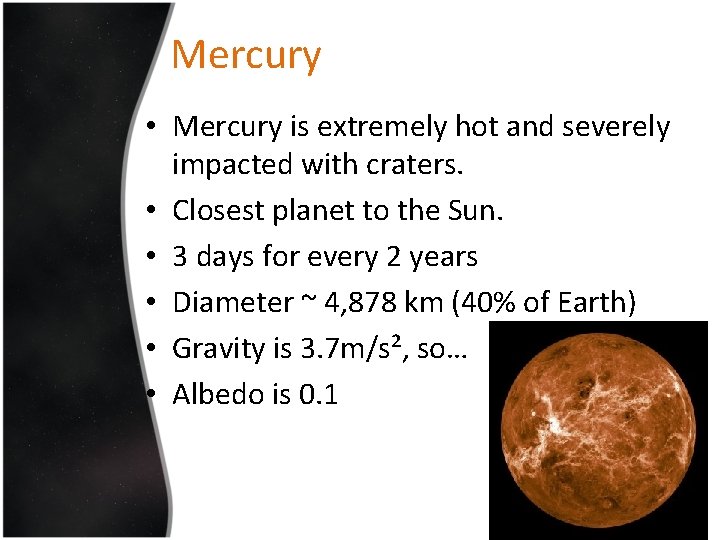
Mercury • Mercury is extremely hot and severely impacted with craters. • Closest planet to the Sun. • 3 days for every 2 years • Diameter ~ 4, 878 km (40% of Earth) • Gravity is 3. 7 m/s², so… • Albedo is 0. 1
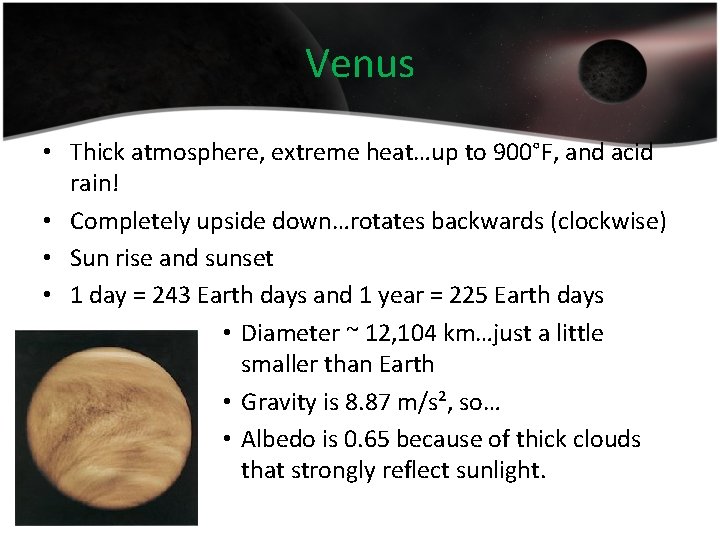
Venus • Thick atmosphere, extreme heat…up to 900°F, and acid rain! • Completely upside down…rotates backwards (clockwise) • Sun rise and sunset • 1 day = 243 Earth days and 1 year = 225 Earth days • Diameter ~ 12, 104 km…just a little smaller than Earth • Gravity is 8. 87 m/s², so… • Albedo is 0. 65 because of thick clouds that strongly reflect sunlight.
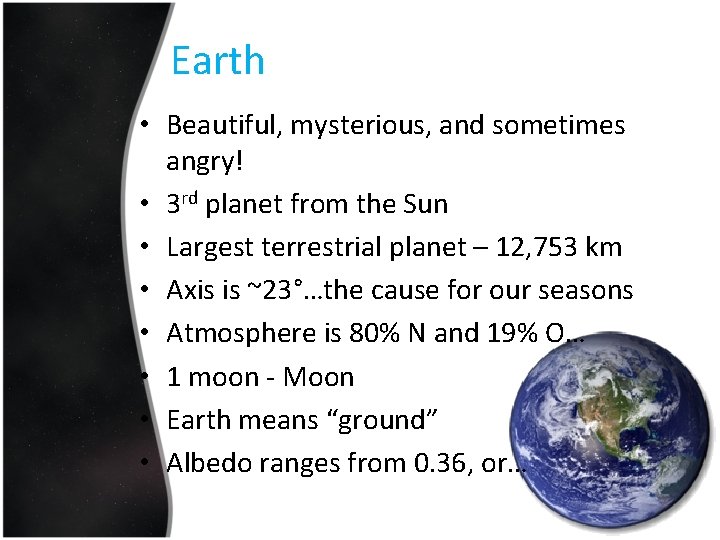
Earth • Beautiful, mysterious, and sometimes angry! • 3 rd planet from the Sun • Largest terrestrial planet – 12, 753 km • Axis is ~23°…the cause for our seasons • Atmosphere is 80% N and 19% O… • 1 moon - Moon • Earth means “ground” • Albedo ranges from 0. 36, or…
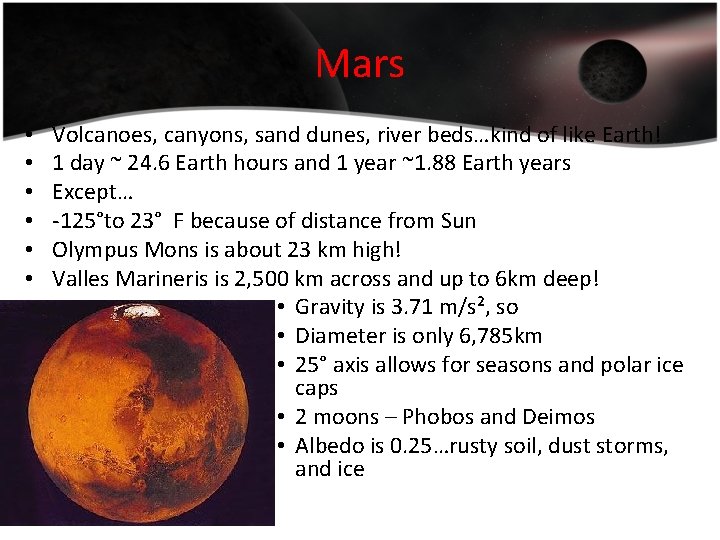
Mars • • • Volcanoes, canyons, sand dunes, river beds…kind of like Earth! 1 day ~ 24. 6 Earth hours and 1 year ~1. 88 Earth years Except… -125°to 23° F because of distance from Sun Olympus Mons is about 23 km high! Valles Marineris is 2, 500 km across and up to 6 km deep! • Gravity is 3. 71 m/s², so • Diameter is only 6, 785 km • 25° axis allows for seasons and polar ice caps • 2 moons – Phobos and Deimos • Albedo is 0. 25…rusty soil, dust storms, and ice
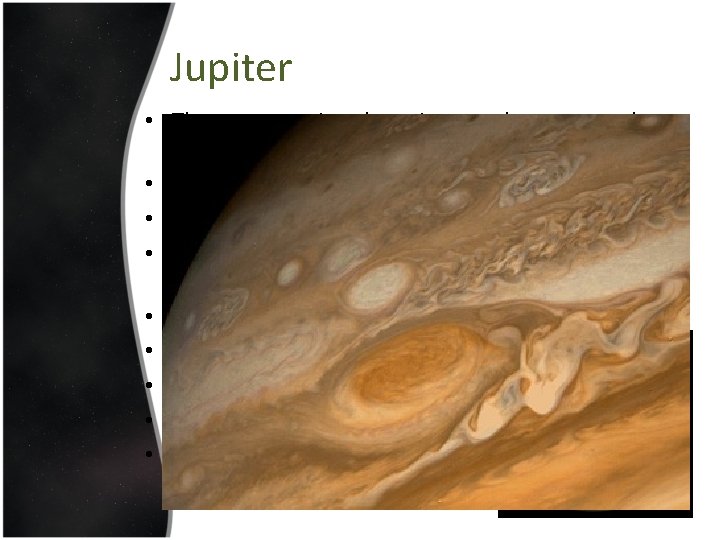
Jupiter • The most massive planet in our solar system…almost a solar system itself! • Great Red Spot is ~ 40, 000 km • 1 day = 9. 8 Earth hours and 1 year = 12 Earth years • Temperature range is -230° F to 70° F to -150° F to 43, 000°F • Axis is 36° - almost straight up and down • Gravity 24. 79 m/s² • Diameter is 142, 800 km • At least 63 moons and 3 rings • Albedo is 0. 52 because of clouds and other gases
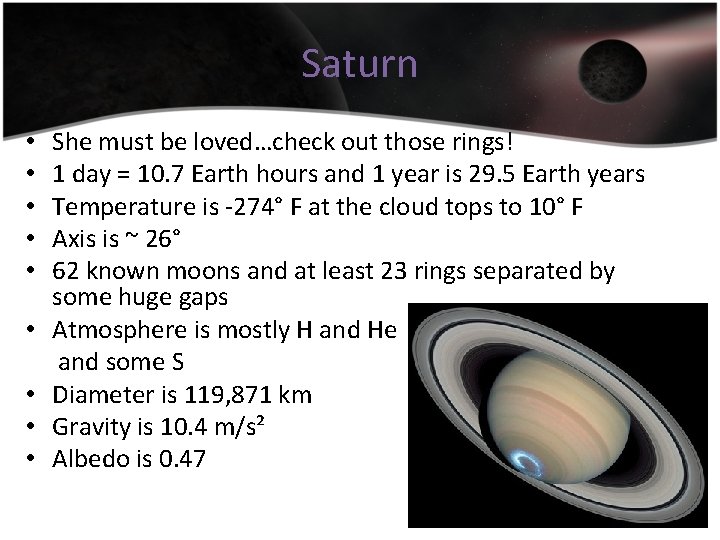
Saturn • • • She must be loved…check out those rings! 1 day = 10. 7 Earth hours and 1 year is 29. 5 Earth years Temperature is -274° F at the cloud tops to 10° F Axis is ~ 26° 62 known moons and at least 23 rings separated by some huge gaps Atmosphere is mostly H and He and some S Diameter is 119, 871 km Gravity is 10. 4 m/s² Albedo is 0. 47

Uranus • It’s gonna be along day… and night! • 1 day = 17. 24 (retrograde) Earth hours and 1 year = 84 Earth years • Diameter is 51, 488 km • Axis is either 98° or 82° • Gravity = 8. 87 m/s² • 27 moons and 13 rings • H and He, but methane rich atmosphere makes it appear blue-green • Albedo is 0. 51
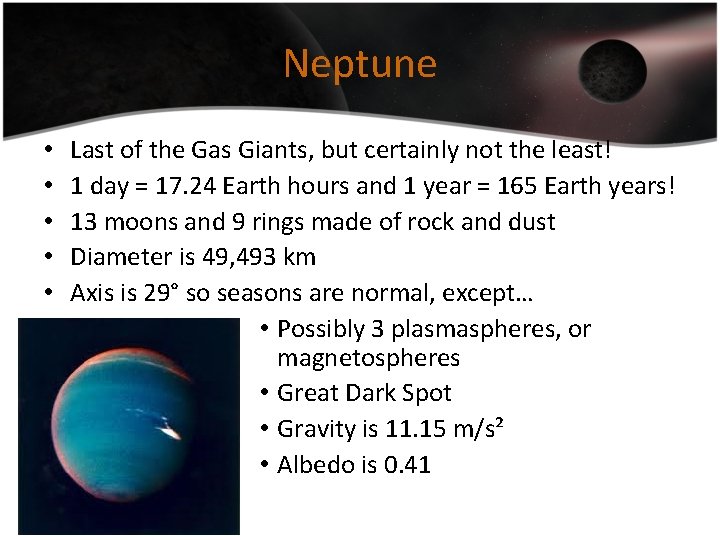
Neptune • • • Last of the Gas Giants, but certainly not the least! 1 day = 17. 24 Earth hours and 1 year = 165 Earth years! 13 moons and 9 rings made of rock and dust Diameter is 49, 493 km Axis is 29° so seasons are normal, except… • Possibly 3 plasmaspheres, or magnetospheres • Great Dark Spot • Gravity is 11. 15 m/s² • Albedo is 0. 41
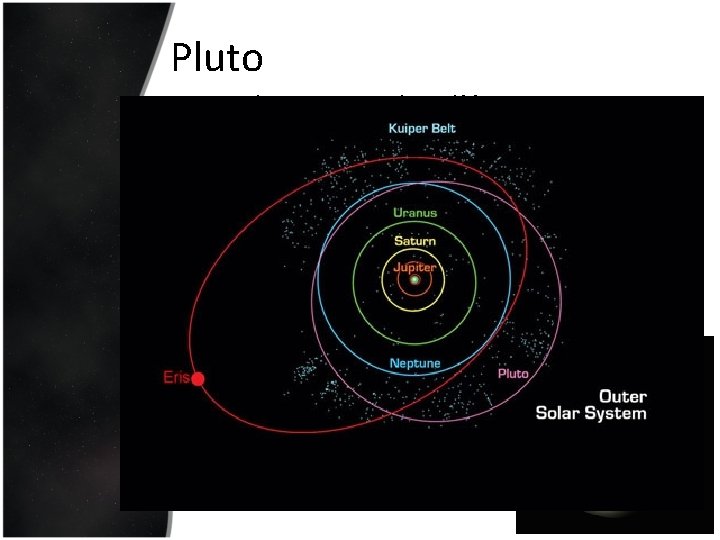
Pluto • Once a planet, now a plutoid? ? • Plutoid - dwarf planets that orbit the Sun beyond Neptune • Located in Kuiper Belt about 4 – 7 billion km from the Sun… • 1 day = 6. 4 Earth days (retrograde) and 1 year = 248 Earth years!! • Rocky core, icy mantle, and CH 4/N atmosphere freeze and thaw throughout the year • 5 known moons… • Diameter is 2, 390 km • Axis is 123° • Gravity is 0. 66 m/s², so… • Albedo ranges from 0. 49 – 0. 66
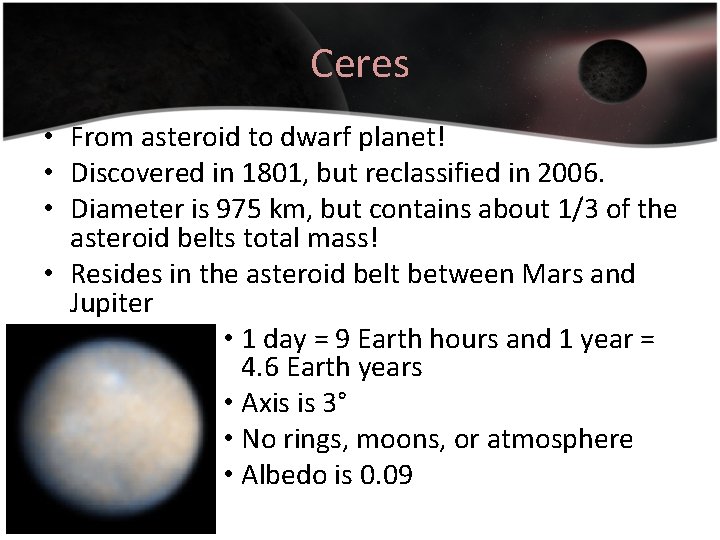
Ceres • From asteroid to dwarf planet! • Discovered in 1801, but reclassified in 2006. • Diameter is 975 km, but contains about 1/3 of the asteroid belts total mass! • Resides in the asteroid belt between Mars and Jupiter • 1 day = 9 Earth hours and 1 year = 4. 6 Earth years • Axis is 3° • No rings, moons, or atmosphere • Albedo is 0. 09
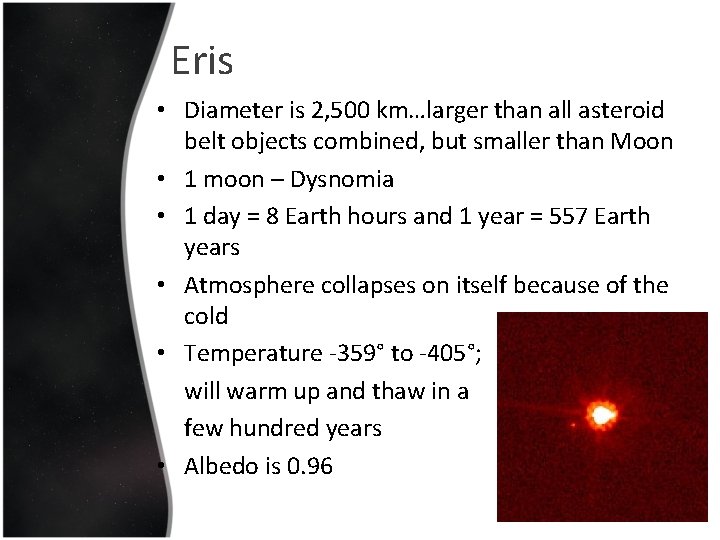
Eris • Diameter is 2, 500 km…larger than all asteroid belt objects combined, but smaller than Moon • 1 moon – Dysnomia • 1 day = 8 Earth hours and 1 year = 557 Earth years • Atmosphere collapses on itself because of the cold • Temperature -359° to -405°; will warm up and thaw in a few hundred years • Albedo is 0. 96
Any other planets? ? ? • Possibly hundreds of other dwarfs! • Planethunters. org • Other interesting discoveries… • Possible rings around Pluto – Nix and Hydra dust might get stuck in Pluto’s orbit because of low gravity • Saturn’s rings disappear every 14 -15 years! http: //www. sciencedaily. com/videos/2008/0708 -are_saturns_rings_disappearing. htm • Jupiter’s Little Red Spot is growing stronger. • Sinkholes in Guatemala, Alaska, all over the world!
- Slides: 13