
Guide to Programming with Python Chapter Eight Part
- Slides: 18
Guide to Programming with Python Chapter Eight (Part II) Object encapsulation, privacy, properties; Critter Caretaker game
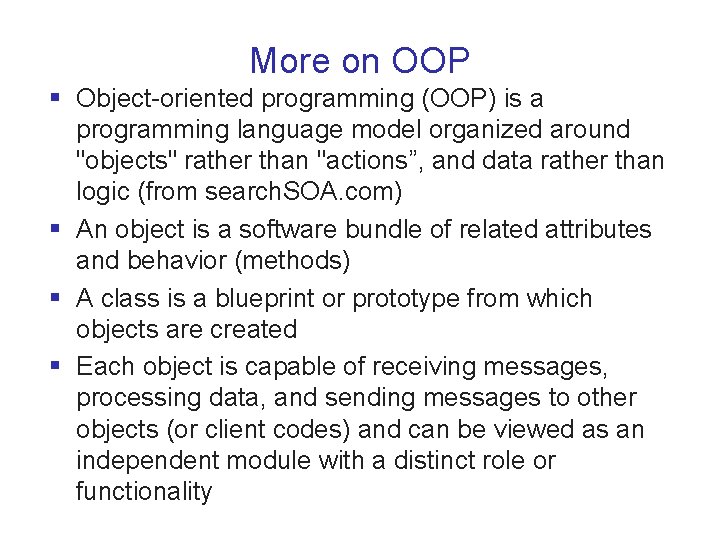
More on OOP § Object-oriented programming (OOP) is a programming language model organized around "objects" rather than "actions”, and data rather than logic (from search. SOA. com) § An object is a software bundle of related attributes and behavior (methods) § A class is a blueprint or prototype from which objects are created § Each object is capable of receiving messages, processing data, and sending messages to other objects (or client codes) and can be viewed as an independent module with a distinct role or functionality
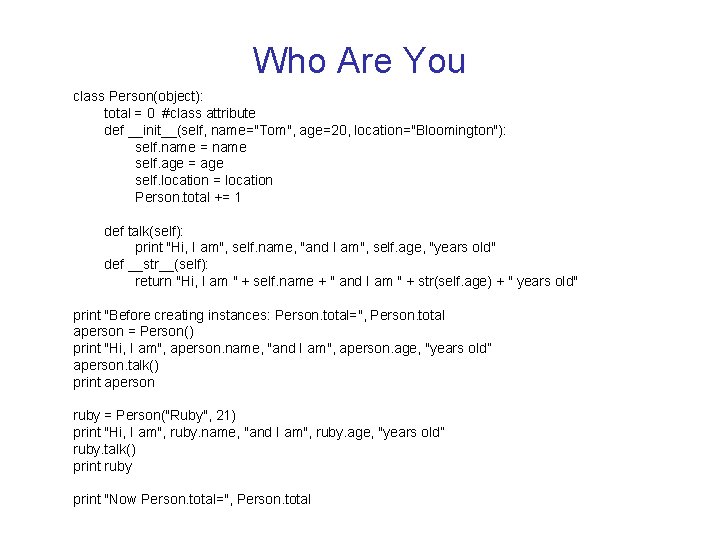
Who Are You class Person(object): total = 0 #class attribute def __init__(self, name="Tom", age=20, location="Bloomington"): self. name = name self. age = age self. location = location Person. total += 1 def talk(self): print "Hi, I am", self. name, "and I am", self. age, "years old" def __str__(self): return "Hi, I am " + self. name + " and I am " + str(self. age) + " years old" print "Before creating instances: Person. total=", Person. total aperson = Person() print "Hi, I am", aperson. name, "and I am", aperson. age, "years old” aperson. talk() print aperson ruby = Person("Ruby", 21) print "Hi, I am", ruby. name, "and I am", ruby. age, "years old” ruby. talk() print ruby print "Now Person. total=", Person. total
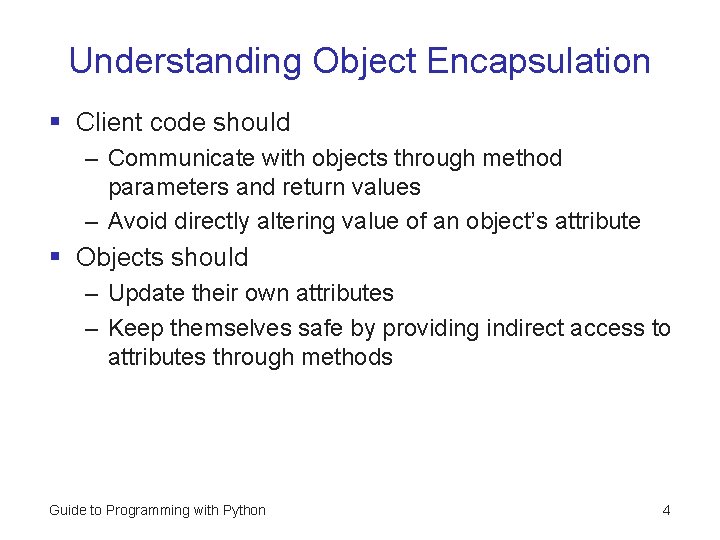
Understanding Object Encapsulation § Client code should – Communicate with objects through method parameters and return values – Avoid directly altering value of an object’s attribute § Objects should – Update their own attributes – Keep themselves safe by providing indirect access to attributes through methods Guide to Programming with Python 4
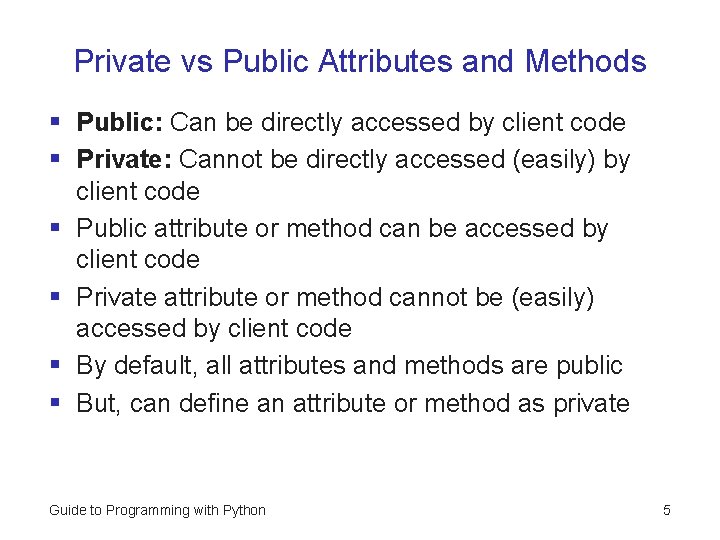
Private vs Public Attributes and Methods § Public: Can be directly accessed by client code § Private: Cannot be directly accessed (easily) by client code § Public attribute or method can be accessed by client code § Private attribute or method cannot be (easily) accessed by client code § By default, all attributes and methods are public § But, can define an attribute or method as private Guide to Programming with Python 5
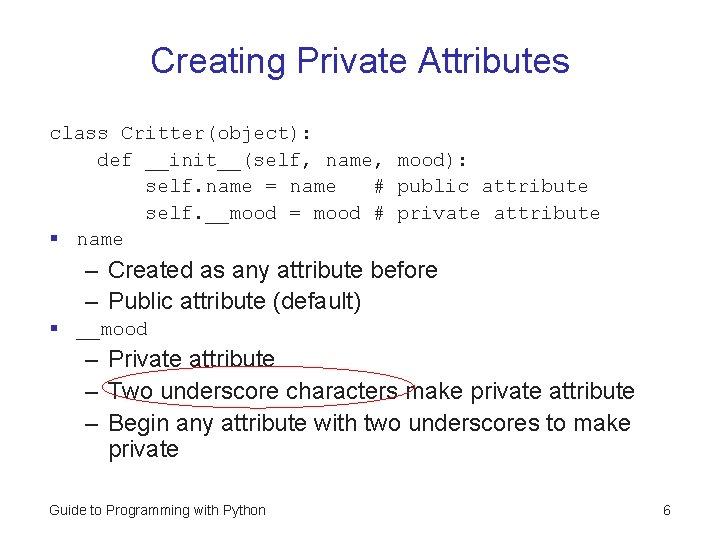
Creating Private Attributes class Critter(object): def __init__(self, name, mood): self. name = name # public attribute self. __mood = mood # private attribute § name – Created as any attribute before – Public attribute (default) § __mood – Private attribute – Two underscore characters make private attribute – Begin any attribute with two underscores to make private Guide to Programming with Python 6
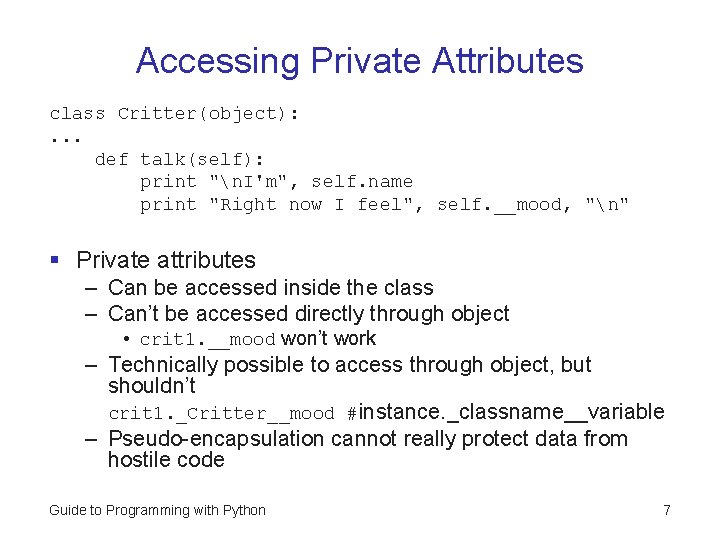
Accessing Private Attributes class Critter(object): . . . def talk(self): print "n. I'm", self. name print "Right now I feel", self. __mood, "n" § Private attributes – Can be accessed inside the class – Can’t be accessed directly through object • crit 1. __mood won’t work – Technically possible to access through object, but shouldn’t crit 1. _Critter__mood #instance. _classname__variable – Pseudo-encapsulation cannot really protect data from hostile code Guide to Programming with Python 7
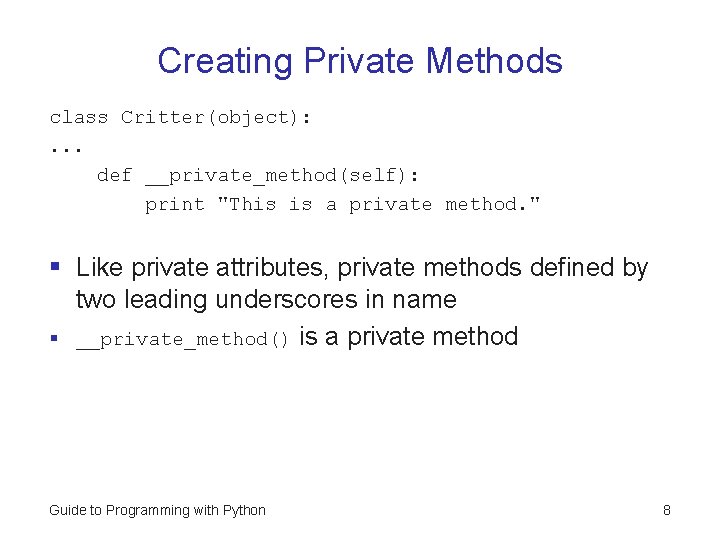
Creating Private Methods class Critter(object): . . . def __private_method(self): print "This is a private method. " § Like private attributes, private methods defined by two leading underscores in name § __private_method() is a private method Guide to Programming with Python 8
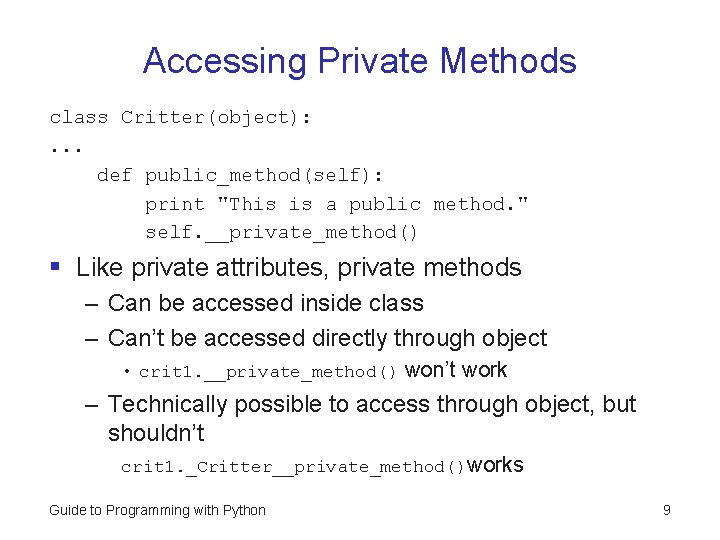
Accessing Private Methods class Critter(object): . . . def public_method(self): print "This is a public method. " self. __private_method() § Like private attributes, private methods – Can be accessed inside class – Can’t be accessed directly through object • crit 1. __private_method() won’t work – Technically possible to access through object, but shouldn’t crit 1. _Critter__private_method()works Guide to Programming with Python 9
Controlling Attribute Access § Instead of denying access to an attribute, can limit access to it § Example: client code can read, but not change attribute § Properties can manage how attribute is accessed or changed Guide to Programming with Python 10
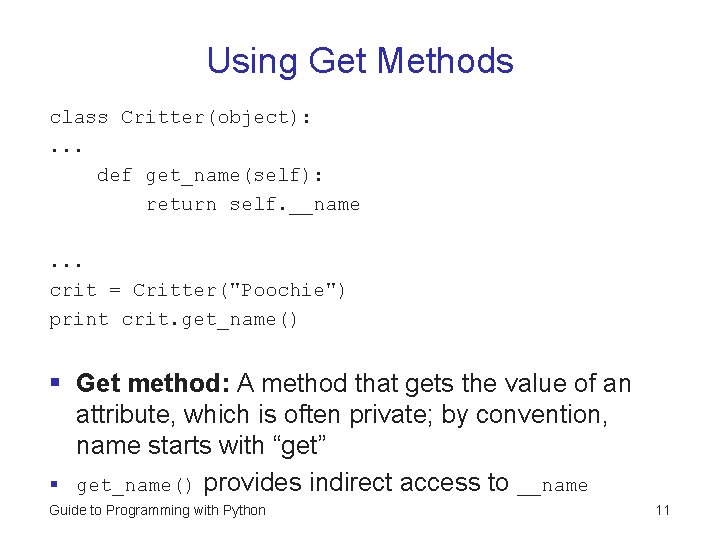
Using Get Methods class Critter(object): . . . def get_name(self): return self. __name. . . crit = Critter("Poochie") print crit. get_name() § Get method: A method that gets the value of an attribute, which is often private; by convention, name starts with “get” § get_name() provides indirect access to __name Guide to Programming with Python 11
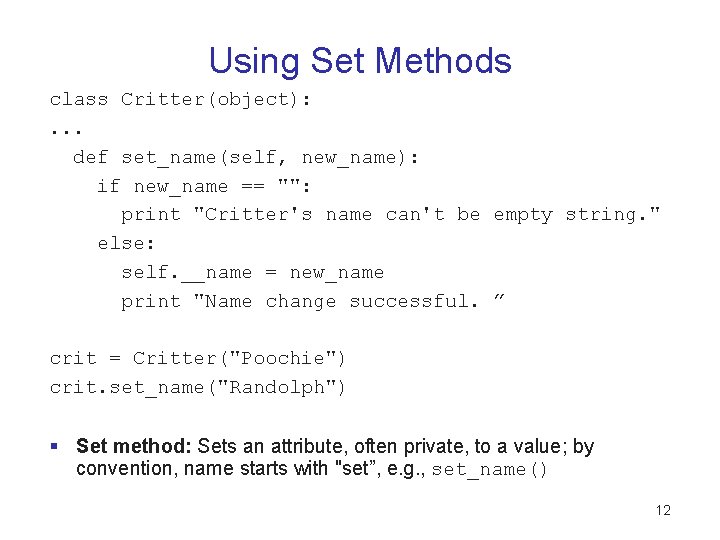
Using Set Methods class Critter(object): . . . def set_name(self, new_name): if new_name == "": print "Critter's name can't be empty string. " else: self. __name = new_name print "Name change successful. ” crit = Critter("Poochie") crit. set_name("Randolph") § Set method: Sets an attribute, often private, to a value; by convention, name starts with "set”, e. g. , set_name() 12
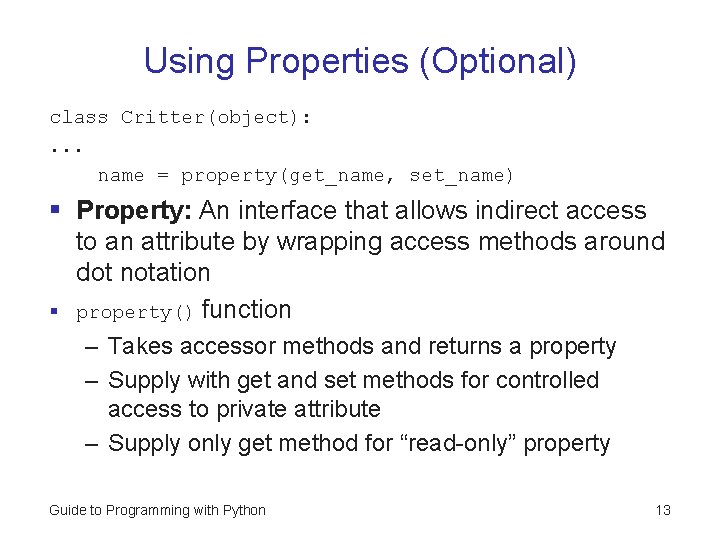
Using Properties (Optional) class Critter(object): . . . name = property(get_name, set_name) § Property: An interface that allows indirect access to an attribute by wrapping access methods around dot notation § property() function – Takes accessor methods and returns a property – Supply with get and set methods for controlled access to private attribute – Supply only get method for “read-only” property Guide to Programming with Python 13
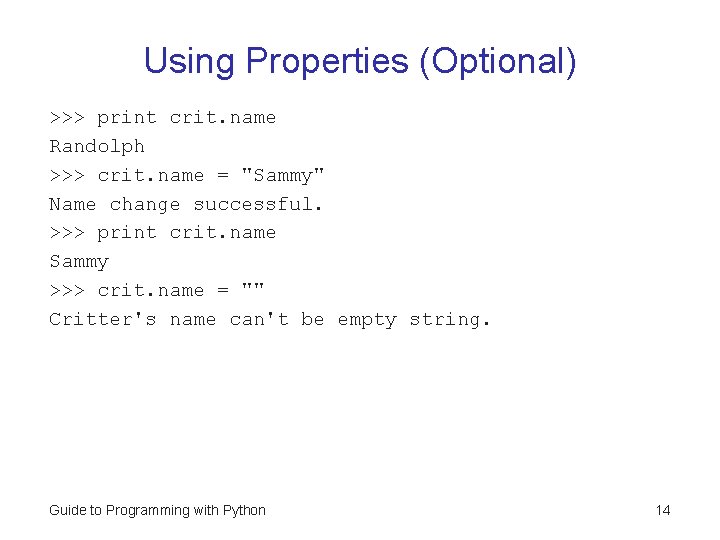
Using Properties (Optional) >>> print crit. name Randolph >>> crit. name = "Sammy" Name change successful. >>> print crit. name Sammy >>> crit. name = "" Critter's name can't be empty string. Guide to Programming with Python 14
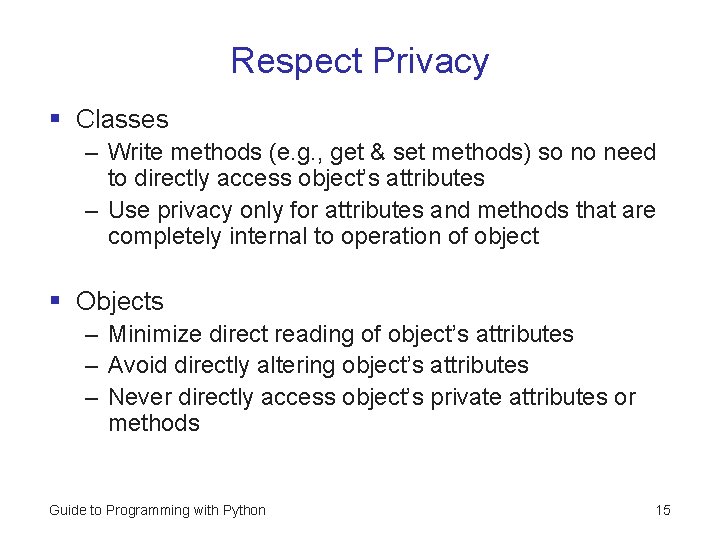
Respect Privacy § Classes – Write methods (e. g. , get & set methods) so no need to directly access object’s attributes – Use privacy only for attributes and methods that are completely internal to operation of object § Objects – Minimize direct reading of object’s attributes – Avoid directly altering object’s attributes – Never directly access object’s private attributes or methods Guide to Programming with Python 15
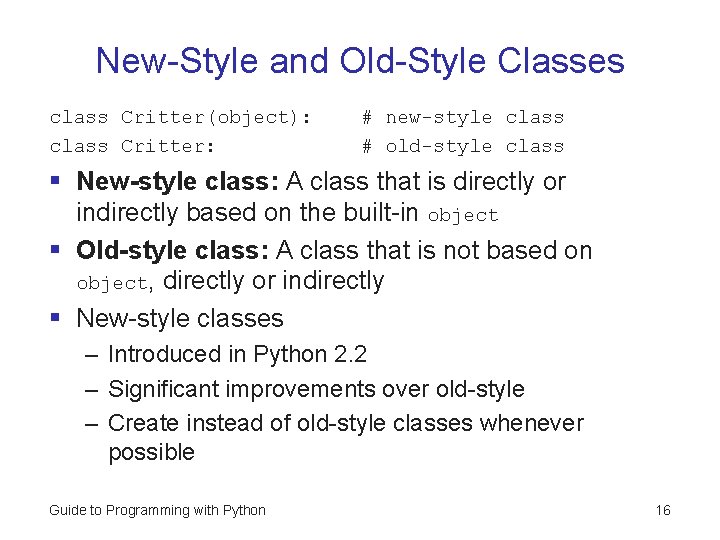
New-Style and Old-Style Classes class Critter(object): class Critter: # new-style class # old-style class § New-style class: A class that is directly or indirectly based on the built-in object § Old-style class: A class that is not based on object, directly or indirectly § New-style classes – Introduced in Python 2. 2 – Significant improvements over old-style – Create instead of old-style classes whenever possible Guide to Programming with Python 16
Examples § The Critter Caretaker Program § Super Dictionary Program
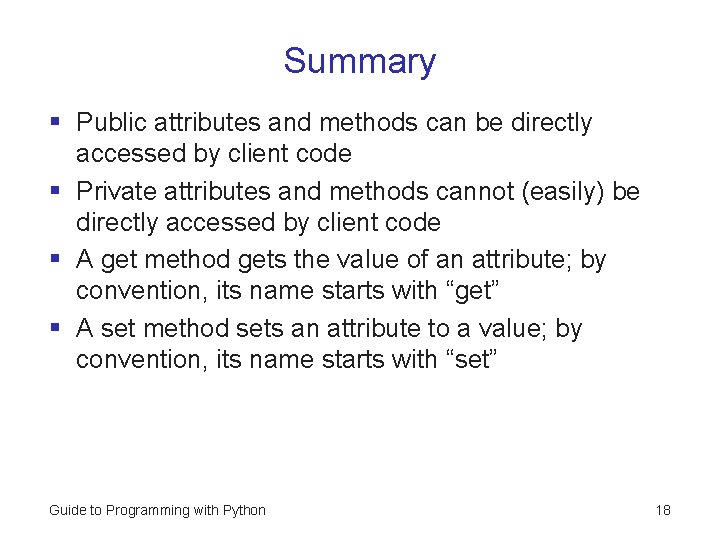
Summary § Public attributes and methods can be directly accessed by client code § Private attributes and methods cannot (easily) be directly accessed by client code § A get method gets the value of an attribute; by convention, its name starts with “get” § A set method sets an attribute to a value; by convention, its name starts with “set” Guide to Programming with Python 18