
Guide to Networking Essentials 8 th Edition Greg

- Slides: 50
Guide to Networking Essentials 8 th Edition Greg Tomsho, Guide to Networking Essentials, 8 th Edition. © 2020 Cengage. All Rights Reserved. May not be scanned, copied or duplicated, or posted to a publicly accessible website, in whole or in part.
Chapter 13 The Internet of Things (Io. T) Greg Tomsho, Guide to Networking Essentials, 8 th Edition. © 2020 Cengage. All Rights Reserved. May not be scanned, copied or duplicated, or posted to a publicly accessible website, in whole or in part.
Objectives • Define the Internet of Things and list use cases • Describe Io. T network technologies • Discuss a variety of Io. T devices • Work with DIY Io. T devices Greg Tomsho, Guide to Networking Essentials, 8 th Edition. © 2020 Cengage. All Rights Reserved. May not be scanned, copied or duplicated, or posted to a publicly accessible website, in whole or in part.
Introduction to the Internet of Things • The Internet of Things (Io. T) is the digitization of our everyday world through the use of networked microprocessors and microcontrollers along with sensors, actuators, motors, and other I/O devices, plus the software that makes it all work together • Examples of Io. T: • Amazon Echo or Google Assistant • Roomba • Smoke detectors • Motion sensors • Intelligent thermostats • Water pumps Greg Tomsho, Guide to Networking Essentials, 8 th Edition. © 2020 Cengage. All Rights Reserved. May not be scanned, copied or duplicated, or posted to a publicly accessible website, in whole or in part.
Io. T Use Cases (1 of 3) • Io. T and Transportation • Google uses location, speed, and direction information provided by smartphones being used on roads to detect traffic jams or accidents • Self-driving cars are filled with sensors, communication devices, and microprocessors • When mass transit systems are outfitted with an Io. T infrastructure, they can be made more efficient and avoid some of the pitfalls that prompt many people not to use them • Io. T and Energy • Electric utilities were an early adopter of using Io. T technologies to deploy a smart grid • Utility usage patterns can be used to determine peak usage periods and even detect leaks or illegal activity • Io. T is being used to improve operator safety in mining for energy products such as coal and natural gas Greg Tomsho, Guide to Networking Essentials, 8 th Edition. © 2020 Cengage. All Rights Reserved. May not be scanned, copied or duplicated, or posted to a publicly accessible website, in whole or in part.
Io. T Use Cases (2 of 3) • Io. T and Manufacturing • Estimates show 90 percent of machines used in manufacturing are not connected to a network, but most would benefit from such a connection • Io. T can be used to monitor the status of equipment and detect potential problem indicators such as excessive heat build-up, excessive vibration, or too many operation cycles between standard and maintenance tasks • Data-driven manufacturing reduces waste in material goods and energy Greg Tomsho, Guide to Networking Essentials, 8 th Edition. © 2020 Cengage. All Rights Reserved. May not be scanned, copied or duplicated, or posted to a publicly accessible website, in whole or in part.
Io. T Use Cases (3 of 3) • Io. T and Emergency Services • Io. T can be used to locate victims • Io. T could be used to create personal fitness devices that could monitor respiration, blood pressure, temperature, and other vital signs that could be sent to a mobile diagnostic device carried by a first responder • Emergency responders may also carry specialized sensors to collect data from the environment and the victim • Robots are being used to investigate dangerous environments such as collapsed buildings or mine shafts, and to investigate suspicious objects that could contain explosives Greg Tomsho, Guide to Networking Essentials, 8 th Edition. © 2020 Cengage. All Rights Reserved. May not be scanned, copied or duplicated, or posted to a publicly accessible website, in whole or in part.
Io. T Technologies (1 of 5) • The goals of most Io. T technologies are to collect, process, analyze, react to, and communicate data • Any technology that does one or more of those tasks is a candidate for use in Io. T applications Greg Tomsho, Guide to Networking Essentials, 8 th Edition. © 2020 Cengage. All Rights Reserved. May not be scanned, copied or duplicated, or posted to a publicly accessible website, in whole or in part.
Io. T Technologies (2 of 5) • Io. T Data Collection • Io. T devices usually collect data from the environment around the device using sensors • Common types of sensors used in Io. T include: • Audio sensors • Proximity sensors • Light sensors • Accelerometers and gyroscopes • Temperature and humidity sensors • Motion and occupancy sensors • Biometric sensors Greg Tomsho, Guide to Networking Essentials, 8 th Edition. © 2020 Cengage. All Rights Reserved. May not be scanned, copied or duplicated, or posted to a publicly accessible website, in whole or in part.
Io. T Technologies (3 of 5) • Io. T Data Processing • Io. T data processing occurs in two places: • The front end, where the sensors collect the data are located; this is often referred to as edge processing or edge computing • The back end, a central location where data is usually sent via a network connection • Edge processing is done by a microprocessor or microcontroller • A microcontroller is a small, low-power processor with built-in analog and digital I/O lines and memory that usually runs at speeds measured in the tens of Megahertz • They are specifically designed to work with sensors and I/O devices and are the processing device of choice for edge computing in Io. T applications • A microcontroller is usually at the heart of an embedded system, a computing system designed to perform a specific function Greg Tomsho, Guide to Networking Essentials, 8 th Edition. © 2020 Cengage. All Rights Reserved. May not be scanned, copied or duplicated, or posted to a publicly accessible website, in whole or in part.
Io. T Technologies (4 of 5) • Io. T Data Processing (continued) • Microprocessors usually have an advanced, multithreaded OS • Microcontrollers typically have a very simple OS designed to run a single application with a dedicated function • A microcontroller may not have an OS at all; it might run only some bootstrap code that downloads an application to the microcontroller’s memory • Whether a device uses a microprocessor or microcontroller, the data processing in most Io. T applications consists mainly of reading data from sensors and other input devices, running an algorithm to determine how to react to the data, and outputting data Greg Tomsho, Guide to Networking Essentials, 8 th Edition. © 2020 Cengage. All Rights Reserved. May not be scanned, copied or duplicated, or posted to a publicly accessible website, in whole or in part.
Io. T Technologies (5 of 5) • Io. T Data Communication • Various consortiums are in the process of developing standards for Io. T communications • The communication aspect of Io. T is complex because of so many of the “things” that generate data are incompatible with one another or lack modern communication technologies and protocols Greg Tomsho, Guide to Networking Essentials, 8 th Edition. © 2020 Cengage. All Rights Reserved. May not be scanned, copied or duplicated, or posted to a publicly accessible website, in whole or in part.
Io. T Networking (1 of 2) • Different types of devices and different environments dictate what type of networking technology is likely to be used by a particular Io. T device • Most Io. T devices use some form of wireless communication • The network technology used by an Io. T device largely depends on the following factors: • Distance • Bandwidth • Power consumption Greg Tomsho, Guide to Networking Essentials, 8 th Edition. © 2020 Cengage. All Rights Reserved. May not be scanned, copied or duplicated, or posted to a publicly accessible website, in whole or in part.
Io. T Networking (2 of 2) • Primary Io. T area network types and some of the technologies they are likely to use include the following: • Neighborhood area network (NAN) • NANs are primarily used in the utility industry to wirelessly collect data from utility meters (consumer endpoint to utility network) • A similar network type, a field area network (FAN), is also used in utility applications and works with NAN technologies (utility network nodes with each other) • Local area network (LAN) • Io. T devices use the same LAN technologies that any connected computing device might use • Personal area network (PAN) • PANs use short-range network technologies such as 802. 15 Bluetooth Greg Tomsho, Guide to Networking Essentials, 8 th Edition. © 2020 Cengage. All Rights Reserved. May not be scanned, copied or duplicated, or posted to a publicly accessible website, in whole or in part.
Io. T Networking Technologies Overview (1 of 4) • Wired technologies are sometimes used in Io. T, however, wireless dominates the field in most applications • 802. 11 Wi-Fi • Io. T devices can use one of the 802. 11 Wi-Fi LAN standards if the bandwidth requirements are high and power is plentiful • Bluetooth • There are Io. T-specific revisions to the Bluetooth standard (Bluetooth 4. 2 and 5. 0) • Bluetooth 5. 1, released in January 2019, adds location tracking features, mesh networking capabilities, and other improvements • Compared with Wi-Fi, Bluetooth has less range, lower bandwidth, and provides less power to Io. T applications Greg Tomsho, Guide to Networking Essentials, 8 th Edition. © 2020 Cengage. All Rights Reserved. May not be scanned, copied or duplicated, or posted to a publicly accessible website, in whole or in part.
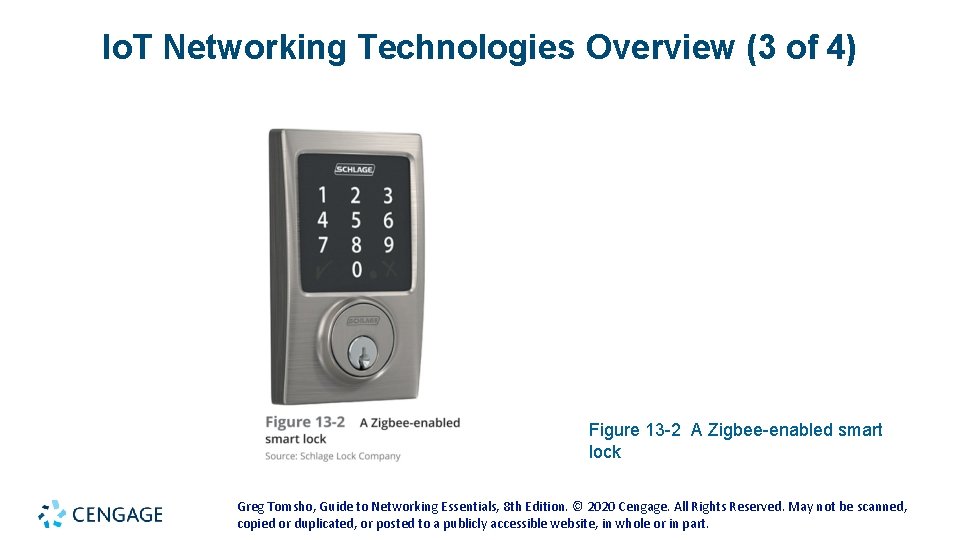
Io. T Networking Technologies Overview (2 of 4) • Zigbee, 6 Lo. WPAN, and Thread • These technologies are based on IEEE 802. 15. 4, which specifies low-bandwidth, lowpower, and inexpensive devices • 802. 15. 4 specifies the Physical and Data link layers , but each technology differs at the upper layers • Zigbee is used in home and building automation applications to connect smart objects such as sensors, lighting, utility meters, locks, and motion detectors • 6 Lo. WPAN uses IPv 6 and is targeted to similar applications as Zigbee • Thread is built upon 6 Lo. WPAN at the Network layer and below, but it provides a mesh topology and a high level of security Greg Tomsho, Guide to Networking Essentials, 8 th Edition. © 2020 Cengage. All Rights Reserved. May not be scanned, copied or duplicated, or posted to a publicly accessible website, in whole or in part.
Io. T Networking Technologies Overview (3 of 4) Figure 13 -2 A Zigbee-enabled smart lock Greg Tomsho, Guide to Networking Essentials, 8 th Edition. © 2020 Cengage. All Rights Reserved. May not be scanned, copied or duplicated, or posted to a publicly accessible website, in whole or in part.
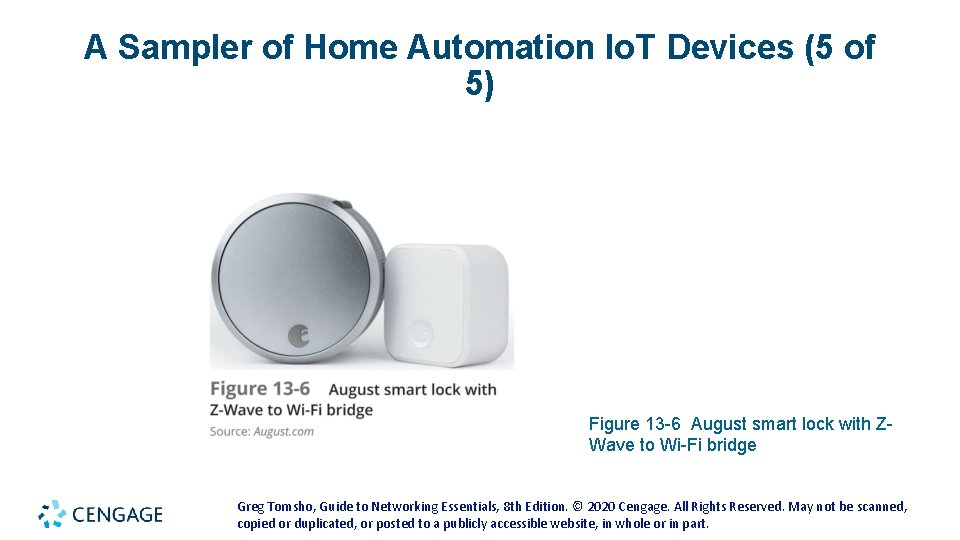
Io. T Networking Technologies Overview (4 of 4) • Z-Wave is used primarily in home automation to wireless connect smart devices such as locks, thermostats, lighting, and security systems • It is a wireless mesh technology that allows devices to communicate with one another and with a central control hub that serves as a gateway to the home Wi-Fi network so devices can be controlled with smart home assistants and smartphones • Lo. Ra. WAN is a low-power wide-area network technology that operates over a wide range of frequencies under 1 GHz • It can transmit up to 25 km under the right conditions • It is ideal for applications that are battery driven and have low bandwidth requirements Greg Tomsho, Guide to Networking Essentials, 8 th Edition. © 2020 Cengage. All Rights Reserved. May not be scanned, copied or duplicated, or posted to a publicly accessible website, in whole or in part.
Commercial and Industrial Io. T Devices • Industrial Io. T (IIo. T) uses some of the same technologies as other Io. T devices but differs in many aspects, such as security, ruggedness, networking, and the types of devices involved • IIo. T is used in utilities, energy, healthcare, manufacturing, city infrastructure, and a plethora of other industries • This section introduces you to common Io. T devices and use cases from both commercial and industrial sectors of Io. T Greg Tomsho, Guide to Networking Essentials, 8 th Edition. © 2020 Cengage. All Rights Reserved. May not be scanned, copied or duplicated, or posted to a publicly accessible website, in whole or in part.
A Sampler of Home Automation Io. T Devices (1 of 5) • Home automation is growing at about 11 percent annually • Popular Io. T devices used in the home and office include: • Smart home assistants • Smart thermostats • Smart vents • Smart light bulbs • Smart door locks • Video doorbells • Smoke alarms • Security systems • Irrigation systems • Smart appliances Greg Tomsho, Guide to Networking Essentials, 8 th Edition. © 2020 Cengage. All Rights Reserved. May not be scanned, copied or duplicated, or posted to a publicly accessible website, in whole or in part.
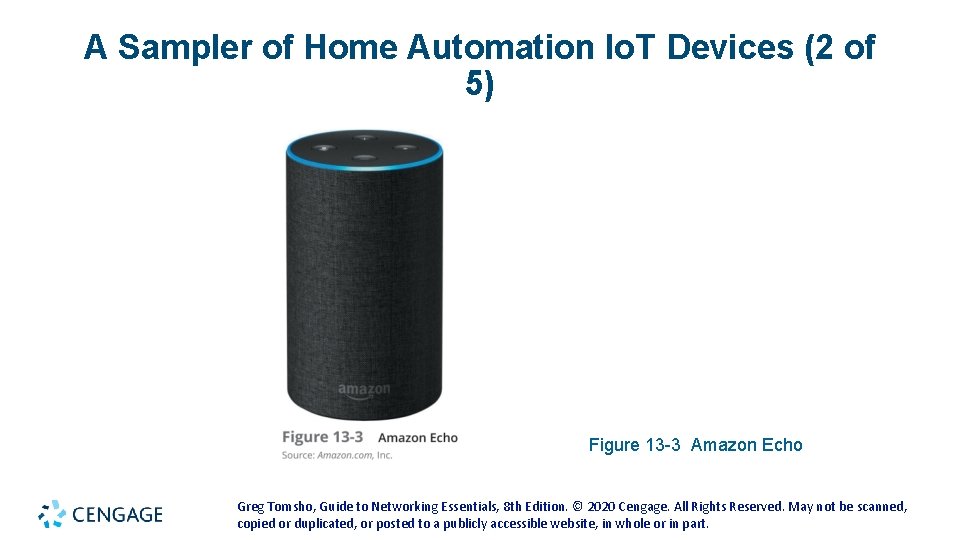
A Sampler of Home Automation Io. T Devices (2 of 5) Figure 13 -3 Amazon Echo Greg Tomsho, Guide to Networking Essentials, 8 th Edition. © 2020 Cengage. All Rights Reserved. May not be scanned, copied or duplicated, or posted to a publicly accessible website, in whole or in part.
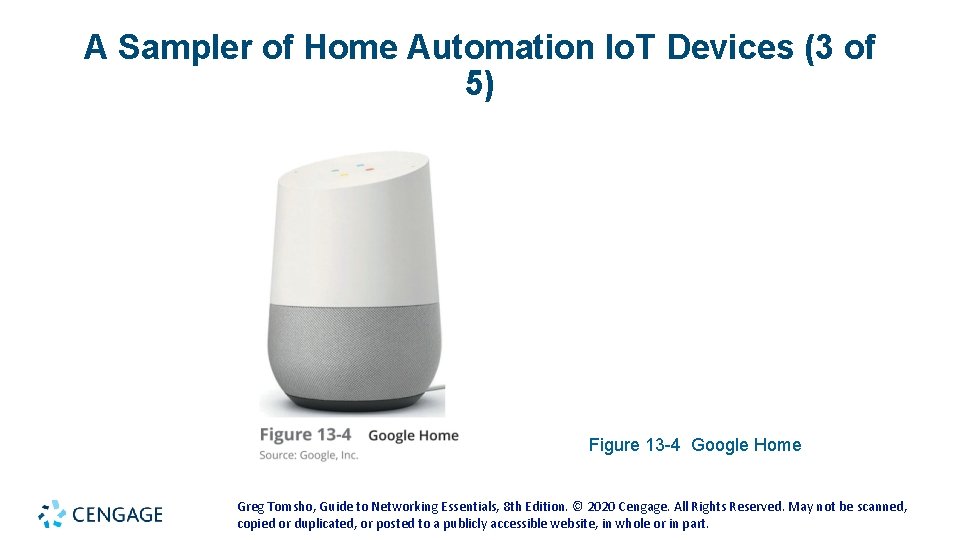
A Sampler of Home Automation Io. T Devices (3 of 5) Figure 13 -4 Google Home Greg Tomsho, Guide to Networking Essentials, 8 th Edition. © 2020 Cengage. All Rights Reserved. May not be scanned, copied or duplicated, or posted to a publicly accessible website, in whole or in part.
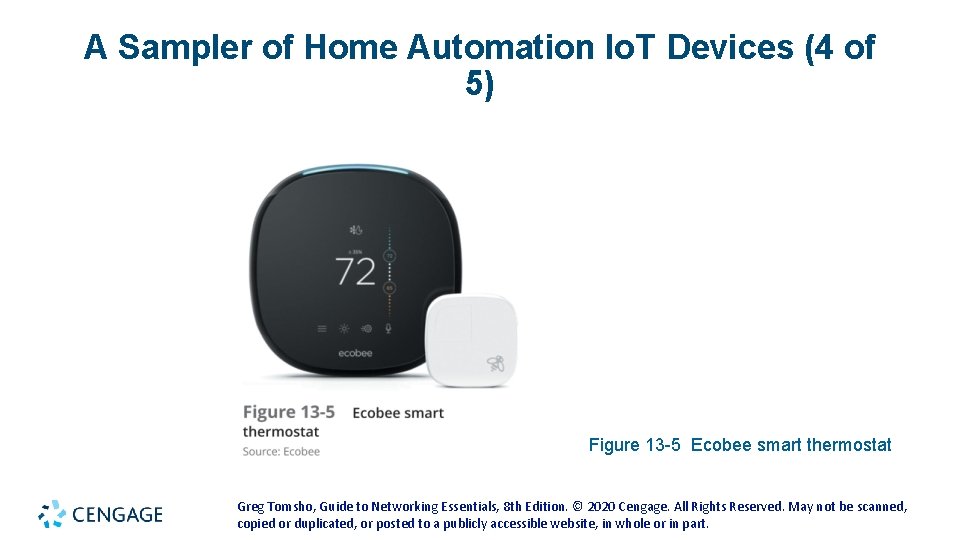
A Sampler of Home Automation Io. T Devices (4 of 5) Figure 13 -5 Ecobee smart thermostat Greg Tomsho, Guide to Networking Essentials, 8 th Edition. © 2020 Cengage. All Rights Reserved. May not be scanned, copied or duplicated, or posted to a publicly accessible website, in whole or in part.
A Sampler of Home Automation Io. T Devices (5 of 5) Figure 13 -6 August smart lock with ZWave to Wi-Fi bridge Greg Tomsho, Guide to Networking Essentials, 8 th Edition. © 2020 Cengage. All Rights Reserved. May not be scanned, copied or duplicated, or posted to a publicly accessible website, in whole or in part.
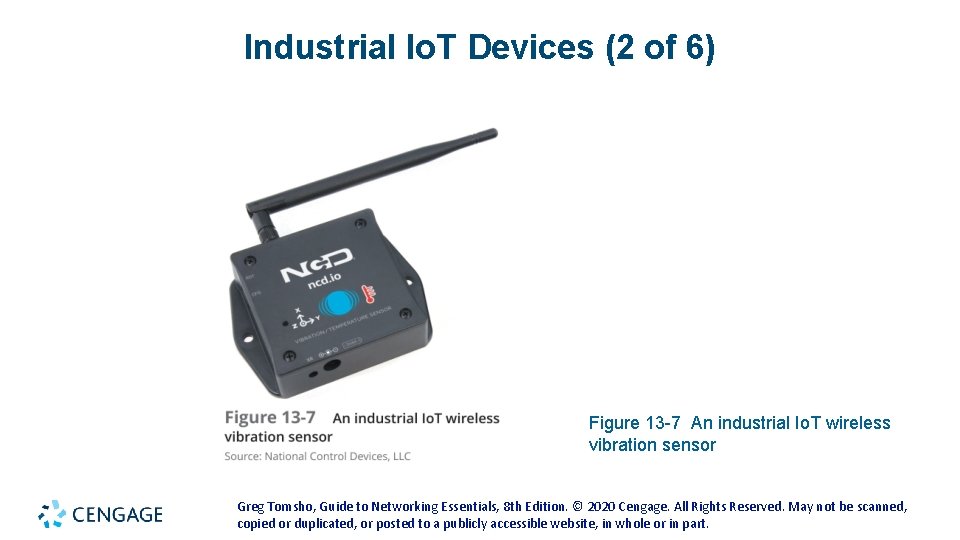
Industrial Io. T Devices (1 of 6) • The use of Io. T technologies in industry has been dubbed Industry 4. 0 • Industry 4. 0 makes use of virtualization, cloud computing, and artificial intelligence to create what is called a cyber-physical system (CPS) • Some of the same Io. T technologies are used in both home automation and industry • Industrial usage often requires industrial version of sensors because they must hold up under harsh environments, high vibrations, and possibly extreme temperatures Greg Tomsho, Guide to Networking Essentials, 8 th Edition. © 2020 Cengage. All Rights Reserved. May not be scanned, copied or duplicated, or posted to a publicly accessible website, in whole or in part.
Industrial Io. T Devices (2 of 6) Figure 13 -7 An industrial Io. T wireless vibration sensor Greg Tomsho, Guide to Networking Essentials, 8 th Edition. © 2020 Cengage. All Rights Reserved. May not be scanned, copied or duplicated, or posted to a publicly accessible website, in whole or in part.
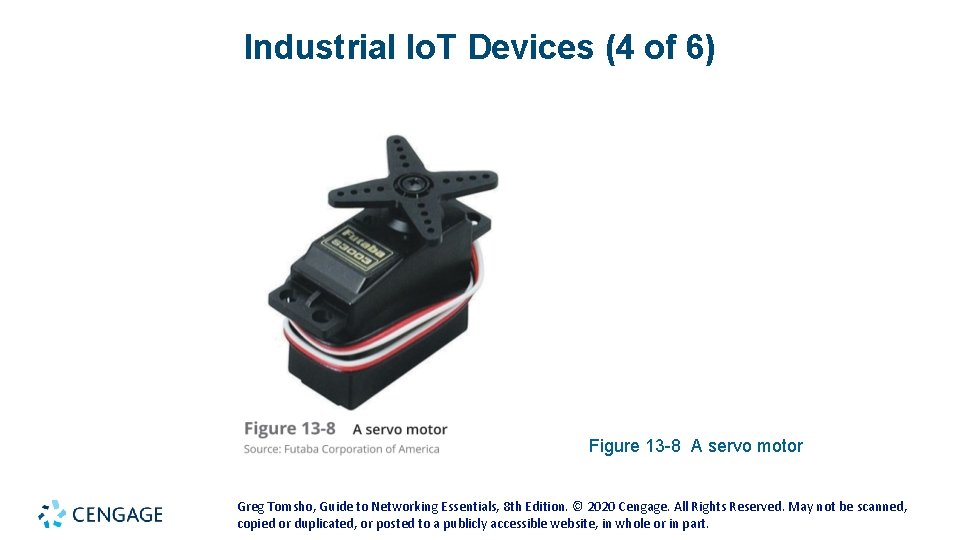
Industrial Io. T Devices (3 of 6) • Types of devices you might find in industrial applications include the following: • Actuators • An actuator is a general category of output device that provides automatic movement, such as turning a valve to open or close a pipe • Electric motor • An electric motor rotates at a particular speed and direction in response to an electrical signal • Stepper motors rotate in a series of steps, providing precise movement • Servo motors provide either partial rotation or continuous rotation Greg Tomsho, Guide to Networking Essentials, 8 th Edition. © 2020 Cengage. All Rights Reserved. May not be scanned, copied or duplicated, or posted to a publicly accessible website, in whole or in part.
Industrial Io. T Devices (4 of 6) Figure 13 -8 A servo motor Greg Tomsho, Guide to Networking Essentials, 8 th Edition. © 2020 Cengage. All Rights Reserved. May not be scanned, copied or duplicated, or posted to a publicly accessible website, in whole or in part.
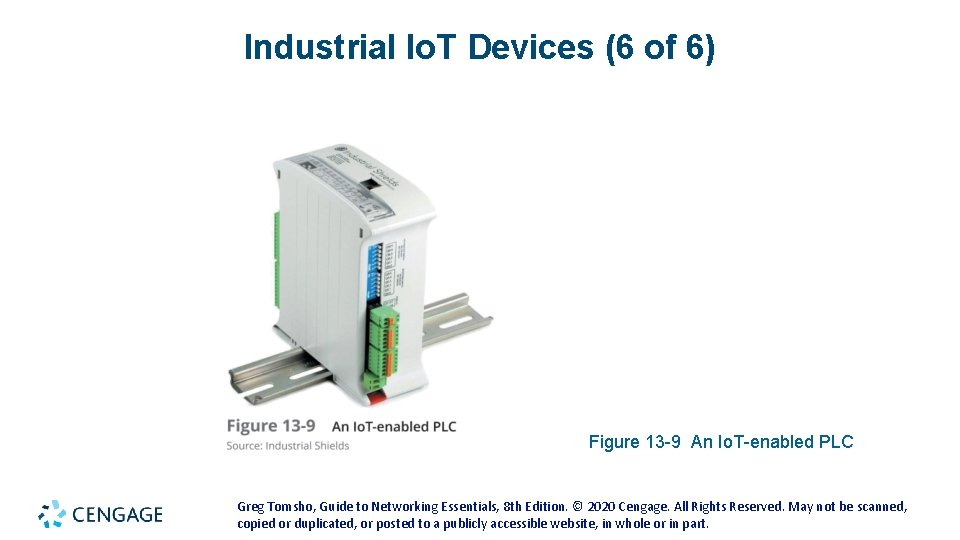
Industrial Io. T Devices (5 of 6) • Types of devices you might find in industrial applications include the following (continued): • Solenoid • A solenoid is a tightly wound coil of wire that creates a strong magnetic field when electricity is applied • RFID tags are attached to objects and are used to identify and track the objects • PLCs • Programmable logic controllers (PLCs) are input/output controllers used in assembly lines, robotics, and automated machinery • Io. T gateways • Io. T gateway devices translate data coming from an Io. T network to another type of network Greg Tomsho, Guide to Networking Essentials, 8 th Edition. © 2020 Cengage. All Rights Reserved. May not be scanned, copied or duplicated, or posted to a publicly accessible website, in whole or in part.
Industrial Io. T Devices (6 of 6) Figure 13 -9 An Io. T-enabled PLC Greg Tomsho, Guide to Networking Essentials, 8 th Edition. © 2020 Cengage. All Rights Reserved. May not be scanned, copied or duplicated, or posted to a publicly accessible website, in whole or in part.
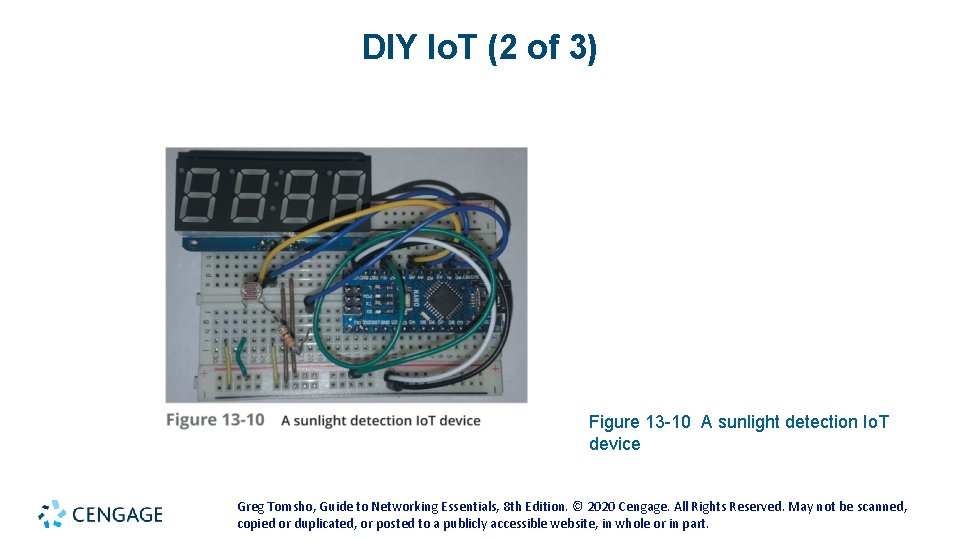
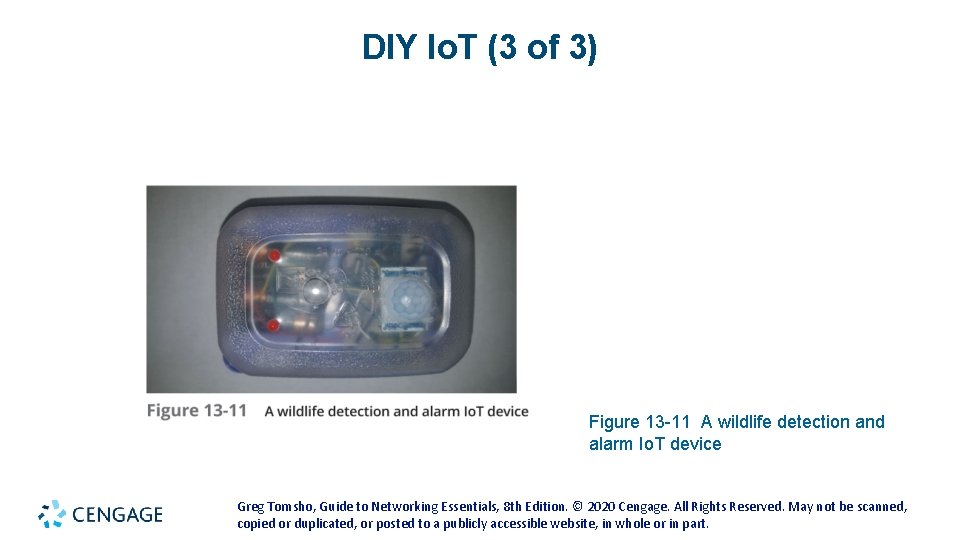
DIY Io. T (1 of 3) • Examples of DIY Io. T: • Studying changes in rock density due to atmospheric conditions • Measuring how many hours of direct sunlight your plants are getting • Creating a wildlife detection and alarm system Greg Tomsho, Guide to Networking Essentials, 8 th Edition. © 2020 Cengage. All Rights Reserved. May not be scanned, copied or duplicated, or posted to a publicly accessible website, in whole or in part.
DIY Io. T (2 of 3) Figure 13 -10 A sunlight detection Io. T device Greg Tomsho, Guide to Networking Essentials, 8 th Edition. © 2020 Cengage. All Rights Reserved. May not be scanned, copied or duplicated, or posted to a publicly accessible website, in whole or in part.
DIY Io. T (3 of 3) Figure 13 -11 A wildlife detection and alarm Io. T device Greg Tomsho, Guide to Networking Essentials, 8 th Edition. © 2020 Cengage. All Rights Reserved. May not be scanned, copied or duplicated, or posted to a publicly accessible website, in whole or in part.
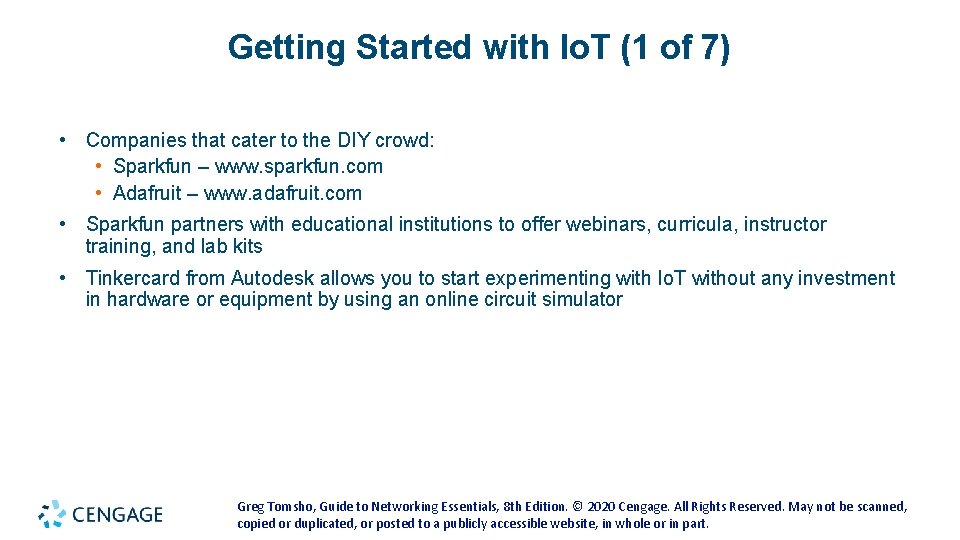
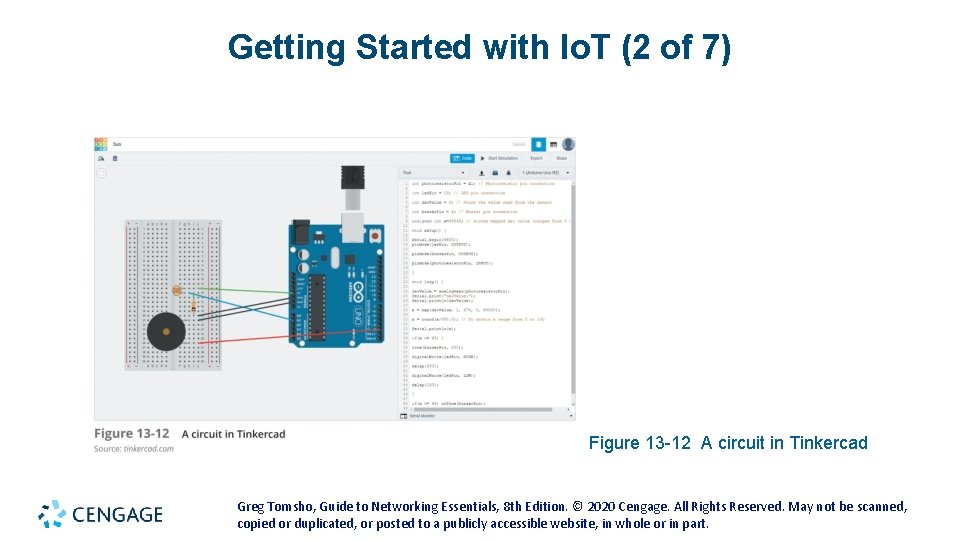
Getting Started with Io. T (1 of 7) • Companies that cater to the DIY crowd: • Sparkfun – www. sparkfun. com • Adafruit – www. adafruit. com • Sparkfun partners with educational institutions to offer webinars, curricula, instructor training, and lab kits • Tinkercard from Autodesk allows you to start experimenting with Io. T without any investment in hardware or equipment by using an online circuit simulator Greg Tomsho, Guide to Networking Essentials, 8 th Edition. © 2020 Cengage. All Rights Reserved. May not be scanned, copied or duplicated, or posted to a publicly accessible website, in whole or in part.
Getting Started with Io. T (2 of 7) Figure 13 -12 A circuit in Tinkercad Greg Tomsho, Guide to Networking Essentials, 8 th Edition. © 2020 Cengage. All Rights Reserved. May not be scanned, copied or duplicated, or posted to a publicly accessible website, in whole or in part.
Getting Started with Io. T (3 of 7) • The following is a list of items you’ll likely need to get started with Io. T: • Microcontroller development board • Solderless breadboard • A solderless breadboard is a development tool into which you plug components, giving you easy access to the computer’s input and output lines • Sensors • Common sensors include LDRs, PIRs, temperature sensors, accelerometers, infrared receivers, force sensors, and audio sensors • LEDs • Light-emitting diodes (LEDs) are small electronic devices that emit light when an electrical current is applied • LEDs are used as indicator lights Greg Tomsho, Guide to Networking Essentials, 8 th Edition. © 2020 Cengage. All Rights Reserved. May not be scanned, copied or duplicated, or posted to a publicly accessible website, in whole or in part.
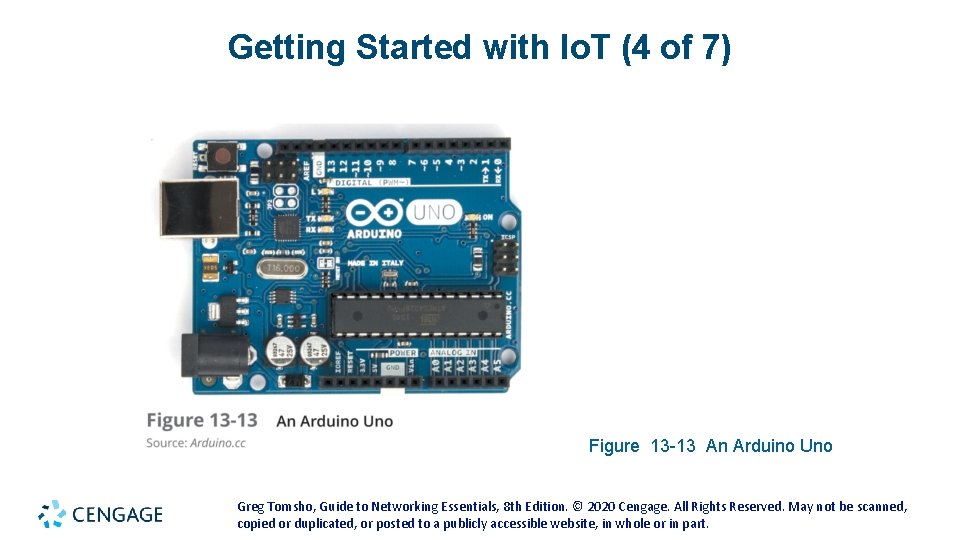
Getting Started with Io. T (4 of 7) Figure 13 -13 An Arduino Uno Greg Tomsho, Guide to Networking Essentials, 8 th Edition. © 2020 Cengage. All Rights Reserved. May not be scanned, copied or duplicated, or posted to a publicly accessible website, in whole or in part.
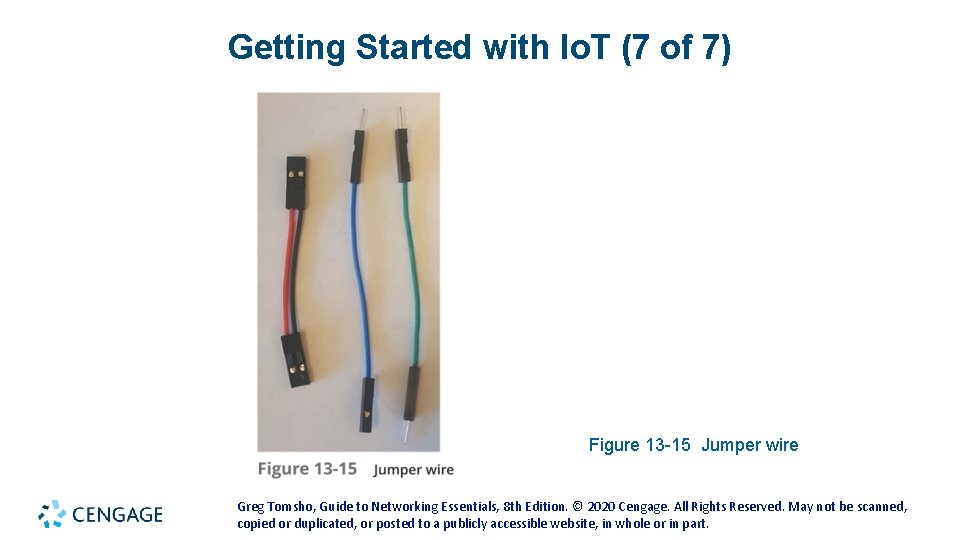
Getting Started with Io. T (5 of 7) • The following is a list of items you’ll likely need to get started with Io. T (continued): • Actuators • Display components • Passive components such as resistors, capacitors, and diodes are part of most electronic designs • Power supply • Jumper wire • A jumper wire is a short length of insulated wire that has a pin or socket on each end and is used to conduct electricity from one component to another Greg Tomsho, Guide to Networking Essentials, 8 th Edition. © 2020 Cengage. All Rights Reserved. May not be scanned, copied or duplicated, or posted to a publicly accessible website, in whole or in part.
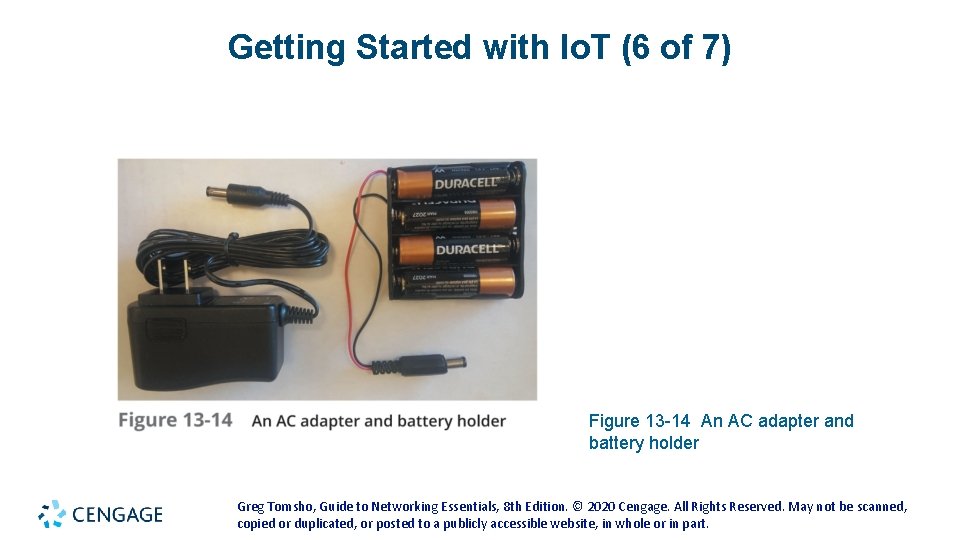
Getting Started with Io. T (6 of 7) Figure 13 -14 An AC adapter and battery holder Greg Tomsho, Guide to Networking Essentials, 8 th Edition. © 2020 Cengage. All Rights Reserved. May not be scanned, copied or duplicated, or posted to a publicly accessible website, in whole or in part.
Getting Started with Io. T (7 of 7) Figure 13 -15 Jumper wire Greg Tomsho, Guide to Networking Essentials, 8 th Edition. © 2020 Cengage. All Rights Reserved. May not be scanned, copied or duplicated, or posted to a publicly accessible website, in whole or in part.
Tools for Io. T • You will likely need some basic tools during the development process: • Wire cutters • Soldering iron • Digital voltmeter • Helping hands is a tool with alligator clips on the end of articulating arms that hold things in place Greg Tomsho, Guide to Networking Essentials, 8 th Edition. © 2020 Cengage. All Rights Reserved. May not be scanned, copied or duplicated, or posted to a publicly accessible website, in whole or in part.
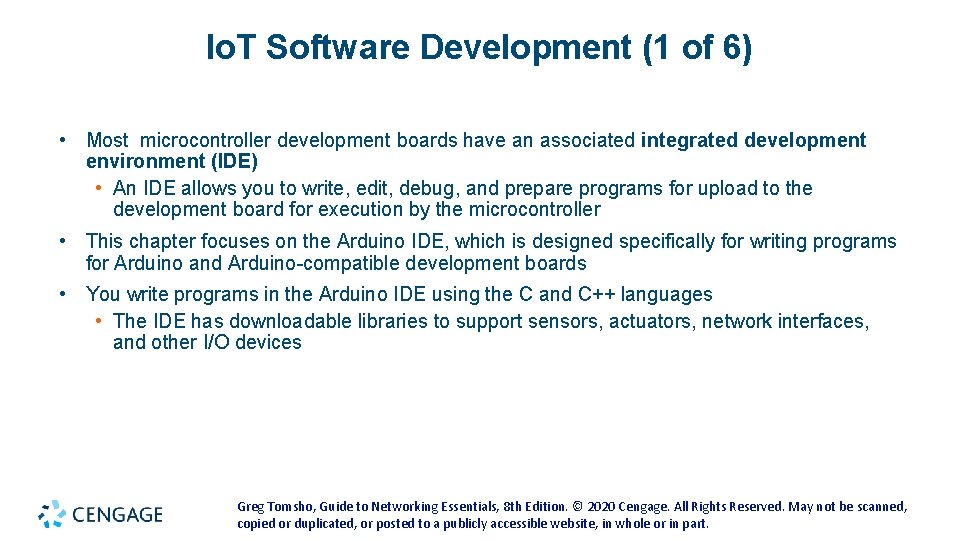
Io. T Software Development (1 of 6) • Most microcontroller development boards have an associated integrated development environment (IDE) • An IDE allows you to write, edit, debug, and prepare programs for upload to the development board for execution by the microcontroller • This chapter focuses on the Arduino IDE, which is designed specifically for writing programs for Arduino and Arduino-compatible development boards • You write programs in the Arduino IDE using the C and C++ languages • The IDE has downloadable libraries to support sensors, actuators, network interfaces, and other I/O devices Greg Tomsho, Guide to Networking Essentials, 8 th Edition. © 2020 Cengage. All Rights Reserved. May not be scanned, copied or duplicated, or posted to a publicly accessible website, in whole or in part.
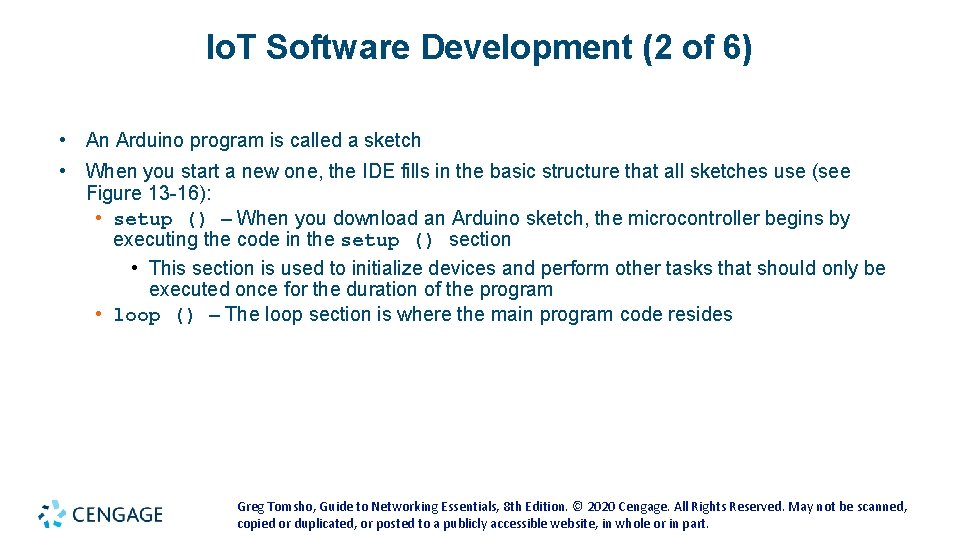
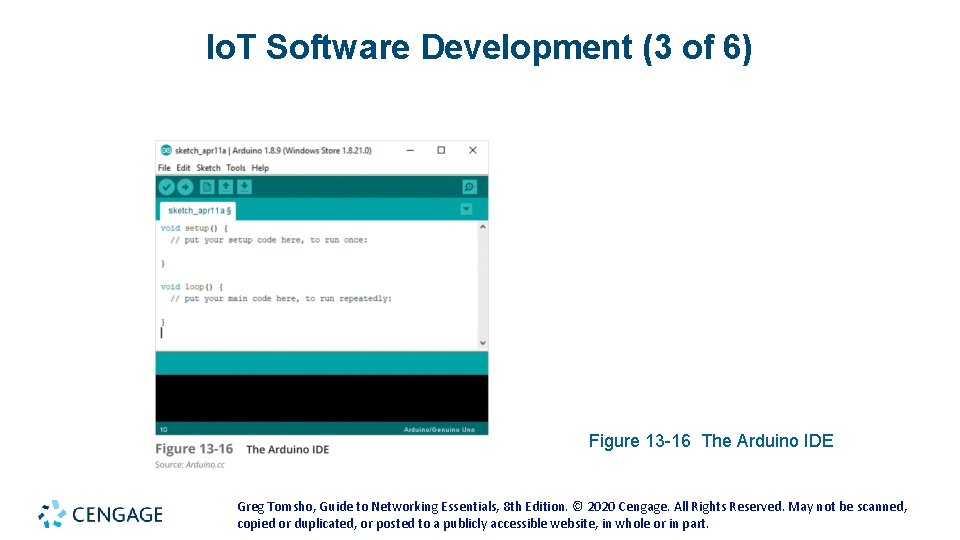
Io. T Software Development (2 of 6) • An Arduino program is called a sketch • When you start a new one, the IDE fills in the basic structure that all sketches use (see Figure 13 -16): • setup () – When you download an Arduino sketch, the microcontroller begins by executing the code in the setup () section • This section is used to initialize devices and perform other tasks that should only be executed once for the duration of the program • loop () – The loop section is where the main program code resides Greg Tomsho, Guide to Networking Essentials, 8 th Edition. © 2020 Cengage. All Rights Reserved. May not be scanned, copied or duplicated, or posted to a publicly accessible website, in whole or in part.
Io. T Software Development (3 of 6) Figure 13 -16 The Arduino IDE Greg Tomsho, Guide to Networking Essentials, 8 th Edition. © 2020 Cengage. All Rights Reserved. May not be scanned, copied or duplicated, or posted to a publicly accessible website, in whole or in part.
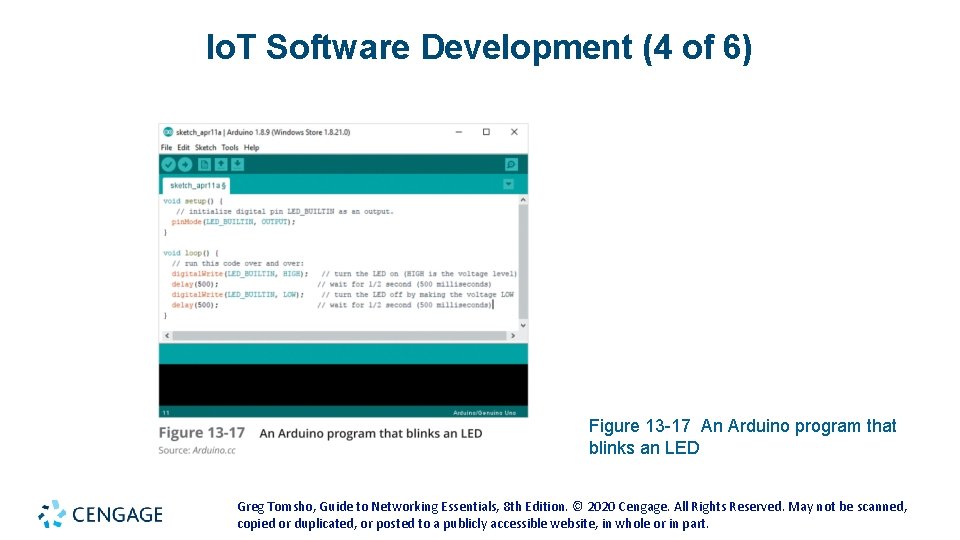
Io. T Software Development (4 of 6) Figure 13 -17 An Arduino program that blinks an LED Greg Tomsho, Guide to Networking Essentials, 8 th Edition. © 2020 Cengage. All Rights Reserved. May not be scanned, copied or duplicated, or posted to a publicly accessible website, in whole or in part.
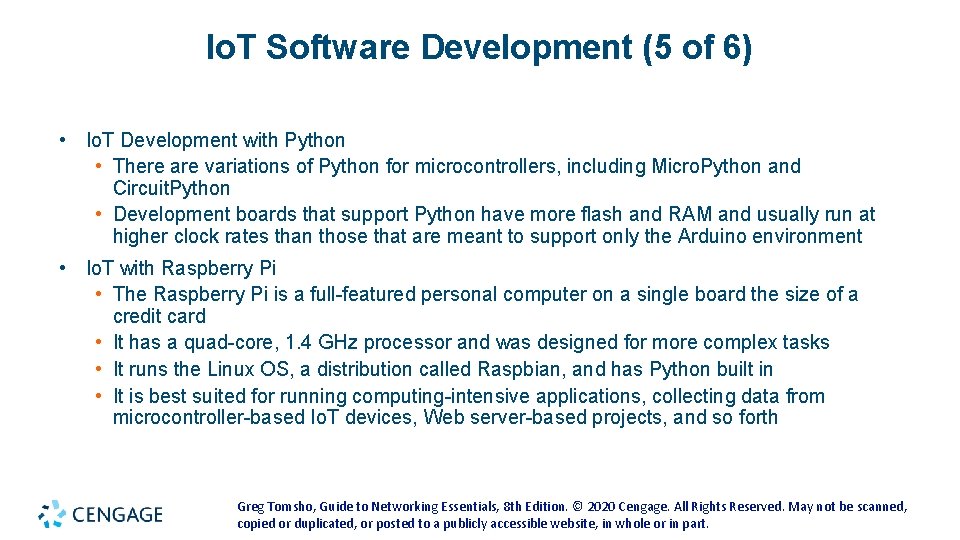
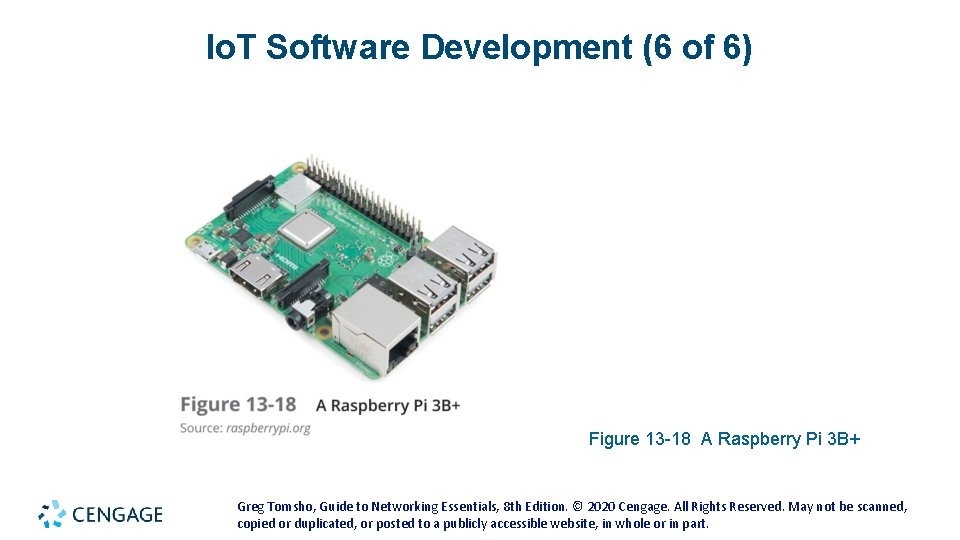
Io. T Software Development (5 of 6) • Io. T Development with Python • There are variations of Python for microcontrollers, including Micro. Python and Circuit. Python • Development boards that support Python have more flash and RAM and usually run at higher clock rates than those that are meant to support only the Arduino environment • Io. T with Raspberry Pi • The Raspberry Pi is a full-featured personal computer on a single board the size of a credit card • It has a quad-core, 1. 4 GHz processor and was designed for more complex tasks • It runs the Linux OS, a distribution called Raspbian, and has Python built in • It is best suited for running computing-intensive applications, collecting data from microcontroller-based Io. T devices, Web server-based projects, and so forth Greg Tomsho, Guide to Networking Essentials, 8 th Edition. © 2020 Cengage. All Rights Reserved. May not be scanned, copied or duplicated, or posted to a publicly accessible website, in whole or in part.
Io. T Software Development (6 of 6) Figure 13 -18 A Raspberry Pi 3 B+ Greg Tomsho, Guide to Networking Essentials, 8 th Edition. © 2020 Cengage. All Rights Reserved. May not be scanned, copied or duplicated, or posted to a publicly accessible website, in whole or in part.
Chapter Summary (1 of 3) • The Internet of Things (Io. T) is the digitization of our everyday world through the use of networked microprocessors and microcontrollers along with sensors, actuators, motors, and other I/O devices • There is a myriad of possible applications of Io. T and the technology is in its infancy • Common use cases include transportation, energy, manufacturing, and public safety • The benefits of Io. T in transportation include automobiles and mass transit systems such as buses and railways • Electric utilities were an early adopter of using Io. T technologies to deploy a smart grid • Estimates are that more than 90 percent of the machines used in manufacturing are not connected to a network, but most would benefit from such a connection • Emergency responders use Io. T to quickly locate victims of accidents, crime, and natural disasters Greg Tomsho, Guide to Networking Essentials, 8 th Edition. © 2020 Cengage. All Rights Reserved. May not be scanned, copied or duplicated, or posted to a publicly accessible website, in whole or in part.
Chapter Summary (2 of 3) • The goals of most Io. T technologies are to collect, process, analyze, react to, and communicate data • Io. T data processing occurs in two places: the front end and the back end • Different types of devices and different environments dictate what type of networking technology is likely to be used by a particular Io. T device • Home automation is a burgeoning industry and a driver of Io. T, but industrial Io. T products will likely have a greater impact on society as a whole • According to Inc. com, the home automation market is a substantial sector of Io. T, and will reach $79 billion by 2022 • The use of Io. T technologies in industry, particularly in manufacturing, has been dubbed Industry 4. 0 Greg Tomsho, Guide to Networking Essentials, 8 th Edition. © 2020 Cengage. All Rights Reserved. May not be scanned, copied or duplicated, or posted to a publicly accessible website, in whole or in part.
Chapter Summary (3 of 3) • The do-it-yourself Io. T industry is booming with hundreds of vendors selling inexpensive microcontroller boards, sensors, actuators, and development tools • Most microcontroller development boards have an associated integrated development environment (IDE) • An IDE allows you to write, edit, debug, and prepare programs for upload to the development board for execution by the microcontroller • Io. T combines electronics, computer hardware, programming, and networking, plus a little needed creativity to imagine what new “things” you can add to the world of Io. T Greg Tomsho, Guide to Networking Essentials, 8 th Edition. © 2020 Cengage. All Rights Reserved. May not be scanned, copied or duplicated, or posted to a publicly accessible website, in whole or in part.