
Guide to Network Defense and Countermeasures Second Edition


- Slides: 41
Guide to Network Defense and Countermeasures Second Edition Chapter 12 Strengthening Defense Through Ongoing Management Guide to Network Defense and Countermeasures, Second Edition
Objectives • Strengthen network control by managing security events • Improve analysis by auditing network security procedures • Strengthen detection by managing an intrusion detection system Guide to Network Defense and Countermeasures, Second Edition 2
Objectives (continued) • Improve network defense by changing a defense in depth configuration • Strengthen network performance by keeping pace with changing needs • Increase your knowledge base by keeping on top of industry trends Guide to Network Defense and Countermeasures, Second Edition 3
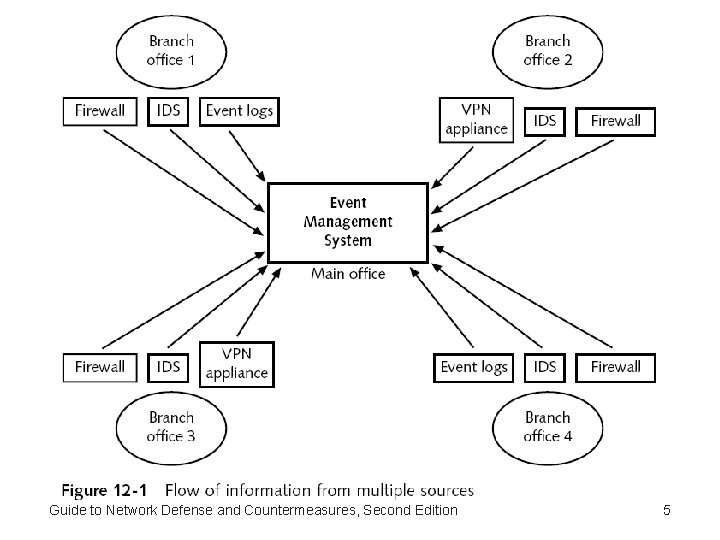
Strengthening Control: Security Event Management • Network devices – – – Packet-filtering routers VPN appliances IDS at each branch office One or more firewalls at each office Event logs or syslogs (system logs) Guide to Network Defense and Countermeasures, Second Edition 4
Guide to Network Defense and Countermeasures, Second Edition 5
Strengthening Control: Security Event Management (continued) • Security event management program – Gathers and consolidates events from multiple sources – Helps analyze the information to improve network security Guide to Network Defense and Countermeasures, Second Edition 6
Monitoring Events • Event monitoring – Review alert and event logs – Test network periodically to identify weak points • Monitor following events – – – Logins Creation of user accounts and groups Correct handling of e-mail attachments Backups Antivirus scanning and control Procedures for secure remote access Guide to Network Defense and Countermeasures, Second Edition 7
Monitoring Events (continued) • Your responses need to occur as quickly as possible • Develop a team approach to network security • Make use of automated responses – Alarms systems built into an IDS • Keep aware of new network security threats Guide to Network Defense and Countermeasures, Second Edition 8
Managing Data from Multiple Sensors • Centralized data collection – Organization’s event and security data are “funneled” to a centralized management console • In the main office – Benefits • Reduced cost because • Less administrative time required • Improved efficiency – Disadvantage • Needs secure communication channel between devices Guide to Network Defense and Countermeasures, Second Edition 9
Guide to Network Defense and Countermeasures, Second Edition 10
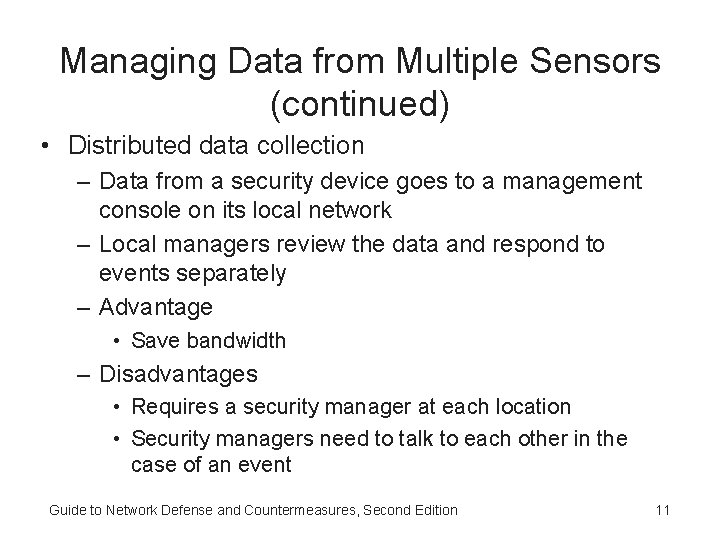
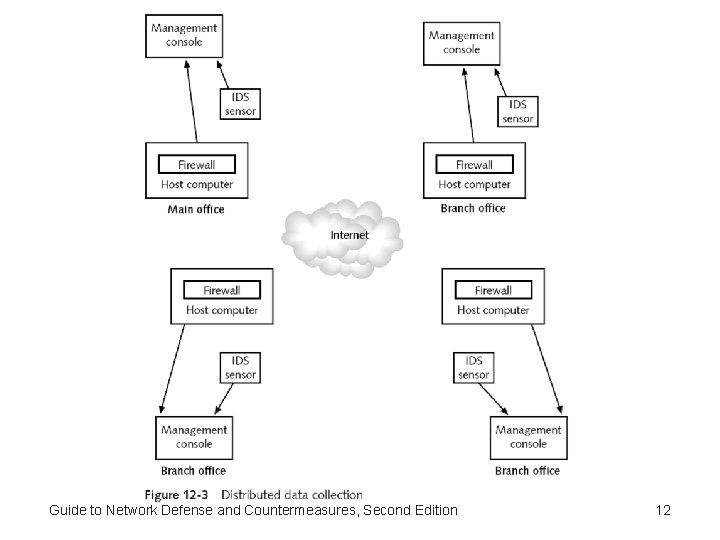
Managing Data from Multiple Sensors (continued) • Distributed data collection – Data from a security device goes to a management console on its local network – Local managers review the data and respond to events separately – Advantage • Save bandwidth – Disadvantages • Requires a security manager at each location • Security managers need to talk to each other in the case of an event Guide to Network Defense and Countermeasures, Second Edition 11
Guide to Network Defense and Countermeasures, Second Edition 12
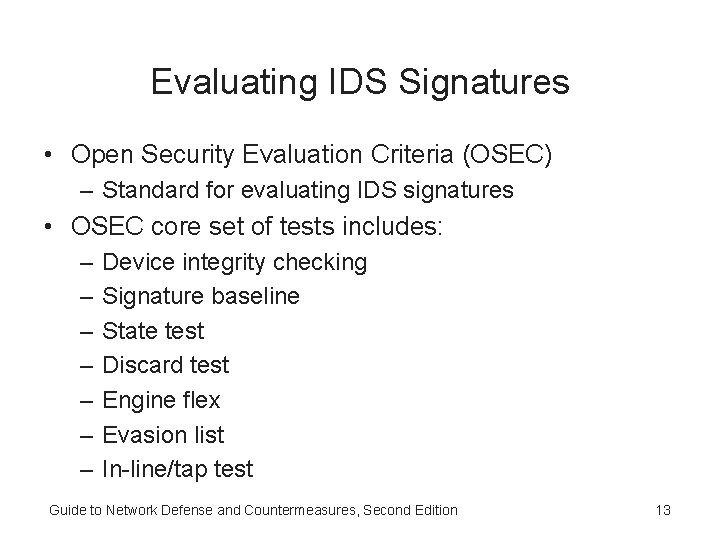
Evaluating IDS Signatures • Open Security Evaluation Criteria (OSEC) – Standard for evaluating IDS signatures • OSEC core set of tests includes: – – – – Device integrity checking Signature baseline State test Discard test Engine flex Evasion list In-line/tap test Guide to Network Defense and Countermeasures, Second Edition 13
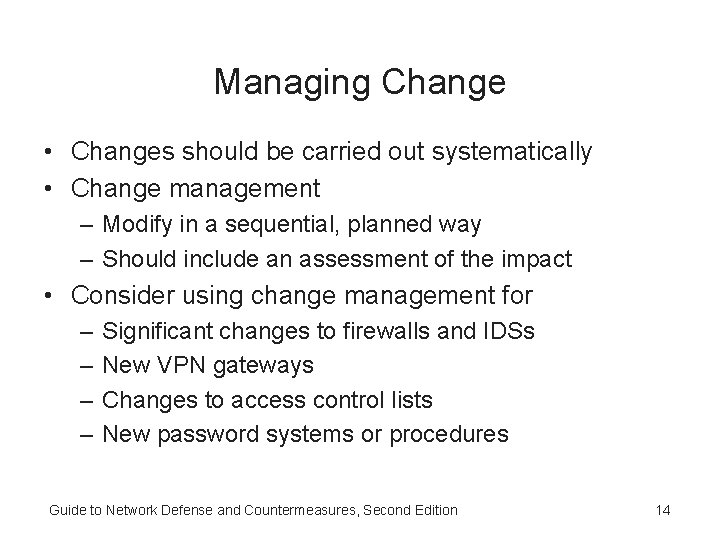
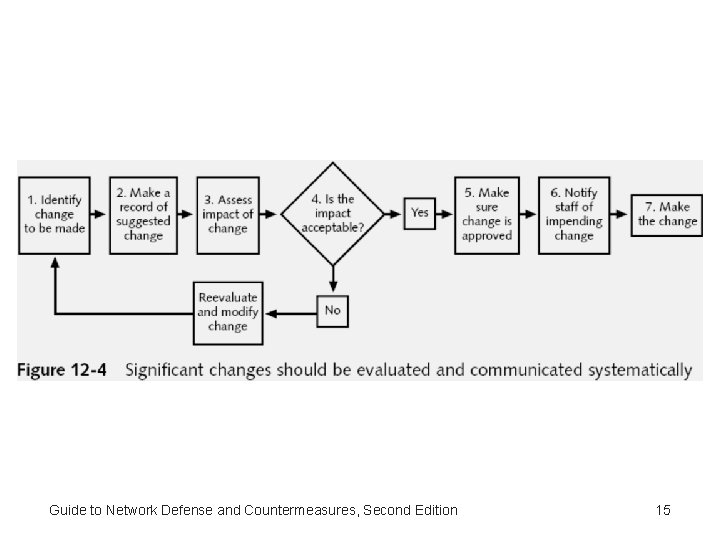
Managing Change • Changes should be carried out systematically • Change management – Modify in a sequential, planned way – Should include an assessment of the impact • Consider using change management for – – Significant changes to firewalls and IDSs New VPN gateways Changes to access control lists New password systems or procedures Guide to Network Defense and Countermeasures, Second Edition 14
Guide to Network Defense and Countermeasures, Second Edition 15
Strengthening Analysis: Security Auditing • Security auditing – Testing effectiveness of a network defense system • Tiger teams – Groups assembled to actively test a network – Members have expertise in security – Commonly used in the past • You need to put together data from several sources – Consolidate these data in a central database Guide to Network Defense and Countermeasures, Second Edition 16
Operational Auditing • Operational audit – IT staff examines system logs – Determine whether they are auditing the right information • They should look for the following – Accounts that have weak passwords or no passwords – Accounts assigned to employees who have left the company or user group – New accounts that need to be checked against a list of authorized users Guide to Network Defense and Countermeasures, Second Edition 17
Operational Auditing (continued) • Financial institutions have regular security audits – Because of government regulations • Social engineering – Attempts to trick employees into giving out passwords or other information • Tinkerbell program – Network connections are scanned – Generates alerts when suspicious connection attempts are made Guide to Network Defense and Countermeasures, Second Edition 18
Independent Auditing • Independent auditing – Hire outside firm to come and inspect your audit logs • Outside firm attempts to detect any flaws or vulnerabilities in your system • External auditor should sign a nondisclosure agreement (NDA) Guide to Network Defense and Countermeasures, Second Edition 19
Strengthening Detection: Managing an IDS • As your network grows, amount of traffic grows too • You might need to adjust your IDS rules Guide to Network Defense and Countermeasures, Second Edition 20
Maintaining Your Current System • Backups – Back up your firewall and IDS in case of disaster – Help you restore the system – Other devices to backup • • Routers Bastion hosts Servers Special-purpose devices – Can use automated backup software Guide to Network Defense and Countermeasures, Second Edition 21
Maintaining Your Current System (continued) • Managing accounts – Task often neglected – Involves • Adding new accounts • Recovering old ones • Changing passwords – Make sure accounts are reviewed every few months • Managing IDS rules – Eliminate unnecessary rules – Improves IDS performance Guide to Network Defense and Countermeasures, Second Edition 22
Maintaining Your Current System (continued) • User management – Teach employees how to use the system more securely – Raise employee awareness • Give lectures • Show easy is to crack a password • Prepare booklets Guide to Network Defense and Countermeasures, Second Edition 23
Changing or Adding Software • Software vendors usually release updated software • Get details on what sort of upgrade path is needed • Ask whether the new version requires – Working with new data formats – Installing new supporting software Guide to Network Defense and Countermeasures, Second Edition 24
Changing or Adding Hardware • Can be expensive – Cost is usually outweighed by the cost of security incidents • Consider adding consoles – Reduces the target-to-console ratio • Number of target computers on your network managed by a single command console • Reevaluate the placement of sensors Guide to Network Defense and Countermeasures, Second Edition 25
Strengthening Defense: Improving Defense in Depth • Defense in Depth (Di. D) – Calls for security through a variety of defense techniques that work together • Di. D calls for maintenance of the following areas – – – Availability Integrity Authentication Confidentiality Nonrepudiation Guide to Network Defense and Countermeasures, Second Edition 26
Active Defense in Depth • Strong implementation of the Di. D concept – Security personnel expect attacks will occur – Try to anticipate to attacks • Calls for multiple levels of protection • Requires respondents to think creatively • Security personnel should be trained – To keep up with attacks and countermeasures Guide to Network Defense and Countermeasures, Second Edition 27
Active Defense in Depth (continued) • Steps for creating a training cycle – – – Training Perimeter defense Intrusion detection Intrusion response New security approaches Guide to Network Defense and Countermeasures, Second Edition 28
Adding Security Layers • Protect a single network by protecting all interconnecting networks • Goal is to establish trust • Layers – – – Firewall and intrusion detection Encryption and authentication Virus protection Access control Information integrity Auditing Guide to Network Defense and Countermeasures, Second Edition 29
Strengthening Performance: Keeping Pace with Network Needs • IDS performance – Capability to capture packets and process them according to the rule base • Factors that affect performance – Memory – Bandwidth – Storage Guide to Network Defense and Countermeasures, Second Edition 30
Managing Memory • Performance depends largely on the number of signatures it has to review • IDS needs to maintain connection state in memory • Memory also stores – Information in cache – Databases containing IDS configuration settings Guide to Network Defense and Countermeasures, Second Edition 31
Managing Bandwidth • Devices need to process data as fast as it moves through the network • IDS should be able to handle 50% of bandwidth – Without losing the capacity to detect • Intrusion detection begins to break down – When bandwidth use exceeds 80% of network capacity Guide to Network Defense and Countermeasures, Second Edition 32
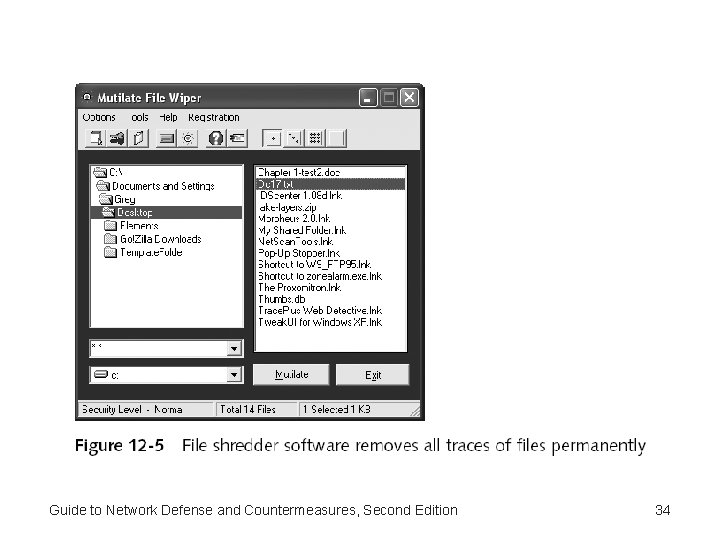
Managing Storage • Some intrusions take place over long periods – Require storage of large amount of historical data • Clear out media when it is full – And the information on it is no longer needed – Shred documents and files completely • Simply deleting or erasing files does not completely remove all information from the disk • Degaussing – Magnetically erasing an electronic device Guide to Network Defense and Countermeasures, Second Edition 33
Guide to Network Defense and Countermeasures, Second Edition 34
Maintaining Your Own Knowledge Base • You cannot carry out ongoing security maintenance in isolation – Visit security-related Web sites – Chat with other professionals in the field Guide to Network Defense and Countermeasures, Second Edition 35
Web Sites • Recommended Web sites – Center for Internet Security (www. cisecurity. org) – SANS Institute (www. sans. org) – CERT Coordination Center (www. cert. org) Guide to Network Defense and Countermeasures, Second Edition 36
Mailing Lists and Newsgroups • Provide more up-to-date information about security issues and vulnerabilities • Recommended mailing lists – NTBugtraq (www. networksecurityarchive. org) – Firewalls Mailing List (www. isc. org/index. pl? /ops/lists/firewalls/) – Security. Focus HOME Mailing Lists (http: //online. securityfocus. com/archive) Guide to Network Defense and Countermeasures, Second Edition 37
Trade Publications • Recommended publications – Compsec Online (www. compseconline. com) – Cisco Systems (www. cisco. com/public/support/tac/tools. shtml#alerts) – SANS newsletters (www. sans. org/newsletters/) Guide to Network Defense and Countermeasures, Second Edition 38
Certifications • Management should understand that certifications benefit the organization • Recommended certifications – Security Certified Program (www. securitycertified. net) – International Information Systems Security Certification Consortium (www. isc 2. org) – Comp. TIA (www. comptia. org) – Go. Certify (www. gocertify. com) Guide to Network Defense and Countermeasures, Second Edition 39
Summary • Security event management – Accumulating data from wide range of security devices • Changes should be done in a systematic way • Security auditing tests the effectiveness of network defenses • Keep an IDS running smoothly – Make backups – Manage user accounts – Reduce number of rules Guide to Network Defense and Countermeasures, Second Edition 40
Summary (continued) • Defense in Depth – Improve overall network security – Anticipate and thwart attack attempts • Keep pace with your network’s needs – Memory – Bandwidth – Storage • Delete files completely by “shredding” them • Maintain your knowledge base Guide to Network Defense and Countermeasures, Second Edition 41