
Guide to Graduate Level Writing Introduction This presentation

- Slides: 36
Guide to Graduate Level Writing
Introduction This presentation serves as a guide to the expectations of writing in your graduate program. Consistently using these general strategies and skills will improve the quality of your writing. These general strategies and skills can be applied to all types of writing assignments but are predominantly geared to papers that require support from the academic and professional literature. Instructors will have different expectations and preferences. You should always defer to the instructions provided by your professor when writing any assignment. Writing in graduate school requires the ability to recall, identify, examine, and explain the correct answer.
Differences between Graduate and Undergraduate Level Writing Many of the writing mistakes that professors allowed at the undergraduate level are not tolerated at the graduate level. Graduate level writing is free of grammatical and technical errors, concise, and clear. Graduate level writing demands increased scholarship to support your points adequately from the academic and professional literature.
Strategy for Developing Graduate Level Papers The following 7 steps will help you to develop and complete a quality graduate level paper. 1. 2. 3. 4. 5. 6. 7. Choose a topic (2 to 3 hours) Find sources (3 to 5 hours) Read sources (3 to 5 hours) Create an outline (1 to 3 hours) Write drafts (3 to 6 hours) Edit the paper (1 to 2 hours) Finalize the paper (1 to 2 hours) These steps are designed with the working student in mind. The time-frames for each step provides an estimation for planning the completion of a 10 to 12 page paper. The process of writing is dynamic and will involve moving between steps in a much less linear fashion than presented here (for the sake of clarity).
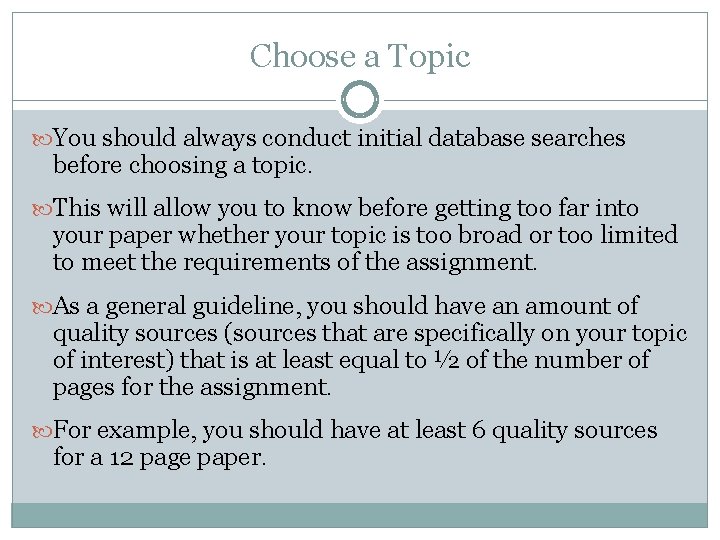
Choose a Topic You should always conduct initial database searches before choosing a topic. This will allow you to know before getting too far into your paper whether your topic is too broad or too limited to meet the requirements of the assignment. As a general guideline, you should have an amount of quality sources (sources that are specifically on your topic of interest) that is at least equal to ½ of the number of pages for the assignment. For example, you should have at least 6 quality sources for a 12 page paper.
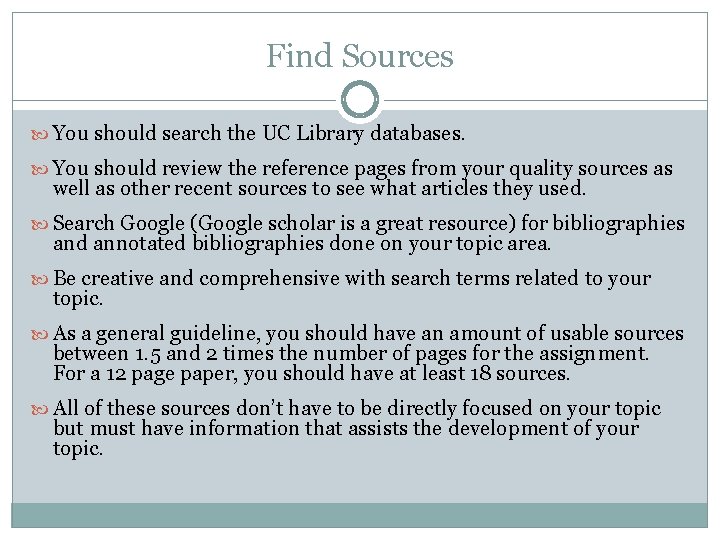
Find Sources You should search the UC Library databases. You should review the reference pages from your quality sources as well as other recent sources to see what articles they used. Search Google (Google scholar is a great resource) for bibliographies and annotated bibliographies done on your topic area. Be creative and comprehensive with search terms related to your topic. As a general guideline, you should have an amount of usable sources between 1. 5 and 2 times the number of pages for the assignment. For a 12 page paper, you should have at least 18 sources. All of these sources don’t have to be directly focused on your topic but must have information that assists the development of your topic.
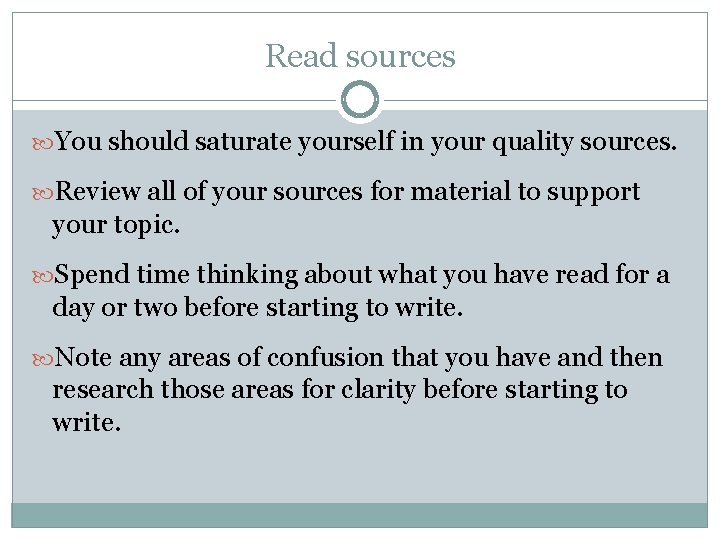
Read sources You should saturate yourself in your quality sources. Review all of your sources for material to support your topic. Spend time thinking about what you have read for a day or two before starting to write. Note any areas of confusion that you have and then research those areas for clarity before starting to write.
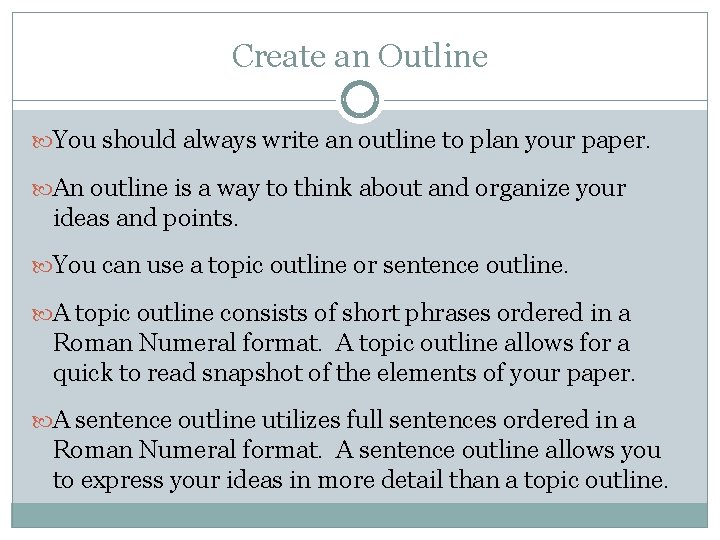
Create an Outline You should always write an outline to plan your paper. An outline is a way to think about and organize your ideas and points. You can use a topic outline or sentence outline. A topic outline consists of short phrases ordered in a Roman Numeral format. A topic outline allows for a quick to read snapshot of the elements of your paper. A sentence outline utilizes full sentences ordered in a Roman Numeral format. A sentence outline allows you to express your ideas in more detail than a topic outline.
Write Drafts You should always write at least two drafts for every paper. The first draft can be very rough. After your first draft, review it for major grammar and spelling errors and ordering of your points. The second draft is not yet perfect but should have all of your points developed.
Edit the Paper You should address all squiggly lines in your document which may indicate spelling or grammar errors identified by your word processing program. Eliminate any unnecessary words for conciseness throughout the paper. Make sure each of your points are in the appropriate section of your paper. Make sure that all ideas that are not your own are cited properly. Ask someone else to read your paper specifically for clarity of all of your points.
Finalize the Paper Write your introduction and conclusion. You do this in the finalization stage, you need to know what is in the body of your paper to write an effective introduction and conclusion. Information in the introduction should be substantiated in the body of the paper. No new information should be added in the conclusion. You should review your paper for any weak spots and find additional support if necessary. Review the assignment instructions to make sure you have covered all required elements. Do one more final edit. Do the finalizing a couple of days before the due date of the assignment.
Areas of Emphasis in Graduate Level Writing There are several specific areas that are very important for writing quality papers at the graduate level. These areas include: Clarity Semantics Conciseness Positive phrases Subordination Parallel structure Paragraph construction Resource: The Elements of Style by William Shrunk Jr. and E. B. White
Clarity Many students mistakenly believe that writing at the graduate level involves writing many complex sentences and using a lot of fancy words. One of the main goals of writing at the graduate level is to clearly present your points for the reader. If your paper lacks clarity, you have wasted your time in writing it and the reader’s time in reading it.
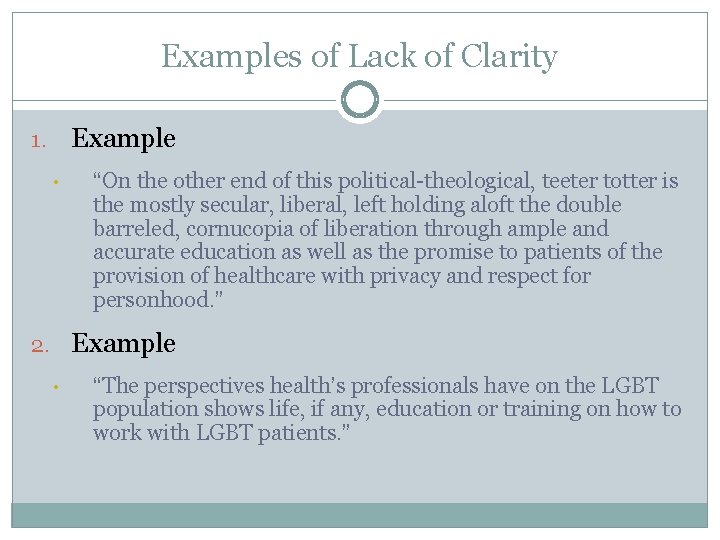
Examples of Lack of Clarity Example 1. • “On the other end of this political-theological, teeter totter is the mostly secular, liberal, left holding aloft the double barreled, cornucopia of liberation through ample and accurate education as well as the promise to patients of the provision of healthcare with privacy and respect for personhood. ” 2. Example • “The perspectives health’s professionals have on the LGBT population shows life, if any, education or training on how to work with LGBT patients. ”
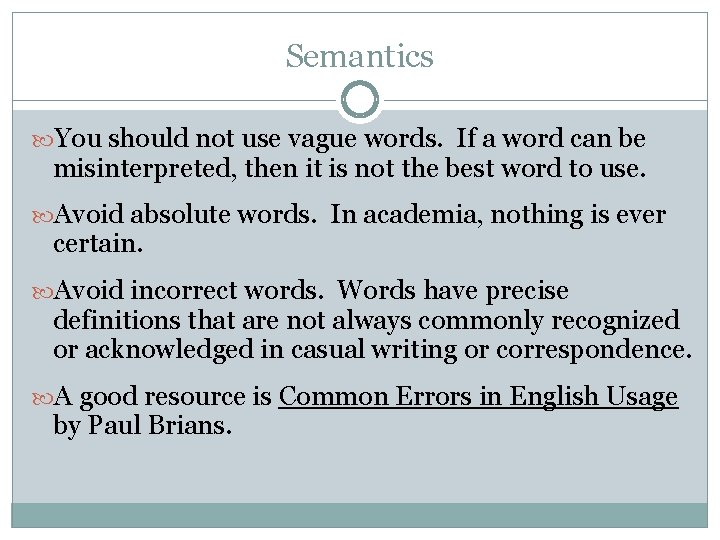
Semantics You should not use vague words. If a word can be misinterpreted, then it is not the best word to use. Avoid absolute words. In academia, nothing is ever certain. Avoid incorrect words. Words have precise definitions that are not always commonly recognized or acknowledged in casual writing or correspondence. A good resource is Common Errors in English Usage by Paul Brians.
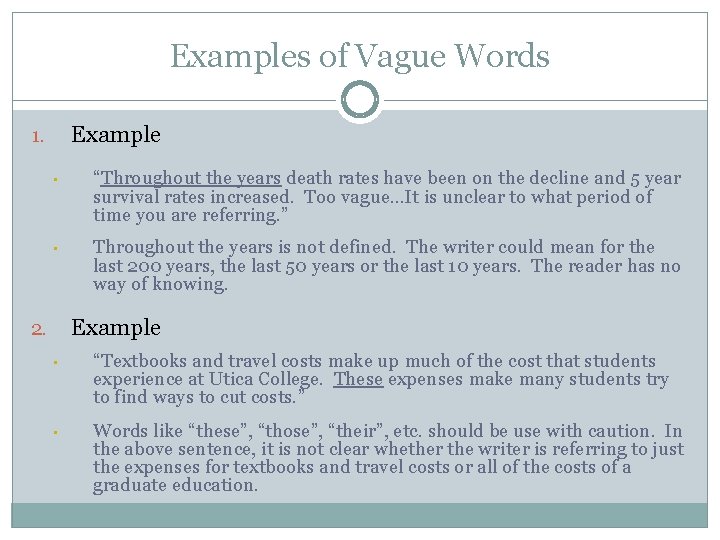
Examples of Vague Words Example 1. • “Throughout the years death rates have been on the decline and 5 year survival rates increased. Too vague…It is unclear to what period of time you are referring. ” • Throughout the years is not defined. The writer could mean for the last 200 years, the last 50 years or the last 10 years. The reader has no way of knowing. Example 2. • “Textbooks and travel costs make up much of the cost that students experience at Utica College. These expenses make many students try to find ways to cut costs. ” • Words like “these”, “those”, “their”, etc. should be use with caution. In the above sentence, it is not clear whether the writer is referring to just the expenses for textbooks and travel costs or all of the costs of a graduate education.
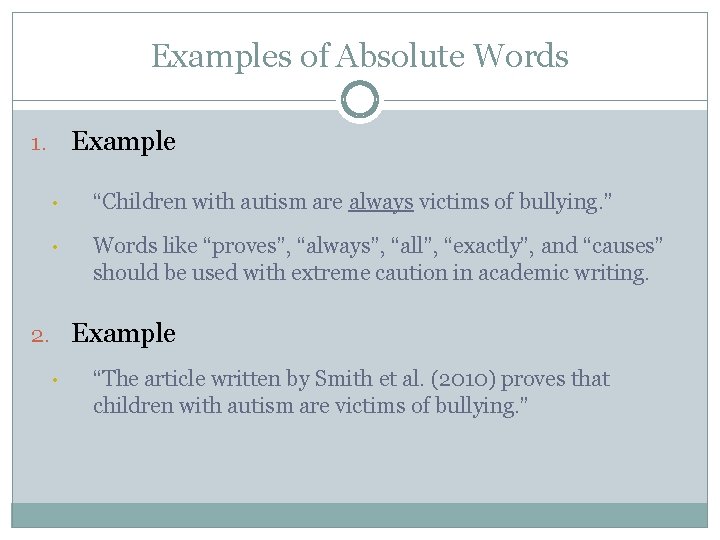
Examples of Absolute Words Example 1. • “Children with autism are always victims of bullying. ” • Words like “proves”, “always”, “all”, “exactly”, and “causes” should be used with extreme caution in academic writing. 2. Example • “The article written by Smith et al. (2010) proves that children with autism are victims of bullying. ”
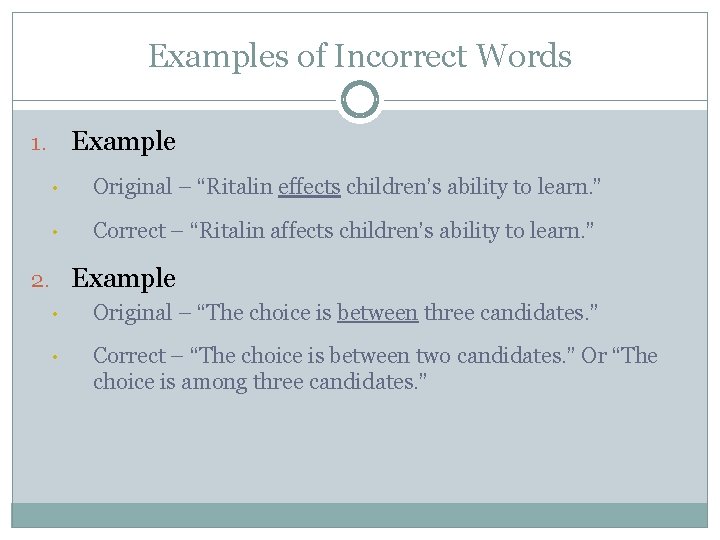
Examples of Incorrect Words Example 1. • Original – “Ritalin effects children’s ability to learn. ” • Correct – “Ritalin affects children’s ability to learn. ” 2. Example • Original – “The choice is between three candidates. ” • Correct – “The choice is between two candidates. ” Or “The choice is among three candidates. ”
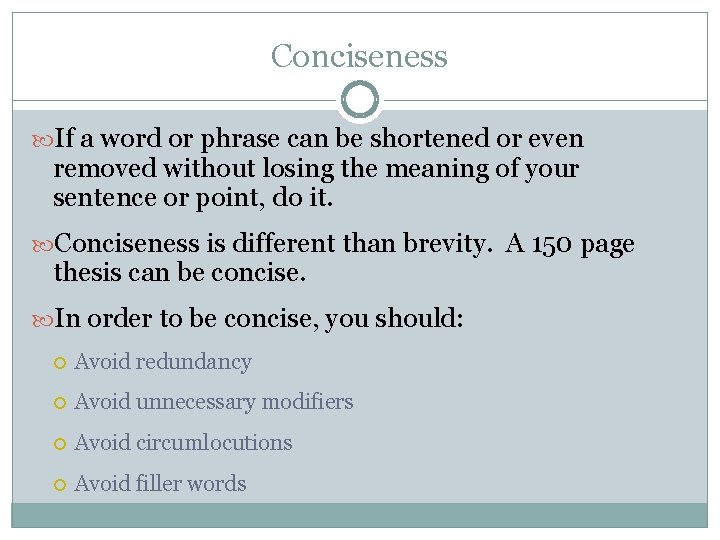
Conciseness If a word or phrase can be shortened or even removed without losing the meaning of your sentence or point, do it. Conciseness is different than brevity. A 150 page thesis can be concise. In order to be concise, you should: Avoid redundancy Avoid unnecessary modifiers Avoid circumlocutions Avoid filler words
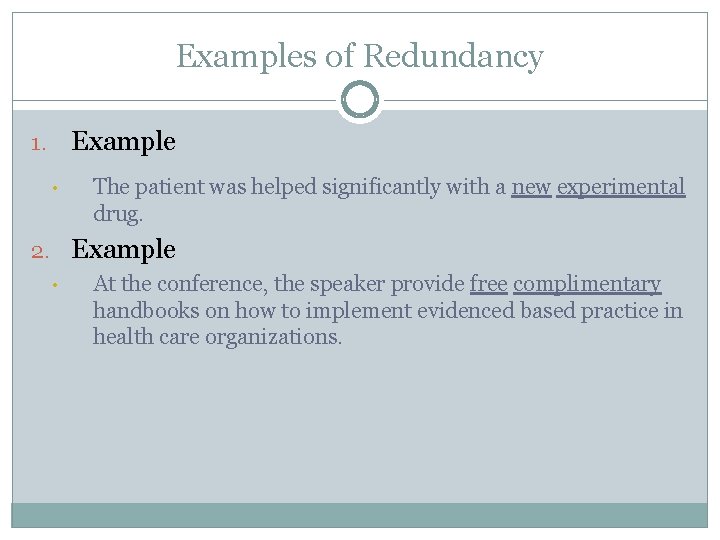
Examples of Redundancy Example 1. • The patient was helped significantly with a new experimental drug. 2. Example • At the conference, the speaker provide free complimentary handbooks on how to implement evidenced based practice in health care organizations.
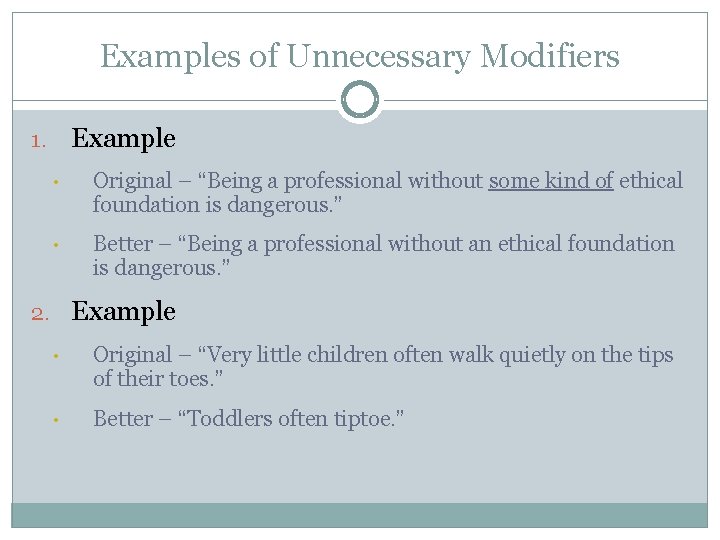
Examples of Unnecessary Modifiers Example 1. • Original – “Being a professional without some kind of ethical foundation is dangerous. ” • Better – “Being a professional without an ethical foundation is dangerous. ” 2. Example • Original – “Very little children often walk quietly on the tips of their toes. ” • Better – “Toddlers often tiptoe. ”
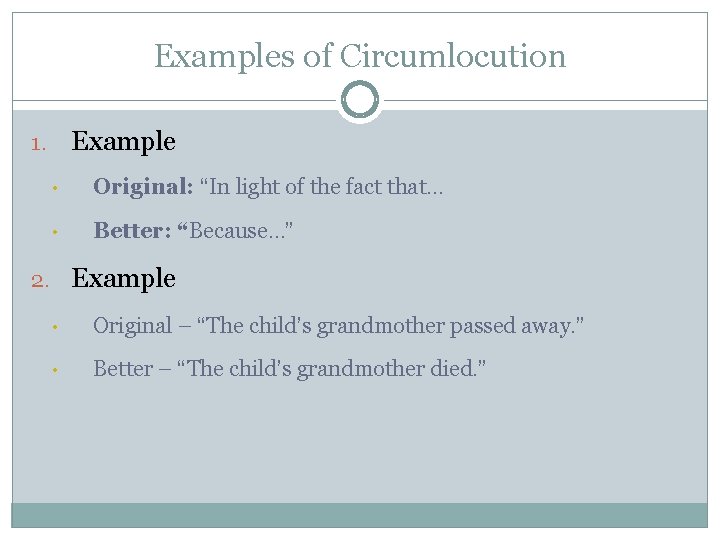
Examples of Circumlocution Example 1. • Original: “In light of the fact that… • Better: “Because…” 2. Example • Original – “The child’s grandmother passed away. ” • Better – “The child’s grandmother died. ”
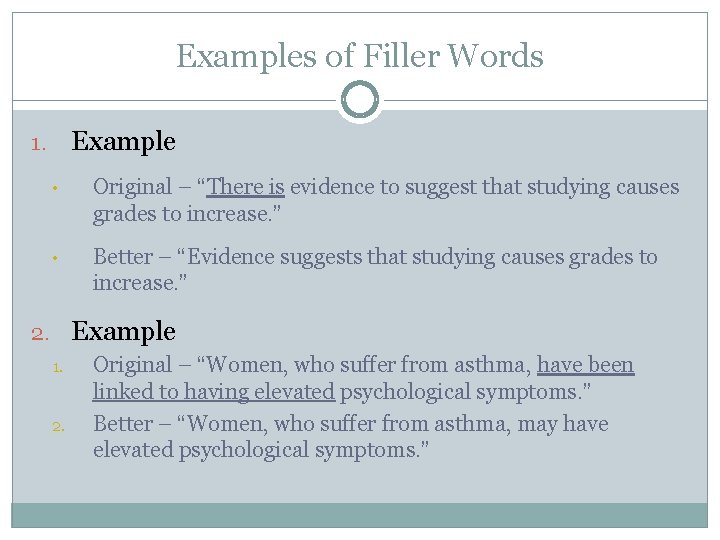
Examples of Filler Words Example 1. • Original – “There is evidence to suggest that studying causes grades to increase. ” • Better – “Evidence suggests that studying causes grades to increase. ” 2. Example 1. 2. Original – “Women, who suffer from asthma, have been linked to having elevated psychological symptoms. ” Better – “Women, who suffer from asthma, may have elevated psychological symptoms. ”
Positive Phrases As a general principle, convert negative phrases into positive phrases whenever possible. A positive phrase is usually more concise than a negative phrase. A positive phrase is usually more clear than a negative phrase.
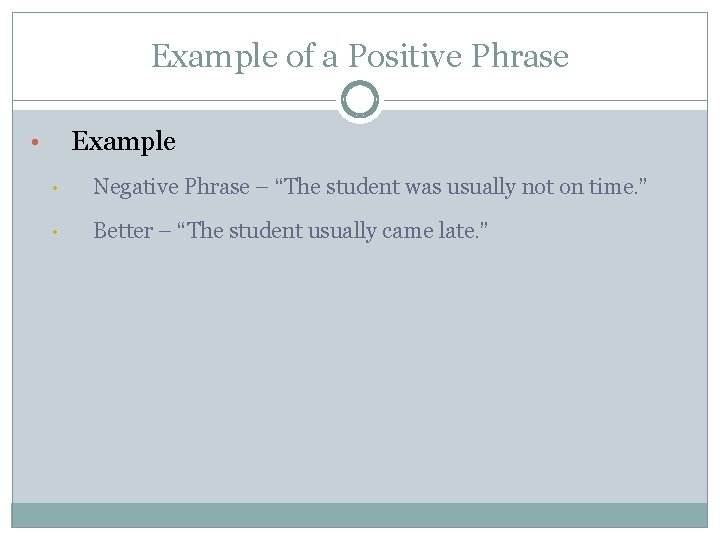
Example of a Positive Phrase Example • • Negative Phrase – “The student was usually not on time. ” • Better – “The student usually came late. ”
Subordination is the restructuring of clauses within other clauses. Utilizing subordination eliminates a lot of words. Utilizing subordination usually increases clarity.
Example of Subordination Example 1. • Original – “The intervention was used to treat autism, and it took five steps. ” • With Subordination – “The intervention was used to treat autism in five steps. ” Or “The five-step intervention was used to treat autism. ” Or “The five-step intervention treated autism. ”
Things to avoid Contractions Incorrect uses of believe, think, or feel You think with your brain, believe with your soul, and feel with your senses. Colloquial terms Abbreviations
Paragraph Construction Every paragraph should have one and only one independent idea. A paragraph should always have a beginning, middle and end. The beginning introduces your idea with a topic sentence. The middle explains your idea with supporting sentences. The end connects your idea to the rest of the paragraph or the section with a concluding sentence. In academic writing, the concluding sentence is typically used only for long paragraphs. Be careful of long paragraphs as they usually contain more than one independent idea.
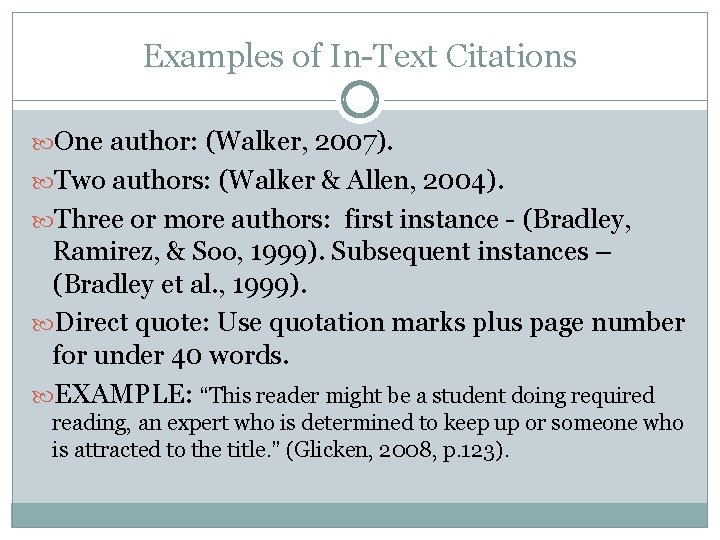
Examples of In-Text Citations One author: (Walker, 2007). Two authors: (Walker & Allen, 2004). Three or more authors: first instance - (Bradley, Ramirez, & Soo, 1999). Subsequent instances – (Bradley et al. , 1999). Direct quote: Use quotation marks plus page number for under 40 words. EXAMPLE: “This reader might be a student doing required reading, an expert who is determined to keep up or someone who is attracted to the title. ” (Glicken, 2008, p. 123).
Reference Page All references must have been used in internal citation and vice versa Reference list must be in alphabetical order
Examples of References Book Chapter in book Article from journal/periodical Electronic copy of journal article Internet document
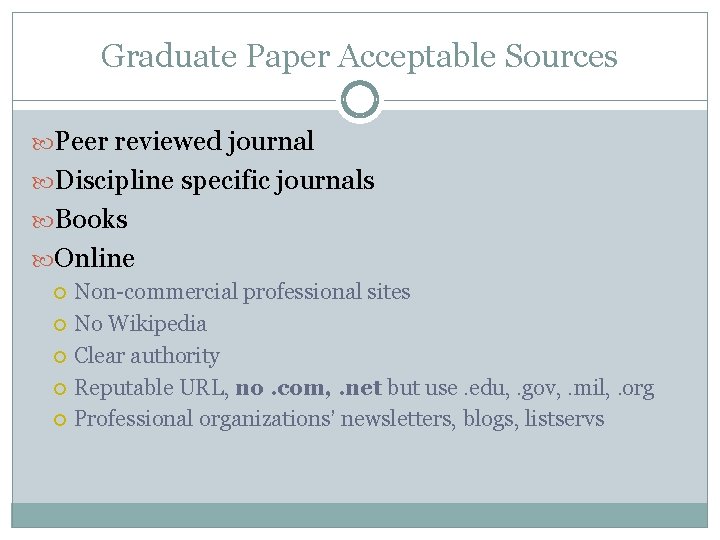
Graduate Paper Acceptable Sources Peer reviewed journal Discipline specific journals Books Online Non-commercial professional sites No Wikipedia Clear authority Reputable URL, no. com, . net but use. edu, . gov, . mil, . org Professional organizations’ newsletters, blogs, listservs
Academic Honesty Policy “Plagiarism is the unacknowledged use of another individual's ideas, words, labor, or assistance. All coursework submitted by a student, including papers, examinations, laboratory reports, and oral presentations, is expected to be the individual effort of the student presenting the work. When it is not, that assistance must be reported to the instructor. If the work involves the consultation of other resources such as journals, books, or other media, those resources must be cited in the appropriate style. All other borrowed material, such as suggestions for organization, ideas, or actual language, must also be cited. Failure to cite any borrowed material, including information from the internet, constitutes plagiarism…”
Academic Honesty Policy Utica College expects its faculty and students to observe traditional canons of scholarly discourse, academic behavior, and due process. The faculty at Utica College expect intellectual honesty from students. Intellectual honesty is necessary for the free exchange of ideas. Plagiarism, a serious form of intellectual dishonesty, is defined as the use of ideas and phrases in the writings of others as one’s own without crediting the source. Cheating refers to both giving and receiving unauthorized assistance in taking examinations. Students who assist other students in acts of plagiarism and/or cheating, or who otherwise contribute to acts of intellectual dishonesty, are subject to the appropriate penalties. Utica College faculty are authorized to assign academic penalties for intellectual dishonesty, including the grade of “F for cheating. ” Students who receive an “F for cheating” forfeit their rights to withdraw from the course without penalty. Students who wish to appeal a penalty should consult with Academic Support Services. Appeals are heard by the Academic Standards Committee, which may recommend a more or less severe penalty. Utica College Academic Honesty Policyhttp: //catalog. utica. edu/content. php? catoid=9&navoid=373#Intellectual_Honesty
Resources through Utica College Faculty Librarians Writing Center Smarthinking (http: //www. utica. edu/student/development/smart/index. cfm) Read and Write Gold (https: //www. utica. edu/student/development/learning/rwgold/index. cfm) These are all free services to all UC students so please take advantage.