
Guide to English Spelling Rules Basics of British
Guide to English Spelling Rules Basics of British and American spelling with a minimum of effort Page Contents ¡ ¡ ¡ ¡ Noun Plural Formation Dropping and Doubling of Letters Troublesome Suffixes and Endings General Observations Words Commonly Confused Troublesome Prefixes One Word or More?

Noun Plural Formation Spelling Rules To form the plural of most nouns, simply add -s Examples cat > cats dog > dogs Exceptions Surviving Old English plural forms: deer > deer; sheep > sheep; ox > oxen; man > men; woman > women; child > children; brother (in a religious sense) > brethren; foot > feet; tooth > teeth. Some compound nouns: passer-by > passers-by; mother-in-law > mothers-in-law. Plural forms of not fully naturalized foreign words: chateau > chateaux; crisis > crises; formula > formulae; index > indices; stimulus > stimuli Plural forms of metric abbreviations: 100 km (kilometres) 60 g (grams) 2. 5 l (litres) Note that with non-metric measurements plural s is optional: 60 lb or 60 lbs

Noun Plural Formation Spelling Rules To form the plural of nouns ending in s, sh, ss, z, x or ch, add -es to facilitate pronunciation To form the plural of nouns ending in y preceded by a consonant, change the y to an i and then add -es Examples gas > gases dish > dishes boss > bosses box > boxes watch > watches lady > ladies baby > babies strawberry > strawberries laboratory > laboratories Exceptions lay-by > lay-bys (Br. E); stand-by > stand-bys Family names: Mr. & Mrs. Brady > The Bradys
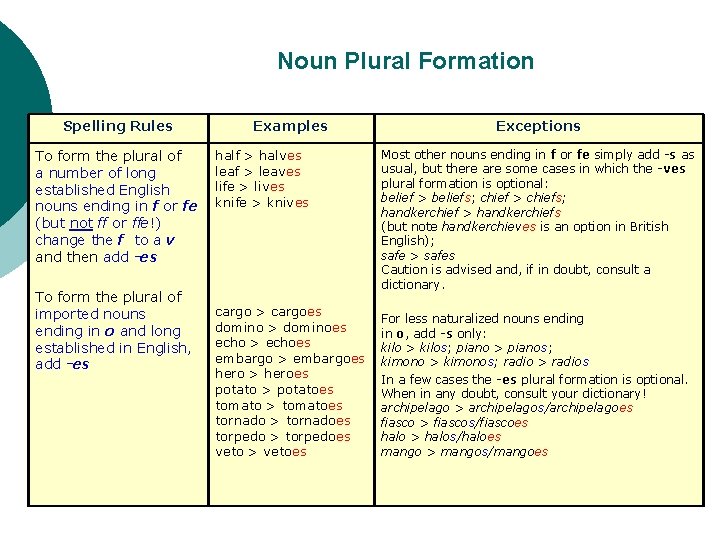
Noun Plural Formation Spelling Rules To form the plural of a number of long established English nouns ending in f or fe (but not ff or ffe!) change the f to a v and then add -es To form the plural of imported nouns ending in o and long established in English, add -es Examples half > halves leaf > leaves life > lives knife > knives cargo > cargoes domino > dominoes echo > echoes embargo > embargoes hero > heroes potato > potatoes tomato > tomatoes tornado > tornadoes torpedo > torpedoes veto > vetoes Exceptions Most other nouns ending in f or fe simply add -s as usual, but there are some cases in which the -ves plural formation is optional: belief > beliefs; chief > chiefs; handkerchief > handkerchiefs (but note handkerchieves is an option in British English); safe > safes Caution is advised and, if in doubt, consult a dictionary. For less naturalized nouns ending in o, add -s only: kilo > kilos; piano > pianos; kimono > kimonos; radio > radios In a few cases the -es plural formation is optional. When in any doubt, consult your dictionary! archipelago > archipelagos/archipelagoes fiasco > fiascos/fiascoes halo > halos/haloes mango > mangos/mangoes
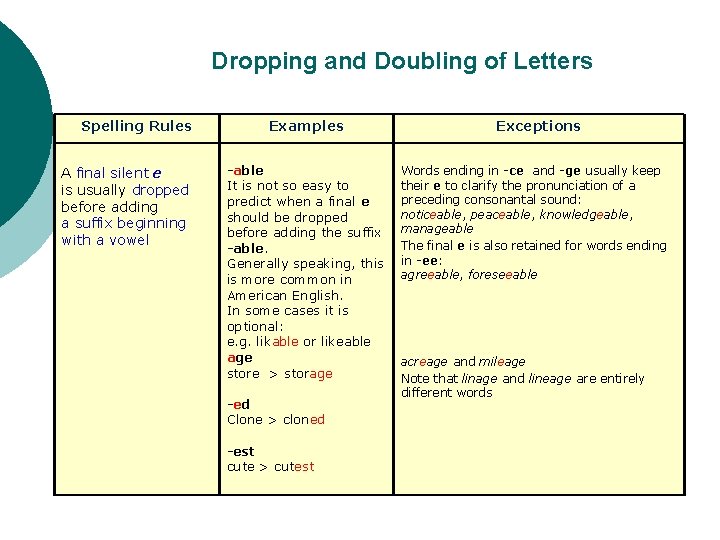
Dropping and Doubling of Letters Spelling Rules A final silent e is usually dropped before adding a suffix beginning with a vowel Examples Exceptions -able It is not so easy to predict when a final e should be dropped before adding the suffix -able. Generally speaking, this is more common in American English. In some cases it is optional: e. g. likable or likeable age store > storage Words ending in -ce and -ge usually keep their e to clarify the pronunciation of a preceding consonantal sound: noticeable, peaceable, knowledgeable, manageable The final e is also retained for words ending in -ee: agreeable, foreseeable -ed Clone > cloned -est cute > cutest acreage and mileage Note that linage and lineage are entirely different words
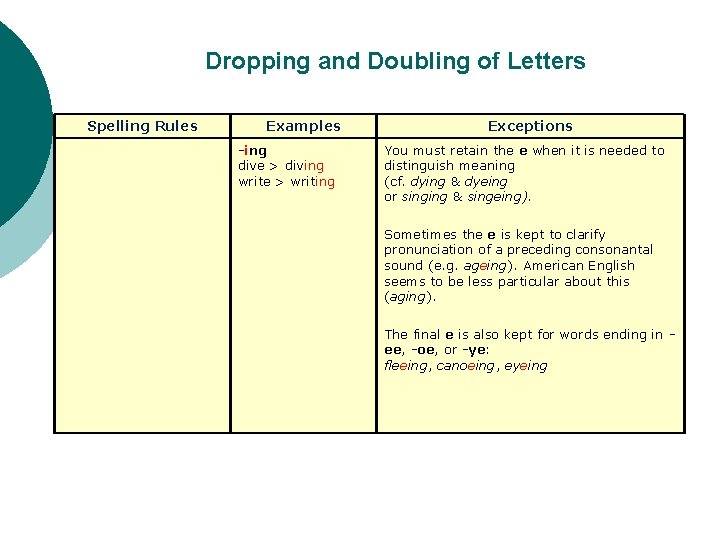
Dropping and Doubling of Letters Spelling Rules Examples -ing dive > diving write > writing Exceptions You must retain the e when it is needed to distinguish meaning (cf. dying & dyeing or singing & singeing). Sometimes the e is kept to clarify pronunciation of a preceding consonantal sound (e. g. ageing). American English seems to be less particular about this (aging). The final e is also kept for words ending in ee, -oe, or -ye: fleeing, canoeing, eyeing
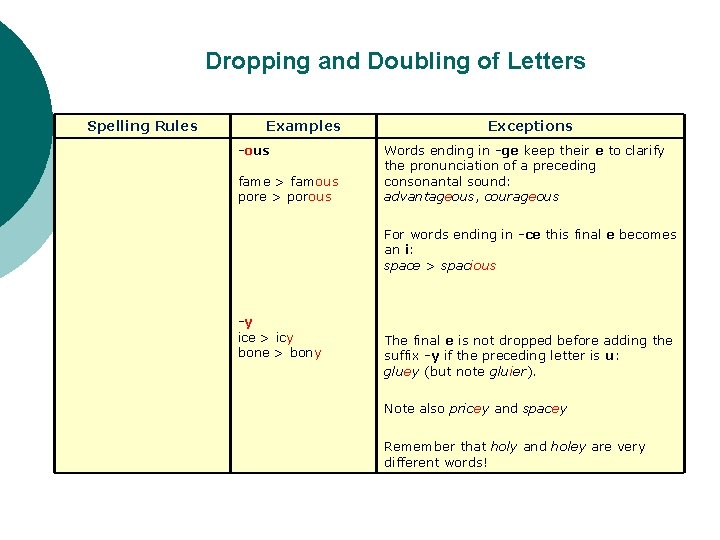
Dropping and Doubling of Letters Spelling Rules Examples -ous fame > famous pore > porous Exceptions Words ending in -ge keep their e to clarify the pronunciation of a preceding consonantal sound: advantageous, courageous For words ending in -ce this final e becomes an i: space > spacious -y ice > icy bone > bony The final e is not dropped before adding the suffix -y if the preceding letter is u: gluey (but note gluier). Note also pricey and spacey Remember that holy and holey are very different words!
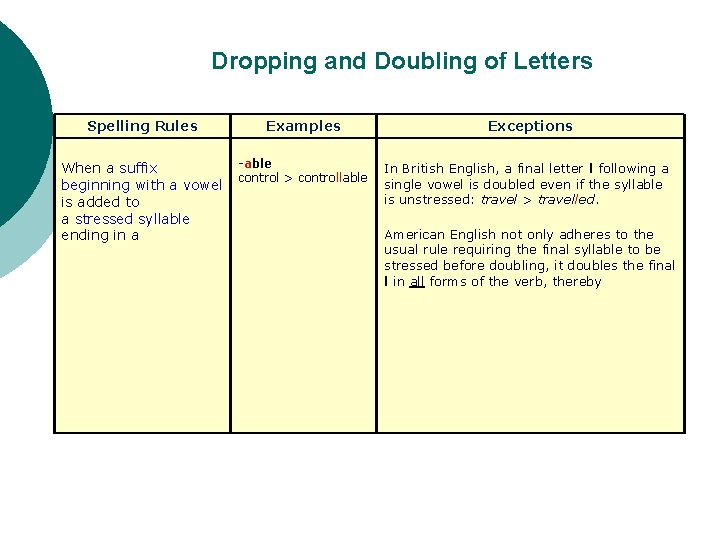
Dropping and Doubling of Letters Spelling Rules Examples -able When a suffix control > controllable beginning with a vowel is added to a stressed syllable ending in a Exceptions In British English, a final letter l following a single vowel is doubled even if the syllable is unstressed: travel > travelled. American English not only adheres to the usual rule requiring the final syllable to be stressed before doubling, it doubles the final l in all forms of the verb, thereby
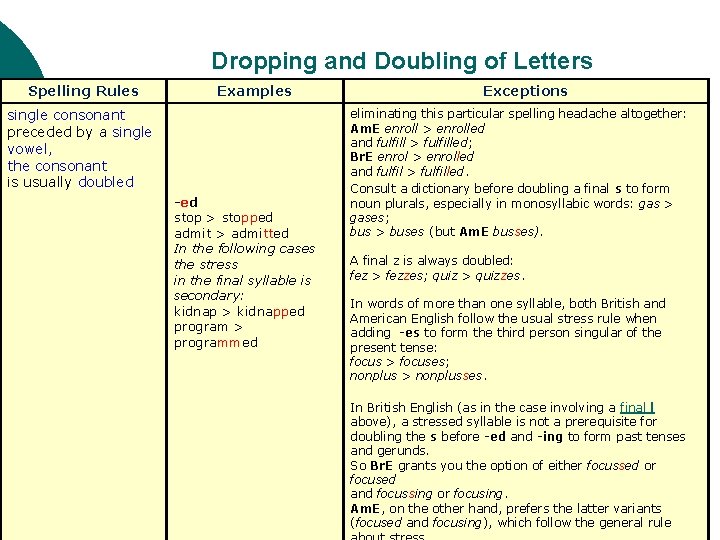
Dropping and Doubling of Letters Spelling Rules Examples single consonant preceded by a single vowel, the consonant is usually doubled -ed stop > stopped admit > admitted In the following cases the stress in the final syllable is secondary: kidnap > kidnapped program > programmed Exceptions eliminating this particular spelling headache altogether: Am. E enroll > enrolled and fulfill > fulfilled; Br. E enrol > enrolled and fulfil > fulfilled. Consult a dictionary before doubling a final s to form noun plurals, especially in monosyllabic words: gas > gases; bus > buses (but Am. E busses). A final z is always doubled: fez > fezzes; quiz > quizzes. In words of more than one syllable, both British and American English follow the usual stress rule when adding -es to form the third person singular of the present tense: focus > focuses; nonplus > nonplusses. In British English (as in the case involving a final l above), a stressed syllable is not a prerequisite for doubling the s before -ed and -ing to form past tenses and gerunds. So Br. E grants you the option of either focussed or focused and focussing or focusing. Am. E, on the other hand, prefers the latter variants (focused and focusing), which follow the general rule
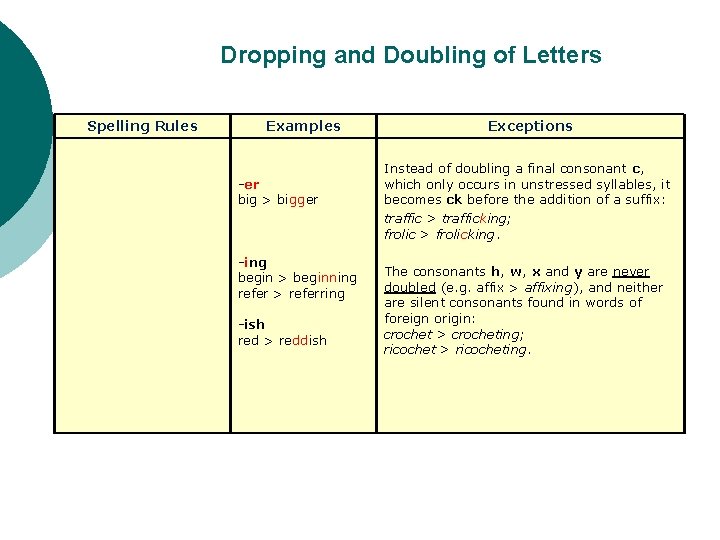
Dropping and Doubling of Letters Spelling Rules Examples -er big > bigger -ing begin > beginning refer > referring -ish red > reddish Exceptions Instead of doubling a final consonant c, which only occurs in unstressed syllables, it becomes ck before the addition of a suffix: traffic > trafficking; frolic > frolicking. The consonants h, w, x and y are never doubled (e. g. affix > affixing), and neither are silent consonants found in words of foreign origin: crochet > crocheting; ricochet > ricocheting.
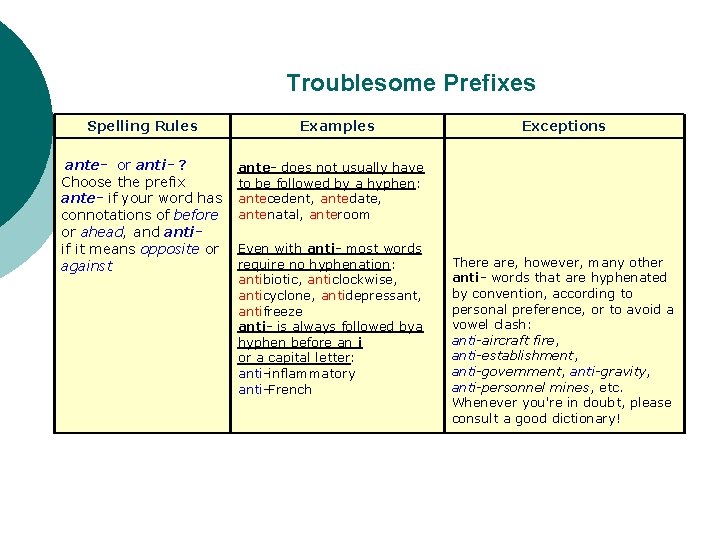
Troublesome Prefixes Spelling Rules ante- or anti- ? Choose the prefix ante- if your word has connotations of before or ahead, and antiif it means opposite or against Examples Exceptions ante- does not usually have to be followed by a hyphen: antecedent, antedate, antenatal, anteroom Even with anti- most words require no hyphenation: antibiotic, anticlockwise, anticyclone, antidepressant, antifreeze anti- is always followed bya hyphen before an i or a capital letter: anti-inflammatory anti-French There are, however, many other anti- words that are hyphenated by convention, according to personal preference, or to avoid a vowel clash: anti-aircraft fire, anti-establishment, anti-government, anti-gravity, anti-personnel mines, etc. Whenever you're in doubt, please consult a good dictionary!
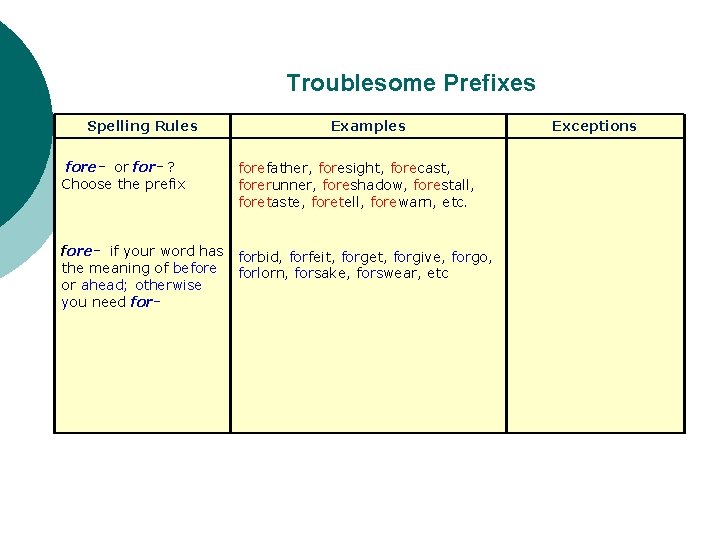
Troublesome Prefixes Spelling Rules fore- or for- ? Choose the prefix Examples forefather, foresight, forecast, forerunner, foreshadow, forestall, foretaste, foretell, forewarn, etc. fore- if your word has forbid, forfeit, forget, forgive, forgo, the meaning of before forlorn, forsake, forswear, etc or ahead; otherwise you need for- Exceptions
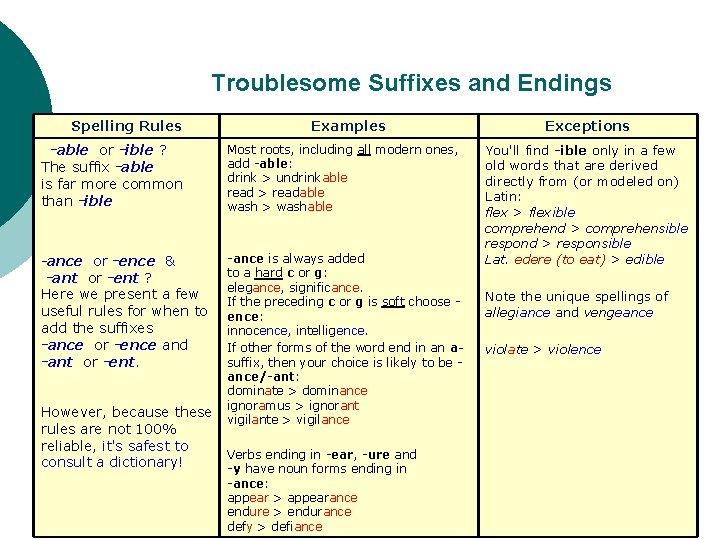
Troublesome Suffixes and Endings Spelling Rules -able or -ible ? The suffix -able is far more common than -ible Examples Most roots, including all modern ones, add -able: drink > undrinkable read > readable wash > washable -ance is always added to a hard c or g: -ant or -ent ? elegance, significance. Here we present a few If the preceding c or g is soft choose useful rules for when to ence: add the suffixes innocence, intelligence. -ance or -ence and If other forms of the word end in an asuffix, then your choice is likely to be -ant or -ent. ance/-ant: dominate > dominance ignoramus > ignorant However, because these vigilante > vigilance -ance or -ence & rules are not 100% reliable, it's safest to consult a dictionary! Verbs ending in -ear, -ure and -y have noun forms ending in -ance: appear > appearance endure > endurance defy > defiance Exceptions You'll find -ible only in a few old words that are derived directly from (or modeled on) Latin: flex > flexible comprehend > comprehensible respond > responsible Lat. edere (to eat) > edible Note the unique spellings of allegiance and vengeance violate > violence
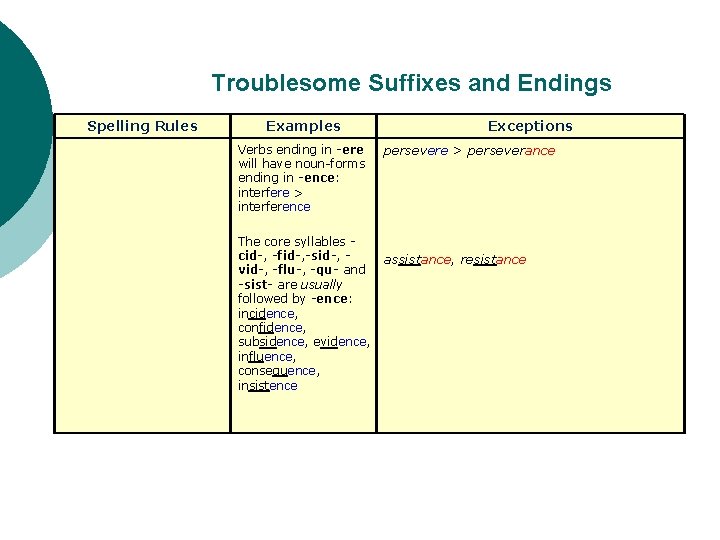
Troublesome Suffixes and Endings Spelling Rules Examples Verbs ending in -ere will have noun-forms ending in -ence: interfere > interference Exceptions persevere > perseverance The core syllables cid-, -fid-, -sid-, assistance, resistance vid-, -flu-, -qu- and -sist- are usually followed by -ence: incidence, confidence, subsidence, evidence, influence, consequence, insistence
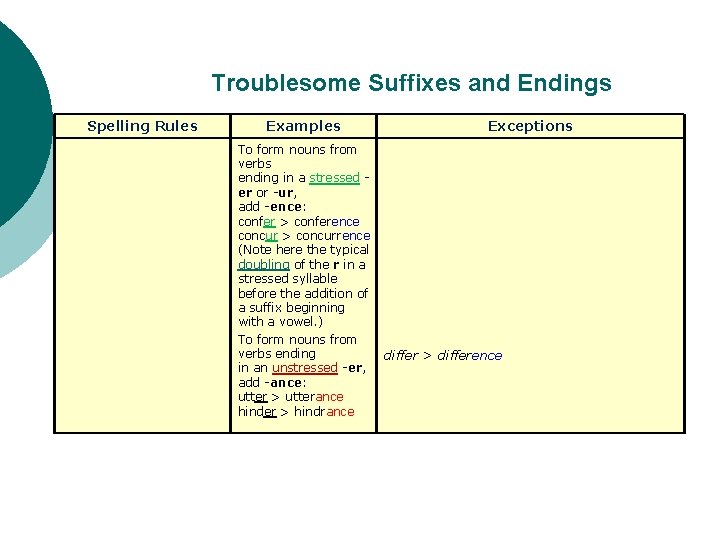
Troublesome Suffixes and Endings Spelling Rules Examples Exceptions To form nouns from verbs ending in a stressed er or -ur, add -ence: confer > conference concur > concurrence (Note here the typical doubling of the r in a stressed syllable before the addition of a suffix beginning with a vowel. ) To form nouns from verbs ending differ > difference in an unstressed -er, add -ance: utter > utterance hinder > hindrance
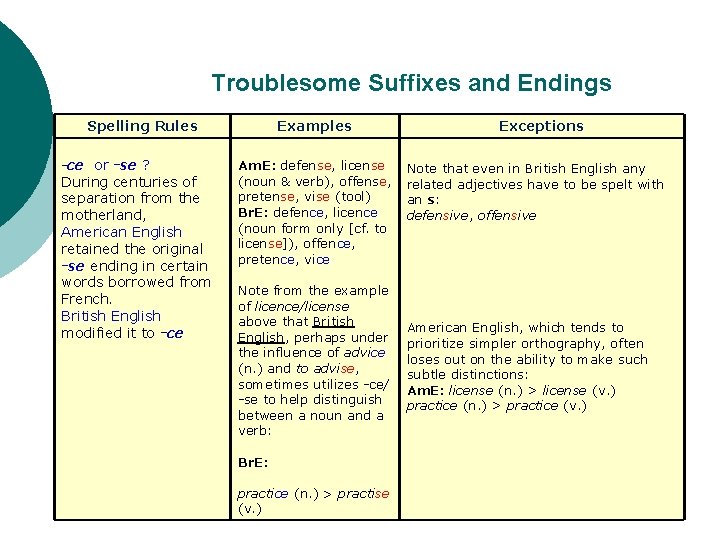
Troublesome Suffixes and Endings Spelling Rules -ce or -se ? During centuries of separation from the motherland, American English retained the original -se ending in certain words borrowed from French. British English modified it to -ce Examples Am. E: defense, license (noun & verb), offense, pretense, vise (tool) Br. E: defence, licence (noun form only [cf. to license]), offence, pretence, vice Note from the example of licence/license above that British English, perhaps under the influence of advice (n. ) and to advise, sometimes utilizes -ce/ -se to help distinguish between a noun and a verb: Br. E: practice (n. ) > practise (v. ) Exceptions Note that even in British English any related adjectives have to be spelt with an s: defensive, offensive American English, which tends to prioritize simpler orthography, often loses out on the ability to make such subtle distinctions: Am. E: license (n. ) > license (v. ) practice (n. ) > practice (v. )
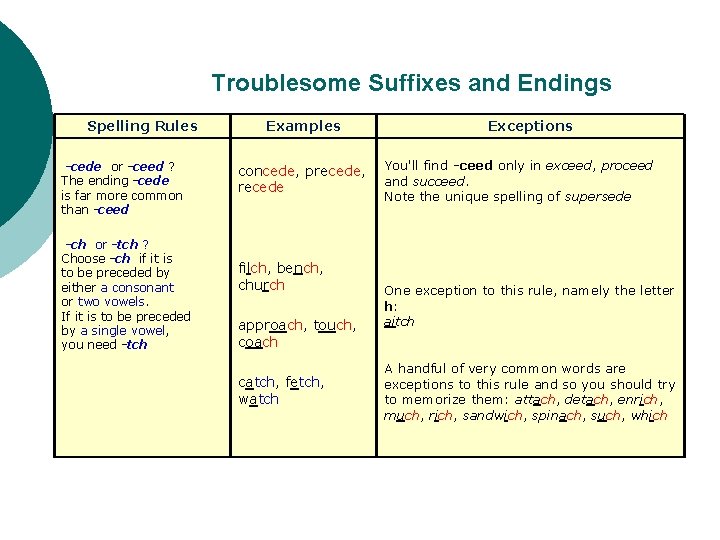
Troublesome Suffixes and Endings Spelling Rules -cede or -ceed ? The ending -cede is far more common than -ceed -ch or -tch ? Choose -ch if it is to be preceded by either a consonant or two vowels. If it is to be preceded by a single vowel, you need -tch Examples Exceptions concede, precede, You'll find -ceed only in exceed, proceed and succeed. recede Note the unique spelling of supersede filch, bench, church approach, touch, coach catch, fetch, watch One exception to this rule, namely the letter h: aitch A handful of very common words are exceptions to this rule and so you should try to memorize them: attach, detach, enrich, much, rich, sandwich, spinach, such, which
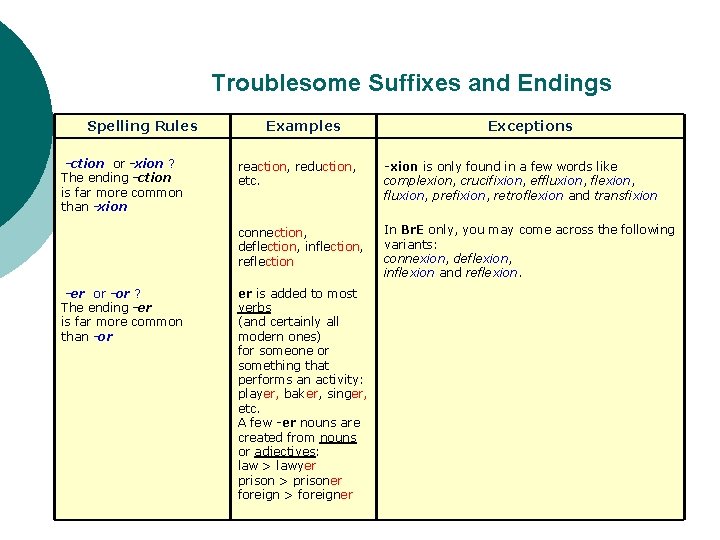
Troublesome Suffixes and Endings Spelling Rules -ction or -xion ? The ending -ction is far more common than -xion -er or -or ? The ending -er is far more common than -or Examples Exceptions reaction, reduction, etc. -xion is only found in a few words like complexion, crucifixion, effluxion, flexion, fluxion, prefixion, retroflexion and transfixion connection, deflection, inflection, reflection In Br. E only, you may come across the following variants: connexion, deflexion, inflexion and reflexion. er is added to most verbs (and certainly all modern ones) for someone or something that performs an activity: player, baker, singer, etc. A few -er nouns are created from nouns or adjectives: law > lawyer prison > prisoner foreign > foreigner
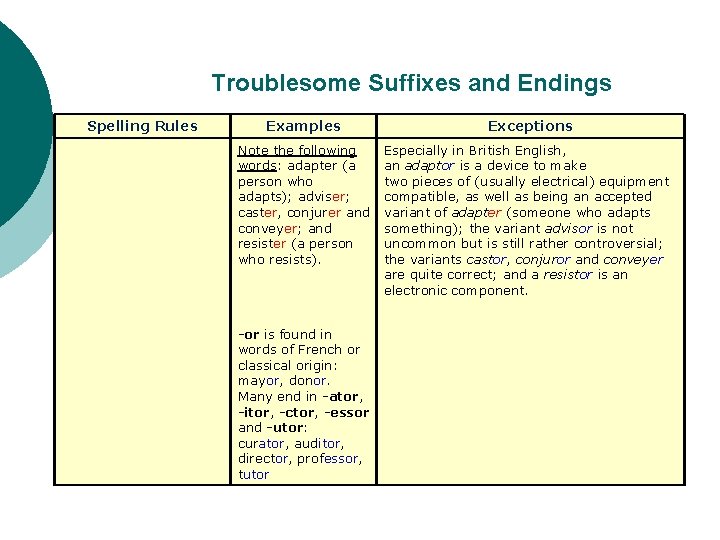
Troublesome Suffixes and Endings Spelling Rules Examples Exceptions Note the following words: adapter (a person who adapts); adviser; caster, conjurer and conveyer; and resister (a person who resists). Especially in British English, an adaptor is a device to make two pieces of (usually electrical) equipment compatible, as well as being an accepted variant of adapter (someone who adapts something); the variant advisor is not uncommon but is still rather controversial; the variants castor, conjuror and conveyer are quite correct; and a resistor is an electronic component. -or is found in words of French or classical origin: mayor, donor. Many end in -ator, -itor, -ctor, -essor and -utor: curator, auditor, director, professor, tutor
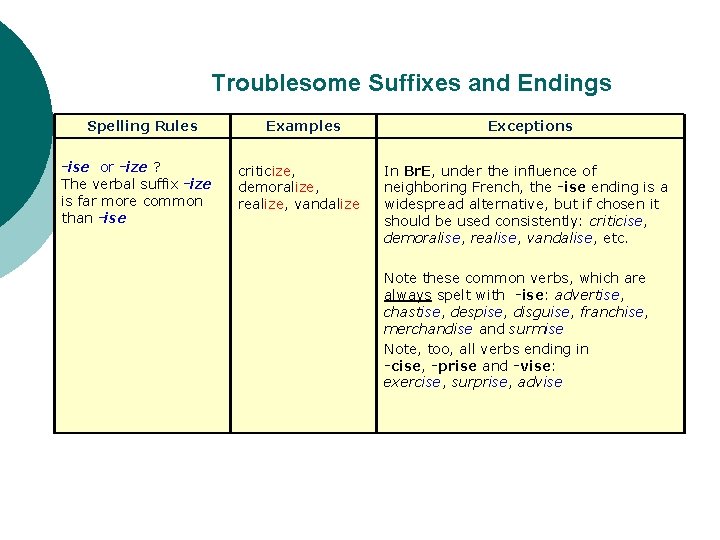
Troublesome Suffixes and Endings Spelling Rules -ise or -ize ? The verbal suffix -ize is far more common than -ise Examples Exceptions criticize, demoralize, realize, vandalize In Br. E, under the influence of neighboring French, the -ise ending is a widespread alternative, but if chosen it should be used consistently: criticise, demoralise, realise, vandalise, etc. Note these common verbs, which are always spelt with -ise: advertise, chastise, despise, disguise, franchise, merchandise and surmise Note, too, all verbs ending in -cise, -prise and -vise: exercise, surprise, advise
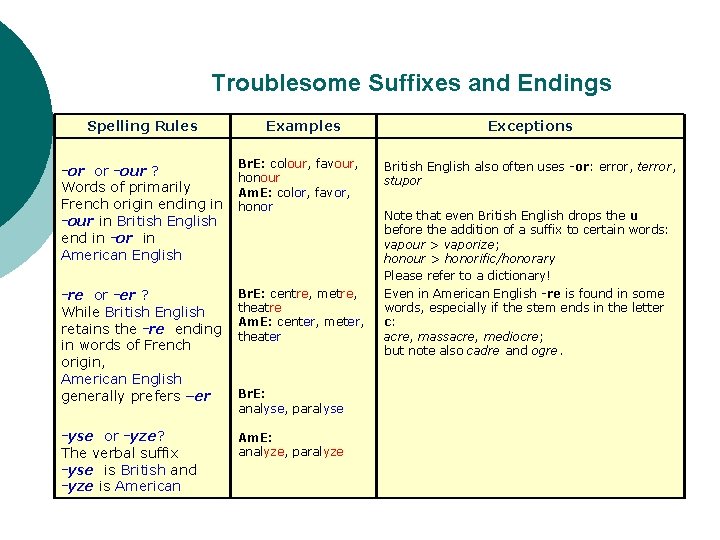
Troublesome Suffixes and Endings Spelling Rules Examples Exceptions Br. E: colour, favour, British English also often uses -or: error, terror, stupor -or or -our ? honour Words of primarily Am. E: color, favor, French origin ending in honor -our in British English end in -or in American English -re or -er ? While British English retains the -re ending in words of French origin, American English generally prefers –er Br. E: centre, metre, theatre Am. E: center, meter, theater -yse or -yze? The verbal suffix -yse is British and -yze is American Am. E: analyze, paralyze Br. E: analyse, paralyse Note that even British English drops the u before the addition of a suffix to certain words: vapour > vaporize; honour > honorific/honorary Please refer to a dictionary! Even in American English -re is found in some words, especially if the stem ends in the letter c: acre, massacre, mediocre; but note also cadre and ogre.

General Observations Spelling Rules -ae/oe or -e ? ae and oe in words of Greek or Latin origin are retained in British English and replaced with a simple e in American English -ie- or -ei- ? In the case of 'ee' /i: / sounds i goes before e except after c q_? q is almost invariably followed by u Examples Br. E: archaeology, gynaecology, haemoglobin, diarrhoea, foetus, oesophagus Exceptions Even in British English there is a slow trend toward simplification: For example, the form encyclopedia is now much more common than encyclopaedia. Am. E: archeology, gynecology, hemoglobin, diarrhea, fetus, esophagus believe, chief, siege ceiling, receive, deceit quack, quality, queen, question, quiz, quote Beware of words that have varied pronunciation: either, neither, heinous Some common names: Keith, Sheila, Neil, Madeira Latin words like species Others: caffeine, protein, inveigle, seize, weird Acronyms & non-English words: Qantas (Australian Airline), Al Qaeda (Islamist terror franchise), Qatar (Gulf state), etc.
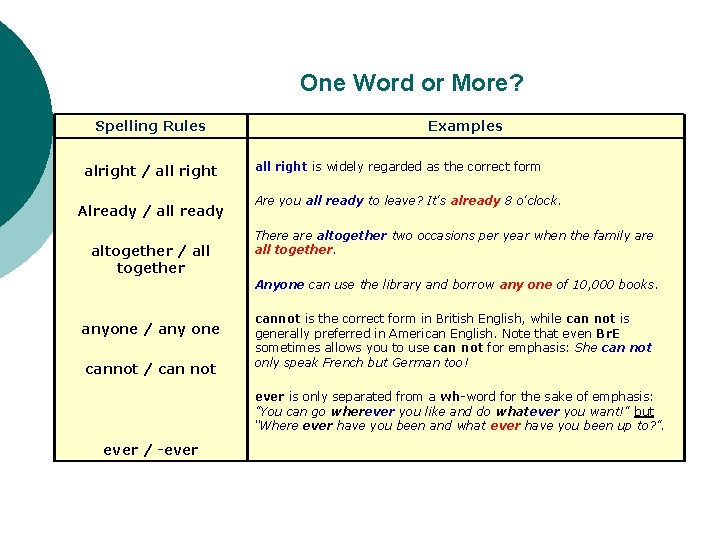
One Word or More? Spelling Rules alright / all right Already / all ready altogether / all together Examples all right is widely regarded as the correct form Are you all ready to leave? It's already 8 o'clock. There altogether two occasions per year when the family are all together. Anyone can use the library and borrow any one of 10, 000 books. anyone / any one cannot / can not cannot is the correct form in British English, while can not is generally preferred in American English. Note that even Br. E sometimes allows you to use can not for emphasis: She can not only speak French but German too! ever is only separated from a wh-word for the sake of emphasis: "You can go wherever you like and do whatever you want!" but "Where ever have you been and what ever have you been up to? ". ever / -ever
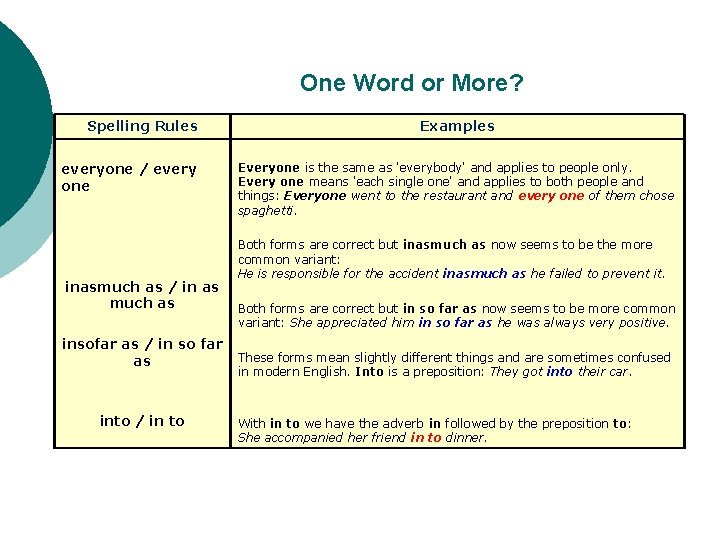
One Word or More? Spelling Rules everyone / every one Examples Everyone is the same as 'everybody' and applies to people only. Every one means 'each single one' and applies to both people and things: Everyone went to the restaurant and every one of them chose spaghetti. Both forms are correct but inasmuch as now seems to be the more common variant: He is responsible for the accident inasmuch as he failed to prevent it. inasmuch as / in as much as Both forms are correct but in so far as now seems to be more common variant: She appreciated him in so far as he was always very positive. insofar as / in so far These forms mean slightly different things and are sometimes confused as in modern English. Into is a preposition: They got into their car. into / in to With in to we have the adverb in followed by the preposition to: She accompanied her friend in to dinner.
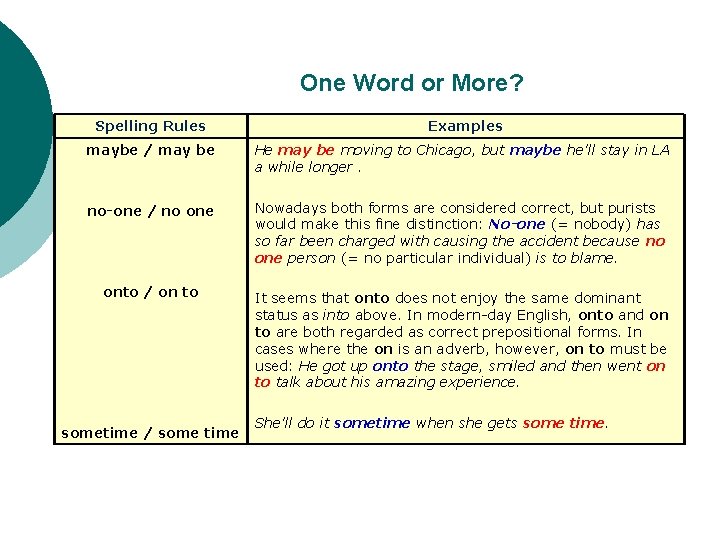
One Word or More? Spelling Rules Examples maybe / may be He may be moving to Chicago, but maybe he'll stay in LA a while longer. no-one / no one Nowadays both forms are considered correct, but purists would make this fine distinction: No-one (= nobody) has so far been charged with causing the accident because no one person (= no particular individual) is to blame. onto / on to It seems that onto does not enjoy the same dominant status as into above. In modern-day English, onto and on to are both regarded as correct prepositional forms. In cases where the on is an adverb, however, on to must be used: He got up onto the stage, smiled and then went on to talk about his amazing experience. sometime / some time She'll do it sometime when she gets some time.
- Slides: 25