
Guide on how to manage atrial fibrillation in
Guide on how to manage atrial fibrillation in the office Tara O’Brien, MD, MSc, FRCPC February 10, 2017
Guiding Principles • Does the patient have symptoms? • What are the patient’s vitals?
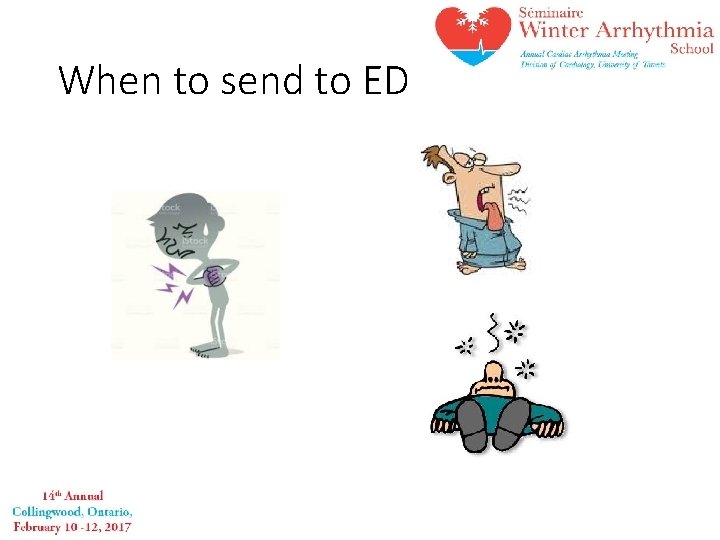
When to send to ED
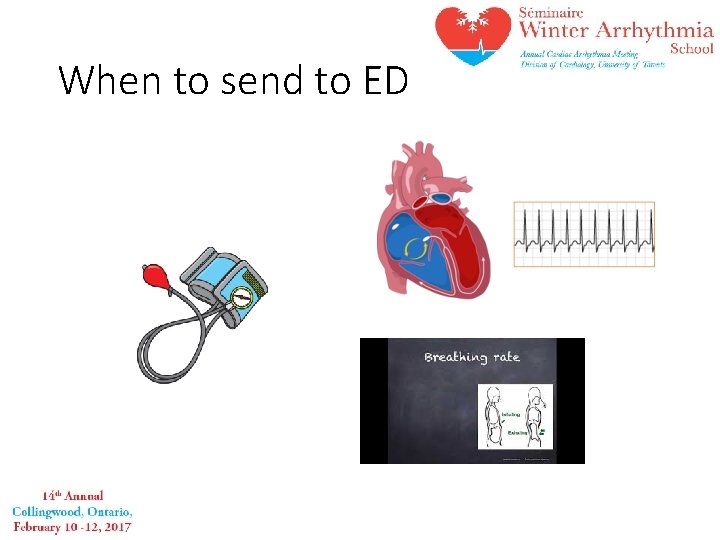
When to send to ED
Does everyone with new afib need to go to the ED?
Approach • Everyone needs an EKG • Etiology (investigations) • Rate/rhythm control • Stroke prevention (anticoagulation)
Case 1 • 75 yr old man with history of HTN presents to the office with SOBOE for 6 weeks. No chest pain and no resting SOB.
Case 1 • On exam: BP 150/80 HR 110 irreg RR 16 Chest clear JVP not elevated Heart sounds normal
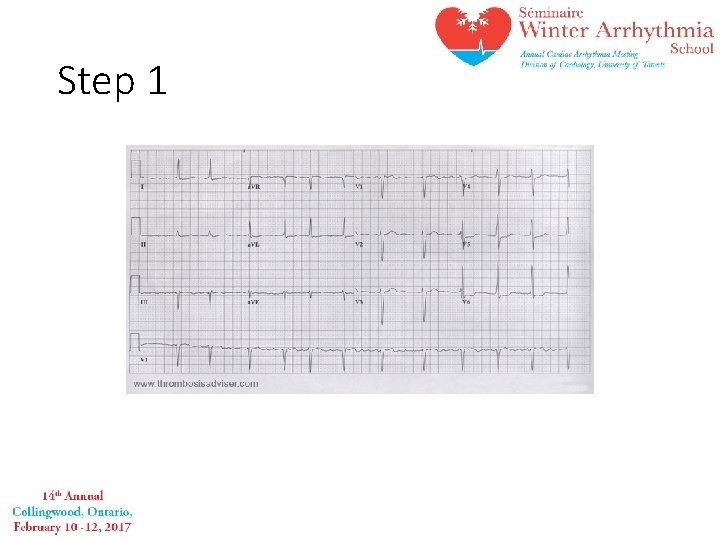
Step 1
Step 2 • Does this patient need to go to the ED?
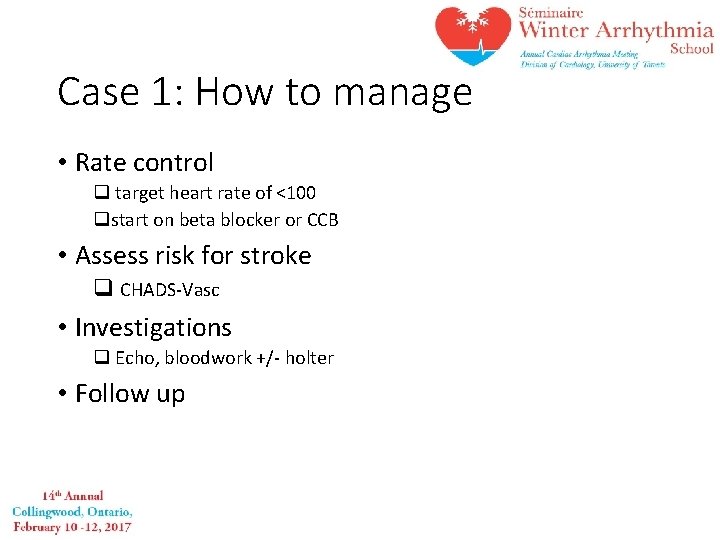
Case 1: How to manage • Rate control q target heart rate of <100 qstart on beta blocker or CCB • Assess risk for stroke q CHADS-Vasc • Investigations q Echo, bloodwork +/- holter • Follow up
Case 2 • 30 yr old man who presents to the office with new palpitations that started 4 hours ago. • Otherwise asymptomatic • BP 140/80 HR 150 irreg RR 16
Case 2: • Does this patient need to go to ED?
Case 2: What will you do
Case 3 • 60 year old man with incidental finding of irregular hear beat on physical exam. He denies palpitations, CP, SOB, syncope. • Otherwise healthy
Case 3 • Physical Exam On exam HR 70 irregular BP 130/80 Chest clear JVP not elevated Heart sounds normal, no murmurs
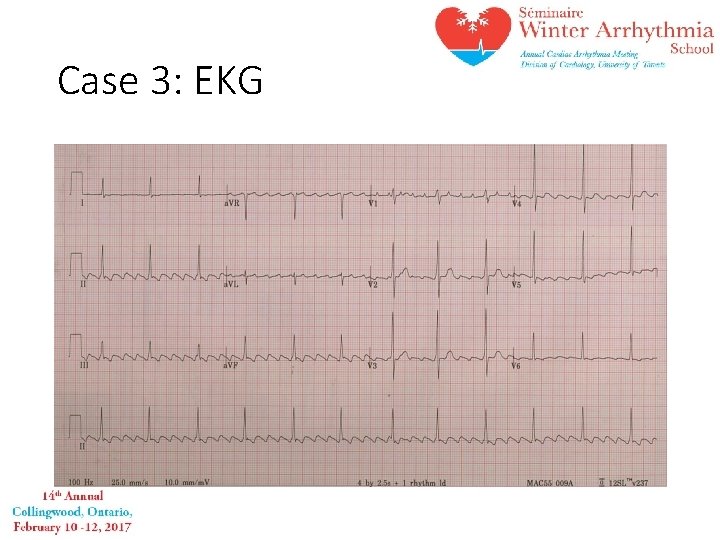
Case 3: EKG
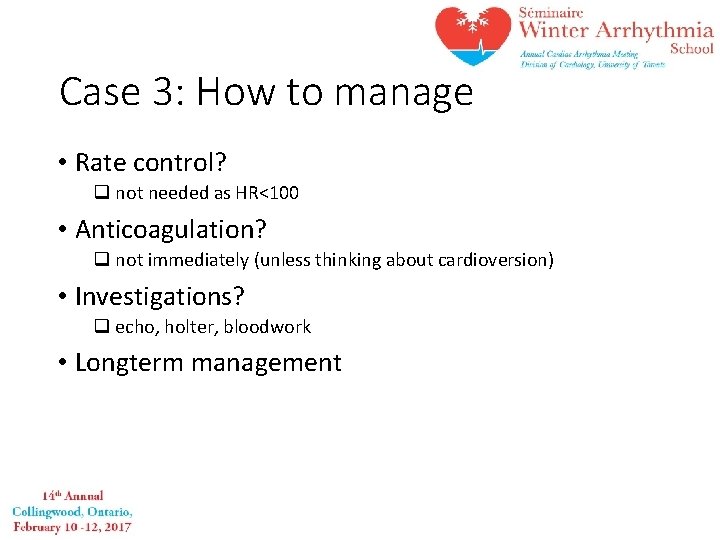
Case 3: How to manage • Rate control? q not needed as HR<100 • Anticoagulation? q not immediately (unless thinking about cardioversion) • Investigations? q echo, holter, bloodwork • Longterm management
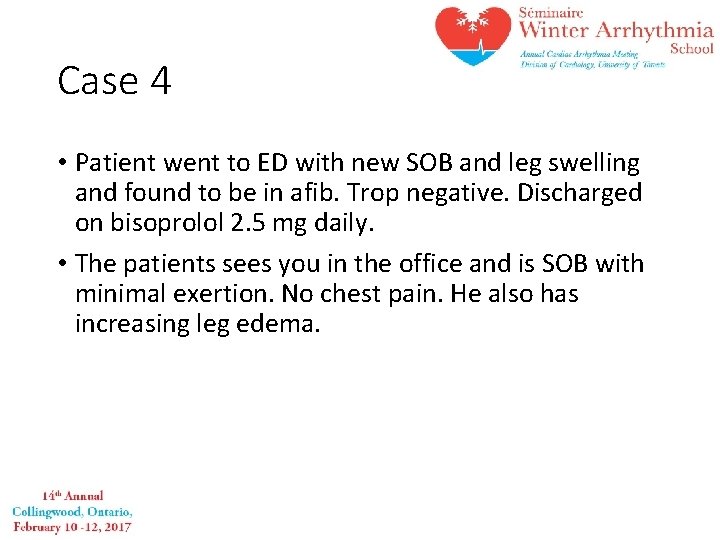
Case 4 • Patient went to ED with new SOB and leg swelling and found to be in afib. Trop negative. Discharged on bisoprolol 2. 5 mg daily. • The patients sees you in the office and is SOB with minimal exertion. No chest pain. He also has increasing leg edema.
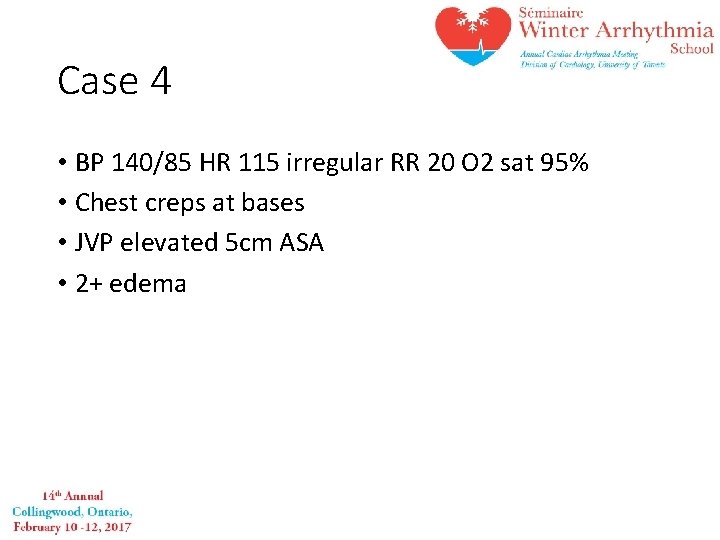
Case 4 • BP 140/85 HR 115 irregular RR 20 O 2 sat 95% • Chest creps at bases • JVP elevated 5 cm ASA • 2+ edema
Case 4: Does this patient need to go to ED?
Case 4 1. Uncontrolled afib 2. Congestive heart failure
Case 4 • Rate control • Anticoagulation • Volume overload • Investigations
Case 4 • In 1 week – much improved with decrease in SOB and heart rate is 95 • Weight has decreased • Echo shows dilated LV with regional wall motion abnormalities – EF 30% • Next steps?
Case 5 • 75 yr old woman with known aortic stenosis who presents with some new mild SOB. • On exam: BP 143/80 HR 104 RR 20 O 2 at 96% chest clear CVS JVP not elevated aortic stenosis murmur • EKG confirms afib
Case 5 • Why does she have afib? • Rate control? • Stroke prevention
Case 5 • Given the aortic stenosis which anticoagulant would you choose? 1. Warfarin 2. New oral anticoagulant
Case 5 • Which type of valvular heart disease can you not use OACs? q Mechanical valves q Mitral stenosis (moderate to severe) q Rheumatic mitral stenosis
Summary Symptoms • YES → Signs ED • Unstable → ED
Questions
- Slides: 30