
Guidance Tools and Techniques By Nichole Welle Environment
Guidance Tools and Techniques By: Nichole Welle
Environment Create a space that fosters positive behaviors.
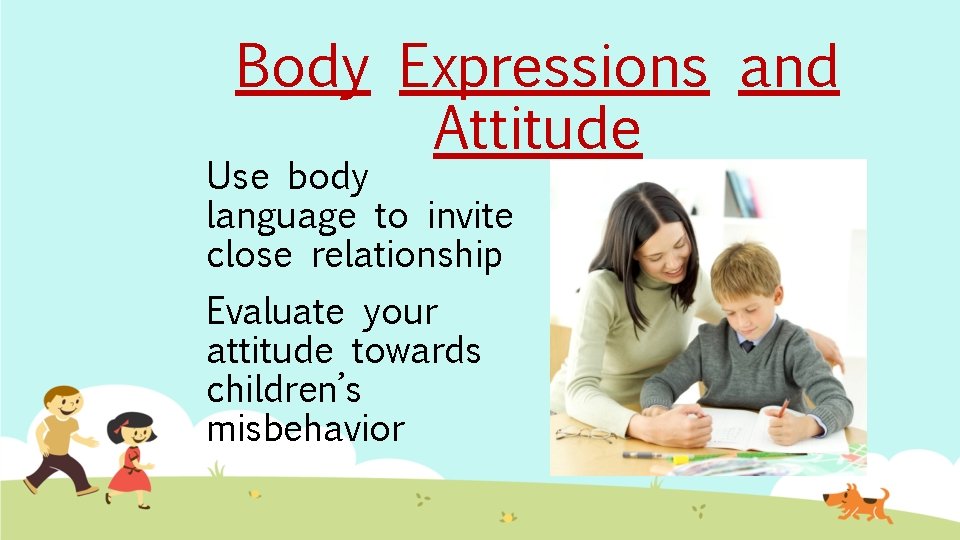
Body Expressions and Attitude Use body language to invite close relationship Evaluate your attitude towards children’s misbehavior
Active Listening Listen carefully, trying to understand what the child is saying beyond the words being used. Reflect back what you think the child has said in your own words
Ignoring Choose not to respond to the child in any way while the behavior persists
Redirection & Distraction Change the activity in which the child is engaged to one that is more acceptable. The new activity may or may not be related to the previous behavior.
Reinforcement The process in which a desired behavior is followed by a consequence that is likely to make the behavior repeated.
Active Problem Solving Engaging the children in confronting their differences and working together to solve their problems.
Offer Choices Suggest two or more choices when there is a possibility of resistance.
Natural Consequence A consequence that is the direct result of the child’s own actions.
Logical Consequence A consequence adults impose that is related to the child’s behavior.
“I” Messages Honest, non-judgmental statements that place no blame on the child but state an observation of behavior and its results.
- Slides: 12