
GST SCENARIO Sec22 Person Liable for REGISTRATION REQUIRED
GST SCENARIO
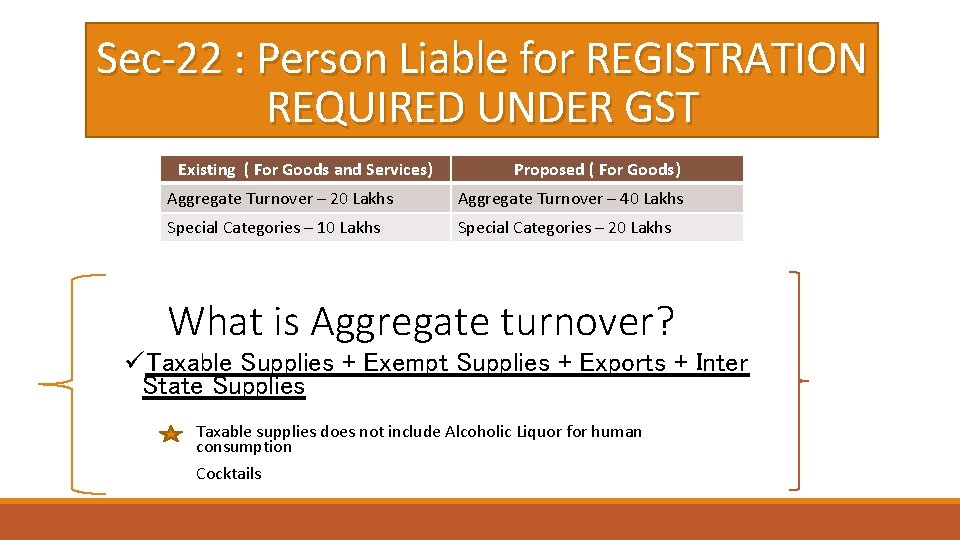
Sec-22 : Person Liable for REGISTRATION REQUIRED UNDER GST Existing ( For Goods and Services) Proposed ( For Goods) Aggregate Turnover – 20 Lakhs Aggregate Turnover – 40 Lakhs Special Categories – 10 Lakhs Special Categories – 20 Lakhs What is Aggregate turnover? üTaxable Supplies + Exempt Supplies + Exports + Inter State Supplies Taxable supplies does not include Alcoholic Liquor for human consumption Cocktails
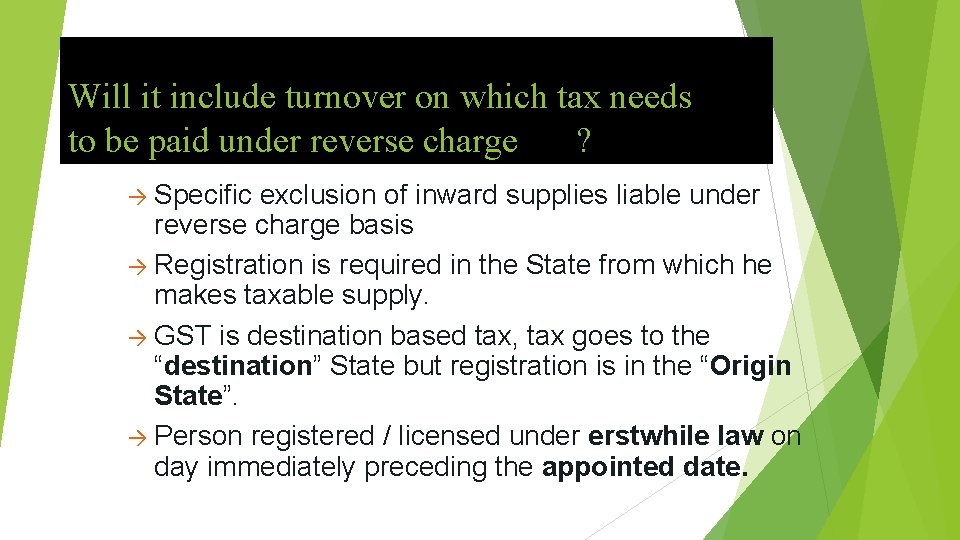
Will it include turnover on which tax needs to be paid under reverse charge ? → Specific exclusion of inward supplies liable under reverse charge basis → Registration is required in the State from which he makes taxable supply. → GST is destination based tax, tax goes to the “destination” State but registration is in the “Origin State”. → Person registered / licensed under erstwhile law on day immediately preceding the appointed date.
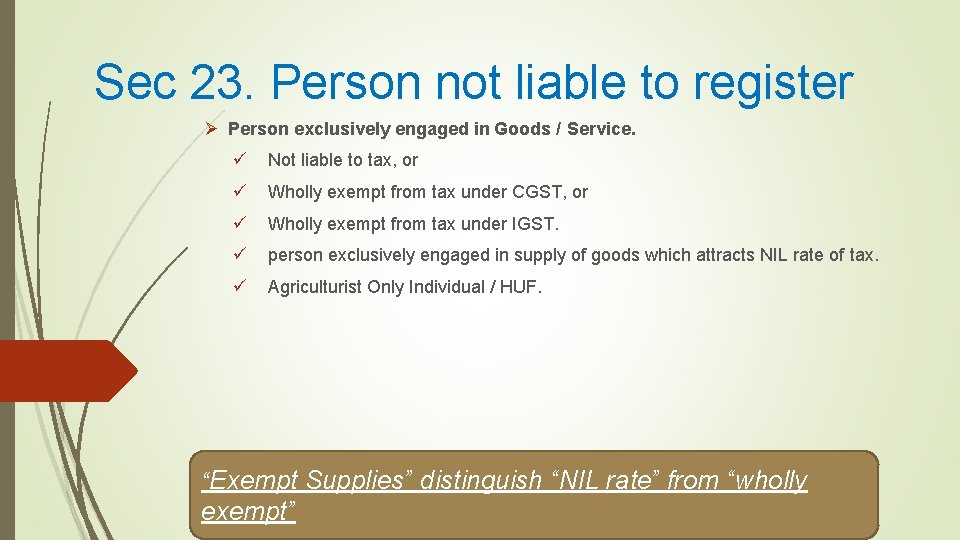
Sec 23. Person not liable to register Ø Person exclusively engaged in Goods / Service. ü Not liable to tax, or ü Wholly exempt from tax under CGST, or ü Wholly exempt from tax under IGST. ü person exclusively engaged in supply of goods which attracts NIL rate of tax. ü Agriculturist Only Individual / HUF. “Exempt Supplies” distinguish “NIL rate” from “wholly exempt”
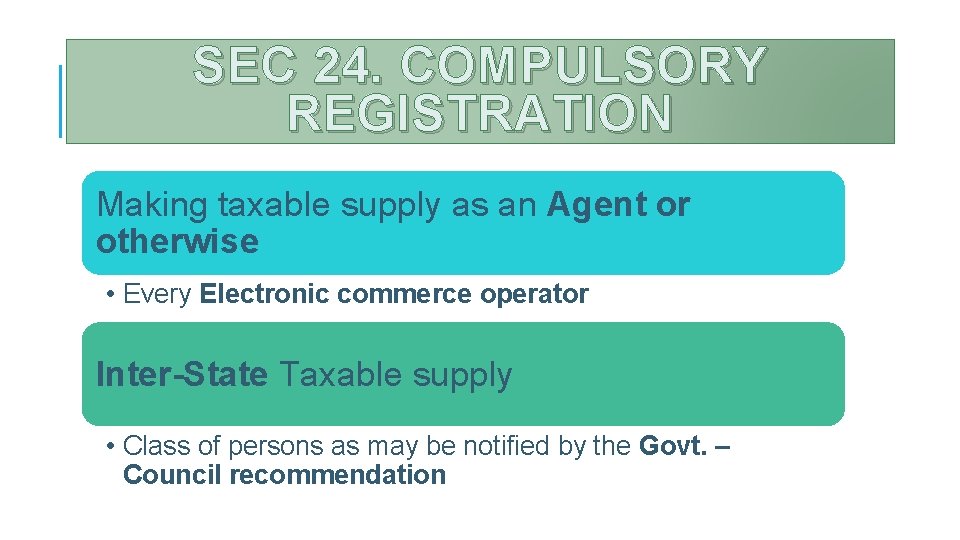
SEC 24. COMPULSORY REGISTRATION Making taxable supply as an Agent or otherwise • Every Electronic commerce operator Inter-State Taxable supply • Class of persons as may be notified by the Govt. – Council recommendation
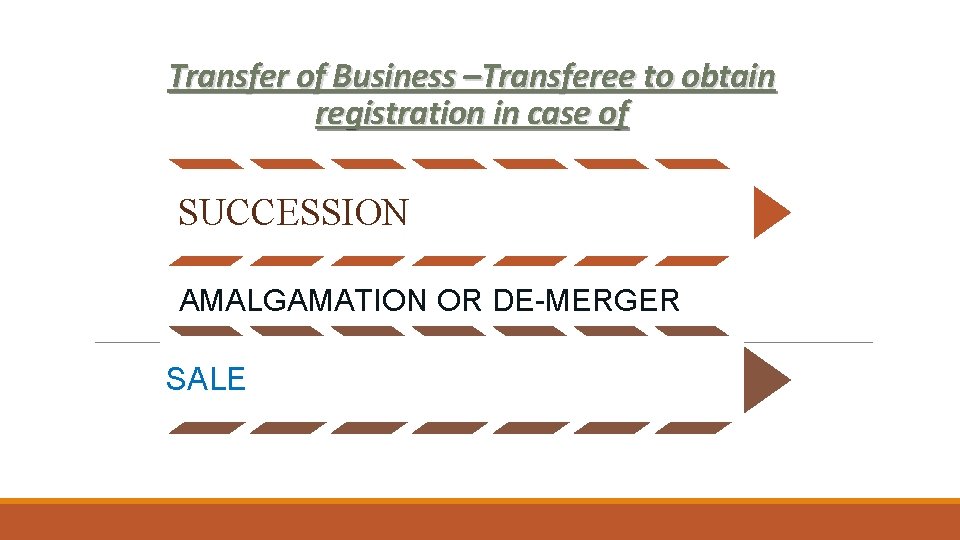
Transfer of Business –Transferee to obtain registration in case of SUCCESSION AMALGAMATION OR DE-MERGER SALE
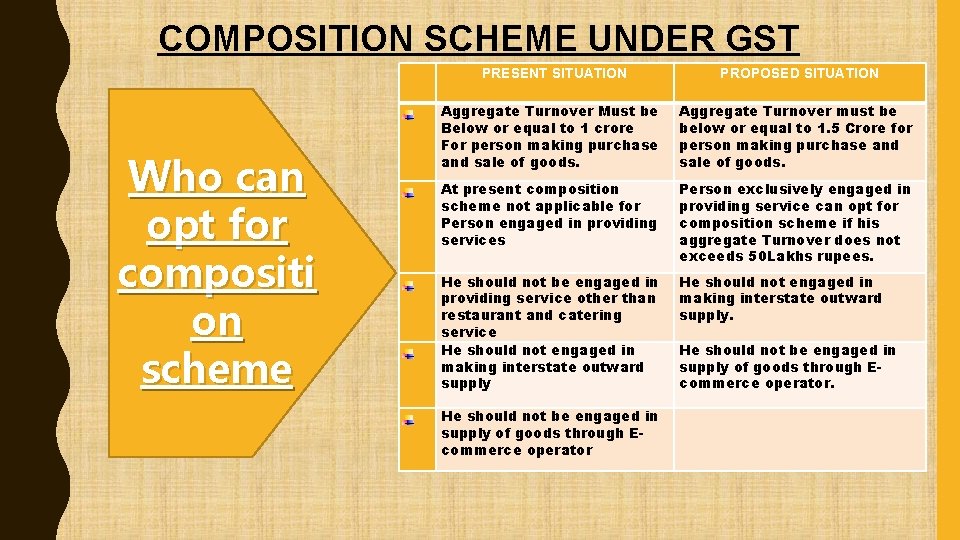
COMPOSITION SCHEME UNDER GST Who can opt for compositi on scheme PRESENT SITUATION PROPOSED SITUATION Aggregate Turnover Must be Below or equal to 1 crore For person making purchase and sale of goods. Aggregate Turnover must be below or equal to 1. 5 Crore for person making purchase and sale of goods. At present composition scheme not applicable for Person engaged in providing services Person exclusively engaged in providing service can opt for composition scheme if his aggregate Turnover does not exceeds 50 Lakhs rupees. He should not be engaged in providing service other than restaurant and catering service He should not engaged in making interstate outward supply. He should not be engaged in supply of goods through Ecommerce operator.
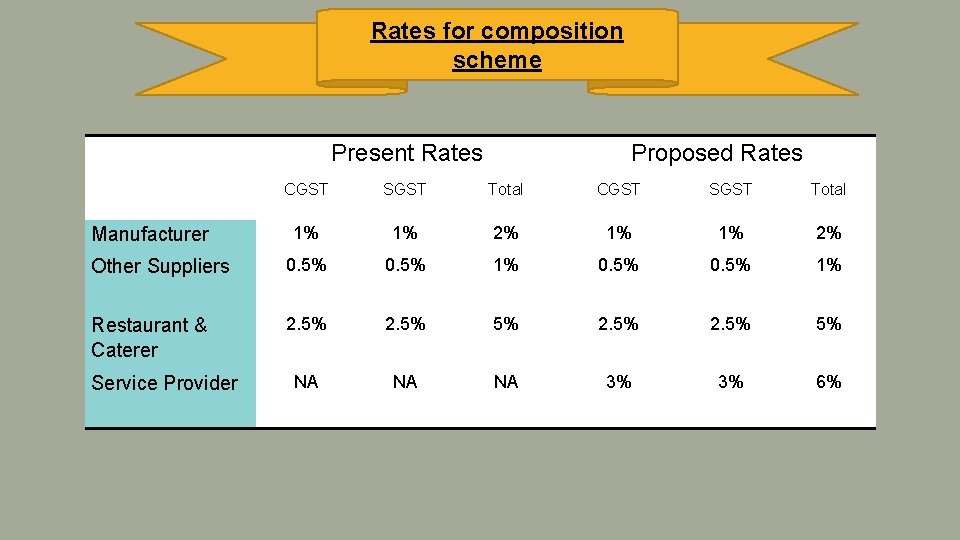
Rates for composition scheme Present Rates Proposed Rates CGST SGST Total 1% 1% 2% Other Suppliers 0. 5% 1% Restaurant & Caterer 2. 5% 5% NA NA NA 3% 3% 6% Manufacturer Service Provider
Returns Form and Due Dates
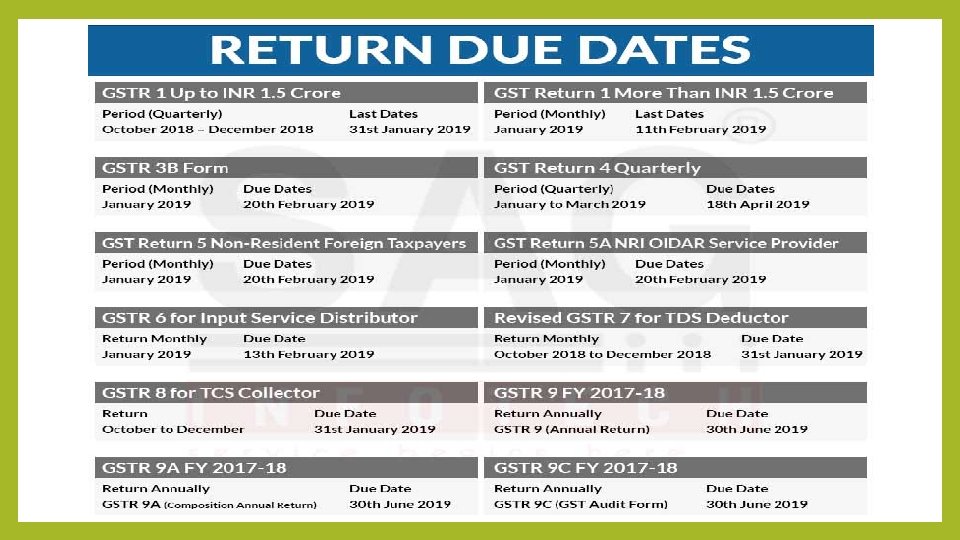
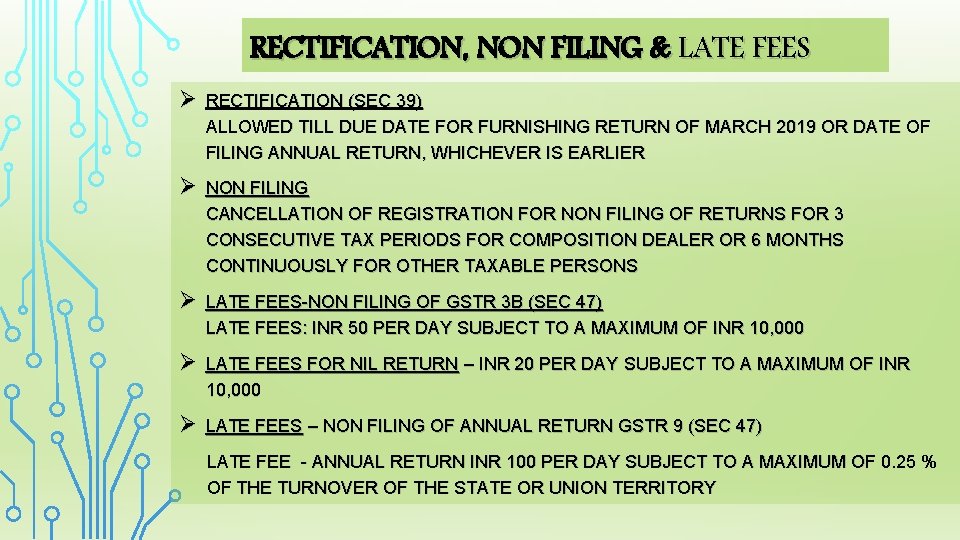
RECTIFICATION, NON FILING & LATE FEES Ø RECTIFICATION (SEC 39) ALLOWED TILL DUE DATE FOR FURNISHING RETURN OF MARCH 2019 OR DATE OF FILING ANNUAL RETURN, WHICHEVER IS EARLIER Ø NON FILING CANCELLATION OF REGISTRATION FOR NON FILING OF RETURNS FOR 3 CONSECUTIVE TAX PERIODS FOR COMPOSITION DEALER OR 6 MONTHS CONTINUOUSLY FOR OTHER TAXABLE PERSONS Ø LATE FEES-NON FILING OF GSTR 3 B (SEC 47) LATE FEES: INR 50 PER DAY SUBJECT TO A MAXIMUM OF INR 10, 000 Ø LATE FEES FOR NIL RETURN – INR 20 PER DAY SUBJECT TO A MAXIMUM OF INR 10, 000 Ø LATE FEES – NON FILING OF ANNUAL RETURN GSTR 9 (SEC 47) LATE FEE - ANNUAL RETURN INR 100 PER DAY SUBJECT TO A MAXIMUM OF 0. 25 % OF THE TURNOVER OF THE STATE OR UNION TERRITORY
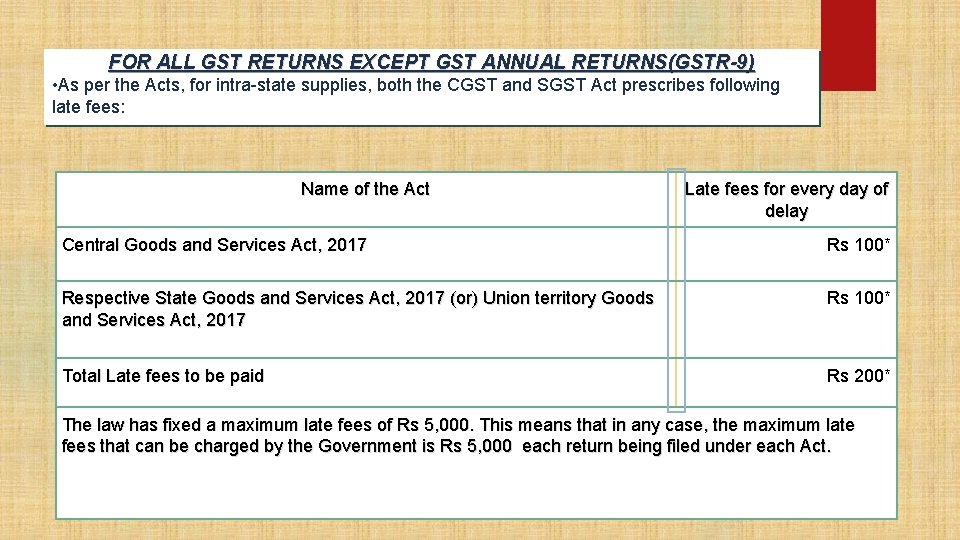
FOR ALL GST RETURNS EXCEPT GST ANNUAL RETURNS(GSTR-9) • As per the Acts, for intra-state supplies, both the CGST and SGST Act prescribes following late fees: Name of the Act Late fees for every day of delay Central Goods and Services Act, 2017 Rs 100* Respective State Goods and Services Act, 2017 (or) Union territory Goods and Services Act, 2017 Rs 100* Total Late fees to be paid Rs 200* The law has fixed a maximum late fees of Rs 5, 000. This means that in any case, the maximum late fees that can be charged by the Government is Rs 5, 000 each return being filed under each Act.
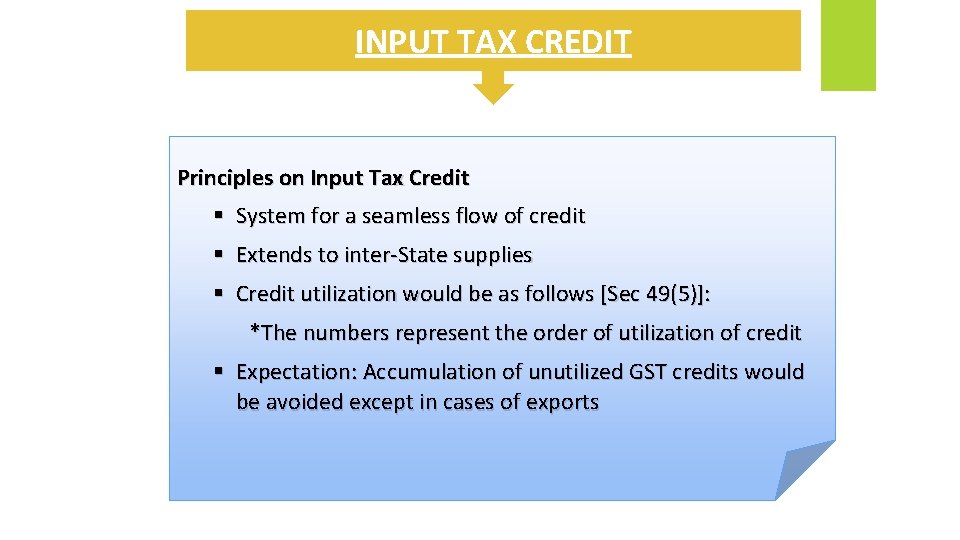
INPUT TAX CREDIT Principles on Input Tax Credit System for a seamless flow of credit Extends to inter-State supplies Credit utilization would be as follows [Sec 49(5)]: *The numbers represent the order of utilization of credit Expectation: Accumulation of unutilized GST credits would be avoided except in cases of exports
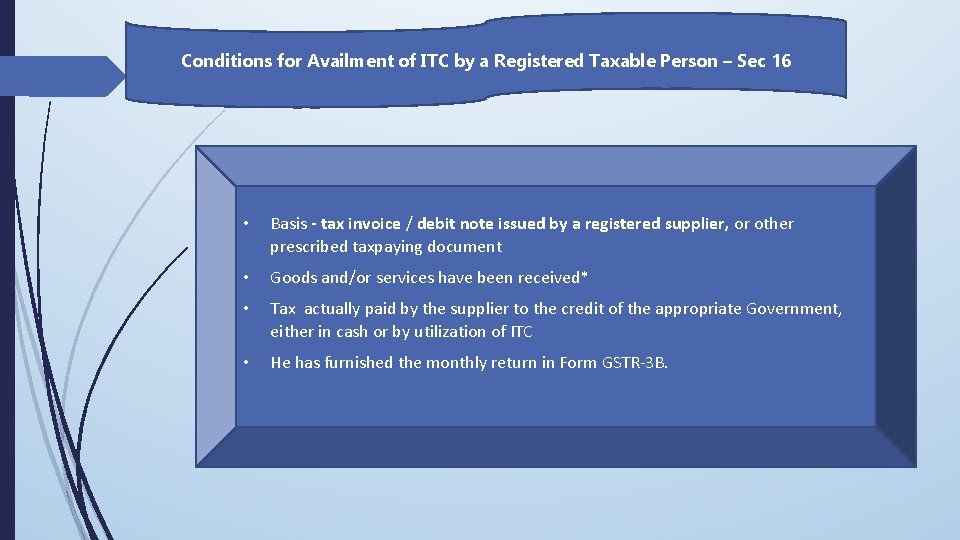
Conditions for Availment of ITC by a Registered Taxable Person – Sec 16 • Basis - tax invoice / debit note issued by a registered supplier, or other prescribed taxpaying document • Goods and/or services have been received* • Tax actually paid by the supplier to the credit of the appropriate Government, either in cash or by utilization of ITC • He has furnished the monthly return in Form GSTR-3 B.
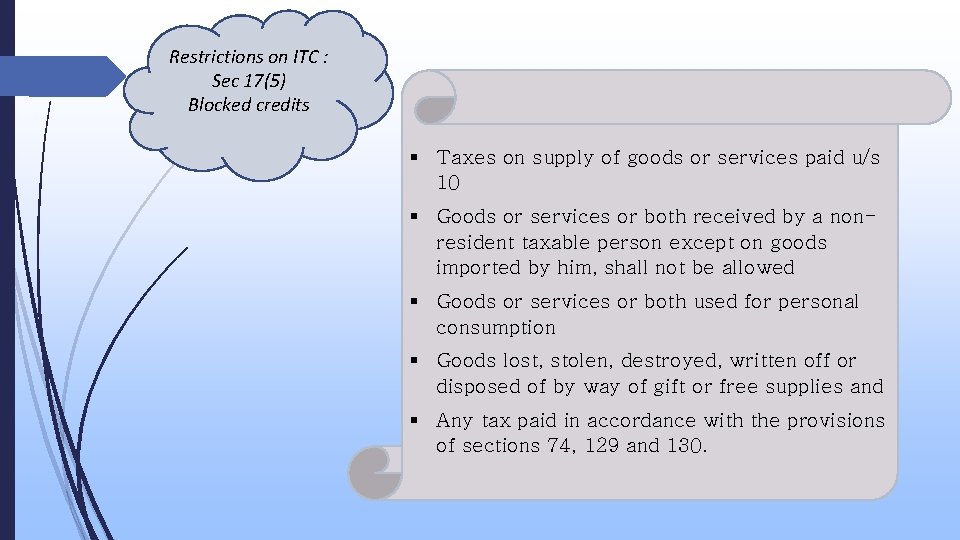
Restrictions on ITC : Sec 17(5) Blocked credits Taxes on supply of goods or services paid u/s 10 Goods or services or both received by a nonresident taxable person except on goods imported by him, shall not be allowed Goods or services or both used for personal consumption Goods lost, stolen, destroyed, written off or disposed of by way of gift or free supplies and Any tax paid in accordance with the provisions of sections 74, 129 and 130.
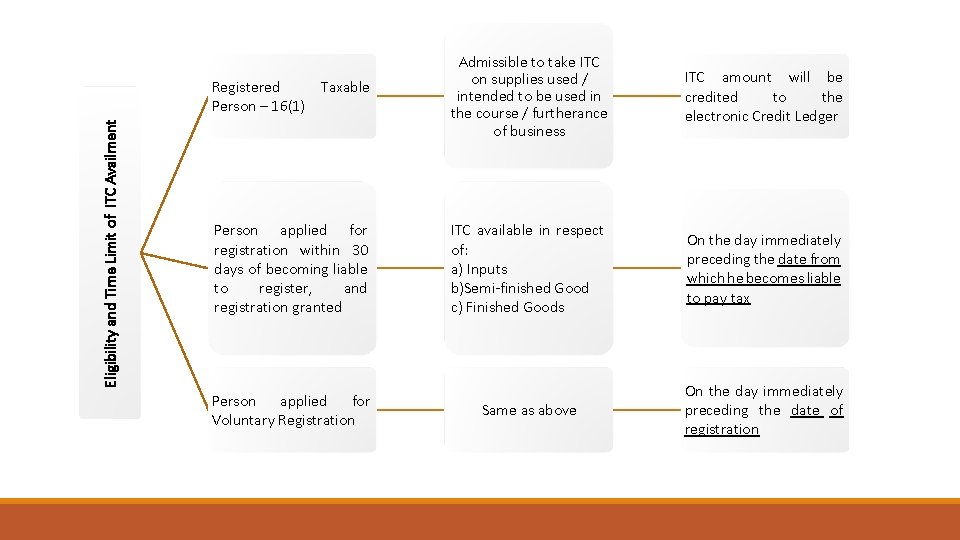
Eligibility and Time Limit of ITC Availment Registered Taxable Person – 16(1) Admissible to take ITC on supplies used / intended to be used in the course / furtherance of business ITC amount will be credited to the electronic Credit Ledger Person applied for registration within 30 days of becoming liable to register, and registration granted ITC available in respect of: a) Inputs b)Semi-finished Good c) Finished Goods On the day immediately preceding the date from which he becomes liable to pay tax Same as above On the day immediately preceding the date of registration Person applied for Voluntary Registration
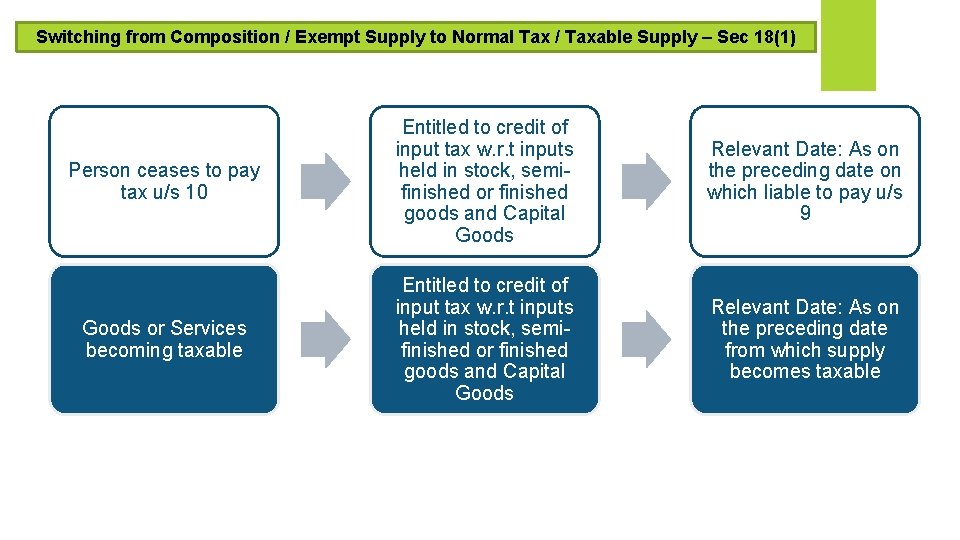
Switching from Composition / Exempt Supply to Normal Tax / Taxable Supply – Sec 18(1) Person ceases to pay tax u/s 10 Entitled to credit of input tax w. r. t inputs held in stock, semifinished or finished goods and Capital Goods Relevant Date: As on the preceding date on which liable to pay u/s 9 Goods or Services becoming taxable Entitled to credit of input tax w. r. t inputs held in stock, semifinished or finished goods and Capital Goods Relevant Date: As on the preceding date from which supply becomes taxable
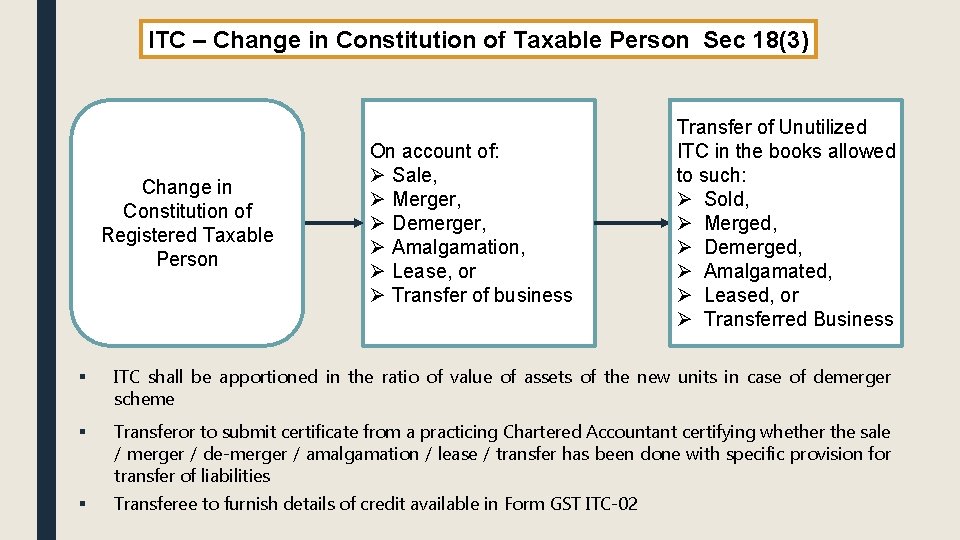
ITC – Change in Constitution of Taxable Person Sec 18(3) Change in Constitution of Registered Taxable Person On account of: Ø Sale, Ø Merger, Ø Demerger, Ø Amalgamation, Ø Lease, or Ø Transfer of business Transfer of Unutilized ITC in the books allowed to such: Ø Sold, Ø Merged, Ø Demerged, Ø Amalgamated, Ø Leased, or Ø Transferred Business ITC shall be apportioned in the ratio of value of assets of the new units in case of demerger scheme Transferor to submit certificate from a practicing Chartered Accountant certifying whether the sale / merger / de-merger / amalgamation / lease / transfer has been done with specific provision for transfer of liabilities Transferee to furnish details of credit available in Form GST ITC-02
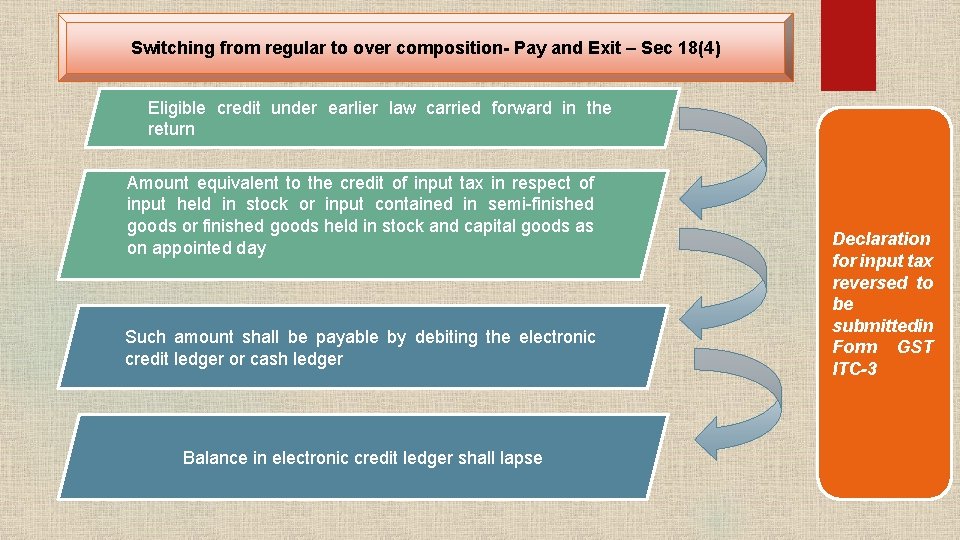
Switching from regular to over composition- Pay and Exit – Sec 18(4) Eligible credit under earlier law carried forward in the return Amount equivalent to the credit of input tax in respect of input held in stock or input contained in semi-finished goods or finished goods held in stock and capital goods as on appointed day Such amount shall be payable by debiting the electronic credit ledger or cash ledger Balance in electronic credit ledger shall lapse Declaration for input tax reversed to be submitted in Form GST ITC-3
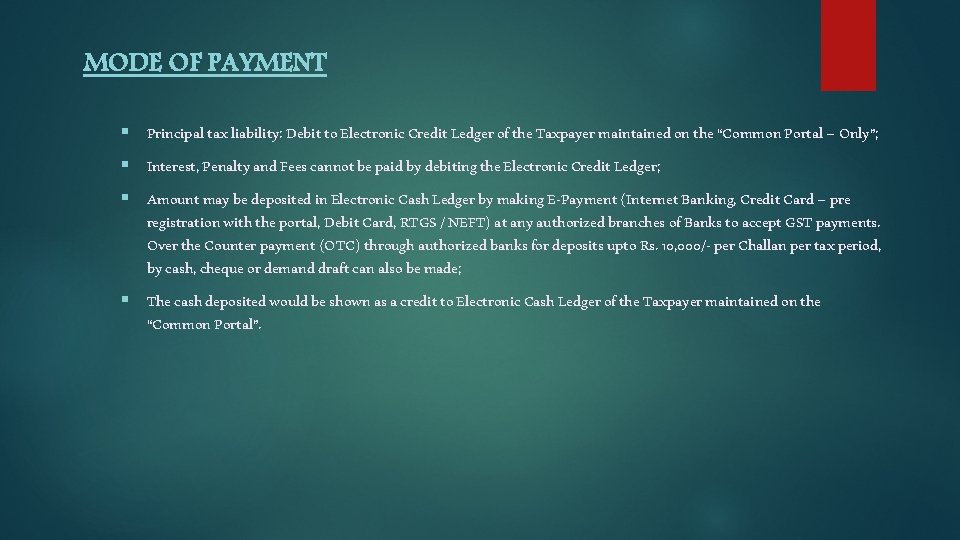
MODE OF PAYMENT Principal tax liability: Debit to Electronic Credit Ledger of the Taxpayer maintained on the “Common Portal – Only”; Interest, Penalty and Fees cannot be paid by debiting the Electronic Credit Ledger; Amount may be deposited in Electronic Cash Ledger by making E-Payment (Internet Banking, Credit Card – pre registration with the portal, Debit Card, RTGS / NEFT) at any authorized branches of Banks to accept GST payments. Over the Counter payment (OTC) through authorized banks for deposits upto Rs. 10, 000/- per Challan per tax period, by cash, cheque or demand draft can also be made; The cash deposited would be shown as a credit to Electronic Cash Ledger of the Taxpayer maintained on the “Common Portal”.
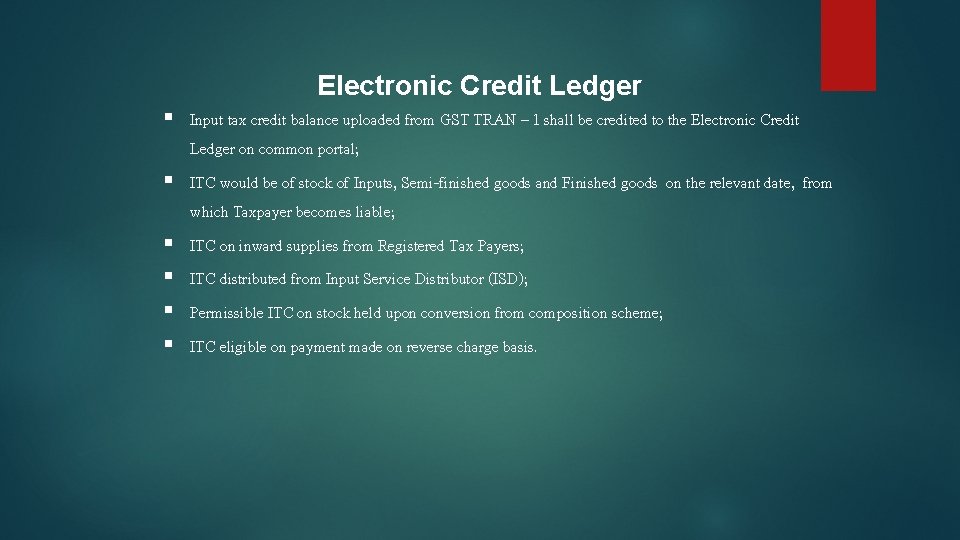
Electronic Credit Ledger Input tax credit balance uploaded from GST TRAN – 1 shall be credited to the Electronic Credit Ledger on common portal; ITC would be of stock of Inputs, Semi-finished goods and Finished goods on the relevant date, from which Taxpayer becomes liable; ITC on inward supplies from Registered Tax Payers; ITC distributed from Input Service Distributor (ISD); Permissible ITC on stock held upon conversion from composition scheme; ITC eligible on payment made on reverse charge basis.
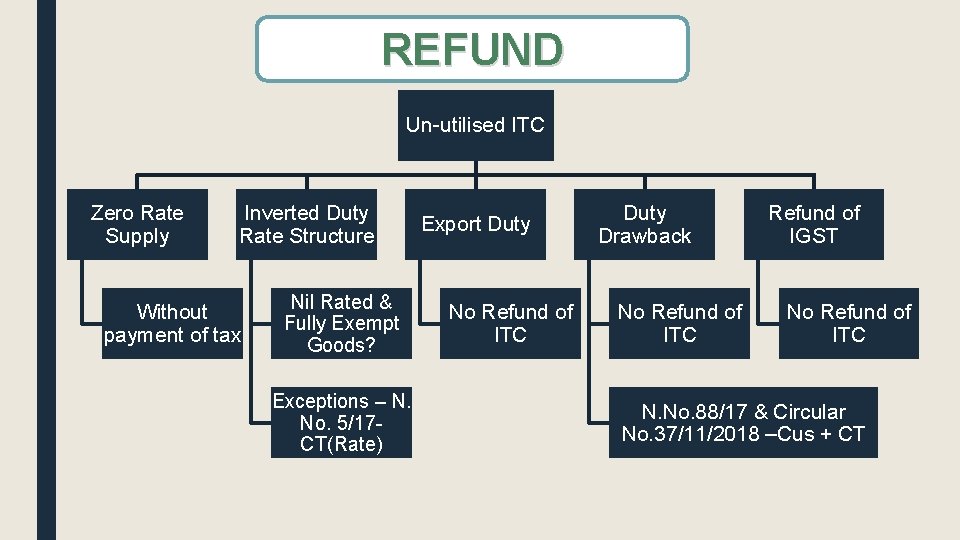
REFUND Un-utilised ITC Zero Rate Supply Inverted Duty Rate Structure Without payment of tax Nil Rated & Fully Exempt Goods? Exceptions – N. No. 5/17 - CT(Rate) Export Duty No Refund of ITC Duty Drawback No Refund of ITC Refund of IGST No Refund of ITC N. No. 88/17 & Circular No. 37/11/2018 –Cus + CT
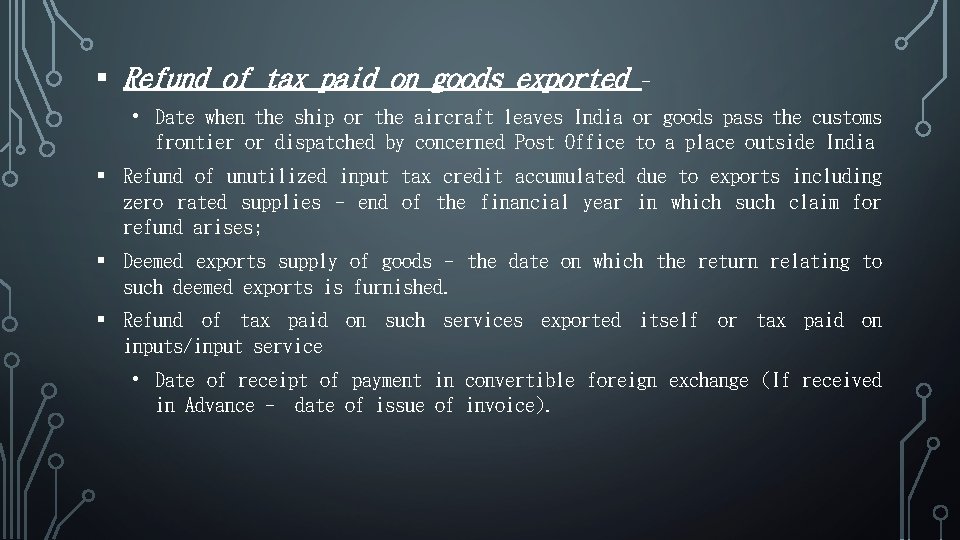
Refund of tax paid on goods exported - • Date when the ship or the aircraft leaves India or goods pass the customs frontier or dispatched by concerned Post Office to a place outside India Refund of unutilized input tax credit accumulated due to exports including zero rated supplies - end of the financial year in which such claim for refund arises; Deemed exports supply of goods - the date on which the return relating to such deemed exports is furnished. Refund of tax paid on such services exported itself or tax paid on inputs/input service • Date of receipt of payment in convertible foreign exchange (If received in Advance - date of issue of invoice).
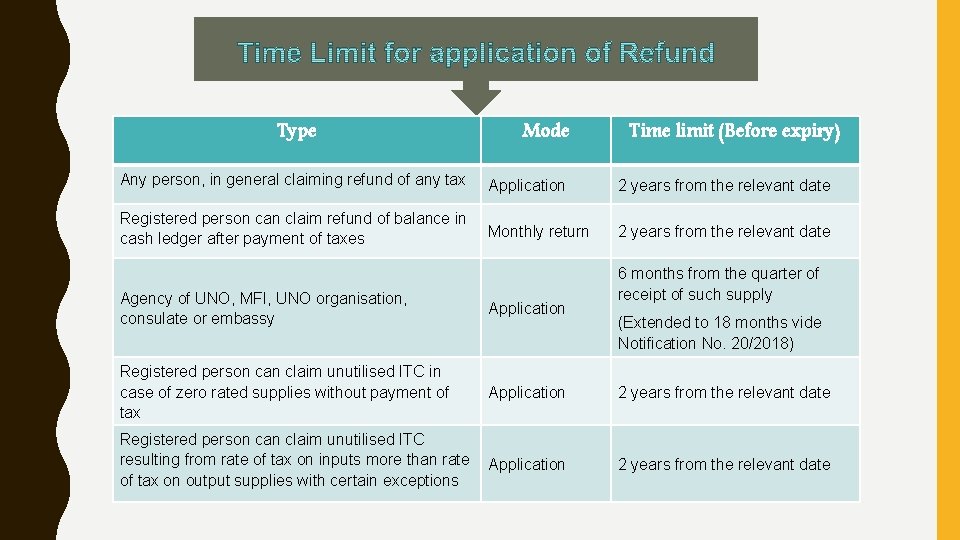
Type Mode Time limit (Before expiry) Any person, in general claiming refund of any tax Application 2 years from the relevant date Registered person can claim refund of balance in cash ledger after payment of taxes Monthly return 2 years from the relevant date 6 months from the quarter of receipt of such supply Agency of UNO, MFI, UNO organisation, consulate or embassy Application Registered person can claim unutilised ITC in case of zero rated supplies without payment of tax Application 2 years from the relevant date Registered person can claim unutilised ITC resulting from rate of tax on inputs more than rate Application of tax on output supplies with certain exceptions 2 years from the relevant date (Extended to 18 months vide Notification No. 20/2018)
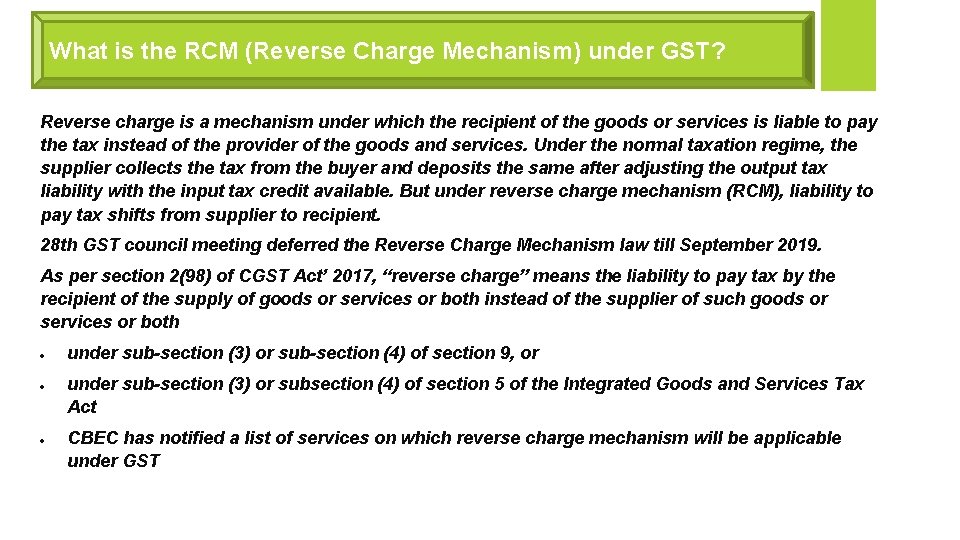
What is the RCM (Reverse Charge Mechanism) under GST? Reverse charge is a mechanism under which the recipient of the goods or services is liable to pay the tax instead of the provider of the goods and services. Under the normal taxation regime, the supplier collects the tax from the buyer and deposits the same after adjusting the output tax liability with the input tax credit available. But under reverse charge mechanism (RCM), liability to pay tax shifts from supplier to recipient. 28 th GST council meeting deferred the Reverse Charge Mechanism law till September 2019. As per section 2(98) of CGST Act’ 2017, “reverse charge” means the liability to pay tax by the recipient of the supply of goods or services or both instead of the supplier of such goods or services or both under sub-section (3) or sub-section (4) of section 9, or under sub-section (3) or subsection (4) of section 5 of the Integrated Goods and Services Tax Act CBEC has notified a list of services on which reverse charge mechanism will be applicable under GST
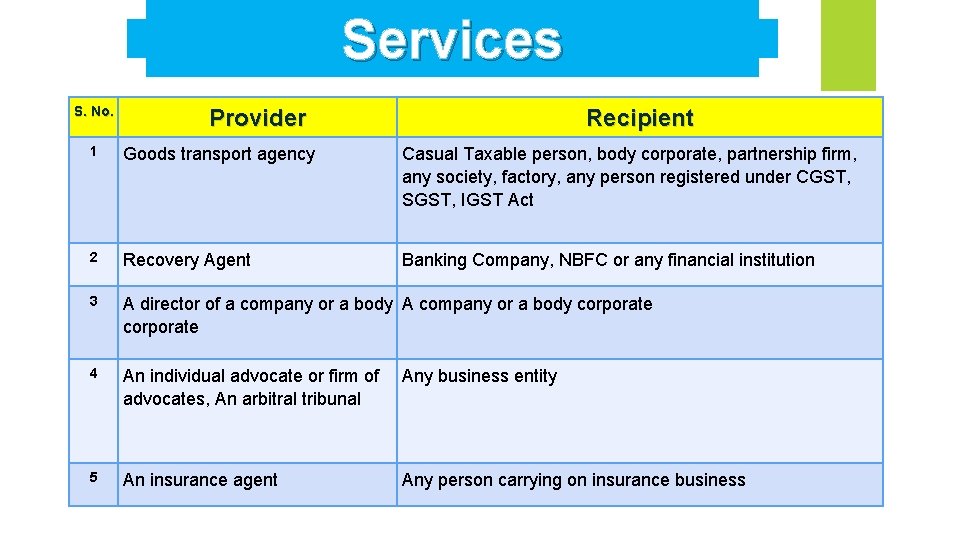
Services S. No. Provider Recipient 1 Goods transport agency Casual Taxable person, body corporate, partnership firm, any society, factory, any person registered under CGST, SGST, IGST Act 2 Recovery Agent Banking Company, NBFC or any financial institution 3 A director of a company or a body A company or a body corporate 4 An individual advocate or firm of Any business entity advocates, An arbitral tribunal 5 An insurance agent Any person carrying on insurance business
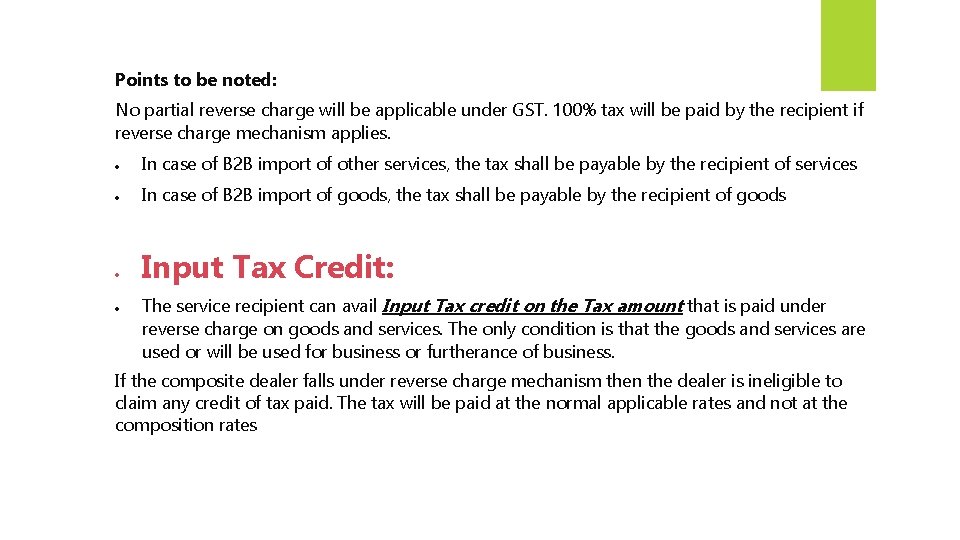
Points to be noted: No partial reverse charge will be applicable under GST. 100% tax will be paid by the recipient if reverse charge mechanism applies. In case of B 2 B import of other services, the tax shall be payable by the recipient of services In case of B 2 B import of goods, the tax shall be payable by the recipient of goods Input Tax Credit: The service recipient can avail Input Tax credit on the Tax amount that is paid under reverse charge on goods and services. The only condition is that the goods and services are used or will be used for business or furtherance of business. If the composite dealer falls under reverse charge mechanism then the dealer is ineligible to claim any credit of tax paid. The tax will be paid at the normal applicable rates and not at the composition rates
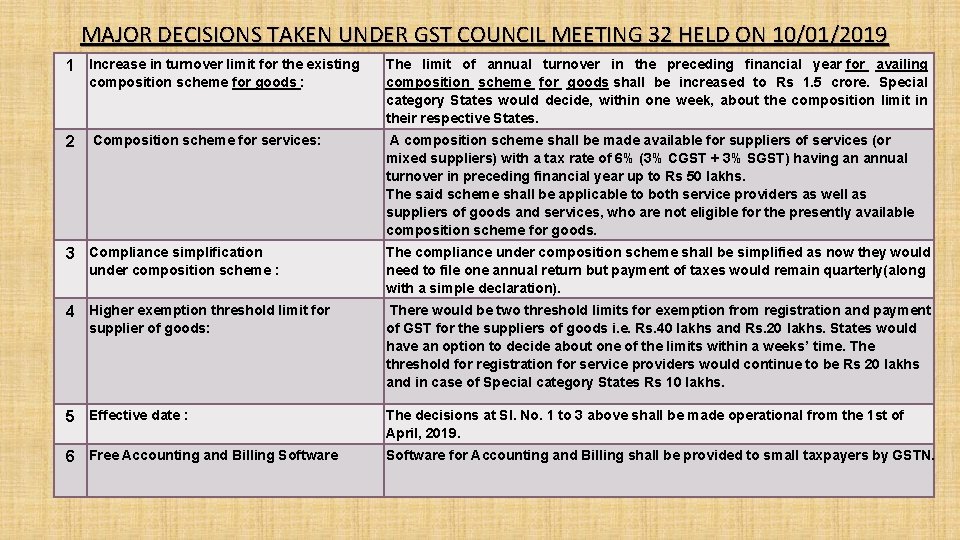
MAJOR DECISIONS TAKEN UNDER GST COUNCIL MEETING 32 HELD ON 10/01/2019 1 Increase in turnover limit for the existing The limit of annual turnover in the preceding financial year for availing composition scheme for goods shall be increased to Rs 1. 5 crore. Special category States would decide, within one week, about the composition limit in their respective States. 2 Composition scheme for services: A composition scheme shall be made available for suppliers of services (or mixed suppliers) with a tax rate of 6% (3% CGST + 3% SGST) having an annual turnover in preceding financial year up to Rs 50 lakhs. The said scheme shall be applicable to both service providers as well as suppliers of goods and services, who are not eligible for the presently available composition scheme for goods. 3 Compliance simplification The compliance under composition scheme shall be simplified as now they would need to file one annual return but payment of taxes would remain quarterly(along with a simple declaration). 4 Higher exemption threshold limit for There would be two threshold limits for exemption from registration and payment of GST for the suppliers of goods i. e. Rs. 40 lakhs and Rs. 20 lakhs. States would have an option to decide about one of the limits within a weeks’ time. The threshold for registration for service providers would continue to be Rs 20 lakhs and in case of Special category States Rs 10 lakhs. 5 Effective date : The decisions at Sl. No. 1 to 3 above shall be made operational from the 1 st of April, 2019. 6 Free Accounting and Billing Software for Accounting and Billing shall be provided to small taxpayers by GSTN. composition scheme for goods : under composition scheme : supplier of goods:
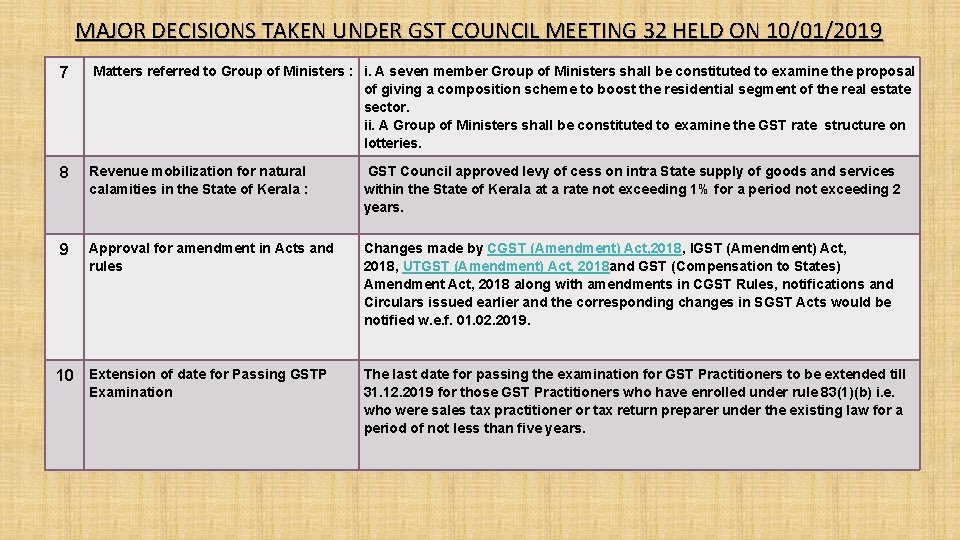
MAJOR DECISIONS TAKEN UNDER GST COUNCIL MEETING 32 HELD ON 10/01/2019 7 Matters referred to Group of Ministers : i. A seven member Group of Ministers shall be constituted to examine the proposal of giving a composition scheme to boost the residential segment of the real estate sector. ii. A Group of Ministers shall be constituted to examine the GST rate structure on lotteries. 8 Revenue mobilization for natural calamities in the State of Kerala : GST Council approved levy of cess on intra State supply of goods and services within the State of Kerala at a rate not exceeding 1% for a period not exceeding 2 years. 9 Approval for amendment in Acts and rules Changes made by CGST (Amendment) Act, 2018, IGST (Amendment) Act, 2018, UTGST (Amendment) Act, 2018 and GST (Compensation to States) Amendment Act, 2018 along with amendments in CGST Rules, notifications and Circulars issued earlier and the corresponding changes in SGST Acts would be notified w. e. f. 01. 02. 2019. 10 Extension of date for Passing GSTP Examination The last date for passing the examination for GST Practitioners to be extended till 31. 12. 2019 for those GST Practitioners who have enrolled under rule 83(1)(b) i. e. who were sales tax practitioner or tax return preparer under the existing law for a period of not less than five years.
- Slides: 29