
GST K VAITHEESWARAN ADVOCATE TAX CONSULTANT Mobile 98400

GST K. VAITHEESWARAN ADVOCATE & TAX CONSULTANT Mobile: 98400 -96876 E-mail : vaithilegal@yahoo. co. in / vaithilegal@gmail. com www. vaithilegal. com ‘VENKATAGIRI’ Flat No. 8/3 & 8/4, Ground Floor, No. 8 (Old No. 9), Sivaprakasam Street, T. Nagar, Chennai - 600 017, India Tel. : 044 + 2433 1029 / 4048 402, Front Wing, House of Lords, 15/16, St. Marks Road, Bengaluru – 560 001, India Tel : 080 22244854/ 41120804
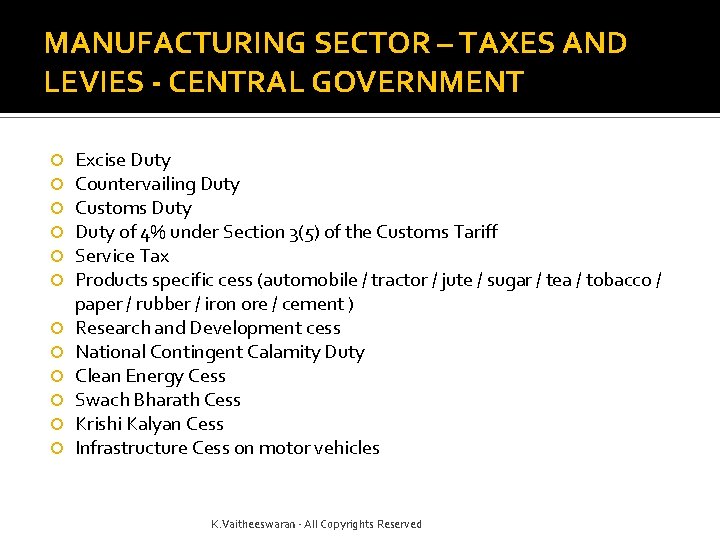
MANUFACTURING SECTOR – TAXES AND LEVIES - CENTRAL GOVERNMENT Excise Duty Countervailing Duty Customs Duty of 4% under Section 3(5) of the Customs Tariff Service Tax Products specific cess (automobile / tractor / jute / sugar / tea / tobacco / paper / rubber / iron ore / cement ) Research and Development cess National Contingent Calamity Duty Clean Energy Cess Swach Bharath Cess Krishi Kalyan Cess Infrastructure Cess on motor vehicles K. Vaitheeswaran - All Copyrights Reserved
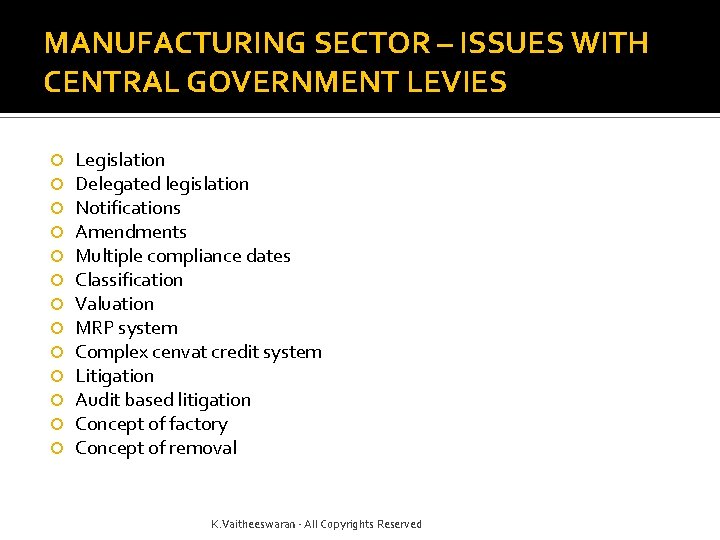
MANUFACTURING SECTOR – ISSUES WITH CENTRAL GOVERNMENT LEVIES Legislation Delegated legislation Notifications Amendments Multiple compliance dates Classification Valuation MRP system Complex cenvat credit system Litigation Audit based litigation Concept of factory Concept of removal K. Vaitheeswaran - All Copyrights Reserved
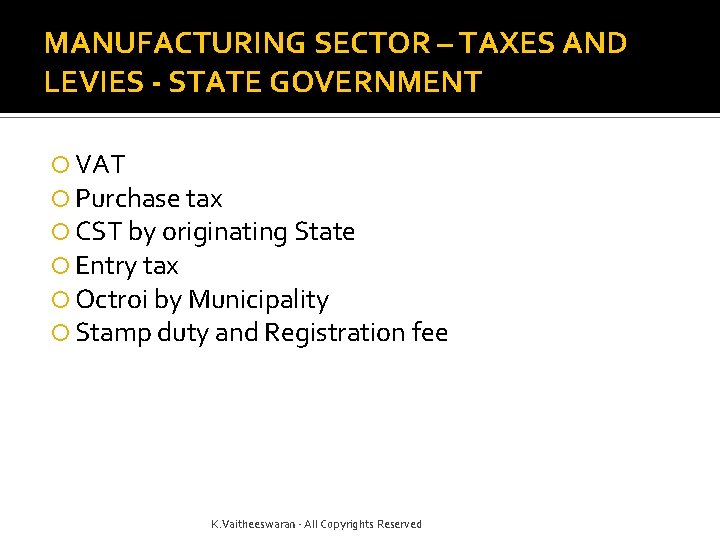
MANUFACTURING SECTOR – TAXES AND LEVIES - STATE GOVERNMENT VAT Purchase tax CST by originating State Entry tax Octroi by Municipality Stamp duty and Registration fee K. Vaitheeswaran - All Copyrights Reserved
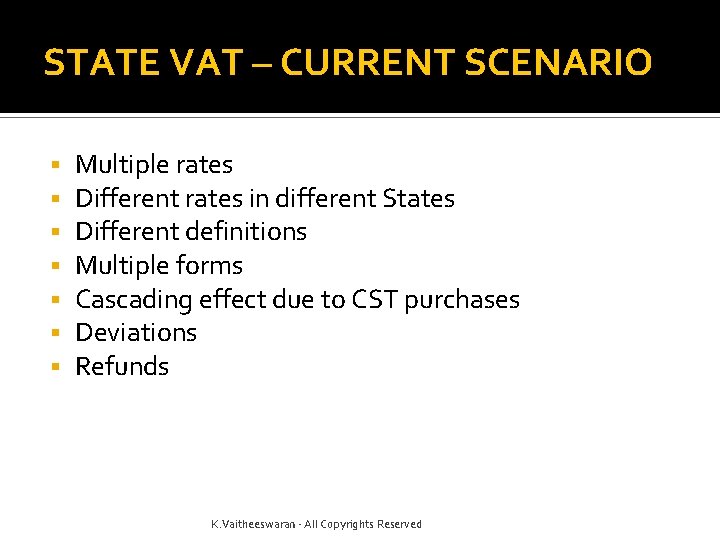
STATE VAT – CURRENT SCENARIO Multiple rates Different rates in different States Different definitions Multiple forms Cascading effect due to CST purchases Deviations Refunds K. Vaitheeswaran - All Copyrights Reserved
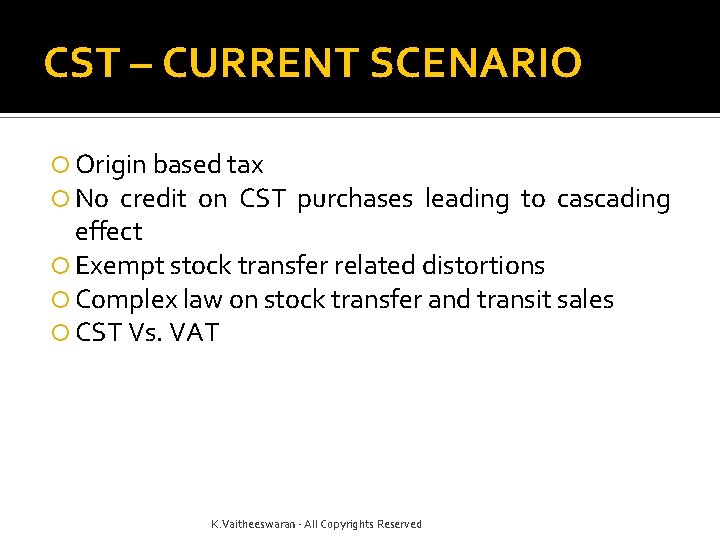
CST – CURRENT SCENARIO Origin based tax No credit on CST purchases leading to cascading effect Exempt stock transfer related distortions Complex law on stock transfer and transit sales CST Vs. VAT K. Vaitheeswaran - All Copyrights Reserved
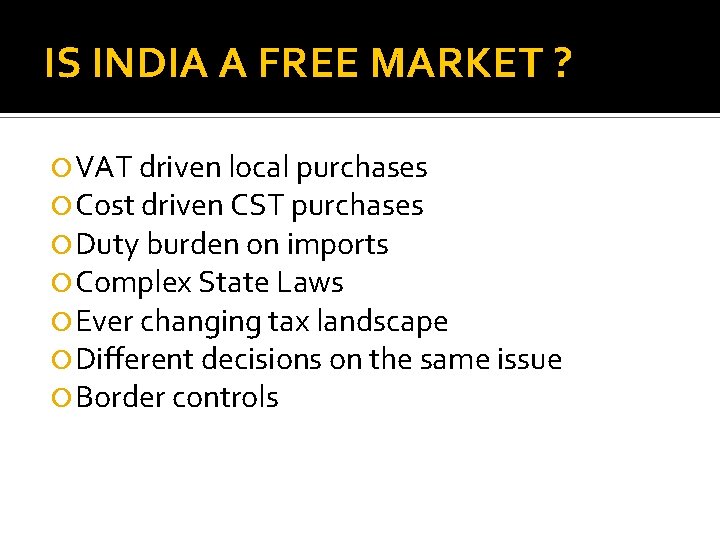
IS INDIA A FREE MARKET ? VAT driven local purchases Cost driven CST purchases Duty burden on imports Complex State Laws Ever changing tax landscape Different decisions on the same issue Border controls
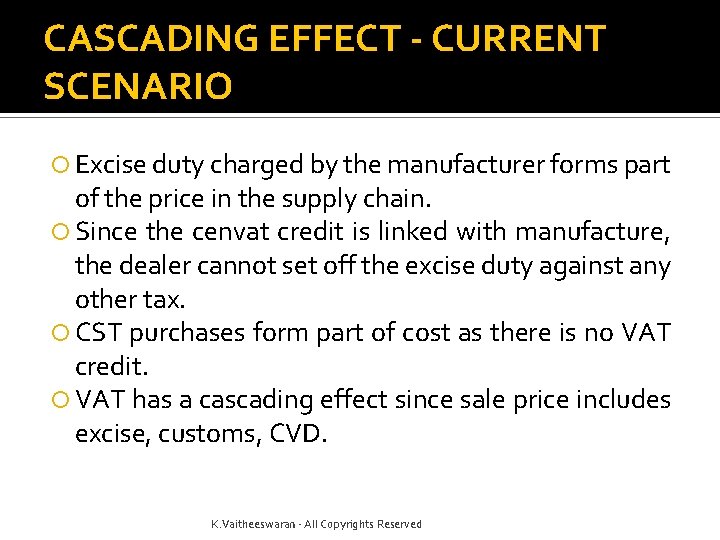
CASCADING EFFECT - CURRENT SCENARIO Excise duty charged by the manufacturer forms part of the price in the supply chain. Since the cenvat credit is linked with manufacture, the dealer cannot set off the excise duty against any other tax. CST purchases form part of cost as there is no VAT credit. VAT has a cascading effect since sale price includes excise, customs, CVD. K. Vaitheeswaran - All Copyrights Reserved
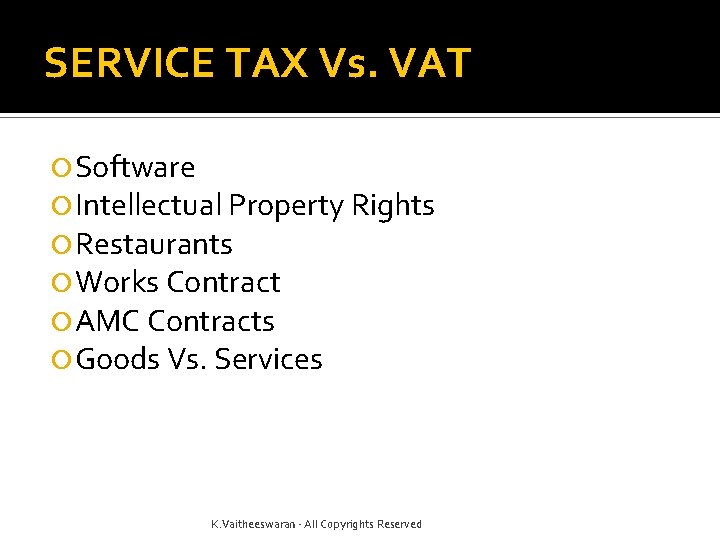
SERVICE TAX Vs. VAT Software Intellectual Property Rights Restaurants Works Contract AMC Contracts Goods Vs. Services K. Vaitheeswaran - All Copyrights Reserved
GST Path breaking tax reform Harmonization of taxes Elimination of tax as a cost Possible elimination of unwanted business structures Long way to go Too many compromises Complex legal structure Not a simple law Huge potential for conflict K. Vaitheeswaran - All Copyrights Reserved
GST IN INDIA CGST would be a levy by the Central Government through law made by the Parliament. SGST would be a levy by each State through law made by State Legislature. UTGST would be a levy on intra-State supply of goods or services or both. IGST would be a levy by the Centre through law made by the Parliament on the supply of any goods and / or services in the course of inter-State trade or commerce. IGST would also apply on a supply of goods and / or services in the course of import into the territory of India. GST Compensation Cess would be a levy by the Central Government on inter / intra-State supplies of goods or services or both.
MANUFACTURING SECTOR Local purchases for the sake of VAT credit Increase in cost on account of CST Cascade on account of VAT on ED Huge cost in collecting C-Forms and tax demands Inverted duty structure Exemption related distortions Cenvat credit issues Unwarranted depots and locations in other States Stock transfer related reversal Stock transfers being treated as CST sales Entry tax Cascading effects DGCEI / Range / Audit / CERA / Enforcement / Audit / Assessment
CGST – SUPPLY – SECTION 7 Supply includes All forms of supply of goods and / or services such as sale, transfer, barter, exchange, license, rental, lease or disposal made or agreed to be made for a consideration by a person in the course or furtherance of business. Import of service for a consideration and whether or not in the course or furtherance of business. Activities specified in Schedule-I – made or agreed to be made without a consideration. Activities to be treated as supply of goods or supply of services referred to in Schedule - II
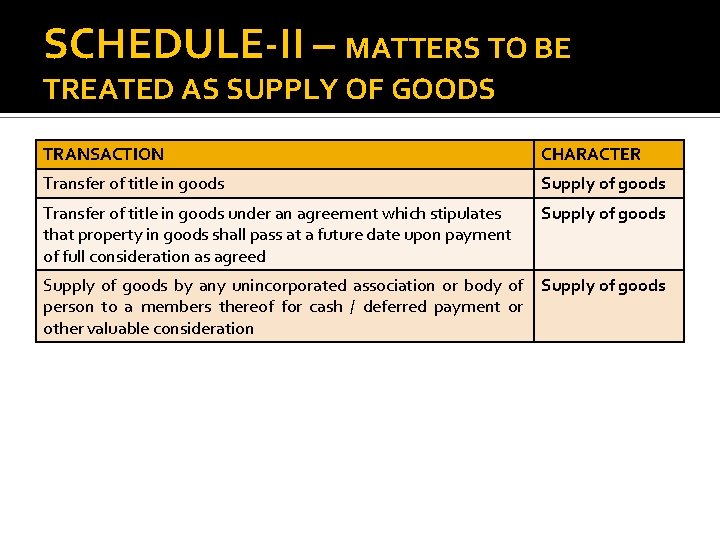
SCHEDULE-II – MATTERS TO BE TREATED AS SUPPLY OF GOODS TRANSACTION CHARACTER Transfer of title in goods Supply of goods Transfer of title in goods under an agreement which stipulates that property in goods shall pass at a future date upon payment of full consideration as agreed Supply of goods by any unincorporated association or body of person to a members thereof for cash / deferred payment or other valuable consideration Supply of goods
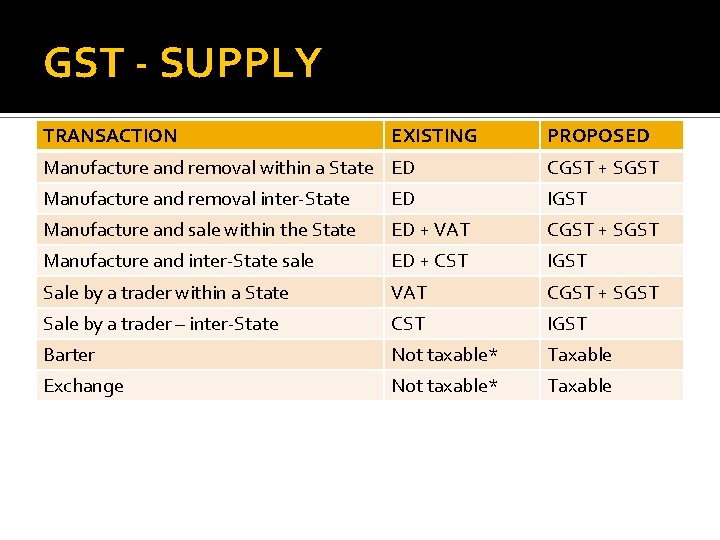
GST - SUPPLY TRANSACTION EXISTING PROPOSED Manufacture and removal within a State ED CGST + SGST Manufacture and removal inter-State ED IGST Manufacture and sale within the State ED + VAT CGST + SGST Manufacture and inter-State sale ED + CST IGST Sale by a trader within a State VAT CGST + SGST Sale by a trader – inter-State CST IGST Barter Not taxable* Taxable Exchange Not taxable* Taxable
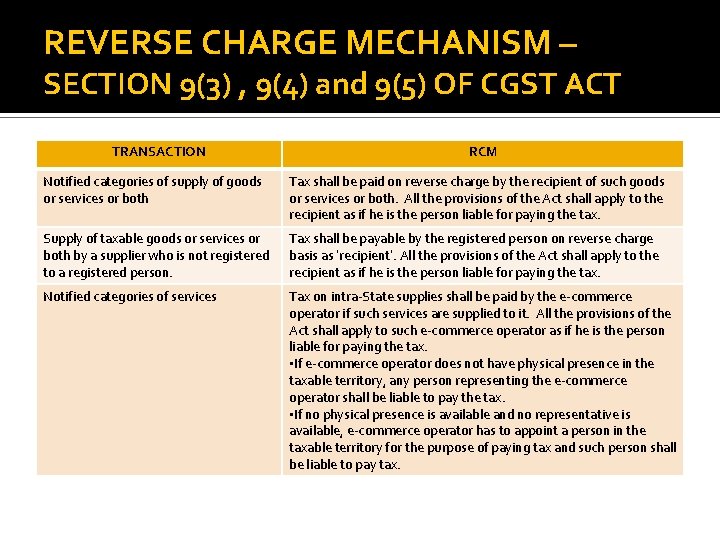
REVERSE CHARGE MECHANISM – SECTION 9(3) , 9(4) and 9(5) OF CGST ACT TRANSACTION RCM Notified categories of supply of goods or services or both Tax shall be paid on reverse charge by the recipient of such goods or services or both. All the provisions of the Act shall apply to the recipient as if he is the person liable for paying the tax. Supply of taxable goods or services or both by a supplier who is not registered to a registered person. Tax shall be payable by the registered person on reverse charge basis as ‘recipient’. All the provisions of the Act shall apply to the recipient as if he is the person liable for paying the tax. Notified categories of services Tax on intra-State supplies shall be paid by the e-commerce operator if such services are supplied to it. All the provisions of the Act shall apply to such e-commerce operator as if he is the person liable for paying the tax. • If e-commerce operator does not have physical presence in the taxable territory, any person representing the e-commerce operator shall be liable to pay the tax. • If no physical presence is available and no representative is available, e-commerce operator has to appoint a person in the taxable territory for the purpose of paying tax and such person shall be liable to pay tax.
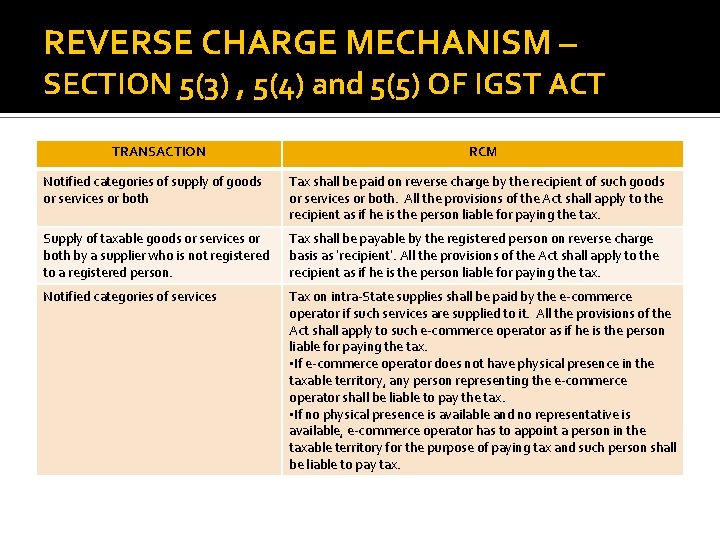
REVERSE CHARGE MECHANISM – SECTION 5(3) , 5(4) and 5(5) OF IGST ACT TRANSACTION RCM Notified categories of supply of goods or services or both Tax shall be paid on reverse charge by the recipient of such goods or services or both. All the provisions of the Act shall apply to the recipient as if he is the person liable for paying the tax. Supply of taxable goods or services or both by a supplier who is not registered to a registered person. Tax shall be payable by the registered person on reverse charge basis as ‘recipient’. All the provisions of the Act shall apply to the recipient as if he is the person liable for paying the tax. Notified categories of services Tax on intra-State supplies shall be paid by the e-commerce operator if such services are supplied to it. All the provisions of the Act shall apply to such e-commerce operator as if he is the person liable for paying the tax. • If e-commerce operator does not have physical presence in the taxable territory, any person representing the e-commerce operator shall be liable to pay the tax. • If no physical presence is available and no representative is available, e-commerce operator has to appoint a person in the taxable territory for the purpose of paying tax and such person shall be liable to pay tax.

PLACE OF SUPPLY
WHY IS PLACE RELEVANT? OF SUPPLY Section 7(1) of the IGST Act – Subject to Section 10 supply of goods in the course inter-State trade or commerce means any supply where location of the supplier and the place of supply are in two different States or two different UTs or a State and a UT.
WHY IS PLACE RELEVANT? OF SUPPLY Section 7(2) – Supply of goods imported into the territory of India till they cross the customs frontiers of India shall be deemed to be a supply in the course of inter-State trade or commerce Import of goods with its grammatical variations and cognate expressions means bringing into India from a place outside India Customs frontiers of India defined in the IGST Act
TERRITORIAL WATERS Where location of the supplier is in the territorial waters, the location of such supplier, shall be deemed to be in the coastal State or UT where the nearest point of the appropriate baseline is located. Where the place of supply is in the territorial water, the place of supply, shall be deemed to be the coastal State or UT where the nearest point of the appropriate baseline is located.
GOODS Section 2(52) defines ‘goods’ to mean every kind of movable property other than money and securities but includes actionable claim, growing crops, grass and things attached to or forming part of the land which are agreed to be severed before supply or under a contract of supply
IGST - PLACE OF SUPPLY OF GOODS
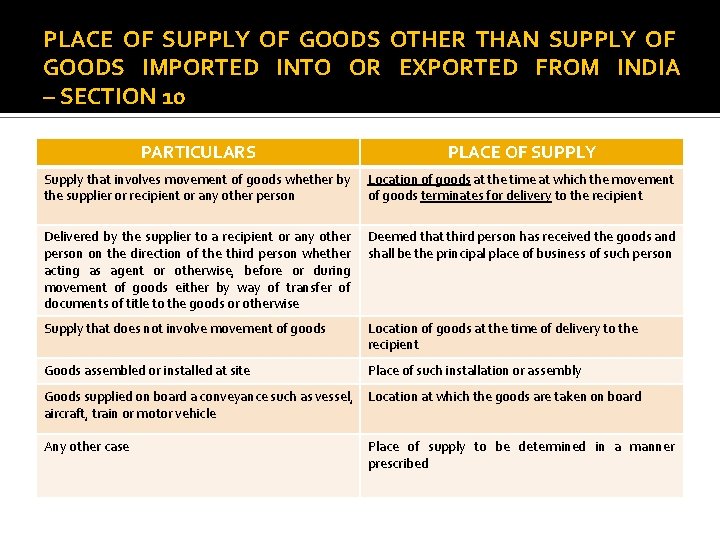
PLACE OF SUPPLY OF GOODS OTHER THAN SUPPLY OF GOODS IMPORTED INTO OR EXPORTED FROM INDIA – SECTION 10 PARTICULARS PLACE OF SUPPLY Supply that involves movement of goods whether by the supplier or recipient or any other person Location of goods at the time at which the movement of goods terminates for delivery to the recipient Delivered by the supplier to a recipient or any other person on the direction of the third person whether acting as agent or otherwise, before or during movement of goods either by way of transfer of documents of title to the goods or otherwise Deemed that third person has received the goods and shall be the principal place of business of such person Supply that does not involve movement of goods Location of goods at the time of delivery to the recipient Goods assembled or installed at site Place of such installation or assembly Goods supplied on board a conveyance such as vessel, Location at which the goods are taken on board aircraft, train or motor vehicle Any other case Place of supply to be determined in a manner prescribed
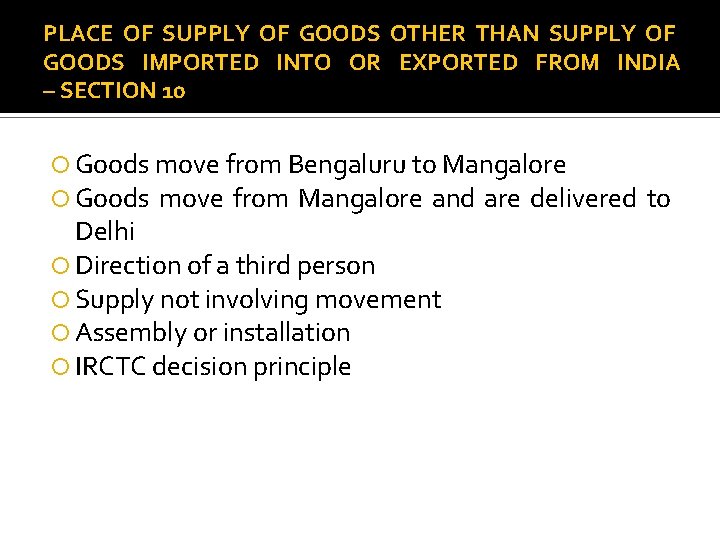
PLACE OF SUPPLY OF GOODS OTHER THAN SUPPLY OF GOODS IMPORTED INTO OR EXPORTED FROM INDIA – SECTION 10 Goods move from Bengaluru to Mangalore Goods move from Mangalore and are delivered Delhi Direction of a third person Supply not involving movement Assembly or installation IRCTC decision principle to
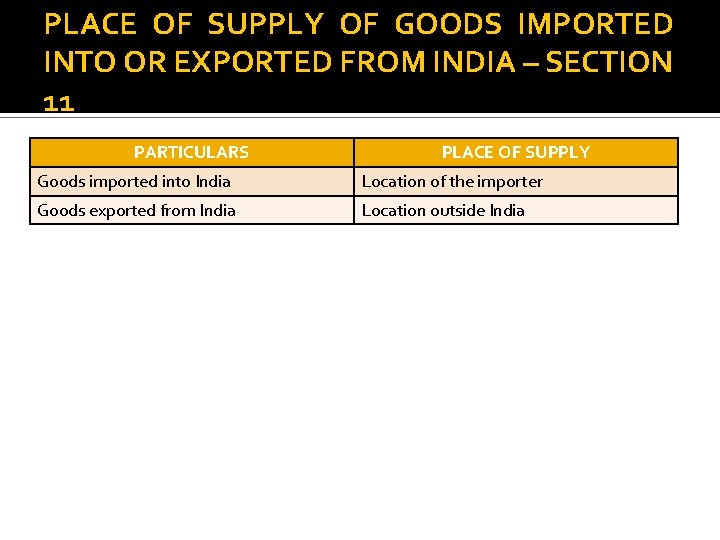
PLACE OF SUPPLY OF GOODS IMPORTED INTO OR EXPORTED FROM INDIA – SECTION 11 PARTICULARS PLACE OF SUPPLY Goods imported into India Location of the importer Goods exported from India Location outside India
COMPOSITE SUPPLY Composite supply means a supply made by a taxable person to a recipient consisting of two or more taxable supplies of goods or services or both, or any combination thereof which are naturally bundled and supplied in conjunction with each other in the ordinary course of business, one of which is a principal supply – Section 2(30) Illustration: - When goods are packed and transported with insurance, supply of goods, packing materials, transport and insurance is a composite supply and supply of goods is the principal supply. In the case of composite supply comprising of two or more supply, one of which is a principal supply shall be treated as supply of such principal supply - Section 8(a) Principal supply means the supply of goods or services which constitutes the predominant element of the composite supply and to which any other supply forming part of the composite supply is ancillary. Dominant test?
MIXED SUPPLY Mixed supply means two or more individual supply of goods or services or any combination thereof made in conjunction with each other by a taxable person for a single price where such supply does not constitute a composite supply – Section 2(74) Illustration: - A supply of package consisting of canned foods, sweets, chocolates, cakes, dry fruits, aerated drink and fruit juices when supplied for a single price is a mixed supply. Each of these items can be supplied separately and is not dependent on any other. It shall not be a mixed supply if these items are supplied separately. A mixed supply comprising of two or more supplies shall be treated as supply of that particular supply which attracts the highest rate of tax – Section 8(b)
IGST – INTER STATE Where the location of the supplier and the place of supply are in two different states or in two different Union Territories or a State and a UT, supply shall be treated as supply of goods in the course of inter-State trade or commerce - Section 7(1) Place of supply is determined under Section 12. If location of supplier is in Tamil Nadu and place of supply is in Andhra Pradesh, on the value determined under Section 15 of the CGST Act, IGST at applicable rates has to be charged. Section 5 is the charging section which provides for a levy of IGST at such rates not exceeding 40% as may be notified by the Government on the recommendation of the Council.
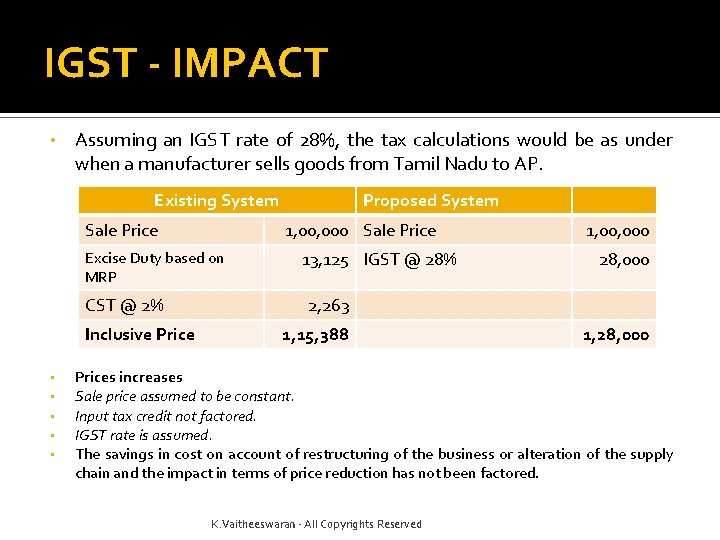
IGST - IMPACT • Assuming an IGST rate of 28%, the tax calculations would be as under when a manufacturer sells goods from Tamil Nadu to AP. Existing System Sale Price 1, 000 Sale Price Excise Duty based on MRP CST @ 2% Inclusive Price • • • Proposed System 13, 125 IGST @ 28% 1, 000 28, 000 2, 263 1, 15, 388 1, 28, 000 Prices increases Sale price assumed to be constant. Input tax credit not factored. IGST rate is assumed. The savings in cost on account of restructuring of the business or alteration of the supply chain and the impact in terms of price reduction has not been factored. K. Vaitheeswaran - All Copyrights Reserved
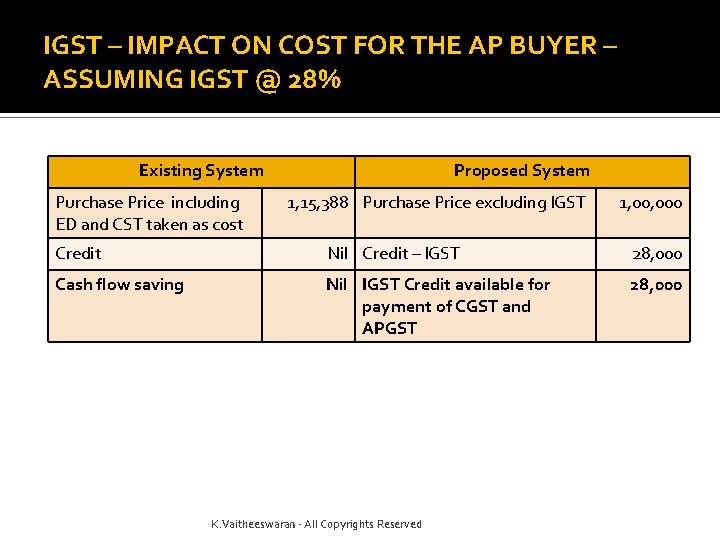
IGST – IMPACT ON COST FOR THE AP BUYER – ASSUMING IGST @ 28% Existing System Purchase Price including ED and CST taken as cost Proposed System 1, 15, 388 Purchase Price excluding IGST 1, 000 Credit Nil Credit – IGST 28, 000 Cash flow saving Nil IGST Credit available for payment of CGST and APGST 28, 000 K. Vaitheeswaran - All Copyrights Reserved
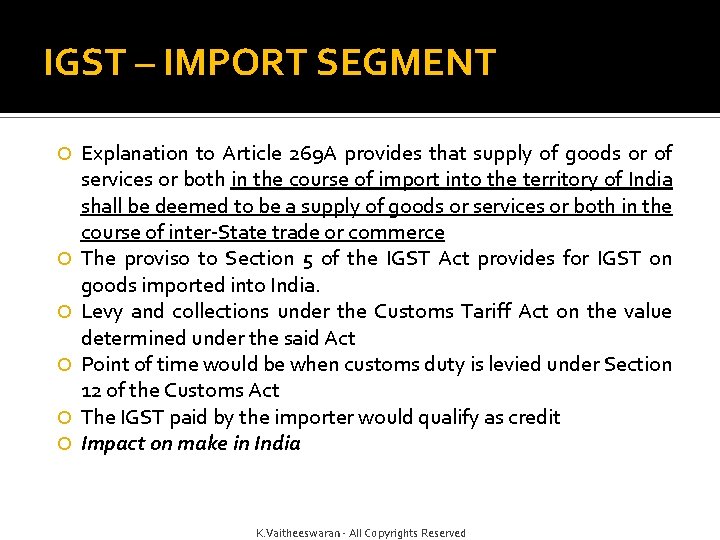
IGST – IMPORT SEGMENT Explanation to Article 269 A provides that supply of goods or of services or both in the course of import into the territory of India shall be deemed to be a supply of goods or services or both in the course of inter-State trade or commerce The proviso to Section 5 of the IGST Act provides for IGST on goods imported into India. Levy and collections under the Customs Tariff Act on the value determined under the said Act Point of time would be when customs duty is levied under Section 12 of the Customs Act The IGST paid by the importer would qualify as credit Impact on make in India K. Vaitheeswaran - All Copyrights Reserved

VALUATION
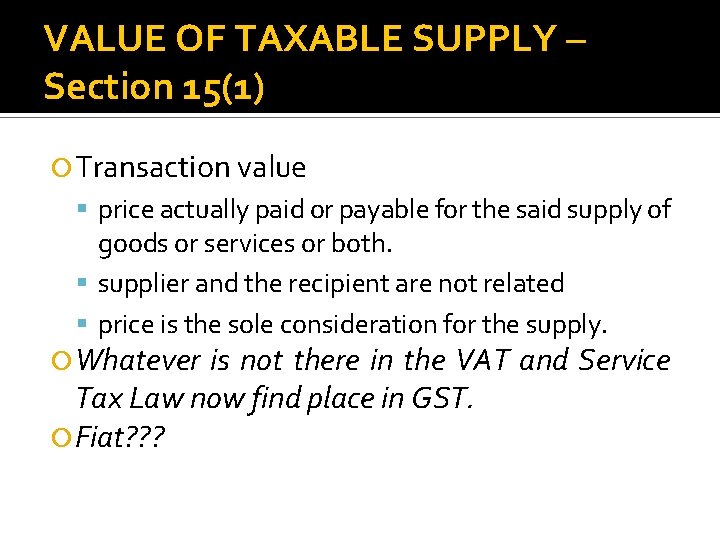
VALUE OF TAXABLE SUPPLY – Section 15(1) Transaction value price actually paid or payable for the said supply of goods or services or both. supplier and the recipient are not related price is the sole consideration for the supply. Whatever is not there in the VAT and Service Tax Law now find place in GST. Fiat? ? ?
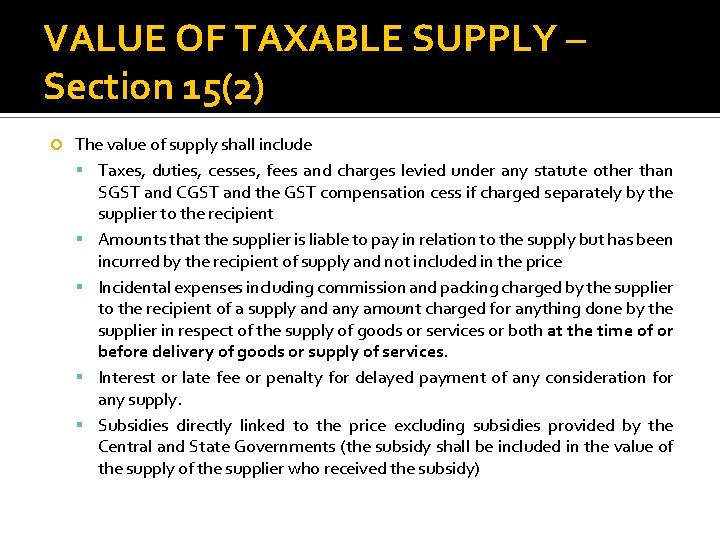
VALUE OF TAXABLE SUPPLY – Section 15(2) The value of supply shall include Taxes, duties, cesses, fees and charges levied under any statute other than SGST and CGST and the GST compensation cess if charged separately by the supplier to the recipient Amounts that the supplier is liable to pay in relation to the supply but has been incurred by the recipient of supply and not included in the price Incidental expenses including commission and packing charged by the supplier to the recipient of a supply and any amount charged for anything done by the supplier in respect of the supply of goods or services or both at the time of or before delivery of goods or supply of services. Interest or late fee or penalty for delayed payment of any consideration for any supply. Subsidies directly linked to the price excluding subsidies provided by the Central and State Governments (the subsidy shall be included in the value of the supply of the supplier who received the subsidy)
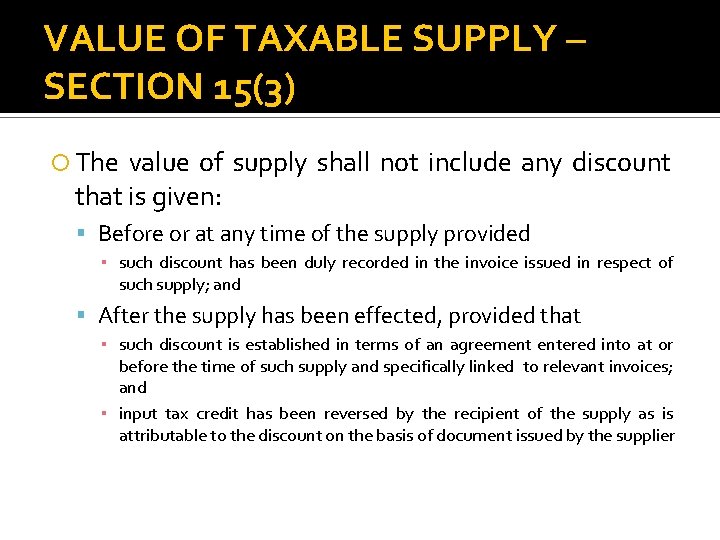
VALUE OF TAXABLE SUPPLY – SECTION 15(3) The value of supply shall not include any discount that is given: Before or at any time of the supply provided ▪ such discount has been duly recorded in the invoice issued in respect of such supply; and After the supply has been effected, provided that ▪ such discount is established in terms of an agreement entered into at or before the time of such supply and specifically linked to relevant invoices; and ▪ input tax credit has been reversed by the recipient of the supply as is attributable to the discount on the basis of document issued by the supplier
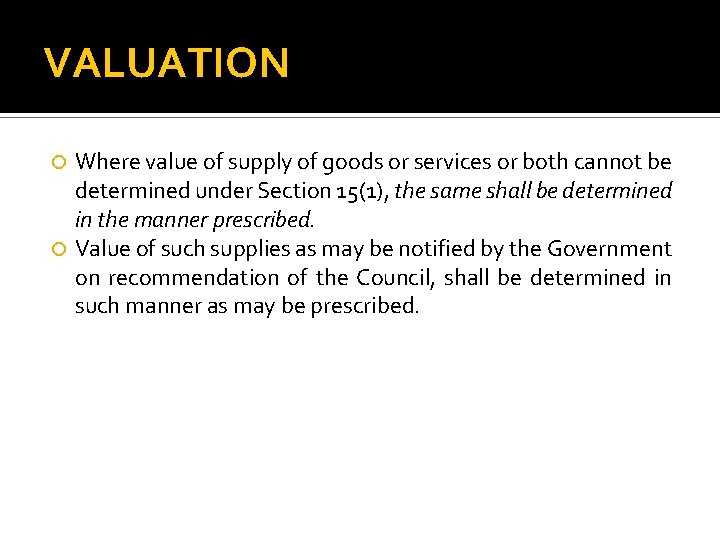
VALUATION Where value of supply of goods or services or both cannot be determined under Section 15(1), the same shall be determined in the manner prescribed. Value of such supplies as may be notified by the Government on recommendation of the Council, shall be determined in such manner as may be prescribed.
DISCOUNTS - ISSUES GST law is in conflict with commercial realities Discounts through credit notes is a common business practice Impact of Ind AS on Discounts through credit notes.
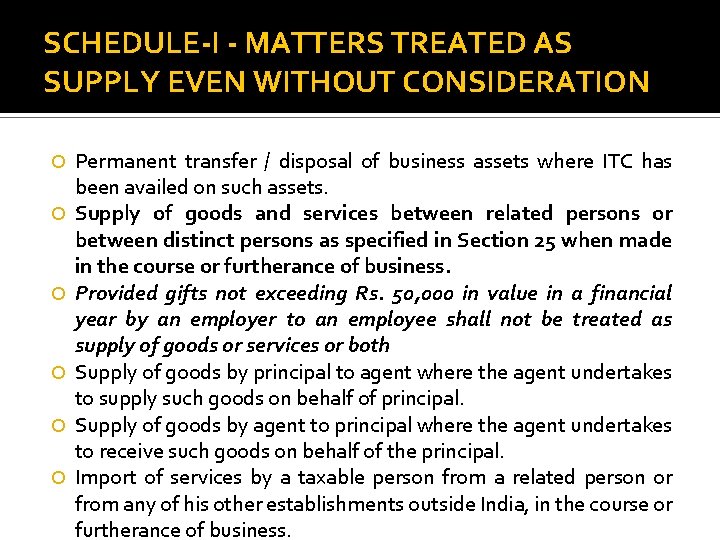
SCHEDULE-I - MATTERS TREATED AS SUPPLY EVEN WITHOUT CONSIDERATION Permanent transfer / disposal of business assets where ITC has been availed on such assets. Supply of goods and services between related persons or between distinct persons as specified in Section 25 when made in the course or furtherance of business. Provided gifts not exceeding Rs. 50, 000 in value in a financial year by an employer to an employee shall not be treated as supply of goods or services or both Supply of goods by principal to agent where the agent undertakes to supply such goods on behalf of principal. Supply of goods by agent to principal where the agent undertakes to receive such goods on behalf of the principal. Import of services by a taxable person from a related person or from any of his other establishments outside India, in the course or furtherance of business.
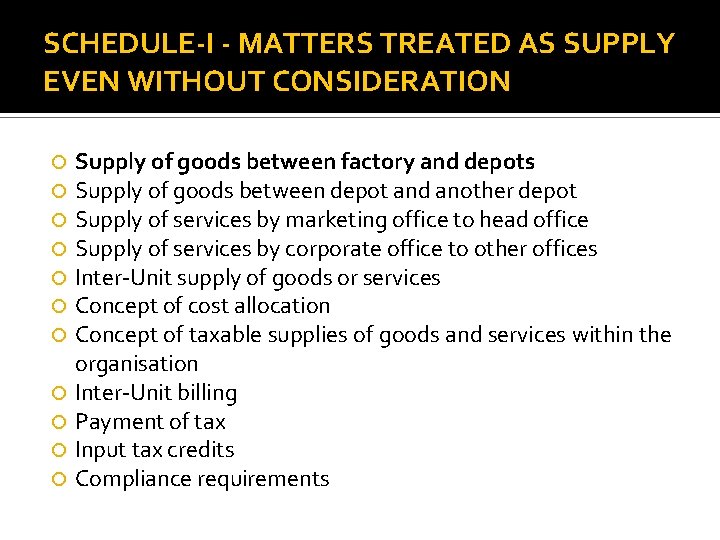
SCHEDULE-I - MATTERS TREATED AS SUPPLY EVEN WITHOUT CONSIDERATION Supply of goods between factory and depots Supply of goods between depot and another depot Supply of services by marketing office to head office Supply of services by corporate office to other offices Inter-Unit supply of goods or services Concept of cost allocation Concept of taxable supplies of goods and services within the organisation Inter-Unit billing Payment of tax Input tax credits Compliance requirements
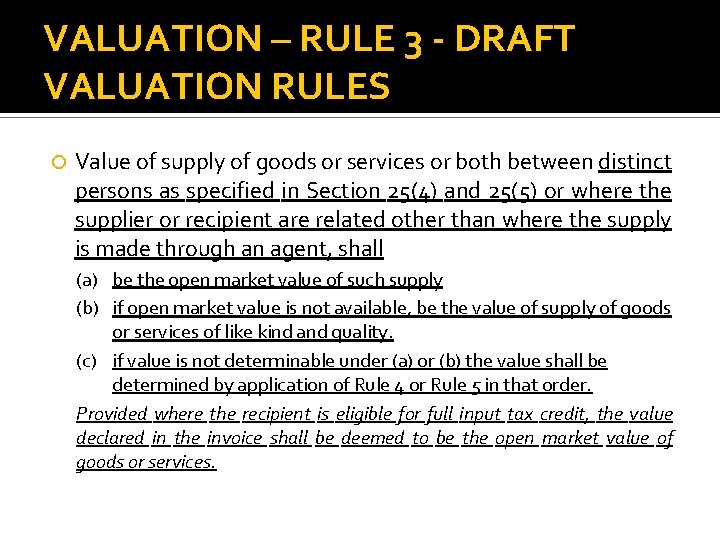
VALUATION – RULE 3 - DRAFT VALUATION RULES Value of supply of goods or services or both between distinct persons as specified in Section 25(4) and 25(5) or where the supplier or recipient are related other than where the supply is made through an agent, shall (a) be the open market value of such supply (b) if open market value is not available, be the value of supply of goods or services of like kind and quality. (c) if value is not determinable under (a) or (b) the value shall be determined by application of Rule 4 or Rule 5 in that order. Provided where the recipient is eligible for full input tax credit, the value declared in the invoice shall be deemed to be the open market value of goods or services.
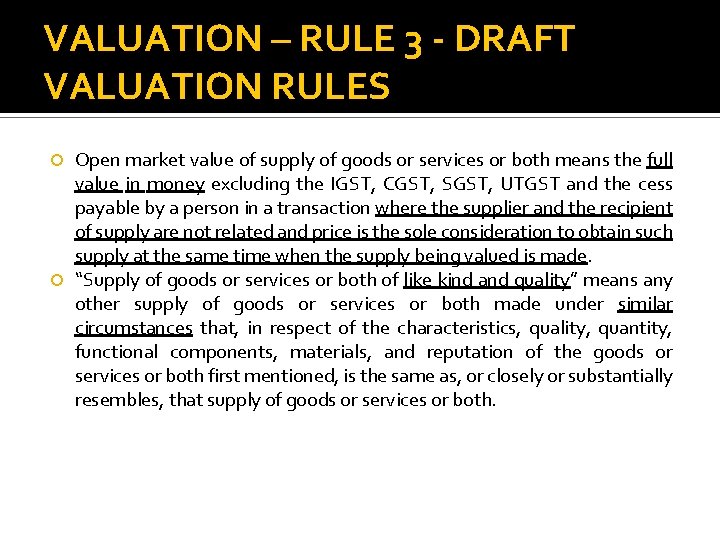
VALUATION – RULE 3 - DRAFT VALUATION RULES Open market value of supply of goods or services or both means the full value in money excluding the IGST, CGST, SGST, UTGST and the cess payable by a person in a transaction where the supplier and the recipient of supply are not related and price is the sole consideration to obtain such supply at the same time when the supply being valued is made. “Supply of goods or services or both of like kind and quality” means any other supply of goods or services or both made under similar circumstances that, in respect of the characteristics, quality, quantity, functional components, materials, and reputation of the goods or services or both first mentioned, is the same as, or closely or substantially resembles, that supply of goods or services or both.
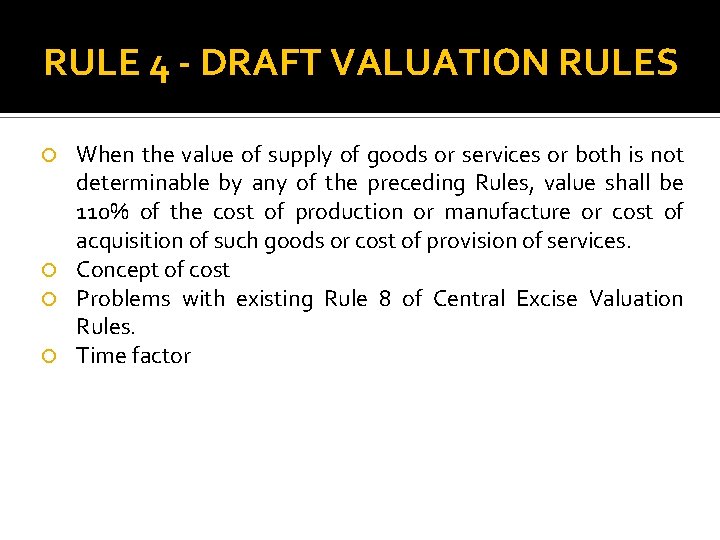
RULE 4 - DRAFT VALUATION RULES When the value of supply of goods or services or both is not determinable by any of the preceding Rules, value shall be 110% of the cost of production or manufacture or cost of acquisition of such goods or cost of provision of services. Concept of cost Problems with existing Rule 8 of Central Excise Valuation Rules. Time factor
RULE 5 – DRAFT VALUATION RULES Where the value of supply of goods or services or both cannot be determined under Rule 1 to Rule 4, the same shall be determined using reasonable means consistent with the principles and general provisions of Section 15 and these Rules. In case of supply of services, the supplier may opt for this Rule, disregarding Rule 4.
GOODS OF LIKE KIND AND QUALITY Any other supply of goods Made under similar circumstances That in respect of Characteristics / quality / quantity / functional components / materials / reputation of the goods first mentioned is the same as, or closely or substantially resembles that supply of goods. ? ? ?
IGST – STOCK TRANSFER CHALLENGES Since the depot is part of the same organization huge cash outflows on stock transfers. Even though depot can avail IGST credit, the set off can happen only on sale which may not be immediate. Dealers ability or willingness to hold stock. Relevance of depot / godowns / C&F. Zero CST Vs. IGST K. Vaitheeswaran - All Copyrights Reserved
POINT OF TAXATION – TIME OF SUPPLY
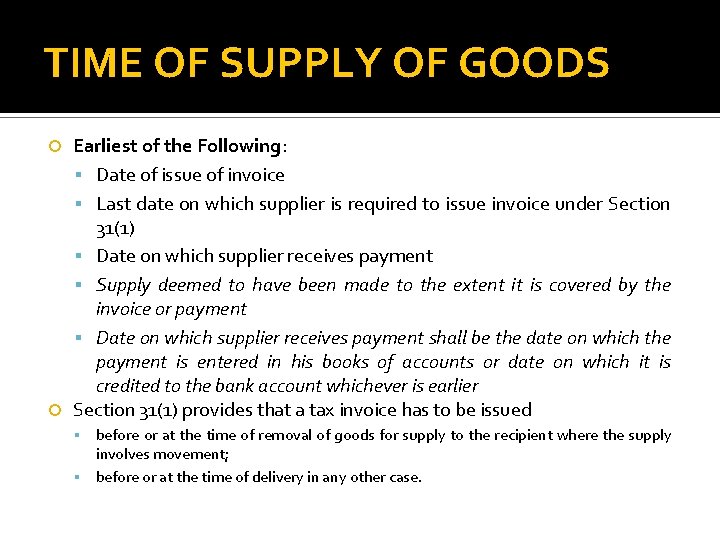
TIME OF SUPPLY OF GOODS Earliest of the Following: Date of issue of invoice Last date on which supplier is required to issue invoice under Section 31(1) Date on which supplier receives payment Supply deemed to have been made to the extent it is covered by the invoice or payment Date on which supplier receives payment shall be the date on which the payment is entered in his books of accounts or date on which it is credited to the bank account whichever is earlier Section 31(1) provides that a tax invoice has to be issued before or at the time of removal of goods for supply to the recipient where the supply involves movement; before or at the time of delivery in any other case.
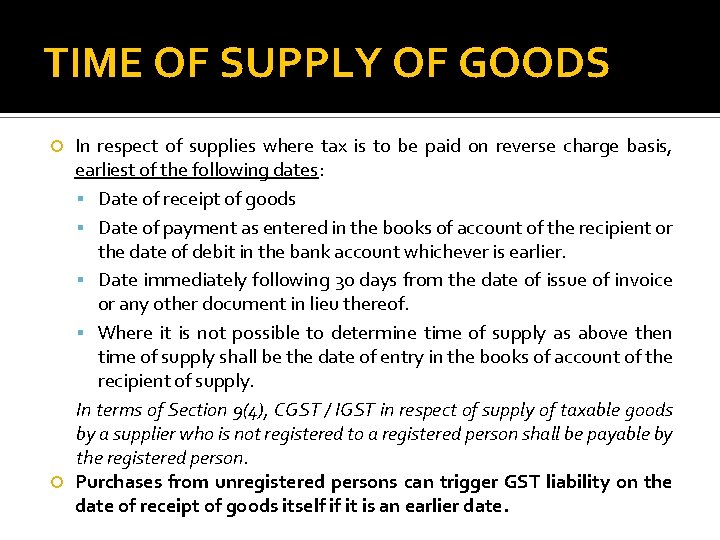
TIME OF SUPPLY OF GOODS In respect of supplies where tax is to be paid on reverse charge basis, earliest of the following dates: Date of receipt of goods Date of payment as entered in the books of account of the recipient or the date of debit in the bank account whichever is earlier. Date immediately following 30 days from the date of issue of invoice or any other document in lieu thereof. Where it is not possible to determine time of supply as above then time of supply shall be the date of entry in the books of account of the recipient of supply. In terms of Section 9(4), CGST / IGST in respect of supply of taxable goods by a supplier who is not registered to a registered person shall be payable by the registered person. Purchases from unregistered persons can trigger GST liability on the date of receipt of goods itself if it is an earlier date.

INPUT TAX CREDIT
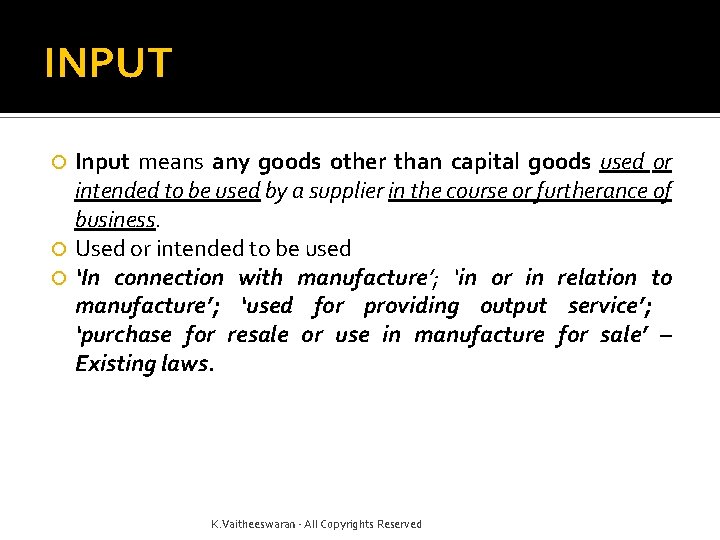
INPUT Input means any goods other than capital goods used or intended to be used by a supplier in the course or furtherance of business. Used or intended to be used ‘In connection with manufacture’; ‘in or in relation to manufacture’; ‘used for providing output service’; ‘purchase for resale or use in manufacture for sale’ – Existing laws. K. Vaitheeswaran - All Copyrights Reserved
INPUT SERVICE Input service means any service used or intended to be used by a supplier in the course or furtherance of business.
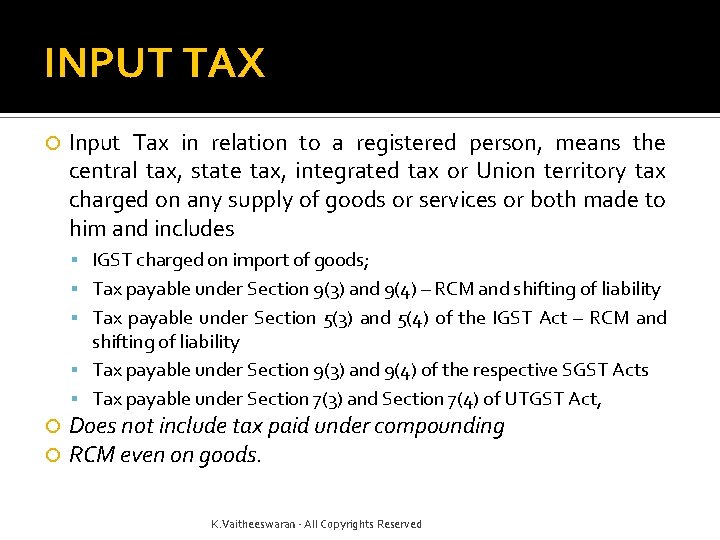
INPUT TAX Input Tax in relation to a registered person, means the central tax, state tax, integrated tax or Union territory tax charged on any supply of goods or services or both made to him and includes IGST charged on import of goods; Tax payable under Section 9(3) and 9(4) – RCM and shifting of liability Tax payable under Section 5(3) and 5(4) of the IGST Act – RCM and shifting of liability Tax payable under Section 9(3) and 9(4) of the respective SGST Acts Tax payable under Section 7(3) and Section 7(4) of UTGST Act, Does not include tax paid under compounding RCM even on goods. K. Vaitheeswaran - All Copyrights Reserved
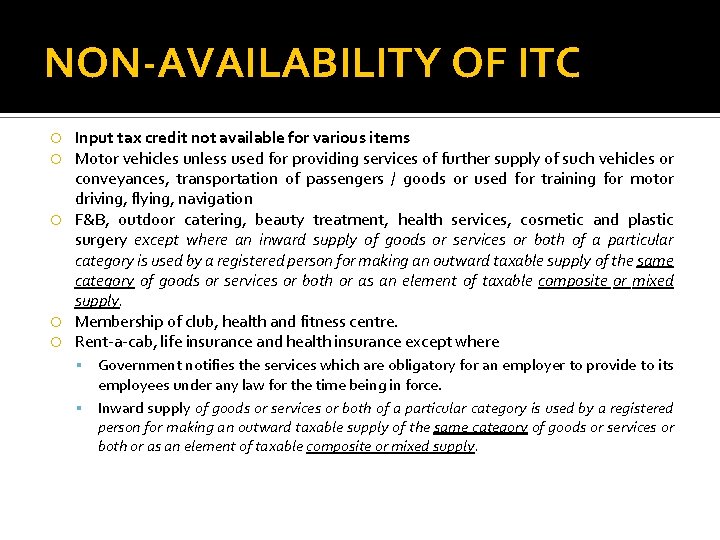
NON-AVAILABILITY OF ITC Input tax credit not available for various items Motor vehicles unless used for providing services of further supply of such vehicles or conveyances, transportation of passengers / goods or used for training for motor driving, flying, navigation F&B, outdoor catering, beauty treatment, health services, cosmetic and plastic surgery except where an inward supply of goods or services or both of a particular category is used by a registered person for making an outward taxable supply of the same category of goods or services or both or as an element of taxable composite or mixed supply. Membership of club, health and fitness centre. Rent-a-cab, life insurance and health insurance except where Government notifies the services which are obligatory for an employer to provide to its employees under any law for the time being in force. Inward supply of goods or services or both of a particular category is used by a registered person for making an outward taxable supply of the same category of goods or services or both or as an element of taxable composite or mixed supply.
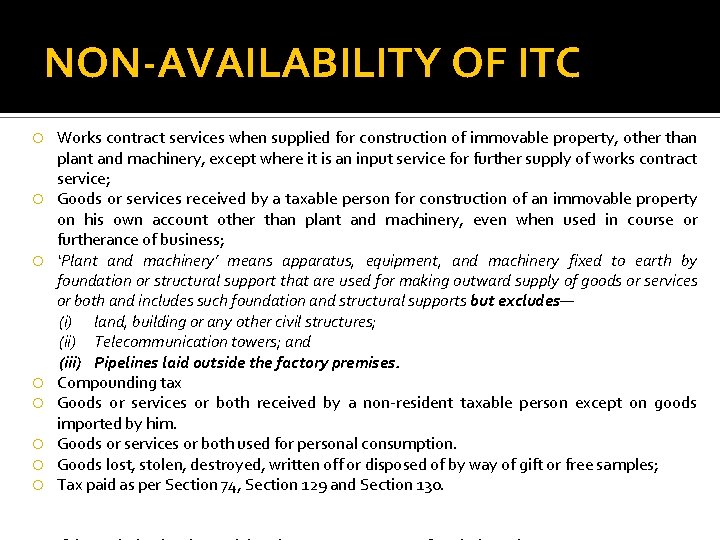
NON-AVAILABILITY OF ITC Works contract services when supplied for construction of immovable property, other than plant and machinery, except where it is an input service for further supply of works contract service; Goods or services received by a taxable person for construction of an immovable property on his own account other than plant and machinery, even when used in course or furtherance of business; ‘Plant and machinery’ means apparatus, equipment, and machinery fixed to earth by foundation or structural support that are used for making outward supply of goods or services or both and includes such foundation and structural supports but excludes— (i) land, building or any other civil structures; (ii) Telecommunication towers; and (iii) Pipelines laid outside the factory premises. Compounding tax Goods or services or both received by a non-resident taxable person except on goods imported by him. Goods or services or both used for personal consumption. Goods lost, stolen, destroyed, written off or disposed of by way of gift or free samples; Tax paid as per Section 74, Section 129 and Section 130.
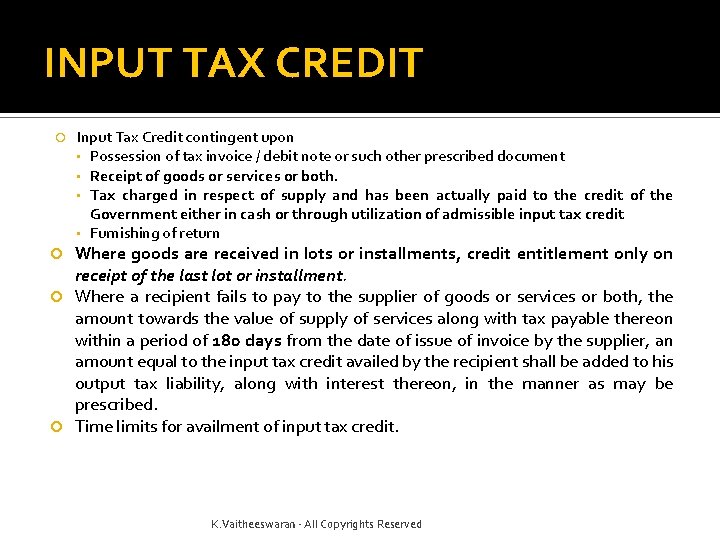
INPUT TAX CREDIT Input Tax Credit contingent upon • Possession of tax invoice / debit note or such other prescribed document • Receipt of goods or services or both. • Tax charged in respect of supply and has been actually paid to the credit of the Government either in cash or through utilization of admissible input tax credit • Furnishing of return Where goods are received in lots or installments, credit entitlement only on receipt of the last lot or installment. Where a recipient fails to pay to the supplier of goods or services or both, the amount towards the value of supply of services along with tax payable thereon within a period of 180 days from the date of issue of invoice by the supplier, an amount equal to the input tax credit availed by the recipient shall be added to his output tax liability, along with interest thereon, in the manner as may be prescribed. Time limits for availment of input tax credit. K. Vaitheeswaran - All Copyrights Reserved
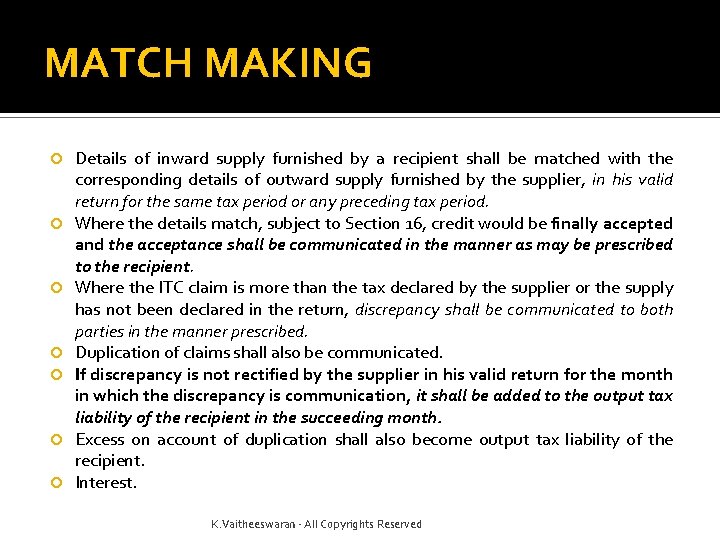
MATCH MAKING Details of inward supply furnished by a recipient shall be matched with the corresponding details of outward supply furnished by the supplier, in his valid return for the same tax period or any preceding tax period. Where the details match, subject to Section 16, credit would be finally accepted and the acceptance shall be communicated in the manner as may be prescribed to the recipient. Where the ITC claim is more than the tax declared by the supplier or the supply has not been declared in the return, discrepancy shall be communicated to both parties in the manner prescribed. Duplication of claims shall also be communicated. If discrepancy is not rectified by the supplier in his valid return for the month in which the discrepancy is communication, it shall be added to the output tax liability of the recipient in the succeeding month. Excess on account of duplication shall also become output tax liability of the recipient. Interest. K. Vaitheeswaran - All Copyrights Reserved
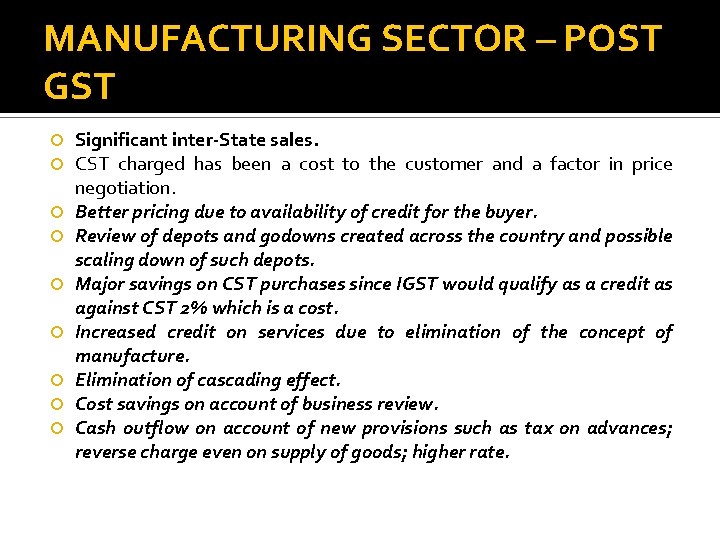
MANUFACTURING SECTOR – POST GST Significant inter-State sales. CST charged has been a cost to the customer and a factor in price negotiation. Better pricing due to availability of credit for the buyer. Review of depots and godowns created across the country and possible scaling down of such depots. Major savings on CST purchases since IGST would qualify as a credit as against CST 2% which is a cost. Increased credit on services due to elimination of the concept of manufacture. Elimination of cascading effect. Cost savings on account of business review. Cash outflow on account of new provisions such as tax on advances; reverse charge even on supply of goods; higher rate.
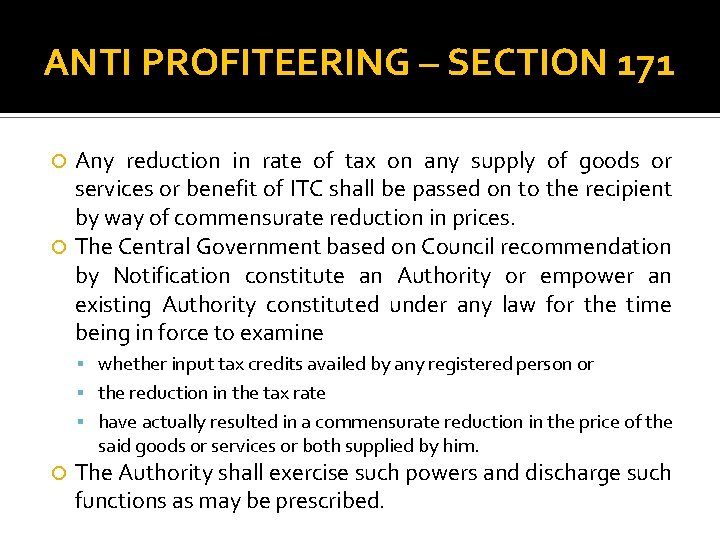
ANTI PROFITEERING – SECTION 171 Any reduction in rate of tax on any supply of goods or services or benefit of ITC shall be passed on to the recipient by way of commensurate reduction in prices. The Central Government based on Council recommendation by Notification constitute an Authority or empower an existing Authority constituted under any law for the time being in force to examine whether input tax credits availed by any registered person or the reduction in the tax rate have actually resulted in a commensurate reduction in the price of the said goods or services or both supplied by him. The Authority shall exercise such powers and discharge such functions as may be prescribed.

TRANSITION
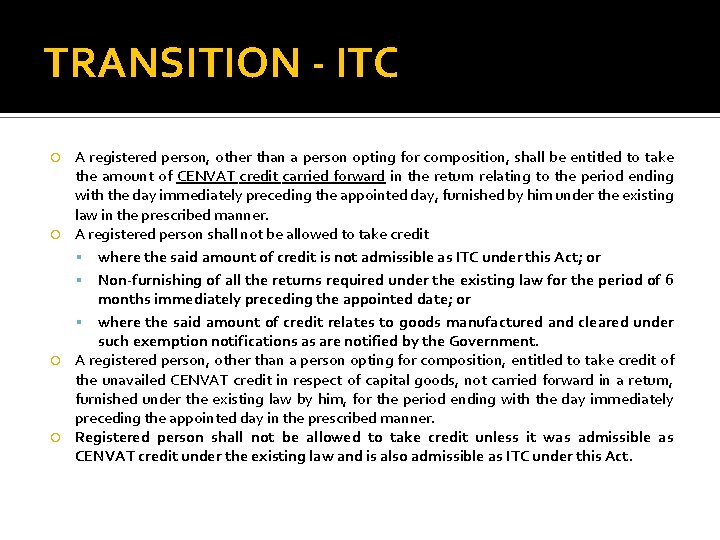
TRANSITION - ITC A registered person, other than a person opting for composition, shall be entitled to take the amount of CENVAT credit carried forward in the return relating to the period ending with the day immediately preceding the appointed day, furnished by him under the existing law in the prescribed manner. A registered person shall not be allowed to take credit where the said amount of credit is not admissible as ITC under this Act; or Non-furnishing of all the returns required under the existing law for the period of 6 months immediately preceding the appointed date; or where the said amount of credit relates to goods manufactured and cleared under such exemption notifications as are notified by the Government. A registered person, other than a person opting for composition, entitled to take credit of the unavailed CENVAT credit in respect of capital goods, not carried forward in a return, furnished under the existing law by him, for the period ending with the day immediately preceding the appointed day in the prescribed manner. Registered person shall not be allowed to take credit unless it was admissible as CENVAT credit under the existing law and is also admissible as ITC under this Act.
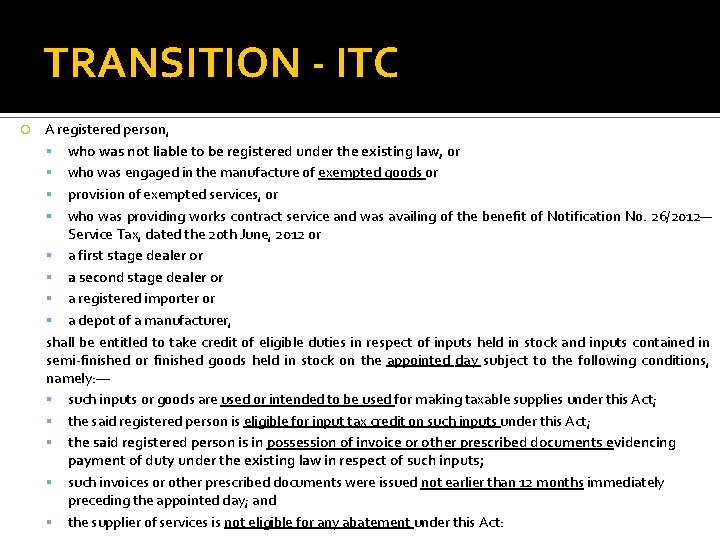
TRANSITION - ITC A registered person, who was not liable to be registered under the existing law, or who was engaged in the manufacture of exempted goods or provision of exempted services, or who was providing works contract service and was availing of the benefit of Notification No. 26/2012— Service Tax, dated the 20 th June, 2012 or a first stage dealer or a second stage dealer or a registered importer or a depot of a manufacturer, shall be entitled to take credit of eligible duties in respect of inputs held in stock and inputs contained in semi-finished or finished goods held in stock on the appointed day subject to the following conditions, namely: –– such inputs or goods are used or intended to be used for making taxable supplies under this Act; the said registered person is eligible for input tax credit on such inputs under this Act; the said registered person is in possession of invoice or other prescribed documents evidencing payment of duty under the existing law in respect of such inputs; such invoices or other prescribed documents were issued not earlier than 12 months immediately preceding the appointed day; and the supplier of services is not eligible for any abatement under this Act:
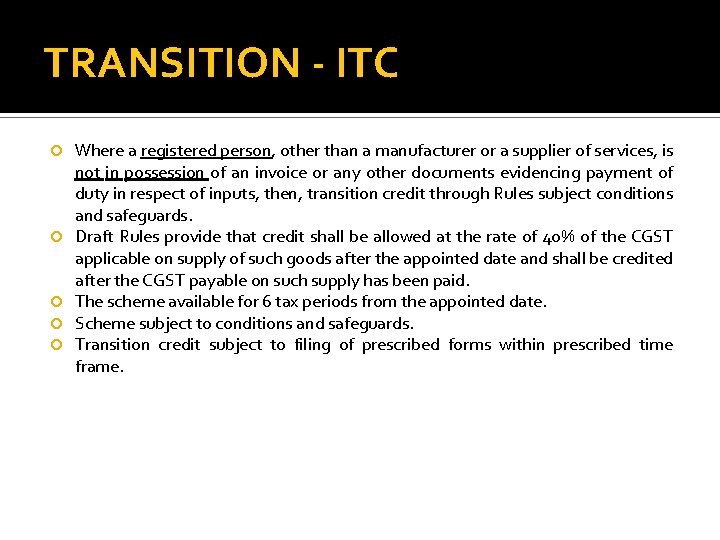
TRANSITION - ITC Where a registered person, other than a manufacturer or a supplier of services, is not in possession of an invoice or any other documents evidencing payment of duty in respect of inputs, then, transition credit through Rules subject conditions and safeguards. Draft Rules provide that credit shall be allowed at the rate of 40% of the CGST applicable on supply of such goods after the appointed date and shall be credited after the CGST payable on such supply has been paid. The scheme available for 6 tax periods from the appointed date. Scheme subject to conditions and safeguards. Transition credit subject to filing of prescribed forms within prescribed time frame.
THE GST DEBATE
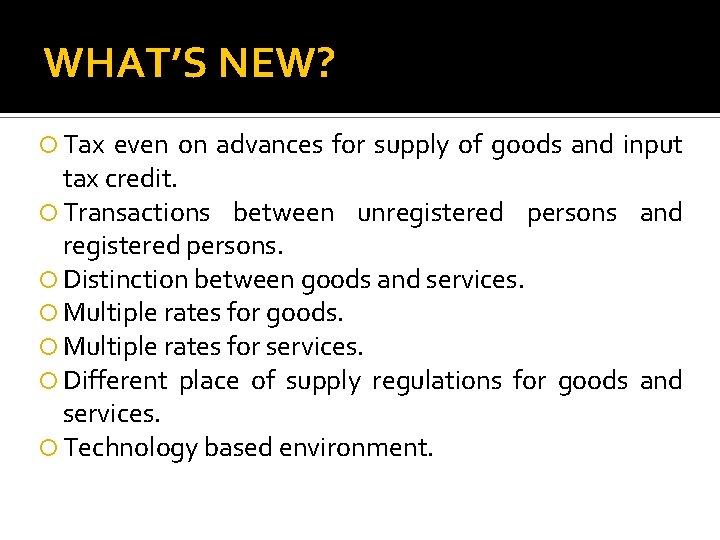
WHAT’S NEW? Tax even on advances for supply of goods and input tax credit. Transactions between unregistered persons and registered persons. Distinction between goods and services. Multiple rates for goods. Multiple rates for services. Different place of supply regulations for goods and services. Technology based environment.
MINIMUM OF 37 ONLINE FILINGS PER STATE PER SUPPLIER
GST WILL BE VERY SIMPLE
GST WILL PROVIDE SEAMLESS CREDIT
GST IN INDIA

THANK YOU K. VAITHEESWARAN ADVOCATE & TAX CONSULTANT Mobile: 98400 -96876 E-mail : vaithilegal@yahoo. co. in vaithilegal@gmail. com www. vaithilegal. com ‘VENKATAGIRI’ Flat No. 8/3 & 8/4, Ground Floor, No. 8 (Old No. 9), Sivaprakasam Street, T. Nagar, Chennai - 600 017, India Tel. : 044 + 2433 1029 / 4048 402, Front Wing, House of Lords, 15/16, St. Marks Road, Bangalore – 560 001, India Tel : 080 22244854/ 41120804
- Slides: 70