
GSM Security Cryptanalysis of A 51 Arber Ceni
GSM Security: Cryptanalysis of A 5/1 Arber Ceni – 07. 02. 2011
Overview (I) � Motivation � Description of A 5/1 � Time-memory tradeoff attacks � Golic 1997 � Biryukov et al. 2000 � Biham and Dunkelman 2000 � Barkan, Biham and Keller 2003 � COPACOBANA 2008 2 GSM Security: Cryptanalysis of A 5/1 Arber Ceni
Overview (II) � Correlation attacks � Ekdahl and Johansson 2003 � Maximov, Johansson and Babbage 2005 � Barkan and Biham 2006 � Other attacks on GSM and A 5 family ciphers � Conclusions 3 GSM Security: Cryptanalysis of A 5/1 Arber Ceni
Motivation � GSM has more than 3 billion customers and covers around 80% of the World’s population � Every over-the-air conversation is protected by A 5/1 � GSM is the biggest cryptosystem ever deployed � A 5/1 developed in 1987 (older than 20 years) � Many flaws discovered � Many attacks conducted 4 GSM Security: Cryptanalysis of A 5/1 Arber Ceni
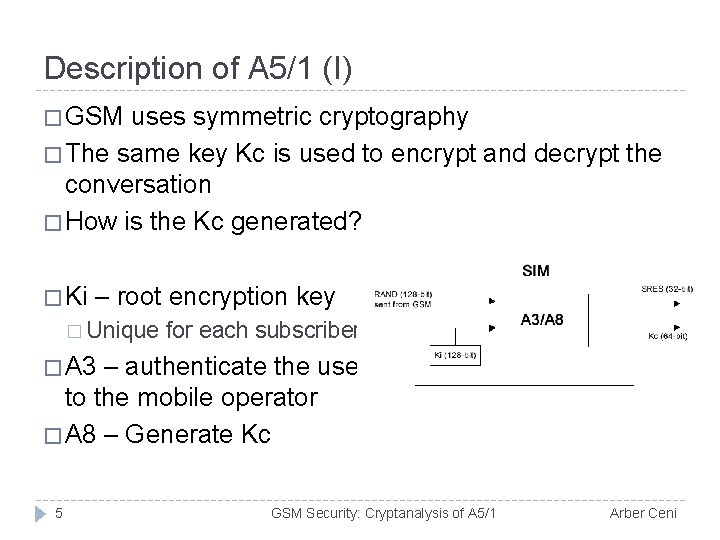
Description of A 5/1 (I) � GSM uses symmetric cryptography � The same key Kc is used to encrypt and decrypt the conversation � How is the Kc generated? � Ki – root encryption key � Unique for each subscriber � A 3 – authenticate the user to the mobile operator � A 8 – Generate Kc 5 GSM Security: Cryptanalysis of A 5/1 Arber Ceni
Description of A 5/1 (II) � Invented in 1987 � Partially leaked in 1994 � Reverse engineered by Briceno in 1999 � Idea: � Conversation as frames transmitted every 4, 6 ms � 228 bits+Kc+Fn=228 bits cyphertext � 114 up, 114 down � Three LFSRs � R 1 – length 19; taping bits 13, 16, 17, 18; clocking bit 8 � R 2 – length 22; taping bits 20, 21; clocking bit 10 � R 3 – length 23; 7, 20, 21, 22; clocking bit 10 6 GSM Security: Cryptanalysis of A 5/1 Arber Ceni
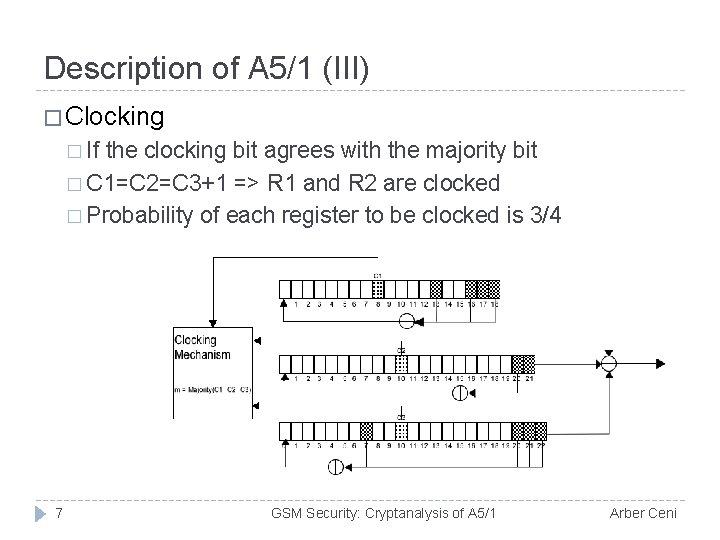
Description of A 5/1 (III) � Clocking � If the clocking bit agrees with the majority bit � C 1=C 2=C 3+1 => R 1 and R 2 are clocked � Probability of each register to be clocked is 3/4 7 GSM Security: Cryptanalysis of A 5/1 Arber Ceni
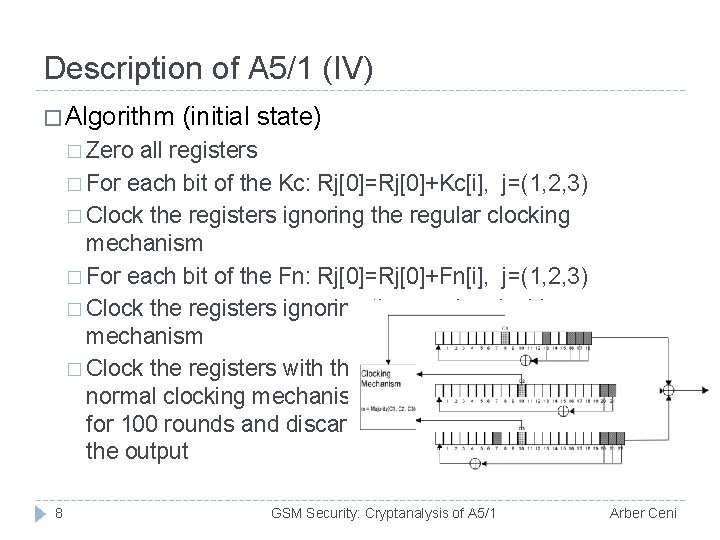
Description of A 5/1 (IV) � Algorithm (initial state) � Zero all registers � For each bit of the Kc: Rj[0]=Rj[0]+Kc[i], j=(1, 2, 3) � Clock the registers ignoring the regular clocking mechanism � For each bit of the Fn: Rj[0]=Rj[0]+Fn[i], j=(1, 2, 3) � Clock the registers ignoring the regular clocking mechanism � Clock the registers with the normal clocking mechanism for 100 rounds and discard the output 8 GSM Security: Cryptanalysis of A 5/1 Arber Ceni
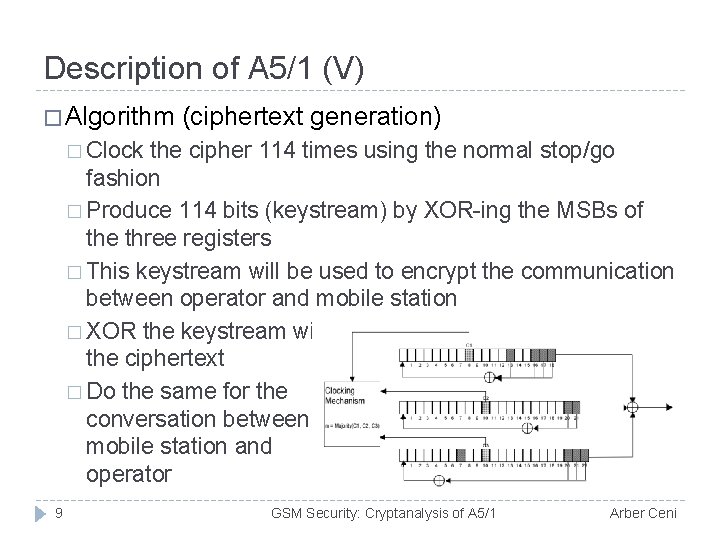
Description of A 5/1 (V) � Algorithm (ciphertext generation) � Clock the cipher 114 times using the normal stop/go fashion � Produce 114 bits (keystream) by XOR-ing the MSBs of the three registers � This keystream will be used to encrypt the communication between operator and mobile station � XOR the keystream with the initial message to produce the ciphertext � Do the same for the conversation between mobile station and operator 9 GSM Security: Cryptanalysis of A 5/1 Arber Ceni
Time-memory tradeoff attacks – Golic 1997 � Alleged but similar A 5/1 cipher � Divide and conquer � Idea: Guess some bits of the state of the registers and find the others by solving linear equations � Complexity: O(240. 16) � How many bits should we guess: �n � n-ri+taui-1 if n ≤ ri-taui+1 otherwise � 1+3 n+4 n/3 linear equations � Linear independent if n< max(tau 1, tau 2, tau 3)-1 � Real A 5/1: max(tau 1, tau 2, tau 3)=10 => O(245. 22) � Time-memory tradeoff: 102·K·M≥ 263. 32 10 GSM Security: Cryptanalysis of A 5/1 Arber Ceni
Time-memory tradeoff attacks – Biryukov et al. 2000 (I) � Store in HDD (prefix, state) pairs for special states starting with α = 16 bits � Flaw of A 5/1: clocking tap doesn’t affect output for 16 clocking cycles � Produces 248 states instead of 264; further reduced to 240 � Compare the prefix of an unknown state � Red states R – special states; |R|= 248 � Green states G – α is encountered in position 101277; |G|= 177*248 � 235 stored states with avg weight 12500 � We can encounter a red state in 2 min of conversation with a probability of 61% 11 GSM Security: Cryptanalysis of A 5/1 Arber Ceni
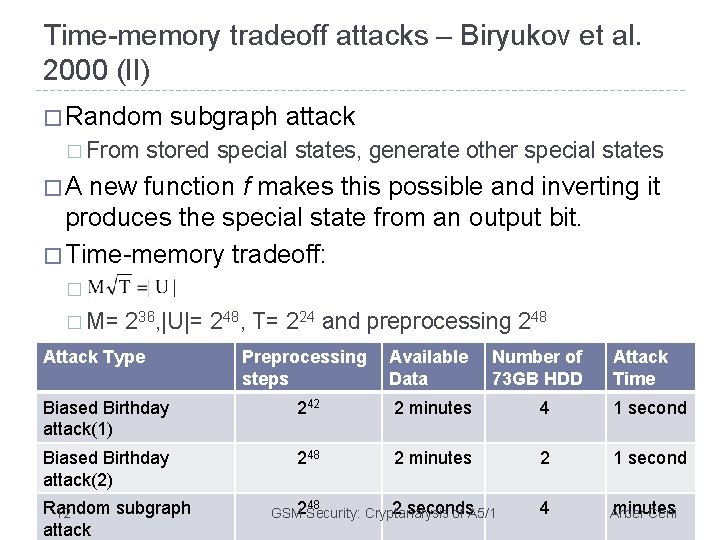
Time-memory tradeoff attacks – Biryukov et al. 2000 (II) � Random � From subgraph attack stored special states, generate other special states �A new function f makes this possible and inverting it produces the special state from an output bit. � Time-memory tradeoff: � � M= 236, |U|= 248, T= 224 and preprocessing 248 Attack Type Preprocessing steps Available Data Biased Birthday attack(1) 242 2 minutes 4 1 second Biased Birthday attack(2) 248 2 minutes 2 1 second 4 minutes Arber Ceni Random subgraph 12 attack Number of 73 GB HDD 2 seconds GSM 2 Security: Cryptanalysis of A 5/1 48 Attack Time
Time-memory tradeoff attacks – Biham and Dukelman 2000 (I) � Wait until an event that gives a lot of information happens � With some improvements to the previous attack, break A 5/1 � R 3 not clocked for 10 consecutive times and R 3[10, 22] are known � We get 20 clocking bits of R 1 and R 2 � Other 11 bits from output stream � Guessing 9 bits from R 1 and 1 from R 2, gives both registers � Guessing 10 bits from R 3, gives the other 11 bits of R 3 � Complexity: O(227) � 220 13� possible starting points for R 3 Complexity: O(247)GSM Security: Cryptanalysis of A 5/1 Arber Ceni
Time-memory tradeoff attacks – Biham and Dukelman 2000 (II) � Improve the techniques of the previous attack � Compute two tables: next-state table – stores the states in the computed order � Pointer table – stores the location of the state � � Total Complexity computed: 220 – possible start points for R 3 � 212 – possible guesses � each of them 21. 53 values which cost 2 cycles (next-state lookup) � 24. 53 – values for 10 guesses of R 3 � each of these clocked and checked in pointer table =>2 cycles � each check needs to be clocked twice � 220 *212 * 21. 53 *2* 24. 53 *(1+1+2*0. 88)= 240. 97 A 5/1 clocking cycles � 14 GSM Security: Cryptanalysis of A 5/1 Arber Ceni
Time-memory tradeoff attacks – Barkan, Biham and Keller 2003 � Man-In-The-Middle � 1 st attack � Ask the victim to start encrypting with A 5/2 � Break A 5/2 (which is easier) and send the authentication to the server � 2 nd attack � Ask the network and the victim to start a conversation with no encryption A 5/0 � This is probable to be discovered by the operator � 3 rd attack � The operator initiate the authentication procedure rarely � The attacker asks the victim to encrypt with A 5/2 � Brake A 5/2 and use it later 15 GSM Security: Cryptanalysis of A 5/1 Arber Ceni
Time-memory tradeoff attacks –COPACOBANA 2008 � 120 parallel FPGAs (Field-Programmable Gate Array) � Offers better performance-cost ratio � Can be connected to normal PC � Using COPACOBANA: � 114 known bits (1 frame) � Preprocessing time: three months � Memory: 4. 85 TB � Online phase: 10. 09 s � Success rate: 63% � Can be increased to 96% � Must increase the output stream length to 4 frames 16 GSM Security: Cryptanalysis of A 5/1 Arber Ceni
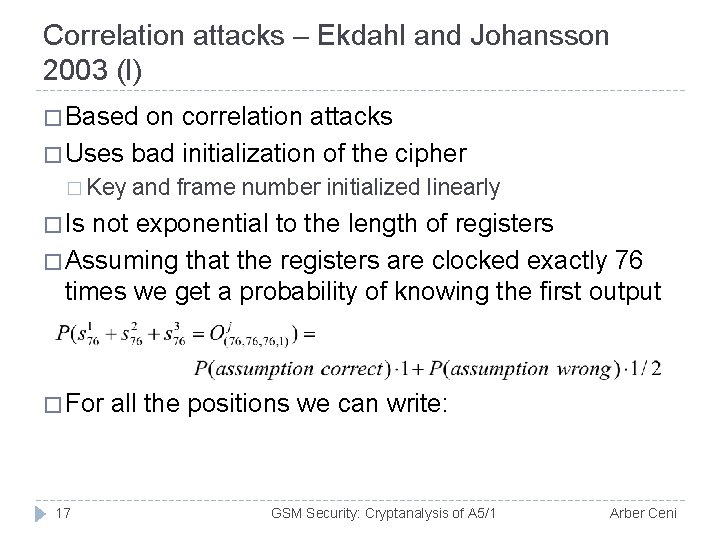
Correlation attacks – Ekdahl and Johansson 2003 (I) � Based on correlation attacks � Uses bad initialization of the cipher � Key and frame number initialized linearly � Is not exponential to the length of registers � Assuming that the registers are clocked exactly 76 times we get a probability of knowing the first output � For 17 all the positions we can write: GSM Security: Cryptanalysis of A 5/1 Arber Ceni
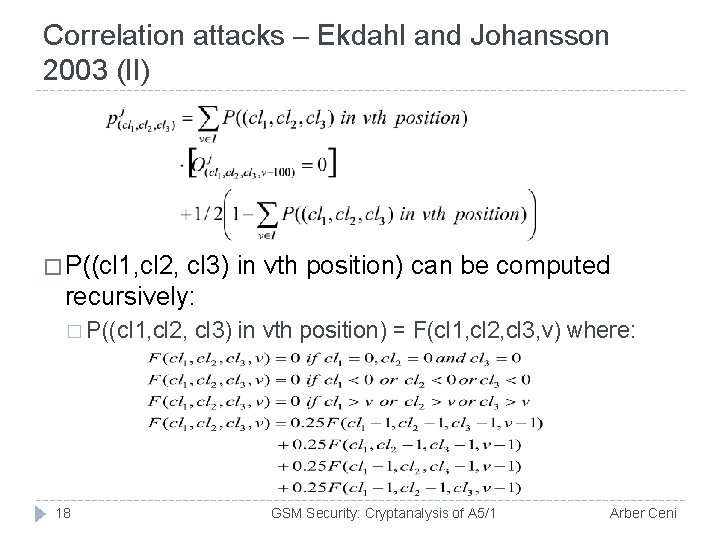
Correlation attacks – Ekdahl and Johansson 2003 (II) � P((cl 1, cl 2, cl 3) in vth position) can be computed recursively: � P((cl 1, cl 2, 18 cl 3) in vth position) = F(cl 1, cl 2, cl 3, v) where: GSM Security: Cryptanalysis of A 5/1 Arber Ceni
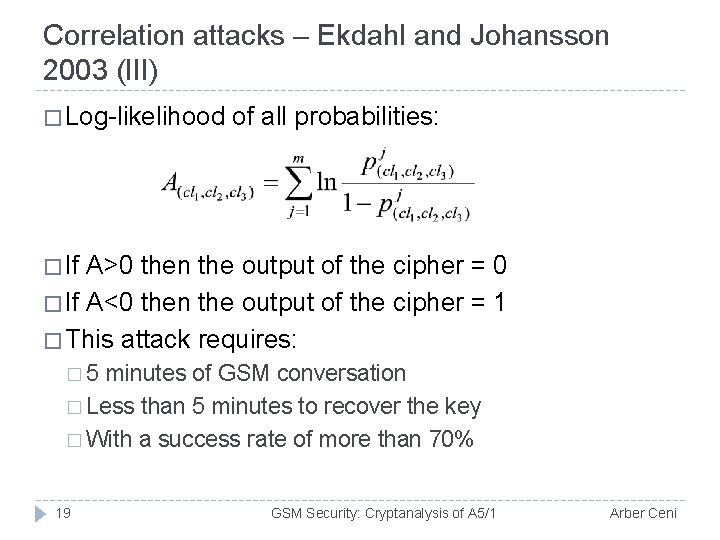
Correlation attacks – Ekdahl and Johansson 2003 (III) � Log-likelihood of all probabilities: � If A>0 then the output of the cipher = 0 � If A<0 then the output of the cipher = 1 � This attack requires: � 5 minutes of GSM conversation � Less than 5 minutes to recover the key � With a success rate of more than 70% 19 GSM Security: Cryptanalysis of A 5/1 Arber Ceni
Correlation attacks – Maximov, Johansson and Babbage 2005 � Improve the attack of Ekdahl and Johansson � Try to reduce the number m of needed frames � Based on two new flaws of A 5/1 � Error-correction codes are applied before encryption � During silence a special kind of frame containing a large number of zeros is sent � They also make use of the log-likelihood to find the key, but they use some improved estimators � Result: �A few seconds of conversation (2000 -5000 frames => 943 s) � Less than one minute of computation 20 GSM Security: Cryptanalysis of A 5/1 Arber Ceni
Correlation attacks – Barkan and Biham 2006 � Based on conditional estimators � Based on previous correlation attacks � Exploit three new weaknesses of the R 2 register Alignment property � Has only two feedback taps which are adjacent � Symmetry property – the clocking tap is at the middle of the register � � Steps: Compute conditional estimators � Decode these estimators to find best candidates for S 1 and S 2 � � Modeled as a huge graph in which can be applied Dijkstra-like algorithms � 21 For each of these candidates recover candidates for S 3. Recover the key from S 1, S 2, S 3 and verify that is the correct one � Results: GSM Security: Cryptanalysis of A 5/1 Arber Ceni
Other attacks on GSM and A 5 family ciphers (I) � FBDD based attack � Developed by Krause 2002 � Complexity: n. O(1)2(1 -α)/(1+ α)n. α is a constant � For A 5/1 complexity: n. O(1)20. 6403 n � Eavesdrop without cryptanalysis � MITM attack � Record RAND; record ciphertext=>output stream of the cipher � Later: � Send the frame number and message to the target mobile � The frame number is the same so the message can be decrypted 22 GSM Security: Cryptanalysis of A 5/1 Arber Ceni
Other attacks on GSM and A 5/1 family ciphers (II) � Open � source project (Nohl 2009) Precompute rainbow tables � The compressed codebook of A 5/1 Used parallelization (FPGA) to reduce precomputing time � First public project to release the tables � 1 st attack: � � MITM attack � Fake base station � Cheap radio equipment � Open source software – Open. BTS � 2 nd attack � Passive attack � Uses the precomputed rainbow tables � 23 Everybody can contribute GSM Security: Cryptanalysis of A 5/1 Arber Ceni
Other attacks on GSM and A 5/1 family ciphers (III) � New A 5/3 again weak � Made public � Based on KASUMI block cipher � Modification � Also of MISTY weak: � By applying a sandwich attack � 226 data, 230 bytes of memory, can complete in 232 time � The authors claim this is realistic and have simulated the attack in a PC 24 GSM Security: Cryptanalysis of A 5/1 Arber Ceni
Conclusions � Most of the attacks presented here, don’t make any claim for the real implementation of A 5/1 in the fielded GSM � However, some of them yes � Breaking A 5/1 has become an open source project! � The new A 5/3 is also weak! � The cryptosystem used in GSM should be changed � It is the biggest cryptosystem ever deployed � It is not used only for conversation � Used for banking information, payment, bank transfer etc 25 GSM Security: Cryptanalysis of A 5/1 Arber Ceni
Thank you! � Questions? 26 GSM Security: Cryptanalysis of A 5/1 Arber Ceni
- Slides: 26