
GSM Mobility Management Rashmi Nigalye Mouloud Rahmani Aruna
GSM Mobility Management Rashmi Nigalye Mouloud Rahmani Aruna Vegesana Garima Mittal December 5, 2001 EL 604: Wireless & Mobile Networking 1
Outline • GSM architecture overview – Network layout – Protocols – Addresses & identifiers • Handover management – Talk and Move • Location management – Move only, without conversation 2
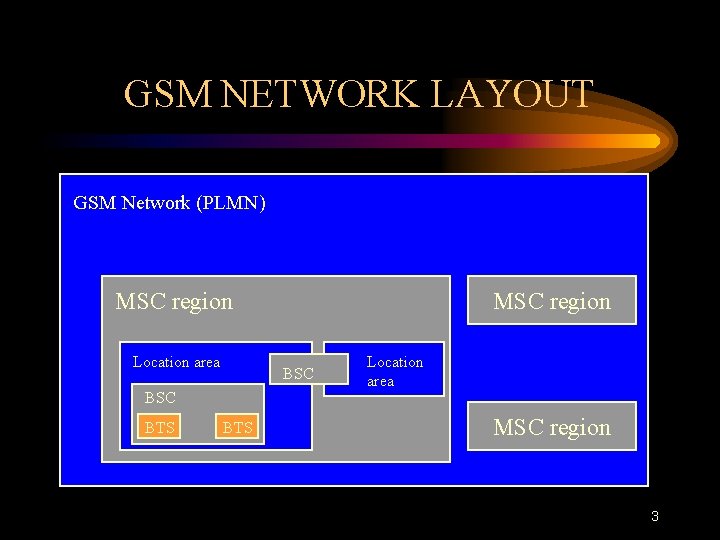
GSM NETWORK LAYOUT GSM Network (PLMN) MSC region Location area BSC BTS Location area MSC region 3
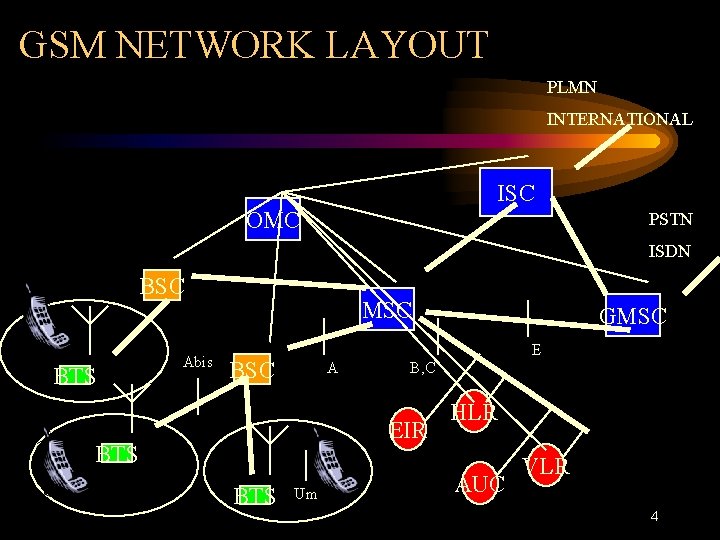
GSM NETWORK LAYOUT PLMN INTERNATIONAL ISC OMC PSTN ISDN BSC BTS Abis MSC E BSC A B, C EIR BTS GMSC Um HLR AUC VLR 4
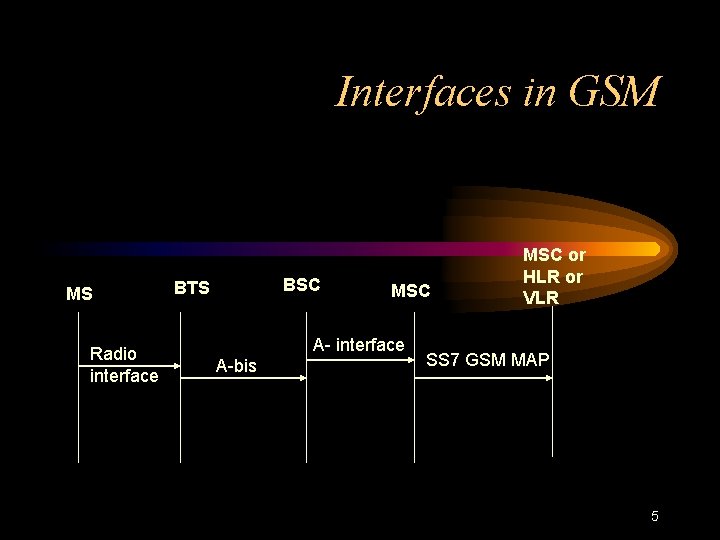
Interfaces in GSM MS Radio interface BSC BTS MSC A- interface A-bis MSC or HLR or VLR SS 7 GSM MAP 5
GSM Protocol layers (GSM has MAP just like IS 41) • To perform network control operations unique to personal communications, GSM adds a Mobile Application Part (MAP) to SS 7. • MAP makes use of the Transactions Capabilities Part (TCAP) transport protocol. • MAP functions: – – Updating of residence information in VLR Storage of routing information in HLR Updating and supplementing of user profiles in HLR Handoff of connections between MSCs 6
What is a location area (LA)? • A powered-on mobile is informed of an incoming call by a paging message sent over the PAGCH channel of a cell • One extreme is to page every cell in the network for each call, which results in a waste of radio bandwidth • Other extreme is to have a Mobile notify the system via location updating messages of its current location at the individual cell level. This requires paging messages to be sent to exactly one cell, but this is wasteful due to the large number of location updating messages. • Hence, in GSM, we group cells into Location Areas (Neighborhoods). 7
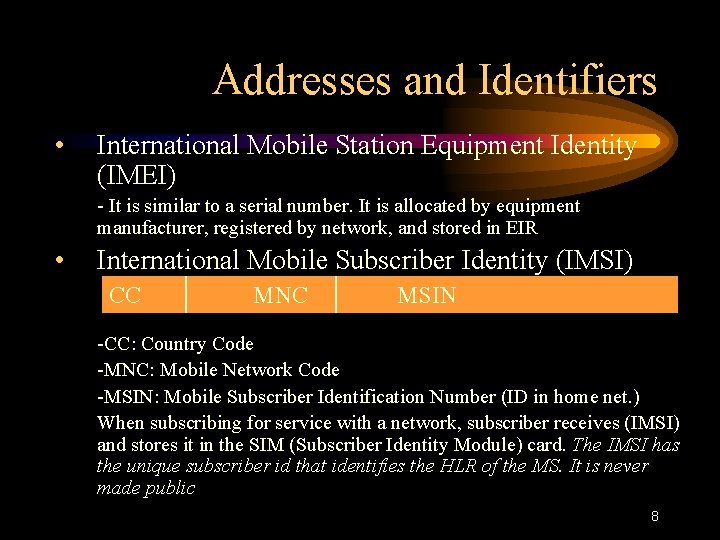
Addresses and Identifiers • International Mobile Station Equipment Identity (IMEI) - It is similar to a serial number. It is allocated by equipment manufacturer, registered by network, and stored in EIR • International Mobile Subscriber Identity (IMSI) CC MNC MSIN -CC: Country Code -MNC: Mobile Network Code -MSIN: Mobile Subscriber Identification Number (ID in home net. ) When subscribing for service with a network, subscriber receives (IMSI) and stores it in the SIM (Subscriber Identity Module) card. The IMSI has the unique subscriber id that identifies the HLR of the MS. It is never made public 8
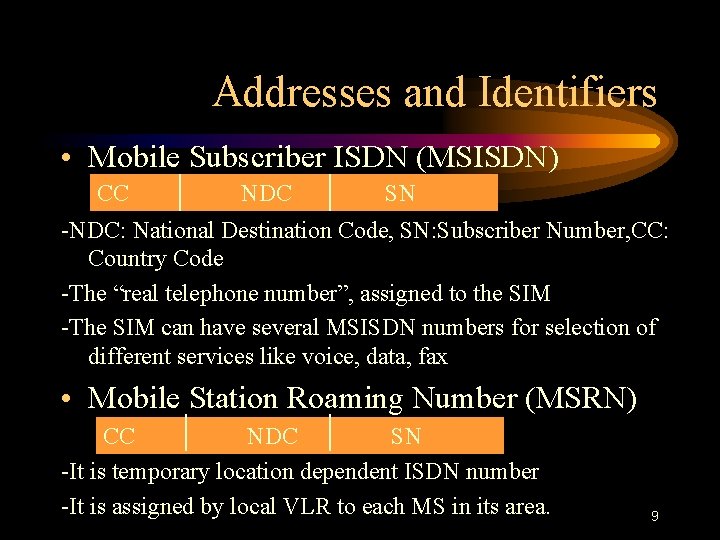
Addresses and Identifiers • Mobile Subscriber ISDN (MSISDN) CC NDC SN -NDC: National Destination Code, SN: Subscriber Number, CC: Country Code -The “real telephone number”, assigned to the SIM -The SIM can have several MSISDN numbers for selection of different services like voice, data, fax • Mobile Station Roaming Number (MSRN) CC NDC SN -It is temporary location dependent ISDN number -It is assigned by local VLR to each MS in its area. 9
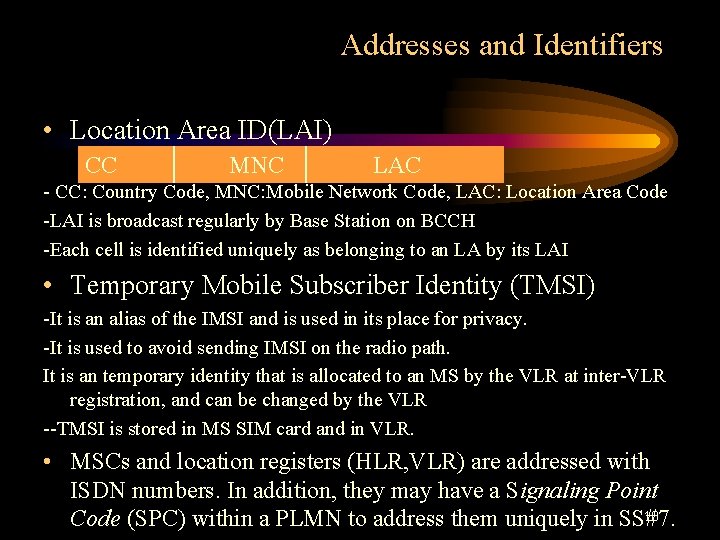
Addresses and Identifiers • Location Area ID(LAI) CC MNC LAC - CC: Country Code, MNC: Mobile Network Code, LAC: Location Area Code -LAI is broadcast regularly by Base Station on BCCH -Each cell is identified uniquely as belonging to an LA by its LAI • Temporary Mobile Subscriber Identity (TMSI) -It is an alias of the IMSI and is used in its place for privacy. -It is used to avoid sending IMSI on the radio path. It is an temporary identity that is allocated to an MS by the VLR at inter-VLR registration, and can be changed by the VLR --TMSI is stored in MS SIM card and in VLR. • MSCs and location registers (HLR, VLR) are addressed with ISDN numbers. In addition, they may have a Signaling Point 10 Code (SPC) within a PLMN to address them uniquely in SS#7.
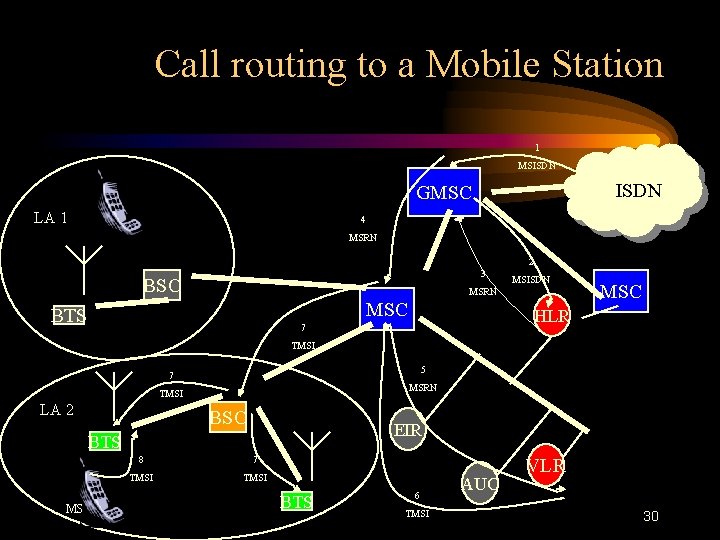
TMSI vs IMSI vs MSRN vs MSISDN • TMSI is used during location update and registration for find, paging and call routing. Instead of using IMSI, the MS sends the TMSI to the BSS, which forwards it to the MSC. • • MSRN is the routing number that identifies the current location of the called MS. MSRN is temporary network identity assigned during the call establishment to a mobile subscriber. MSRN is the address to the serving MSC/VLR. MSRN is used during call termination (Incoming call to the MS). • • • MSISDN is dialed during call termination. MSISDN points to the subscribers records in the HLR that contains information to locate the MSC where the subscriber is currently located. MSISDN is the telephone number. • There is an association between IMSI and MSISDN in the HLR. 11

Types of handover (same as “handoff”) • There are four different types of handover in the GSM system. Handover involves transferring a call between: – Channels (time slots) in the same cell – Cells (Base Transceiver Stations) under the control of the same Base Station Controller (BSC), – Cells under the control of different BSCs, but belonging to the same Mobile services Switching Center (MSC), and – Cells under the control of different MSCs. 12
Attributes of radio-link handover • • • Hard handover MAHO Backward Handover messages Channel allocation schemes • COS selection scheme: static • Cross-over switch: anchor switch • Does GSM cross-over fit the generic scheme? – Yes –Circuit switching • No buffering 13
Handover (MAHO) • Handovers are initiated by the BSS/MSC (as a means of traffic load balancing). • During its idle time slots, the mobile scans the Broadcast Control Channel of up to 16 neighboring cells, and forms a list of the six best candidates for possible handover, based on the received signal strength. • This information is passed to the BSC and MSC, at least once per second, and is used by the handover algorithm. 14
Integrated/Overlay Handover • Integrated – ISUP messages used for selecting inter-switch channel 15
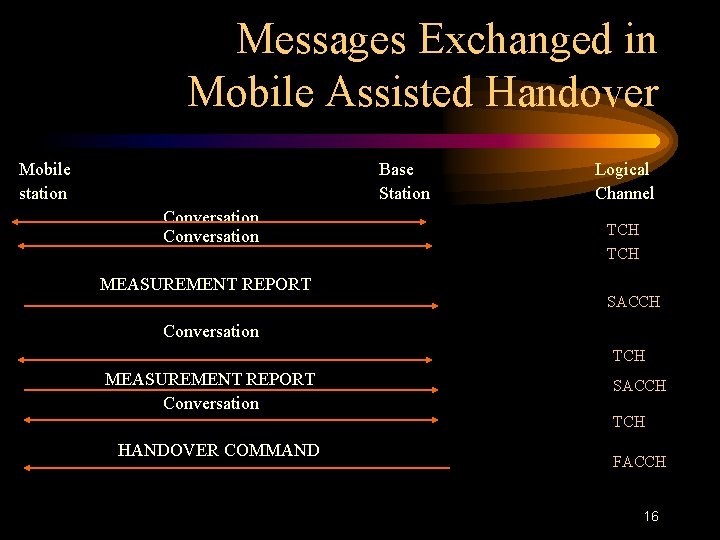
Messages Exchanged in Mobile Assisted Handover Mobile station Base Station Conversation MEASUREMENT REPORT Logical Channel TCH SACCH Conversation TCH MEASUREMENT REPORT Conversation SACCH TCH HANDOVER COMMAND FACCH 16
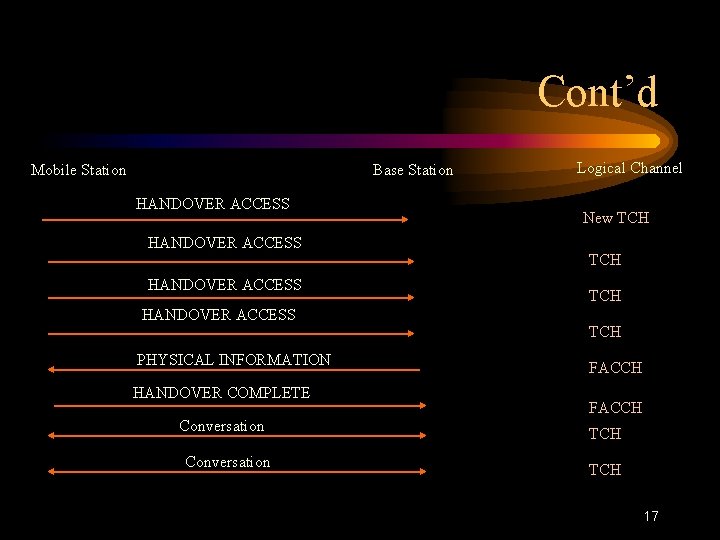
Cont’d Mobile Station Base Station HANDOVER ACCESS PHYSICAL INFORMATION HANDOVER COMPLETE Conversation Logical Channel New TCH TCH FACCH TCH 17
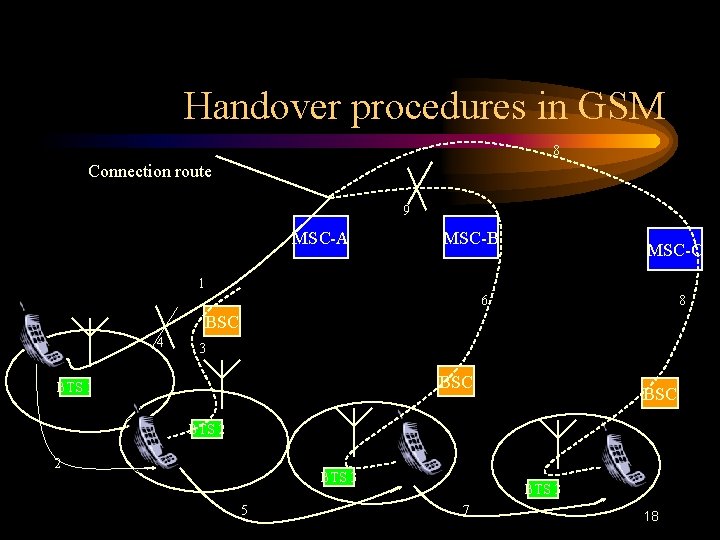
Handover procedures in GSM 8 Connection route 9 MSC-A MSC-B MSC-C 1 6 8 BSC 4 3 BSC BTS 1 BSC BTS 2 2 BTS 3 5 BTS 3 7 18
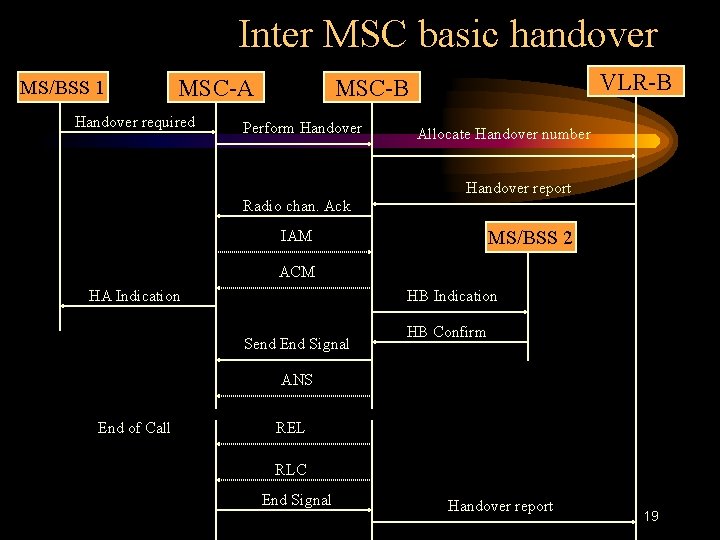
Inter MSC basic handover MS/BSS 1 MSC-A Handover required VLR-B MSC-B Perform Handover Allocate Handover number Handover report Radio chan. Ack MS/BSS 2 IAM ACM HA Indication HB Indication Send End Signal HB Confirm ANS End of Call REL RLC End Signal Handover report 19
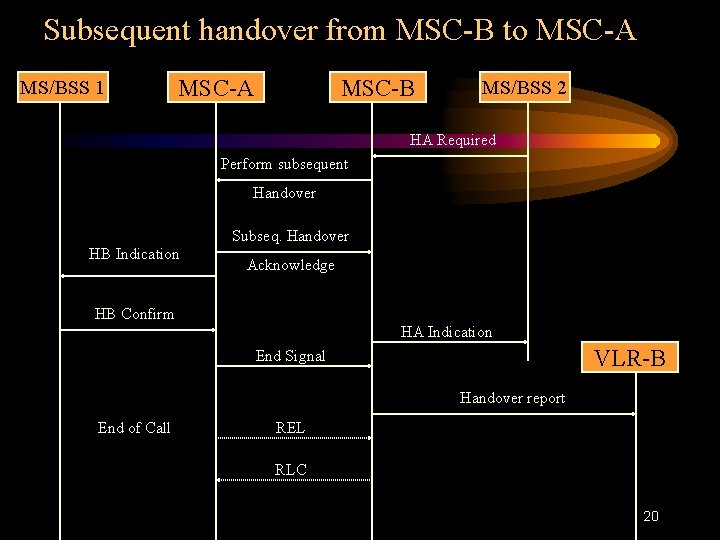
Subsequent handover from MSC-B to MSC-A MS/BSS 1 MSC-A MSC-B MS/BSS 2 HA Required Perform subsequent Handover Subseq. Handover HB Indication Acknowledge HB Confirm HA Indication VLR-B End Signal Handover report End of Call REL RLC 20
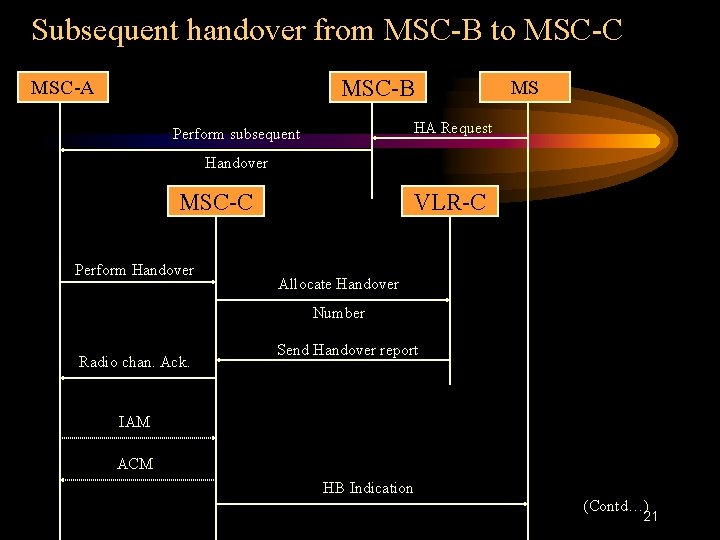
Subsequent handover from MSC-B to MSC-C MSC-B MSC-A MS HA Request Perform subsequent Handover MSC-C Perform Handover VLR-C Allocate Handover Number Radio chan. Ack. Send Handover report IAM ACM HB Indication (Contd…) 21
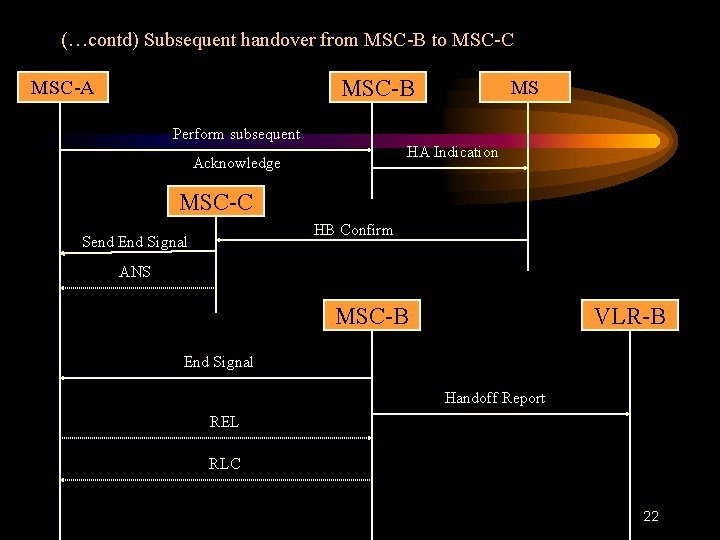
(…contd) Subsequent handover from MSC-B to MSC-C MSC-B MSC-A MS Perform subsequent HA Indication Acknowledge MSC-C HB Confirm Send End Signal ANS MSC-B VLR-B End Signal Handoff Report REL RLC 22
Location management • Set of procedures to: – track a mobile user – find the mobile user to deliver it calls • Current location of MS maintained by 2 level hierarchical strategy with HLRs and VLRs. 23
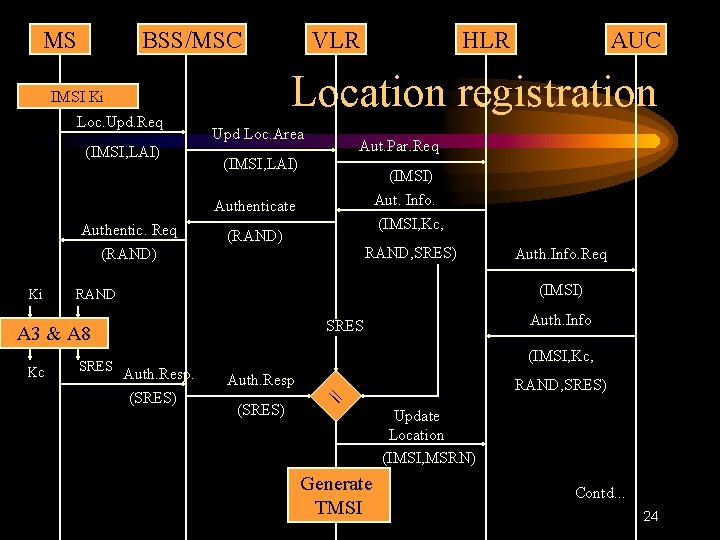
MS BSS/MSC (IMSI, LAI) HLR Upd Loc. Area Aut. Par. Req (IMSI, LAI) (IMSI) Aut. Info. (IMSI, Kc, Authenticate Authentic. Req (RAND) Ki (RAND) Auth. Info. Req (IMSI) Auth. Info SRES A 3 & A 8 Kc RAND, SRES) RAND SRES AUC Location registration IMSI Ki Loc. Upd. Req VLR (IMSI, Kc, Auth. Resp. (SRES) Auth. Resp (SRES) RAND, SRES) = Update Location (IMSI, MSRN) Generate TMSI Contd. . . 24
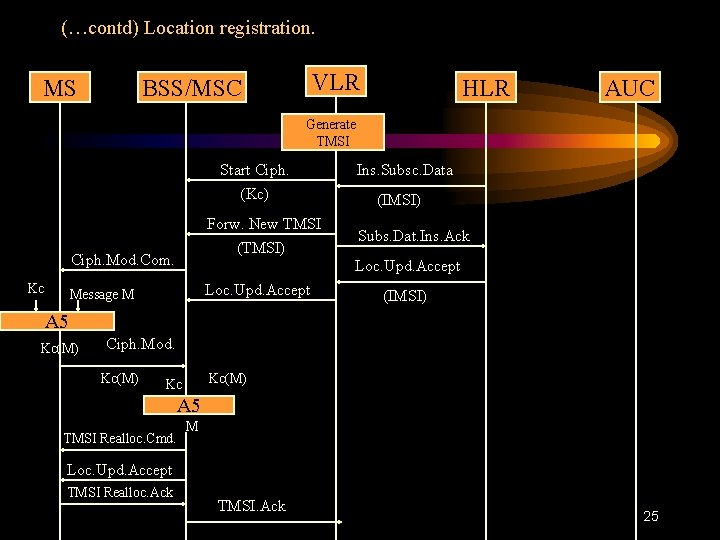
(…contd) Location registration. MS VLR BSS/MSC HLR AUC Generate TMSI Start Ciph. (Kc) Forw. New TMSI (TMSI) Ciph. Mod. Com. Kc Ins. Subsc. Data (IMSI) Subs. Dat. Ins. Ack Loc. Upd. Accept Message M (IMSI) A 5 Kc(M) Ciph. Mod. Kc(M) Kc A 5 TMSI Realloc. Cmd. M Loc. Upd. Accept TMSI Realloc. Ack TMSI. Ack 25
Location registration • MS has to register with the PLMN to get communication services • Registration is required for a change of PLMN • MS has to report to current PLMN with its IMSI and receive new TMSI by executing Location Registration process. • The TMSI is stored in SIM, so that even after power on or off, there is only normal Location Update. • If the MS recognizes by reading the LAI broadcast on BCCH that it is in new LA, it performs Location Update to update the HLR records. • Location update procedure could also be performed periodically, independent of the MS movement. • The difference in Location Registration and Location Update is that in location update the MS has already been assigned a TMSI. 26
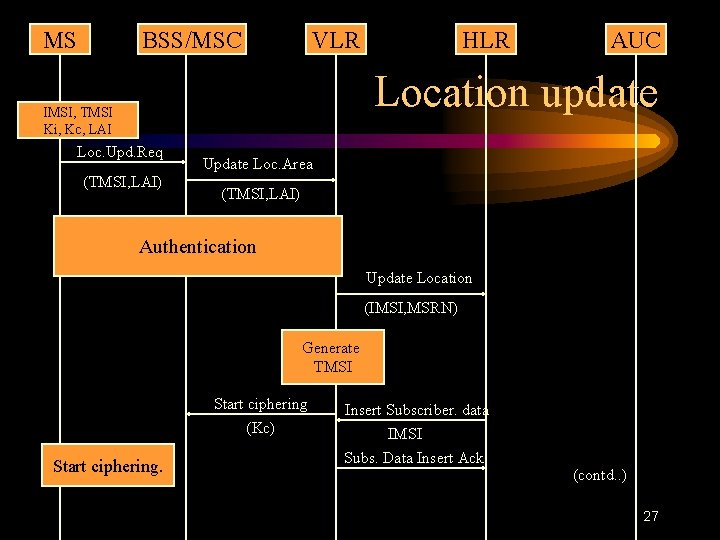
MS BSS/MSC VLR HLR AUC Location update IMSI, TMSI Ki, Kc, LAI Loc. Upd. Req (TMSI, LAI) Update Loc. Area (TMSI, LAI) Authentication Update Location (IMSI, MSRN) Generate TMSI Start ciphering (Kc) Start ciphering. Insert Subscriber. data IMSI Subs. Data Insert Ack (contd. . ) 27
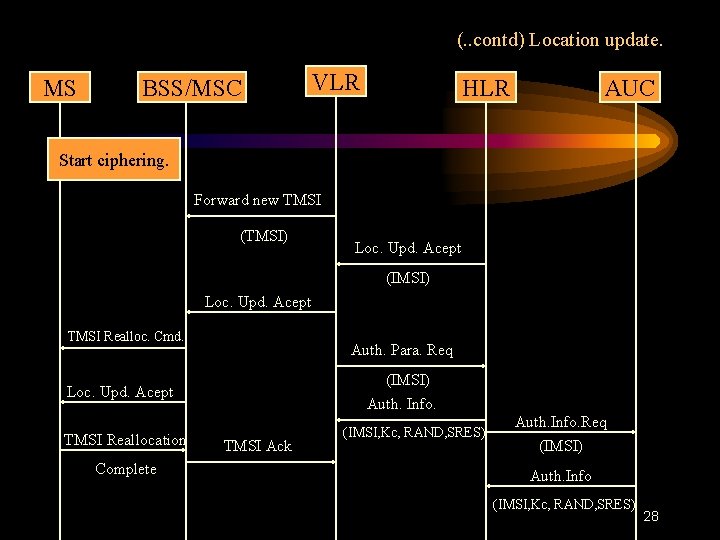
(. . contd) Location update. MS BSS/MSC VLR HLR AUC Start ciphering. Forward new TMSI (TMSI) Loc. Upd. Acept (IMSI) Loc. Upd. Acept TMSI Realloc. Cmd. Auth. Para. Req (IMSI) Auth. Info. Loc. Upd. Acept TMSI Reallocation Complete TMSI Ack (IMSI, Kc, RAND, SRES) Auth. Info. Req (IMSI) Auth. Info (IMSI, Kc, RAND, SRES) 28
Ways to obtain MSRN 1. 2. Obtaining at location update– MSRN for the MS is assigned at the time of each location update which is stored in the HLR. This way the HLR is in a position to supply immediately the routing info (MSRN) needed to switch a call through to the local MSC. Obtaining on a per call basis– This case requires that the HLR has at least an identification for the currently responsible VLR. When routing info is requested from the HLR, it first has to obtain the MSRN from the VLR. This MSRN is assigned on a per call basis, i. e. each call involves a new MSRN assignment 29
Call routing to a Mobile Station 1 MSISDN GMSC LA 1 1 4 MSRN 2 3 BSC MSISDN MSRN MSC BTS MSC HLR 7 TMSI 5 7 MSRN TMSI LA 2 BSC EIR BTS MS 8 7 TMSI BTS 6 TMSI AUC VLR 30
Call Origination VLR 2 u 1 3 PSTN VLR MSC 4 PSTN 1 MSC MS 1. call origination request 2. MAP_SEND_INFO_FOR_OUTGOING_CALL 3. MAP_SEND_INFO_FOR_OUTGOING_CALL_ack 4. IAM 31
Call Termination PSTN 1 GMSC 5 2 4 HLR VLR 3 6 Target MSC Originating HLR Switch GMSC 1. ISUP IAM 2. MAP_SEND_ROUTING_INFO VLR Target MSC 3. MAP_PROVIDE_ROAMING_NUMBER 4. MAP_PROVIDE_ROAMING_NUMBER_ack 5. MAP_SEND_ROUTING_INFO_ack 6. ISUP IAM 32
Find Operation • Inter-LA – Both LA’s belong to same MSC, call/packets will be routed directly • Inter-MSC • Inter-VLR 33
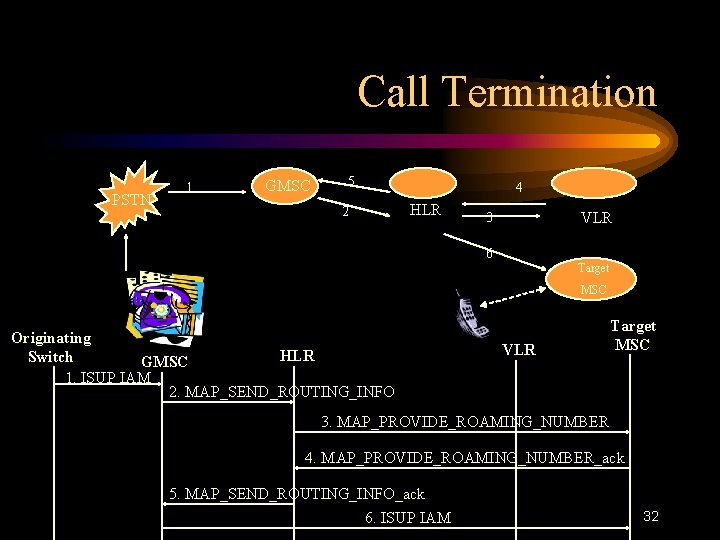
Find operation in GSM • • • ISDN switch recognizes from the MSISDN that the call subscriber is a mobile subscriber. Therefore, forward the call to the GMSC of the home PLMN (Public Land Mobile Network) GMSC requests the current routing address (MSRN) from the HLR using MAP By way of MSRN the call is forwarded to the local MSC Local MSC determines the TMSI of the MS (by querying VLR) and initiates the paging procedure in the relevant LA After MS responds to the page the connection can be switched through. 34
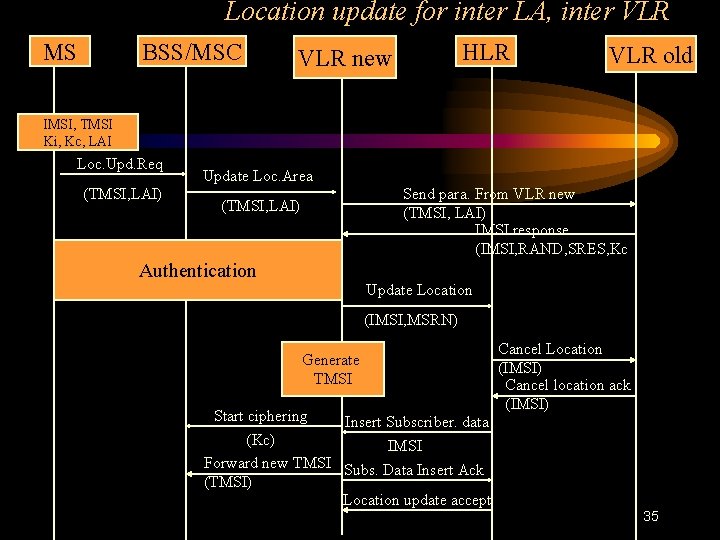
Location update for inter LA, inter VLR MS BSS/MSC HLR VLR new VLR old IMSI, TMSI Ki, Kc, LAI Loc. Upd. Req (TMSI, LAI) Update Loc. Area Send para. From VLR new (TMSI, LAI) IMSI response (IMSI, RAND, SRES, Kc (TMSI, LAI) Authentication Update Location (IMSI, MSRN) Generate TMSI Start ciphering Insert Subscriber. data (Kc) IMSI Forward new TMSI Subs. Data Insert Ack (TMSI) Location update accept Cancel Location (IMSI) Cancel location ack (IMSI) 35
VLR Overflow • • Too many mobile users move into the LA in a short period If VLR is full when mobile arrives: – User fails to “register” in the database – It cannot receive cellular services • VLR Overflow Resolutions 36
Abbreviations • • • • ISC: International switching center OMC: Operations and maintenance center GMSC: Gateway switching center MSC: Mobile switching center VLR: Visitor location register HLR: Home Location register EIR: Equipment Identification register AUC: Authentication center BSC: Base station controller BTS: Base transceiver station MS: Mobile subscriber TMSI: Temporary Mobile Subscriber Identity IMSI: International Mobile Subscriber Identity 37
Reference Material • Wireless and Mobile Network Architectures by Yi-Bing Lin & Imrich Chlamtac • The GSM Sytem for Mobile communications by Mouly & Pautet • Wireless Personal Communications Systems by Dr. Goodman • GSM Switching, Services and Protocols by Jorg Eberspacher and Hans -Jorg Vogel 38
- Slides: 38