
GSM Global System for Mobiles 1 TOPICS GSM
GSM Global System for Mobiles 1
TOPICS • • GSM CONCEPTS GSM SYSTEM ARCHITECTURE IDENTITIES USED IN GSM CHANNELS GSM RADIO LINK MOBILITY MANAGEMENT CALL MANAGEMENT RADIO RESOURCE MANAGEMENT 2
TOPICS • • GSM CONCEPTS GSM SYSTEM ARCHITECTURE IDENTITIES USED IN GSM CHANNELS GSM RADIO LINK MOBILITY MANAGEMENT CALL MANAGEMENT RADIO RESOURCE MANAGEMENT 3
Telecom Basics • Communication – Voice and Data – Analog and Digital – Circuit Switched and Packet Switched – Media - Copper Wire, Co-axial cable, Air, Optical Fibre – Networks -PSTN, ISDN, PDN and Mobile Networks 4
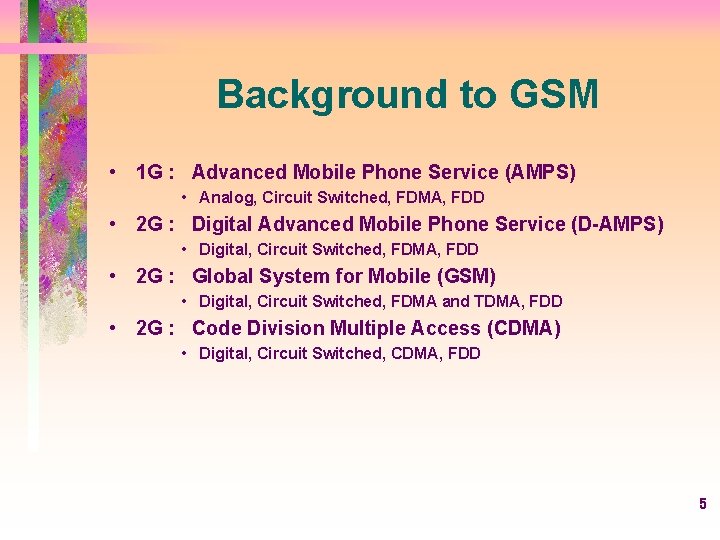
Background to GSM • 1 G : Advanced Mobile Phone Service (AMPS) • Analog, Circuit Switched, FDMA, FDD • 2 G : Digital Advanced Mobile Phone Service (D-AMPS) • Digital, Circuit Switched, FDMA, FDD • 2 G : Global System for Mobile (GSM) • Digital, Circuit Switched, FDMA and TDMA, FDD • 2 G : Code Division Multiple Access (CDMA) • Digital, Circuit Switched, CDMA, FDD 5

GSM History 6
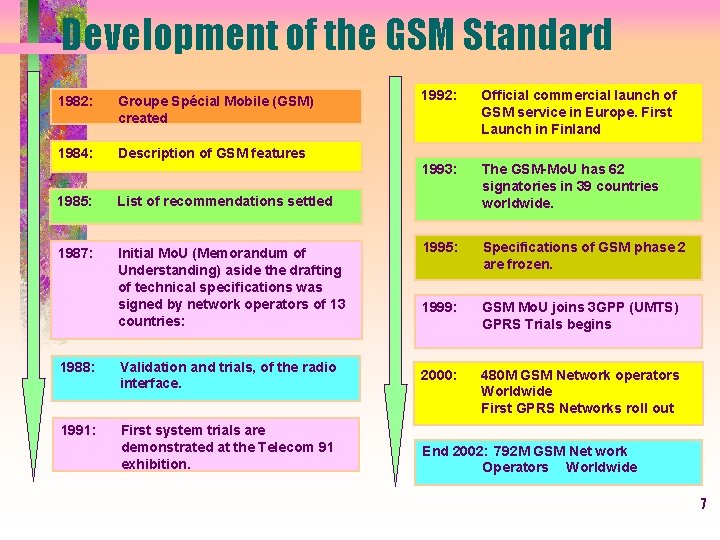
Development of the GSM Standard 1982: Groupe Spécial Mobile (GSM) created 1984: Description of GSM features 1985: List of recommendations settled 1987: Initial Mo. U (Memorandum of Understanding) aside the drafting of technical specifications was signed by network operators of 13 countries: 1988: Validation and trials, of the radio interface. 1991: First system trials are demonstrated at the Telecom 91 exhibition. 1992: Official commercial launch of GSM service in Europe. First Launch in Finland 1993: The GSM-Mo. U has 62 signatories in 39 countries worldwide. 1995: Specifications of GSM phase 2 are frozen. 1999: GSM Mo. U joins 3 GPP (UMTS) GPRS Trials begins 2000: 480 M GSM Network operators Worldwide First GPRS Networks roll out End 2002: 792 M GSM Net work Operators Worldwide 7
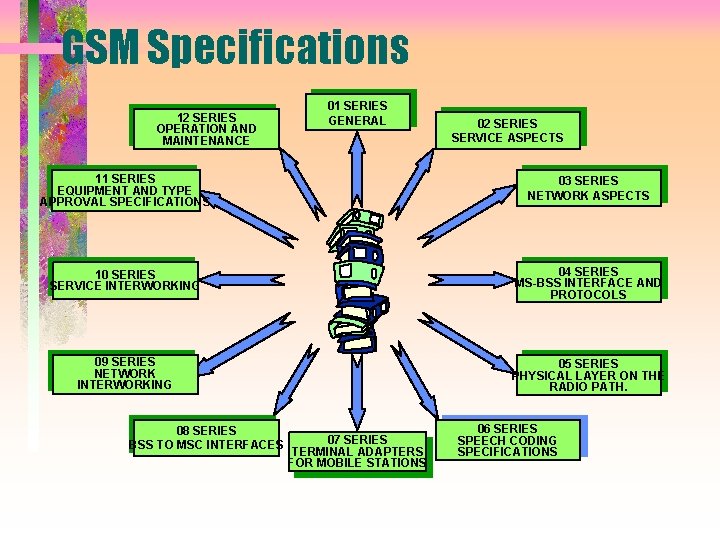
GSM Specifications 12 SERIES OPERATION AND MAINTENANCE 01 SERIES GENERAL 02 SERIES SERVICE ASPECTS 11 SERIES EQUIPMENT AND TYPE APPROVAL SPECIFICATIONS 03 SERIES NETWORK ASPECTS 10 SERIES SERVICE INTERWORKING 04 SERIES MS-BSS INTERFACE AND PROTOCOLS 09 SERIES NETWORK INTERWORKING 05 SERIES PHYSICAL LAYER ON THE RADIO PATH. 08 SERIES BSS TO MSC INTERFACES 07 SERIES TERMINAL ADAPTERS FOR MOBILE STATIONS 06 SERIES SPEECH CODING SPECIFICATIONS

Increasing GSM Data Rates UMTS photo E/GPRS web video clip report video report clip photo ISDN e-mail web photo PSTN e-mail web e-mail GSM 0 Transmission Time 10 sec video report clip photo web photo 1 min video report clip 10 min GPRS = General Packet Radio Service HSCSD = High Speed Circuit Switched Data EDGE = Enhanced Data rate for GSM Evolution UMTS = Universal Mobile Telecommunication System 1 hour
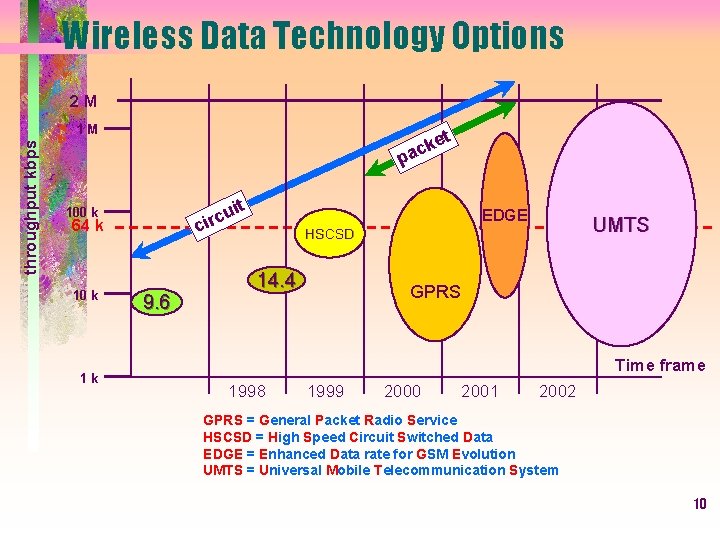
Wireless Data Technology Options 2 M throughput kbps 1 M t e k c a p it cu r i c 100 k 64 k 10 k 1 k 9. 6 EDGE UMTS HSCSD 14. 4 GPRS Time frame 1998 1999 2000 2001 2002 GPRS = General Packet Radio Service HSCSD = High Speed Circuit Switched Data EDGE = Enhanced Data rate for GSM Evolution UMTS = Universal Mobile Telecommunication System 10
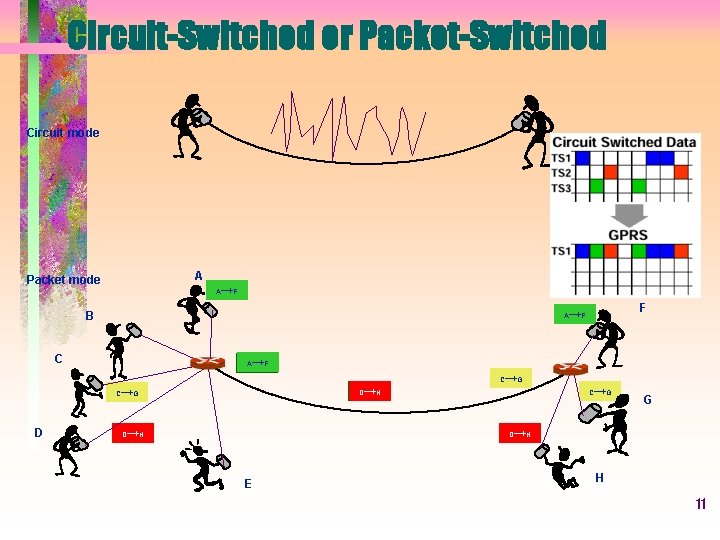
Circuit-Switched or Packet-Switched Circuit mode A Packet mode →F A F →F B A C →GHF → D A C →GHF C D A → →GHF →G C D A C D →H →G C G →H D D E H 11
What are the types in GSM Network? • GSM-900 (Channels 125 operating band 900 Mhz carrier spacing 200 khz spacing 45 Mhz) • GSM -1800 (Channels 374 spacing 95 Mhz) • GSM -1900(Used in USA) 13
Multiple Access Technique • Multiple Access – Achieved by dividing the available radio frequency spectrum, so that multiple users can be given access at the same time. • FDMA - Frequency Division Multiple Access – ( eg: GSM each Frequency channel is 200 KHz) • TDMA - Time Division Multiple Access – ( eg: GSM each frequency channel is divided into 8 timeslots) • CDMA - Code Division Multiple Access – (eg: IS 95 - Each User data is coded with a unique code) 14
Duplex Technique • Duplex - How the up link and Down link of a user is separated • FDD - Frequency Division Duplex – (eg: In GSM the up link and down link of a user is separated by 45 MHz ) • TDD - Time Division Duplex – (the up link and down link of a user will be at the same frequency but at different Time ) 15
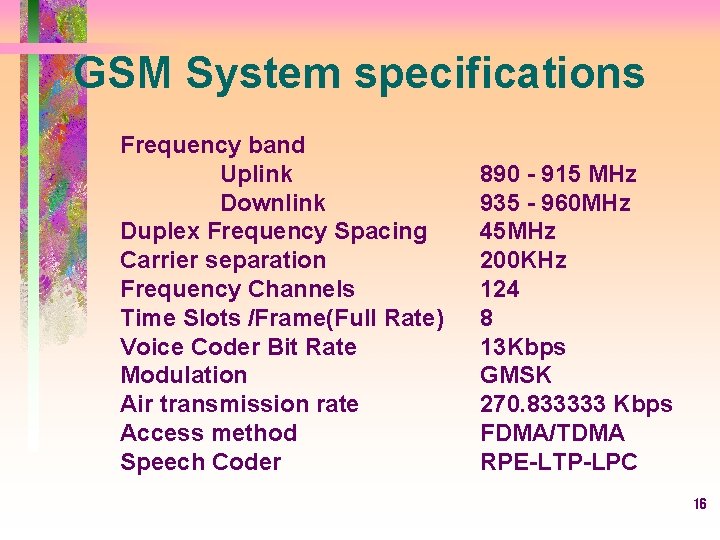
GSM System specifications Frequency band Uplink Downlink Duplex Frequency Spacing Carrier separation Frequency Channels Time Slots /Frame(Full Rate) Voice Coder Bit Rate Modulation Air transmission rate Access method Speech Coder 890 - 915 MHz 935 - 960 MHz 45 MHz 200 KHz 124 8 13 Kbps GMSK 270. 833333 Kbps FDMA/TDMA RPE-LTP-LPC 16
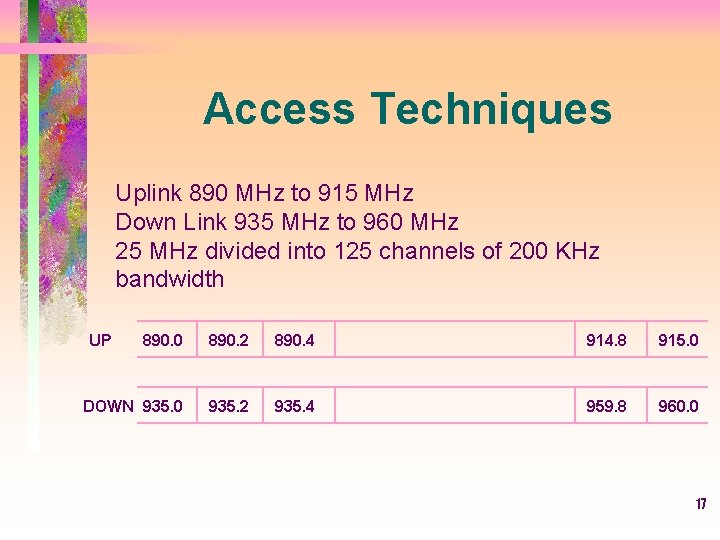
Access Techniques Uplink 890 MHz to 915 MHz Down Link 935 MHz to 960 MHz 25 MHz divided into 125 channels of 200 KHz bandwidth UP 890. 0 890. 2 890. 4 914. 8 915. 0 DOWN 935. 0 935. 2 935. 4 959. 8 960. 0 17
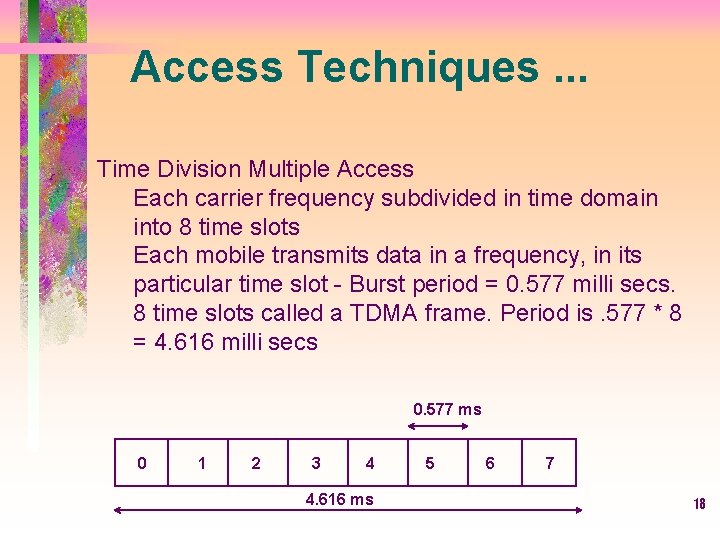
Access Techniques. . . Time Division Multiple Access Each carrier frequency subdivided in time domain into 8 time slots Each mobile transmits data in a frequency, in its particular time slot - Burst period = 0. 577 milli secs. 8 time slots called a TDMA frame. Period is. 577 * 8 = 4. 616 milli secs 0. 577 ms 0 1 2 3 4 4. 616 ms 5 6 7 18
19
GSM in comparison with other Standards • GSM gives mobility without any loss in Audio quality • Encryption techniques used gives high security in the air Interface and also use of SIM. • Bit Interleaving for high efficiency in Transmission. • Variable Power (Power budgeting- extend battery life) • Minimum Interference. • Features-CCS 7 Signaling – SMS (Short Message Services) – Emergency Calls – CELL Broadcast 20
TOPICS • • GSM CONCEPTS GSM SYSTEM ARCHITECTURE IDENTITIES USED IN GSM CHANNELS GSM RADIO LINK MOBILITY MANAGEMENT CALL MANAGEMENT RADIO RESOURCE MANAGEMENT 21
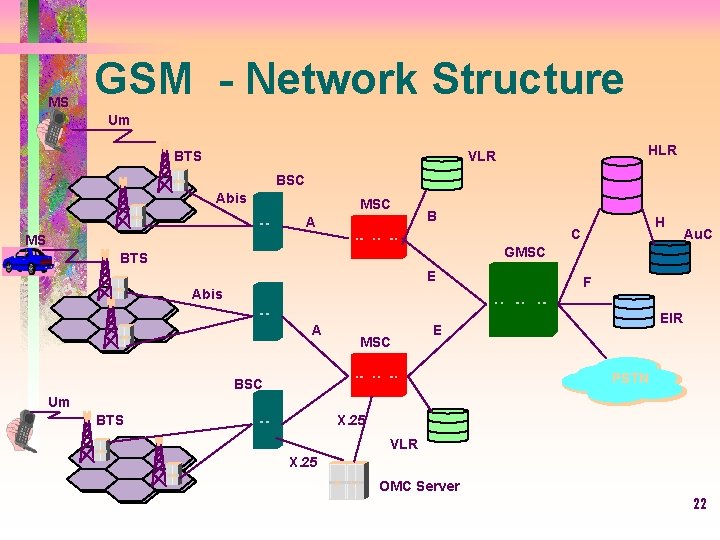
MS GSM - Network Structure Um BTS HLR VLR BSC Abis MSC A B H C MS Au. C GMSC BTS E Abis A MSC F EIR E PSTN BSC Um BTS X. 25 VLR X. 25 OMC Server 22
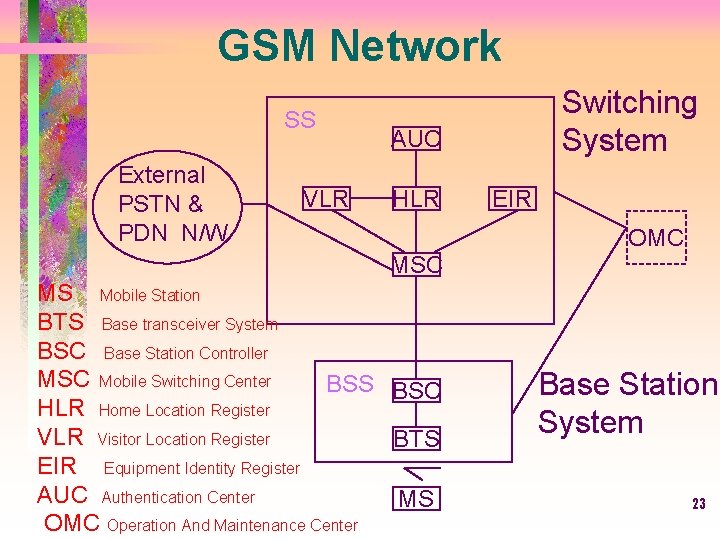
GSM Network SS External PSTN & PDN N/W VLR Switching System AUC HLR EIR OMC MS Mobile Station BTS Base transceiver System BSC Base Station Controller MSC Mobile Switching Center BSS BSC HLR Home Location Register VLR Visitor Location Register BTS EIR Equipment Identity Register AUC Authentication Center MS OMC Operation And Maintenance Center Base Station System 23
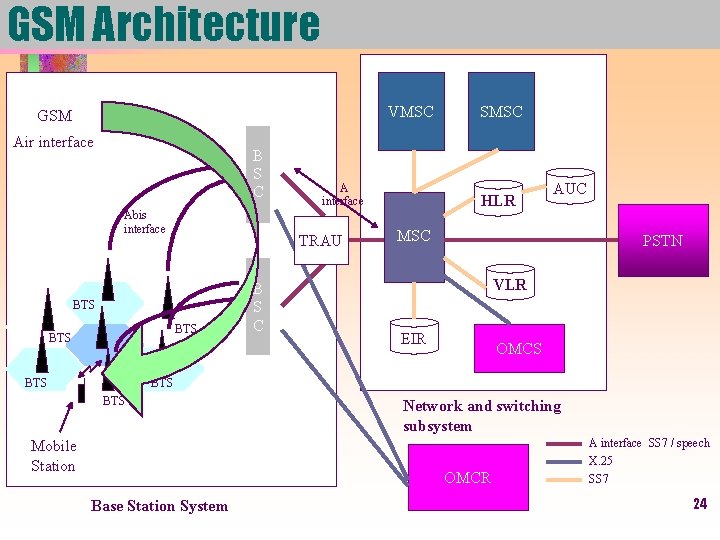
GSM Architecture VMSC GSM Air interface B S C Abis interface TRAU BTS BTS A interface B S C SMSC HLR AUC MSC PSTN VLR EIR OMCS BTS Mobile Station Network and switching subsystem OMCR Base Station System A interface SS 7 / speech X. 25 SS 7 24
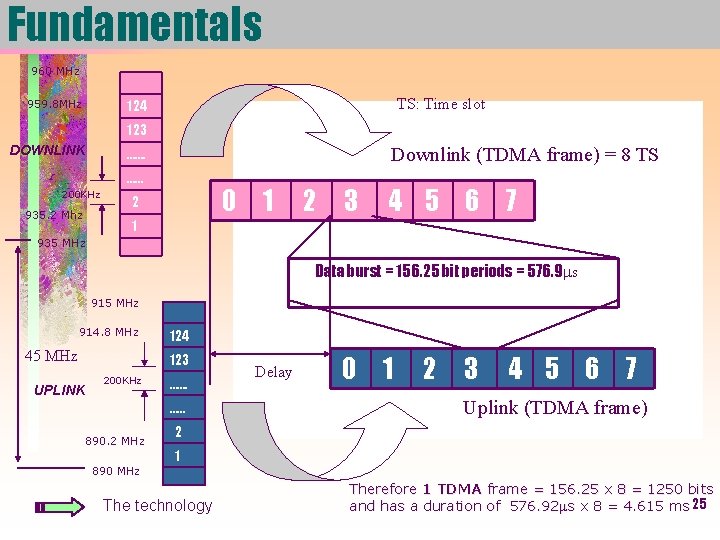
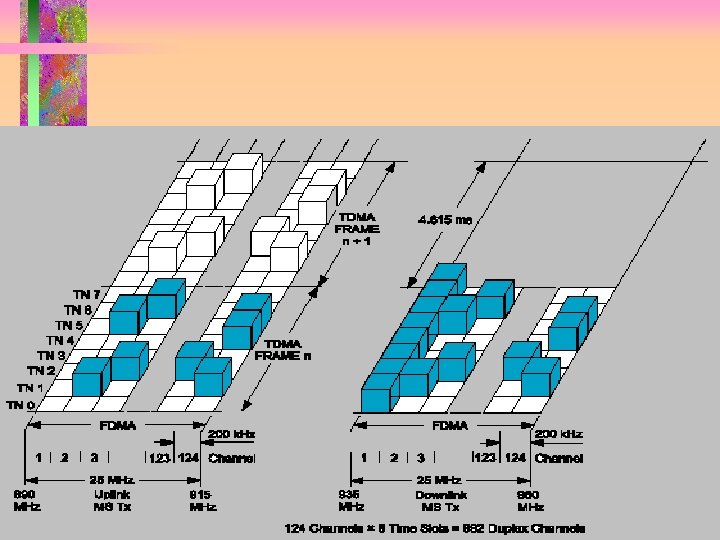
Fundamentals 960 MHz 959. 8 MHz TS: Time slot 124 123 DOWNLINK GSM utilizes two bands(TDMA of 25 MHz. Downlink frame)890 -915 = 8 TS MHz band is used for uplink while the 935960 MHz is used for downlink. ……. …… 200 KHz 935. 2 Mhz 0 1 2 935 MHz 915 MHz 45 MHz 124 123 UPLINK 200 KHz ……. …… 890. 2 MHz 4 5 6 7 The frequency bands are divided into 200 KHz wide channels called ARFCNs (Absolute Radio Frequency Channel Numbers) i. e. Data burst = 156. 25 bit periods = 576. 9 s there are 125 ARFCNs out of which only 124 are used. 1 914. 8 MHz 2 3 Each ARFCN supports 8 users with each user transmitting / receiving on a particular time Delay 0 1 2 3 4 5 6 7 slot (TS). Uplink (TDMA frame) 2 1 890 MHz The technology Therefore 1 TDMA frame = 156. 25 x 8 = 1250 bits and has a duration of 576. 92 s x 8 = 4. 615 ms 25
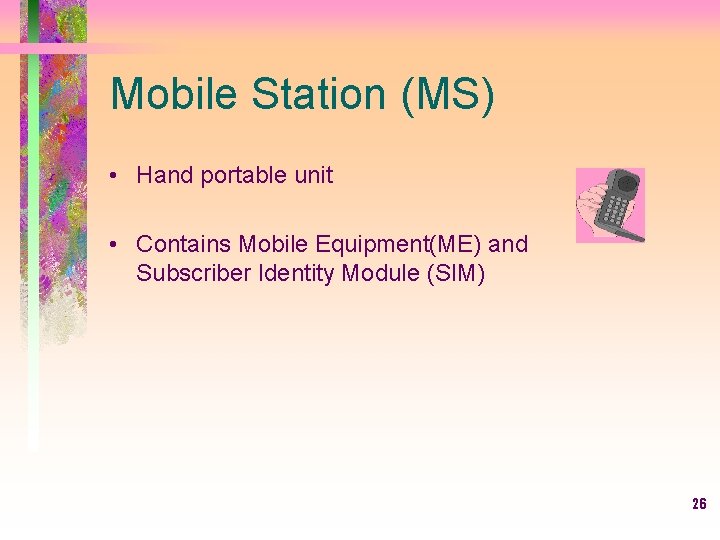
Mobile Station (MS) • Hand portable unit • Contains Mobile Equipment(ME) and Subscriber Identity Module (SIM) 26
Mobile Equipment(ME) • • • Frequency and Time Synchronization Voice encoding and transmission Voice encryption/decryption functions Power measurements of adjacent cells Display of short messages International Mobile Equipment Identifier (IMEI) 27
SIM • Portable Smart Card with memory (ROM-6 KB to 16 KB-A 3/A 8 algorithm, RAM- 128 KB TO 256 KB, EEPROM- 3 KB to 8 KB ) • Static Information – International Mobile Subscriber Identity(IMSI) – Personal Identification Number (PIN) – Authentication Key (Ki) • Dynamic Information – Temporary Mobile Subscriber Identity(TMSI) – Location Area Identity (LAI) – Phone memories, billing information – Ability to store Short Messages received 28
Base Transceiver Station (BTS) • Handles the radio interface to the mobile station. • Consists of one or more radio terminals for transmission and reception • Each Radio terminal represents an RF Channel • TRX and MS communicates over Um interface • Received data transcoding • Voice encryption/decryption • Signal processing functions of the radio interface • Uplink Radio channel power measurements 29
Base Station Controller (BSC) • Provides all the control functions and physical links between the MSC and BTS • External Interfaces – ‘Abis’ interface towards the BTS – ‘A’ interface towards the MSC • Monitors and controls several BTSs • Management of channels on the radio interface • Alarm Handling from the external interfaces • Performs inter-cell Handover • Switching from ‘Abis’ link to the ‘A’ link • Interface to OMC for BSS Management 30
Mobile Switching Center (MSC) • • Performs call switching Interface of the cellular network to PSTN Routes calls between PLMN and PSTN Queries HLR when calls come from PSTN to mobile user • Inter-BSC Handover • Paging • Billing 31
Home Location Register (HLR) • Stores user data of all Subscribers related to the GMSC – International Mobile Subscriber Identity(IMSI) – Users telephone number (MS ISDN) – Subscription information and services – VLR address – Reference to Authentication center for key (Ki) • Referred when call comes from public land network 32
Visitor Location Register (VLR) • Database that contains Subscriber parameters and location information for all mobile subscribers currently located in the geographical area controlled by that VLR • Identity of Mobile Subscriber • Copy of subscriber data from HLR • Generates and allocates a Temporary Mobile Subscriber Identity(TMSI) • Location Area Code • Provides necessary data when mobile originates call 33
Authentication Center (Au. C) • Stores Subscriber authentication data called Ki, a copy of which is also stored in in the SIM card • Generates security related parameters to authorize a subscriber (SRES-Signed RESponse) • Generates unique data pattern called Cipher key (Kc) for user data encryption • Provides triplets - RAND, SRES & Kc, to the HLR on request. 34
EIR (Equipment Identity Register) • EIR is a database that contains a list of all valid mobile station equipment within the network, where each mobile station is identified by its International Mobile Equipment Identity(IMEI). • EIR has three databases. , – White list - For all known, good IMEI’s – Black list - For all bad or stolen handsets – Grey list - For handsets/IMEI’s that are on observation 35
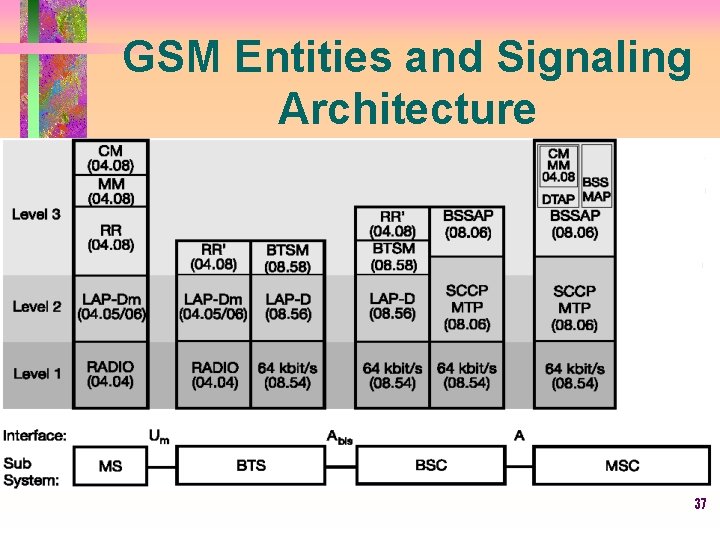
GSM Entities and Signaling Architecture 37
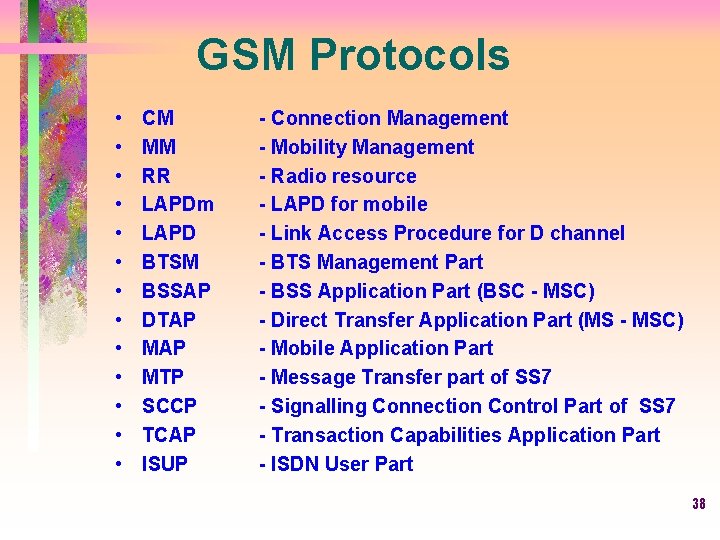
GSM Protocols • • • • CM MM RR LAPDm LAPD BTSM BSSAP DTAP MTP SCCP TCAP ISUP - Connection Management - Mobility Management - Radio resource - LAPD for mobile - Link Access Procedure for D channel - BTS Management Part - BSS Application Part (BSC - MSC) - Direct Transfer Application Part (MS - MSC) - Mobile Application Part - Message Transfer part of SS 7 - Signalling Connection Control Part of SS 7 - Transaction Capabilities Application Part - ISDN User Part 38
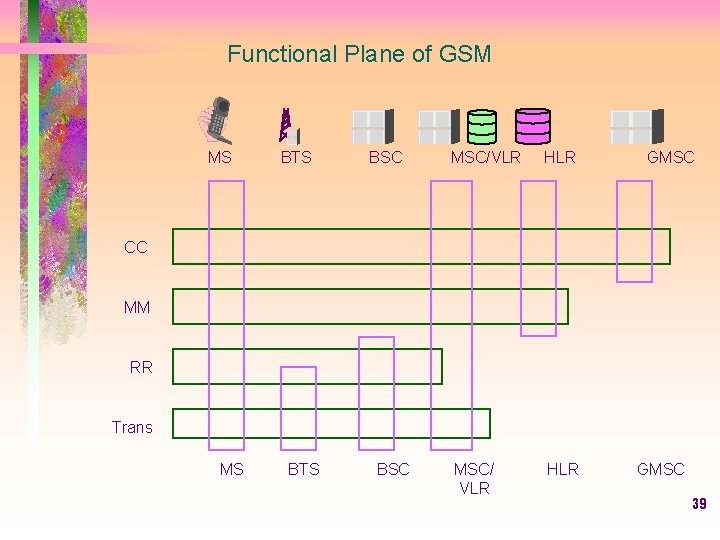
Functional Plane of GSM MS BTS BSC MSC/VLR HLR MSC/ VLR HLR GMSC CC MM RR Trans MS BTS BSC GMSC 39
TOPICS • • GSM CONCEPTS GSM SYSTEM ARCHITECTURE IDENTIFIERS USED IN GSM CHANNELS GSM RADIO LINK MOBILITY MANAGEMENT CALL MANAGEMENT RADIO RESOURCE MANAGEMENT 40
Subscriber Identity -MSISDN • The MSISDN is a GSM directory number which uniquely identifies a mobile subscription in the Public Switched Telephone Network (PSTN). • Calls will be routed from the PSTN and other networks based on the Mobile Subscribers’ MSISDN number. • MSISDN= CC + NDC + SN – CC= Country Code (91) – NDC= National Destination Code(98370) – SN= Subscriber Number (12345) 41
![International Mobile Subscriber Identity [IMSI] • Subscriber always identified within the GSM network by](http://slidetodoc.com/presentation_image_h2/a3c9a4f4bc70a0fde0a3ec72dfa99de5/image-40.jpg "International Mobile Subscriber Identity [IMSI] • Subscriber always identified within the GSM network by")
International Mobile Subscriber Identity [IMSI] • Subscriber always identified within the GSM network by the IMSI • This is used for all signaling in the PLMN stored in SIM and HLR/VLR • The IMSI consists of three different parts – MCC = Mobile Country Code(3 Digits) – MNC = Mobile Network Code(2 Digits) – MSIN = Mobile Station Identification Number(Upto 10 digits) 42
![Temporary Mobile Subscriber Identity [TMSI] • The TMSI is used for the subscriber’s confidentiality.](http://slidetodoc.com/presentation_image_h2/a3c9a4f4bc70a0fde0a3ec72dfa99de5/image-41.jpg "Temporary Mobile Subscriber Identity [TMSI] • The TMSI is used for the subscriber’s confidentiality.")
Temporary Mobile Subscriber Identity [TMSI] • The TMSI is used for the subscriber’s confidentiality. • It should be combined with the LAI to uniquely identify a MS. • Since the TMSI has only local significance (that is, within the MSC/VLR area), the structure may be chosen by each administration. • The TMSI should not consist of more than four octets. 43
![Mobile Station Roaming Number[MSRN] • HLR knows in what Service area the subscriber is](http://slidetodoc.com/presentation_image_h2/a3c9a4f4bc70a0fde0a3ec72dfa99de5/image-42.jpg "Mobile Station Roaming Number[MSRN] • HLR knows in what Service area the subscriber is")
Mobile Station Roaming Number[MSRN] • HLR knows in what Service area the subscriber is located. • In order to provide a temporary number to be used for routing, the HLR requests the current MSC/VLR to allocate a Mobile Station Roaming Number(MSRN) to the called subscriber and to return it. • At reception of the MSRN, HLR sends it to the MSC, which now can route the call to the VLR where the called subscriber is currently registered. 44
![International Mobile Equipment Identity [IMEI] • The IMEI is used for equipment identification. An](http://slidetodoc.com/presentation_image_h2/a3c9a4f4bc70a0fde0a3ec72dfa99de5/image-43.jpg "International Mobile Equipment Identity [IMEI] • The IMEI is used for equipment identification. An")
International Mobile Equipment Identity [IMEI] • The IMEI is used for equipment identification. An IMEI • uniquely identifies a mobile station as a piece or assembly of equipment. • IMEI = TAC + FAC + SNR + sp – TAC= Type Approval Code (6 digits), determined by GSM body – FAC= Final Assembly Code (2 digits), identifies themanufacturer – SNR= Serial Number (6 digits), uniquely identifying all equipment within each TAC and FAC – sp = Spare for future use (1 digit) 45
Location Area Identity • LAI identifies a location area which is a group of cells. . • It is transmitted in the BCCH. • When the MS moves into another LA (detected by monitoring LAI transmitted on the BCCH) it must perform a LU. • LAI = MCC + MNC + LAC – MCC= Mobile Country Code(3 digits), identifies the country – MNC= Mobile Network Code(1 -2 digits), identifies the GSMPLMN – LAC= Location Area Code, identifies a location area within a GSM PLMN network. The maximum length of LAC is 16 bits, enabling 65536 different location areas to be defined in one GSM PLMN. 46
TOPICS • • GSM CONCEPTS GSM SYSTEM ARCHITECTURE IDENTITIES USED IN GSM CHANNELS GSM RADIO LINK MOBILITY MANAGEMENT CALL MANAGEMENT RADIO RESOURCE MANAGEMENT 47
Channels : differentiating between Physical and Logical channels Physical channels : The combination of an ARFCN and a time slot defines a physical channel. Logical channels : These are channels specified by GSM which are mapped on physical channels. 48
Channel concept Physical channel: One timeslot of a TDMA-frame on one carrier is referred to as a physical channel. There are 8 physical channels per carrier in GSM, channel 0 -7(timeslot 0 -7) Logical channel: A great variety of information must be transmitted between BTS and the MS, for e. g. user data and control signaling. Depending on the kind of information transmitted we refer to different logical channels. These logical channels are mapped on physical channel. 49
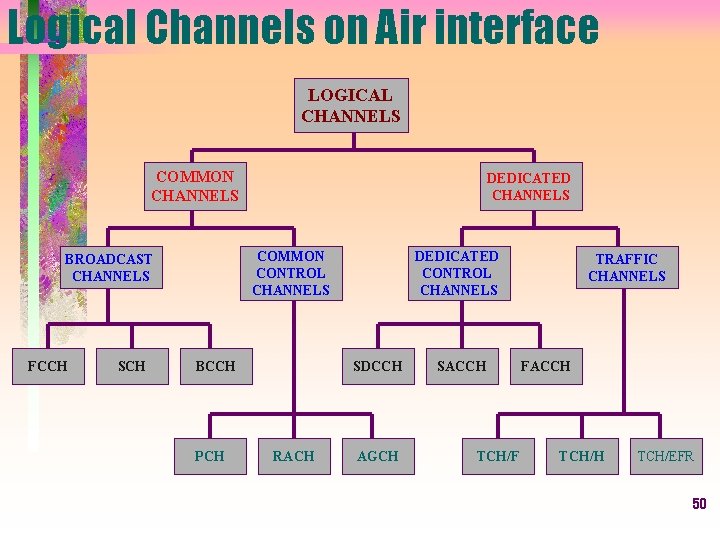
Logical Channels on Air interface LOGICAL CHANNELS COMMON CONTROL CHANNELS BROADCAST CHANNELS FCCH SCH DEDICATED CHANNELS BCCH PCH DEDICATED CONTROL CHANNELS SDCCH RACH AGCH SACCH TCH/F TRAFFIC CHANNELS FACCH TCH/EFR 50
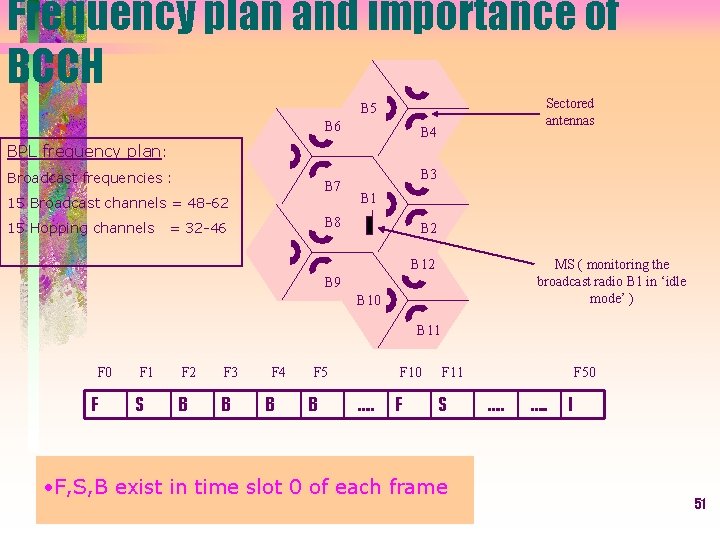
Frequency plan and importance of BCCH Sectored antennas B 5 B 6 B 4 BPL frequency plan: Broadcast frequencies : B 7 15 Broadcast channels = 48 -62 15 Hopping channels B 3 B 1 B 8 = 32 -46 B 2 B 12 MS ( monitoring the broadcast radio B 1 in ‘idle mode’ ) B 9 B 10 B 11 F 0 F F 1 S F 2 F 3 B B F 4 B F 5 B F 10 …. . F F 11 S • F, S, B exist in time slot 0 of each frame F 50 …. . I 51
Broadcast channels BCH • Broadcast Channel-BCH – Alloted one ARFCN & is ON all the time in every cell. Present in TS 0 and other 7 TS used by TCH. • Frequency correction channel-FCCH – To make sure this is the BCCH carrier. – Allow the MS to synchronize to the frequency. – Carries a 142 bit zero sequence and repeats once in every 10 frames on the BCH. • Synchronization Channel-SCH – This is used by the MS to synchronize to the TDMA frame structure within the particular cell. – Listening to the SCH the MS receives the TDMA frame number and also the BSIC ( in the coded part- 39 bits). 52 – Repeats once in every 10 frames.
1. The MS is monitoring the BCCH and has all the decoded information stored on the SIM ( including the LAC) 2. As soon as the mobile is on a TCH it sends the signal strength indication on the corresponding SACCH 3. The BSC monitors the signal strengths and on analysis sends a ‘handoff request’ on FACCH. The handoff process is completed on the FACCH. 4. After the completion of call, the MS starts monitoring the BCCH again. On finding the LAC (stored on SIM) and that decoded from the BCCH to be different , the MS requests a ‘Location Update’ through SDCCH. Back 53
Broadcast channels BCH. . . • BCH – The last information the MS must receive in order to receive calls or make calls is some information concerning the cell. This is BCCH. – This include the information of Max power allowed in the cell. – List of channels in use in the cell. – BCCH carriers for the neighboring cells, Location Area Identity etc. – BCCH occupies 4 frames (normal bursts) on BCH and repeats once every Multiframe. – This is transmitted Downlink point to multipoint. • Cell Broadcast Channel - CBCH – Used for the Transmission of generally accessible information like Short Message Services(SMS) 54
What information does Broadcast Control channel (BCCH) contain? l Serves as a Beacon for the Cell l Country Code (CC) and the Network Code (NC) l Location Area Identity (LAI) l List of neighboring cells which should be monitored by MS l List of frequencies used in the cell l Cell identity Back 55
Common Control Channels CCCH • CCCH- – Shares TS-0 with BCH on a Multiframe. • Random access channel-RACH: – Used by Mobile Station for requesting for a channel. When the mobile realizes it is paged it answers by requesting a signaling channel (SDCCH) on RACH is also used by the MS if it wants to originate a call. – Initially MS doesn’t know the path delay (timing advance), hence uses a short burst (with a large guard period = 68. 25 bits). – MS sends normal burst only after getting the timing advance info on the SACCH. – It is transmitted in Uplink point to point. 56
Common Control Channels CCCH. . • Access Grant Channel-AGCH – On request for a signaling channel by MS the network assigns a signaling channel(SDCCH) through AGCH is transmitted on the downlink point to point. • Paging Channel-PCH – The information on this channel is a paging message including the MS’s identity(IMSI/TMSI). This is transmitted on Downlink, point-to-multipoint. 57
Dedicated Control Channels. DCCH • Stand alone dedicated control channel(SDCCH) • AGCH assigns SDCCH as signaling channel on request by MS. The MS is informed about which frequency(ARFCN) & timeslot to use for traffic. • Used for location update, subscriber authentication, ciphering information, equipment validation and assignment of TCH. • This is used both sides, up and Downlink point-point. 58
Dedicated Control Channels. DCCH • Slow associated control channel-SACCH – Transmission of radio link signal measurement, power control etc. – Average signal strengths(RXLev) and quality of service (RXQual) of the serving base station and of the neighboring cells is sent on SACCH (on uplink). – Mobile receives information like what TX power it has to transmit and the timing advance. It is associated with TCH or SDCCH • Fast associated control channel-FACCH – Used for Hand over commands and during call setup and release. FACCH data is sent over TCH with stealing flag set 59
Traffic Channels-TCH • TCH carries the voice data. • Two blocks of 57 bits contain voice data in the normal burst. • One TCH is allocated for every active call. • Full rate traffic channel occupies one physical channel(one TS on a carrier) and carries voice data at 13 kbps • Two half rate (6. 5 kbps) TCHs can share one physical channel. 60
TOPICS • • GSM CONCEPTS GSM SYSTEM ARCHITECTURE IDENTITIES USED IN GSM CHANNELS GSM RADIO LINK MOBILITY MANAGEMENT CALL MANAGEMENT RADIO RESOURCE MANAGEMENT 61
GSM Radio Link • Speech Coding -Done at Transcoder of BSC and MS – The Linear Predictive Coder uses RPE-LTP(Regular Pulse Excitation- Long Term Prediction) – Converts 64 kbps voice to 13 kbps(260 bits every 20 ms) • Channel Coding - Done at BTS and MS – Uses Convolution Coding and CRC (Cyclic Redundancy Check) – Converts 13 kbps to 22. 8 kbps (456 bits per 20 ms) 62
GSM Radio Link • Bit Interleaving - Done at BTS and MS • Encryption - Done at BTS and MS – EX OR data with cipher block, which is generated by applying A 5 Algorithm to the Ciphering Key(Kc) • Multiplexing - Done at BTS • Modulation - Done at BTS and MS – GMSK(Gaussian filtered Minimum Shift Keying) – Phase change of +90 for 0 and -90 for 1 63
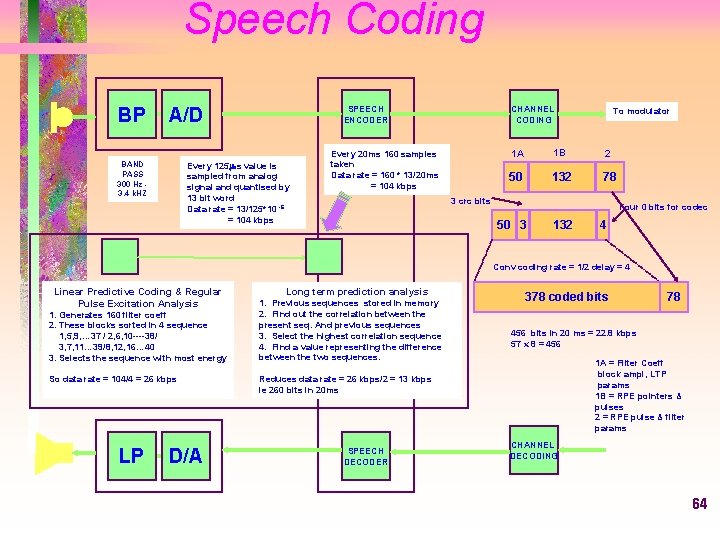
Speech Coding BP A/D BAND PASS 300 Hz 3. 4 k. HZ SPEECH ENCODER Every 125 s value is sampled from analog signal and quantised by 13 bit word Data rate = 13/125*10 -6 = 104 kbps CHANNEL CODING Every 20 ms 160 samples taken Data rate = 160 * 13/20 ms = 104 kbps To modulator 1 A 1 B 2 50 132 78 3 crc bits Four 0 bits for codec 50 3 132 4 Conv coding rate = 1/2 delay = 4 Linear Predictive Coding & Regular Pulse Excitation Analysis 1. Generates 160 filter coeff 2. These blocks sorted in 4 sequence 1, 5, 9, … 37 / 2, 6, 10 ----38/ 3, 7, 11… 39/8, 12, 16… 40 3. Selects the sequence with most energy So data rate = 104/4 = 26 kbps LP D/A Long term prediction analysis 1. Previous sequences stored in memory 2. Find out the correlation between the present seq. And previous sequences 3. Select the highest correlation sequence 4. Find a value representing the difference between the two sequences. 378 coded bits 456 bits in 20 ms = 22. 8 kbps 57 x 8 = 456 1 A = Filter Coeff block ampl, LTP params 1 B = RPE pointers & pulses 2 = RPE pulse & filter params Reduces data rate = 26 kbps/2 = 13 kbps ie 260 bits in 20 ms SPEECH DECODER 78 CHANNEL DECODING 64
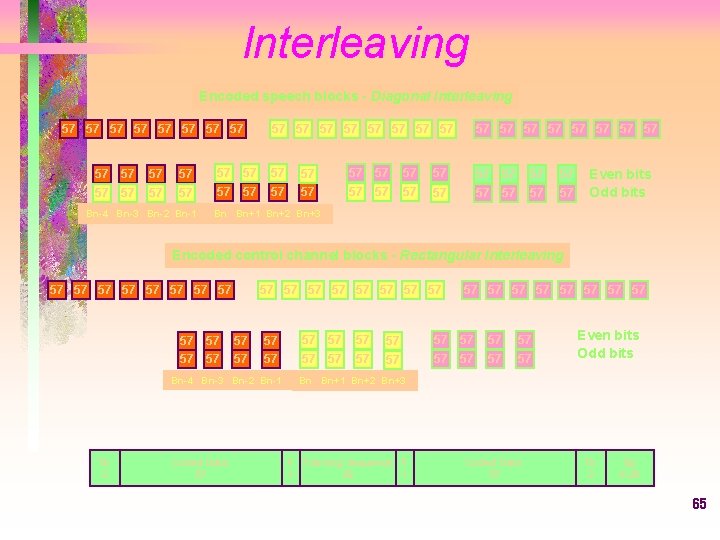
Interleaving Encoded speech blocks - Diagonal Interleaving 57 57 57 57 57 57 57 57 57 57 Bn-4 Bn-3 Bn-2 Bn-1 57 57 57 57 57 Even bits Odd bits Bn Bn+1 Bn+2 Bn+3 Encoded control channel blocks - Rectangular Interleaving 57 57 57 57 57 57 Bn-4 Bn-3 Bn-2 Bn-1 Tb 3 Coded Data 57 57 57 57 57 57 57 Even bits Odd bits Bn Bn+1 Bn+2 Bn+3 F Training Sequence F 1 26 1 Coded Data 57 Tb 3 Gp 8. 25 65
Burst • The information format transmitted during one timeslot in the TDMA frame is called a burst. • Different Types of Bursts – – Normal Burst Random Access Burst Frequency Correction Burst Synchronization Burst 66
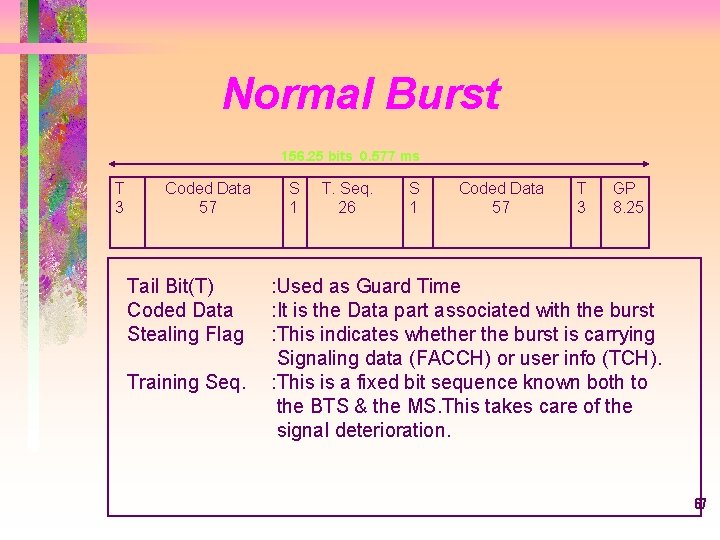
Normal Burst 156. 25 bits 0. 577 ms T 3 Coded Data 57 Tail Bit(T) Coded Data Stealing Flag Training Seq. S 1 T. Seq. 26 S 1 Coded Data 57 T 3 GP 8. 25 : Used as Guard Time : It is the Data part associated with the burst : This indicates whether the burst is carrying Signaling data (FACCH) or user info (TCH). : This is a fixed bit sequence known both to the BTS & the MS. This takes care of the signal deterioration. 67
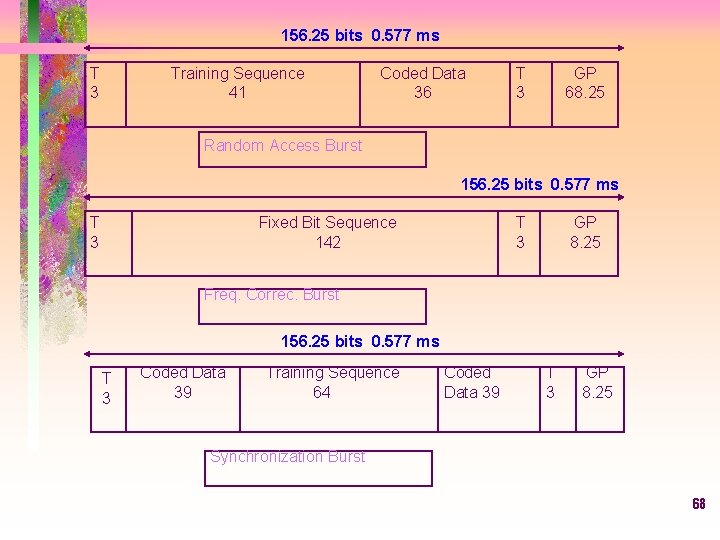
156. 25 bits 0. 577 ms T 3 Training Sequence 41 Coded Data 36 T 3 GP 68. 25 Random Access Burst 156. 25 bits 0. 577 ms T 3 Fixed Bit Sequence 142 T 3 GP 8. 25 Freq. Correc. Burst 156. 25 bits 0. 577 ms T 3 Coded Data 39 Training Sequence 64 Coded Data 39 T 3 GP 8. 25 Synchronization Burst 68
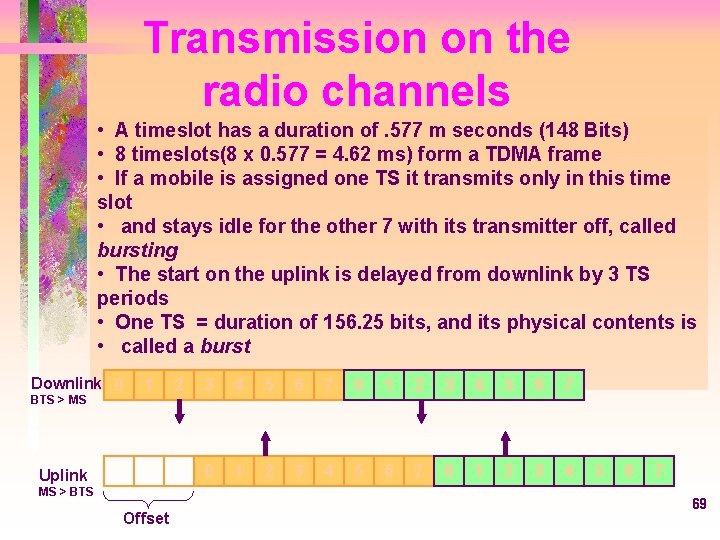
Transmission on the radio channels • A timeslot has a duration of. 577 m seconds (148 Bits) • 8 timeslots(8 x 0. 577 = 4. 62 ms) form a TDMA frame • If a mobile is assigned one TS it transmits only in this time slot • and stays idle for the other 7 with its transmitter off, called bursting • The start on the uplink is delayed from downlink by 3 TS periods • One TS = duration of 156. 25 bits, and its physical contents is • called a burst Downlink 0 BTS > MS 1 Uplink MS > BTS Offset 2 3 4 5 6 7 0 1 2 3 4 5 6 7 69
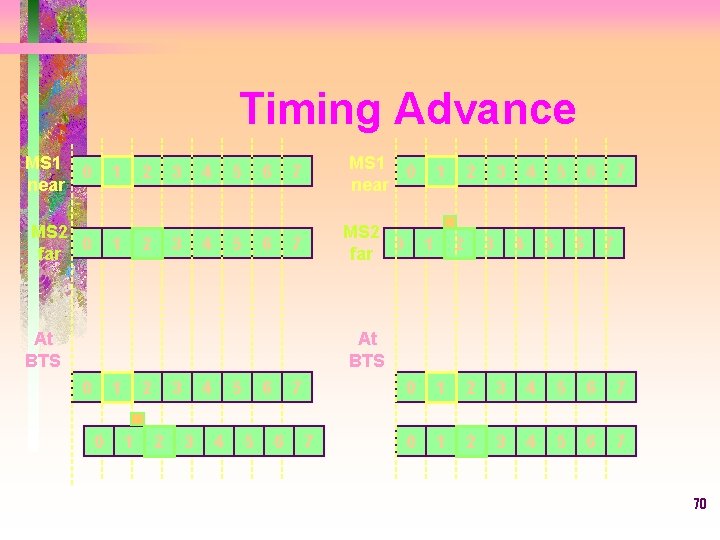
Timing Advance MS 1 0 near 1 2 3 4 5 6 7 MS 2 0 far 1 2 3 4 5 6 7 MS 1 0 near MS 2 0 far At BTS 1 1 2 2 3 3 4 4 5 5 6 6 7 7 At BTS 0 1 0 2 1 3 2 4 3 5 4 6 5 7 6 7 0 1 2 3 4 5 6 7 70
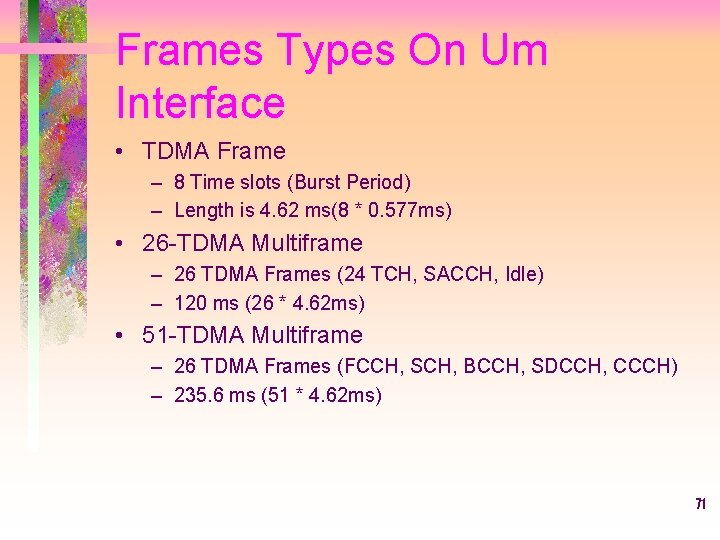
Frames Types On Um Interface • TDMA Frame – 8 Time slots (Burst Period) – Length is 4. 62 ms(8 * 0. 577 ms) • 26 -TDMA Multiframe – 26 TDMA Frames (24 TCH, SACCH, Idle) – 120 ms (26 * 4. 62 ms) • 51 -TDMA Multiframe – 26 TDMA Frames (FCCH, SCH, BCCH, SDCCH, CCCH) – 235. 6 ms (51 * 4. 62 ms) 71
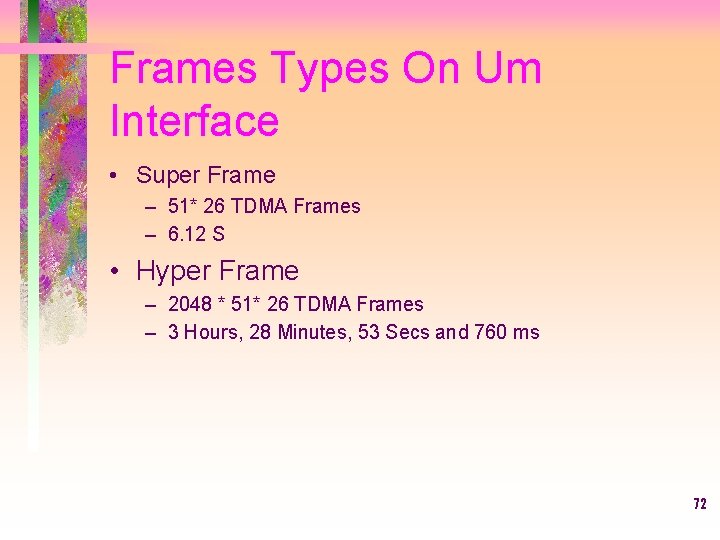
Frames Types On Um Interface • Super Frame – 51* 26 TDMA Frames – 6. 12 S • Hyper Frame – 2048 * 51* 26 TDMA Frames – 3 Hours, 28 Minutes, 53 Secs and 760 ms 72
TOPICS • • GSM CONCEPTS GSM SYSTEM ARCHITECTURE IDENTITIES USED IN GSM CHANNELS GSM RADIO LINK MOBILITY MANAGEMENT CALL MANAGEMENT RADIO RESOURCE MANAGEMENT 73
Mobility Management • • Mobility Management (MM) Location updating- normal, periodic, IMSI attach Paging Security Management – Preventing unauthorized users- authentication – Maintaining Privacy of users- ciphering • Providing roaming facility • MM functionality mainly handled by MS, HLR, MSC/VLR. 74
Network Attachment · Cell Identification · MS scans complete GSM frequency band for highest power · Tunes to highest powered frequency and looks for FCCH. Synchronizes in frequency domain · Get training sequence from SCH which follows FCCH. Synchronizes in time domain. · Accesses BCCH for network id, location area and frequencies of the neighboring cells. · Stores a list of 30 BCCH channels 75
Network Attachment…. . · PLMN Selection · Get the operator information from SIM. · Cell Selection · Selected cell should be a cell of the selected PLMN · Signal strength should be above threshold. · Cell should not be barred · Location Update · Register with the network by means of location updation procedures. 76
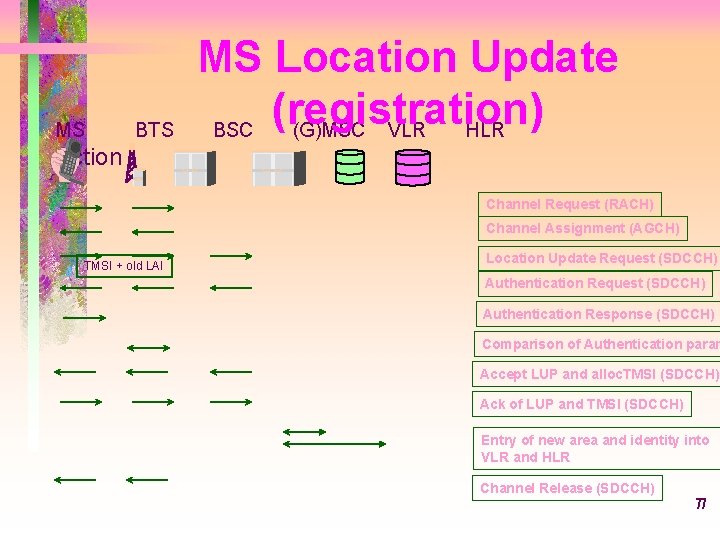
MS BTS MS Location Update (registration) BSC (G)MSC VLR HLR Action Channel Request (RACH) Channel Assignment (AGCH) TMSI + old LAI Location Update Request (SDCCH) Authentication Response (SDCCH) Comparison of Authentication param Accept LUP and alloc. TMSI (SDCCH) Ack of LUP and TMSI (SDCCH) Entry of new area and identity into VLR and HLR Channel Release (SDCCH) 77
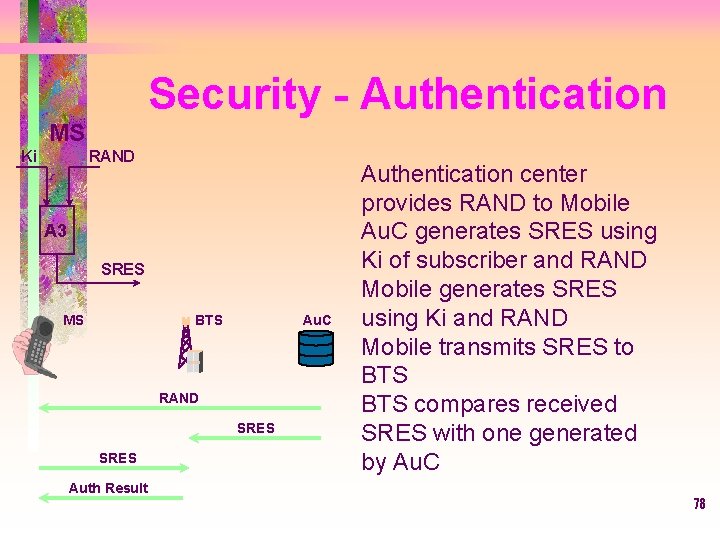
Security - Authentication MS Ki RAND A 3 SRES MS BTS Au. C RAND SRES Auth Result Authentication center provides RAND to Mobile Au. C generates SRES using Ki of subscriber and RAND Mobile generates SRES using Ki and RAND Mobile transmits SRES to BTS compares received SRES with one generated by Au. C 78
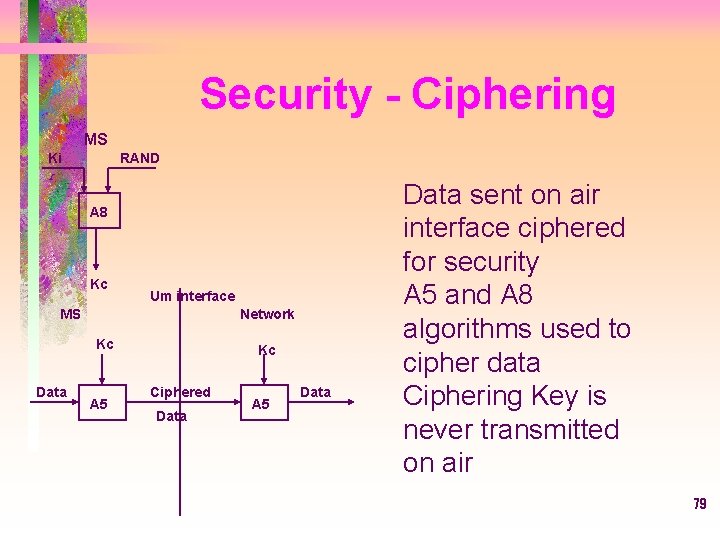
Security - Ciphering MS Ki RAND A 8 Kc Um interface MS Network Kc Data A 5 Kc Ciphered Data A 5 Data sent on air interface ciphered for security A 5 and A 8 algorithms used to cipher data Ciphering Key is never transmitted on air 79
TOPICS • • GSM CONCEPTS GSM SYSTEM ARCHITECTURE IDENTITIES USED IN GSM CHANNELS GSM RADIO LINK MOBILITY MANAGEMENT CALL MANAGEMENT RADIO RESOURCE MANAGEMENT 80
Communication Management (CM) • Setup of calls between users on request • Routing function i. e. Choice of transmission segments linking users • Point to Point Short message services 81
Mobile Originated Call • • Request for Service Authentication Ciphering Equipment Validation Call Setup Handovers Call Release 82
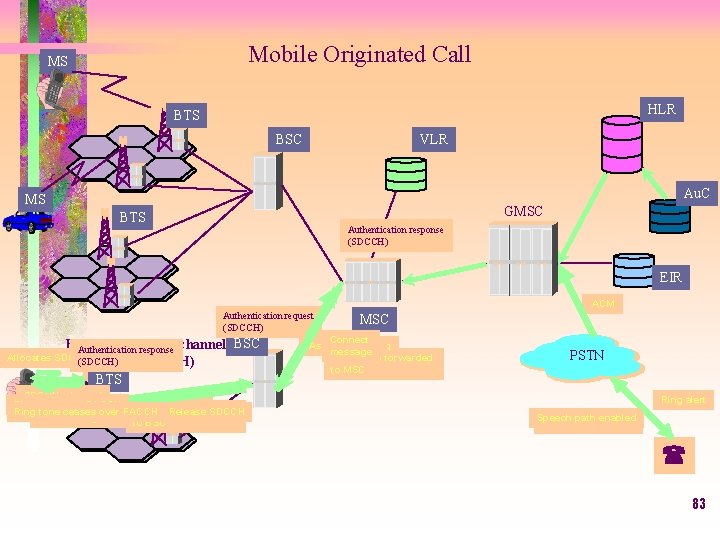
Mobile Originated Call MS HLR BTS BSC VLR Au. C MS GMSC BTS Authentication response (SDCCH) EIR ACM Authentication request (SDCCH) Req for dedicated Authentication response channel BSC Allocates SDCCH using the for(SDCCH) signaling. AGCH (RACH) BTS SDCCH released TCH assigned Ring Sends tone over call. FACCH set-up request Give including SDCCH Call set-up forwarded Ring tone ceases over FACCH Release Activate SDCCH TCH dialled digits on SDCCH to BSC MSC Connect Assigns TCH Req Assn complete message Call set-up forwarded to MSC PSTN Ring alert Speech path enabled Called Sub answers 83
Mobile Terminated Call • • Paging Authentication Ciphering Equipment Validation Call Setup Handovers Call Release 84
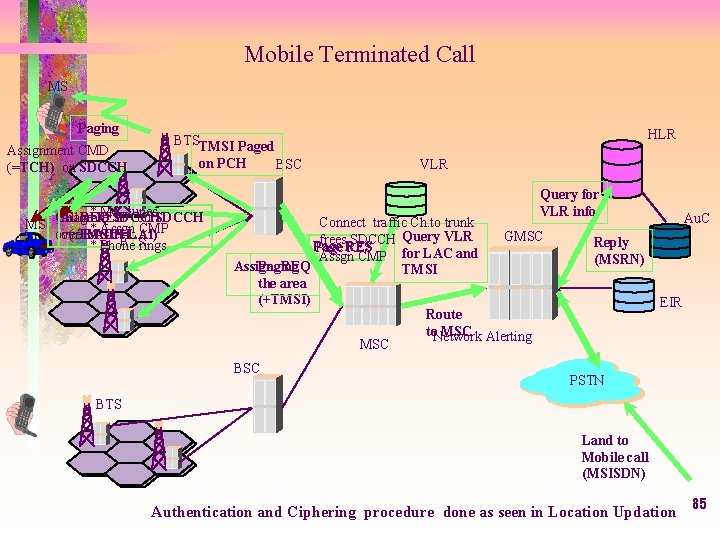
Mobile Terminated Call MS Paging Assignment CMD (=TCH) on SDCCH BTSTMSI Paged on PCH BSC *RESP MS tunes Allocate SDCCH Page on SDCCH Ch. REQ MS * Assgn CMP over AGCH ( TMSI + LAI) over RACH BTS * Phone rings HLR VLR Query for VLR info Connect traffic Ch. to trunk GMSC frees SDCCH Query VLR Page RES Assgn CMP for LAC and Assign. REQ Paging TMSI the area (+TMSI) Route to. Network MSC Alerting MSC BSC Au. C Reply (MSRN) EIR PSTN BTS Land to Mobile call (MSISDN) Authentication and Ciphering procedure done as seen in Location Updation 85
TOPICS • • GSM CONCEPTS GSM SYSTEM ARCHITECTURE IDENTITIES USED IN GSM CHANNELS GSM RADIO LINK MOBILITY MANAGEMENT CALL MANAGEMENT RADIO RESOURCE MANAGEMENT 86
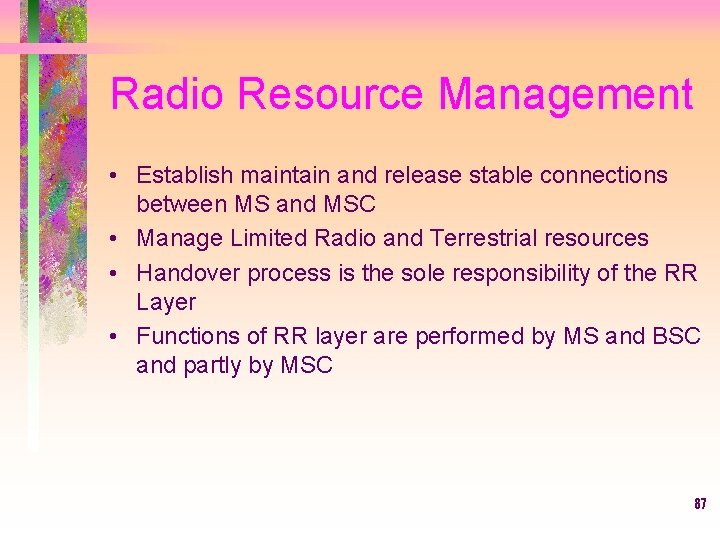
Radio Resource Management • Establish maintain and release stable connections between MS and MSC • Manage Limited Radio and Terrestrial resources • Handover process is the sole responsibility of the RR Layer • Functions of RR layer are performed by MS and BSC and partly by MSC 87
Radio Resource Management • • Power Control Hand over Control Discontinuous Transmission Frequency Hopping 88
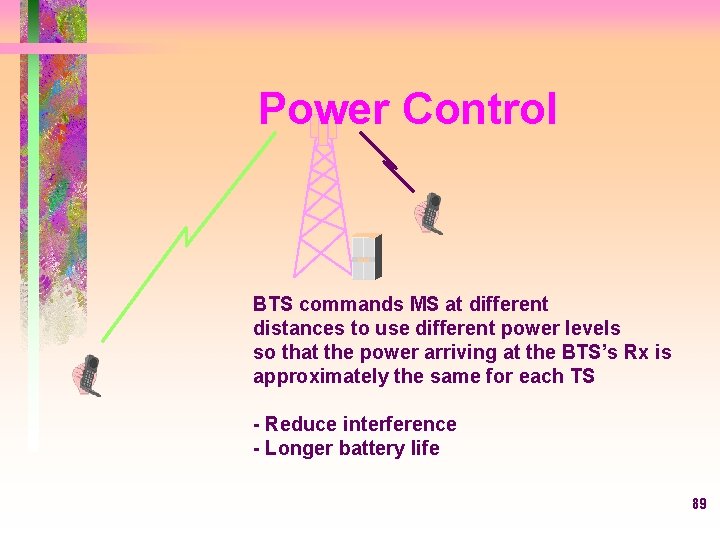
Power Control BTS commands MS at different distances to use different power levels so that the power arriving at the BTS’s Rx is approximately the same for each TS - Reduce interference - Longer battery life 89
Handover Means to continue a call even a mobile crosses the border of one cell to another Procedure which made the mobile station really roam Handover causes Rx. Lev (Signal strength , uplink or downlink) Rx. Qual (BER on data) O & M intervention Timing Advance Traffic or Load balancing 90
Handover Types • Internal Handover (Intra-BSS) – Within same base station - intra cell – Between different base stations - inter cell • External Handover (Inter-BSS) – Within same MSC -intra MSC – Between different MSCs - inter-MSC 91
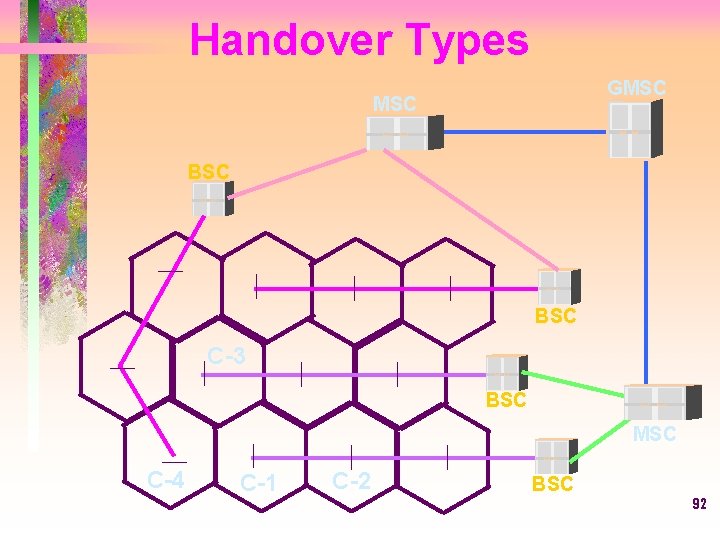
Handover Types GMSC BSC C-3 BSC MSC C-4 C-1 C-2 BSC 92
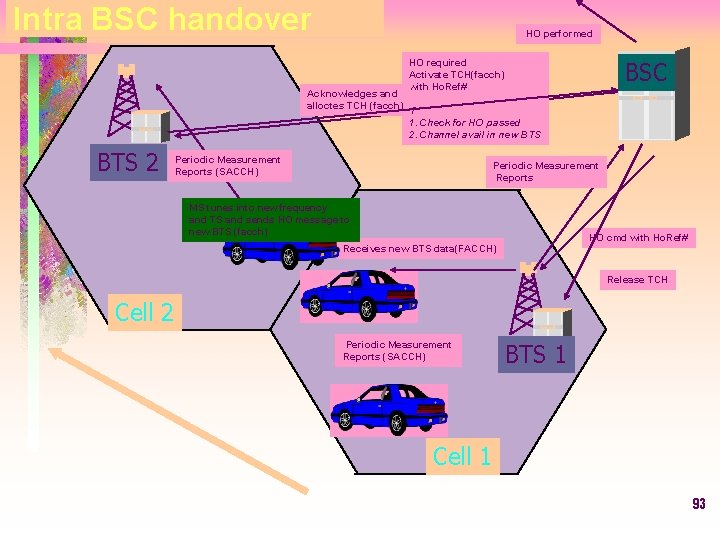
Intra BSC handover HO performed HO required Activate TCH(facch) with Ho. Ref# BSC Acknowledges and alloctes TCH (facch) if 1. Check for HO passed 2. Channel avail in new BTS 2 Periodic Measurement Reports (SACCH) Periodic Measurement Reports MS tunes into new frequency and TS and sends HO message to new BTS (facch) HO cmd with Ho. Ref# Receives new BTS data(FACCH) Release TCH Cell 2 Periodic Measurement Reports (SACCH) BTS 1 Cell 1 93
Discontinuous Transmission • Discontinuous Transmission(DTX) allows the radio transmitter to be switched off most of the time during speech pauses. • A Silence Indicator Block is transmitted at 500 bps, which generates a comfort noise • Down Link interference is decreased. • Up link battery is saved 94
Frequency Hopping • Frequency Hopping permits the dynamic switching of radio links from one carrier frequency to another. • Base Band Hopping – At the BTS each the timeslot is shifted to another transceiver, which is transmitting at the hop frequency. User will be connected to different Transceivers depending on hop sequence. • Synthesis Hopping – At the BTS transceiver changes the frequencies used. The user will be connected to only one transceiver. • Decreases the probability of interference • Suppresses the effect of Rayleigh fading 95
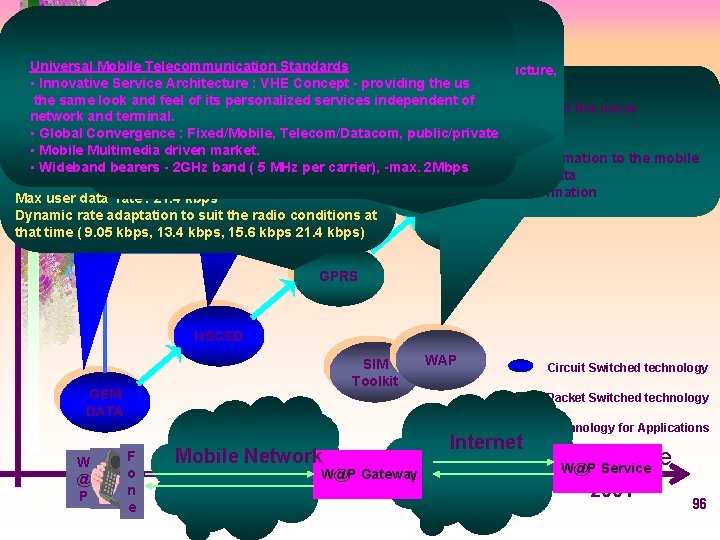
Add-on to GSM network : rate for GSM Evolution Enhanced Data PCU; Packet • EDGE Segmentation/re-assembly scheduling is an enhancement ofand GPRS and CSD technologies. • Radio channel access control and management Universal Mobile Telecommunication Standards • Based on the current GSM technology - same TDMA frame structure, • Transmission error detection and retransmission. • Innovative Service Architecture : VHE Concept - providing the us same bandwidth (200 k. Hz). • Power control the same feelmodulation of its personalized of • look Usesand 8 -PSK instead services of GMSK. independent Surf the Internet while on the move SGSN: GPRS mobility network and terminal. • Requires good. Switched propagation High Speed Circuit Dataconditions. • Encryption • Global Convergence : Fixed/Mobile, Telecom/Datacom, public/private • Allows upto 48 kbps (EGPRS) and upto 28. 8 kbps (ECSD) on: every User Data Rate: 14. 5 kbps W@P Gateway • Charging • Mobile Multimedia driven market. Useradio multiple timeslots (max=8), • Adaptation of the information to the mobile 160 channel -numeric characters GGSN : Data: Interface to the- PDN, Internet • SMS Wideband bearers 2 GHz band ( 5 MHz per carrier), -max. 2 Mbps • EDGE helps GSM-Only operators to compete with UMTS. hence max: 9. 6 kbps rate = 115. 2 kbps. • Compression of the UMTS data User Data Rate Needs a duplexor in MS for • Buffering of the information One time slotrate over the air interface Max user data : 21. 4 kbps simultaneous Tx and Rx Dynamic rate adaptation to suit the radio conditions at EDGE that time ( 9. 05 kbps, 13. 4 kbps, 15. 6 kbps 21. 4 kbps) Wireless Data Application GPRS HSCSD SIM Toolkit GSM DATA W @ P WAP Circuit Switched technology Packet Switched technology F o n e Internet Mobile Network 98 W@P Gateway 99 Technology for Applications Time W@P Service 2000 2001 96
References • Wireless and Personal Communication Systems. Vijay. K. Garg and Wilkes • Overview of the GSM System and Protocol Architecture, IEEE Comm. Magazine, Moe Rahnema. • The GSM System for Mobile Communications- Michel Mouly & Marie-Bernadette Pautet • Overview of the GSM Comm- John Scourias. 97

98
Location Updates can be classified into two: Periodic Location Updates: This occurs as per the timer set by the network operator. If the MS does not perform this update the MSC marks the MS as ‘Detached’ on the VLR. Location Update on a handover: This occurs if during a handover the MS is moved into a new Location Area Code (LAC). 99
- Slides: 97