
GSM Fundamental By Uke Kurniawan Usman 1 Uke
GSM Fundamental By Uke Kurniawan Usman 1 Uke Kurniawan Usman - 2005
Agenda l l l l 2 Network Architecture Functional Layer of GSM Air Interface System Capacity Anti Interference Technology Network Planning Numbering arrangement Uke Kurniawan Usman - 2005
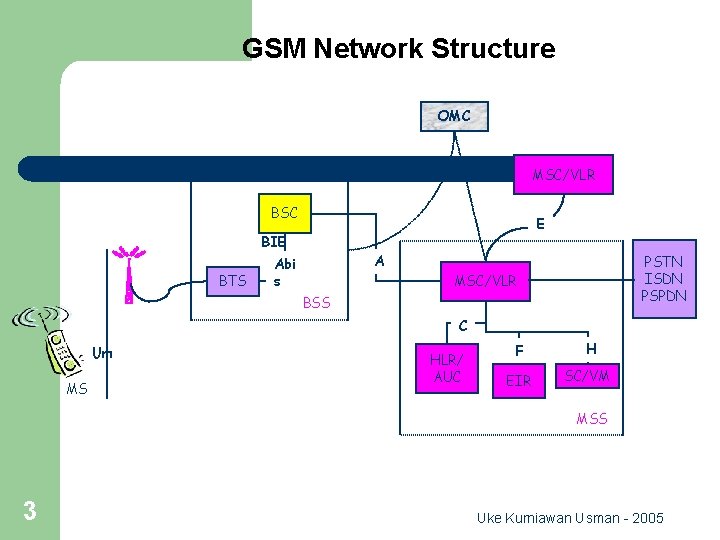
GSM Network Structure OMC MSC/VLR BSC E BIE BTS A Abi s PSTN ISDN PSPDN MSC/VLR BSS C Um MS HLR/ AUC F H EIR SC/VM MSS 3 Uke Kurniawan Usman - 2005
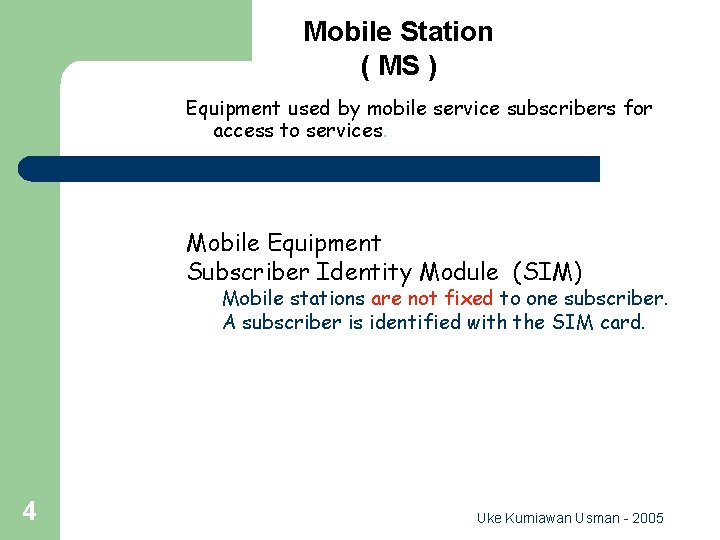
Mobile Station ( MS ) Equipment used by mobile service subscribers for access to services. Mobile Equipment Subscriber Identity Module (SIM) Mobile stations are not fixed to one subscriber. A subscriber is identified with the SIM card. 4 Uke Kurniawan Usman - 2005
GSM Network Entity Base Transceiver Station ( BTS ) Base Transceiver Station (BTS) Wireless transmission Wireless diversity Wireless channel encryption Conversion between wired and wireless signals Frequency Hopping 5 v. Base. Band Unit: voice and data speed adapting and channel coding v. RF Unit: modulating/demodulating, transmitter and receiver v. Common Control Unit: BTS operation and maintenance Uke Kurniawan Usman - 2005
GSM Network Entity Base Station Controller ( BSC ) Managing Wireless network-BSS Monitoring BTS Controls: Wireless link distribution between MS and BTS Communication connection and disconnection MS location, handover and paging Voice encoding, transecoding (TC), rate, adaptation, The operation and maintenance functions of BSS. 6 Uke Kurniawan Usman - 2005
GSM Network Entity Mobile Service Switching Center ( MSC ) Øholds all the switching functions Ømanages the necessary radio resources, updating the location registration carrying out the inter-BSC and inter-MSC tender ØInter-working with other networks (IWF). 7 Uke Kurniawan Usman - 2005
GSM Network Entity Home Location Register ( HLR ) Manages the mobile subscribers database v subscriber information v part of the mobile location information 8 v 3 identities essential the International Mobile subscriber Identity the Mobile station ISDN Number the VLR address Uke Kurniawan Usman - 2005
GSM Network Entity Visitor Location Register ( VLR ) dynamically stores subscriber information needed to handle incoming/outgoing calls ØMobile Station Roaming Number When a roaming mobile enters an MSC area. This MSC warns the associated VLR of this situation; the mobile enters a registration procedure through which it is assigned a mobile subscriber roaming number (MSRN) 9 ØTemporary Mobile Subscriber Identity, if applicable ØThe location area in which the mobile has been registered ØData related to supplementary service parameters Uke Kurniawan Usman - 2005
GSM Network Entity AUC/EIR Authentication Center(s) (AUC) Providing the authentication key used for authorizing the subscriber access to the associated GSM PLMN. Equipment Identity Register(s) (EIR) Handling Mobile Station Equipment Identity 10 Uke Kurniawan Usman - 2005
Agenda l l l l 11 Network Architecture Functional Layer of GSM Air Interface System Capacity Anti Interference Technology Network Planning Numbering arrangement Uke Kurniawan Usman - 2005
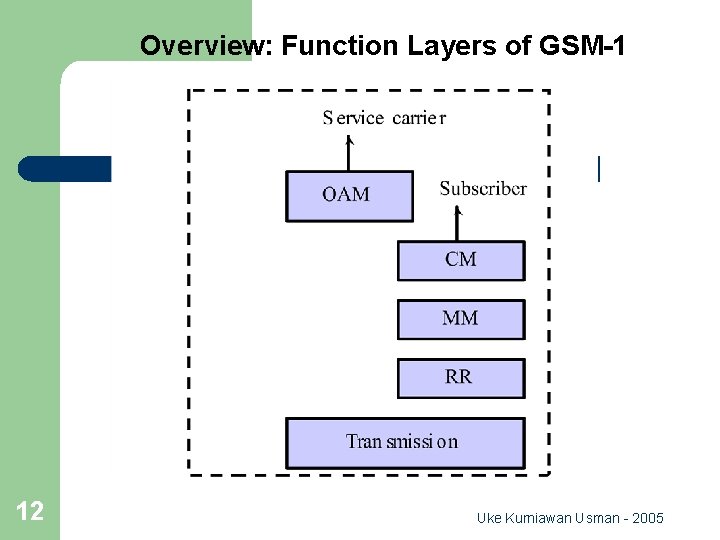
Overview: Function Layers of GSM-1 12 Uke Kurniawan Usman - 2005
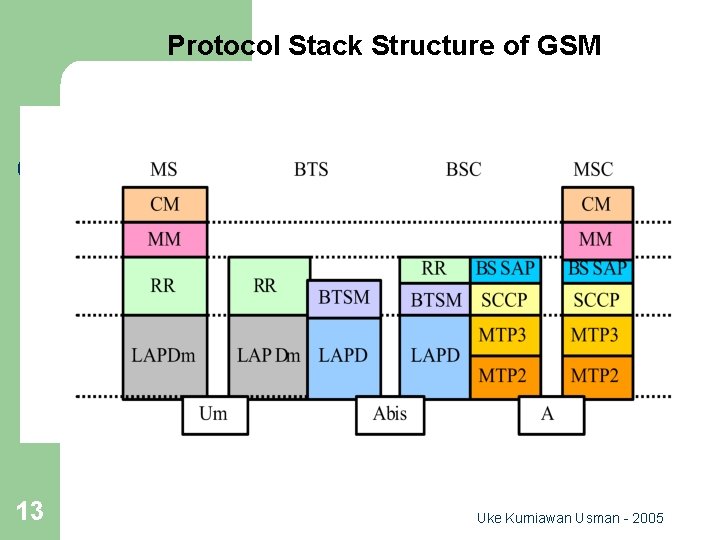
Protocol Stack Structure of GSM 13 Uke Kurniawan Usman - 2005
Agenda l. Network Architecture l. Functional Layer of GSM l. Air Interface l. System Capacity l. Anti Interference Technology l. Network Planning l. Numbering arrangement 14 Uke Kurniawan Usman - 2005
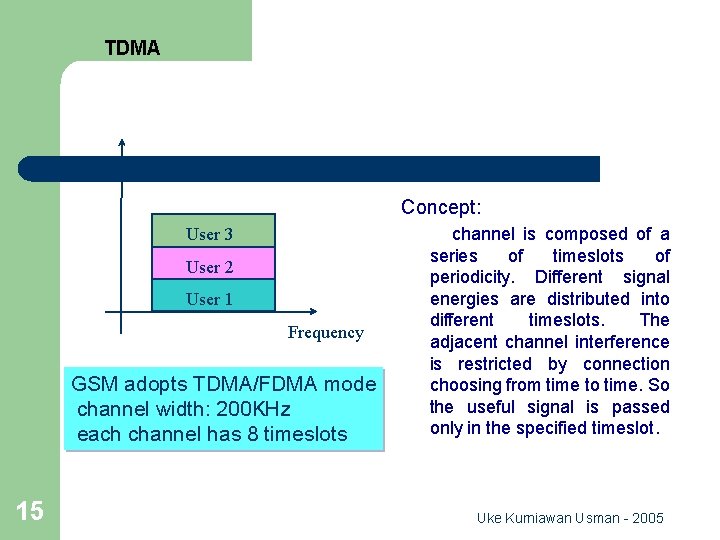
TDMA time Concept: User 3 User 2 User 1 Frequency GSM adopts TDMA/FDMA mode channel width: 200 KHz each channel has 8 timeslots 15 channel is composed of a series of timeslots of periodicity. Different signal energies are distributed into different timeslots. The adjacent channel interference is restricted by connection choosing from time to time. So the useful signal is passed only in the specified timeslot. Uke Kurniawan Usman - 2005
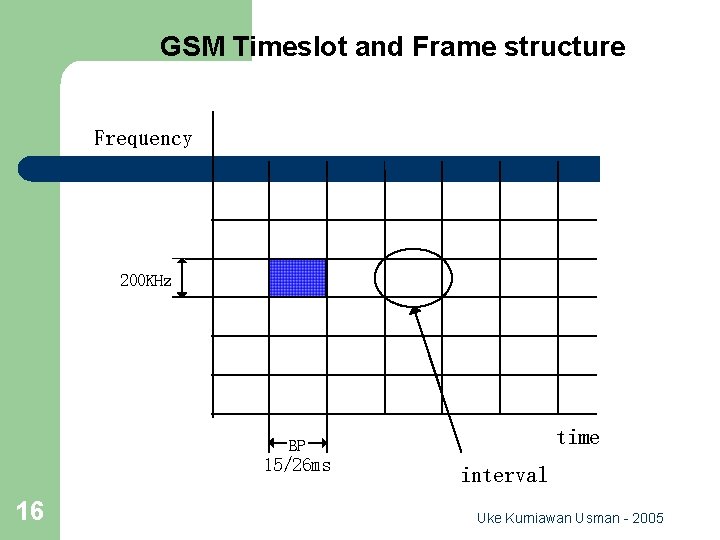
GSM Timeslot and Frame structure Frequency 200 KHz time BP 15/26 ms 16 interval Uke Kurniawan Usman - 2005
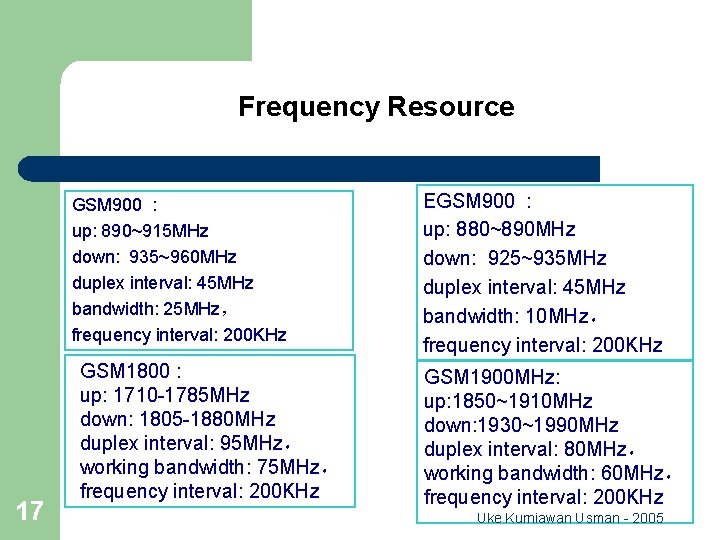
Frequency Resource GSM 900 : up: 890~915 MHz down: 935~960 MHz duplex interval: 45 MHz bandwidth: 25 MHz, frequency interval: 200 KHz 17 GSM 1800 : up: 1710 -1785 MHz down: 1805 -1880 MHz duplex interval: 95 MHz, working bandwidth: 75 MHz, frequency interval: 200 KHz EGSM 900 : up: 880~890 MHz down: 925~935 MHz duplex interval: 45 MHz bandwidth: 10 MHz, frequency interval: 200 KHz GSM 1900 MHz: up: 1850~1910 MHz down: 1930~1990 MHz duplex interval: 80 MHz, working bandwidth: 60 MHz, frequency interval: 200 KHz Uke Kurniawan Usman - 2005
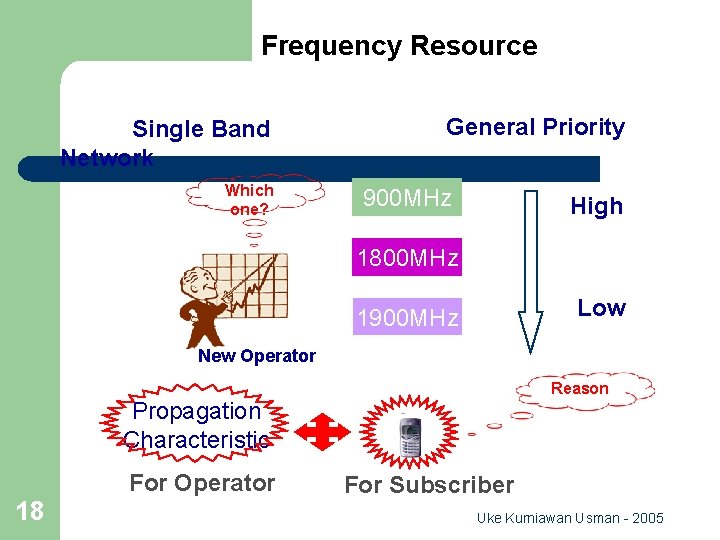
Frequency Resource Single Band Network Which one? General Priority 900 MHz High 1800 MHz Low 1900 MHz New Operator Reason Propagation Characteristic For Operator 18 For Subscriber Uke Kurniawan Usman - 2005
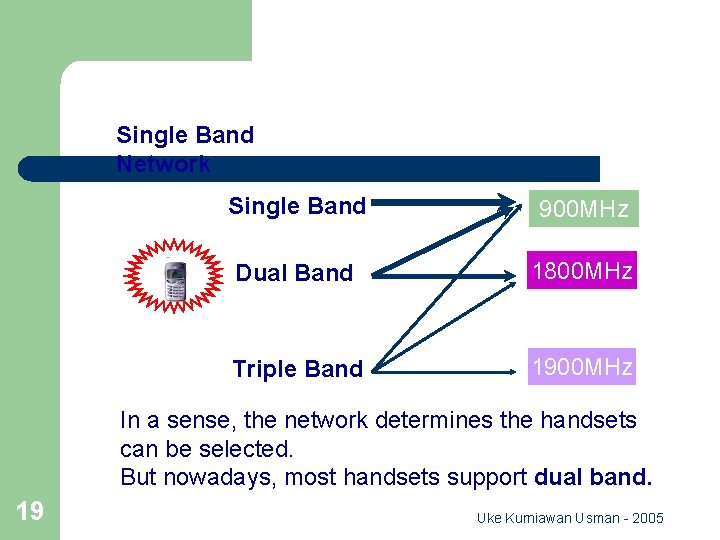
Frequency Resource Single Band Network Single Band 900 MHz Dual Band 1800 MHz Triple Band 1900 MHz In a sense, the network determines the handsets can be selected. But nowadays, most handsets support dual band. 19 Uke Kurniawan Usman - 2005
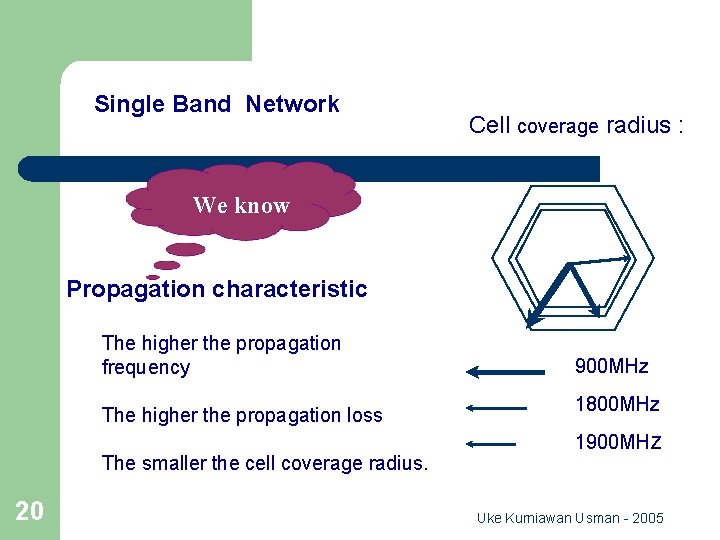
Frequency Resource Single Band Network Cell coverage radius : We know Propagation characteristic The higher the propagation frequency The higher the propagation loss The smaller the cell coverage radius. 20 900 MHz 1800 MHz 1900 MHz Uke Kurniawan Usman - 2005
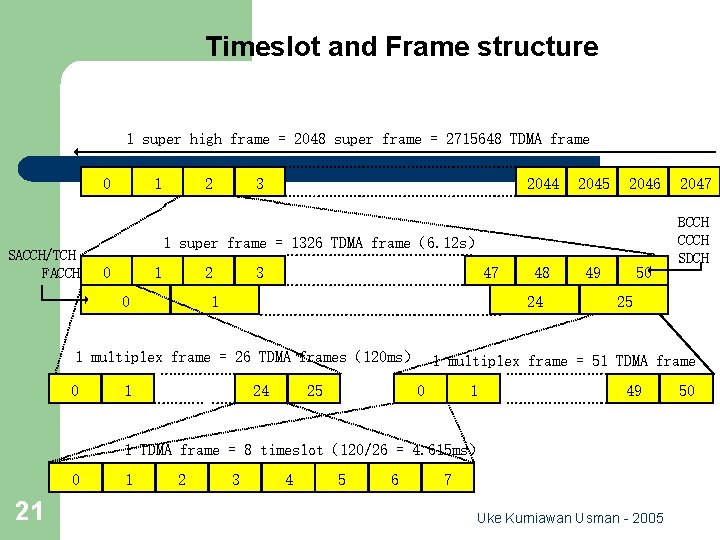
Timeslot and Frame structure 1 super high frame = 2048 super frame = 2715648 TDMA frame 0 SACCH/TCH FACCH 1 2 3 2044 2045 2046 1 super frame = 1326 TDMA frame(6. 12 s) 0 1 2 0 3 47 1 48 24 49 50 2047 BCCH CCCH SDCH 25 1 multiplex frame = 26 TDMA frames(120 ms) 1 multiplex frame = 51 TDMA frame 0 1 24 25 0 1 49 1 TDMA frame = 8 timeslot(120/26 = 4. 615 ms) 0 21 1 2 3 4 5 6 7 Uke Kurniawan Usman - 2005 50
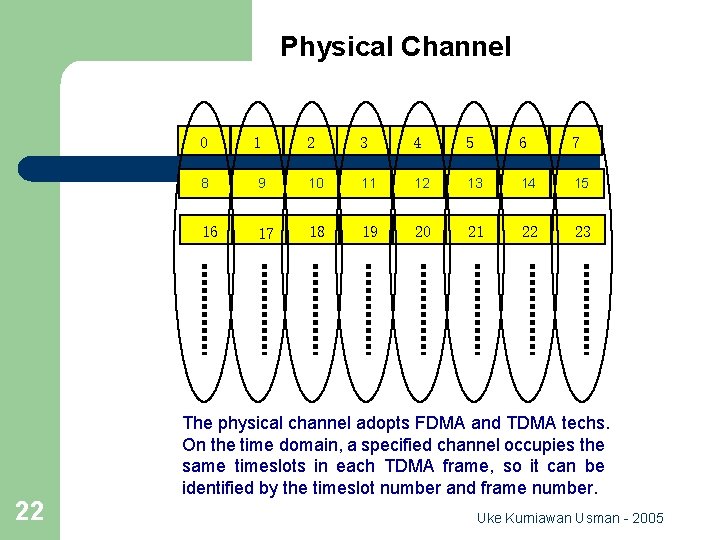
Physical Channel 0 22 1 2 3 4 5 6 7 8 9 10 11 12 13 14 15 16 17 18 19 20 21 22 23 The physical channel adopts FDMA and TDMA techs. On the time domain, a specified channel occupies the same timeslots in each TDMA frame, so it can be identified by the timeslot number and frame number. Uke Kurniawan Usman - 2005
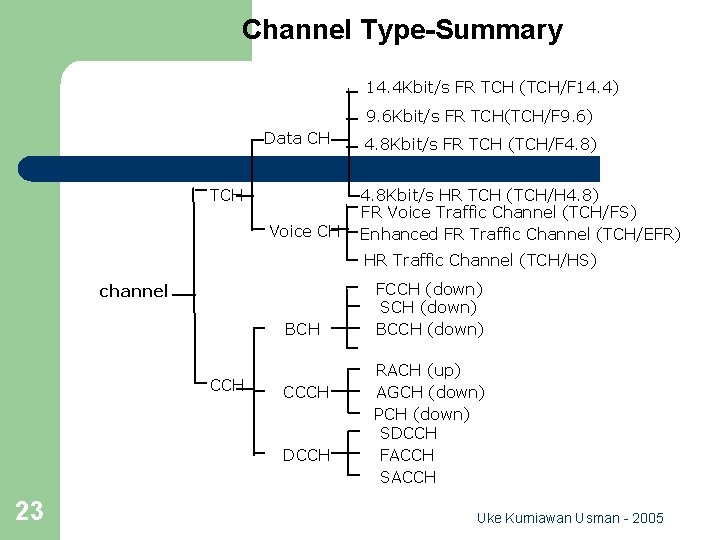
Channel Type-Summary 14. 4 Kbit/s FR TCH (TCH/F 14. 4) 9. 6 Kbit/s FR TCH(TCH/F 9. 6) Data CH TCH Voice CH 4. 8 Kbit/s FR TCH (TCH/F 4. 8) 4. 8 Kbit/s HR TCH (TCH/H 4. 8) FR Voice Traffic Channel (TCH/FS) Enhanced FR Traffic Channel (TCH/EFR) HR Traffic Channel (TCH/HS) channel BCH CCCH DCCH 23 FCCH (down) SCH (down) BCCH (down) RACH (up) AGCH (down) PCH (down) SDCCH FACCH SACCH Uke Kurniawan Usman - 2005
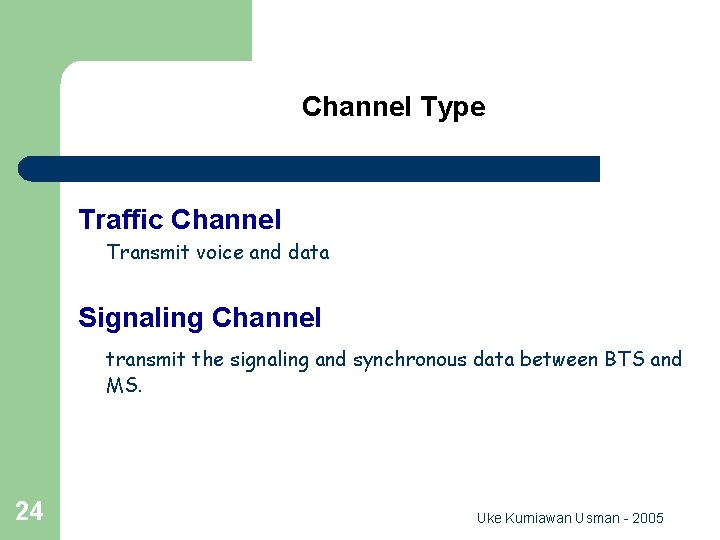
Channel Type Traffic Channel Transmit voice and data Signaling Channel transmit the signaling and synchronous data between BTS and MS. 24 Uke Kurniawan Usman - 2005
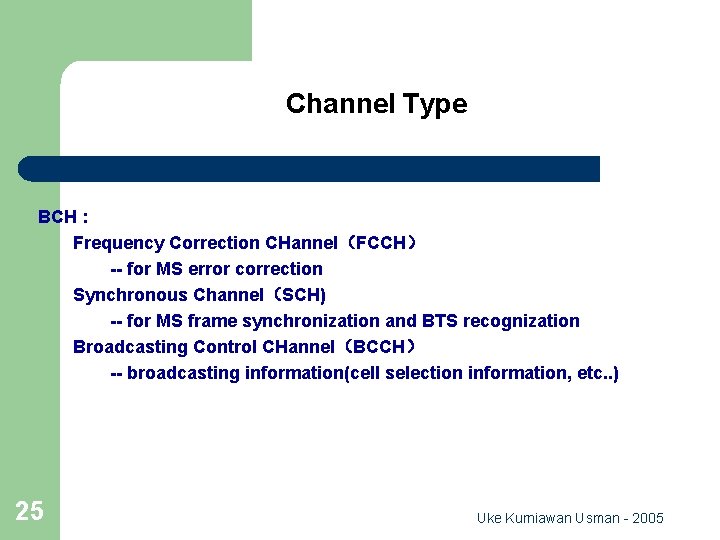
Channel Type BCH : Frequency Correction CHannel(FCCH) -- for MS error correction Synchronous Channel(SCH) -- for MS frame synchronization and BTS recognization Broadcasting Control CHannel(BCCH) -- broadcasting information(cell selection information, etc. . ) 25 Uke Kurniawan Usman - 2005
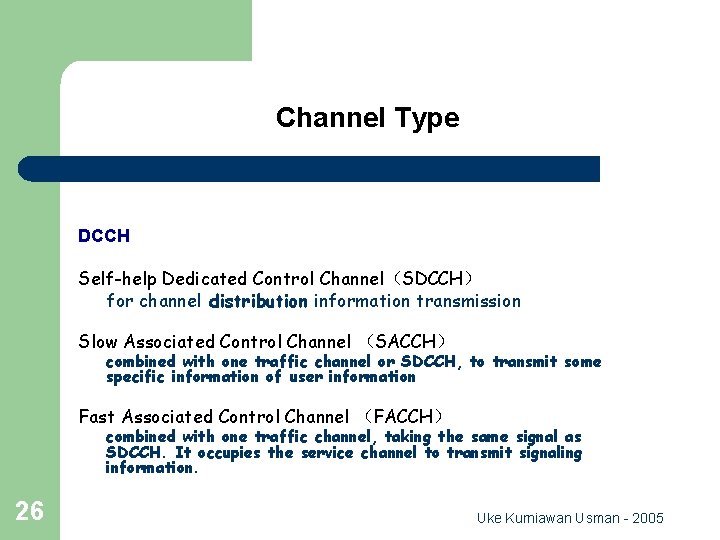
Channel Type DCCH Self-help Dedicated Control Channel(SDCCH) for channel distribution information transmission Slow Associated Control Channel (SACCH) combined with one traffic channel or SDCCH, to transmit some specific information of user information Fast Associated Control Channel (FACCH) combined with one traffic channel, taking the same signal as SDCCH. It occupies the service channel to transmit signaling information. 26 Uke Kurniawan Usman - 2005
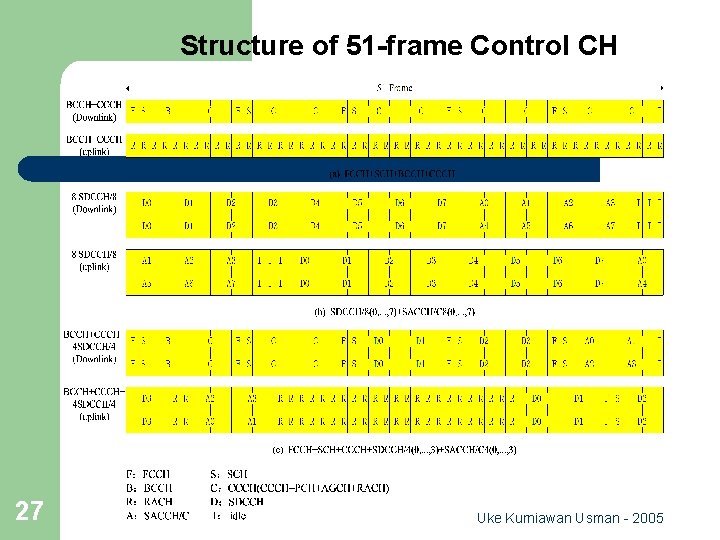
Structure of 51 -frame Control CH 27 Uke Kurniawan Usman - 2005
Channel Combination Type 28 Uke Kurniawan Usman - 2005
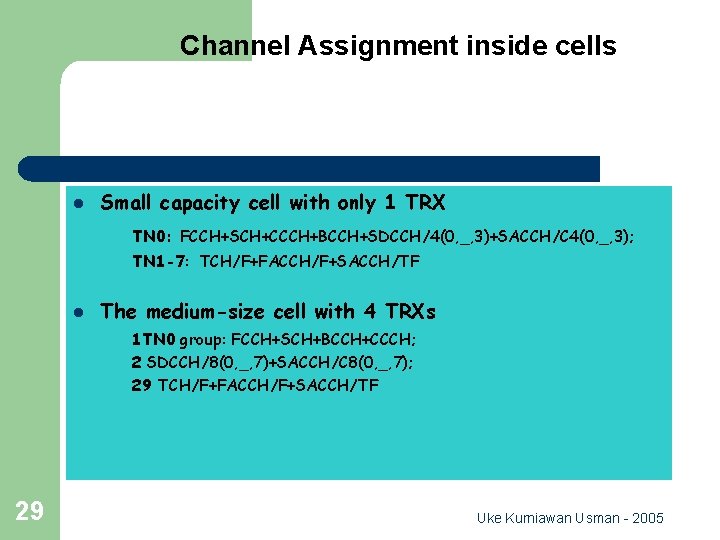
Channel Assignment inside cells l Small capacity cell with only 1 TRX TN 0: FCCH+SCH+CCCH+BCCH+SDCCH/4(0, _, 3)+SACCH/C 4(0, _, 3); TN 1 -7: TCH/F+FACCH/F+SACCH/TF l The medium-size cell with 4 TRXs 1 TN 0 group: FCCH+SCH+BCCH+CCCH; 2 SDCCH/8(0, _, 7)+SACCH/C 8(0, _, 7); 29 TCH/F+FACCH/F+SACCH/TF 29 Uke Kurniawan Usman - 2005
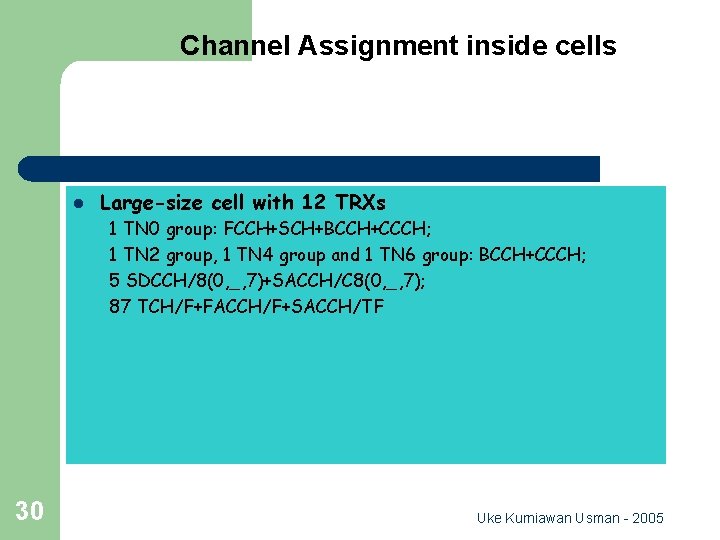
Channel Assignment inside cells l Large-size cell with 12 TRXs 1 TN 0 group: FCCH+SCH+BCCH+CCCH; 1 TN 2 group, 1 TN 4 group and 1 TN 6 group: BCCH+CCCH; 5 SDCCH/8(0, _, 7)+SACCH/C 8(0, _, 7); 87 TCH/F+FACCH/F+SACCH/TF 30 Uke Kurniawan Usman - 2005
Agenda l. Network Architecture l. Functional Layer of GSM l. Air Interface l. System Capacity l. Anti Interference Technology l. Network Planning l. Numbering arrangement 31 Uke Kurniawan Usman - 2005
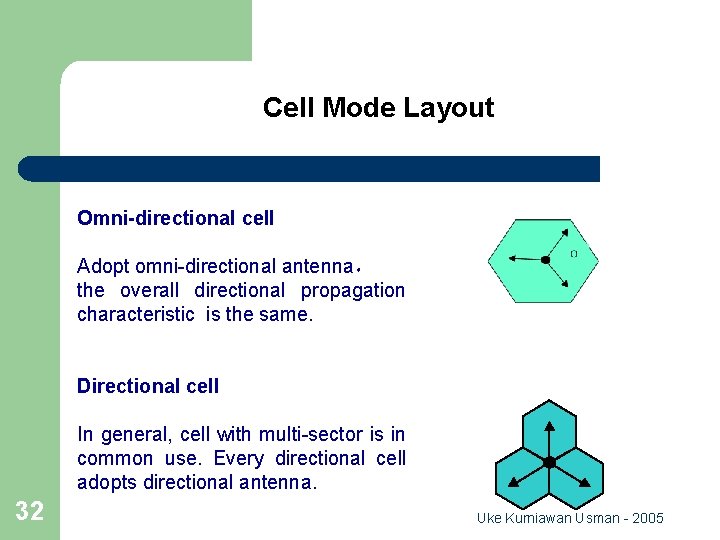
Cell Mode Layout Omni-directional cell Adopt omni-directional antenna, the overall directional propagation characteristic is the same. Directional cell In general, cell with multi-sector is in common use. Every directional cell adopts directional antenna. 32 Uke Kurniawan Usman - 2005
BTS Mode v Capacity When the traffic is very low, and no possibility for quick increment, Omni-directional cell is used in common. Otherwise, we suggest to adopt the sector cell. Note: TRX-transceiver, each TRX handles 1 frequency. 33 v Coverage Area Sector cell is often used to enlarge the cell coverage radius because of the higher antenna gain. For special coverage , such as road coverage, two-sector cell is adopted firstly. Uke Kurniawan Usman - 2005
System capacity Erlang : the traffic intensity of a totally occupied channel (i. e. the call hour of a unit hour or the call minute of a unit minute). For example, the traffic of a channel occupied for 30 minutes in an hour is 0. 5 Erlang) GOS: 34 defined as the probability of call blocking or the probability when the call delay time is longer than a given queuing time. Uke Kurniawan Usman - 2005
Agenda l. Network Architecture l. Functional Layer of GSM l. Air Interface l. System Capacity l. Anti Interference Technology l. Network Planning l. Numbering arrangement 35 Uke Kurniawan Usman - 2005
Reasons for Interference The transmission path is very complex, ranging from the simple line-of-sight transmission to encountering such terrain as buildings, hills and trees. Wireless channels are extremely unpredictable. Abrupt drop, or fading, of signal strength in the land mobile wireless channel is quite common. The fading feature of the mobile channel depends on the radio wave propagation environment. 36 Uke Kurniawan Usman - 2005
Reasons for interference Environmental factors: 37 • Terrain (mountains, hills, plains, water bodies, etc. ); • The quantity, heights, distribution and materials of buildings; • The vegetation of the region; • Weather conditions; • Natural and artificial electromagnetic noises; • Frequency; • How MS is moved. Uke Kurniawan Usman - 2005
Interference v. Co-Channel Interference Conception: 38 the interference among the signals of cochannel cells is called co-channel interference. Result from : Frequency reuse Reduction method: co-channel cells must physically be spaced at a minimum interval to ensure Uke Kurniawan Usman - 2005 adequate isolation of transmissions.
Interference v Adjacent Channel Interference Conception: The signal interference from the frequency adjacent to that of the signal used is called adjacent channel interference. Reduction method: accurate filtering and channel allocation (maximizing channel intervals of the cell). Interval of frequency reuse inter-cell interference, such as C/I, C/A 39 Uke Kurniawan Usman - 2005
Solution -Anti-interference 40 ü FH technology ü Dynamic power control (DPC) ü Discontinuous Transceiving (DTX) ü Diversity receiving technique Uke Kurniawan Usman - 2005
Frequency Hopping Technique Reason: l counteract Rayleigh Fading l scatter interference among multiple calls Types: & Base band frequency hopping keeps the transmission and receiving frequency of each carrier unit unchanged, but merely sends FU transmission data to different carrier units at different FN moments. & radio frequency hopping controls the frequency synthesizer of each transceiver, making it hop according to different schemes in different time slots. 41 Uke Kurniawan Usman - 2005
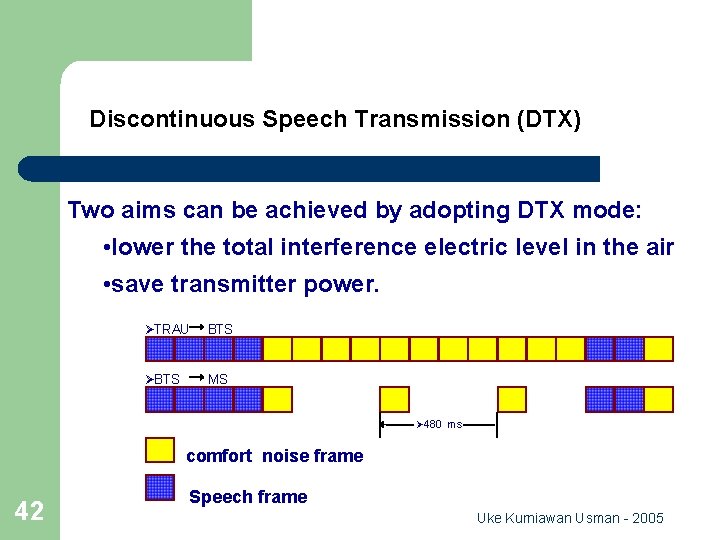
Discontinuous Speech Transmission (DTX) Two aims can be achieved by adopting DTX mode: • lower the total interference electric level in the air • save transmitter power. ØTRAU BTS ØBTS MS Ø 480 ms comfort noise frame 42 Speech frame Uke Kurniawan Usman - 2005
Diversity Reception Technology The multi-path propagation of radio signals causes magnitude fading and delay time. v Space Diversity (antenna diversity) v Polarization Diversity orthogonal polarization diversity. horizontal polarization and vertical polarization. 43 v Frequency Diversity The working principle of this technology is that such fading won’t take place on the frequency outside the coherence bandwidth of the channel. Uke Kurniawan Usman - 2005
Agenda l. Network Architecture l. Functional Layer of GSM l. Air Interface l. System Capacity l. Anti Interference Technology l. Network Planning l. Numbering arrangement 44 Uke Kurniawan Usman - 2005
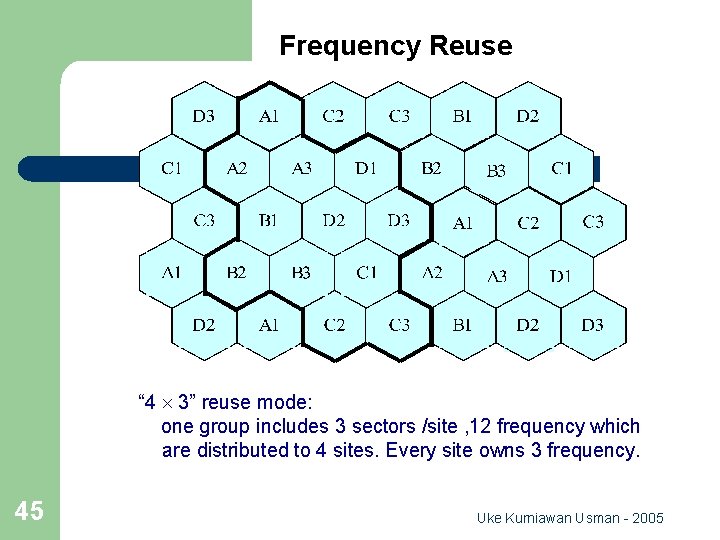
Frequency Reuse “ 4 ´ 3” reuse mode: one group includes 3 sectors /site , 12 frequency which are distributed to 4 sites. Every site owns 3 frequency. 45 Uke Kurniawan Usman - 2005
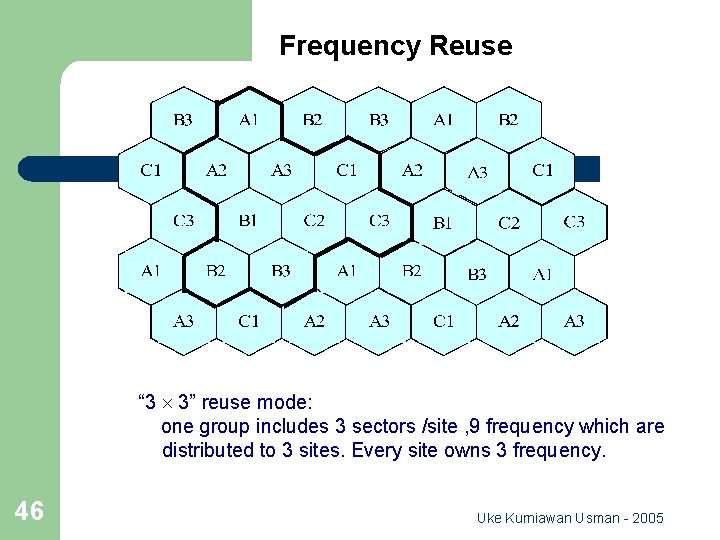
Frequency Reuse “ 3 ´ 3” reuse mode: one group includes 3 sectors /site , 9 frequency which are distributed to 3 sites. Every site owns 3 frequency. 46 Uke Kurniawan Usman - 2005
Agenda l. Network Architecture l. Functional Layer of GSM l. Air Interface l. System Capacity l. Anti Interference Technology l. Network Planning l. Numbering arrangement 47 Uke Kurniawan Usman - 2005
Numbering Arrangement International Mobile Subscriber Identification number (IMSI) It identifies a unique international universal number of a mobile subscriber, which consists of MCC+MNC+MSIN. 1) MCC: country code, 460 2)MNC: network code, 00 or 01 3)MSIN: subscriber identification, H 1 H 2 H 3 H 4 9 XXXXXX, H 1 H 2 H 3 H 4: subscriber registering place H 1 H 2: assigned by the P&T Administrative Bureau (operator )to different provinces, to each province H 3 H 4: assigned by each province/city 48 the IMSI of user will be written into the SIM card by specific device and software and be stored into the HLR Uke Kurniawan Usman - 2005 with other user information.
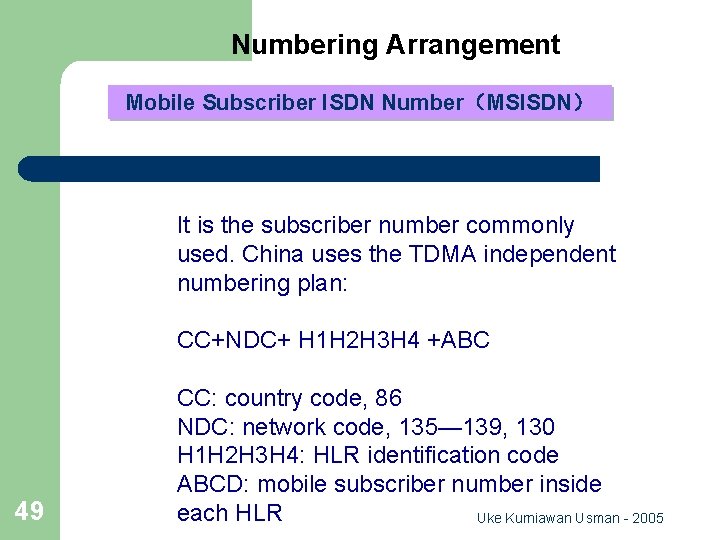
Numbering Arrangement Mobile Subscriber ISDN Number(MSISDN) It is the subscriber number commonly used. China uses the TDMA independent numbering plan: CC+NDC+ H 1 H 2 H 3 H 4 +ABC 49 CC: country code, 86 NDC: network code, 135— 139, 130 H 1 H 2 H 3 H 4: HLR identification code ABCD: mobile subscriber number inside each HLR Uke Kurniawan Usman - 2005
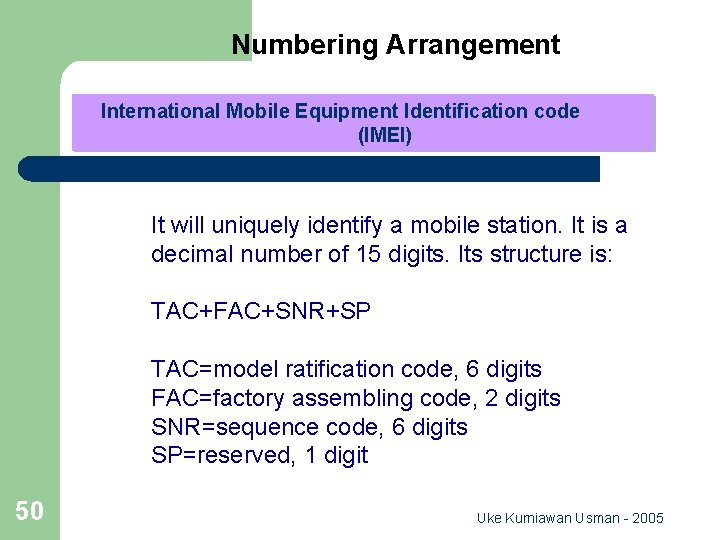
Numbering Arrangement International Mobile Equipment Identification code (IMEI) It will uniquely identify a mobile station. It is a decimal number of 15 digits. Its structure is: TAC+FAC+SNR+SP TAC=model ratification code, 6 digits FAC=factory assembling code, 2 digits SNR=sequence code, 6 digits SP=reserved, 1 digit 50 Uke Kurniawan Usman - 2005
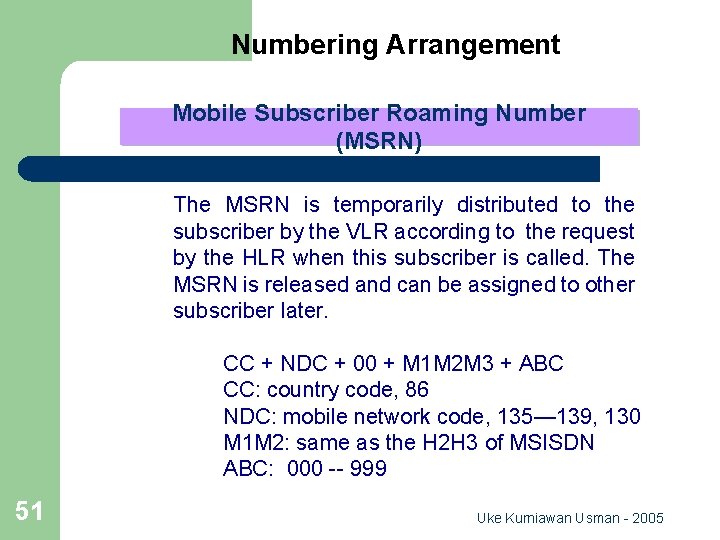
Numbering Arrangement Mobile Subscriber Roaming Number (MSRN) The MSRN is temporarily distributed to the subscriber by the VLR according to the request by the HLR when this subscriber is called. The MSRN is released and can be assigned to other subscriber later. CC + NDC + 00 + M 1 M 2 M 3 + ABC CC: country code, 86 NDC: mobile network code, 135— 139, 130 M 1 M 2: same as the H 2 H 3 of MSISDN ABC: 000 -- 999 51 Uke Kurniawan Usman - 2005
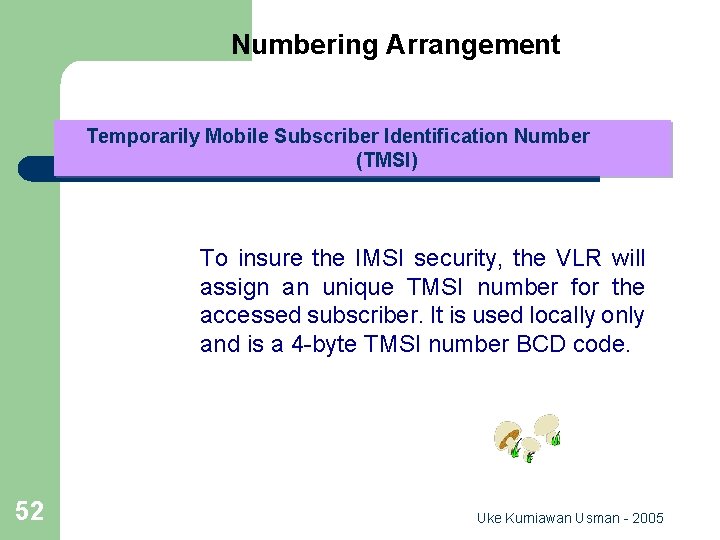
Numbering Arrangement Temporarily Mobile Subscriber Identification Number (TMSI) To insure the IMSI security, the VLR will assign an unique TMSI number for the accessed subscriber. It is used locally only and is a 4 -byte TMSI number BCD code. 52 Uke Kurniawan Usman - 2005
- Slides: 52