
GSM frequency bands common GSM Global System for

GSM frequency bands (common) • GSM: Global System for Mobile Communications • GSM-900 and GSM-1800 § Europe, Middle East, Africa, most of Asia • GSM-850 and GSM-1900 § USA, Canada, other countries in America • GSM-400 and GSM-450 rarer
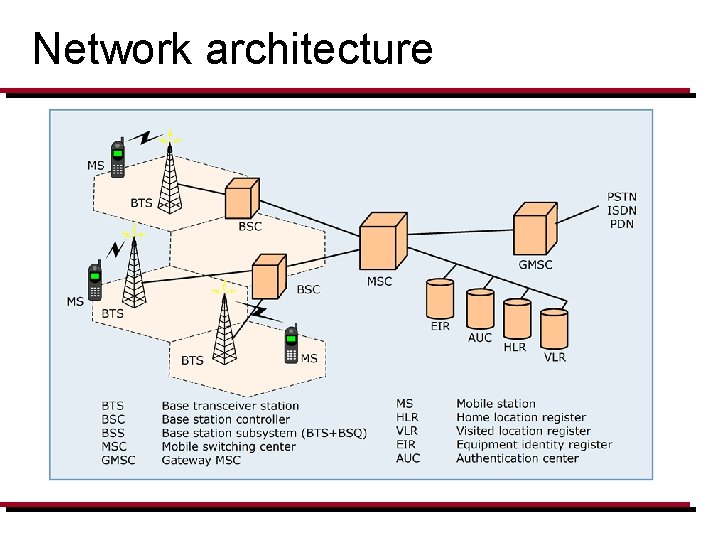
Network architecture
Network elements • Mobile Station § Mobile Equipment ¨Identified by the International Mobile Equipment Identity (IMEI) § Subscriber Identity Module (SIM) ¨Contains a unique identification number called IMSI ¨It is removable, thus irrespective of a specific terminal
Base Station Subsystens • Base Station Subsystem (BSS) § Base Transceiver Station (BTS) ¨ A BTS is comprised of radio transceivers, antennas, the interface to the PCM facility ¨ BTS is the entity that connects the mobiles to a cellular network § Base Station Controller (BSC) ¨ Its primary function is call maintenance, by deciding when to initiate a handover, changing the BTS transmitter power, etc. ¨ A BSC is connected to a group of BTSs and manages the radio resources for them
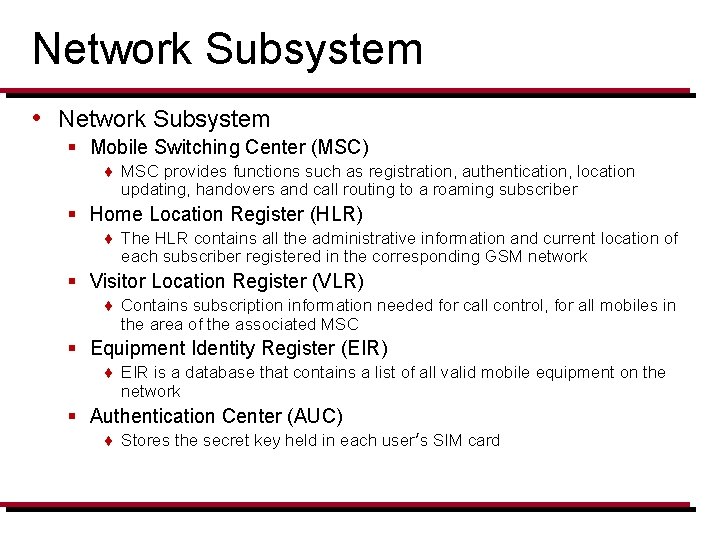
Network Subsystem • Network Subsystem § Mobile Switching Center (MSC) ¨ MSC provides functions such as registration, authentication, location updating, handovers and call routing to a roaming subscriber § Home Location Register (HLR) ¨ The HLR contains all the administrative information and current location of each subscriber registered in the corresponding GSM network § Visitor Location Register (VLR) ¨ Contains subscription information needed for call control, for all mobiles in the area of the associated MSC § Equipment Identity Register (EIR) ¨ EIR is a database that contains a list of all valid mobile equipment on the network § Authentication Center (AUC) ¨ Stores the secret key held in each user’s SIM card
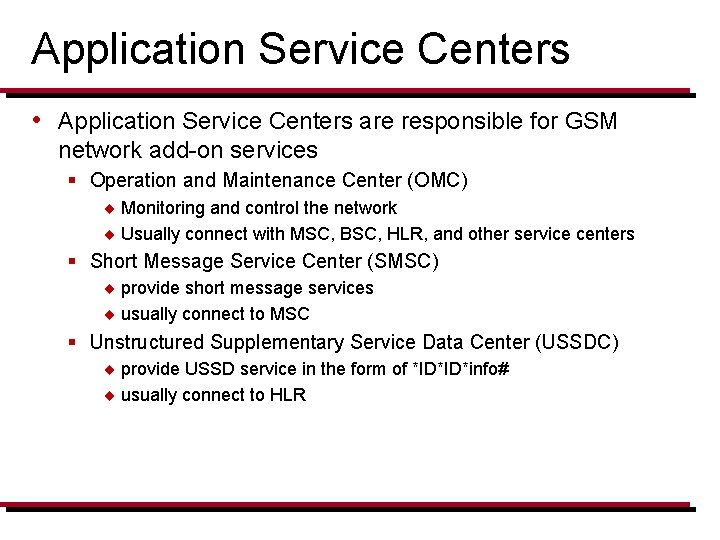
Application Service Centers • Application Service Centers are responsible for GSM network add-on services § Operation and Maintenance Center (OMC) ¨ Monitoring and control the network ¨ Usually connect with MSC, BSC, HLR, and other service centers § Short Message Service Center (SMSC) ¨ provide short message services ¨ usually connect to MSC § Unstructured Supplementary Service Data Center (USSDC) ¨ provide USSD service in the form of *ID*ID*info# ¨ usually connect to HLR
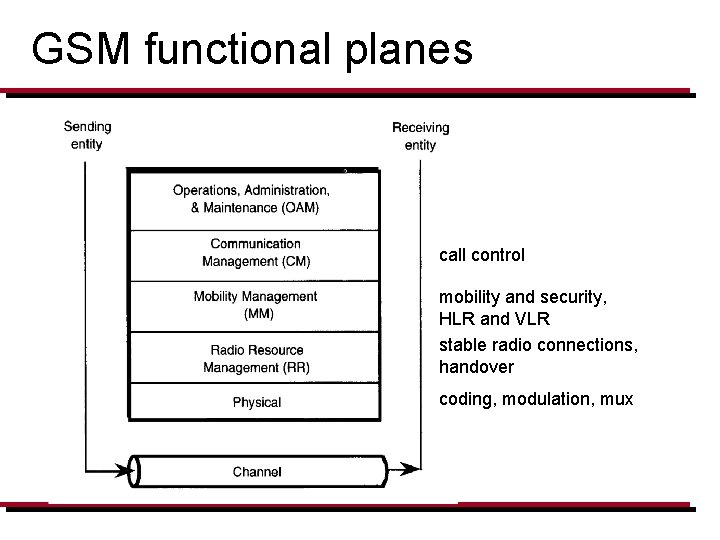
GSM functional planes call control mobility and security, HLR and VLR stable radio connections, handover coding, modulation, mux
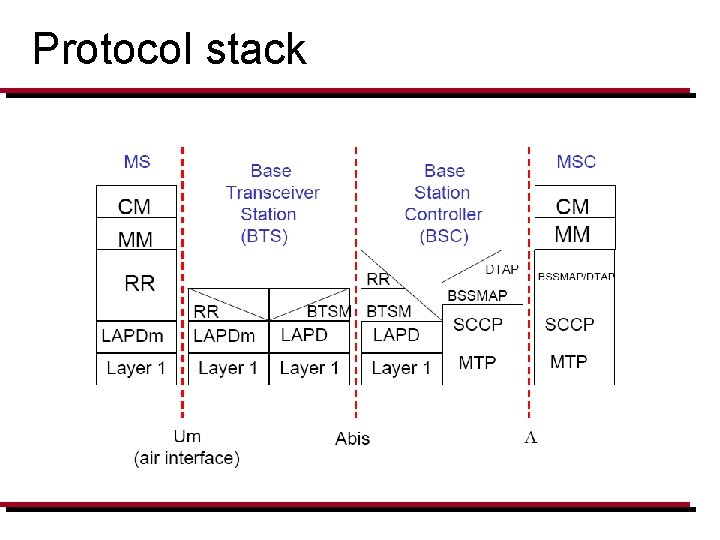
Protocol stack
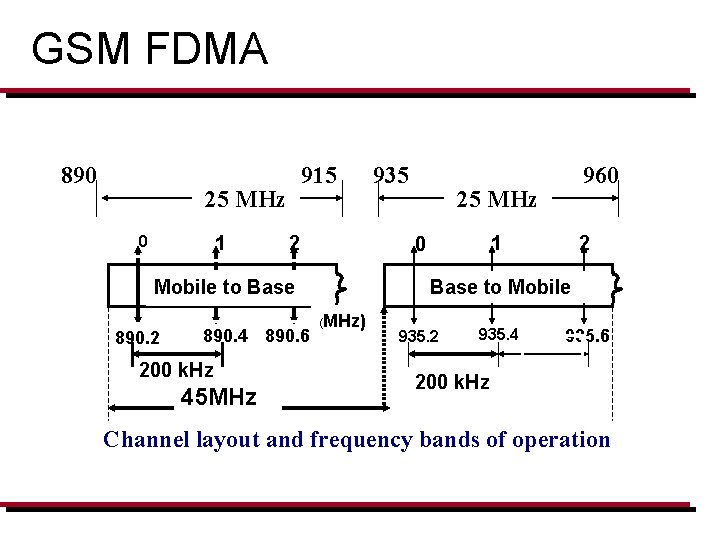
GSM FDMA 890 915 25 MHz 1 0 2 890. 4 890. 6 200 k. Hz 45 MHz 960 25 MHz 1 0 Mobile to Base 890. 2 935 2 Base to Mobile (MHz) 935. 2 935. 4 935. 6 200 k. Hz Channel layout and frequency bands of operation
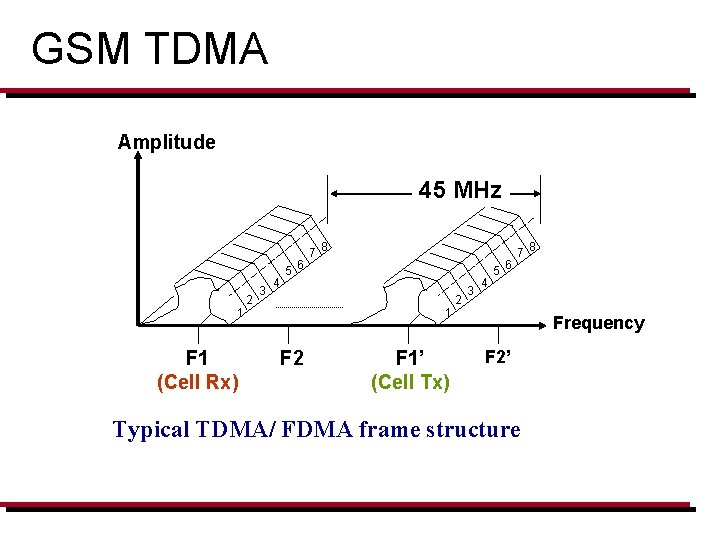
GSM TDMA Amplitude 45 MHz 1 F 1 (Cell Rx) 2 3 4 5 6 7 8 1 F 2 F 1’ (Cell Tx) 2 3 4 5 6 7 8 Frequency F 2’ Typical TDMA/ FDMA frame structure
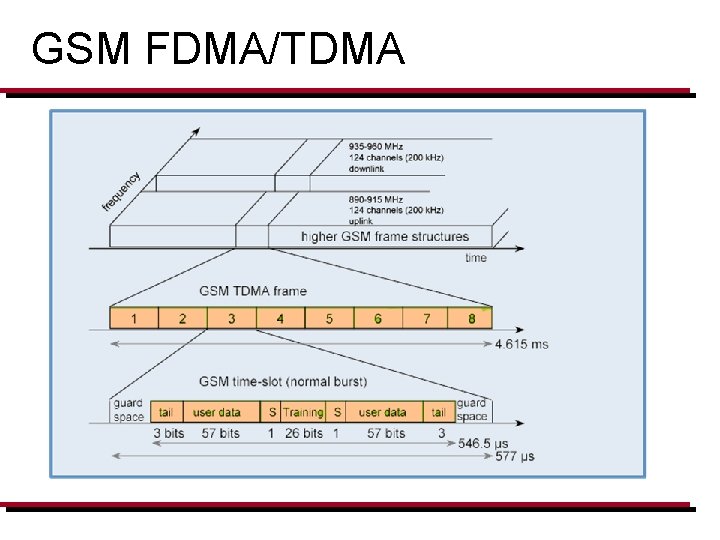
GSM FDMA/TDMA
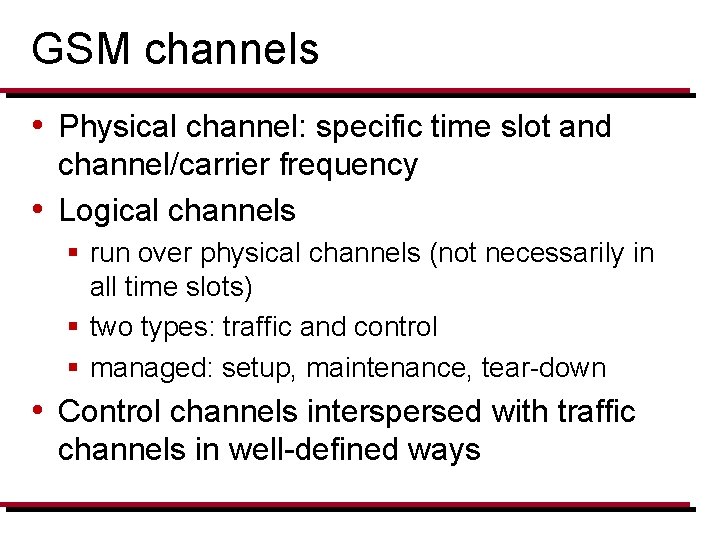
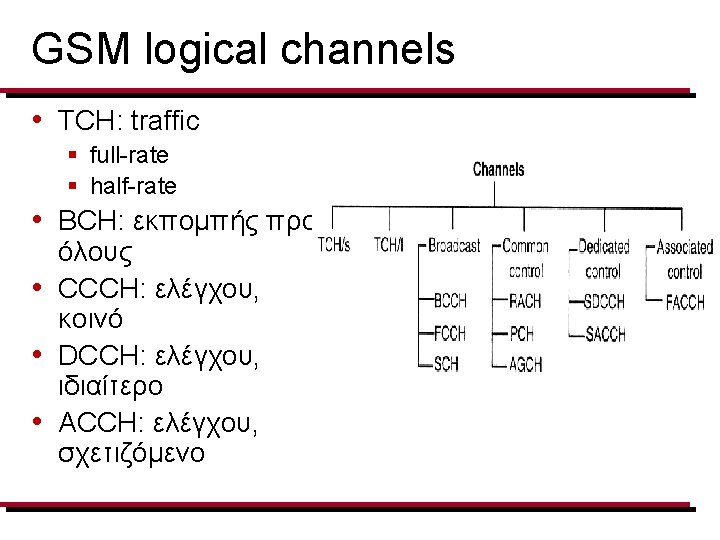
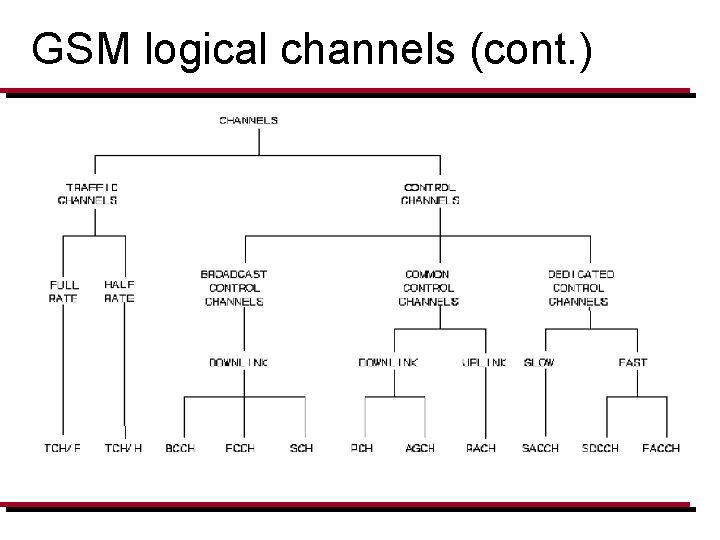
GSM channels • Physical channel: specific time slot and channel/carrier frequency • Logical channels § run over physical channels (not necessarily in all time slots) § two types: traffic and control § managed: setup, maintenance, tear-down • Control channels interspersed with traffic channels in well-defined ways
GSM logical channels (cont. )
Traffic channels • Full rate: 22. 8 kbps § speech data: 13 kbps voice data + FEC § packet data: 12, 6, 3. 6 kbps + FEC • Half rate: 11. 4 kbps • To achieve higher rates multiple logical channels have to be allocated (GPRS does this)
Control channels • Help MS locate control channels • Provide information about § § voice and control channel repetition cycle. parameters in the cell surrounding cells paging • Allow random access attempts by the MS
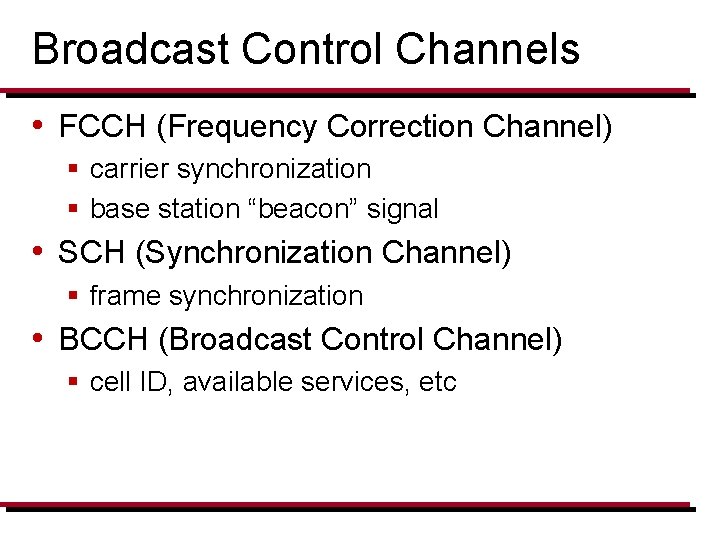
Broadcast Control Channels • FCCH (Frequency Correction Channel) § carrier synchronization § base station “beacon” signal • SCH (Synchronization Channel) § frame synchronization • BCCH (Broadcast Control Channel) § cell ID, available services, etc
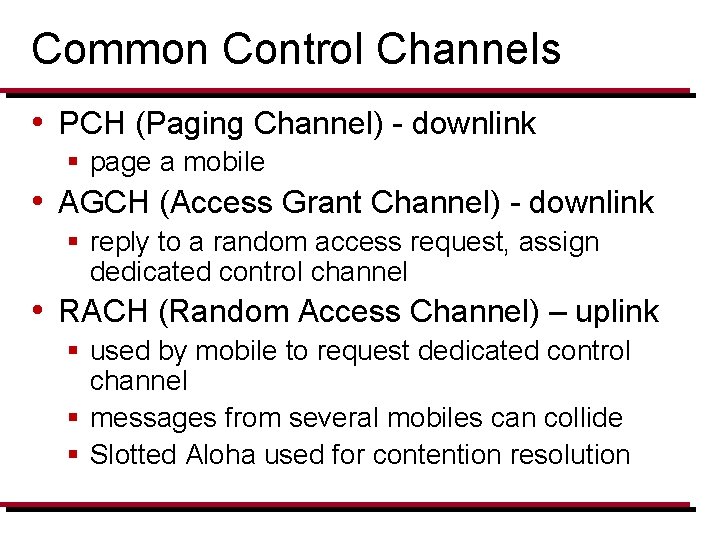
Common Control Channels • PCH (Paging Channel) - downlink § page a mobile • AGCH (Access Grant Channel) - downlink § reply to a random access request, assign dedicated control channel • RACH (Random Access Channel) – uplink § used by mobile to request dedicated control channel § messages from several mobiles can collide § Slotted Aloha used for contention resolution
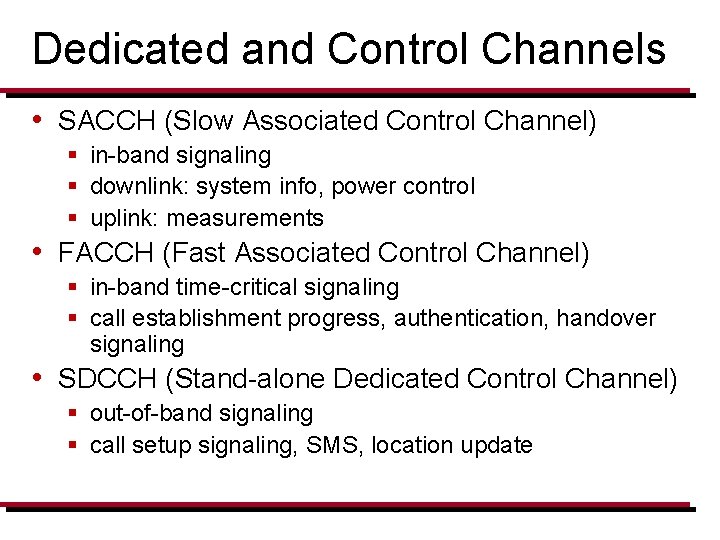
Dedicated and Control Channels • SACCH (Slow Associated Control Channel) § in-band signaling § downlink: system info, power control § uplink: measurements • FACCH (Fast Associated Control Channel) § in-band time-critical signaling § call establishment progress, authentication, handover signaling • SDCCH (Stand-alone Dedicated Control Channel) § out-of-band signaling § call setup signaling, SMS, location update
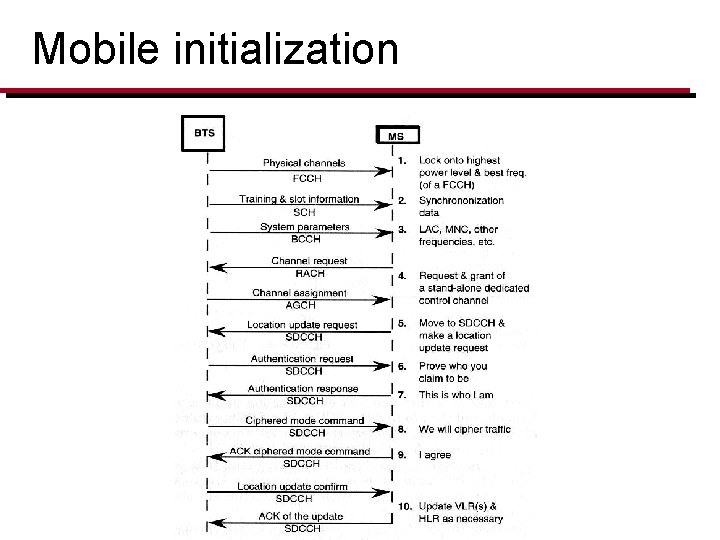
Mobile initialization
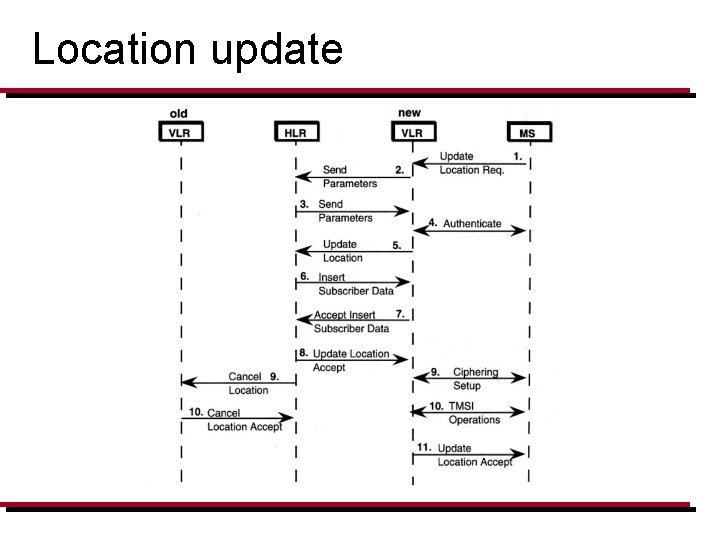
Location update
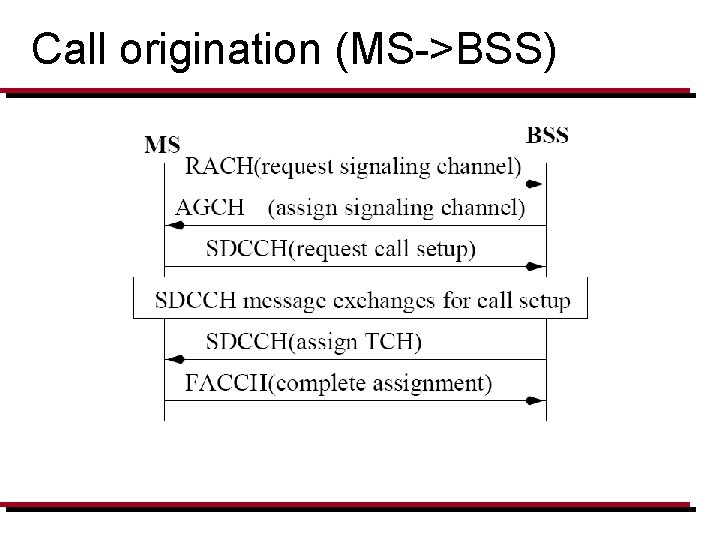
Call origination (MS->BSS)
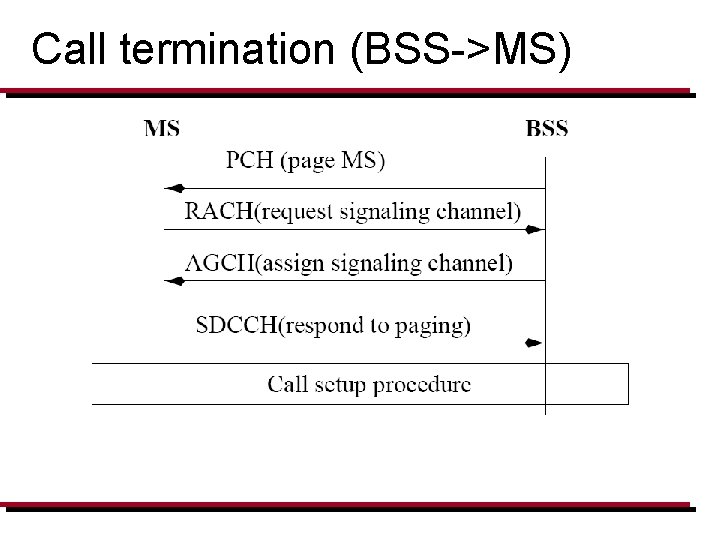
Call termination (BSS->MS)
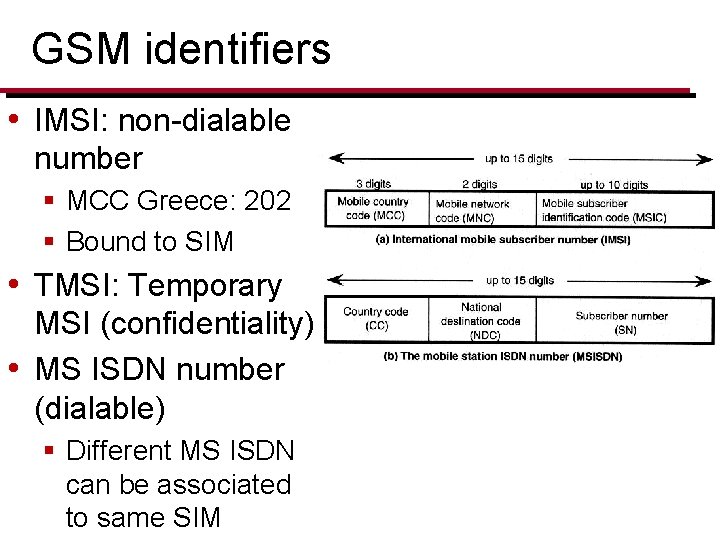
GSM identifiers • IMSI: non-dialable number § MCC Greece: 202 § Bound to SIM • TMSI: Temporary MSI (confidentiality) • MS ISDN number (dialable) § Different MS ISDN can be associated to same SIM
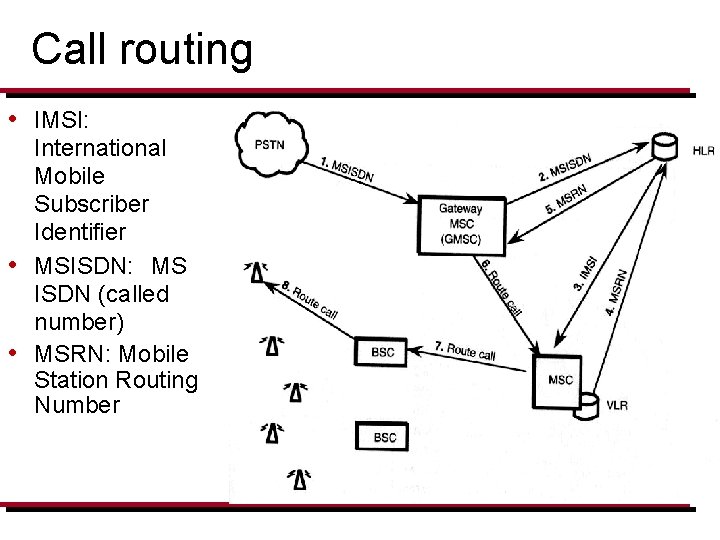
Call routing • IMSI: International Mobile Subscriber Identifier • MSISDN: MS ISDN (called number) • MSRN: Mobile Station Routing Number
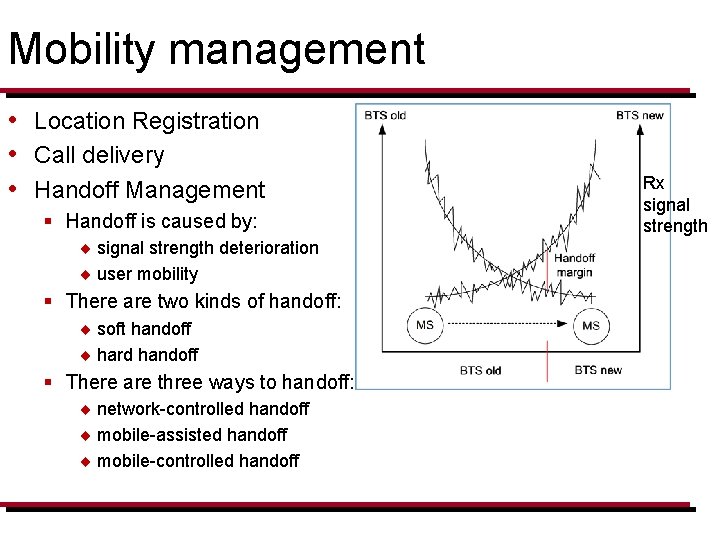
Mobility management • Location Registration • Call delivery • Handoff Management § Handoff is caused by: ¨ signal strength deterioration ¨ user mobility § There are two kinds of handoff: ¨ soft handoff ¨ hard handoff § There are three ways to handoff: ¨ network-controlled handoff ¨ mobile-assisted handoff ¨ mobile-controlled handoff Rx signal strength
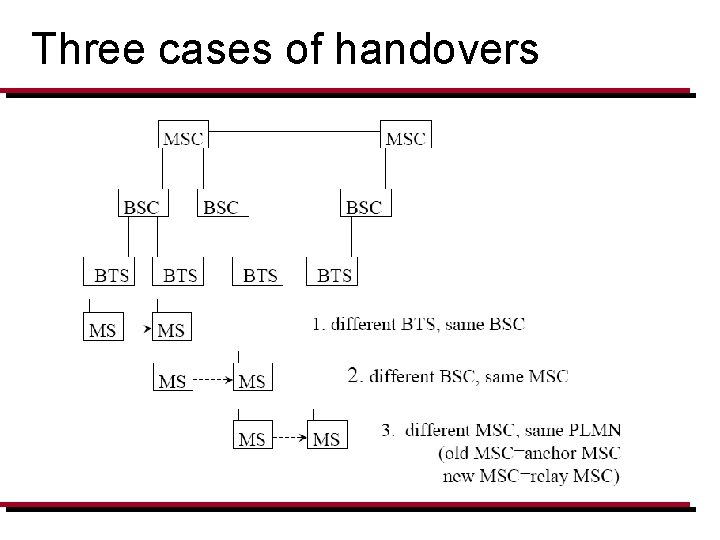
Three cases of handovers
Power control • Operator - dependent • Mobile: § Peak Tx power classes: GSM-900: 8, 5, 2, 0. 8 Watt (39, 37, 33, 29 d. Bm), GSM-1800: 1, 0. 25, 4 Watt (30, 24, 36 d. Bm) § minimum Tx power: GSM-900: 19 m. W, GSM-1800: 15 m. W § step: 2 d. Bm • Base station: § 8 classes: 320 -2. 5 Watt (55 -34 d. Bm) • Base station decides power control changes for both § Mobile measures signal strength, quality (BER) and reports to Base station § Goal: operate at lowest power level while maintaining acceptable signal quality
- Slides: 30