
GSM Architecture Network Components Switching SystemSS Base Station
GSM Architecture
Network Components • • Switching System(SS) Base Station System(BSS) 2
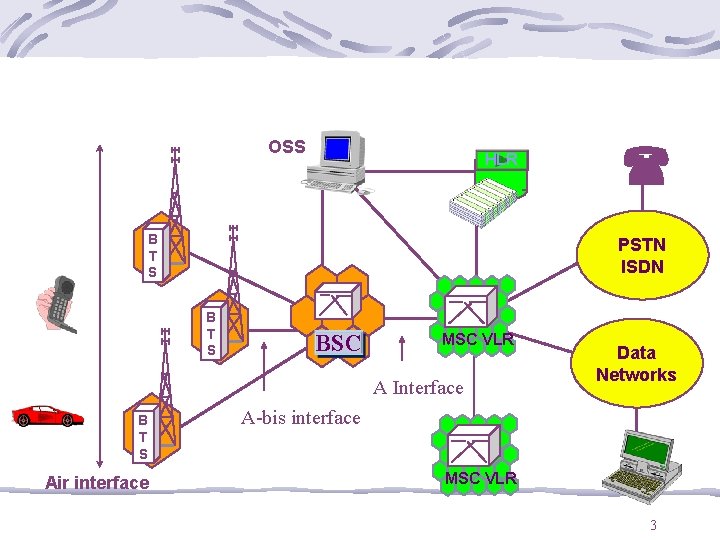
OSS HLR B T S PSTN ISDN B T S BSC MSC VLR A Interface B T S Air interface ( Data Networks A-bis interface MSC VLR 3
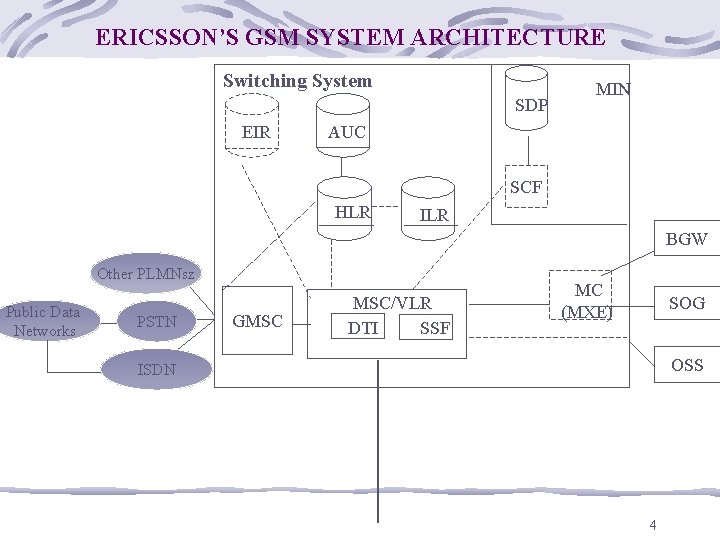
ERICSSON’S GSM SYSTEM ARCHITECTURE Switching System SDP EIR MIN AUC SCF HLR ILR BGW Other PLMNsz Public Data Networks PSTN GMSC MSC/VLR DTI SSF MC (MXE) SOG OSS ISDN 4
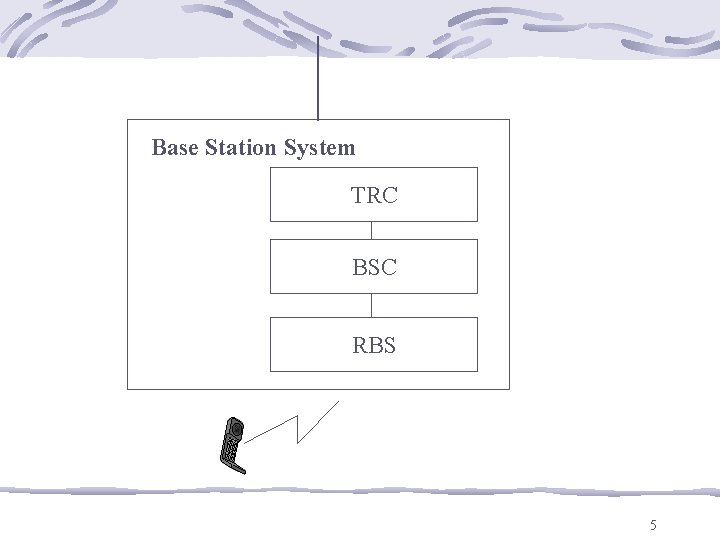
Base Station System TRC BSC RBS 5
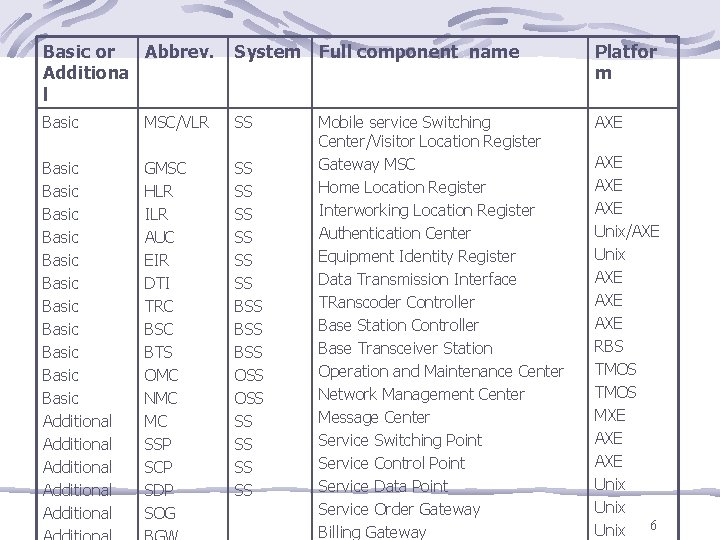
Basic or Abbrev. Additiona l System Full component name Platfor m Basic MSC/VLR SS AXE Basic Basic Basic Additional Additional GMSC HLR ILR AUC EIR DTI TRC BSC BTS OMC NMC MC SSP SCP SDP SOG SS SS SS BSS BSS OSS SS SS Mobile service Switching Center/Visitor Location Register Gateway MSC Home Location Register Interworking Location Register Authentication Center Equipment Identity Register Data Transmission Interface TRanscoder Controller Base Station Controller Base Transceiver Station Operation and Maintenance Center Network Management Center Message Center Service Switching Point Service Control Point Service Data Point Service Order Gateway Billing Gateway AXE AXE Unix/AXE Unix AXE AXE RBS TMOS MXE AXE Unix 6
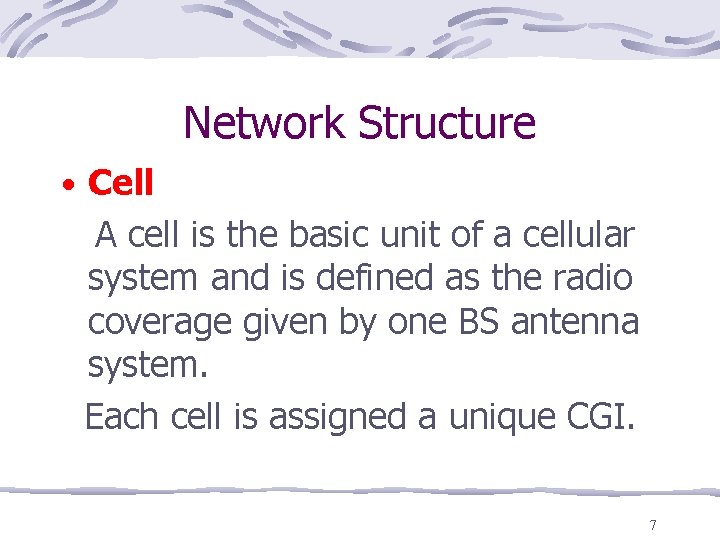
Network Structure • Cell A cell is the basic unit of a cellular system and is defined as the radio coverage given by one BS antenna system. Each cell is assigned a unique CGI. 7
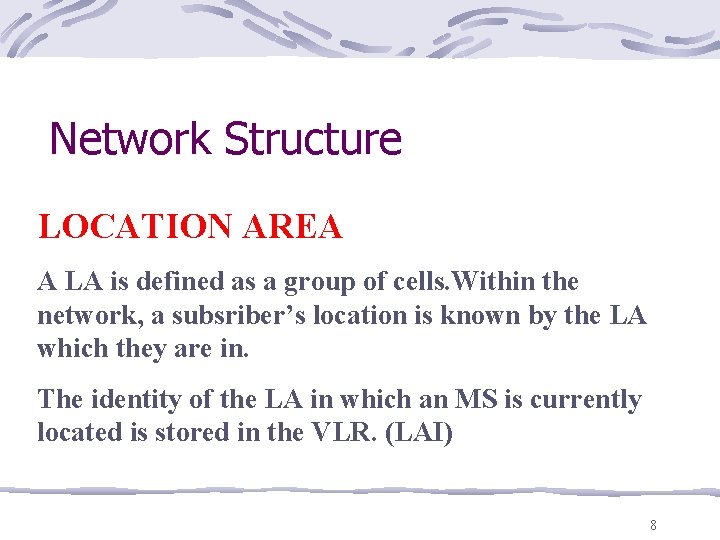
Network Structure LOCATION AREA A LA is defined as a group of cells. Within the network, a subsriber’s location is known by the LA which they are in. The identity of the LA in which an MS is currently located is stored in the VLR. (LAI) 8
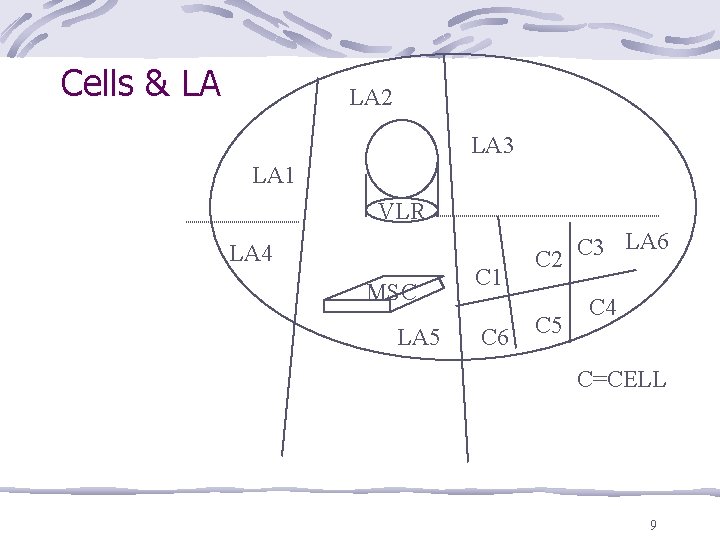
Cells & LA LA 2 LA 3 LA 1 VLR LA 4 MSC LA 5 C 1 C 6 LA 6 C 3 C 2 C 5 C 4 C=CELL 9
Network Structure • MSC Service Area An MSC Service Area is made up of LAs and represents the geographical part of the network controlled by one MSC. 10
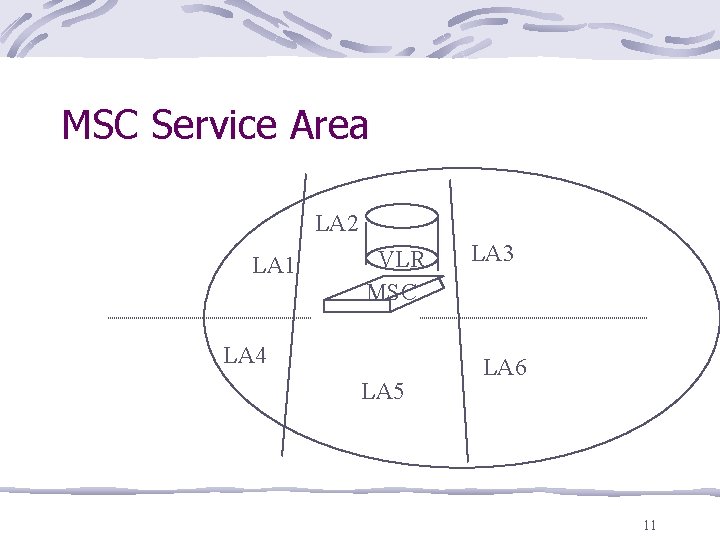
MSC Service Area LA 2 LA 1 VLR MSC LA 4 LA 5 LA 3 LA 6 11
Network Structure • PLMN SERVICE AREA A PLMN service area is the entire set of cells served by one network operator and is defined as the area in which an operator offers radio coverage and access to its network. 12
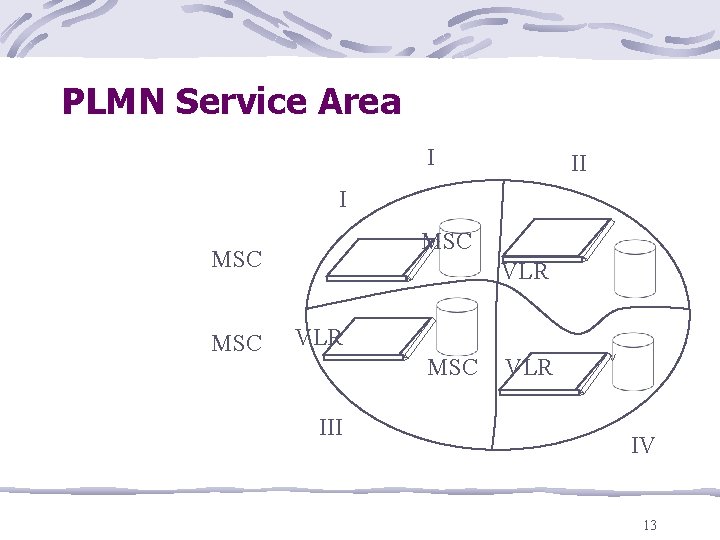
PLMN Service Area I II I MSC MSC VLR MSC III VLR V IV 13
Network Structure • GSM SERVICE AREA The GSM service area is the entire geographical area in which a subscriber can gain access to a GSM network. 14
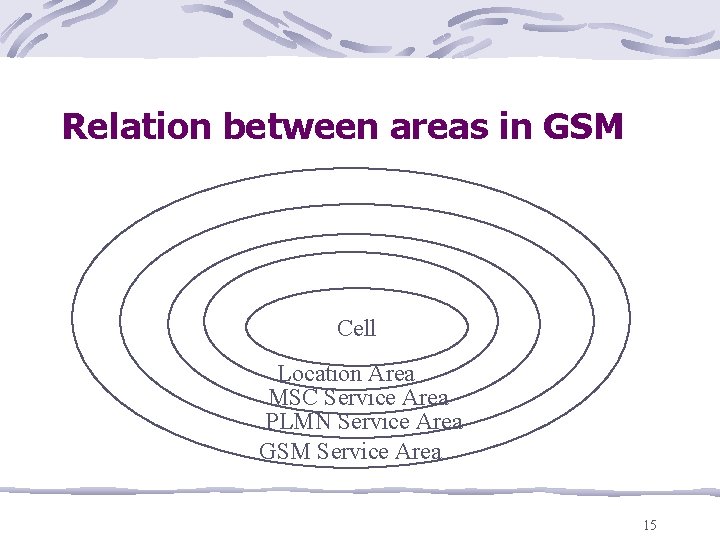
Relation between areas in GSM Location Cell. Area Location Area MSC Service Area PLMN Service Area GSM Service Area 15

Mobile Station GSM MSs consist of: • Mobile Equipment • Subscriber Identity Module 16
Functions of Mobile Station • Voice and data transmission& receipt • Frequency and time synchronization • Monitoring of power and signal quality of the surrounding cells • Provision of location updates even during inactive state 17
Mobile Station • Discontinuous Transmission(DTX) • Discontinuous reception(DRX) • MS identified by unique IMEI • STAR#06# 18
SIM Fixed data stored for the subscription: • IMSI, • Authentication Key, Ki • Security Algorithms: kc, A 3, A 8 • PIN&PUK 19
SIM • Temporary network data: Location area of subscriber and forbidden PLMNs • Service data: language preference, advice of charge 20
KEY TERMS An MS can have one of the following states : • Idle: the MS is ON but a call is not in progress. • Active: the MS is ON and a call is in progress. • Detached: the MS is OFF. 21
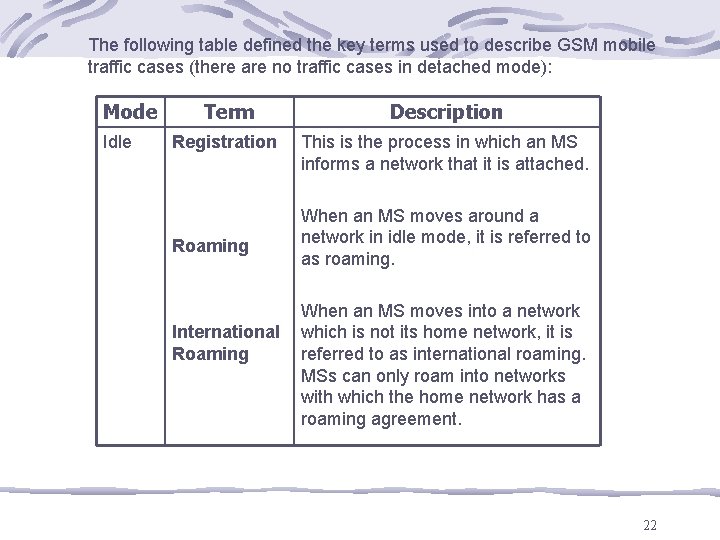
The following table defined the key terms used to describe GSM mobile traffic cases (there are no traffic cases in detached mode): Mode Idle Term Description Registration This is the process in which an MS informs a network that it is attached. Roaming International Roaming When an MS moves around a network in idle mode, it is referred to as roaming. When an MS moves into a network which is not its home network, it is referred to as international roaming. MSs can only roam into networks with which the home network has a roaming agreement. 22
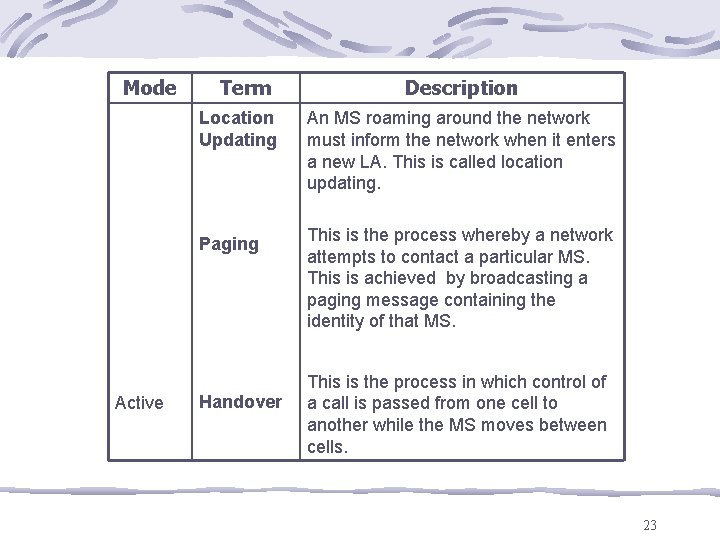
Mode Active Term Description Location Updating An MS roaming around the network must inform the network when it enters a new LA. This is called location updating. Paging This is the process whereby a network attempts to contact a particular MS. This is achieved by broadcasting a paging message containing the identity of that MS. Handover This is the process in which control of a call is passed from one cell to another while the MS moves between cells. 23
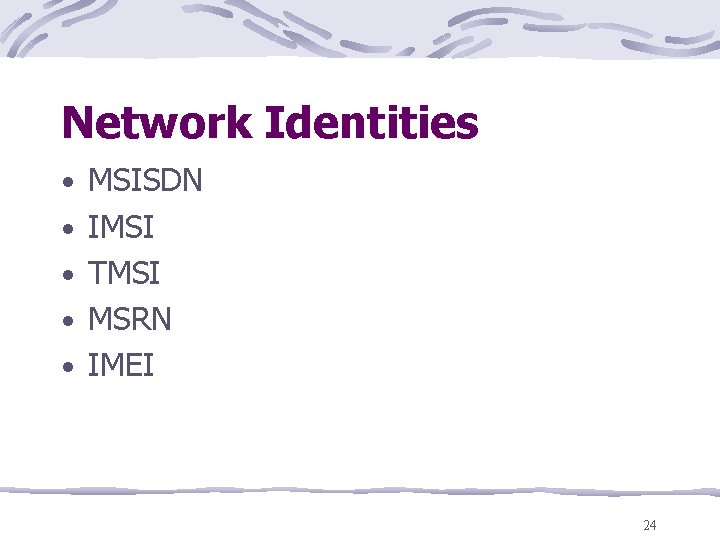
Network Identities • MSISDN • IMSI • TMSI • MSRN • IMEI 24
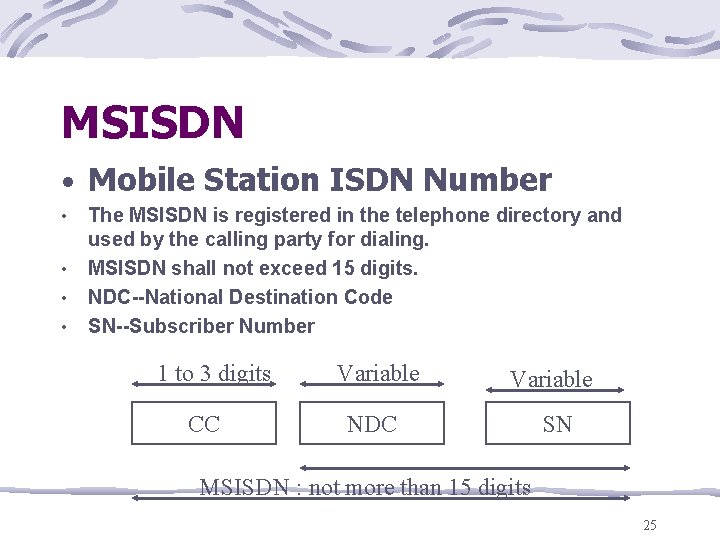
MSISDN • Mobile Station ISDN Number • • The MSISDN is registered in the telephone directory and used by the calling party for dialing. MSISDN shall not exceed 15 digits. NDC--National Destination Code SN--Subscriber Number 1 to 3 digits CC Variable NDC SN MSISDN : not more than 15 digits 25
IMSI • International mobile subscriber Identity • The IMSI is an unique identity which is used internationally and used within the network to identify the mobile subscribers. • The IMSI is stored in the subscriber identity module (SIM), the HLR, VLR database. 26
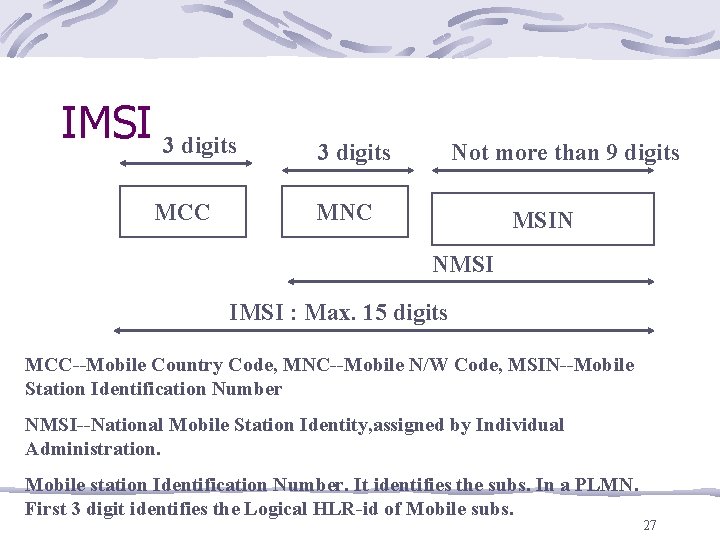
IMSI 3 digits MCC 3 digits Not more than 9 digits MNC MSIN NMSI IMSI : Max. 15 digits MCC--Mobile Country Code, MNC--Mobile N/W Code, MSIN--Mobile Station Identification Number NMSI--National Mobile Station Identity, assigned by Individual Administration. Mobile station Identification Number. It identifies the subs. In a PLMN. First 3 digit identifies the Logical HLR-id of Mobile subs. 27
Temporary Mobile subscriber Identity • TMSI is a temporary IMSI no. made known to • • • an MS at registration. The VLR assigns a TMSI to each mobile subscribers entering the VLR area. Assigned only after successful authentication. TMSI has only local significance i. e. within VLR area & controlled by the VLR. TMSI changes on location updation. TMSI is less than 8 digit. 28
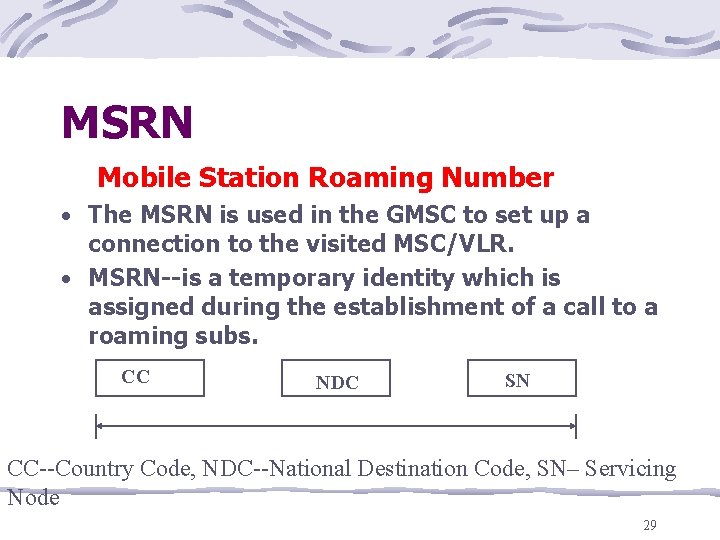
MSRN Mobile Station Roaming Number • The MSRN is used in the GMSC to set up a connection to the visited MSC/VLR. • MSRN--is a temporary identity which is assigned during the establishment of a call to a roaming subs. CC NDC SN CC--Country Code, NDC--National Destination Code, SN– Servicing Node 29
IMEI • International Mobile Equipment Identity • The IMEI is an unique code allocated to each mobile equipment. It is checked in the EIR. • IMEI check List · White List · Grey List · Black List 30
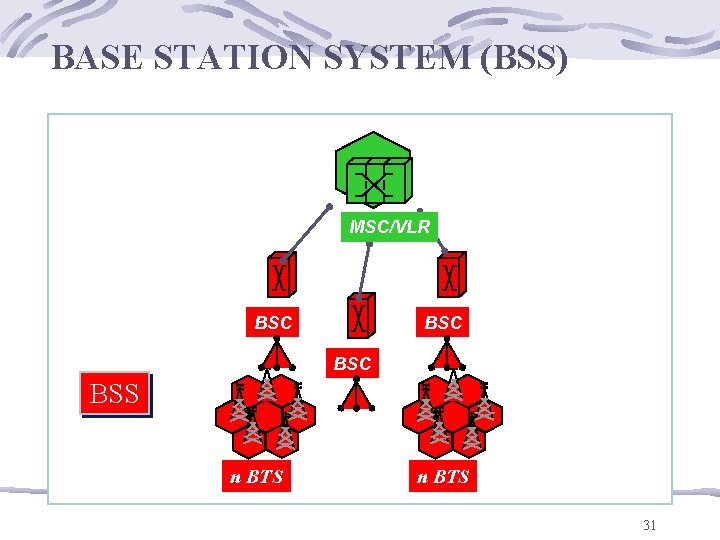
BASE STATION SYSTEM (BSS) MSC/VLR BSC BSC BSS n BTS 31
FUNCTIONS OF BTS • Radio resources • Signal Processing • Signaling link management • Synchronization • Local maintenance handling • Functional supervision and Testing 32
FUNCTIONS OF BSC • Radio Network management • RBS Management • TRC Handling • Tx. Network Management • Internal BSC O&M • Handling of MS connections 33
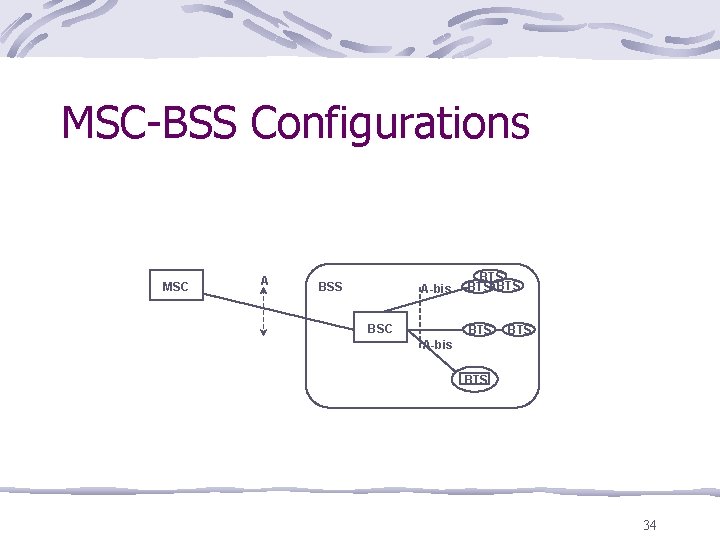
MSC-BSS Configurations MSC A BSS A-bis BSC BTS BTS BTS A-bis BTS 34
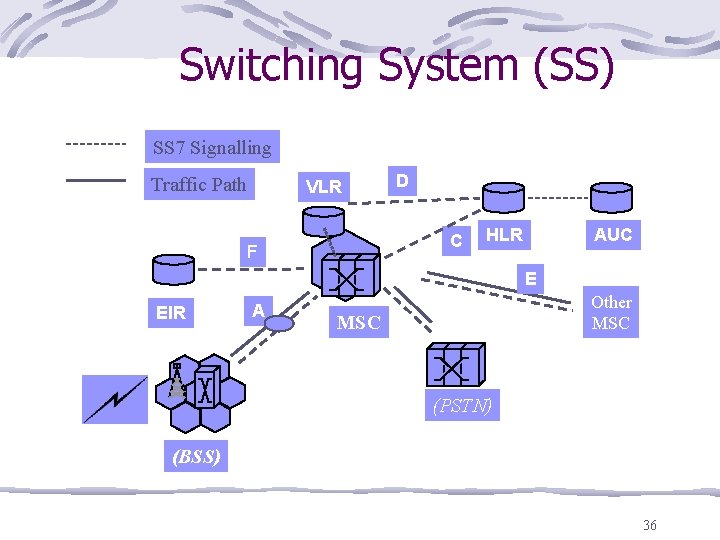
Switching System (SS) SS 7 Signalling Traffic Path VLR D C F HLR AUC E EIR A Other MSC (PSTN) (BSS) 36
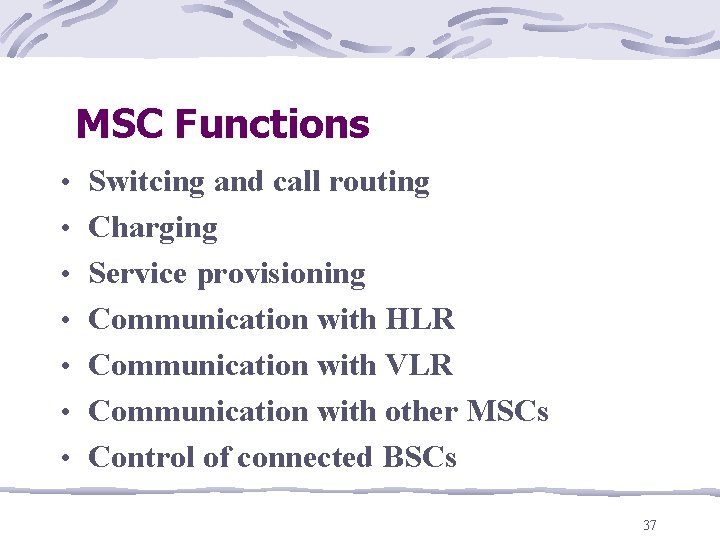
MSC Functions • Switcing and call routing • Charging • Service provisioning • Communication with HLR • Communication with VLR • Communication with other MSCs • Control of connected BSCs 37
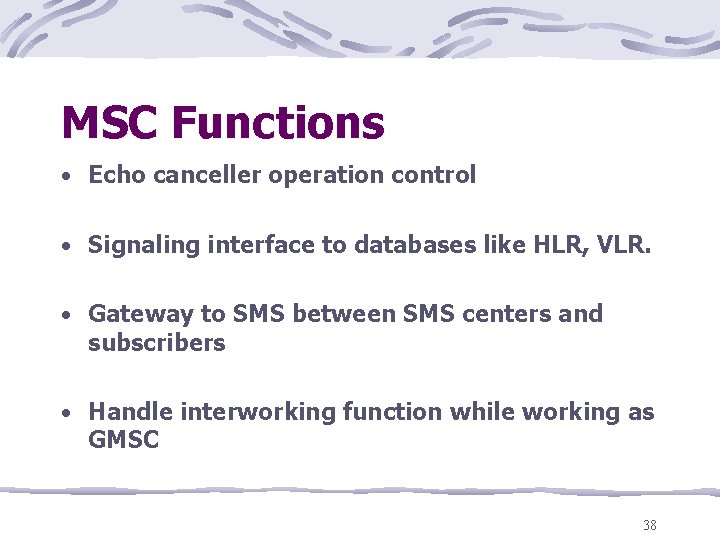
MSC Functions • Echo canceller operation control • Signaling interface to databases like HLR, VLR. • Gateway to SMS between SMS centers and subscribers • Handle interworking function while working as GMSC 38
VISITOR LOCATION REGISTER (VLR) • It controls those mobiles roaming in its area. • VLR reduces the number of queries to HLR • One VLR may be incharge of one or more LA. • VLR is updated by HLR on entry of MS its area. • VLR assigns TMSI which keeps on changing. • IMSI detach and attach operation 39
Data in VLR • IMSI & TMSI • MSISDN • MSRN. • Location Area • Supplementary service parameters • MS category • Authentication Key 40
Home Location Register(HLR) • Reference store for subscriber’s parameters, numbers, authentication & Encryption values. • Current subscriber status and associated VLR. • Both VLR and HLR can be implemented in the same equipment in an MSC. • one PLMN may contain one or several HLR. 41
Home Location Register(HLR) • Permanent data in HLR • Data stored is changed only by commands. • IMSI, MS-ISDN number. • Category of MS ( whether pay phone or not ) • Roaming restriction ( allowed or not ). • Supplementary services like call forwarding 42
Home Location Register(HLR) • Temporary data in HLR • The data changes from call to call & is dynamic • MSRN • RAND /SRES and Kc • VLR address , MSC address. • Messages waiting data used for SMS 43
EQUIPMENT IDENTITY REGISTER ( EIR ) • This data base stores IMEI for all registered mobile equipments and is unique to every ME. • Only one EIR per PLMN. • White list : IMEI, assigned to valid ME. • Black list : IMEI reported stolen • Gray list : IMEI having problems like faulty software, wrong make of equipment etc. 44
AUthentication Center (AUC) To authenticate the subs. attempting to use a network. AUC is connected to HLR which provides it with authentication parameters and ciphering keys used to ensure network security. 45
AUC Functions To perform subscriber authentication and to establish ciphering procedures on the radio link between the network and MS. 46
AUC Functions Information provided is called a TRIPLET consists of: 1. RAND(non predictable random number) 2. SRES(Signed response) 3. Kc(ciphering key) 47
Operations and Maintenance Centre OMC The centralized operation of the various units in the system and functions needed to maintain the subsystems. Dynamic monitoring and controlling of the network 48
Functions Of OMC -O&M data function -Configuration management --Fault report and alarm handling -Performance supervision/management -Storage of system software and data 49
- Slides: 48