
GSICS A WIGOS Component Mitch Goldberg GSICS EP
GSICS A WIGOS Component Mitch Goldberg, GSICS EP Chair Kenneth Holmlund (GSICS EP Vice-Chair) Toshiyuki Kurino (GSICS Secretariat) INTER-COMMISSION COORDINATION GROUP ON WIGOS Task Team on WIGOS Data Quality Monitoring System (TT-WDQMS) Third Session GENEVA, 4 -6 DECEMBER 2018
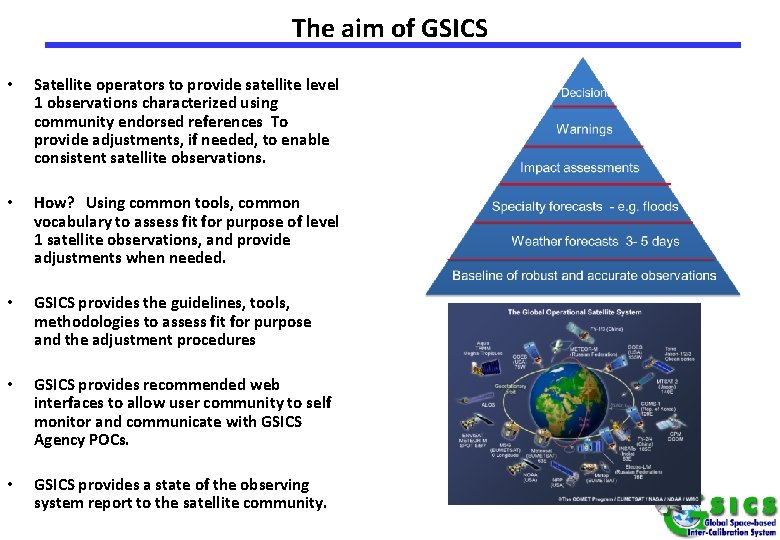
The aim of GSICS • Satellite operators to provide satellite level 1 observations characterized using community endorsed references To provide adjustments, if needed, to enable consistent satellite observations. • How? Using common tools, common vocabulary to assess fit for purpose of level 1 satellite observations, and provide adjustments when needed. • GSICS provides the guidelines, tools, methodologies to assess fit for purpose and the adjustment procedures • GSICS provides recommended web interfaces to allow user community to self monitor and communicate with GSICS Agency POCs. • GSICS provides a state of the observing system report to the satellite community.
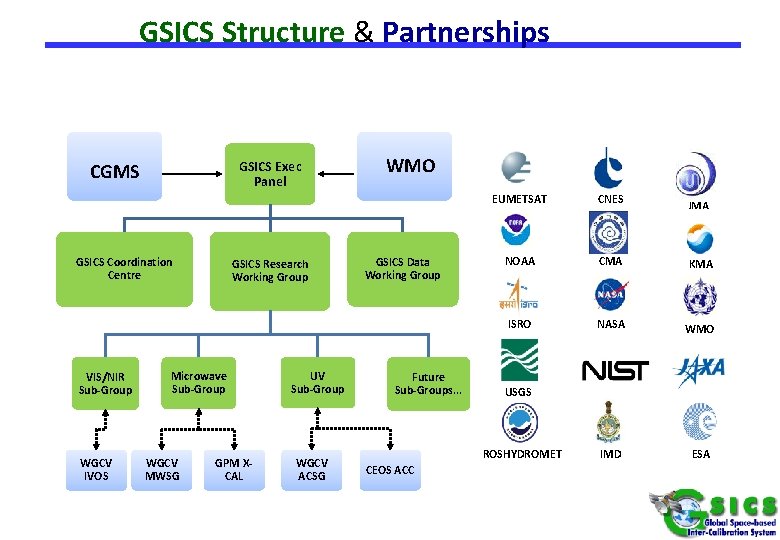
GSICS Structure & Partnerships GSICS Exec Panel CGMS GSICS Coordination Centre VIS/NIR Sub-Group WGCV IVOS GSICS Research Working Group Microwave Sub-Group WGCV MWSG GPM XCAL UV Sub-Group WGCV ACSG WMO GSICS Data Working Group Future Sub-Groups. . . EUMETSAT CNES NOAA CMA KMA ISRO NASA WMO USGS NIST JAXA IMD ESA ROSHYDROMET CEOS ACC JMA
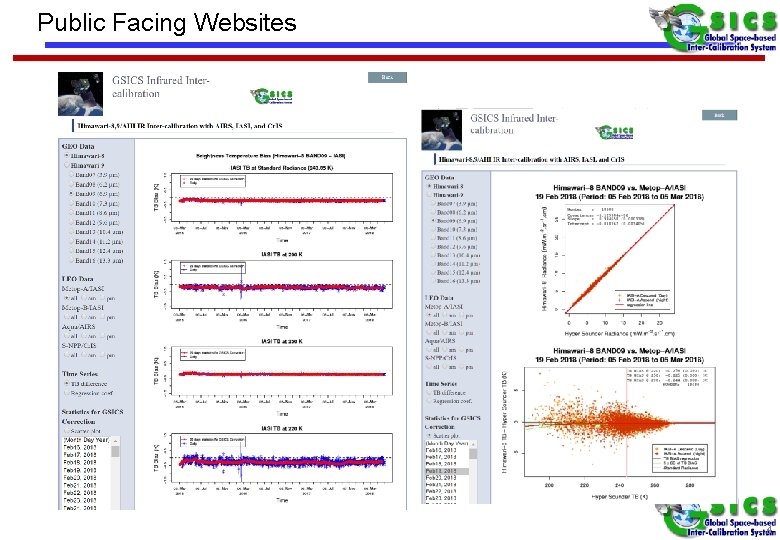
Public Facing Websites 4
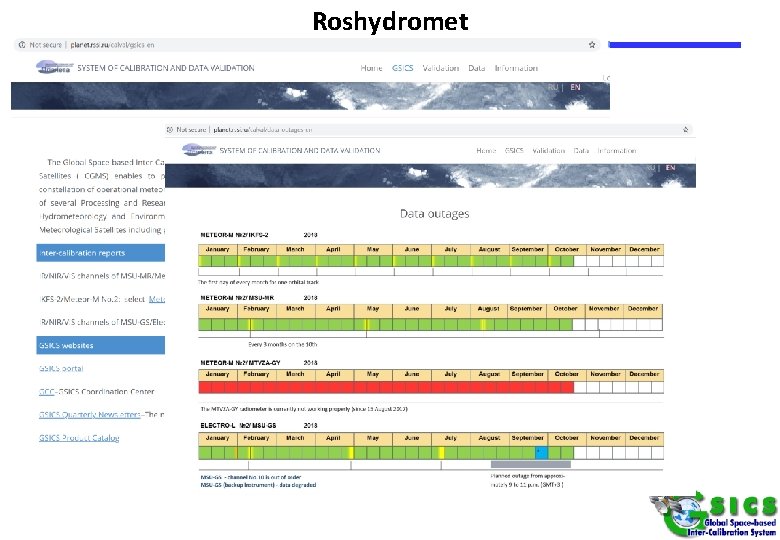
Roshydromet
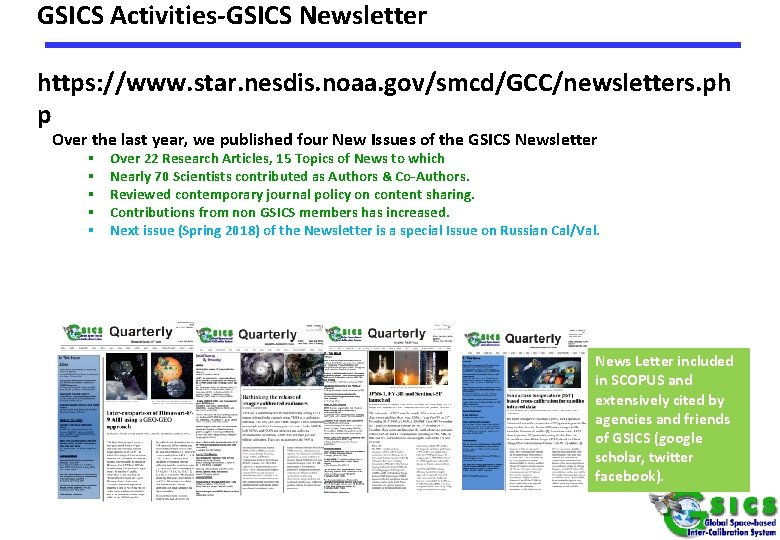
GSICS Activities-GSICS Newsletter https: //www. star. nesdis. noaa. gov/smcd/GCC/newsletters. ph p Over the last year, we published four New Issues of the GSICS Newsletter § § § Over 22 Research Articles, 15 Topics of News to which Nearly 70 Scientists contributed as Authors & Co-Authors. Reviewed contemporary journal policy on content sharing. Contributions from non GSICS members has increased. Next issue (Spring 2018) of the Newsletter is a special Issue on Russian Cal/Val. News Letter included in SCOPUS and extensively cited by agencies and friends of GSICS (google scholar, twitter facebook).
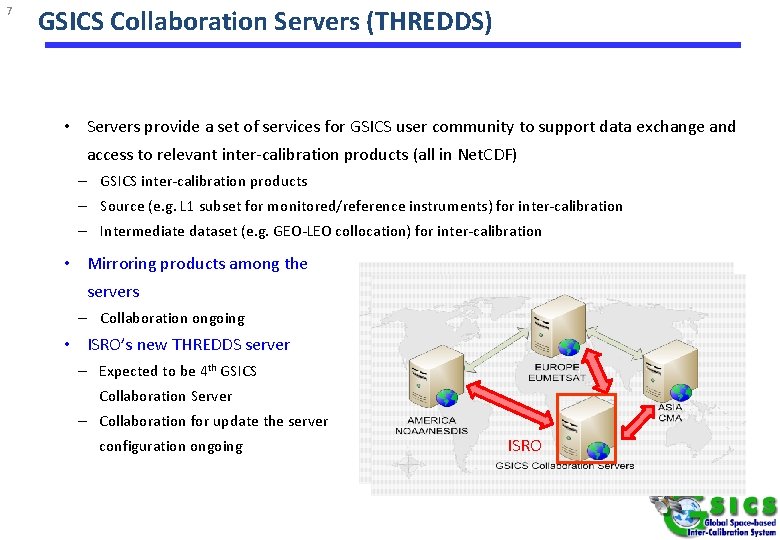
7 GSICS Collaboration Servers (THREDDS) • Servers provide a set of services for GSICS user community to support data exchange and access to relevant inter-calibration products (all in Net. CDF) – GSICS inter-calibration products – Source (e. g. L 1 subset for monitored/reference instruments) for inter-calibration – Intermediate dataset (e. g. GEO-LEO collocation) for inter-calibration • Mirroring products among the servers – Collaboration ongoing • ISRO’s new THREDDS server – Expected to be 4 th GSICS Collaboration Server – Collaboration for update the server configuration ongoing ISRO
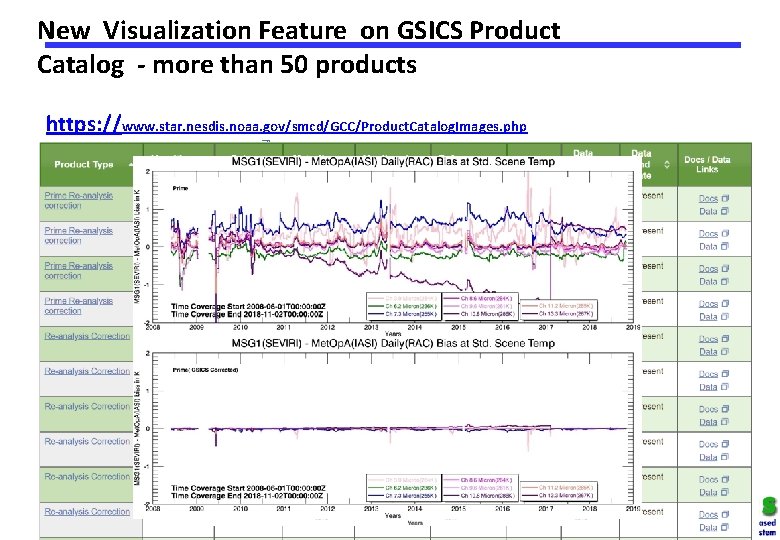
New Visualization Feature on GSICS Product Catalog - more than 50 products https: //www. star. nesdis. noaa. gov/smcd/GCC/Product. Catalog. Images. php
GSICS Annual State of the Observing System Annual assessment of observing system performance with respect to reference instruments using a common template 9
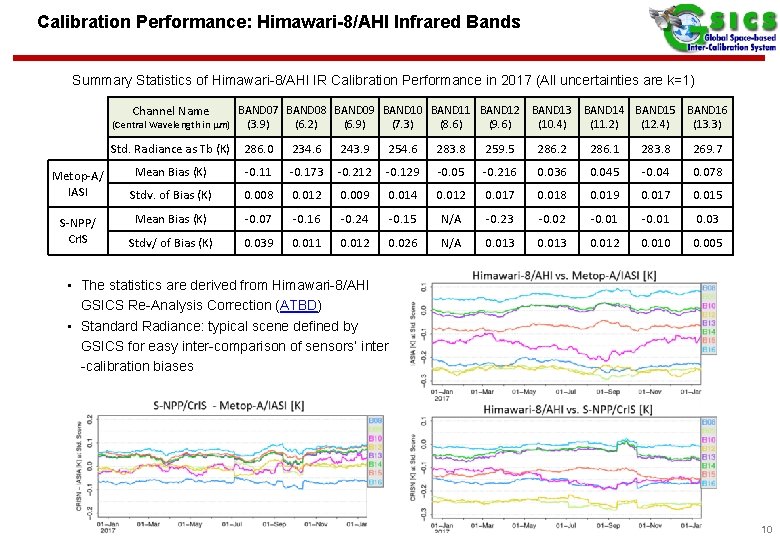
Calibration Performance: Himawari-8/AHI Infrared Bands Summary Statistics of Himawari-8/AHI IR Calibration Performance in 2017 (All uncertainties are k=1) BAND 07 BAND 08 BAND 09 BAND 10 BAND 11 BAND 12 BAND 13 BAND 14 BAND 15 BAND 16 (3. 9) (6. 2) (6. 9) (7. 3) (8. 6) (9. 6) (10. 4) (11. 2) (12. 4) (13. 3) (Central Wavelength in m) Channel Name Metop-A/ IASI S-NPP/ Cr. IS Std. Radiance as Tb (K) 286. 0 234. 6 243. 9 254. 6 283. 8 259. 5 286. 2 286. 1 283. 8 269. 7 Mean Bias (K) -0. 11 -0. 173 -0. 212 -0. 129 -0. 05 -0. 216 0. 036 0. 045 -0. 04 0. 078 Stdv. of Bias (K) 0. 008 0. 012 0. 009 0. 014 0. 012 0. 017 0. 018 0. 019 0. 017 0. 015 Mean Bias (K) -0. 07 -0. 16 -0. 24 -0. 15 N/A -0. 23 -0. 02 -0. 01 0. 03 Stdv/ of Bias (K) 0. 039 0. 011 0. 012 0. 026 N/A 0. 013 0. 012 0. 010 0. 005 • The statistics are derived from Himawari-8/AHI GSICS Re-Analysis Correction (ATBD) • Standard Radiance: typical scene defined by GSICS for easy inter-comparison of sensors’ inter -calibration biases 10
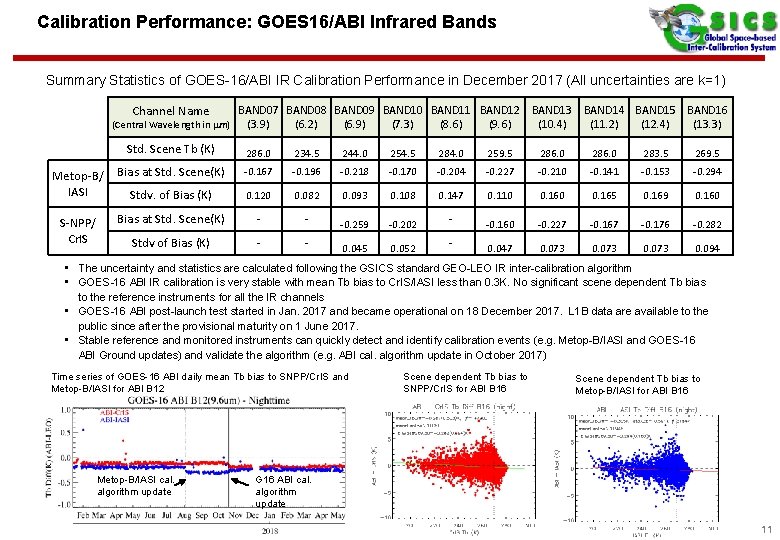
Calibration Performance: GOES 16/ABI Infrared Bands Summary Statistics of GOES-16/ABI IR Calibration Performance in December 2017 (All uncertainties are k=1) BAND 07 BAND 08 BAND 09 BAND 10 BAND 11 BAND 12 BAND 13 BAND 14 BAND 15 BAND 16 (3. 9) (6. 2) (6. 9) (7. 3) (8. 6) (9. 6) (10. 4) (11. 2) (12. 4) (13. 3) (Central Wavelength in m) Channel Name Std. Scene Tb (K) 286. 0 234. 5 244. 0 254. 5 284. 0 259. 5 286. 0 283. 5 269. 5 Metop-B/ IASI Bias at Std. Scene(K) -0. 167 -0. 196 -0. 218 -0. 170 -0. 204 -0. 227 -0. 210 -0. 141 -0. 153 -0. 294 Stdv. of Bias (K) 0. 120 0. 082 0. 093 0. 108 0. 147 0. 110 0. 165 0. 169 0. 160 S-NPP/ Cr. IS Bias at Std. Scene(K) - - -0. 259 -0. 202 - -0. 160 -0. 227 -0. 167 -0. 176 -0. 282 Stdv of Bias (K) - - 0. 045 0. 052 - 0. 047 0. 073 0. 094 • The uncertainty and statistics are calculated following the GSICS standard GEO-LEO IR inter-calibration algorithm • GOES-16 ABI IR calibration is very stable with mean Tb bias to Cr. IS/IASI less than 0. 3 K. No significant scene dependent Tb bias to the reference instruments for all the IR channels • GOES-16 ABI post-launch test started in Jan. 2017 and became operational on 18 December 2017. L 1 B data are available to the public since after the provisional maturity on 1 June 2017. • Stable reference and monitored instruments can quickly detect and identify calibration events (e. g. Metop-B/IASI and GOES-16 ABI Ground updates) and validate the algorithm (e. g. ABI cal. algorithm update in October 2017) Time series of GOES-16 ABI daily mean Tb bias to SNPP/Cr. IS and Metop-B/IASI for ABI B 12 Metop-B/IASI cal. algorithm update Scene dependent Tb bias to SNPP/Cr. IS for ABI B 16 Scene dependent Tb bias to Metop-B/IASI for ABI B 16 G 16 ABI cal. algorithm update 11
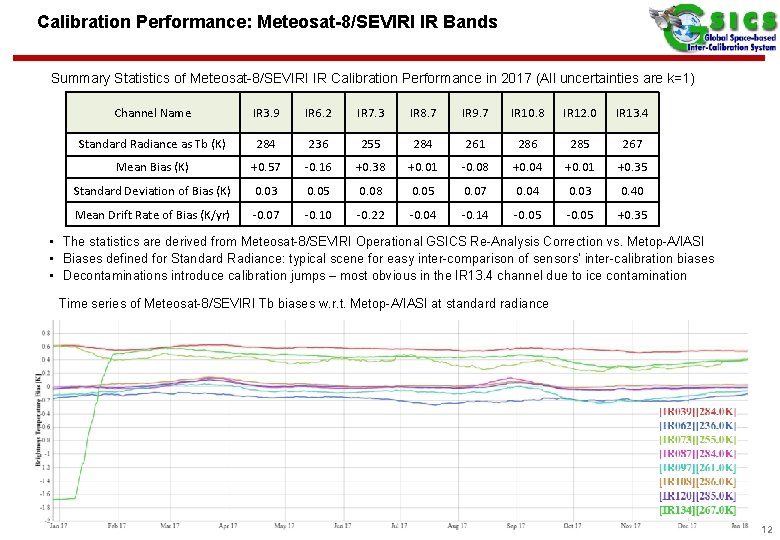
Calibration Performance: Meteosat-8/SEVIRI IR Bands Summary Statistics of Meteosat-8/SEVIRI IR Calibration Performance in 2017 (All uncertainties are k=1) Channel Name IR 3. 9 IR 6. 2 IR 7. 3 IR 8. 7 IR 9. 7 IR 10. 8 IR 12. 0 IR 13. 4 Standard Radiance as Tb (K) 284 236 255 284 261 286 285 267 Mean Bias (K) +0. 57 -0. 16 +0. 38 +0. 01 -0. 08 +0. 04 +0. 01 +0. 35 Standard Deviation of Bias (K) 0. 03 0. 05 0. 08 0. 05 0. 07 0. 04 0. 03 0. 40 Mean Drift Rate of Bias (K/yr) -0. 07 -0. 10 -0. 22 -0. 04 -0. 14 -0. 05 +0. 35 • The statistics are derived from Meteosat-8/SEVIRI Operational GSICS Re-Analysis Correction vs. Metop-A/IASI • Biases defined for Standard Radiance: typical scene for easy inter-comparison of sensors’ inter-calibration biases • Decontaminations introduce calibration jumps – most obvious in the IR 13. 4 channel due to ice contamination Time series of Meteosat-8/SEVIRI Tb biases w. r. t. Metop-A/IASI at standard radiance 12
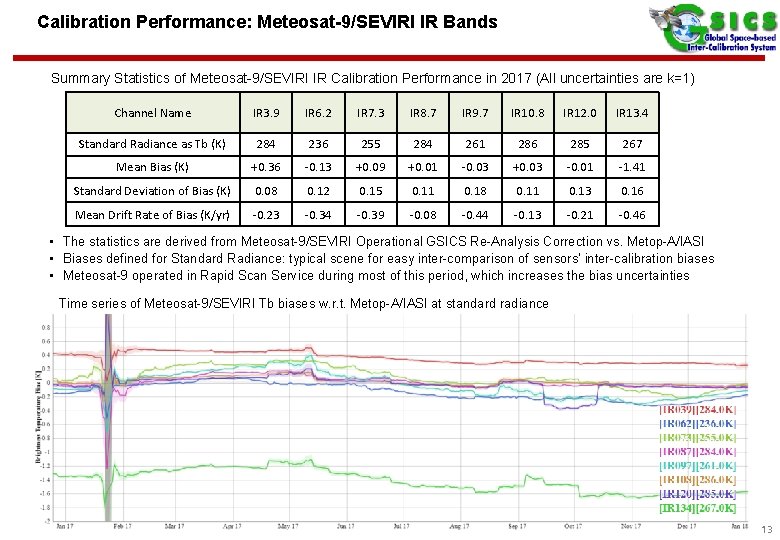
Calibration Performance: Meteosat-9/SEVIRI IR Bands Summary Statistics of Meteosat-9/SEVIRI IR Calibration Performance in 2017 (All uncertainties are k=1) Channel Name IR 3. 9 IR 6. 2 IR 7. 3 IR 8. 7 IR 9. 7 IR 10. 8 IR 12. 0 IR 13. 4 Standard Radiance as Tb (K) 284 236 255 284 261 286 285 267 Mean Bias (K) +0. 36 -0. 13 +0. 09 +0. 01 -0. 03 +0. 03 -0. 01 -1. 41 Standard Deviation of Bias (K) 0. 08 0. 12 0. 15 0. 11 0. 18 0. 11 0. 13 0. 16 Mean Drift Rate of Bias (K/yr) -0. 23 -0. 34 -0. 39 -0. 08 -0. 44 -0. 13 -0. 21 -0. 46 • The statistics are derived from Meteosat-9/SEVIRI Operational GSICS Re-Analysis Correction vs. Metop-A/IASI • Biases defined for Standard Radiance: typical scene for easy inter-comparison of sensors’ inter-calibration biases • Meteosat-9 operated in Rapid Scan Service during most of this period, which increases the bias uncertainties Time series of Meteosat-9/SEVIRI Tb biases w. r. t. Metop-A/IASI at standard radiance 13
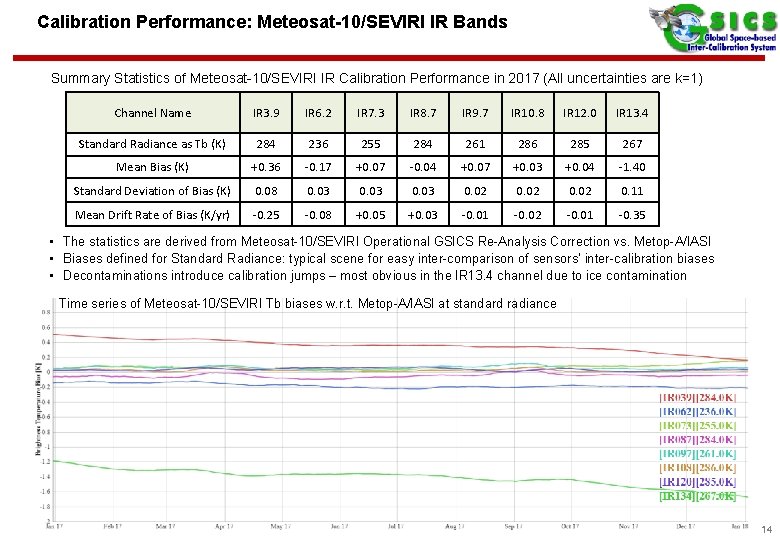
Calibration Performance: Meteosat-10/SEVIRI IR Bands Summary Statistics of Meteosat-10/SEVIRI IR Calibration Performance in 2017 (All uncertainties are k=1) Channel Name IR 3. 9 IR 6. 2 IR 7. 3 IR 8. 7 IR 9. 7 IR 10. 8 IR 12. 0 IR 13. 4 Standard Radiance as Tb (K) 284 236 255 284 261 286 285 267 Mean Bias (K) +0. 36 -0. 17 +0. 07 -0. 04 +0. 07 +0. 03 +0. 04 -1. 40 Standard Deviation of Bias (K) 0. 08 0. 03 0. 02 0. 11 Mean Drift Rate of Bias (K/yr) -0. 25 -0. 08 +0. 05 +0. 03 -0. 01 -0. 02 -0. 01 -0. 35 • The statistics are derived from Meteosat-10/SEVIRI Operational GSICS Re-Analysis Correction vs. Metop-A/IASI • Biases defined for Standard Radiance: typical scene for easy inter-comparison of sensors’ inter-calibration biases • Decontaminations introduce calibration jumps – most obvious in the IR 13. 4 channel due to ice contamination Time series of Meteosat-10/SEVIRI Tb biases w. r. t. Metop-A/IASI at standard radiance 14
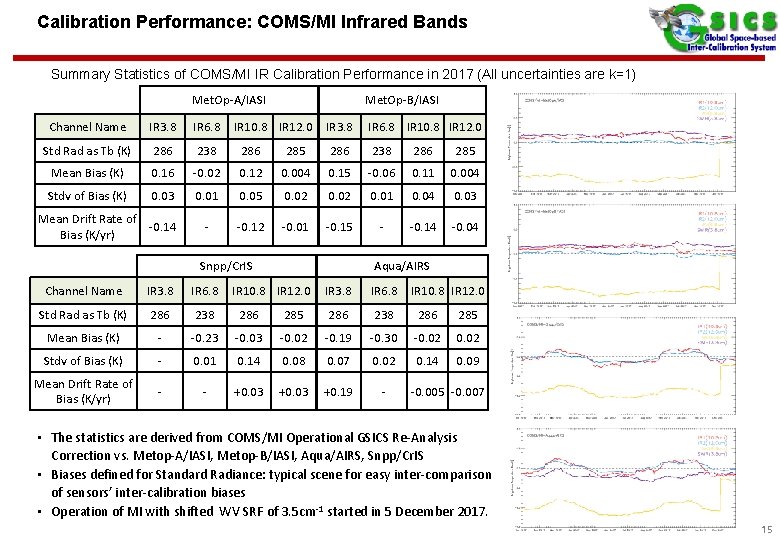
Calibration Performance: COMS/MI Infrared Bands Summary Statistics of COMS/MI IR Calibration Performance in 2017 (All uncertainties are k=1) Met. Op-A/IASI Channel Name IR 3. 8 IR 6. 8 Std Rad as Tb (K) 286 238 286 Mean Bias (K) 0. 16 -0. 02 Stdv of Bias (K) 0. 03 Mean Drift Rate of -0. 14 Bias (K/yr) Met. Op-B/IASI IR 10. 8 IR 12. 0 IR 3. 8 IR 6. 8 IR 10. 8 IR 12. 0 285 286 238 286 285 0. 12 0. 004 0. 15 -0. 06 0. 11 0. 004 0. 01 0. 05 0. 02 0. 01 0. 04 0. 03 - -0. 12 -0. 01 -0. 15 - -0. 14 -0. 04 Snpp/Cr. IS Channel Name IR 3. 8 IR 6. 8 Std Rad as Tb (K) 286 238 286 Mean Bias (K) - -0. 23 Stdv of Bias (K) - Mean Drift Rate of Bias (K/yr) - Aqua/AIRS IR 10. 8 IR 12. 0 IR 3. 8 IR 6. 8 IR 10. 8 IR 12. 0 285 286 238 286 285 -0. 03 -0. 02 -0. 19 -0. 30 -0. 02 0. 01 0. 14 0. 08 0. 07 0. 02 0. 14 0. 09 - +0. 03 +0. 19 - -0. 005 -0. 007 • The statistics are derived from COMS/MI Operational GSICS Re-Analysis Correction vs. Metop-A/IASI, Metop-B/IASI, Aqua/AIRS, Snpp/Cr. IS • Biases defined for Standard Radiance: typical scene for easy inter-comparison of sensors’ inter-calibration biases • Operation of MI with shifted WV SRF of 3. 5 cm-1 started in 5 December 2017. 15
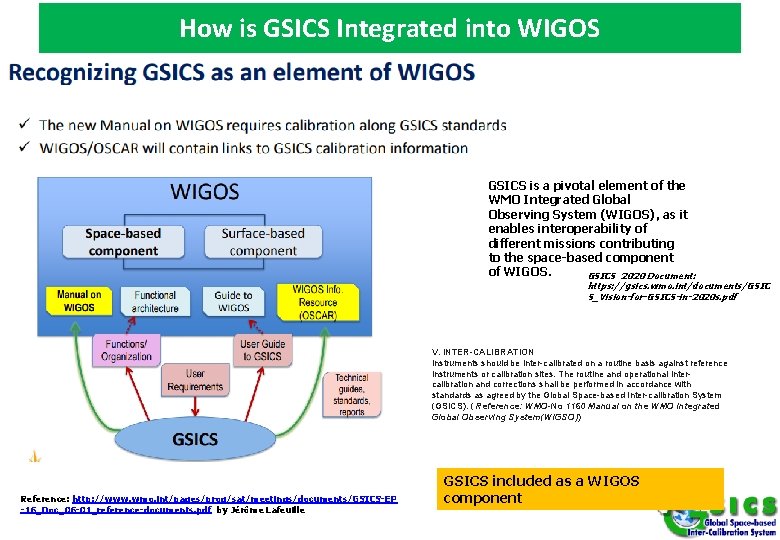
How is GSICS Integrated into WIGOS GSICS is a pivotal element of the WMO Integrated Global Observing System (WIGOS), as it enables interoperability of different missions contributing to the space-based component of WIGOS. GSICS 2020 Document: https: //gsics. wmo. int/documents/GSIC S_Vision-for-GSICS-in-2020 s. pdf V. INTER-CALIBRATION Instruments should be inter-calibrated on a routine basis against reference instruments or calibration sites. The routine and operational intercalibration and corrections shall be performed in accordance with standards as agreed by the Global Space-based Inter-calibration System (GSICS). ( Reference: WMO-No 1160 Manual on the WMO Integrated Global Observing System(WIGSO)) Reference: http: //www. wmo. int/pages/prog/sat/meetings/documents/GSICS-EP -16_Doc_06 -01_reference-documents. pdf by Jérôme Lafeuille GSICS included as a WIGOS component
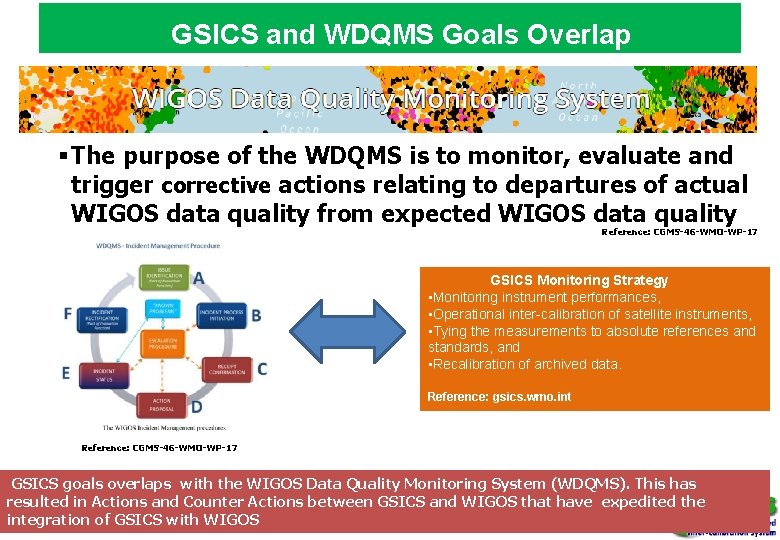
GSICS and WDQMS Goals Overlap § The purpose of the WDQMS is to monitor, evaluate and trigger corrective actions relating to departures of actual WIGOS data quality from expected WIGOS data quality Reference: CGMS-46 -WMO-WP-17 GSICS Monitoring Strategy • Monitoring instrument performances, • Operational inter-calibration of satellite instruments, • Tying the measurements to absolute references and standards, and • Recalibration of archived data. Reference: gsics. wmo. int Reference: CGMS-46 -WMO-WP-17 GSICS goals overlaps with the WIGOS Data Quality Monitoring System (WDQMS). This has resulted in Actions and Counter Actions between GSICS and WIGOS that have expedited the integration of GSICS with WIGOS
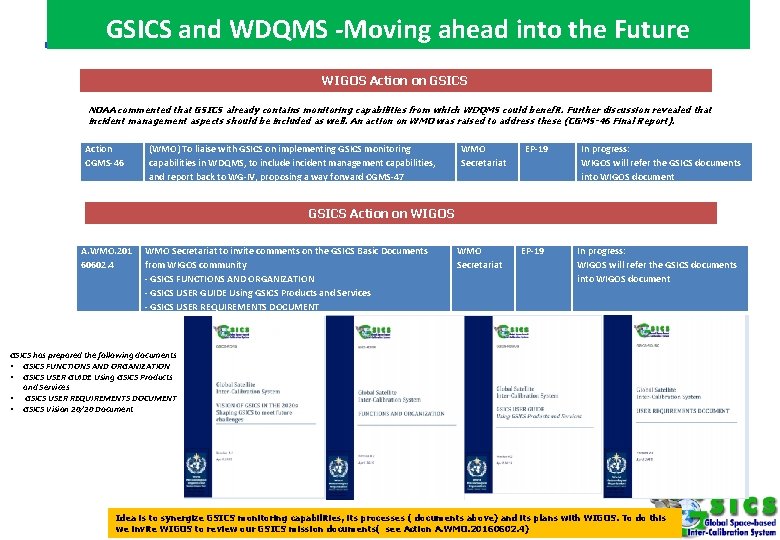
GSICS and WDQMS -Moving ahead into the Future WIGOS Action on GSICS NOAA commented that GSICS already contains monitoring capabilities from which WDQMS could benefit. Further discussion revealed that incident management aspects should be included as well. An action on WMO was raised to address these (CGMS-46 Final Report). Action CGMS-46 (WMO) To liaise with GSICS on implementing GSICS monitoring capabilities in WDQMS, to include incident management capabilities, and report back to WG-IV, proposing a way forward CGMS-47 WMO Secretariat EP-19 In progress: WIGOS will refer the GSICS documents into WIGOS document GSICS Action on WIGOS A. WMO. 201 60602. 4 WMO Secretariat to invite comments on the GSICS Basic Documents from WIGOS community - GSICS FUNCTIONS AND ORGANIZATION - GSICS USER GUIDE Using GSICS Products and Services - GSICS USER REQUIREMENTS DOCUMENT WMO Secretariat EP-19 In progress: WIGOS will refer the GSICS documents into WIGOS document GSICS has prepared the following documents • GSICS FUNCTIONS AND ORGANIZATION • GSICS USER GUIDE Using GSICS Products and Services • GSICS USER REQUIREMENTS DOCUMENT • GSICS Vision 20/20 Document Idea is to synergize GSICS monitoring capabilities, its processes ( documents above) and its plans with WIGOS. To do this we invite WIGOS to review our GSICS mission documents( see Action A. WMO. 20160602. 4)
SUMMARY • Integration of GSICS with WIGOS is underway • Critical steps have been taken to make the synergy. Some of these are • Initiate GSICS Style monitoring in WDQMS • Initiate review of GSICS Products, Processes and Long Term Satellite Monitoring Plan by WIGOS. These are in the documents submitted to them. • GSICS has been invited to contribute to the Guide to the WMO integrated Global Observing System (WIGOS) Chapter 6: Calibration and Validation ( Reference: Section 9: GSICS EP-19 Final Report) • GSICS Action Tracker can also be shared with WIGOS
- Slides: 20