
GSFLOW Coupled GroundwaterSurfaceWater Model Background and Possible Applications
GSFLOW Coupled Groundwater/Surface-Water Model: Background and Possible Applications in the Great Valley Water Resources Science Forum October 7, 2009
Why was GSFLOW developed? n To improve our ability to simulate and understand v. Watershed hydrologic processes and water availability v. Links between hydrologic processes and climate, vegetation, land uses, watersupply development, and ecology
Uses of GSFLOW n Determine flow rates and storage volumes of water throughout a watershed—from the tree canopy to deep aquifers: v. Evaporation and plant transpiration v. Soil infiltration and interflow v. Snowpack generation and depletion v. Groundwater recharge v. Streamflow generation

Components of Streamflow for a Year of Below-Average Precipitation, Sagehen Creek, Truckee, CA
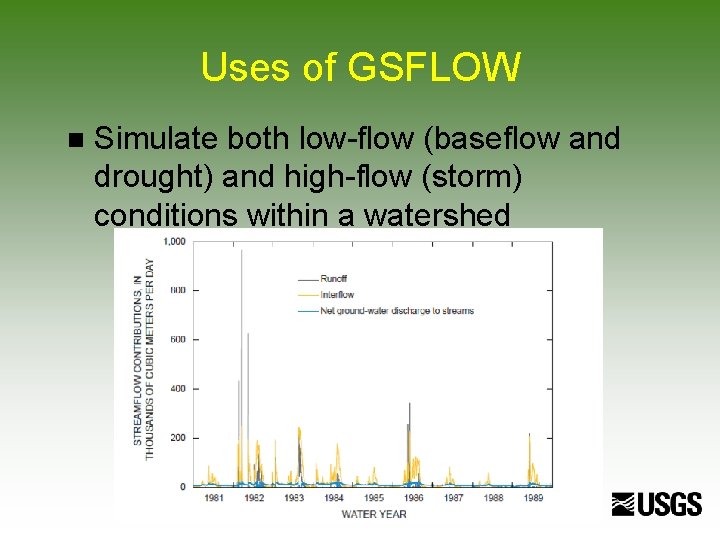
Uses of GSFLOW n Simulate both low-flow (baseflow and drought) and high-flow (storm) conditions within a watershed

Uses of GSFLOW Simulate hydrologic response to changing land uses, population growth, and possible future climate conditions 28 25 22 Projected average maximum daily temperature, Tahoe Basin, California and Nevada 2097 2091 2085 2079 2073 2067 2061 2055 2049 2043 2037 2031 2025 2019 2013 16 2007 19 2001 Maximum Temperature, degrees C n
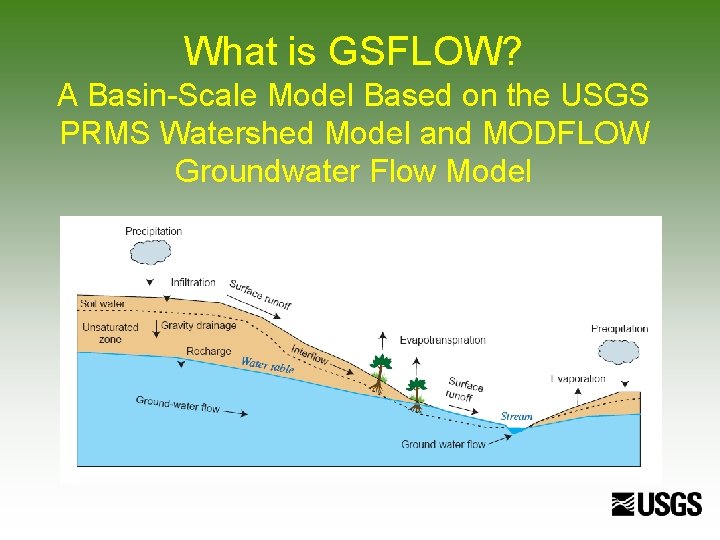
What is GSFLOW? A Basin-Scale Model Based on the USGS PRMS Watershed Model and MODFLOW Groundwater Flow Model
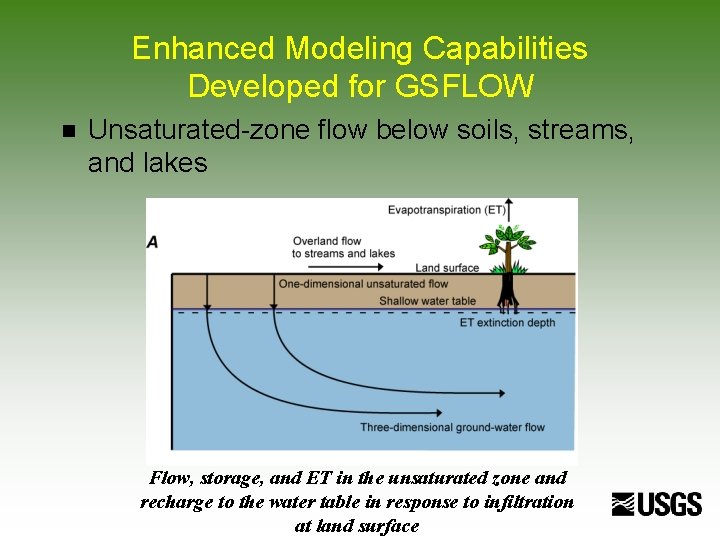
Enhanced Modeling Capabilities Developed for GSFLOW n Unsaturated-zone flow below soils, streams, and lakes Flow, storage, and ET in the unsaturated zone and recharge to the water table in response to infiltration at land surface
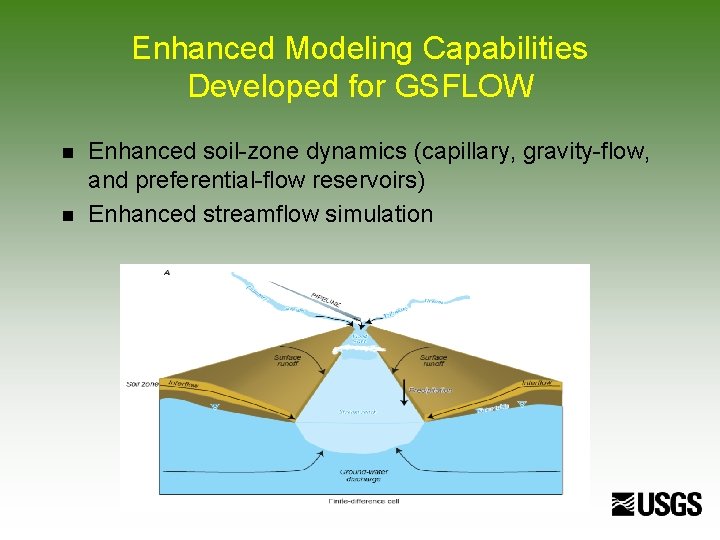
Enhanced Modeling Capabilities Developed for GSFLOW n n Enhanced soil-zone dynamics (capillary, gravity-flow, and preferential-flow reservoirs) Enhanced streamflow simulation
Some of the Hydrologic Processes Simulated n n n Potential ET Canopy interception Snowpack accumulation, melting, sublimation Surface-water runoff Interflow Infiltration to soil zone ET within soil zone 1 -D Unsaturated-zone flow, storage, and ET 3 -D Groundwater flow Streamflow Lakes
Climatic and Hydrologic Drivers Precipitation n Air Temperature n Solar radiation n Groundwater withdrawals n Groundwater flow and water-level conditions along boundary of simulated area n
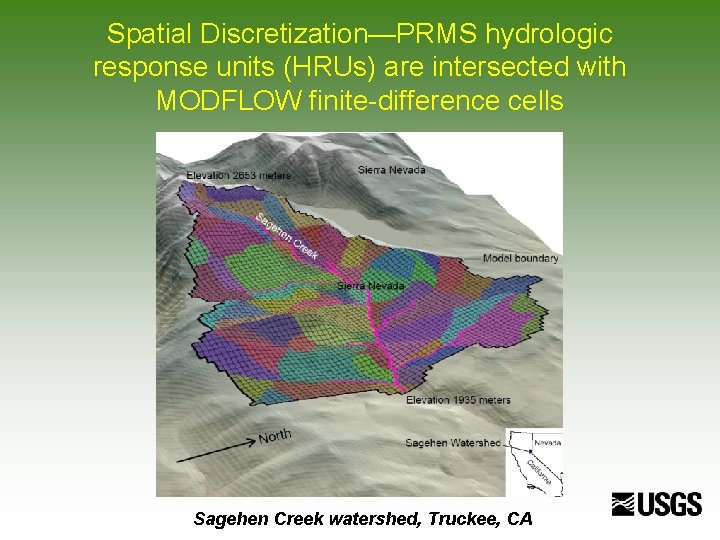
Spatial Discretization—PRMS hydrologic response units (HRUs) are intersected with MODFLOW finite-difference cells Sagehen Creek watershed, Truckee, CA
Some Important Design Criteria for GSFLOW Development Calculate and provide detailed waterbudget information for the various hydrologic processes in both space and time n Ensure that the model conserves mass n Allow simulations using only PRMS or MODFLOW to facilitate initial calibration of model parameters prior to a full GSFLOW (coupled-model) simulation n

Initial GSFLOW Applications by the USGS Trout Lake Watershed, WI n Black Earth Creek Watershed, WI n Spring Creek Watershed, PA n Incline Basin near Lake Tahoe, Nevada n Walker Lake Watershed, NV n Santa Rosa Plain, northern CA n Rialto-Colton Basin, southern CA n
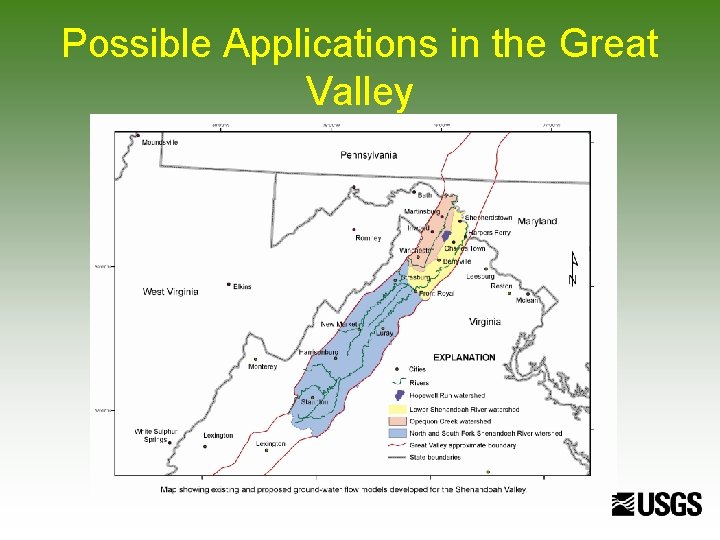
Possible Applications in the Great Valley
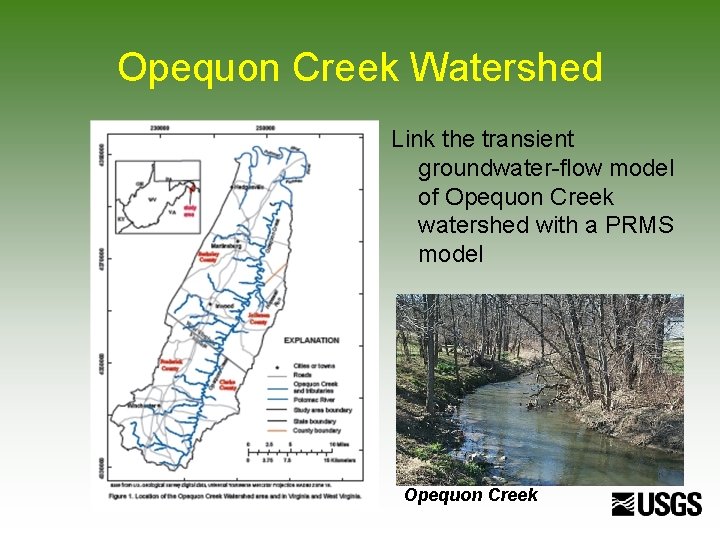
Opequon Creek Watershed Link the transient groundwater-flow model of Opequon Creek watershed with a PRMS model Opequon Creek
Benefits v Improved representation of hydrologic processes in the watershed and links among land-surface, subsurface, and surface-water hydrologic systems v Improved water budgets throughout all hydrologic components of the watershed
Data Considerations v Climate inputs: v. Daily precipitation and air-temperature data v Land-surface processes: v. Evapotranspiration v. Canopy interception v. Snowpack dynamics v. Surface runoff v. Soil-zone processes
Data Considerations v Streamflow and Springs v Subsurface processes: v. Unsaturated-zone flow v. Groundwater flow, including wells
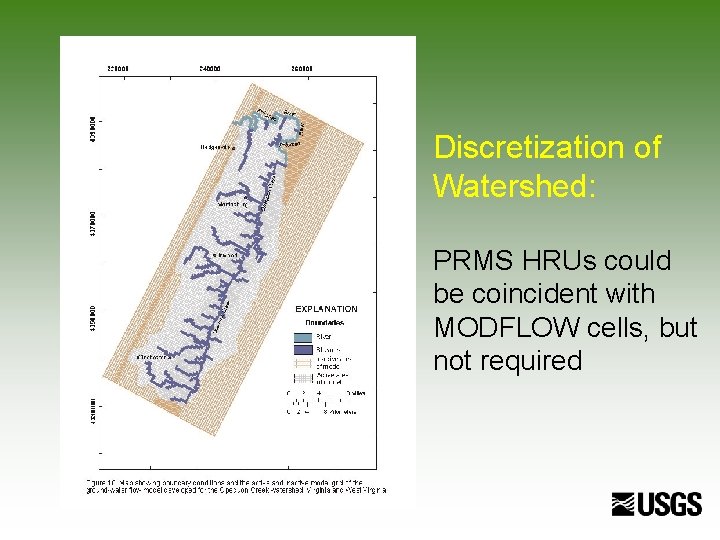
Discretization of Watershed: PRMS HRUs could be coincident with MODFLOW cells, but not required
Calibration Considerations v. A multistep process: v. PRMS transient (daily) calibration v. MODFLOW steady-state calibration v. Coupled GSFLOW transient (daily) calibration v Calibration data: v. Streamflow v. Groundwater levels
GSFLOW Code and Documentation Report Available online: v USGS Water Resources Groundwater Software webpage vhttp: //water. usgs. gov/software/lists/groundwate r/

Questions?
- Slides: 23