
GSFC Photography Club Beginners Class Session 2 Camera
GSFC Photography Club Beginners Class Session 2 – Camera Mechanics Scott Hull 12/3/2013
Agenda �Terms �Camera Types �Camera Parts �Camera Settings �Shooting Modes and Scene Modes �Lenses �Filters �Flash �Gadgets
Terms �ISO (ISO = ASA) (adjustable) The sensitivity of the CCD sensor chip �Aperture (adjustable) The amount of the lens diameter that you use �White Balance (adjustable) The color correction for the light you are collecting �Optical vs. Digital Zoom Optical zoom is where the lens moves to expand or contract the image Digital zoom is a marketing tool – basically just cropping �Live View The ability to view the image on the display while you compose the shot
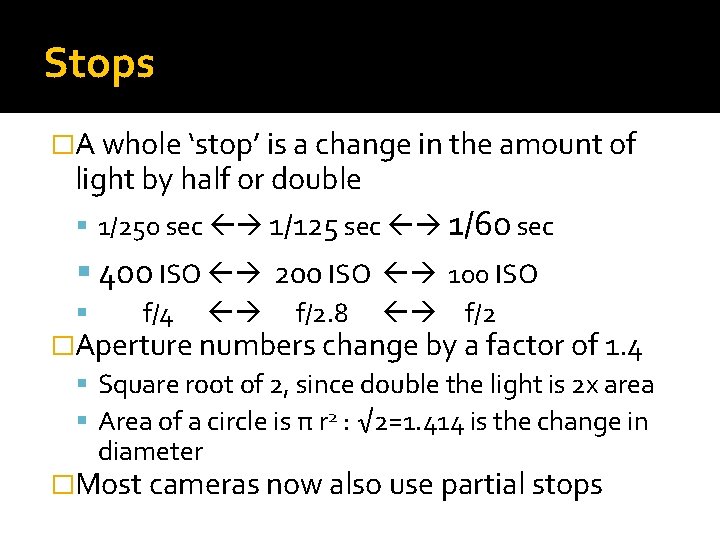
Stops �A whole ‘stop’ is a change in the amount of light by half or double 1/250 sec 1/125 sec 1/60 sec 400 ISO 200 ISO 100 ISO f/4 f/2. 8 f/2 �Aperture numbers change by a factor of 1. 4 Square root of 2, since double the light is 2 x area Area of a circle is π r 2 : √ 2=1. 414 is the change in diameter �Most cameras now also use partial stops

Camera Types “Pocket” Camera DSLR Digital Single Lens Reflex “Point and Shoot” Compact
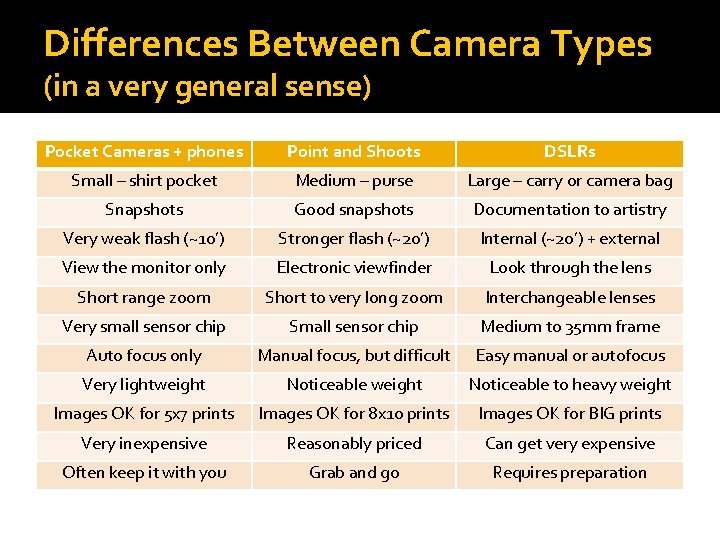
Differences Between Camera Types (in a very general sense) Pocket Cameras + phones Point and Shoots DSLRs Small – shirt pocket Medium – purse Large – carry or camera bag Snapshots Good snapshots Documentation to artistry Very weak flash (~10’) Stronger flash (~20’) Internal (~20’) + external View the monitor only Electronic viewfinder Look through the lens Short range zoom Short to very long zoom Interchangeable lenses Very small sensor chip Small sensor chip Medium to 35 mm frame Auto focus only Manual focus, but difficult Easy manual or autofocus Very lightweight Noticeable to heavy weight Images OK for 5 x 7 prints Images OK for 8 x 10 prints Images OK for BIG prints Very inexpensive Reasonably priced Can get very expensive Often keep it with you Grab and go Requires preparation
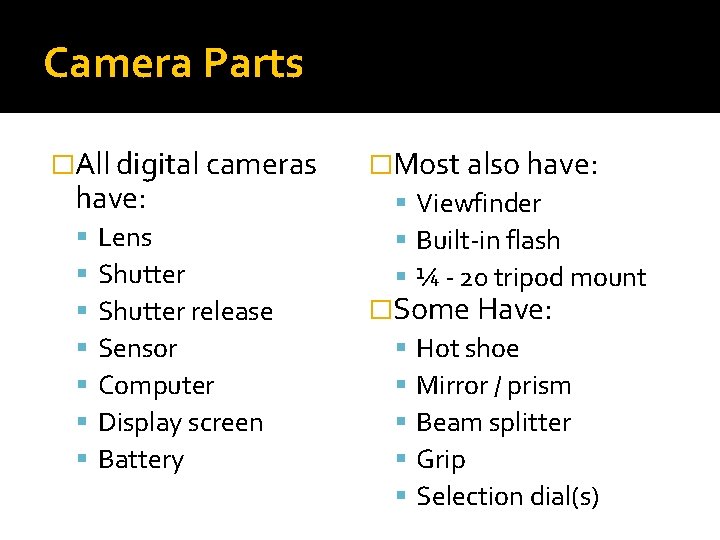
Camera Parts �All digital cameras have: Lens Shutter release Sensor Computer Display screen Battery �Most also have: Viewfinder Built-in flash ¼ - 20 tripod mount �Some Have: Hot shoe Mirror / prism Beam splitter Grip Selection dial(s)
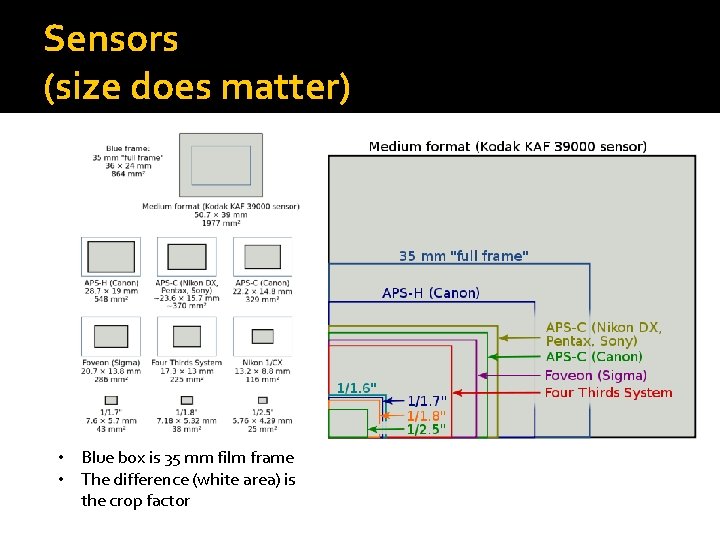
Sensors (size does matter) • Blue box is 35 mm film frame • The difference (white area) is the crop factor
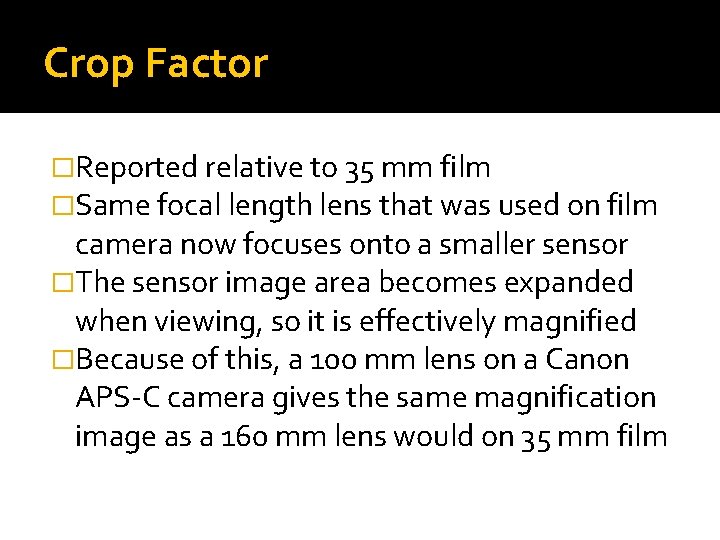
Crop Factor �Reported relative to 35 mm film �Same focal length lens that was used on film camera now focuses onto a smaller sensor �The sensor image area becomes expanded when viewing, so it is effectively magnified �Because of this, a 100 mm lens on a Canon APS-C camera gives the same magnification image as a 160 mm lens would on 35 mm film
Camera Settings �Shooting Modes �Scene Modes �Focus Modes �Metering/ Exposure Compensation �File Type/ Image Quality �White Balance �Playback �A whole book full of others – read that book! (the User’s Manual)
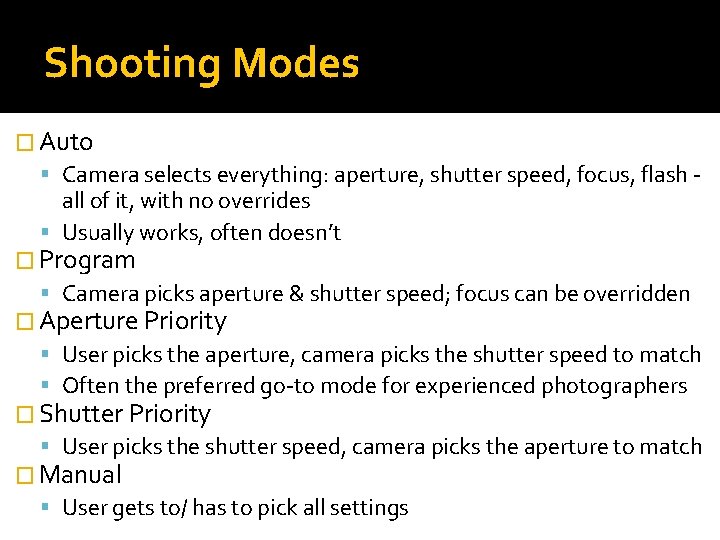
Shooting Modes � Auto Camera selects everything: aperture, shutter speed, focus, flash - all of it, with no overrides Usually works, often doesn’t � Program Camera picks aperture & shutter speed; focus can be overridden � Aperture Priority User picks the aperture, camera picks the shutter speed to match Often the preferred go-to mode for experienced photographers � Shutter Priority User picks the shutter speed, camera picks the aperture to match � Manual User gets to/ has to pick all settings
Scene Modes �Portrait �Landscape �Night Scene �Night �Sunset �Fireworks �Food �Documents �Beach/Snow �Underwater Portrait �Sports �Indoor (4 options) �Macro �Snow �Self Portrait �Close-up �Museum �Backlight �Panorama �Candle �Probably many more…
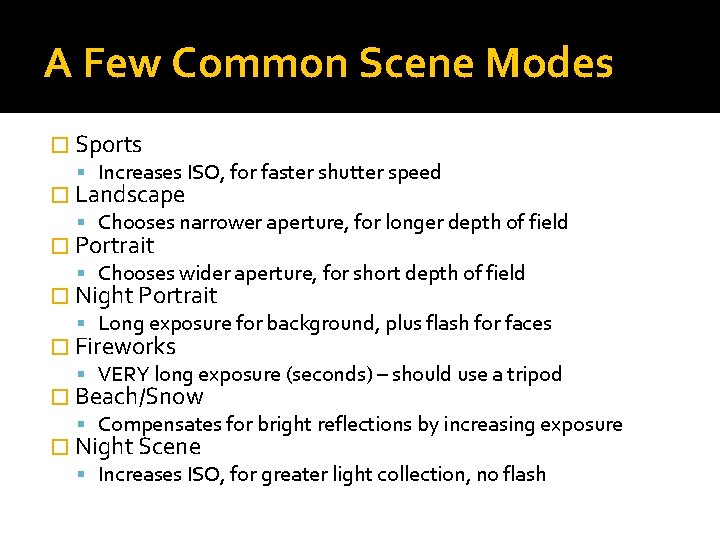
A Few Common Scene Modes � Sports Increases ISO, for faster shutter speed � Landscape Chooses narrower aperture, for longer depth of field � Portrait Chooses wider aperture, for short depth of field � Night Portrait Long exposure for background, plus flash for faces � Fireworks VERY long exposure (seconds) – should use a tripod � Beach/Snow Compensates for bright reflections by increasing exposure � Night Scene Increases ISO, for greater light collection, no flash
Focus Modes �Autofocus on most new cameras is pretty darned good Even experienced pros are starting to use it instead of always manually focusing Still not always perfectly crisp Doesn’t work for all situations �Very dependent on high contrast areas �Focus point can usually be defined on DSLRs �Might still need to tweak the ‘sweet spot’ �Manual focus on pocket cameras and point and shoots is difficult, if possible
Metering �Average Original film approach, not used much anymore �Multi-zone metering (aka Matrix, ESP, other names) Most commonly used default mode Mysterious algorithms consider many factors including focus point, light distribution, etc. �Center-weighted average Central portion represents most of the input �Spot ~1 -5% of the field Location is usually definable, often in the center �Use exposure compensation (+/-) to make small adjustments
Files/ Image Quality �RAW vs. JPEG RAW is all of the data, straight from the sensor ▪ Largest files, most flexibility later, and highest resolution JPEG is processed and compressed before saving ▪ Losses occur each time it is saved ▪ Usually several levels of compression available �Why not just maximize everything with RAW? E-5 Example (12. 3 MP camera) ▪ RAW file: 12. 4 MB, High quality JPEG: 5. 3 MB ▪ Little discernible loss in image quality until you zoom in ▪ In fact, RAW initially looks much noisier at high magnification Memory cards are big, but not infinite capacity RAW is also not as portable between viewers
White Balance �Colors change based on the type of light Light brown shirt in incandescent light can look green in fluorescent light Even sunlight vs. shade makes a difference �Image is interpreted differently based on settings �Auto white balance is pretty good ~98% of the time �Check your display frequently, and change the WB if necessary �RAW images are not corrected, so you can change it later if it was incorrect �Most DSLRs can also set WB manually for unusual situations
Lenses � Built-in vs. interchangeable Depends on the camera type � Fixed vs. zoom Fixed is typically lighter and has higher image quality Zoom is more flexible � Cheap vs. expensive More expensive lenses have more elements, better coatings, wider apertures, heavier weight � Macro capability Highly detailed close-up images � Teleconverters Goes between camera and lens to produce 1. 4, 1. 6, or even 2. 0 x the focal length
Zoom Lens Cautions � A ‘wobble’ of only 0. 03° will cause the image to move by 1/8” at 20 feet With a 50 mm lens, you may not see that With a 400 mm lens, it is 8 times bigger, and very noticeable � Zoom lenses are also usually unbalanced when hand held More likely to get that 0. 03° - or more � They also tend to have smaller maximum apertures, so longer exposure times � Tripods help, but faster shutter speeds are more practical Tripod pointing is awkward and slow Faster shutter usually means higher ISO, though more noise � Thus, the driver for more expensive, “faster” zoom lenses
Image Stabilization � Uses tiny gyroscopes to detect movement � Optical Image Stabilization Lens shifts the optical path, to stabilize the image Unique to the lens; extra $ for each lens Canon, Nikon, some Sony, Panasonic � Sensor shift Sensor is moved to stabilize image Works with all lenses, even old film lenses Olympus, Pentax, some Sony, Konica-Minolta � Digital Image Stabilization Used in some video cameras Computer changes the pixel region from frame to frame � Performance is rated in equivalent stops improvement � Turn image stabilization OFF when using a tripod
Filters � Ultraviolet Mostly to protect the lens Cheap, and nearly invisible in the image � Polarizer Reduces glare Rotate for best effectiveness � Infrared Sees heat, for an ‘other-worldly’ effect � Neutral Density Reduces light, without shifting colors � Color Highlights individual colors � Gradient Neutral density on one end to clear on the other Great for darkening skies
Flash �Obviously used to brighten a scene �Flash power is determined by the Guide Number GN = distance x aperture, at a specific ISO Example: 18 m at ISO 200 (Olympus E-5 internal) Means that at f/5. 6 and 200 ISO, anything beyond 3. 2 m (~11 ft) will not be fully illuminated �External flash GN is typically about 30 to 50 Can be moved off-axis, to control shadows Many are remote triggered; can use multiple units
Gadgets �Tripod �Shutter release �Remote control �Monopod �Camera Bag �Lens caps �Spare batteries �Spare memory cards �Reflectors/ diffusers �GPS data tagger �The list goes on and on…
What next? Now that I figured out my camera and I’m taking great pictures, I have a bunch of pretty files. What can I do with them? � Photoshop Elements If you think they look great now, just wait… Elements has the same basic tools at ~1/10 the price � Prints Costco, Target, Wal-Mart, etc. Probably not worth getting your own printer ▪ Usually clog up if you don’t print a lot of pictures � Create a photo book about a subject (cheaper than you think) Online software and Elements both make it pretty easy � Post them online Recommend a Flickr free account Photo Club Flickr site – we want to see what you’ve done! Facebook, other social media
Backup Slides
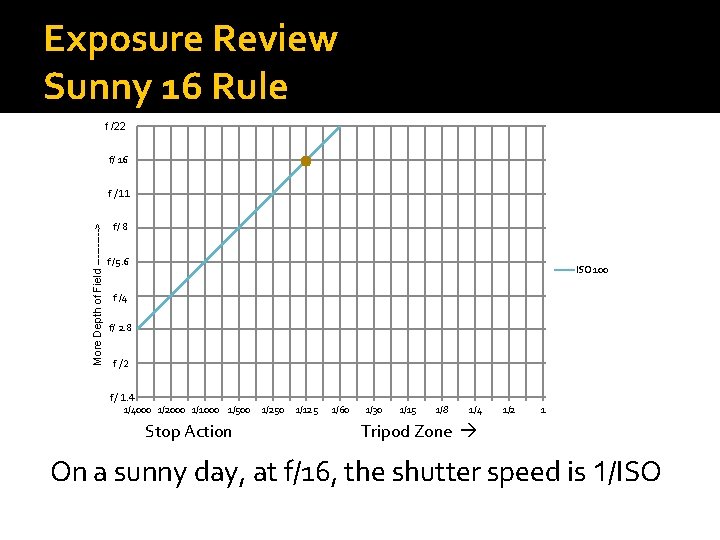
Exposure Review Sunny 16 Rule f /22 f/ 16 More Depth of Field -----> f /11 f/ 8 f /5. 6 ISO 100 f /4 f/ 2. 8 f /2 f/ 1. 4 1/4000 1/2000 1/1000 1/500 Stop Action 1/250 1/125 1/60 1/30 1/15 1/8 1/4 1/2 1 Tripod Zone On a sunny day, at f/16, the shutter speed is 1/ISO
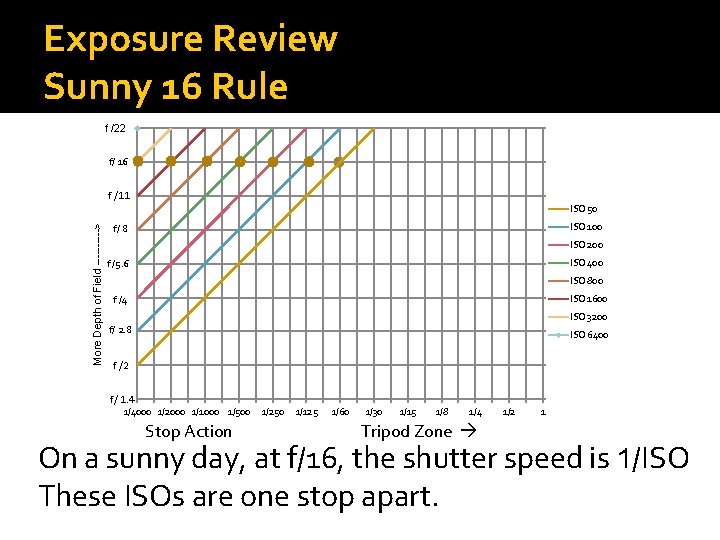
Exposure Review Sunny 16 Rule f /22 f/ 16 f /11 More Depth of Field -----> ISO 50 ISO 100 f/ 8 ISO 200 ISO 400 f /5. 6 ISO 800 f /4 ISO 1600 ISO 3200 f/ 2. 8 ISO 6400 f /2 f/ 1. 4 1/4000 1/2000 1/1000 1/500 Stop Action 1/250 1/125 1/60 1/30 1/15 1/8 1/4 Tripod Zone 1/2 1 On a sunny day, at f/16, the shutter speed is 1/ISO These ISOs are one stop apart.
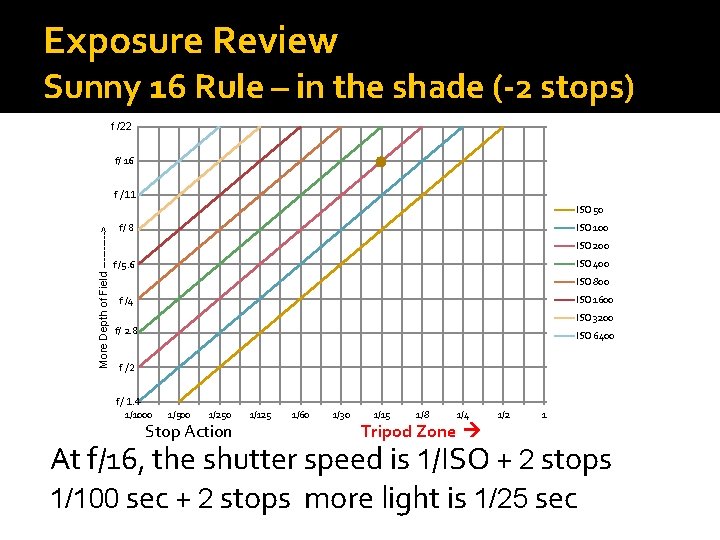
Exposure Review Sunny 16 Rule – in the shade (-2 stops) f /22 f/ 16 f /11 More Depth of Field -----> ISO 50 f/ 8 ISO 100 ISO 200 f /5. 6 ISO 400 ISO 800 f /4 ISO 1600 ISO 3200 f/ 2. 8 ISO 6400 f /2 f/ 1. 4 1/1000 1/500 1/250 Stop Action 1/125 1/60 1/30 1/15 1/8 1/4 Tripod Zone 1/2 1 At f/16, the shutter speed is 1/ISO + 2 stops 1/100 sec + 2 stops more light is 1/25 sec
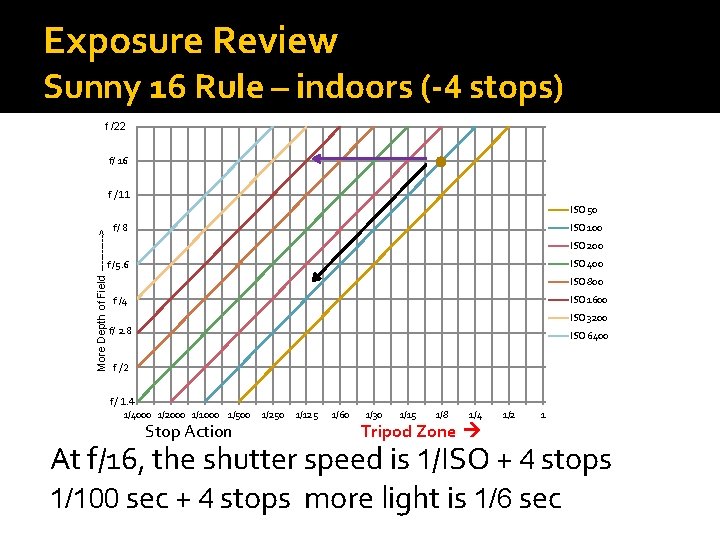
Exposure Review Sunny 16 Rule – indoors (-4 stops) f /22 f/ 16 f /11 More Depth of Field -----> ISO 50 f/ 8 ISO 100 ISO 200 f /5. 6 ISO 400 ISO 800 f /4 ISO 1600 ISO 3200 f/ 2. 8 ISO 6400 f /2 f/ 1. 4 1/4000 1/2000 1/1000 1/500 Stop Action 1/250 1/125 1/60 1/30 1/15 1/8 1/4 Tripod Zone 1/2 1 At f/16, the shutter speed is 1/ISO + 4 stops 1/100 sec + 4 stops more light is 1/6 sec
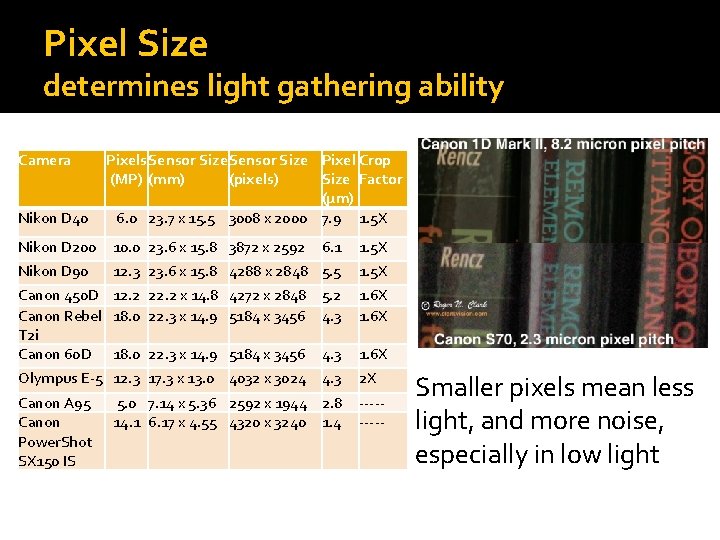
Pixel Size determines light gathering ability Camera Nikon D 40 Pixels Sensor Size Pixel Crop (MP) (mm) (pixels) Size Factor (µm) 6. 0 23. 7 x 15. 5 3008 x 2000 7. 9 1. 5 X Nikon D 200 Nikon D 90 Canon 450 D Canon Rebel T 2 i Canon 60 D Olympus E-5 10. 0 12. 3 12. 2 18. 0 Canon A 95 Canon Power. Shot SX 150 IS 23. 6 x 15. 8 22. 2 x 14. 8 22. 3 x 14. 9 3872 x 2592 4288 x 2848 4272 x 2848 5184 x 3456 6. 1 5. 5 5. 2 4. 3 1. 5 X 1. 6 X 18. 0 22. 3 x 14. 9 5184 x 3456 4. 3 12. 3 17. 3 x 13. 0 4032 x 3024 4. 3 1. 6 X 2 X 5. 0 7. 14 x 5. 36 2592 x 1944 2. 8 14. 1 6. 17 x 4. 55 4320 x 3240 1. 4 ----- Smaller pixels mean less light, and more noise, especially in low light
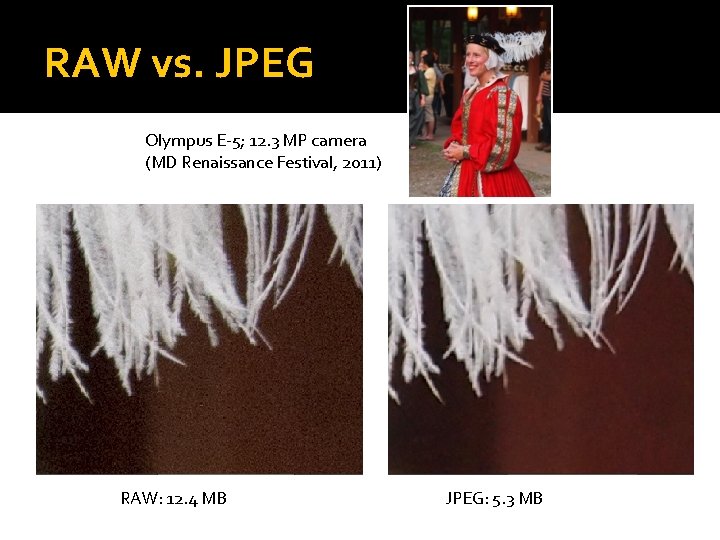
RAW vs. JPEG Olympus E-5; 12. 3 MP camera (MD Renaissance Festival, 2011) RAW: 12. 4 MB JPEG: 5. 3 MB
Recommended References � Your camera User’s Manual – read it! Download it for easy searching Carry it in your camera bag for reference � Web sites www. penncamera. com www. DPReview. com www. learnmyshot. com www. photoextremist. com � TV show Wild Photo Adventures � Magazines Digital Photo Popular Photography Photoshop Elements Techniques

- Slides: 33