
GSCA 2019 2020 Governance Introduction Who Are We


- Slides: 30
GSCA 2019 -2020 Governance Introduction
+ Who Are We?
+ What is An Association? n IRS Definition: a group of persons banded together for a specific purpose n ASAE (American Society of Association Executives) Definition: A sense of community coordination is at the heart of the association profession. People voluntarily join associations because they want to work together on a common cause or interest…today’s associations still share the purpose of coming together to produce positive results n The Will to Govern Well: Associations are unique because they are like a triplehelix DNA composed of three intertwined threads- members as owners, members as customers, and members as workforce… Associations’ owners, customers, and workforce are one and the same. Key competitive advantages associations have in the 21 st century- the aggregate intellectual capital of their membership, their energy as a community with common purpose, and their credibility as a voluntary institution n Summary: a group of people who voluntarily come together to solve common problems, meet common needs, and accomplish common goals n Associations are unique because of their commonness, voluntary nature, goals and people
+ What is An Association? n GSCA is a 501(c)(3) nonprofit corporation governed by Georgia corporate law n Note: this does not mean we are exempt from sales tax; we simply are exempt from income tax for activities that fall within the scope of the mission
+ Who We Are: Guiding Principles New Mission Statement Approved November 2017: The Georgia School Counselor Association supports school counselors in Georgia as they promote student success.
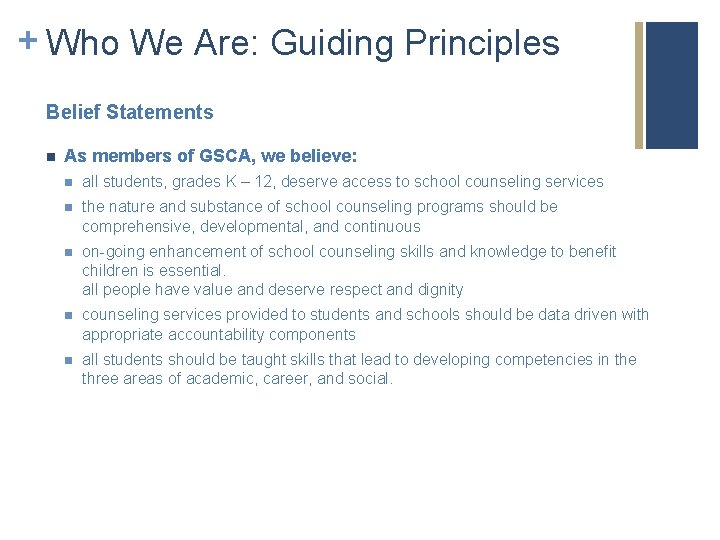
+ Who We Are: Guiding Principles Belief Statements n As members of GSCA, we believe: n all students, grades K – 12, deserve access to school counseling services n the nature and substance of school counseling programs should be comprehensive, developmental, and continuous n on-going enhancement of school counseling skills and knowledge to benefit children is essential. all people have value and deserve respect and dignity n counseling services provided to students and schools should be data driven with appropriate accountability components n all students should be taught skills that lead to developing competencies in the three areas of academic, career, and social.
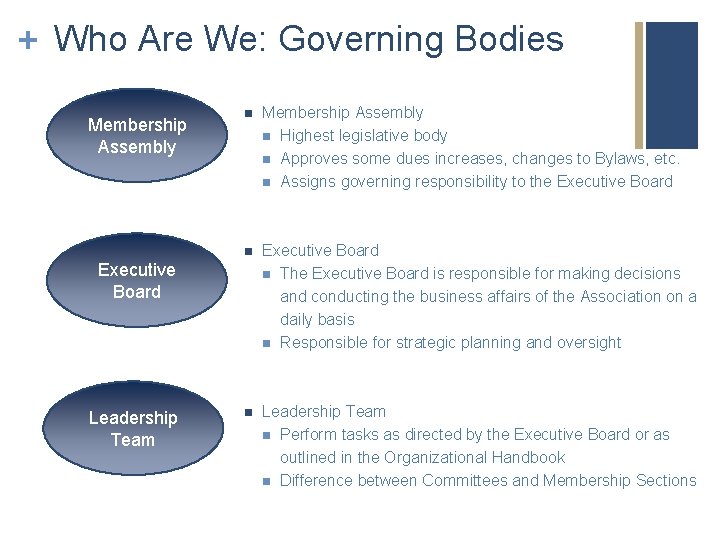
+ Who Are We: Governing Bodies Membership Assembly n Highest legislative body n Approves some dues increases, changes to Bylaws, etc. n Assigns governing responsibility to the Executive Board n The Executive Board is responsible for making decisions and conducting the business affairs of the Association on a daily basis n Responsible for strategic planning and oversight n Leadership Team n Perform tasks as directed by the Executive Board or as outlined in the Organizational Handbook n Difference between Committees and Membership Sections Executive Board Leadership Team
+ Governance
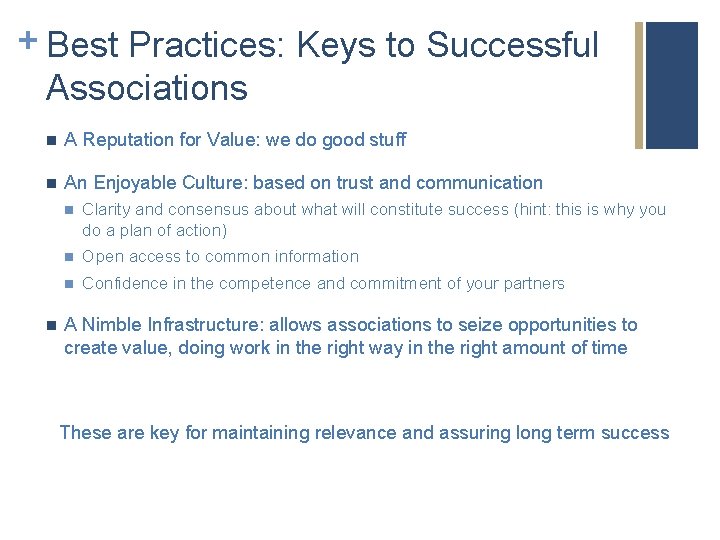
+ Best Practices: Keys to Successful Associations n A Reputation for Value: we do good stuff n An Enjoyable Culture: based on trust and communication n n Clarity and consensus about what will constitute success (hint: this is why you do a plan of action) n Open access to common information n Confidence in the competence and commitment of your partners A Nimble Infrastructure: allows associations to seize opportunities to create value, doing work in the right way in the right amount of time These are key for maintaining relevance and assuring long term success
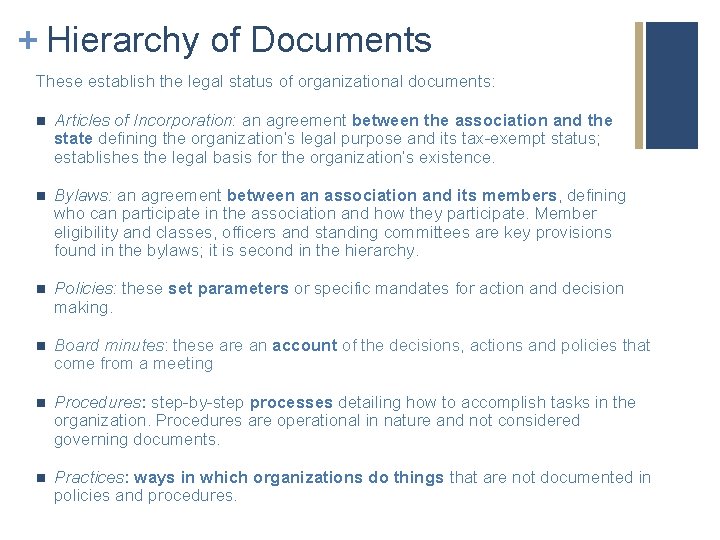
+ Hierarchy of Documents These establish the legal status of organizational documents: n Articles of Incorporation: an agreement between the association and the state defining the organization’s legal purpose and its tax-exempt status; establishes the legal basis for the organization’s existence. n Bylaws: an agreement between an association and its members, defining who can participate in the association and how they participate. Member eligibility and classes, officers and standing committees are key provisions found in the bylaws; it is second in the hierarchy. n Policies: these set parameters or specific mandates for action and decision making. n Board minutes: these are an account of the decisions, actions and policies that come from a meeting n Procedures: step-by-step processes detailing how to accomplish tasks in the organization. Procedures are operational in nature and not considered governing documents. n Practices: ways in which organizations do things that are not documented in policies and procedures.
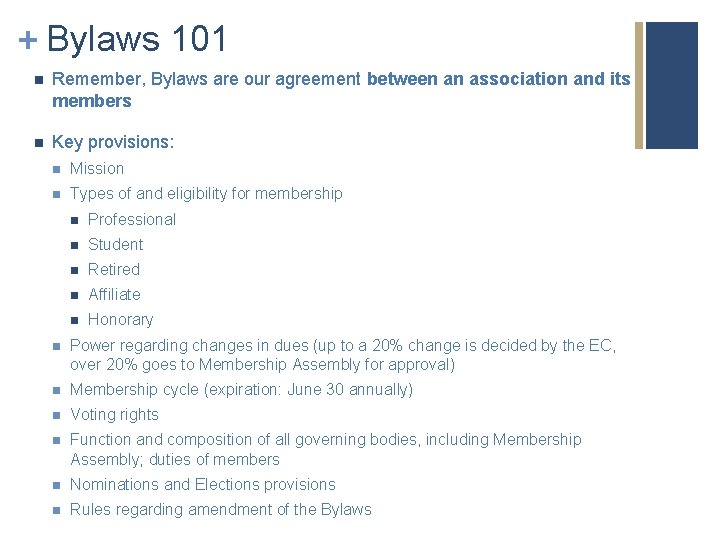
+ Bylaws 101 n Remember, Bylaws are our agreement between an association and its members n Key provisions: n Mission n Types of and eligibility for membership n Professional n Student n Retired n Affiliate n Honorary n Power regarding changes in dues (up to a 20% change is decided by the EC, over 20% goes to Membership Assembly for approval) n Membership cycle (expiration: June 30 annually) n Voting rights n Function and composition of all governing bodies, including Membership Assembly; duties of members n Nominations and Elections provisions n Rules regarding amendment of the Bylaws
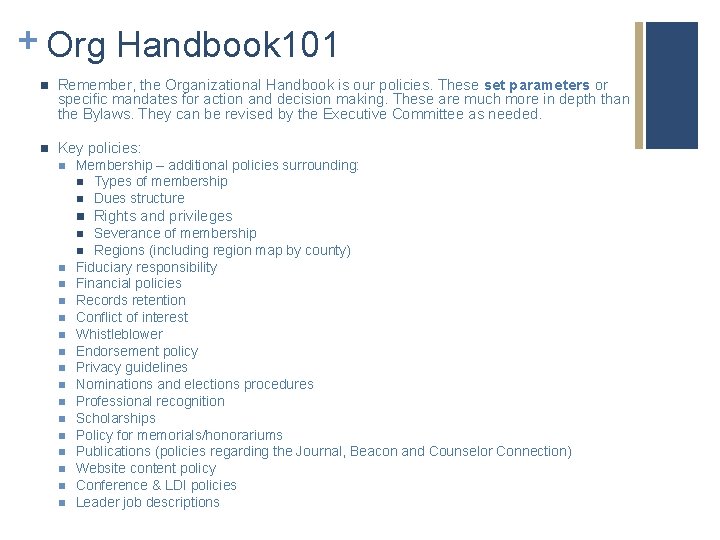
+ Org Handbook 101 n Remember, the Organizational Handbook is our policies. These set parameters or specific mandates for action and decision making. These are much more in depth than the Bylaws. They can be revised by the Executive Committee as needed. n Key policies: n Membership – additional policies surrounding: n Types of membership n Dues structure n Severance of membership n Regions (including region map by county) Fiduciary responsibility Financial policies Records retention Conflict of interest Whistleblower Endorsement policy Privacy guidelines Nominations and elections procedures Professional recognition Scholarships Policy for memorials/honorariums Publications (policies regarding the Journal, Beacon and Counselor Connection) Website content policy Conference & LDI policies Leader job descriptions n n n n Rights and privileges
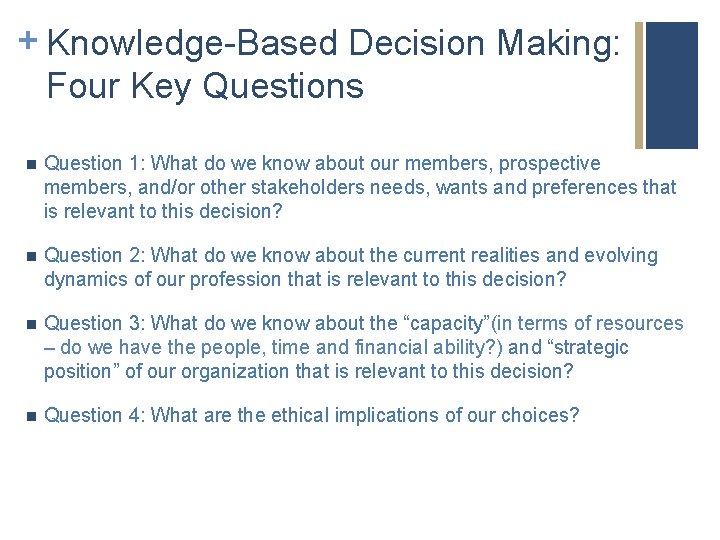
+ Knowledge-Based Decision Making: Four Key Questions n Question 1: What do we know about our members, prospective members, and/or other stakeholders needs, wants and preferences that is relevant to this decision? n Question 2: What do we know about the current realities and evolving dynamics of our profession that is relevant to this decision? n Question 3: What do we know about the “capacity”(in terms of resources – do we have the people, time and financial ability? ) and “strategic position” of our organization that is relevant to this decision? n Question 4: What are the ethical implications of our choices?
+ Leadership Role and Function
+ Fiduciary Duties n n n Duty of Care n Leaders must use responsible care and good judgment in making their decisions on behalf of the interests of the whole organization n Attendance: bound by board actions, even if you are absent Duty of Loyalty n Faithful to the organization n Avoid (and disclose potential) conflicts of interest Duty of Obedience n Comply with the governing documents n Act in ways that are consistent with mission and central goals of GSCA n The board acts as a whole, not as individuals More information can be found on pages 7 -8 of the Organizational Handbook
+ Leader Responsibilities n Governance n n n Ensure legal and ethical integrity and maintain accountability n Immediately disclose any potential conflicts of interest n Keep confidentiality Be responsible for the financial health of the organization, including n n Alert the President if you become unable to fulfill your responsibilities Promote GSCA’s image n n Being aware of financial status and acting in a fiscally responsible manner Do not spend (or commit) money without prior approval (i. e. unless it is budgeted and within the scope of your role) Do not sign contracts, agreements, etc. Understand your responsibilities/duties and commit to fulfill them n n Be accountable for execution of the mission Read and familiarize self with all governing documents (Bylaws and Organizational Handbook) Be accountable for following these documents Serve as a steward of the profession with the members and the public Never speak on behalf of GSCA (including to the press) without a direct request from the President Do not use GSCA logo, letterhead, etc. without authorization Operations n Ensure all files you use to conduct your work are on file with the GSCA office
+ Responsibilities – By Role See job responsibilities in the Organizational Handbook It is critical for all leaders to have: n Shared commitment to fulfilling the mission and vision n Understanding of responsibilities/duties and commitment to fulfill them (or alert the President if you become unable to)
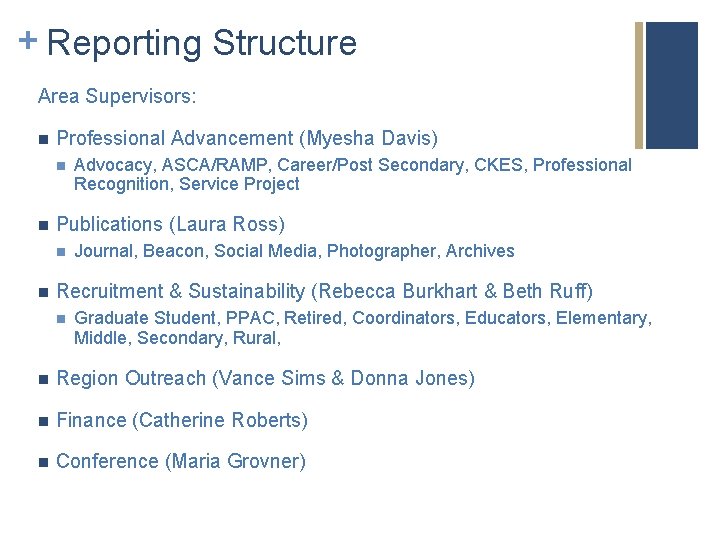
+ Reporting Structure Area Supervisors: n Professional Advancement (Myesha Davis) n n Publications (Laura Ross) n n Advocacy, ASCA/RAMP, Career/Post Secondary, CKES, Professional Recognition, Service Project Journal, Beacon, Social Media, Photographer, Archives Recruitment & Sustainability (Rebecca Burkhart & Beth Ruff) n Graduate Student, PPAC, Retired, Coordinators, Educators, Elementary, Middle, Secondary, Rural, n Region Outreach (Vance Sims & Donna Jones) n Finance (Catherine Roberts) n Conference (Maria Grovner)
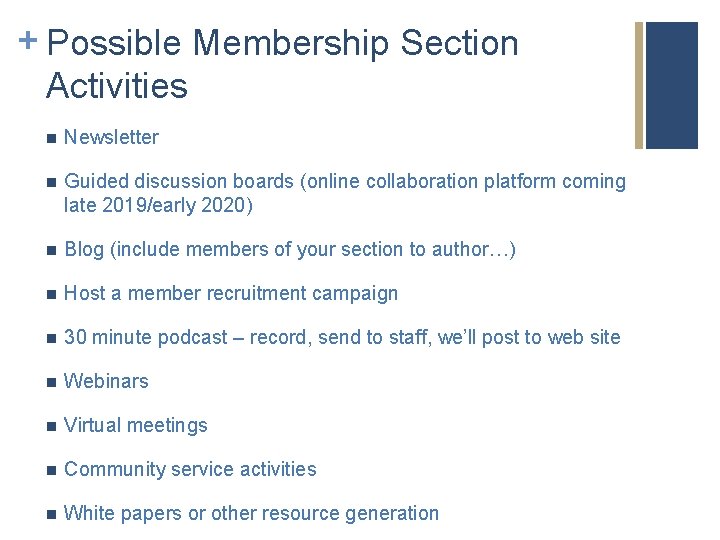
+ Possible Membership Section Activities n Newsletter n Guided discussion boards (online collaboration platform coming late 2019/early 2020) n Blog (include members of your section to author…) n Host a member recruitment campaign n 30 minute podcast – record, send to staff, we’ll post to web site n Webinars n Virtual meetings n Community service activities n White papers or other resource generation
+ Financial Procedures and Budget
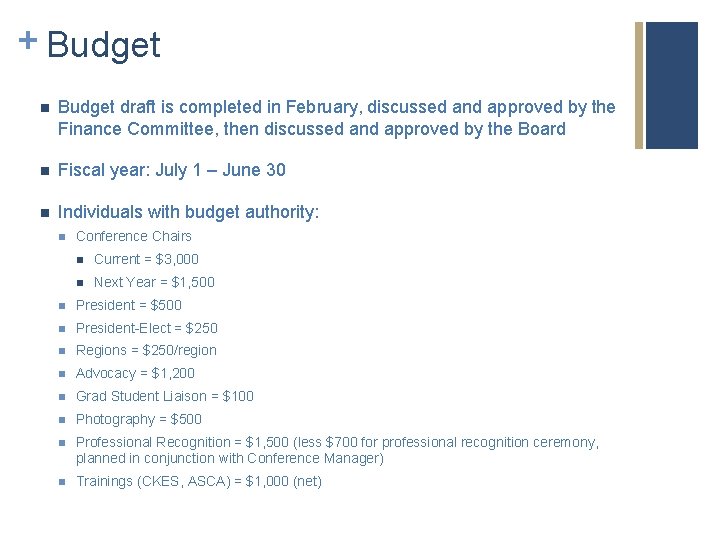
+ Budget n Budget draft is completed in February, discussed and approved by the Finance Committee, then discussed and approved by the Board n Fiscal year: July 1 – June 30 n Individuals with budget authority: n Conference Chairs n Current = $3, 000 n Next Year = $1, 500 n President = $500 n President-Elect = $250 n Regions = $250/region n Advocacy = $1, 200 n Grad Student Liaison = $100 n Photography = $500 n Professional Recognition = $1, 500 (less $700 for professional recognition ceremony, planned in conjunction with Conference Manager) n Trainings (CKES, ASCA) = $1, 000 (net)
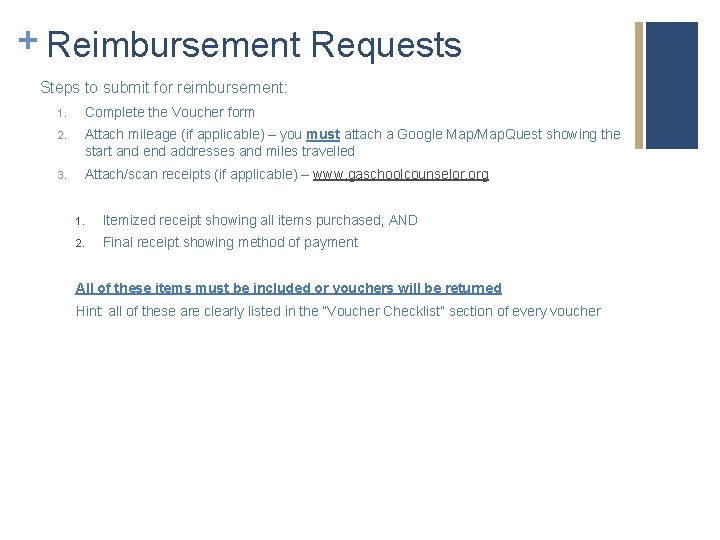
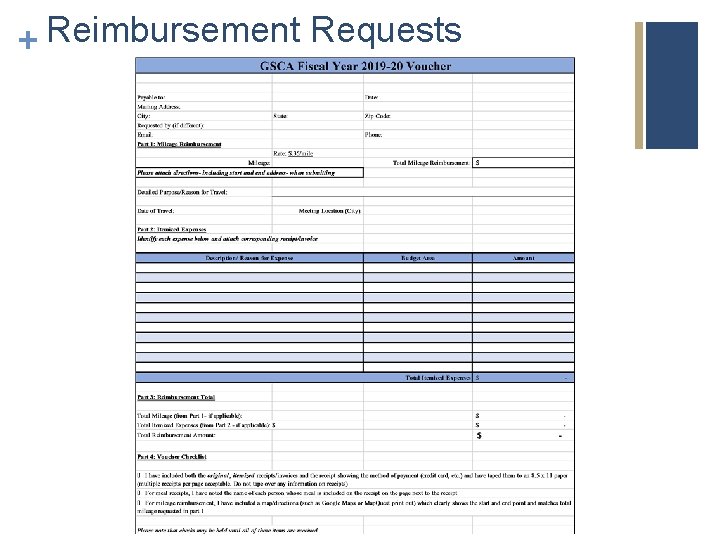
+ Reimbursement Requests Steps to submit for reimbursement: 1. Complete the Voucher form 2. Attach mileage (if applicable) – you must attach a Google Map/Map. Quest showing the start and end addresses and miles travelled 3. Attach/scan receipts (if applicable) – www. gaschoolcounselor. org 1. Itemized receipt showing all items purchased; AND 2. Final receipt showing method of payment All of these items must be included or vouchers will be returned Hint: all of these are clearly listed in the “Voucher Checklist” section of every voucher
+ Reimbursement Requests
+ Leadership Team and Staff: How do We Work Together?
+ Members’ and Leaders’ Expectations of Staff n Value and appreciate the profession of school counseling and its impact on society n Be sufficiently familiar with the condition of the profession in order to clearly understand what is going on (note: staff judgments about what to do are never a substitute for the judgments of members) n Have sufficient knowledge of the dynamics and direction of GSCA n Give good counsel about conditions, challenges and opportunities and provide insightful advice on choices Adapted from Gabriel Eckert, CAE
+ Staff’s Expectations of Members and Leaders n Agree to consider and value staff’s insights, perspectives and counsel about conditions, challenges and opportunities for the association n Be clear about outcomes desired and provide sufficient empowerment to senior staff to design and execute strategies required to achieve progress n Understand that staff’s role as an association management professional reflects a distinct and unique set of professional competencies and deserves the respect that the profession of school counseling receives Adapted from Gabriel Eckert, CAE
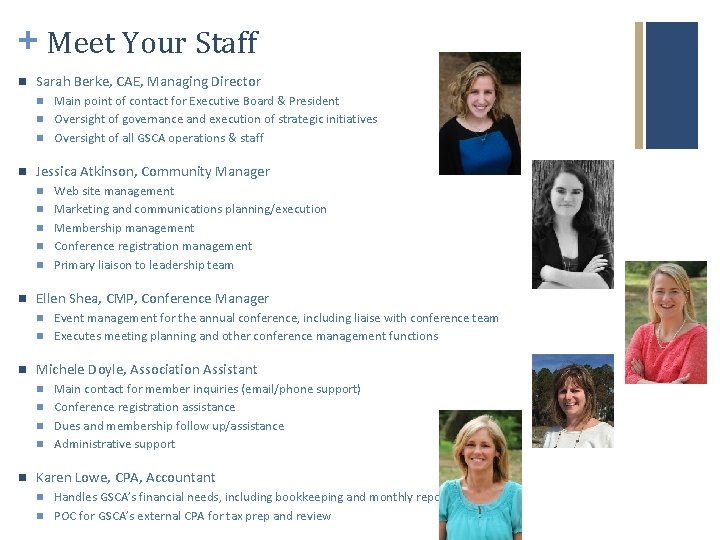
+ Meet Your Staff n Sarah Berke, CAE, Managing Director n n Jessica Atkinson, Community Manager n n n n Event management for the annual conference, including liaise with conference team Executes meeting planning and other conference management functions Michele Doyle, Association Assistant n n n Web site management Marketing and communications planning/execution Membership management Conference registration management Primary liaison to leadership team Ellen Shea, CMP, Conference Manager n n Main point of contact for Executive Board & President Oversight of governance and execution of strategic initiatives Oversight of all GSCA operations & staff Main contact for member inquiries (email/phone support) Conference registration assistance Dues and membership follow up/assistance Administrative support Karen Lowe, CPA, Accountant n n Handles GSCA’s financial needs, including bookkeeping and monthly reporting POC for GSCA’s external CPA for tax prep and review
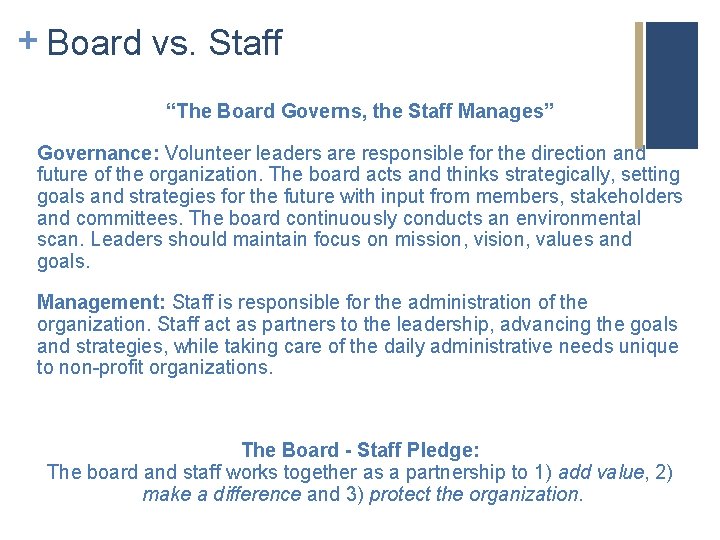
+ Board vs. Staff “The Board Governs, the Staff Manages” Governance: Volunteer leaders are responsible for the direction and future of the organization. The board acts and thinks strategically, setting goals and strategies for the future with input from members, stakeholders and committees. The board continuously conducts an environmental scan. Leaders should maintain focus on mission, vision, values and goals. Management: Staff is responsible for the administration of the organization. Staff act as partners to the leadership, advancing the goals and strategies, while taking care of the daily administrative needs unique to non-profit organizations. The Board - Staff Pledge: The board and staff works together as a partnership to 1) add value, 2) make a difference and 3) protect the organization.
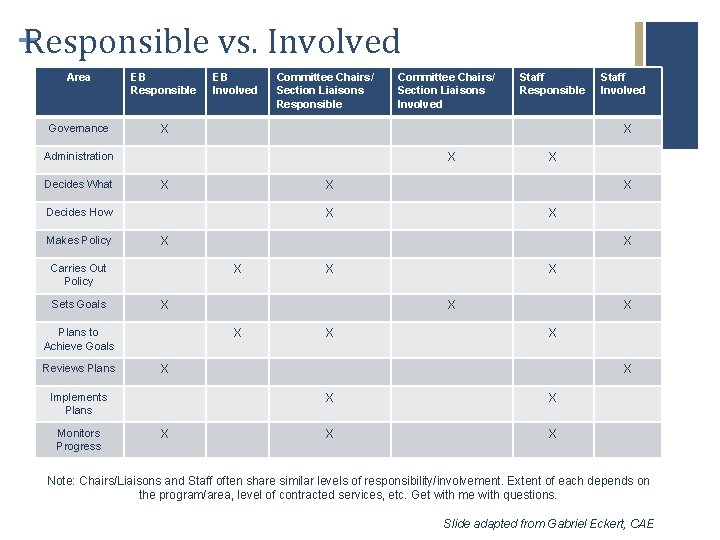
+Responsible vs. Involved Area EB Responsible Governance X EB Involved Committee Chairs/ Section Liaisons Responsible X X Sets Goals X X X Implements Plans Monitors Progress X X Plans to Achieve Goals Reviews Plans X X Carries Out Policy X Staff Involved X X Decides How Makes Policy Staff Responsible X Administration Decides What Committee Chairs/ Section Liaisons Involved X X X Note: Chairs/Liaisons and Staff often share similar levels of responsibility/involvement. Extent of each depends on the program/area, level of contracted services, etc. Get with me with questions. Slide adapted from Gabriel Eckert, CAE
It's easy to make a buck. It's a lot tougher to make a difference. ~Tom Brokaw