
GS 221 Work and Society Dr Haydar Badawi
GS 221 Work and Society Dr. Haydar Badawi Sadig
Part 4: Contemporary Theories
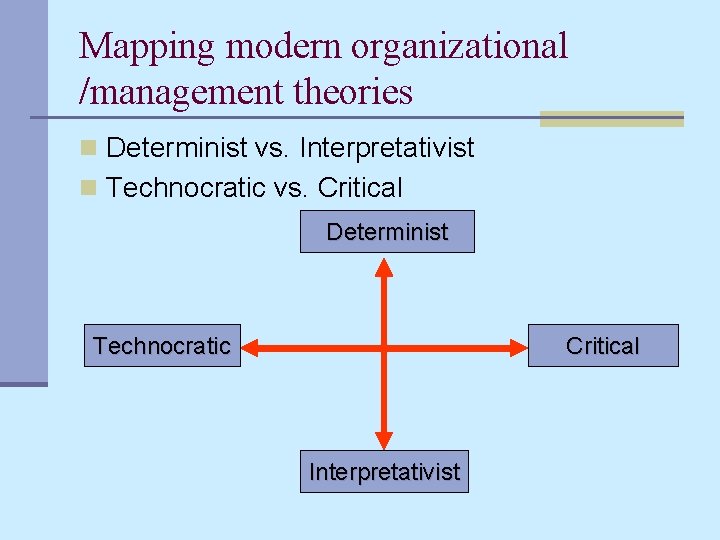
Mapping modern organizational /management theories n Determinist vs. Interpretativist n Technocratic vs. Critical Determinist Technocratic Critical Interpretativist
Modern theory 1: Taylorism (scientific management) n Definition: production efficiency methodology that breaks every action job or task into small and simple segments which can be easily analyzed and taught. Maximum efficiency by minimizing skill requirement and learning time, n Precise measurement n Clear work n Standardized environment, equipment, and tools n Scientific training n Separation of manual and design work. n
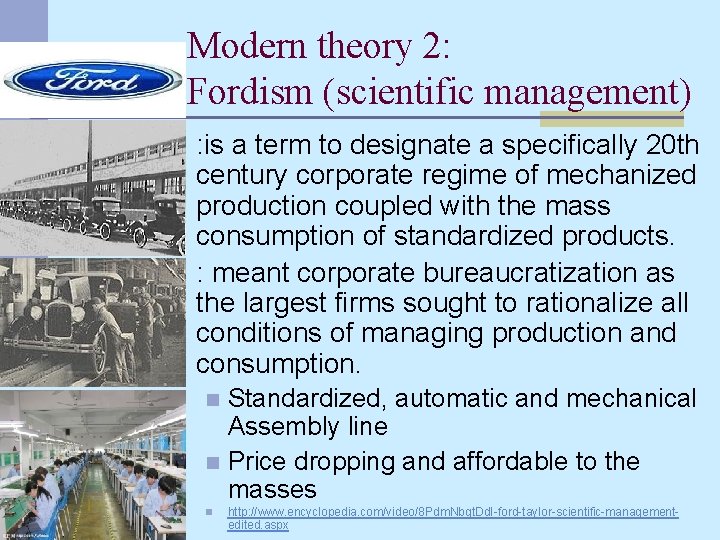
Modern theory 2: Fordism (scientific management) n : is a term to designate a specifically 20 th century corporate regime of mechanized production coupled with the mass consumption of standardized products. n : meant corporate bureaucratization as the largest firms sought to rationalize all conditions of managing production and consumption. Standardized, automatic and mechanical Assembly line n Price dropping and affordable to the masses n n http: //www. encyclopedia. com/video/8 Pdm. Nbqt. Dd. I-ford-taylor-scientific-managementedited. aspx
Modern theory 3: Management by Coercion n Brutal (military type) management n Exploitation (alter factory clock) n Inhuman: self-control (real boss hiding behind) n Only aim: productivity n Assumption: productivity can be increased by coercion (determinist).
Modern theory 4: Management by Paternalism n Humanist type management n The more powerful obligation (responsibility, concerns) the less powerful. n Popular in work studies and gender studies n Assumption: not to challenging the power structure (authority structure). (Let’s talk, not to excited. “Wolf covered by sheep skin”? ) n Assumption: productivity can be increased by a certain method (determinist). n http: //www. youtube. com/watch? v=qs. LMf. NRNCPM
- Slides: 7