
GS 1 Standards Autumn Event 8 12 October

GS 1 Standards Autumn Event 8 -12 October 2012 – Dublin, Ireland Building Standards to Deliver Business Value Name of Session: RFID Bar Code Interoperability Guideline Time of Session: Tuesday 7. 45 Who May Attend: Everyone Speaker names: Michael Sarachman Ken Traub Andrew Osborne
Anti-Trust Caution GS 1 and the GSMP operate under the GS 1 anti-trust caution. Strict compliance with anti-trust laws is and always has been the policy of GS 1. The best way to avoid problems is to remember that the purpose of the committee is to enhance the ability of all industry members to compete more efficiently. This means: • There shall be no discussion of prices, allocation of customers, or products, etc. • If any participant believes the group is drifting towards an impermissible discussion, the topic shall be tabled until the opinion of counsel can be obtained. • The full anti-trust caution is available in the Community Room if you would like to read it in its entirety. © 2012 GS 1 2
Meeting Etiquette Meetings will begin promptly at designated start times Avoid distracting behaviour: • Place all mobile devices on silent mode • Avoid cell phones • Avoid sidebar conversations Speak in turn and be respectful of others Be collaborative in support of the meeting objectives © 2012 GS 1 3
Agenda • Interoperability Challenges Michael Sarachman • Guideline Overview Ken Traub • Benefits Andrew Osborne • On-going Initiatives Michael Sarachman © 2012 GS 1 4
Background • Bar. Codes & EPC Interoperability Work Group • Kicked off – November 2009 • Business Requirements Analysis Document issued August 2010 © 2012 GS 1
Background – Business Requirements • Identified 26 requirements delivered via three initiatives: • Implementation Guideline – 6 requirements • Update EPCIS standards – 2 requirements • GS 1 company prefix length determination solution – 7 requirements • Final 11 out of scope or previously resolved • Guideline Objectives • Clarify encoding, decoding and handling of GS 1 Keys and attributes using Bar. Codes and EPC RFID © 2012 GS 1
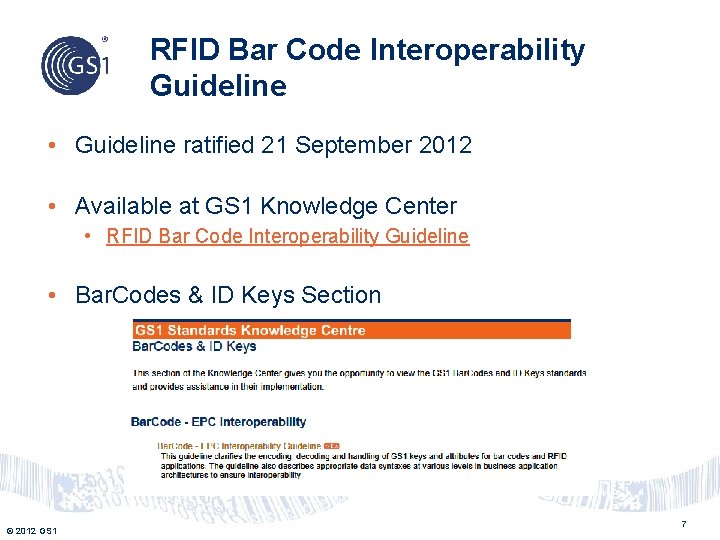
RFID Bar Code Interoperability Guideline • Guideline ratified 21 September 2012 • Available at GS 1 Knowledge Center • RFID Bar Code Interoperability Guideline • Bar. Codes & ID Keys Section © 2012 GS 1 7

Guideline Overview © 2012 GS 1 8
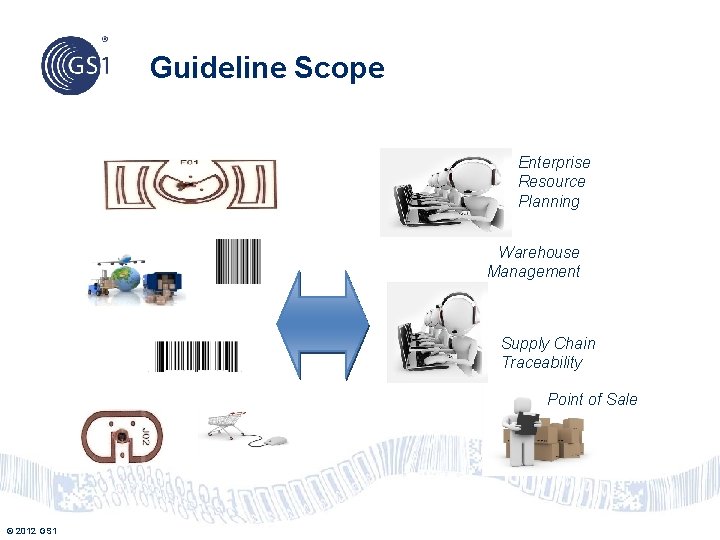
Guideline Scope Enterprise Resource Planning Warehouse Management Supply Chain Traceability Point of Sale © 2012 GS 1
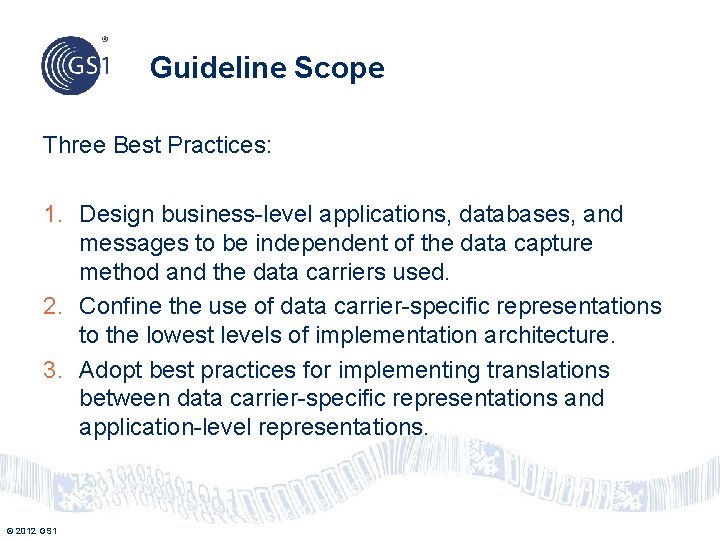
Guideline Scope Three Best Practices: 1. Design business-level applications, databases, and messages to be independent of the data capture method and the data carriers used. 2. Confine the use of data carrier-specific representations to the lowest levels of implementation architecture. 3. Adopt best practices for implementing translations between data carrier-specific representations and application-level representations. © 2012 GS 1
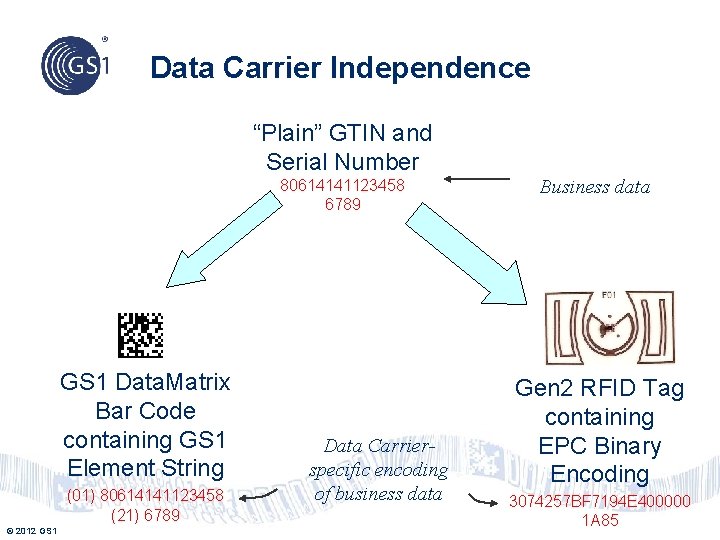
Data Carrier Independence “Plain” GTIN and Serial Number 80614141123458 6789 GS 1 Data. Matrix Bar Code containing GS 1 Element String (01) 80614141123458 (21) 6789 © 2012 GS 1 Data Carrierspecific encoding of business data Business data Gen 2 RFID Tag containing EPC Binary Encoding 3074257 BF 7194 E 400000 1 A 85

Application-Level Syntax • Key concept: Use application-level syntax at the business application level (not carrier-specific syntax) Biz App Data Capture SW Biz DB Right: <gtin>80614141123458</gtin> <serial>6789<serial> Wrong: ]C 10180614141123458216789 3074257 BF 7194 E 4000001 A 85 © 2012 GS 1
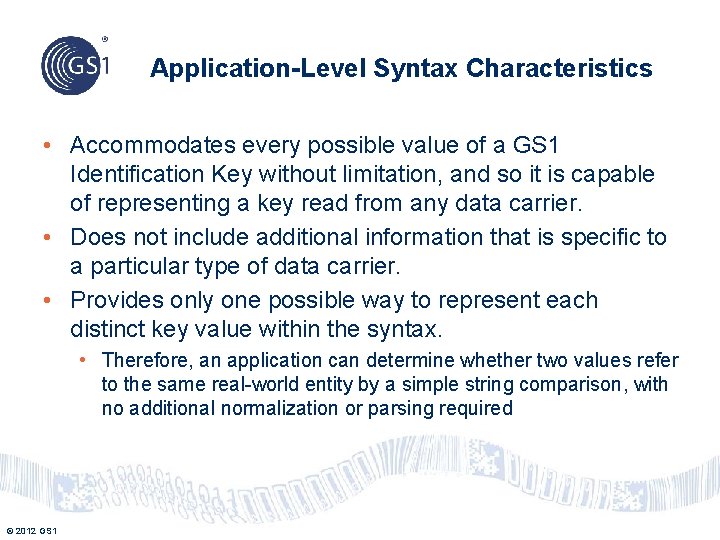
Application-Level Syntax Characteristics • Accommodates every possible value of a GS 1 Identification Key without limitation, and so it is capable of representing a key read from any data carrier. • Does not include additional information that is specific to a particular type of data carrier. • Provides only one possible way to represent each distinct key value within the syntax. • Therefore, an application can determine whether two values refer to the same real-world entity by a simple string comparison, with no additional normalization or parsing required © 2012 GS 1
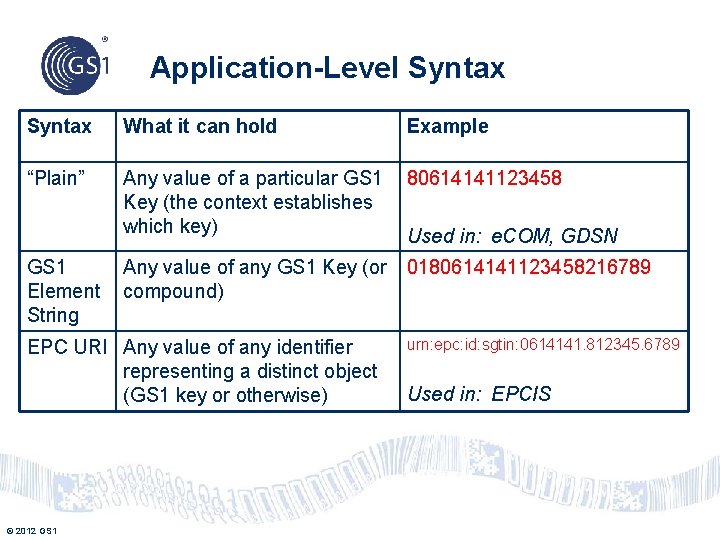
Application-Level Syntax What it can hold Example “Plain” Any value of a particular GS 1 Key (the context establishes which key) 80614141123458 Any value of any GS 1 Key (or compound) 0180614141123458216789 GS 1 Element String EPC URI Any value of any identifier representing a distinct object (GS 1 key or otherwise) © 2012 GS 1 Used in: e. COM, GDSN urn: epc: id: sgtin: 0614141. 812345. 6789 Used in: EPCIS
![Carrier-Specific Syntax Example Carrier-specific Aspects Bar code scanner output ]C 10180614141123458216789 Symbology identifier Same](http://slidetodoc.com/presentation_image_h2/936bafad309f104de18021d434f98acc/image-15.jpg "Carrier-Specific Syntax Example Carrier-specific Aspects Bar code scanner output ]C 10180614141123458216789 Symbology identifier Same")
Carrier-Specific Syntax Example Carrier-specific Aspects Bar code scanner output ]C 10180614141123458216789 Symbology identifier Same GS 1 Key yields different output depending on symbology (e. g. , UPC-A vs Data. Matrix) EPC Tag URI urn: epc: tag: sgtin-96: 3. 0614141. 812345. 6789 “Filter” value and other RFIDspecific controls Size-related restrictions Same GS 1 Key yields different outputs depending on size and control info EPC Binary Encoding 3074257 BF 7194 E 4000001 A 85 All of above, plus: RFID-specific binary compression © 2012 GS 1
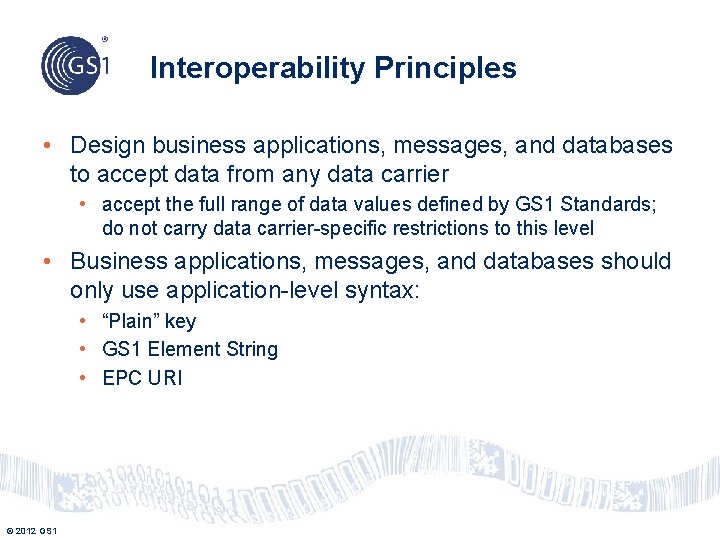
Interoperability Principles • Design business applications, messages, and databases to accept data from any data carrier • accept the full range of data values defined by GS 1 Standards; do not carry data carrier-specific restrictions to this level • Business applications, messages, and databases should only use application-level syntax: • “Plain” key • GS 1 Element String • EPC URI © 2012 GS 1
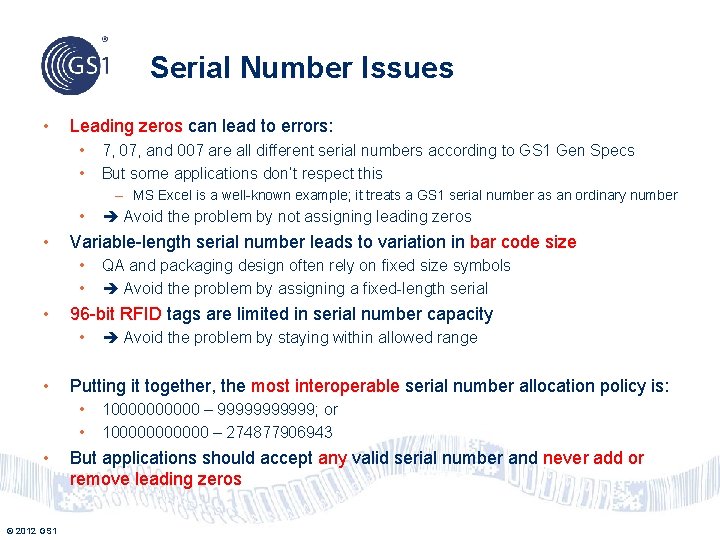
Serial Number Issues • Leading zeros can lead to errors: • • 7, 07, and 007 are all different serial numbers according to GS 1 Gen Specs But some applications don’t respect this – MS Excel is a well-known example; it treats a GS 1 serial number as an ordinary number • • Variable-length serial number leads to variation in bar code size • • • © 2012 GS 1 Avoid the problem by staying within allowed range Putting it together, the most interoperable serial number allocation policy is: • • • QA and packaging design often rely on fixed size symbols Avoid the problem by assigning a fixed-length serial 96 -bit RFID tags are limited in serial number capacity • • Avoid the problem by not assigning leading zeros 100000 – 999999; or 1000000 – 274877906943 But applications should accept any valid serial number and never add or remove leading zeros
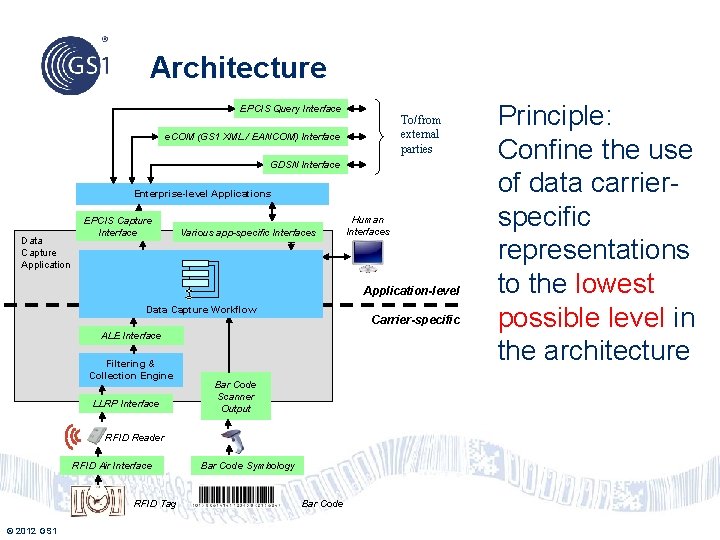
Architecture EPCIS Query Interface To/from external parties e. COM (GS 1 XML / EANCOM) Interface GDSN Interface Enterprise-level Applications Data Capture Application EPCIS Capture Interface Various app-specific Interfaces Human Interfaces Application-level Data Capture Workflow Carrier-specific ALE Interface Filtering & Collection Engine LLRP Interface Bar Code Scanner Output RFID Reader RFID Air Interface RFID Tag © 2012 GS 1 Bar Code Symbology Bar Code Principle: Confine the use of data carrierspecific representations to the lowest possible level in the architecture
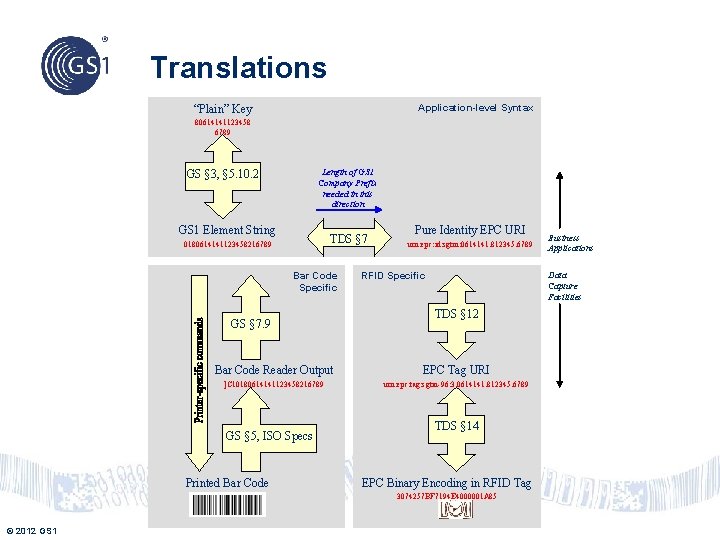
Translations Application-level Syntax “Plain” Key 80614141123458 6789 Length of GS 1 Company Prefix needed in this direction GS § 3, § 5. 10. 2 GS 1 Element String TDS § 7 0180614141123458216789 Bar Code Specific GS § 7. 9 Pure Identity EPC URI urn: epc: id: sgtin: 0614141. 812345. 6789 Data Capture Facilities RFID Specific TDS § 12 Bar Code Reader Output EPC Tag URI ]C 10180614141123458216789 urn: epc: tag: sgtin-96: 3. 0614141. 812345. 6789 GS § 5, ISO Specs Printed Bar Code TDS § 14 EPC Binary Encoding in RFID Tag 3074257 BF 7194 E 4000001 A 85 © 2012 GS 1 Business Applications
Guideline Scope Three Best Practices: 1. Design business-level applications, databases, and messages to be independent of the data capture method and the data carriers used. 2. Confine the use of data carrier-specific representations to the lowest levels of implementation architecture. 3. Adopt best practices for implementing translations between data carrier-specific representations and application-level representations. © 2012 GS 1
Member Organization View © 2012 GS 1 21

This is the UK © 2012 GS 1
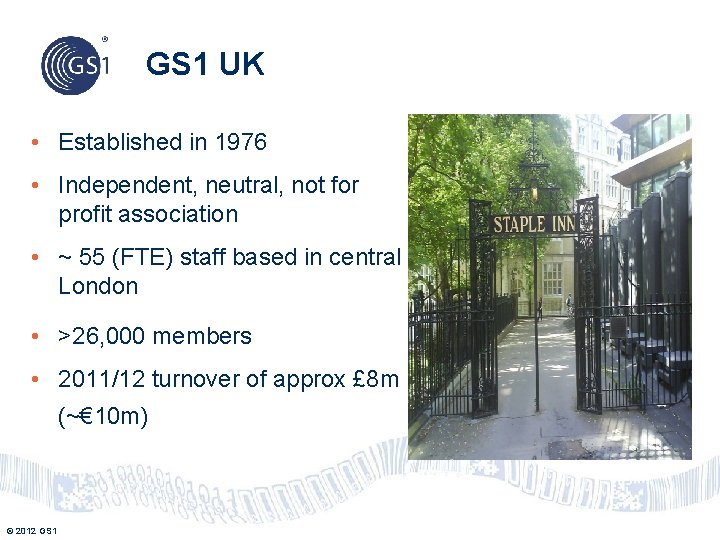
GS 1 UK • Established in 1976 • Independent, neutral, not for profit association • ~ 55 (FTE) staff based in central London • >26, 000 members • 2011/12 turnover of approx £ 8 m (~€ 10 m) © 2012 GS 1
In Principle • • • © 2012 GS 1 Carrier Independence RFID/ Bar code co-existence Seamless transition Application level syntax One system not two: correcting perceptions
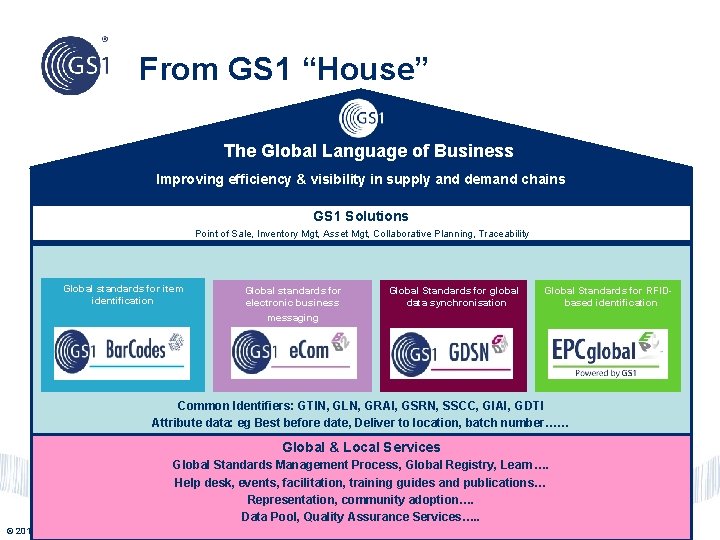
From GS 1 “House” The Global Language of Business Improving efficiency & visibility in supply and demand chains GS 1 Solutions Point of Sale, Inventory Mgt, Asset Mgt, Collaborative Planning, Traceability Global standards for item identification Global standards for electronic business messaging Global Standards for global data synchronisation Global Standards for RFIDbased identification Common Identifiers: GTIN, GLN, GRAI, GSRN, SSCC, GIAI, GDTI Attribute data: eg Best before date, Deliver to location, batch number…… Global & Local Services Global Standards Management Process, Global Registry, Learn…. Help desk, events, facilitation, training guides and publications… Representation, community adoption…. Data Pool, Quality Assurance Services…. . © 2012 GS 1
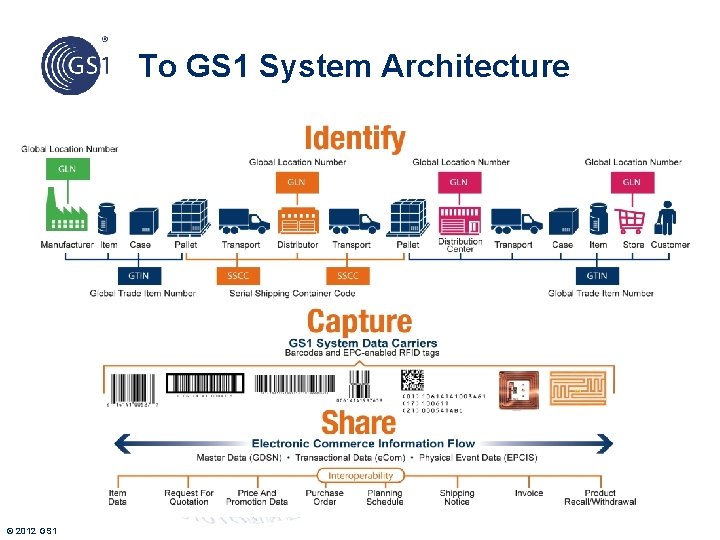
To GS 1 System Architecture © 2012 GS 1
Demand for the Document • Overwhelming? • Real? © 2012 GS 1

Our small members © 2012 GS 1
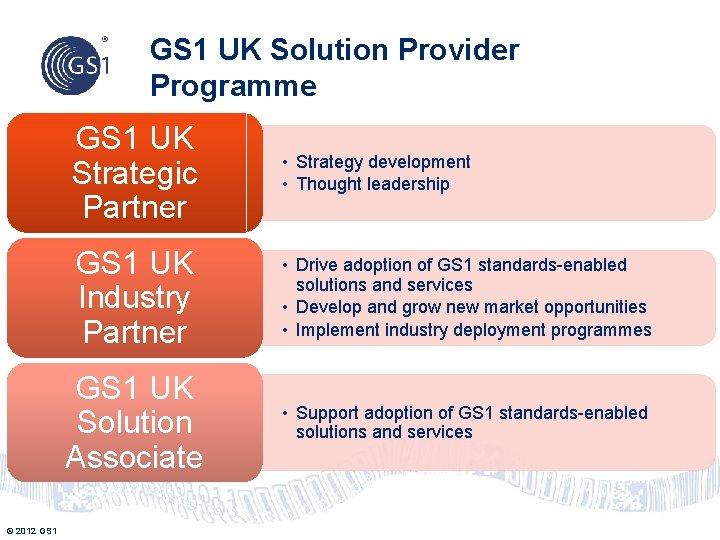
GS 1 UK Solution Provider Programme © 2012 GS 1 UK Strategic Partner • Strategy development • Thought leadership GS 1 UK Industry Partner • Drive adoption of GS 1 standards-enabled solutions and services • Develop and grow new market opportunities • Implement industry deployment programmes GS 1 UK Solution Associate • Support adoption of GS 1 standards-enabled solutions and services
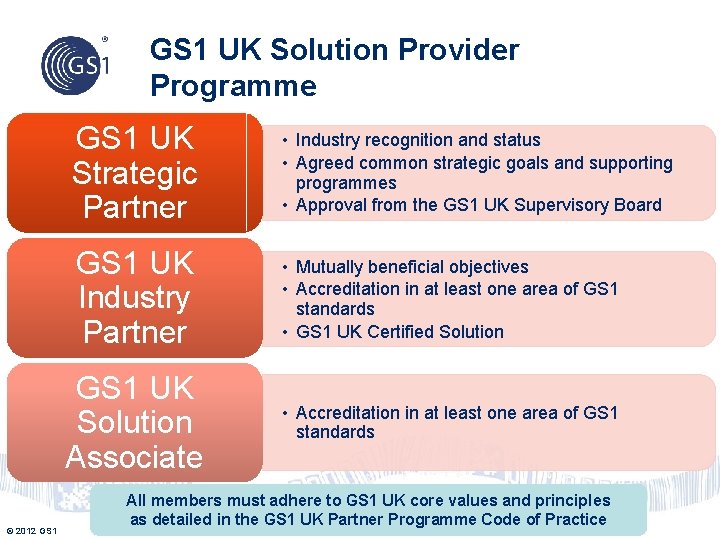
GS 1 UK Solution Provider Programme © 2012 GS 1 UK Strategic Partner • Industry recognition and status • Agreed common strategic goals and supporting programmes • Approval from the GS 1 UK Supervisory Board GS 1 UK Industry Partner • Mutually beneficial objectives • Accreditation in at least one area of GS 1 standards • GS 1 UK Certified Solution GS 1 UK Solution Associate • Accreditation in at least one area of GS 1 standards All members must adhere to GS 1 UK core values and principles as detailed in the GS 1 UK Partner Programme Code of Practice
Summary • Based on principles • Grounded in reality • Practical advice © 2012 GS 1

Ongoing Initiatives © 2012 GS 1 32
Company Prefix Solution • Project launched August 2012 • Objectives • Develop and launch tool that enables smooth interoperability • Support applications not continually connected to Internet © 2012 GS 1 33
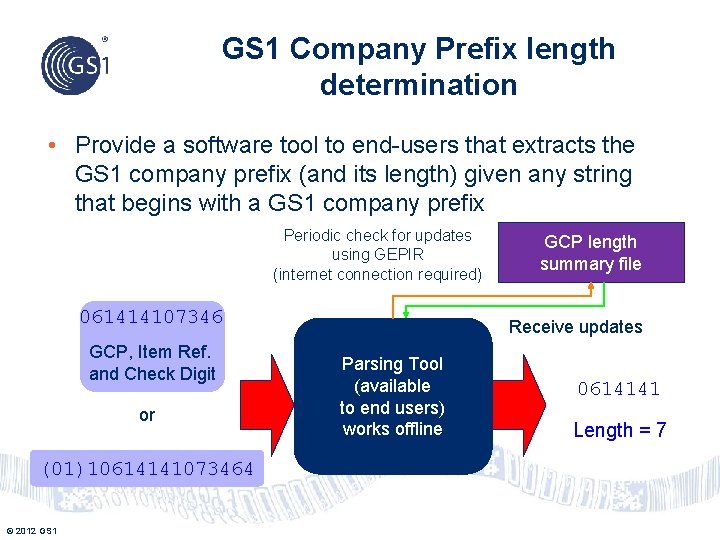
GS 1 Company Prefix length determination • Provide a software tool to end-users that extracts the GS 1 company prefix (and its length) given any string that begins with a GS 1 company prefix Periodic check for updates using GEPIR (internet connection required) 061414107346 GCP, Item Ref. and Check Digit or (01)10614141073464 © 2012 GS 1 GCP length summary file Receive updates Parsing Tool (available to end users) works offline 0614141 Length = 7
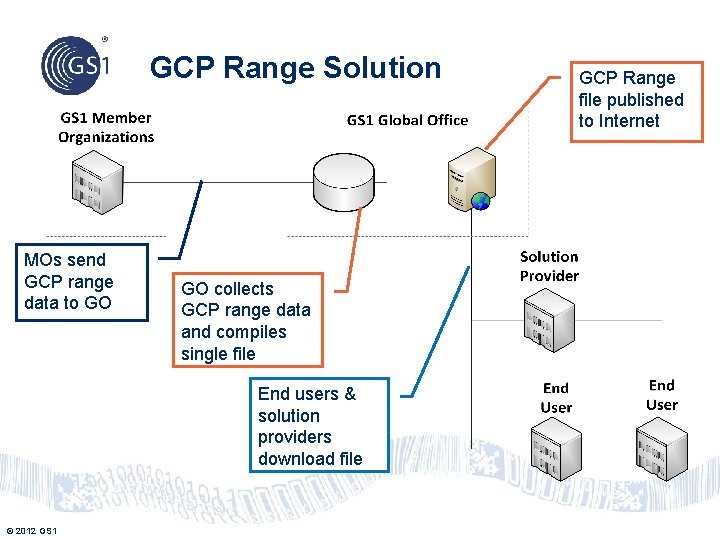
GCP Range Solution MOs send GCP range data to GO GO collects GCP range data and compiles single file End users & solution providers download file © 2012 GS 1 GCP Range file published to Internet
GCP Tool Project Update • Status • Project team formed & meeting bi-weekly • Requirements developed – drafting functional specifications • Next Steps • Prepare pilot program – Collect and consolidate GCP ranges from 5 to 8 MOs – 2 -3 Solution Providers test GCP length programs using pilot data table – Publish pilot report in December 2012 • Plan ongoing system development and testing • Contacts for more information • Henri Barthel • Michael Sarachman © 2012 GS 1 36

GS 1 Standards Spring Event Dallas, TX, USA Hosted by © 2012 GS 1 Save the date! 18 -22 March 2013
Community feedback drives our continual improvement! There are three types surveys: 1. Individual Session Surveys - Please complete the hard copy satisfaction survey at the end of each working group session. Your group leader will provide it to you. • You might win a Kindle e. Reader! 2. Overall Event Survey – All attendees will receive an email on Friday to rate your overall satisfaction of the event. • You might win a Kindle e. Reader! 3. Knowledge Center Usability Test Visit the GS 1 Registration Desk to participate • You might win a Google Nexus Tablet! © 2012 GS 1 38

Contact Details GS 1 Global Office Avenue Louise 326, bte 10 B-1050 Brussels, Belgium T + 32 2 788 78 00 W www. gs 1. org
- Slides: 39