
Gryff Unifying Consensus and Shared Registers Matthew Burke
Gryff: Unifying Consensus and Shared Registers Matthew Burke Cornell University Audrey Cheng Wyatt Lloyd Princeton University 1
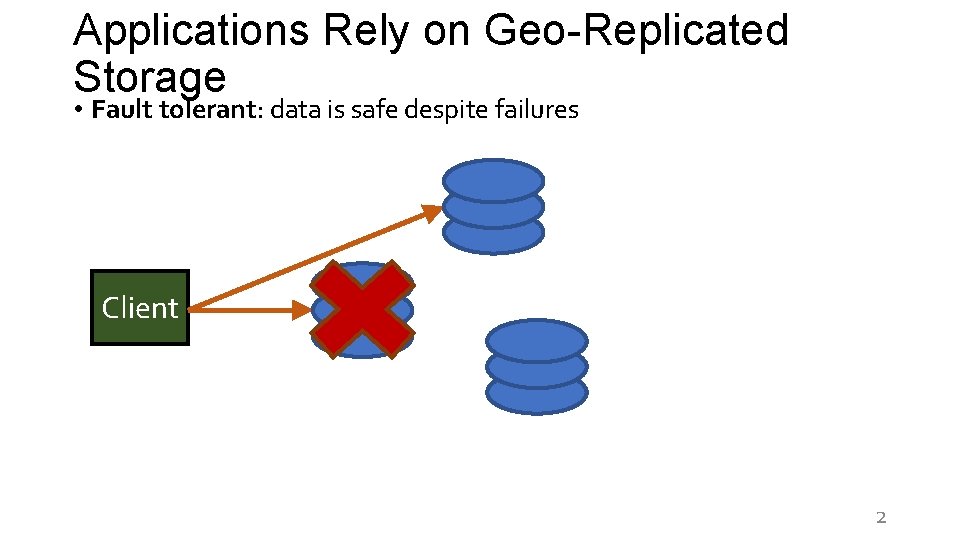
Applications Rely on Geo-Replicated Storage • Fault tolerant: data is safe despite failures Client 2

Applications Rely on Geo-Replicated Storage • Fault tolerant: data is safe despite failures • Linearizable: intuitive for application developers ≡ 3
Linearizable Replicated Storage Systems Cloud Spanner 4
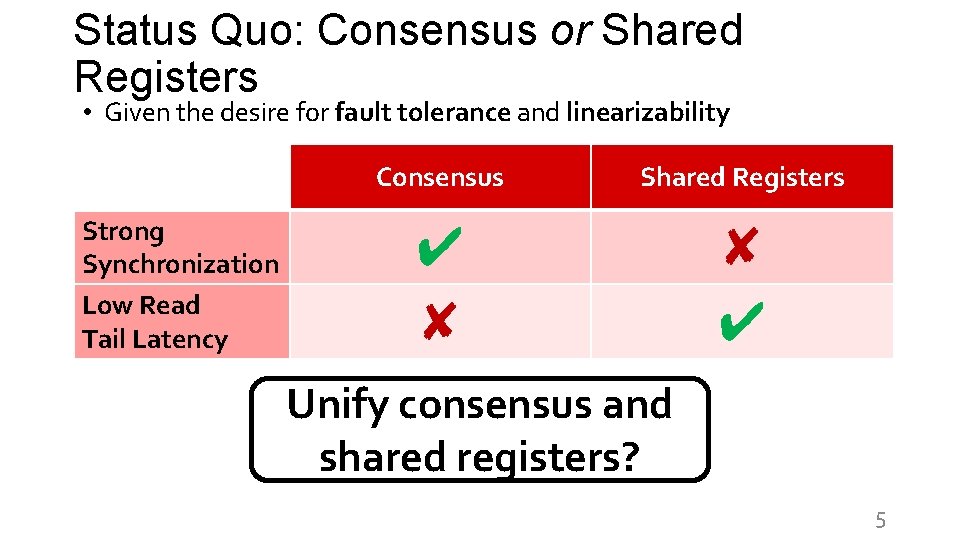
Status Quo: Consensus or Shared Registers • Given the desire for fault tolerance and linearizability Strong Synchronization Low Read Tail Latency Consensus Shared Registers ✔ ✘ ✘ ✔ Unify consensus and shared registers? 5

Consensus & State Machine Replication (SMR) • Generic interface: Command(c(. )) • Stable ordering: all preceding log positions are assigned commands • Used in etcd, Cockroach. DB, Spanner, Azure Storage, Chubby c 1 c 2 c 3 c 4 6
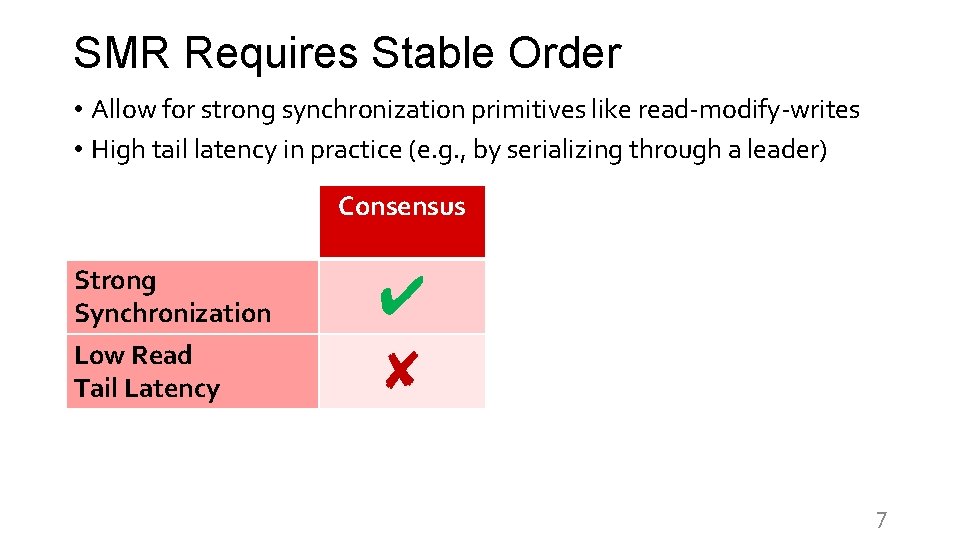
SMR Requires Stable Order • Allow for strong synchronization primitives like read-modify-writes • High tail latency in practice (e. g. , by serializing through a leader) Consensus Strong Synchronization Low Read Tail Latency ✔ ✘ 7
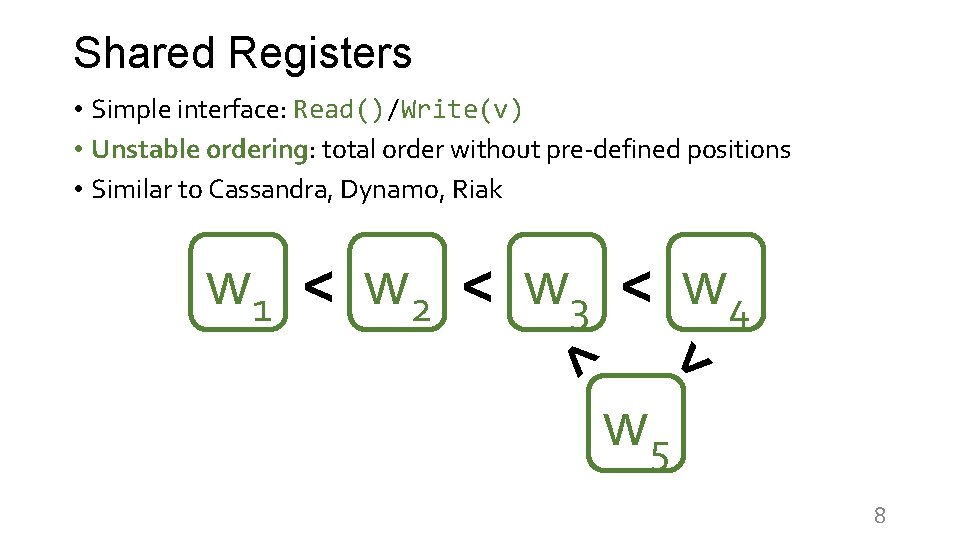
Shared Registers • Simple interface: Read()/Write(v) • Unstable ordering: total order without pre-defined positions • Similar to Cassandra, Dynamo, Riak < < w 1 < w 2 < w 3 < w 4 w 5 8
![Shared Registers Use Unstable Order • Cannot implement strong synchronization primitives [Herlihy 91] •](http://slidetodoc.com/presentation_image_h2/bee976e310b7ecc911f4e3941eaa0ea2/image-9.jpg "Shared Registers Use Unstable Order • Cannot implement strong synchronization primitives [Herlihy 91] •")
Shared Registers Use Unstable Order • Cannot implement strong synchronization primitives [Herlihy 91] • Flexibility of unstable order provides favorable tail latency Strong Synchronization Low Read Tail Latency Consensus Shared Registers ✔ ✘ ✘ ✔ 9
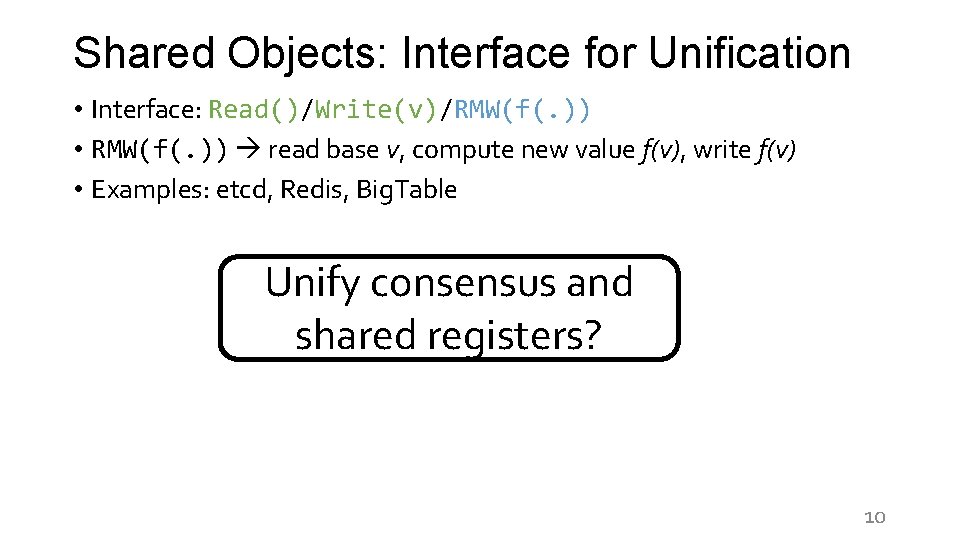
Shared Objects: Interface for Unification • Interface: Read()/Write(v)/RMW(f(. )) • RMW(f(. )) read base v, compute new value f(v), write f(v) • Examples: etcd, Redis, Big. Table RMWs Unify consensus with low read and shared tail latency? registers? 10
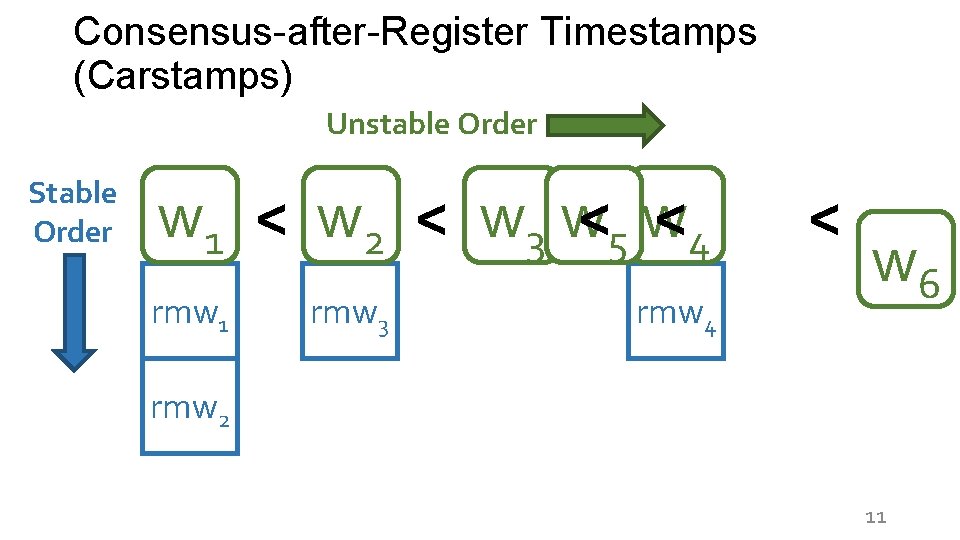
Consensus-after-Register Timestamps (Carstamps) Unstable Order Stable Order <4 w 1 < w 2 < w 3 w<5 w rmw 1 rmw 3 rmw 4 < w 6 rmw 2 11
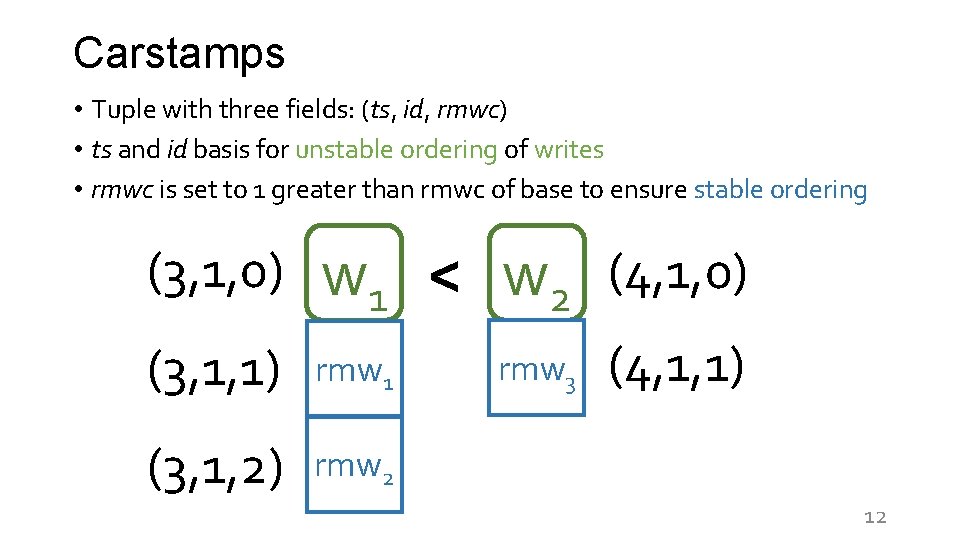
Carstamps • Tuple with three fields: (ts, id, rmwc) • ts and id basis for unstable ordering of writes • rmwc is set to 1 greater than rmwc of base to ensure stable ordering (3, 1, 0) w 1 < w 2 (4, 1, 0) (3, 1, 1) rmw 1 (3, 1, 2) rmw 2 rmw 3 (4, 1, 1) 12
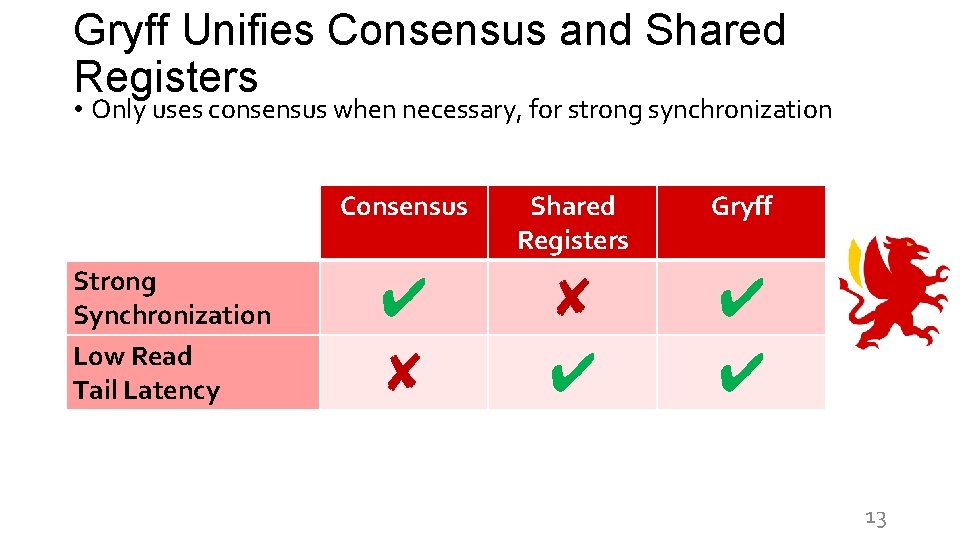
Gryff Unifies Consensus and Shared Registers • Only uses consensus when necessary, for strong synchronization Strong Synchronization Low Read Tail Latency Consensus Shared Registers Gryff ✔ ✘ ✘ ✔ ✔ ✔ 13
![Gryff Design • Combine multi-writer [LS 97] ABD [ABD 95] & EPaxos [MAK 13]](http://slidetodoc.com/presentation_image_h2/bee976e310b7ecc911f4e3941eaa0ea2/image-14.jpg "Gryff Design • Combine multi-writer [LS 97] ABD [ABD 95] & EPaxos [MAK 13]")
Gryff Design • Combine multi-writer [LS 97] ABD [ABD 95] & EPaxos [MAK 13] • Modifications needed for safety: • Carstamps for proper ordering • Synchronous Commit phase for rmws • Modifications for better read tail latency: • Early termination for reads (fast path) • Proxy optimization for reads (fast path more often) See the paper for details! 14
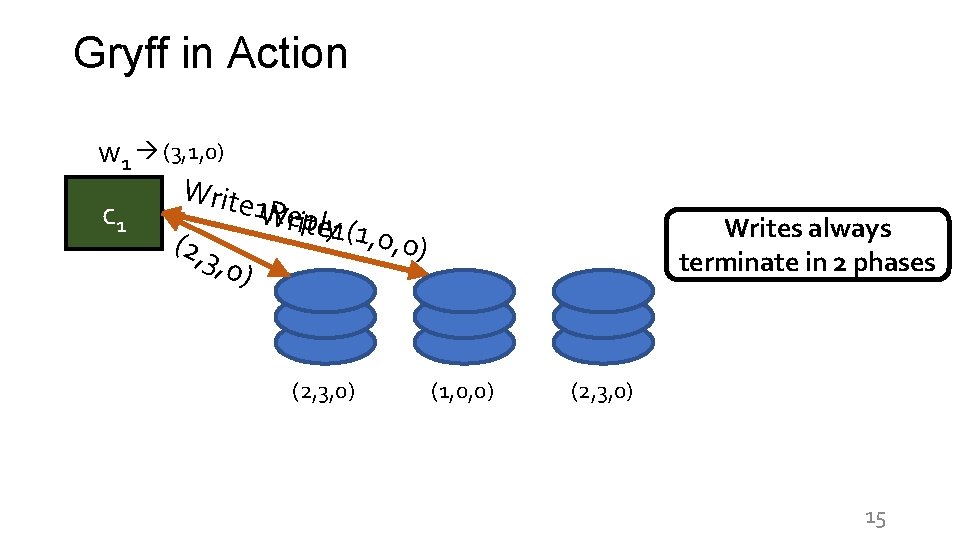
Gryff in Action w 1 (3, 1, 0) Write 1 W Reriptely c 1 1(1, 0, 0 (2, 3 ) , 0) (2, 3, 0) Writes always terminate in 2 phases (1, 0, 0) (2, 3, 0) 15
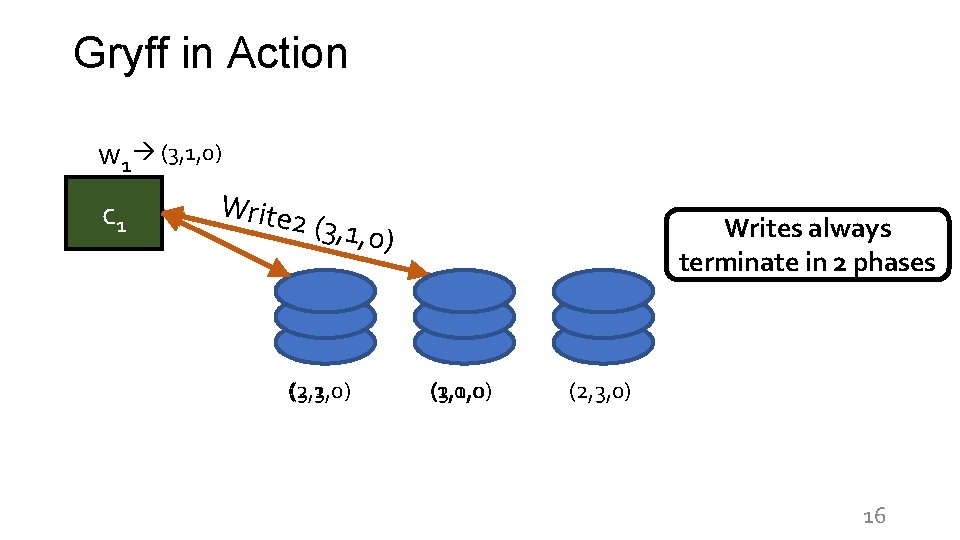
Gryff in Action w 1 (3, 1, 0) c 1 Write 2 (3, 1, 0) (2, 3, 0) (3, 1, 0) Writes always terminate in 2 phases (1, 0, 0) (3, 1, 0) (2, 3, 0) 16
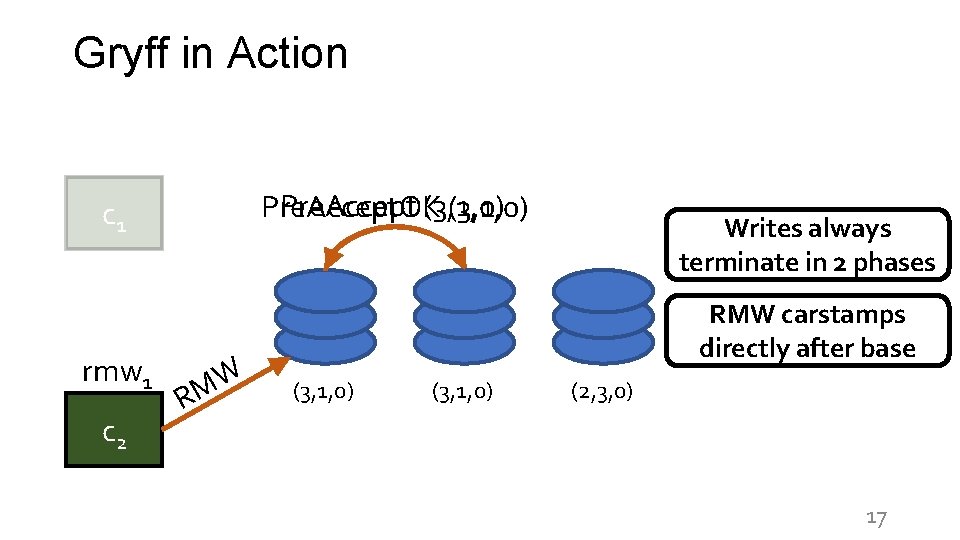
Gryff in Action Pre. Accept (3, 1, 0) Pre. Accept. OK (3, 1, 0) c 1 rmw 1 c 2 W RM Writes always terminate in 2 phases RMW carstamps directly after base (3, 1, 0) (2, 3, 0) 17
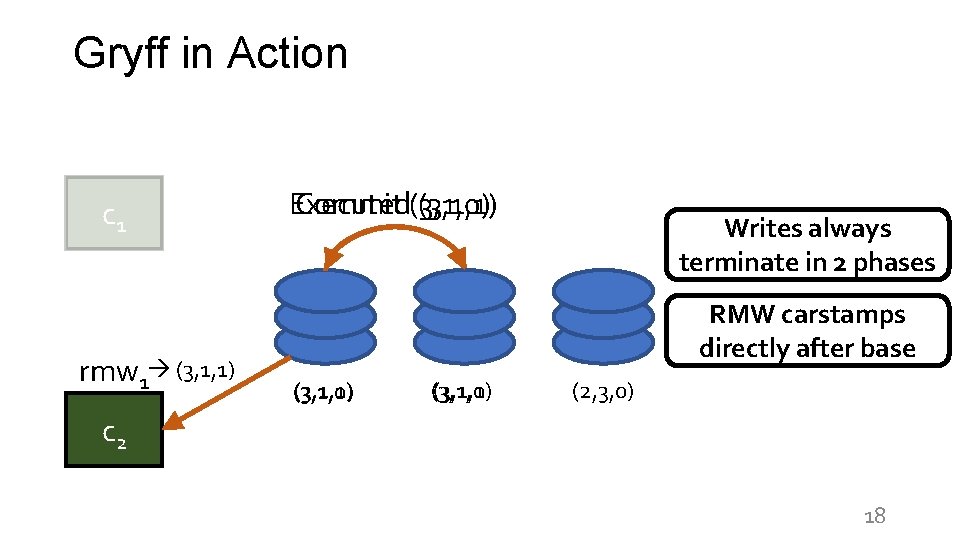
Gryff in Action c 1 rmw 1 (3, 1, 1) Commit (3, 1, 0) Executed (3, 1, 1) Writes always terminate in 2 phases RMW carstamps directly after base (3, 1, 1) (3, 1, 0) (3, 1, 1) (2, 3, 0) c 2 18
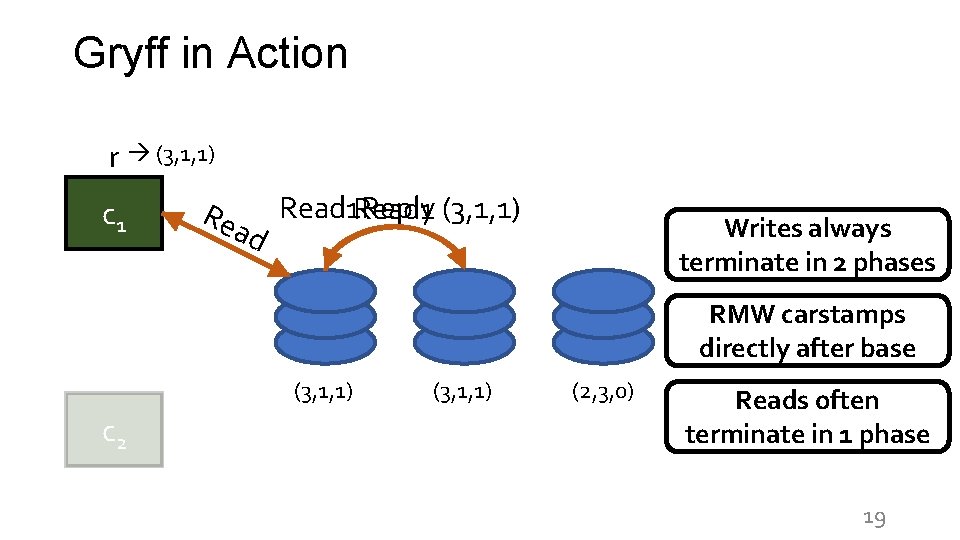
Gryff in Action r (3, 1, 1) c 1 Read 1 (3, 1, 1) Read 1 Reply d Writes always terminate in 2 phases RMW carstamps directly after base (3, 1, 1) c 2 (3, 1, 1) (2, 3, 0) Reads often terminate in 1 phase 19
Evaluation Relative to state-of-the-art-consensus protocols: 1. How do Gryff’s read/write protocols affect read tail latency? 2. What is the latency distribution of Gryff’s reads, writes, and rmws? 3. What maximum throughput does Gryff achieve? 4. How does Gryff perform in tail-at-scale workloads? 20
Evaluation Relative to state-of-the-art-consensus protocols: 1. How do Gryff’s read/write protocols affect read tail latency? 2. What is the latency distribution of Gryff’s reads, writes, and rmws? 3. What maximum throughput does Gryff achieve? 4. How does Gryff perform in tail-at-scale workloads? 21
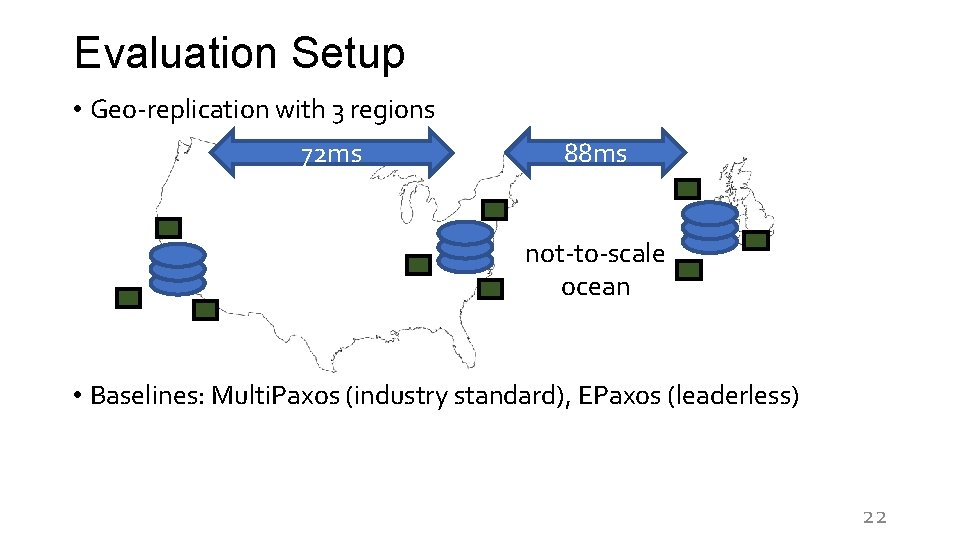
Evaluation Setup • Geo-replication with 3 regions 72 ms 88 ms not-to-scale ocean • Baselines: Multi. Paxos (industry standard), EPaxos (leaderless) 22
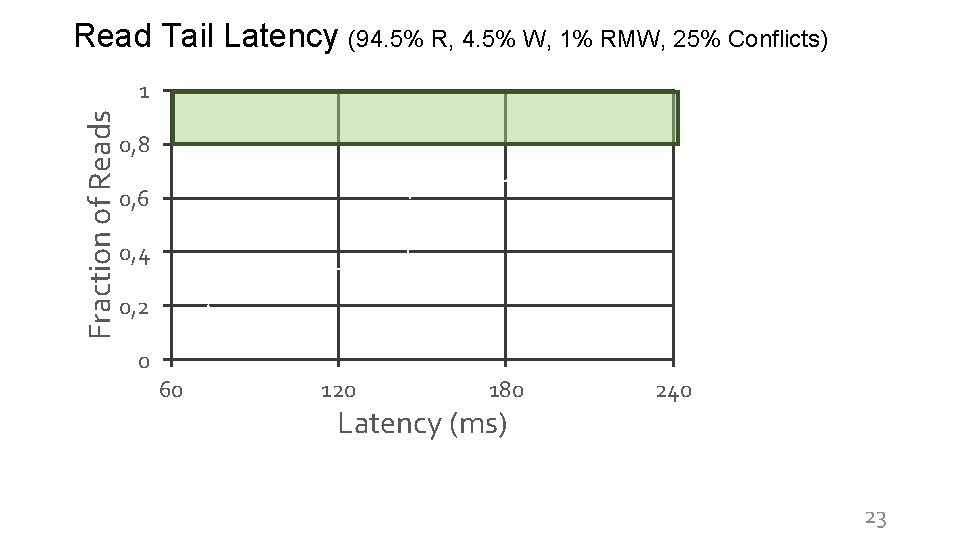
Read Tail Latency (94. 5% R, 4. 5% W, 1% RMW, 25% Conflicts) Fraction of Reads 1 0, 8 0, 6 0, 4 Multi. Paxos 0, 2 0 60 120 180 Latency (ms) 240 23
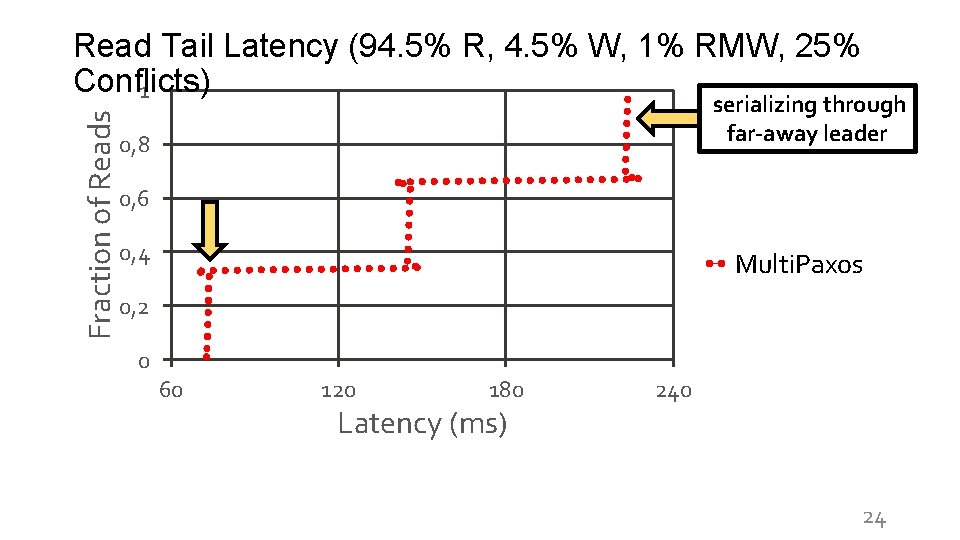
Fraction of Reads Read Tail Latency (94. 5% R, 4. 5% W, 1% RMW, 25% Conflicts) 1 serializing through far-away leader 0, 8 0, 6 0, 4 Multi. Paxos 0, 2 0 60 120 180 Latency (ms) 240 24
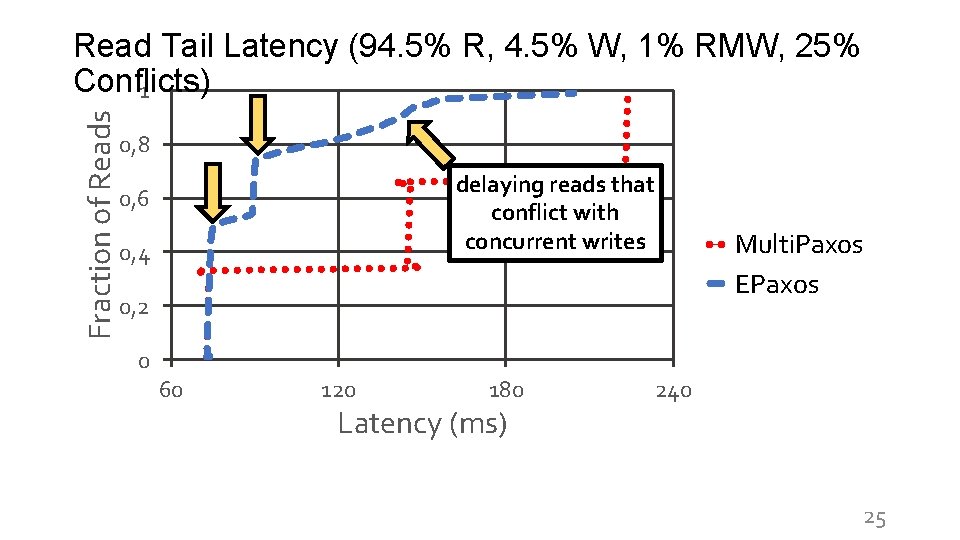
Fraction of Reads Read Tail Latency (94. 5% R, 4. 5% W, 1% RMW, 25% Conflicts) 1 0, 8 delaying reads that conflict with concurrent writes 0, 6 0, 4 Multi. Paxos EPaxos 0, 2 0 60 120 180 Latency (ms) 240 25
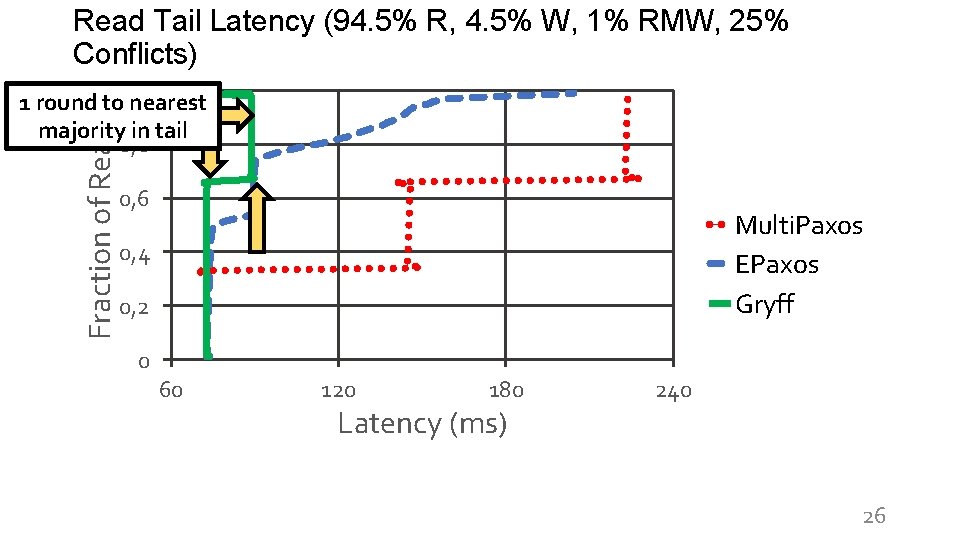
Read Tail Latency (94. 5% R, 4. 5% W, 1% RMW, 25% Conflicts) Fraction of Reads 1 1 round to nearest majority in tail 0, 8 0, 6 Multi. Paxos EPaxos Gryff 0, 4 0, 2 0 60 120 180 Latency (ms) 240 26
Summary • Consensus: strong synchronization w/ high tail latency Shared registers: low tail latency w/o strong synchronization • Carstamps stably order read-modify-writes within a more efficient unstable order for reads and writes • Gryff unifies an optimized shared register protocol with a state-of-the-art consensus protocol using carstamps • Gryff provides strong synchronization w/ low read tail latency 27

28
Image Attribution • Griffin by Delapouite / CC BY 3. 0 Unported (modified) • etcd • Cockroach. DB • Spanner by Google / CC BY 4. 0 29
- Slides: 29