
Growth Mindset A Key Competency in SocialEmotional Learning



- Slides: 32
Growth Mindset A Key Competency in Social-Emotional Learning Equipping students with the mindsets, skills and habits they need to succeed © 2015 by Transforming Education This work is licensed under the Creative Commons Attribution-Non. Commercial-Share. Alike 4. 0 International License. To view a copy of this license, visit http: //creativecommons. org/licenses/by-nc-sa/4. 0/.
Contents – Introduction – Growth Mindset – Teri’s Story – One Way to Encourage Growth Mindset: Praise – Sample Growth Mindset Practices – Growth Mindset in Class – Wrapping Up 2
Introduction In this session, you will – Build a deeper understanding of growth mindset, one example of a social-emotional competency that can help students succeed – Leave with at least one specific technique or idea that you could try in the classroom to support your students in developing a growth mindset In this session, you will not – Be asked to implement a new program or trendy curriculum related to growth mindset and other social-emotional skills 3
Introduction Skills beyond academic knowledge are crucial to college and career readiness – E. g. , perseverance, motivation, social awareness, self-control, etc. – Teachers have long known the importance of these skills and have taught them to their students – They are often referred to as social-emotional skills or non-cognitive skills But current standardized tests don’t assess these skills – Schools don’t always acknowledge the importance of these skills or give teachers the credit they deserve for the work they’re already doing in this area 4
Warm Up Turn to a Partner – Describe something that you’ve learned that was extremely challenging and that took you a few tries to learn. o Did you ever think you might not succeed? o What process did you go through? o What different learning strategies did you try? 5
Growth Mindset A powerful concept, with a strong evidence base © 2015 by Transforming Education
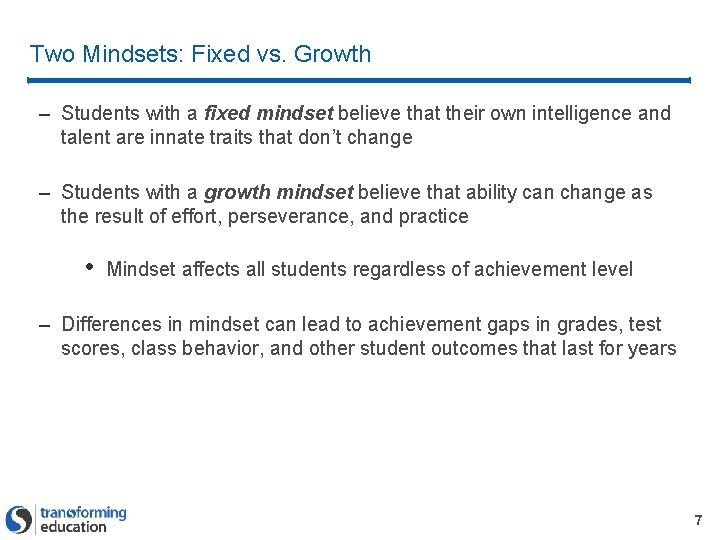
Two Mindsets: Fixed vs. Growth – Students with a fixed mindset believe that their own intelligence and talent are innate traits that don’t change – Students with a growth mindset believe that ability can change as the result of effort, perseverance, and practice • Mindset affects all students regardless of achievement level – Differences in mindset can lead to achievement gaps in grades, test scores, class behavior, and other student outcomes that last for years 7
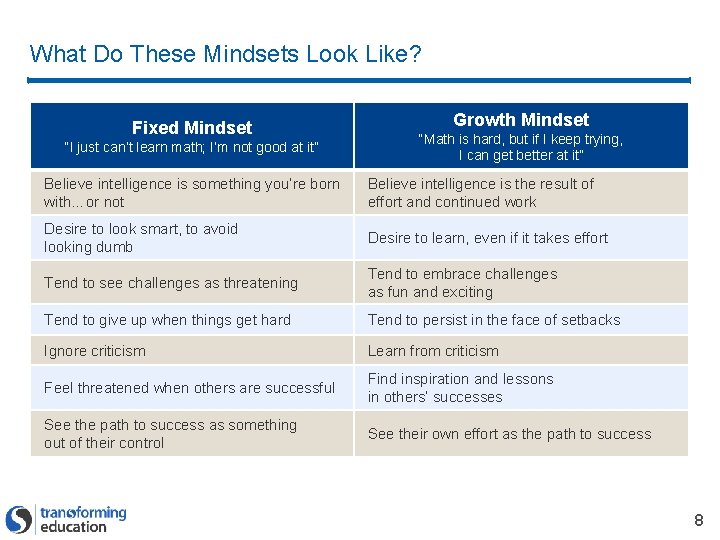
What Do These Mindsets Look Like? Fixed Mindset “I just can’t learn math; I’m not good at it” Growth Mindset “Math is hard, but if I keep trying, I can get better at it” Believe intelligence is something you’re born with…or not Believe intelligence is the result of effort and continued work Desire to look smart, to avoid looking dumb Desire to learn, even if it takes effort Tend to see challenges as threatening Tend to embrace challenges as fun and exciting Tend to give up when things get hard Tend to persist in the face of setbacks Ignore criticism Learn from criticism Feel threatened when others are successful Find inspiration and lessons in others’ successes See the path to success as something out of their control See their own effort as the path to success 8
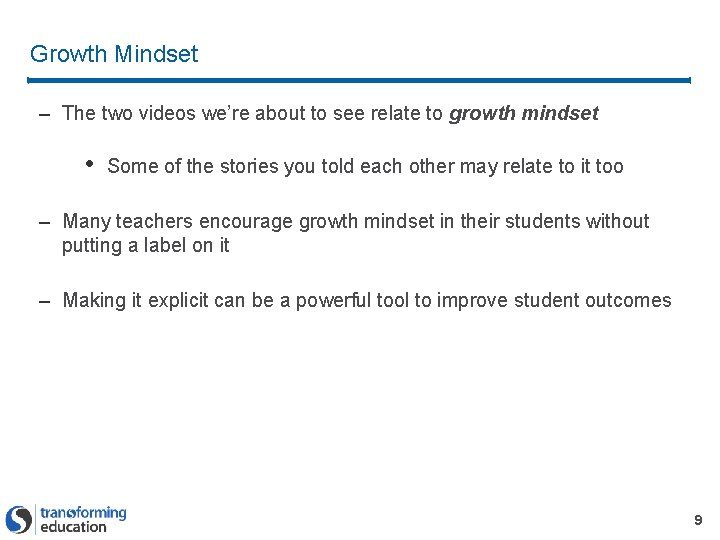
Growth Mindset – The two videos we’re about to see relate to growth mindset • Some of the stories you told each other may relate to it too – Many teachers encourage growth mindset in their students without putting a label on it – Making it explicit can be a powerful tool to improve student outcomes 9
Teri’s Story A challenge the 10 th-grader struggled with in school © 2015 by Transforming Education
Video_1_Teri_Student_Voice. mp 4
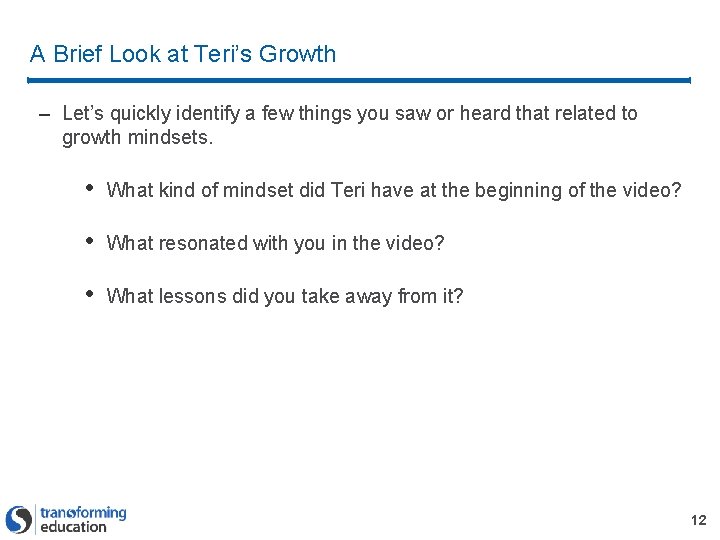
A Brief Look at Teri’s Growth – Let’s quickly identify a few things you saw or heard that related to growth mindsets. • What kind of mindset did Teri have at the beginning of the video? • What resonated with you in the video? • What lessons did you take away from it? 12
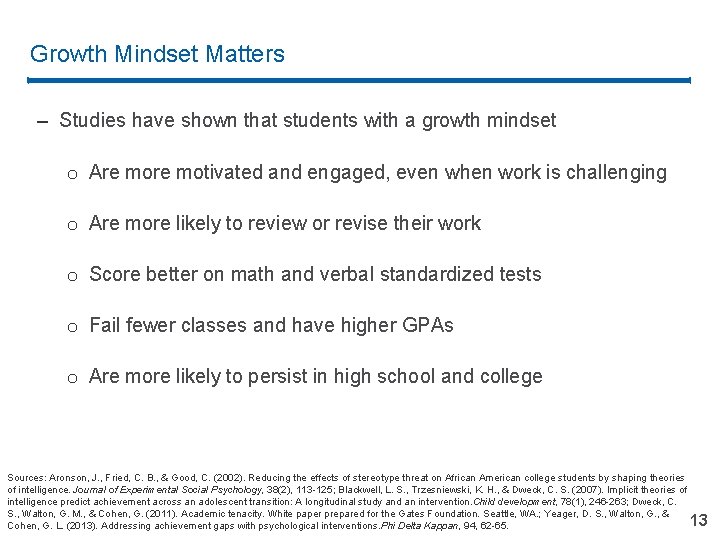
Growth Mindset Matters – Studies have shown that students with a growth mindset o Are motivated and engaged, even when work is challenging o Are more likely to review or revise their work o Score better on math and verbal standardized tests o Fail fewer classes and have higher GPAs o Are more likely to persist in high school and college Sources: Aronson, J. , Fried, C. B. , & Good, C. (2002). Reducing the effects of stereotype threat on African American college students by shaping theories of intelligence. Journal of Experimental Social Psychology, 38(2), 113 -125; Blackwell, L. S. , Trzesniewski, K. H. , & Dweck, C. S. (2007). Implicit theories of intelligence predict achievement across an adolescent transition: A longitudinal study and an intervention. Child development, 78(1), 246 -263; Dweck, C. S. , Walton, G. M. , & Cohen, G. (2011). Academic tenacity. White paper prepared for the Gates Foundation. Seattle, WA. ; Yeager, D. S. , Walton, G. , & Cohen, G. L. (2013). Addressing achievement gaps with psychological interventions. Phi Delta Kappan, 94, 62 -65. 13
Encouraging a Growth Mindset The power of praise
Video_2__the_Impact_of_Praise. mp 4 15
What Can a Teacher Do? Sample growth mindset practices developed by educators © 2015 by Transforming Education
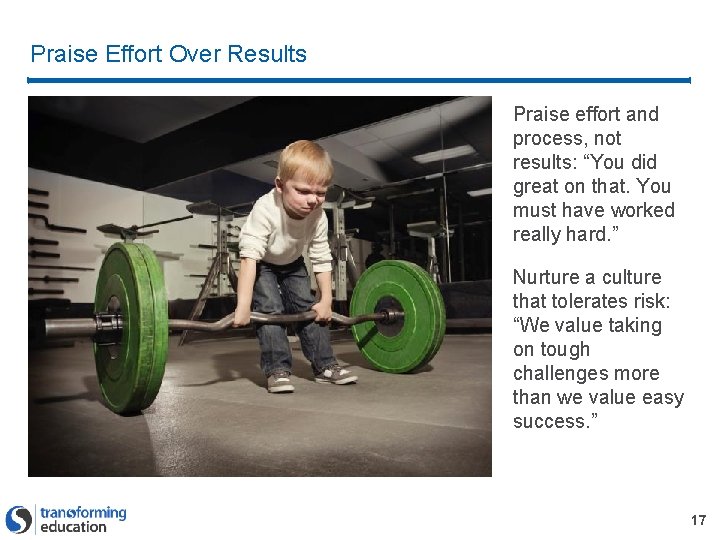
Praise Effort Over Results Praise effort and process, not results: “You did great on that. You must have worked really hard. ” Nurture a culture that tolerates risk: “We value taking on tough challenges more than we value easy success. ” 17
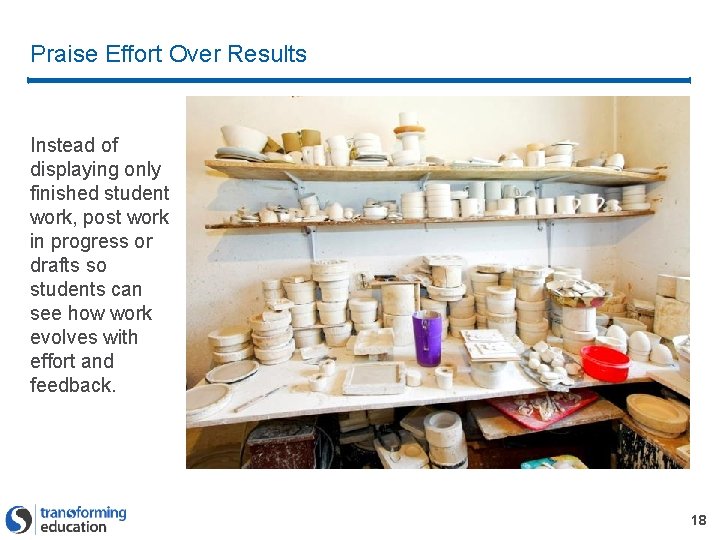
Praise Effort Over Results Instead of displaying only finished student work, post work in progress or drafts so students can see how work evolves with effort and feedback. 18
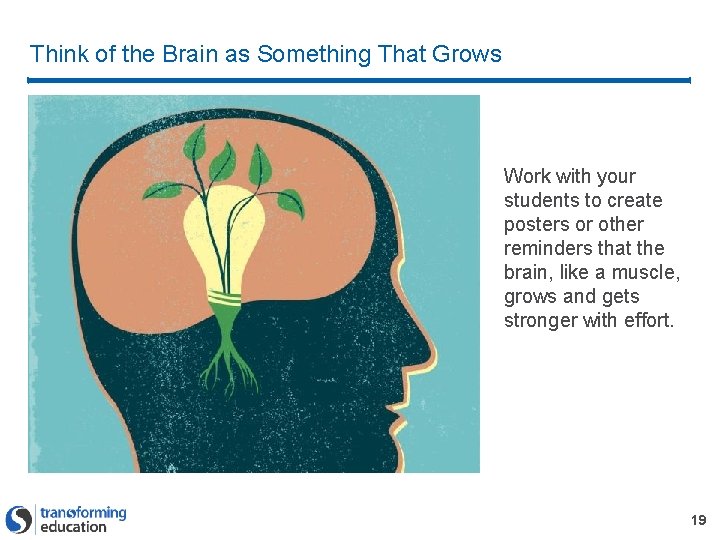
Think of the Brain as Something That Grows Work with your students to create posters or other reminders that the brain, like a muscle, grows and gets stronger with effort. 19
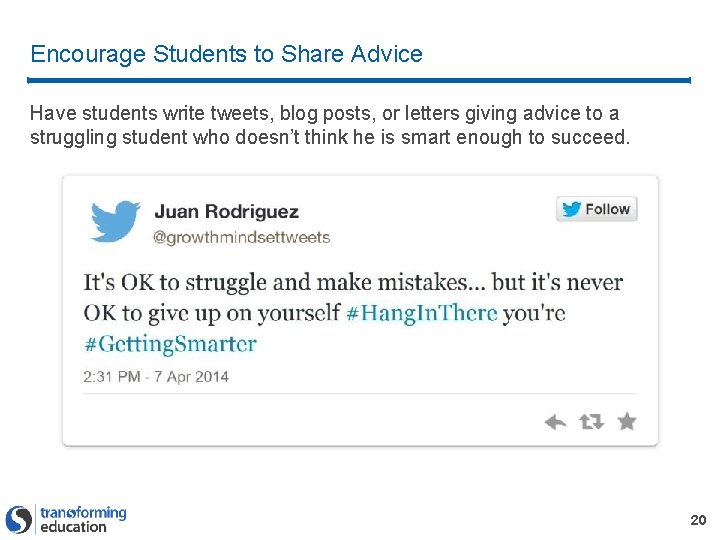
Encourage Students to Share Advice Have students write tweets, blog posts, or letters giving advice to a struggling student who doesn’t think he is smart enough to succeed. 20
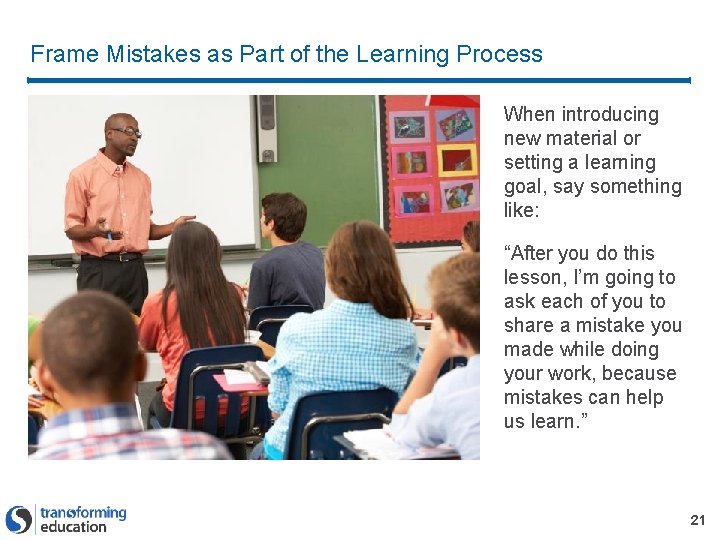
Frame Mistakes as Part of the Learning Process When introducing new material or setting a learning goal, say something like: “After you do this lesson, I’m going to ask each of you to share a mistake you made while doing your work, because mistakes can help us learn. ” 21
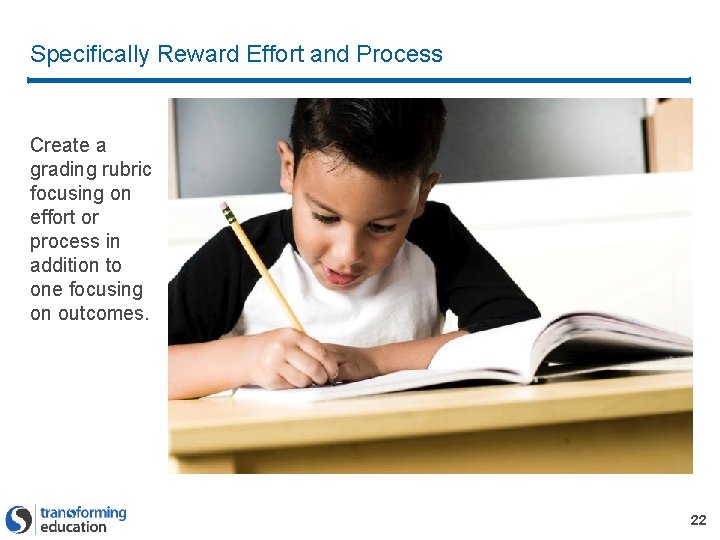
Specifically Reward Effort and Process Create a grading rubric focusing on effort or process in addition to one focusing on outcomes. 22
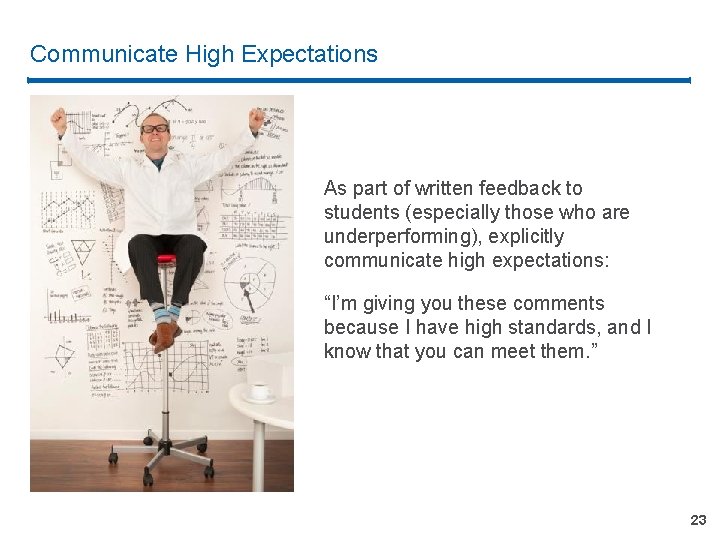
Communicate High Expectations As part of written feedback to students (especially those who are underperforming), explicitly communicate high expectations: “I’m giving you these comments because I have high standards, and I know that you can meet them. ” 23
Growth Mindset in Your Classroom What can you do quickly and easily? Please get a copy of the Introduction to Growth Mindset handout © 2015 by Transforming Education
Working Toward a Growth Mindset Classroom – Discuss the following questions with a partner or in small teams: If you decided to do more to encourage growth mindset among your students • Which of the practices we just discussed would you want to try in your classroom? Why did you choose this activity? • • • How would you put it in place or get started? What will your immediate next steps be? What’s something that’s not on this list you would do? Why? The Introduction to Growth Mindset handout lists all the activities we’ve just seen 25
Wrapping Up A few more details to cover © 2015 by Transforming Education
Want to Know More? Growth Mindset Social-Emotional Learning – Mindset – Social-Emotional Learning – Even Geniuses Work Hard – Students’ View of Intelligence Can Help Grades – A National Teacher Survey on How Social and Emotional Learning Can Empower Children and Transform Schools – ‘Growth Mindset’ Gaining Traction as School Improvement Strategy – Smart Hearts: Social and Emotional Learning Overview – The Power of Mistakes: Creating a Risk-Tolerant Culture at Home and School – Emotional Intelligence Is the Missing Piece – Mindsets and Success – Character Lab – Can Emotional Intelligence Be Taught? – The Heart-Brain Connection: The Neuroscience of Social and Emotional Learning Please note: The links above will only function in “presentation” mode. 27
Looking for Some Quick Feedback – Transforming Education is constantly trying to improve the resources we create for educators – You may have received a link to a very short survey about this session to help us improve it o The survey is also at: Tiny. URL. com/SELTeacher. Survey o Please share your feedback with us so that we can improve the free tools we create for teachers 28
Thank You! Equipping students with the mindsets, skills and habits they need to succeed www. transformingeducation. org
Extra Slides Additional information © 2015 by Transforming Education
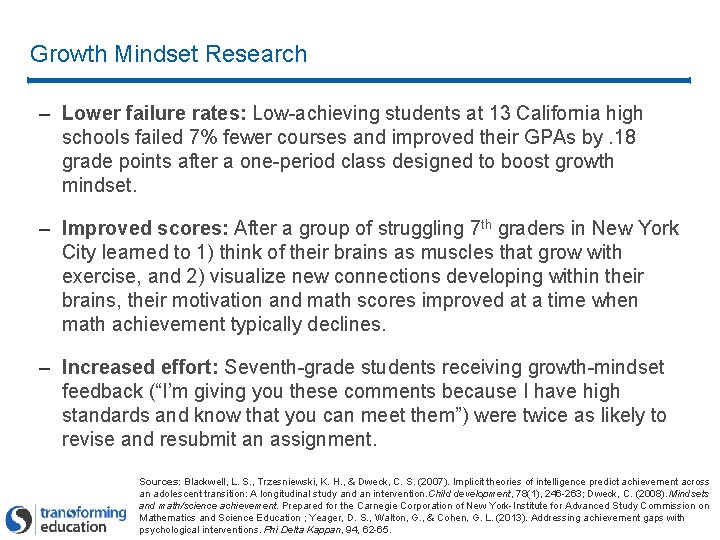
Growth Mindset Research – Lower failure rates: Low-achieving students at 13 California high schools failed 7% fewer courses and improved their GPAs by. 18 grade points after a one-period class designed to boost growth mindset. – Improved scores: After a group of struggling 7 th graders in New York City learned to 1) think of their brains as muscles that grow with exercise, and 2) visualize new connections developing within their brains, their motivation and math scores improved at a time when math achievement typically declines. – Increased effort: Seventh-grade students receiving growth-mindset feedback (“I’m giving you these comments because I have high standards and know that you can meet them”) were twice as likely to revise and resubmit an assignment. Sources: Blackwell, L. S. , Trzesniewski, K. H. , & Dweck, C. S. (2007). Implicit theories of intelligence predict achievement across an adolescent transition: A longitudinal study and an intervention. Child development, 78(1), 246 -263; Dweck, C. (2008). Mindsets and math/science achievement. Prepared for the Carnegie Corporation of New York-Institute for Advanced Study Commission on Mathematics and Science Education ; Yeager, D. S. , Walton, G. , & Cohen, G. L. (2013). Addressing achievement gaps with 31 psychological interventions. Phi Delta Kappan, 94, 62 -65.
What Is Transforming Education? – Transforming Education is a nonprofit supporting educators and education systems in equipping students with mindsets, skills, and habits they need to succeed in school, career, and life. We believe these mindsets, skills, and habits should be taught in school alongside academics. – Transforming Education is redefining success for one million students as the lead advisor on social-emotional learning to a collaborative of seven districts across California, including Fresno, Los Angeles, Long Beach, Oakland, San Francisco, Sanger, and Santa Ana. In partnership with these districts, we are refining measures of students’ social-emotional skills and implementing them at scale to help schools foster student growth. – We also work with other schools and districts around the country. – For more information, please visit www. transformingeducation. org.