
GROWTH Growth refers to an increase in physical
- Slides: 32
GROWTH Growth refers to an increase in physical size of the whole body or any of its parts. It is measurable physical changes that occur throughout a person’s life. It is multiplication of cells commencing from fertilization to physical maturity. It can be measured in Kg, pounds, meters, inches.
DEVELOPMENT Development refers to the increase of functional capacity specialised tissues. Development is a measure of functional or physiological maturation of the nervous system. It signifies accomplishment of mental, emotional and social abilities. It refers to the changes in intellectual, mental and emotional skills that occur over time.
Principles of Growth & Development Cephalocaudal direction: The head region starts growth at first. The child gains control of the head, then the arms and then the legs. Proximodistal direction: From centre or midline to the periphery (Near to far). The spinal cord develops before outer parts of the body. The child’s arm developsnbefore the hands. The hands and feet develop before the fingers and toes.
Principles (Cont’d) 3. General to Specific direction: From genetic sounds emerge words and then specific sentences with meaning. Children first able to hold pencil, then draw cycle to writing letters after the words. 4. Differentiality: Development does not occur at an even pace. Individuals differ in the rate of growth and development. Boys and girls have different development rates. Each part of the body has its own particular rate of growth.
Principles (Cont’d) Influenced by environmental and genetic factor: Individuals work with and affect their environment, and in turn the environment works with and affects them. Predictability: Growth and development are predictable Simple to Complex: Proceeds in this manner Continuity: From conception to death (Womb to Tomb). From child to be an adult in respect of body size, functioning, behavior. Adulthood changes to old age. Then comes the death which ends the life cycle.
Factors influencing Growth & Development Genetic factors: Parental phenotype & familiar patterns, race and nationality, Sex, genetic disorder (Chromosomal/gene defects) Prenatal factor: Maternal nutrition, infection, substance use, illness, hormones.
Factors influencing (End) Postnatal factor: Growth potentials, nutrition, childhood illness, physical environment, psychological environment, cultural difference, socioeconomic status, climate & season, play & exercise, birth order of the child, hormonal influence.
STAGES OF GROWTH The stages of growth have been classified in different periods: Prenatal Period: • The prenatal period comprises on the average 9 calendar months or 40 weeks. • Prenatal growth has three distinct stages: • Fertilized ovum (egg), • Zygote (first 2 weeks); • Embryo (from 2 to 8 weeks) • Foetus (from 9 to 40 weeks).
STAGES OF GROWTH Postnatal Period: Postnatal growth is commonly divided into the following age periods: • Neonate (0 -28 days): During this period baby establish independent respiration and circulation. • Infancy (28 days to 1 year): This is a period of rapid growth in most bodily systems and dimensions and rapid development of the neuromuscular system.
STAGES (End) Early Childhood: 1 -6 years Late childhood: 6 -12 years Adolescence: 12 -18 years Early Adulthood: 19 -40 Years Middle Adulthood: 40 -65 Years Late Adulthood: 65 Years and Older
DEVELOPMENTAL MILESTONES Developmental milestones are physical or behavioural signs of development or maturation of infants and children. Rolling over, crawling, walking and talking is considered developmental milestones and provides important information regarding the child's development. ” The milestones are different for each age range.
DEVELOPMENTAL MILESTONES As age advances, child acquires better coordination of motor activity and reacts to environment willfully Development is a continuous process and different levels of development (milestones) are achieved at an anticipated age (+/- few months) Early primitive reflexes are lost 4 areas of development: Gross motor Fine motor (adaptive) Social Language
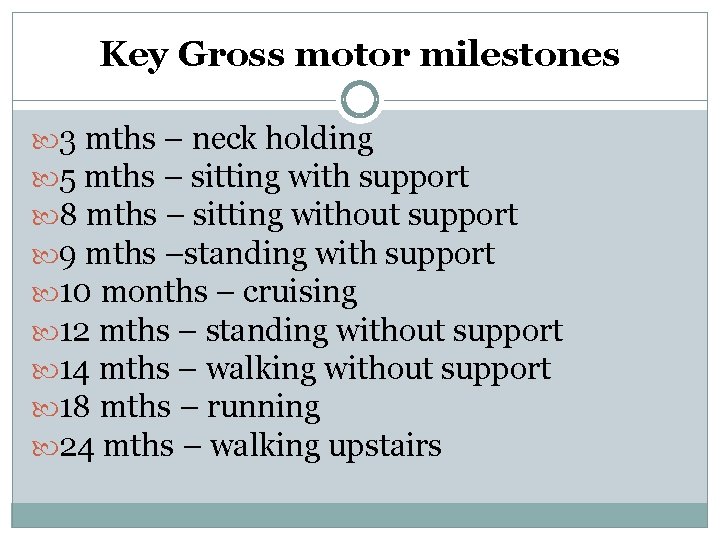
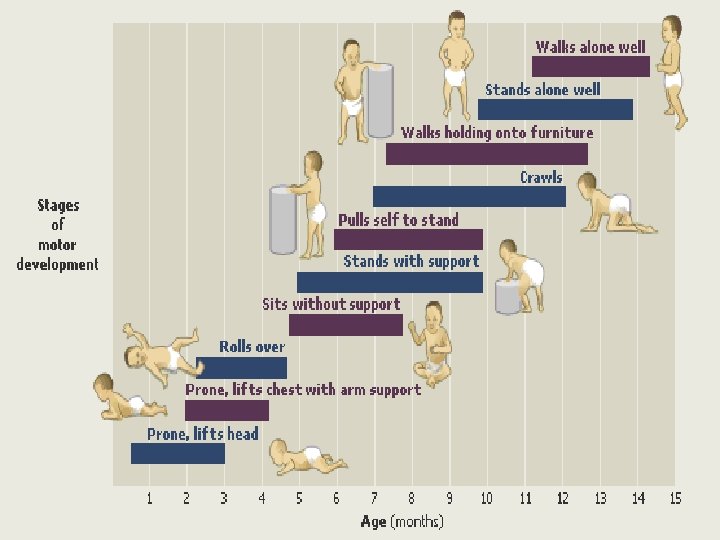
Key Gross motor milestones 3 mths – neck holding 5 mths – sitting with support 8 mths – sitting without support 9 mths –standing with support 10 months – cruising 12 mths – standing without support 14 mths – walking without support 18 mths – running 24 mths – walking upstairs
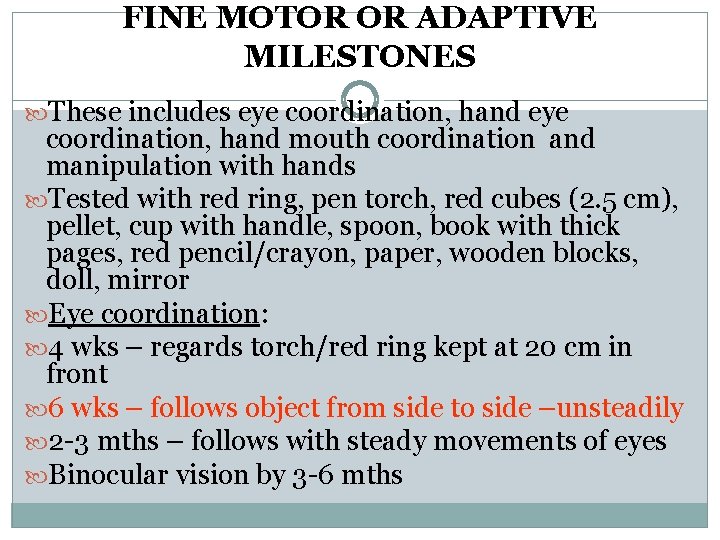
FINE MOTOR OR ADAPTIVE MILESTONES These includes eye coordination, hand mouth coordination and manipulation with hands Tested with red ring, pen torch, red cubes (2. 5 cm), pellet, cup with handle, spoon, book with thick pages, red pencil/crayon, paper, wooden blocks, doll, mirror Eye coordination: 4 wks – regards torch/red ring kept at 20 cm in front 6 wks – follows object from side to side –unsteadily 2 -3 mths – follows with steady movements of eyes Binocular vision by 3 -6 mths
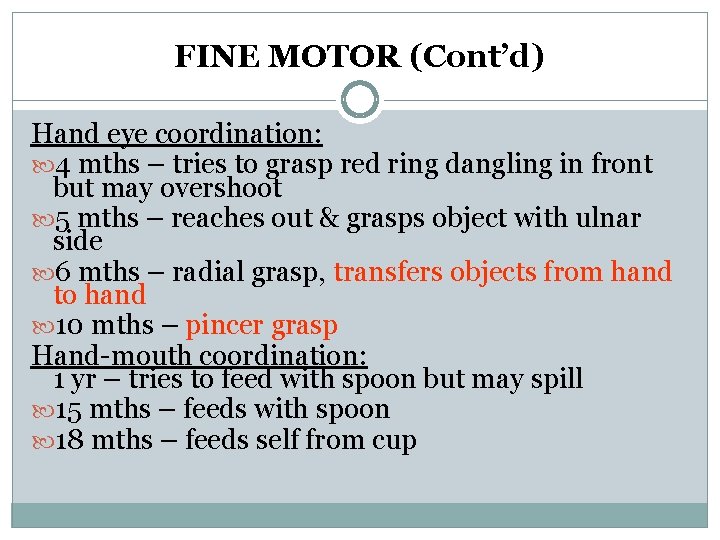
FINE MOTOR (Cont’d) Hand eye coordination: 4 mths – tries to grasp red ring dangling in front but may overshoot 5 mths – reaches out & grasps object with ulnar side 6 mths – radial grasp, transfers objects from hand to hand 10 mths – pincer grasp Hand-mouth coordination: 1 yr – tries to feed with spoon but may spill 15 mths – feeds with spoon 18 mths – feeds self from cup
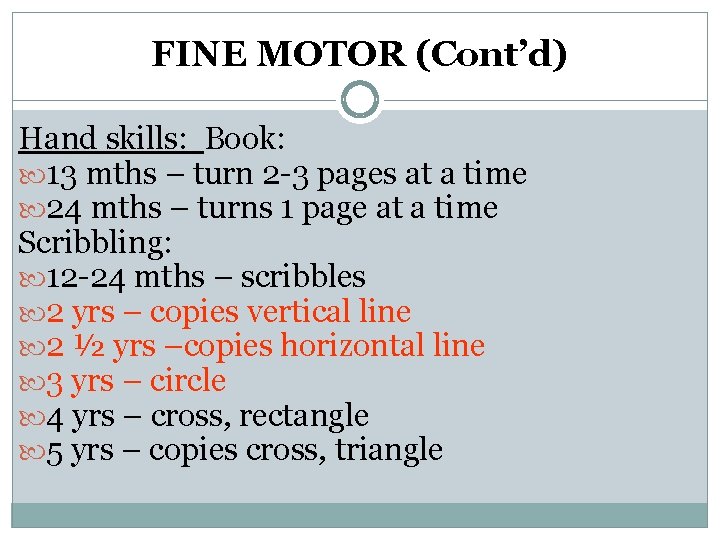
FINE MOTOR (Cont’d) Hand skills: Book: 13 mths – turn 2 -3 pages at a time 24 mths – turns 1 page at a time Scribbling: 12 -24 mths – scribbles 2 yrs – copies vertical line 2 ½ yrs –copies horizontal line 3 yrs – circle 4 yrs – cross, rectangle 5 yrs – copies cross, triangle
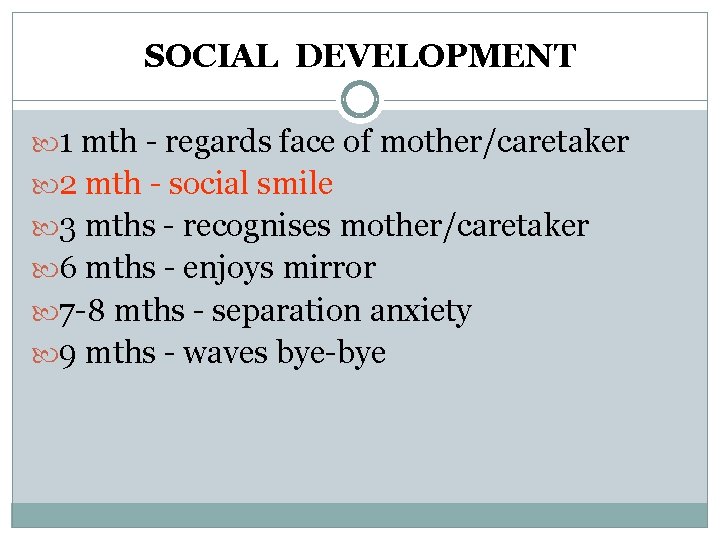
SOCIAL DEVELOPMENT 1 mth - regards face of mother/caretaker 2 mth - social smile 3 mths - recognises mother/caretaker 6 mths - enjoys mirror 7 -8 mths - separation anxiety 9 mths - waves bye-bye
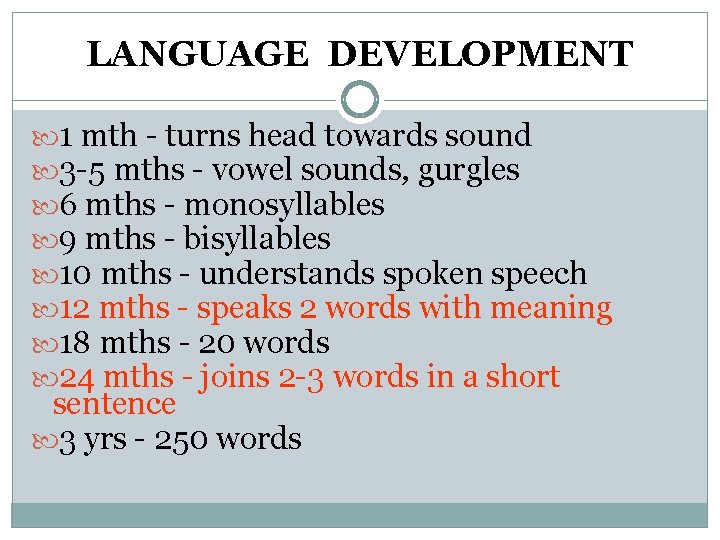
LANGUAGE DEVELOPMENT 1 mth - turns head towards sound 3 -5 mths - vowel sounds, gurgles 6 mths - monosyllables 9 mths - bisyllables 10 mths - understands spoken speech 12 mths - speaks 2 words with meaning 18 mths - 20 words 24 mths - joins 2 -3 words in a short sentence 3 yrs - 250 words
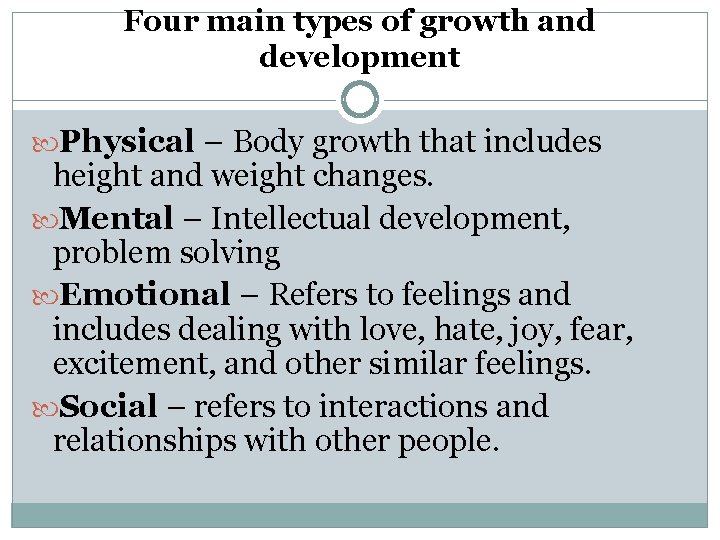
Four main types of growth and development Physical – Body growth that includes height and weight changes. Mental – Intellectual development, problem solving Emotional – Refers to feelings and includes dealing with love, hate, joy, fear, excitement, and other similar feelings. Social – refers to interactions and relationships with other people.
THEORIES OF DEVELOPMENT According to Freud, child development is described as a series of 'psychosexual stages. • Oral stage • Anal stage • Phallic stage • Latency period • Genital stage
THEORIES (Cont’d) ERICKSON’S 8 STAGES OF DEVELOPMENT ERIK ERICKSON 1902 -1994 Stage 1: Infant (Birth – 18 months): Trust vs. Mistrust An infant develops their sense of trust. With proper care and attention, the child will be able to trust. However, if this does not happen, it leads to mistrust in the child’s life. • Important events: Feeding • Basic Virtue: Hope and Drive •
THEORIES (Cont’d) Stage 2. Early Childhood(toddler) 18 months to 3 yrs Autonomy vs. Shame and Doubt(Will) Child needs to develop a certain level of independence through exploration. Important Events: Toilet training, bodily functions, muscular control, walking. • Basic Virtue: Willpower and Self-Control.
THEORIES (Cont’d) Stage 3. Preschool (3 to 5 yrs) Initiative vs. Guilt A sense of control and power is important in a child’s life at this stage. They feel a sense of purpose if they succeed in this. • Important Events: Exploration, and discovery, adventure and play • Basic Virtue: Purpose and Direction.
THEORIES (Cont’d) Stage 4. School Age (6 to 12 yrs) Industry vs. Inferiority • Children are forced to cope with school and other social demands. • Important Events: School • Basic Virtue: Competence and Method
THEORIES (Cont’d) Stage 5. Adolescence (12 to 18 yrs) Identity vs. Role Confusion Teens develop a sense of self. If they accomplish this, they can stay true to themselves and what they believe. • Important Events: Social Relationships • Basic Virtue: Fidelity and Devotion.
THEORIES (Cont’d) Stage 6. Young Adulthood (20 to 24 yrs) Intimacy vs. Isolation Intimate, loving relationships need to form in this stage. If this fails to happen, people feel alone and isolated. Important Events: Relationships • Basic Virtue: Love and Affiliation.
THEORIES (Cont’d) Stage 7. Middle Adulthood (25 to 64 yrs) Generativity vs. Stagnation Adults need to create things that they can nurture that will outlast them; generally, children. If they do not accomplish this, they will feel as though they did nothing good for the world. Important Events: Work and Parenthood Basic Virtue: Care and Production.
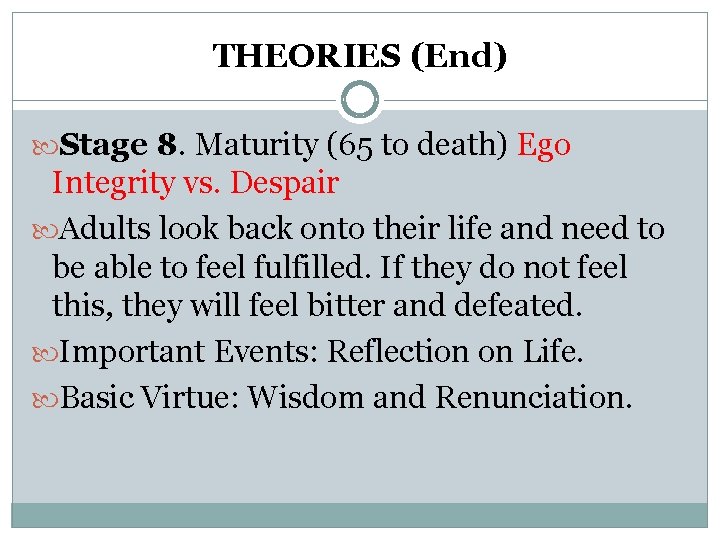
THEORIES (End) Stage 8. Maturity (65 to death) Ego Integrity vs. Despair Adults look back onto their life and need to be able to feel fulfilled. If they do not feel this, they will feel bitter and defeated. Important Events: Reflection on Life. Basic Virtue: Wisdom and Renunciation.
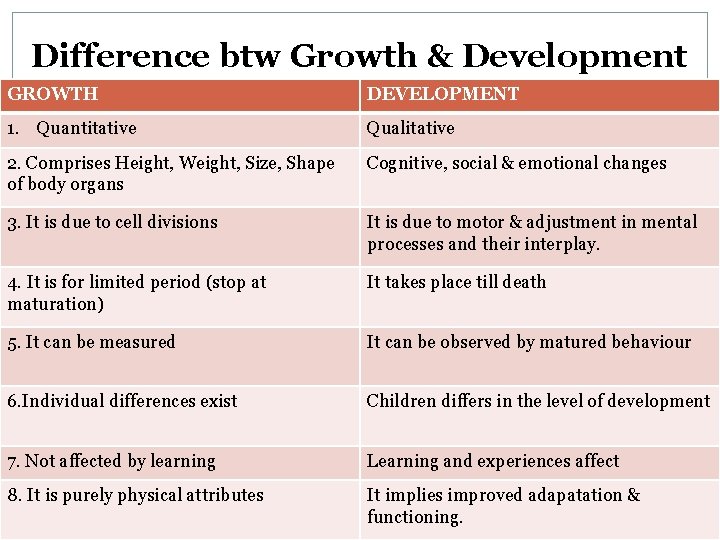
Difference btw Growth & Development GROWTH DEVELOPMENT 1. Quantitative Qualitative 2. Comprises Height, Weight, Size, Shape of body organs Cognitive, social & emotional changes 3. It is due to cell divisions It is due to motor & adjustment in mental processes and their interplay. 4. It is for limited period (stop at maturation) It takes place till death 5. It can be measured It can be observed by matured behaviour 6. Individual differences exist Children differs in the level of development 7. Not affected by learning Learning and experiences affect 8. It is purely physical attributes It implies improved adapatation & functioning.
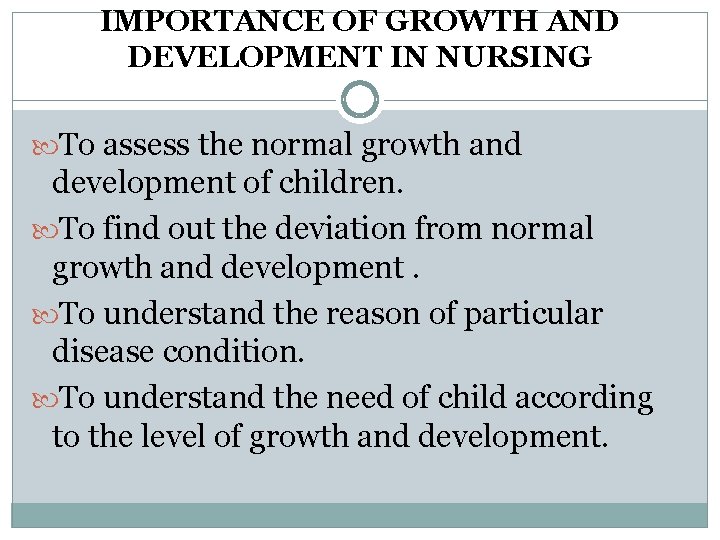
IMPORTANCE OF GROWTH AND DEVELOPMENT IN NURSING To assess the normal growth and development of children. To find out the deviation from normal growth and development. To understand the reason of particular disease condition. To understand the need of child according to the level of growth and development.
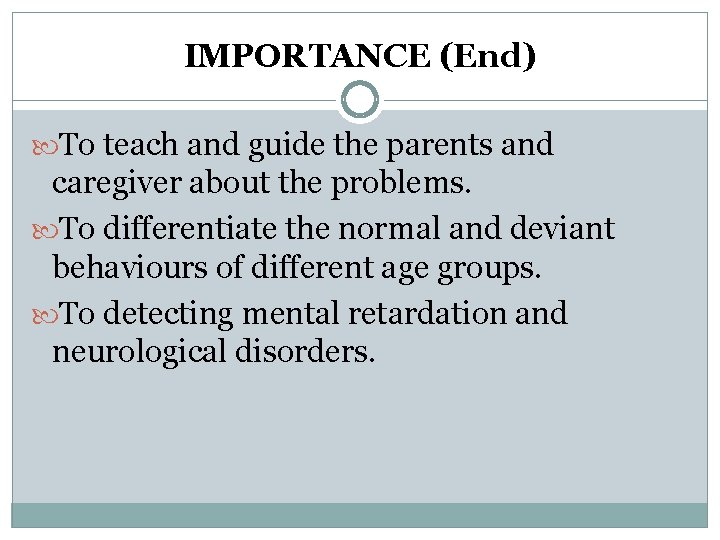
IMPORTANCE (End) To teach and guide the parents and caregiver about the problems. To differentiate the normal and deviant behaviours of different age groups. To detecting mental retardation and neurological disorders.