
Growth differentiation development Development of matured plant from


- Slides: 17
Growth + differentiation= development. Development of matured plant from a zygote follow precise and ordered succession of events. COMPLEX BODY ORGANISATION IS FORMED – ROOTS, LEAVES, BRANCHES, FLOWERS, FRUITS AND SEEDS. - DIE
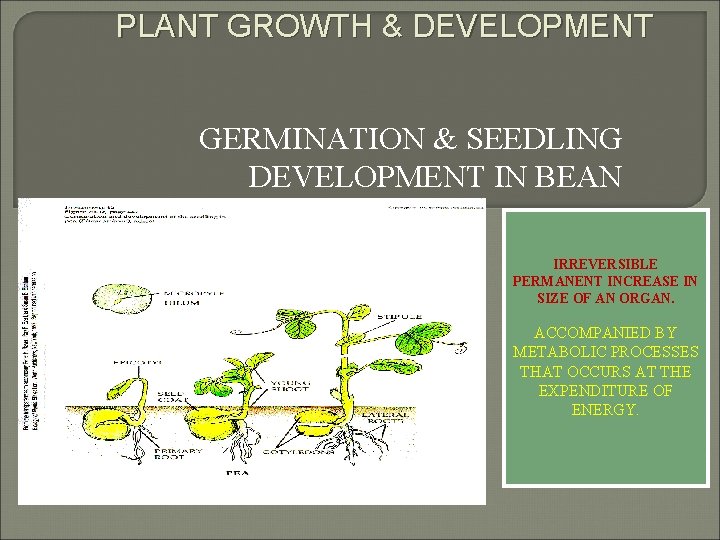
PLANT GROWTH & DEVELOPMENT GERMINATION & SEEDLING DEVELOPMENT IN BEAN IRREVERSIBLE PERMANENT INCREASE IN SIZE OF AN ORGAN. ACCOMPANIED BY METABOLIC PROCESSES THAT OCCURS AT THE EXPENDITURE OF ENERGY.
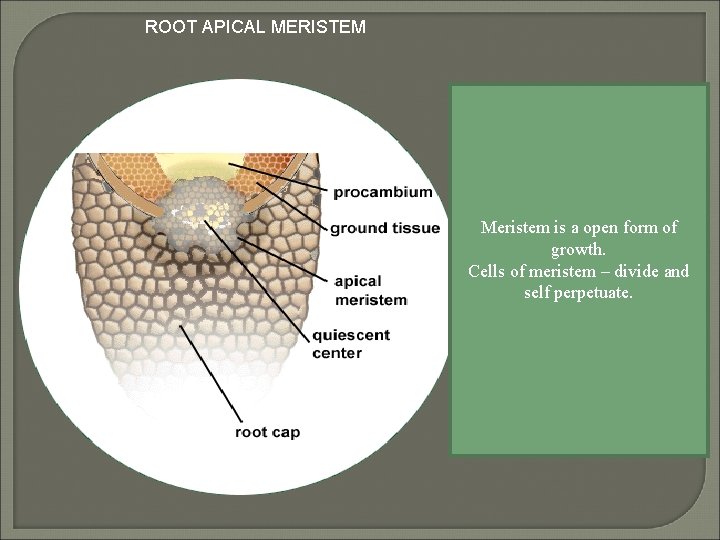
ROOT APICAL MERISTEM Meristem is a open form of growth. Cells of meristem – divide and self perpetuate.
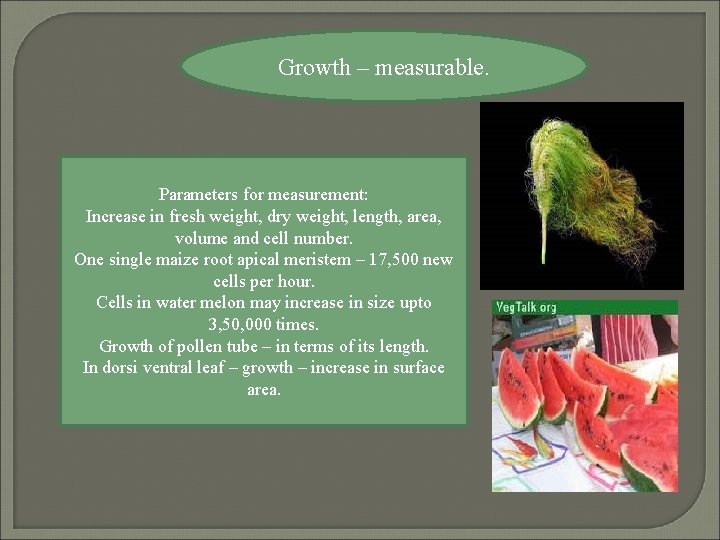
Growth – measurable. Parameters for measurement: Increase in fresh weight, dry weight, length, area, volume and cell number. One single maize root apical meristem – 17, 500 new cells per hour. Cells in water melon may increase in size upto 3, 50, 000 times. Growth of pollen tube – in terms of its length. In dorsi ventral leaf – growth – increase in surface area.
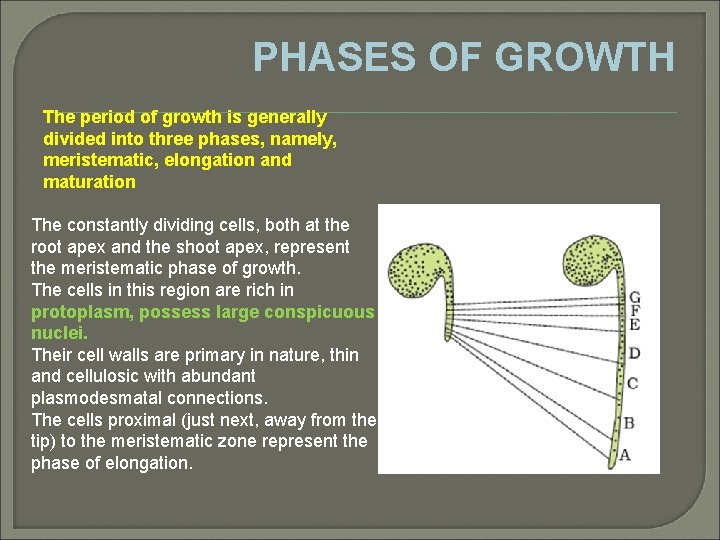
PHASES OF GROWTH The period of growth is generally divided into three phases, namely, meristematic, elongation and maturation The constantly dividing cells, both at the root apex and the shoot apex, represent the meristematic phase of growth. The cells in this region are rich in protoplasm, possess large conspicuous nuclei. Their cell walls are primary in nature, thin and cellulosic with abundant plasmodesmatal connections. The cells proximal (just next, away from the tip) to the meristematic zone represent the phase of elongation.
Increased vacuolation, cell enlargement and new cell wall deposition are the characteristics of the cells in this phase. Further away from the apex, i. e. , more proximal to the phase of elongation, lies the portion of axis which is undergoing the phase of maturation. The cells of this zone, attain their maximal size in terms of wall thickening and protoplasmic modifications.
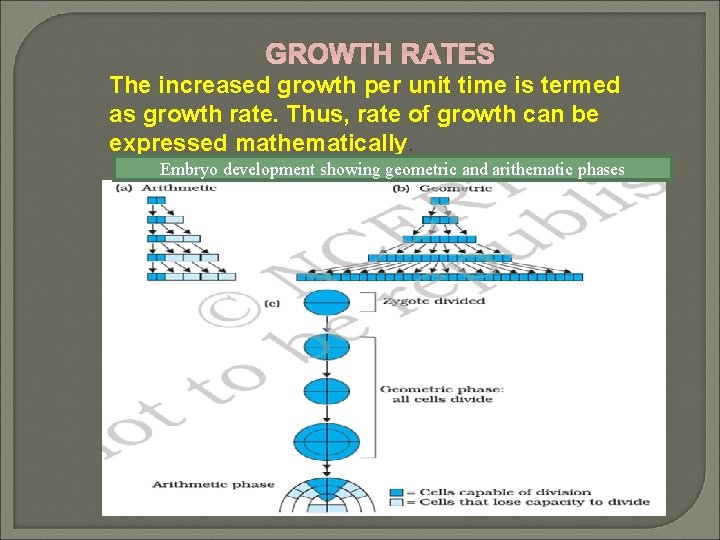
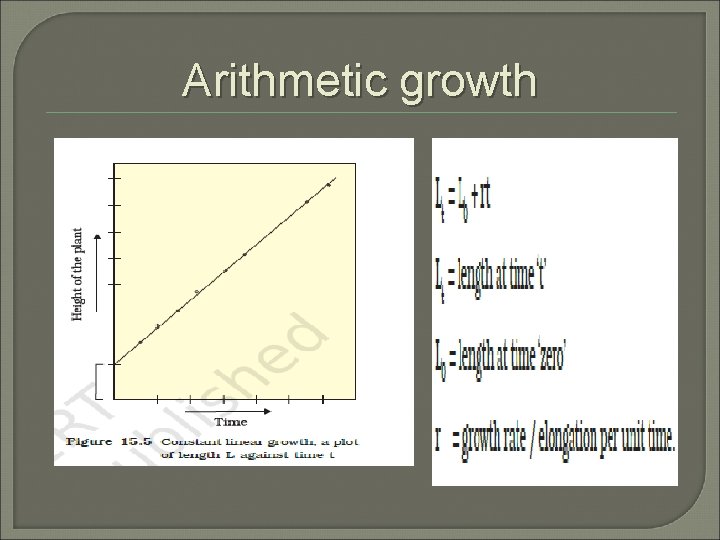
GROWTH RATES The increased growth per unit time is termed as growth rate. Thus, rate of growth can be expressed mathematically. Embryo development showing geometric and arithematic phases
Arithmetic growth
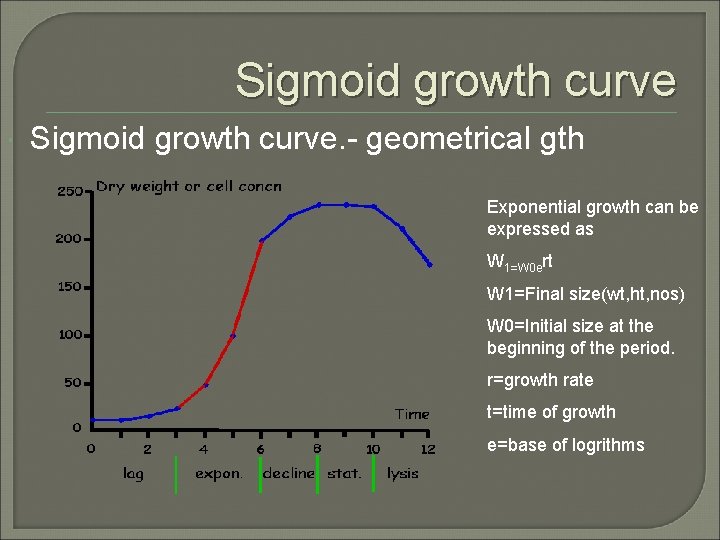
Sigmoid growth curve Sigmoid growth curve. - geometrical gth Exponential growth can be expressed as W 1=W 0 ert W 1=Final size(wt, ht, nos) W 0=Initial size at the beginning of the period. r=growth rate t=time of growth e=base of logrithms
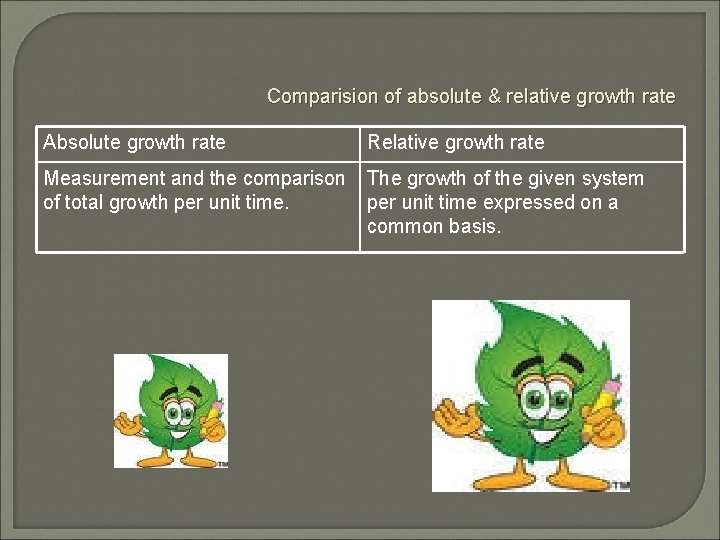
Comparision of absolute & relative growth rate Absolute growth rate Relative growth rate Measurement and the comparison of total growth per unit time. The growth of the given system per unit time expressed on a common basis.
Conditions for growth Oxygen-release metabolic energy Nutrients-required for the synthesis of protoplasm. - acts as energy resource 3. Water - plant cells grow in size by cell enlargement—turgidity of cells helps in extension growth. - medium for enzymatic activities. 4. Optimum temperature. 5. Light & gravity- affects the stages of growth. 1. 2.
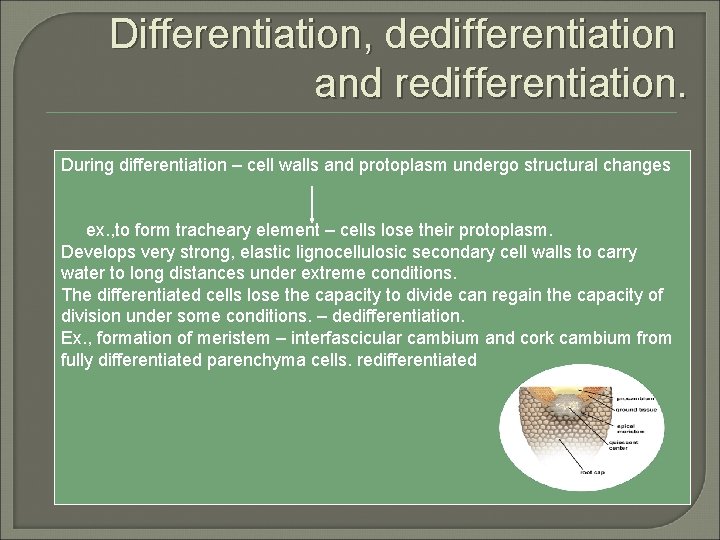
Differentiation, dedifferentiation and redifferentiation. During differentiation – cell walls and protoplasm undergo structural changes ex. , to form tracheary element – cells lose their protoplasm. Develops very strong, elastic lignocellulosic secondary cell walls to carry water to long distances under extreme conditions. The differentiated cells lose the capacity to divide can regain the capacity of division under some conditions. – dedifferentiation. Ex. , formation of meristem – interfascicular cambium and cork cambium from fully differentiated parenchyma cells. redifferentiated
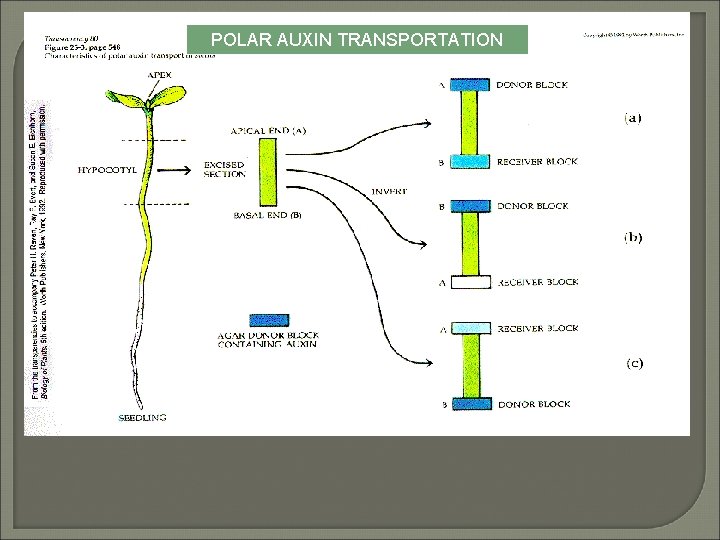
POLAR AUXIN TRANSPORTATION
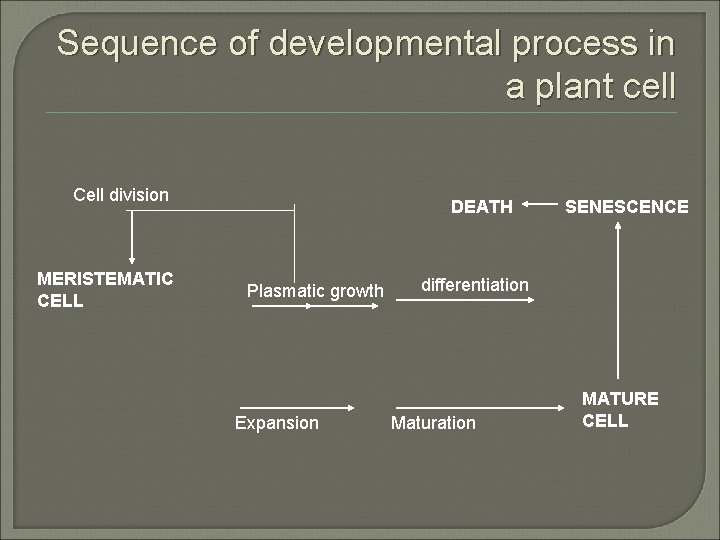
Sequence of developmental process in a plant cell Cell division MERISTEMATIC CELL DEATH Plasmatic growth Expansion SENESCENCE differentiation Maturation MATURE CELL
The ability of the plants to form diff. kinds of structures in response to environment or phases of life.