
Growth Cycle of the Bacteria Dr Baha Eldin
Growth Cycle of the Bacteria Dr. Baha Eldin Khalid Elamin
Lesson Outcomes • Describe the growth cycle of bacteria and their ability to grow on artificial culture media. • Explain the basic principles of solid and liquid media. • List some commonly used media.
Bacterial growth Binary fission Generation time Phases of growth 4 -3
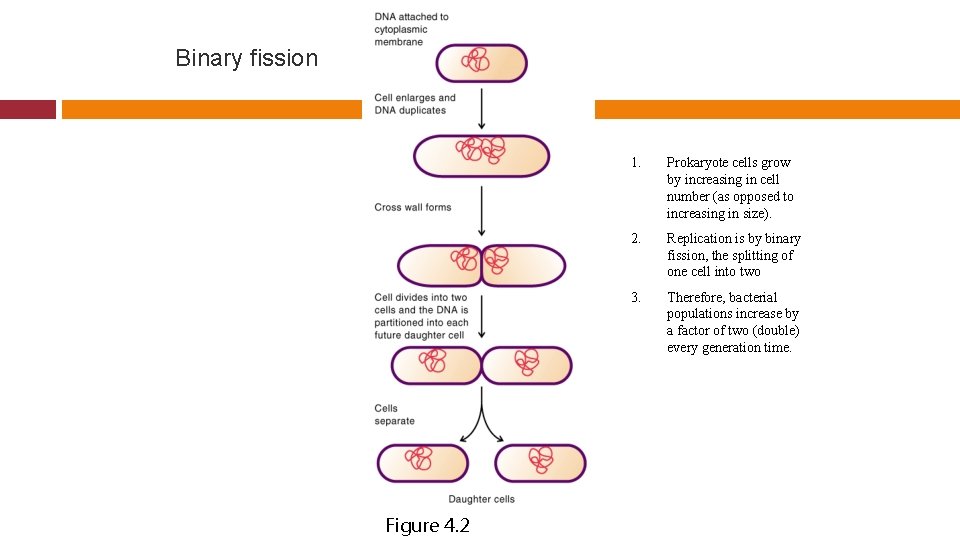
Binary fission Figure 4. 2 1. Prokaryote cells grow by increasing in cell number (as opposed to increasing in size). 2. Replication is by binary fission, the splitting of one cell into two 3. Therefore, bacterial populations increase by a factor of two (double) every generation time.

Growth curve (six phases) A: lag phase, B: acceleration phase, C: log (exponential) phase, D: deceleration phase, E: stationary phase, F: death phase Y-axis presents the log number of living cells X-axis presents the period of time (usually in hours) The curve can be divided into six phages represented by the letters A-F
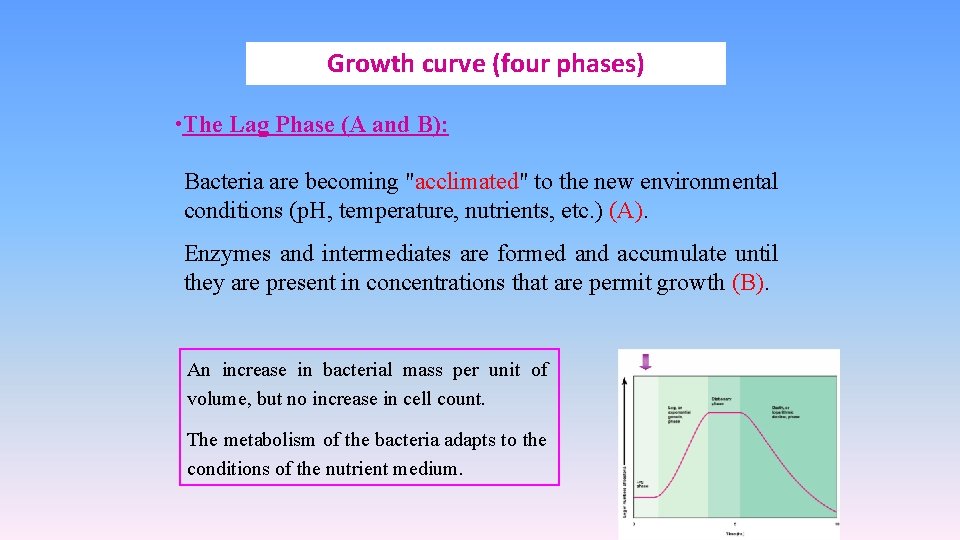
Growth curve (four phases) • The Lag Phase (A and B): Bacteria are becoming "acclimated" to the new environmental conditions (p. H, temperature, nutrients, etc. ) (A). Enzymes and intermediates are formed and accumulate until they are present in concentrations that are permit growth (B). An increase in bacterial mass per unit of volume, but no increase in cell count. The metabolism of the bacteria adapts to the conditions of the nutrient medium.
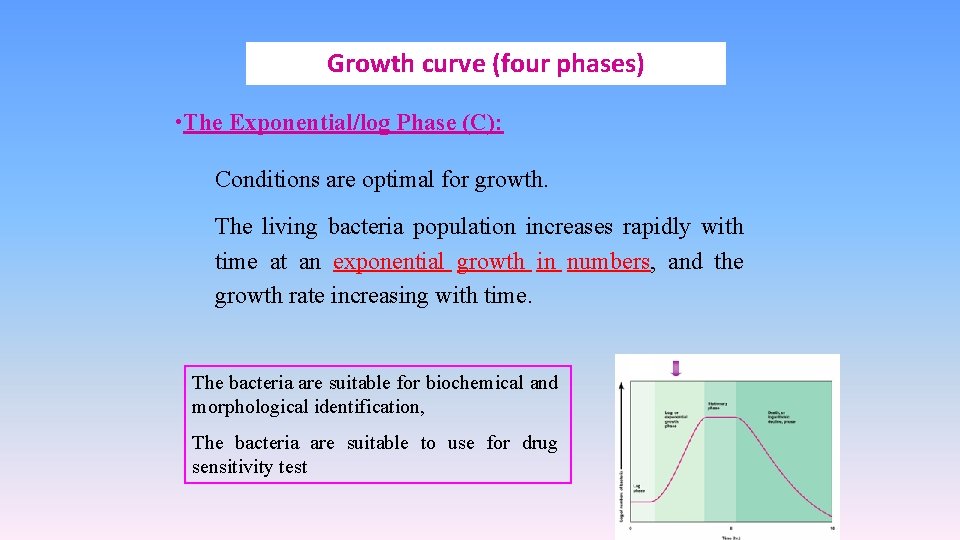
Growth curve (four phases) • The Exponential/log Phase (C): Conditions are optimal for growth. The living bacteria population increases rapidly with time at an exponential growth in numbers, and the growth rate increasing with time. The bacteria are suitable for biochemical and morphological identification, The bacteria are suitable to use for drug sensitivity test
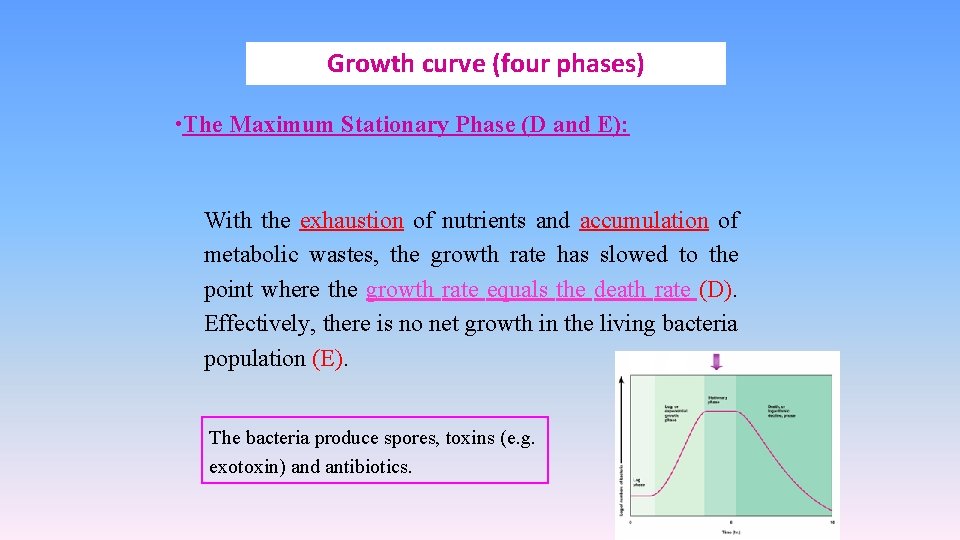
Growth curve (four phases) • The Maximum Stationary Phase (D and E): With the exhaustion of nutrients and accumulation of metabolic wastes, the growth rate has slowed to the point where the growth rate equals the death rate (D). Effectively, there is no net growth in the living bacteria population (E). The bacteria produce spores, toxins (e. g. exotoxin) and antibiotics.
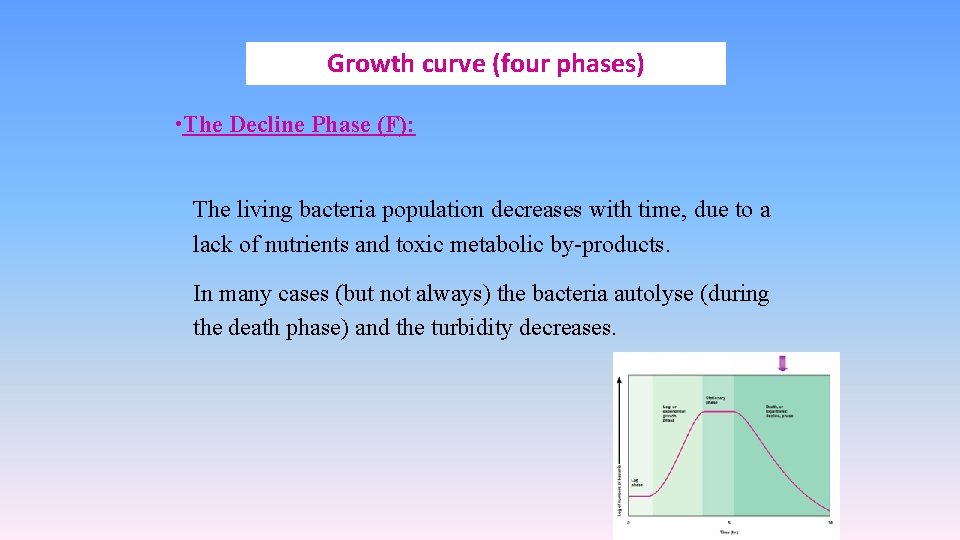
Growth curve (four phases) • The Decline Phase (F): The living bacteria population decreases with time, due to a lack of nutrients and toxic metabolic by-products. In many cases (but not always) the bacteria autolyse (during the death phase) and the turbidity decreases.
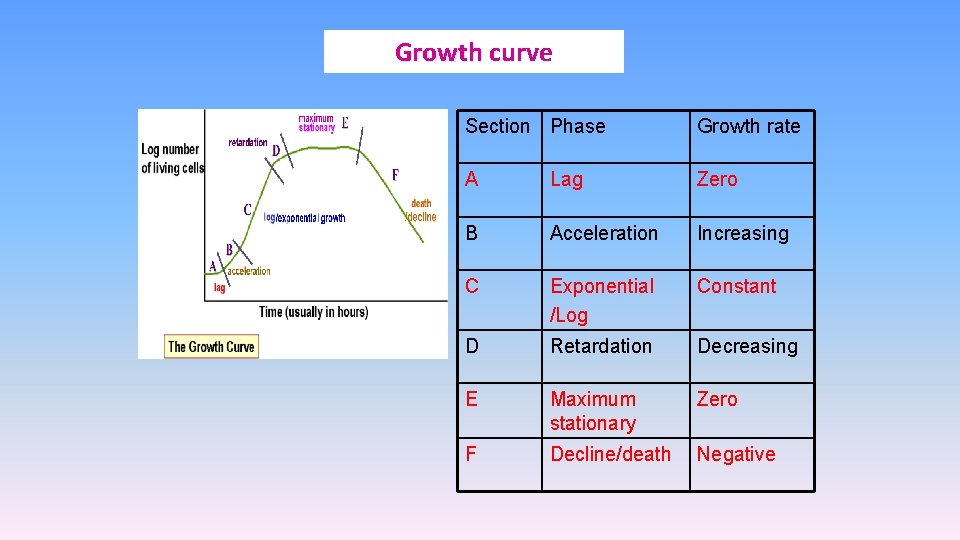
Growth curve Section Phase Growth rate A Lag Zero B Acceleration Increasing C Exponential /Log Constant D Retardation Decreasing E Maximum stationary Zero F Decline/death Negative
Cultivation methods Concerning two parts: I. Choice of suitable medium II. Isolation of bacteria for pure culture

I. Choice of suitable medium
Medium (I) (1) raise a crop of cells of a particular species that is on hand; (2) determine the numbers and types of organisms present in a given material; (3) isolate a particular type of microorganism from a natural source.

Medium (I) • A classification of media based on their respective usages: Basic medium Enrichment medium Selective medium Differential medium
Basic medium: supplies only the minimal nutritional requirements of a particular microorganism. e. g. broth Enrichment medium: Nutrient broth, nutrient agar, peptone water are commonly used in enrichment media. e. g. blood agar plate

Selective medium: Ø Supports the growth of desired bacteria while inhibiting the growth of many or most of the unwanted ones, either by adding one or more selective agents which is a "poison" to the unwanted bacteria but not harmful to desired bacteria, or by including certain nutrients for the desired ones and deleting certain nutrients for the unwanted ones. e. g. L-G medium for M. tuberculosis
Differential medium ØThis medium allows two or more different bacteria to grow, but it contains dyes and/or other components upon which different bacteria act in various ways to produce a variety of end products or effects (usually by showing different colors). e. g. SS agar
Medium (II) • Classification according to physical condition (according to the content of solidifying agent): liquid medium Solid medium Semi-solid medium
• Agar • The major solidifying agent used in bacteriological media. • An polysaccharide gum that extracted from certain red algae. • Agar can be dissolved at 100 C, and solidified at about 43 C. • Added 1. 5 -2. 0% of Agar for solid plates or slanted media, 0. 1 -0. 5% for semisolid media.
Examples of Media used in Microbiology Lab • Blood Agar. • Chocolate Blood Agar • TCBS medium • CLED Medium • Mac. Conkey Agar
- Slides: 20