
GROWTH AND REPRODUCTION BASIC KNOWLEDGE REQUIRED CHROMOSOME Rod
GROWTH AND REPRODUCTION
BASIC KNOWLEDGE REQUIRED • CHROMOSOME: Rod like structure visible during cell division. Made up of DNA. Carries hereditary information. • GENE: A unit of inheritance. Small segment of DNA in a chromosome that controls a particular characteristic in an organism.
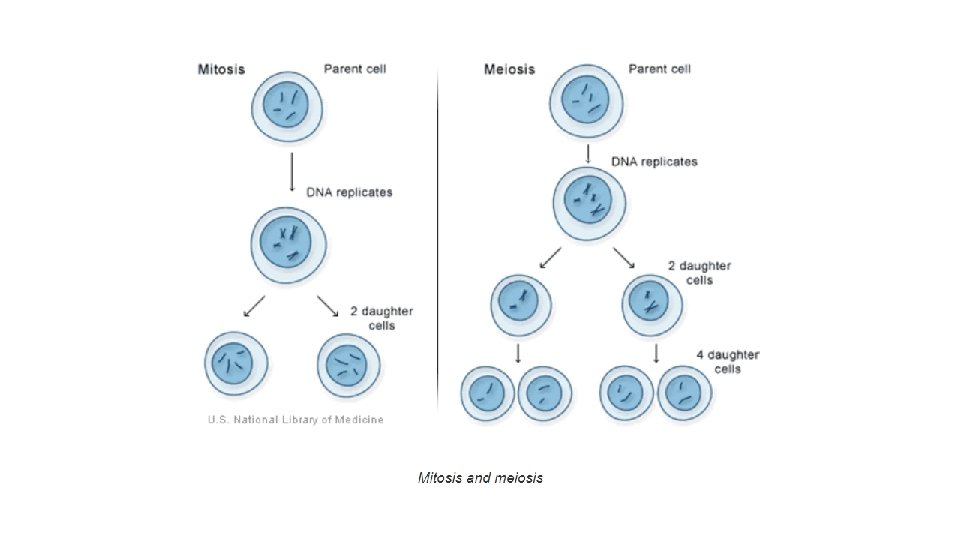
MITOSIS • Define mitosis as cell division giving rise to genetically identical cells in which the chromosome number is maintained. ( DNA Replicates) • State the role of mitosis in growth, repair of damaged tissues, replacement of worn-out cells and asexual reproduction ( VEGETATIVE REPRODUCTION IN PLANTS e. g. potatoes) • The nucleus of a cell contains a number of chromosomes and that number is fixed and constant for each species (46 in the human being). A new body cell must be an exact copy of the cell producing it. (Details of the stages in mitosis are not required). • Mistakes in DNA replication may cause uncontrolled division – CANCER, MUTATIONS, ABNORMAL PROTEINS ( REJECTED BY IMMUNE SYSTEM) • https: //www. cellsalive. com/mitosis_js. htm
ASEXUAL REPRODUCTION • Define asexual reproduction as the process resulting in the production of genetically identical offspring from one parent • describe one named, commercially important application of asexual reproduction in plants • For the chosen commercial application (e. g. a potato tuber) learners should understand the benefits and the disadvantages of this method of reproduction • Produce a table comparing the benefits and disadvantages together with an outline of how the technique is used in a named commercially important application.

ASEXUAL REPRODCUTION • ADVANTAGES • One parent required • All beneficial; qualities are passed on to offspring • Faster method of producing offspring • Can colonise the area rapidly • DISADVANTAGE • No genetic variation : not well adapted to changes in the environment.
MEIOSIS • Define meiosis as a reduction division in which the chromosome number is halved from diploid to haploid ( after replication – 4 cells) • Details of meiotic division are not required other than its role in halving of the chromosome number. • Define the terms gamete (sex/reproductive cells with half the no. of chromosomes), diploid (complete set of chromososmes) and haploid ( half the no. of chromosomes) should be explained • State that gametes are the result of meiosis (reduction division) • https: //www. cellsalive. com/meiosis_js. htm

SEXUAL REPRODUCTION • Define sexual reproduction as the process involving the fusion of haploid nuclei to form a diploid zygote and the production of genetically dissimilar offspring. ( due to crossing over and independent assortment of chromosomes) Fig 16. 27 page 311. • Learners should appreciate that each parent therefore makes an equal contribution to the diploid cell from which an offspring will develop • Draw a flow chart showing gametes, zygote and embryo onto which they may annotate each stage to show the chromosome number (n or 2 n) and type of cell division (mitosis or meiosis) involved.

SEXUAL REPRODUCTION • ADVANTAGES • Genetic variation : species better adapted to changes in the environment • Offspring may inherit beneficial qualities from both parents. DISADVANATGES • Two parents needed ( except in plants with bisexual flowers) • Fusion of gametes required • Slower method as compared to asexual reproduction.
IMPORTANCE OF MEIOSIS • Meiosis produces haploid nucleus. Fusion of gametes leads to diploid nucleus. • Meiosis results in variations which increases the chances of survival of the species during changes in the environment. • Nature selects organisms with favourable characteristics to survive, while the others die. Those that survive pass on their favourable genes to their offspring. Thus species lives on
- Slides: 10