
Growth and Multiplication of Bacteria Hugh B Fackrell
Growth and Multiplication of Bacteria Hugh B. Fackrell Sept 1997 Filename: Growth. ppt
Requirements for Growth/Multiplication § ALL required nutrients § correct l l l p. H temperature salinity, moisture redox potential atmosphere
Growth Liquid vs Solid Media § Liquid: clear >>turbid § Solid: individual colonies l each colony derived from a single cell
Growth Event § Absorption of water & nutrients § Catabolism of carbon source l inorganic or organic § Biosynthesis of new cellular components l major energy consumption § Cell enlargement § Cell division ( Binary Fission)

Binary Fission § § § DNA replication Plasma membrane invaginate Cell wall deposited in invaginated space Cross wall completed Cells separate
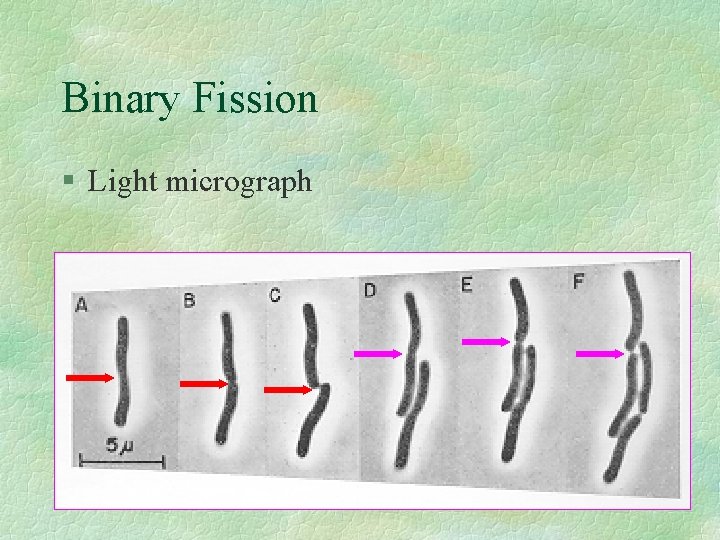
Binary Fission § Light micrograph

Binary Fission
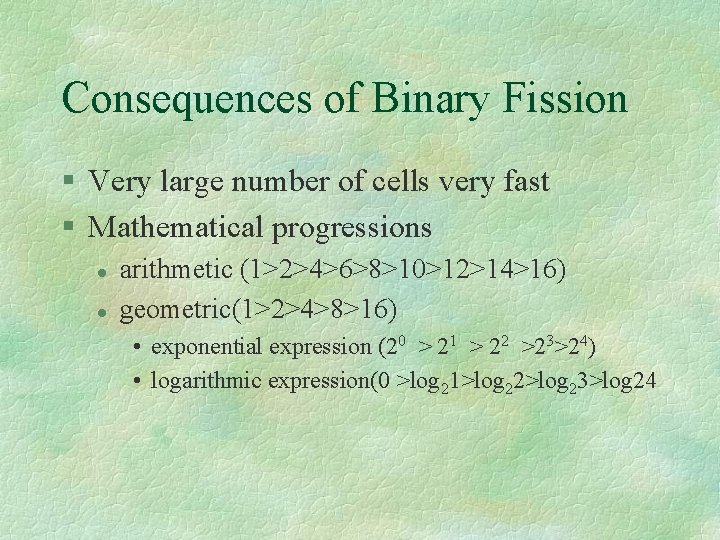
Consequences of Binary Fission § Very large number of cells very fast § Mathematical progressions l l arithmetic (1>2>4>6>8>10>12>14>16) geometric(1>2>4>8>16) • exponential expression (20 > 21 > 22 >23>24) • logarithmic expression(0 >log 21>log 22>log 23>log 24
Logarithmic Plots § Can plot very large Range of numbers § Phases of growth demonstrated § Generation time easily calculated
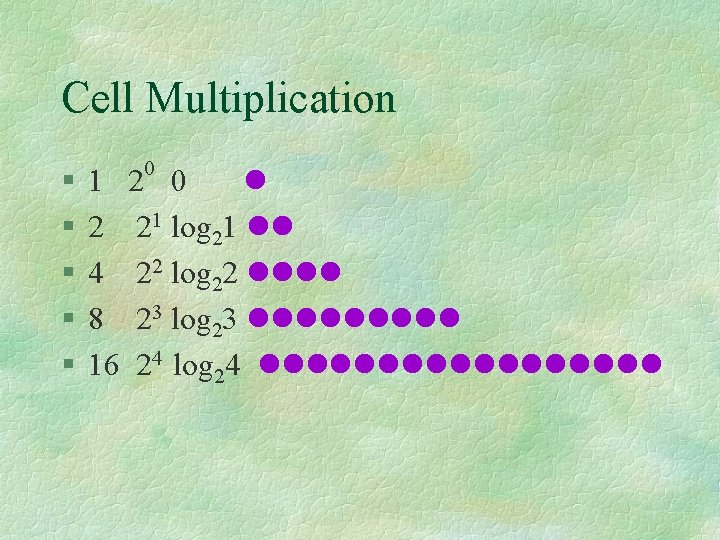
Cell Multiplication § § § 0 1 2 0 l 2 21 log 21 ll 4 22 log 22 llll 8 23 log 23 lllll 16 24 log 24 lllllllll
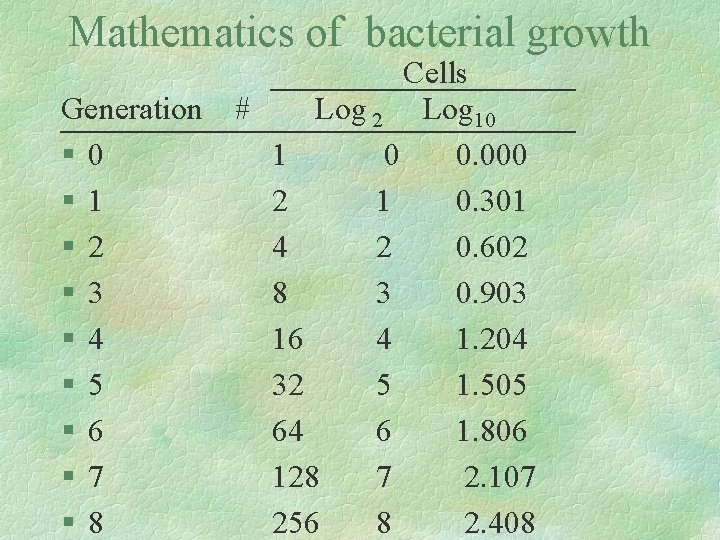
Mathematics of bacterial growth Generation § 0 § 1 § 2 § 3 § 4 § 5 § 6 § 7 § 8 Cells # Log 2 Log 10 1 0 0. 000 2 1 0. 301 4 2 0. 602 8 3 0. 903 16 4 1. 204 32 5 1. 505 64 6 1. 806 128 7 2. 107 256 8 2. 408
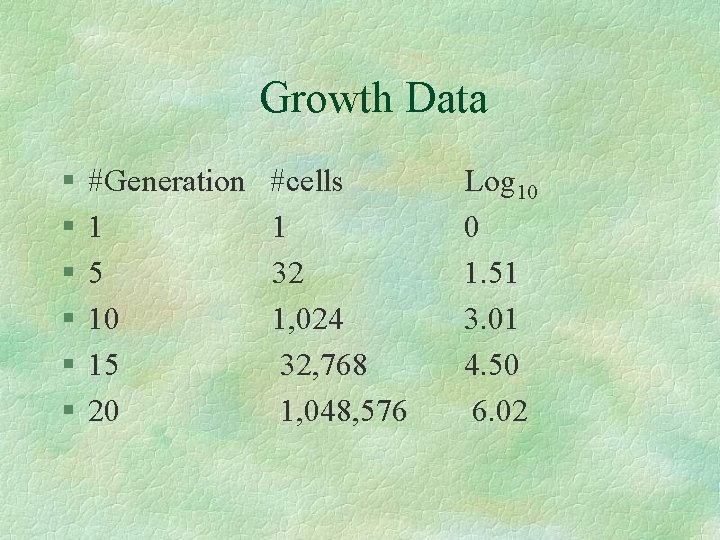
Growth Data § § § #Generation 1 5 10 15 20 #cells 1 32 1, 024 32, 768 1, 048, 576 Log 10 0 1. 51 3. 01 4. 50 6. 02
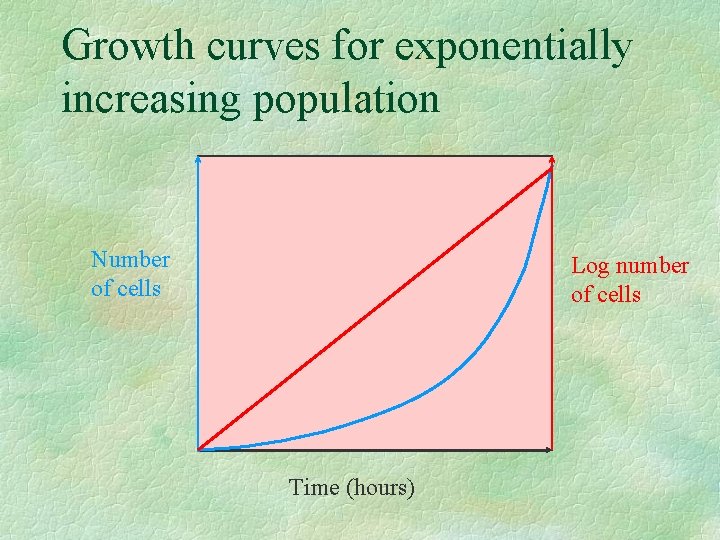
Growth curves for exponentially increasing population Number of cells Log number of cells Time (hours)

Bacterial Growth Curve Stationary phase Death phase Log phase Lag phase 1 5 Time (hours) 10
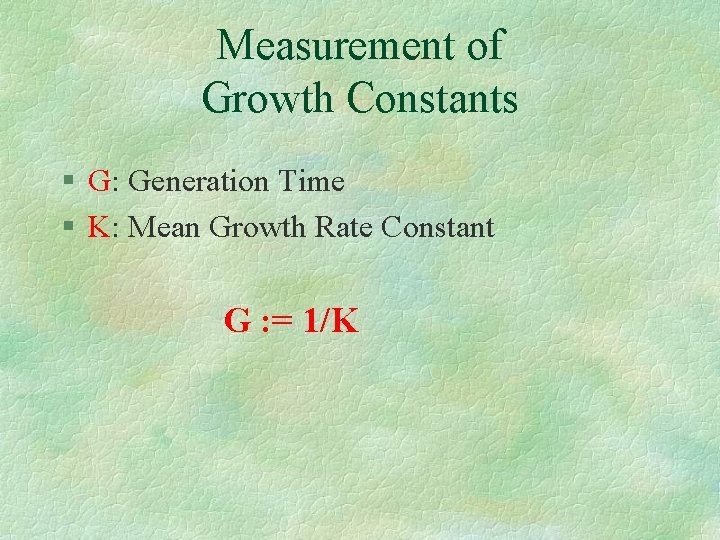
Measurement of Growth Constants § G: Generation Time § K: Mean Growth Rate Constant G : = 1/K
G: Generation time Time in minutes or hours for a population of bacteria to double in number
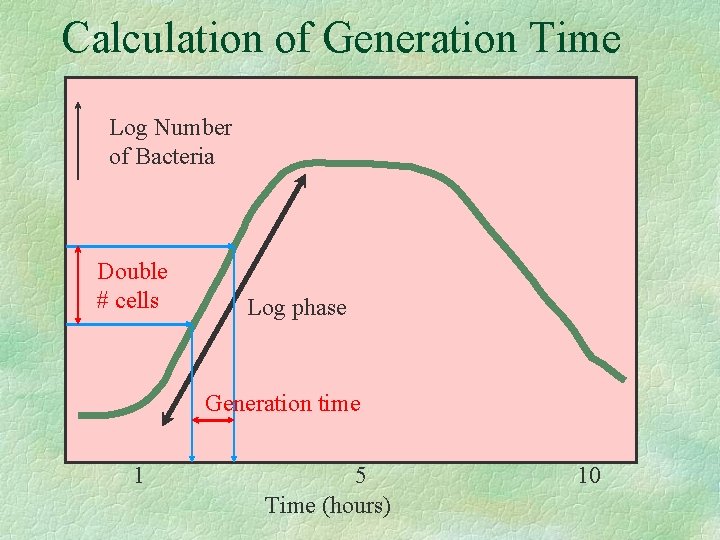
Calculation of Generation Time Log Number of Bacteria Double # cells Log phase Generation time 1 5 Time (hours) 10
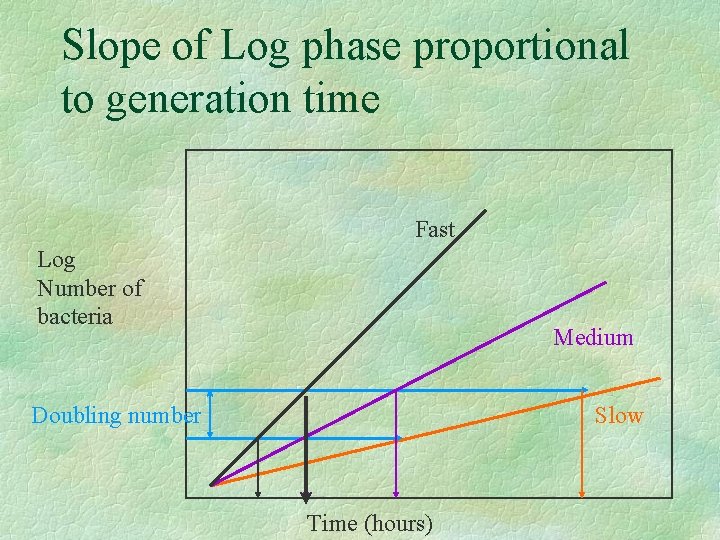
Slope of Log phase proportional to generation time Fast Log Number of bacteria Medium Doubling number Slow Time (hours)
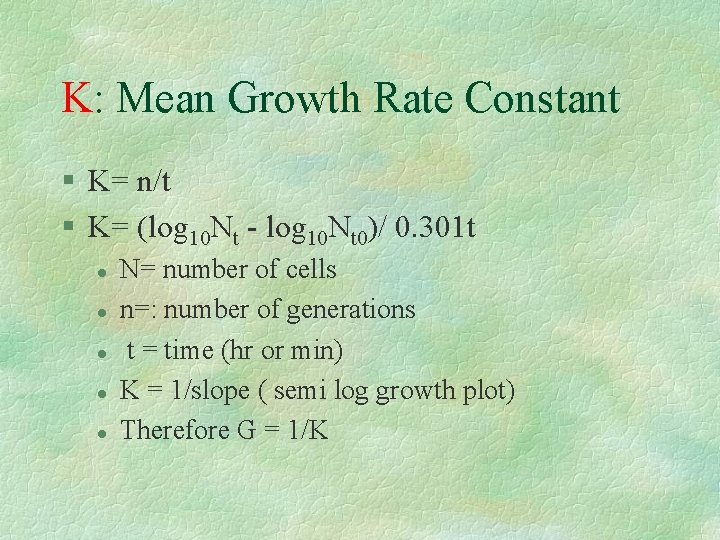
K: Mean Growth Rate Constant § K= n/t § K= (log 10 Nt - log 10 Nt 0)/ 0. 301 t l l l N= number of cells n=: number of generations t = time (hr or min) K = 1/slope ( semi log growth plot) Therefore G = 1/K
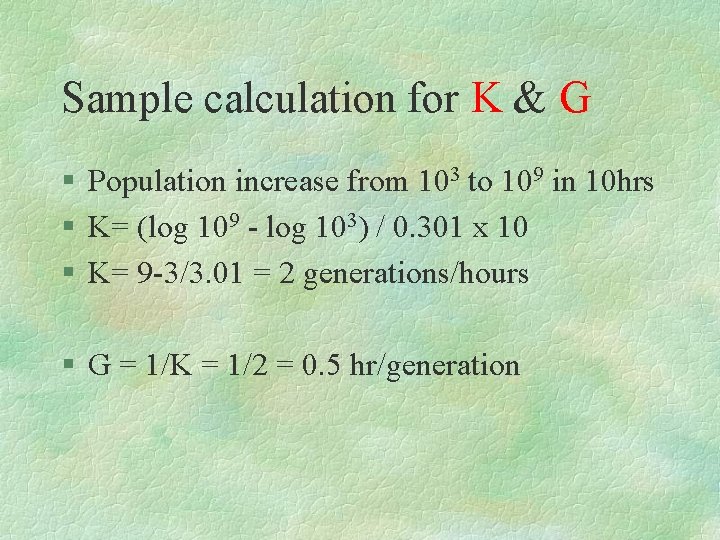
Sample calculation for K & G § Population increase from 103 to 109 in 10 hrs § K= (log 109 - log 103) / 0. 301 x 10 § K= 9 -3/3. 01 = 2 generations/hours § G = 1/K = 1/2 = 0. 5 hr/generation
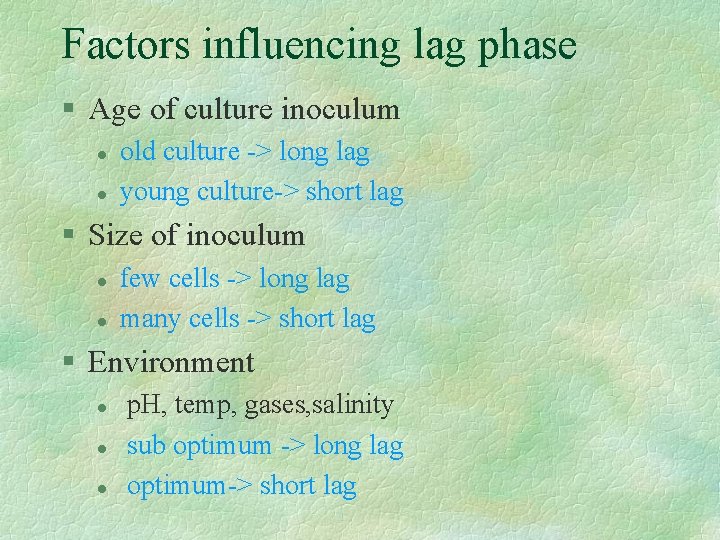
Factors influencing lag phase § Age of culture inoculum l l old culture -> long lag young culture-> short lag § Size of inoculum l l few cells -> long lag many cells -> short lag § Environment l l l p. H, temp, gases, salinity sub optimum -> long lag optimum-> short lag
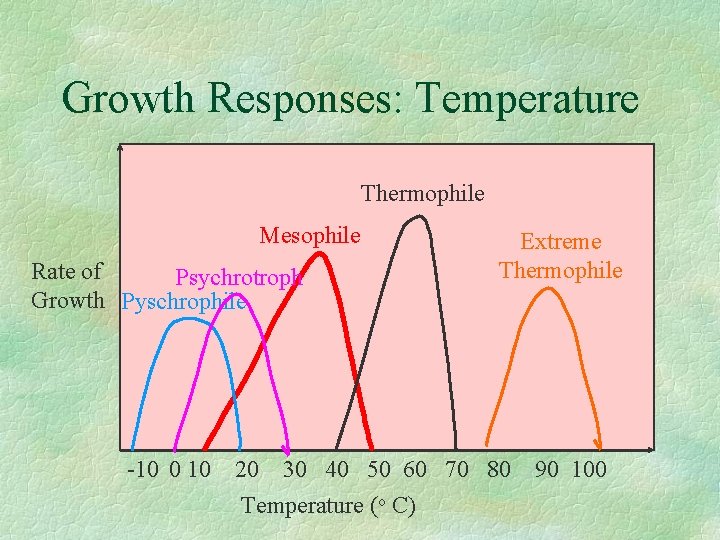
Growth Responses: Temperature Thermophile Mesophile Rate of Psychrotroph Growth Pyschrophile -10 0 10 Extreme Thermophile 20 30 40 50 60 70 80 Temperature (o C) 90 100
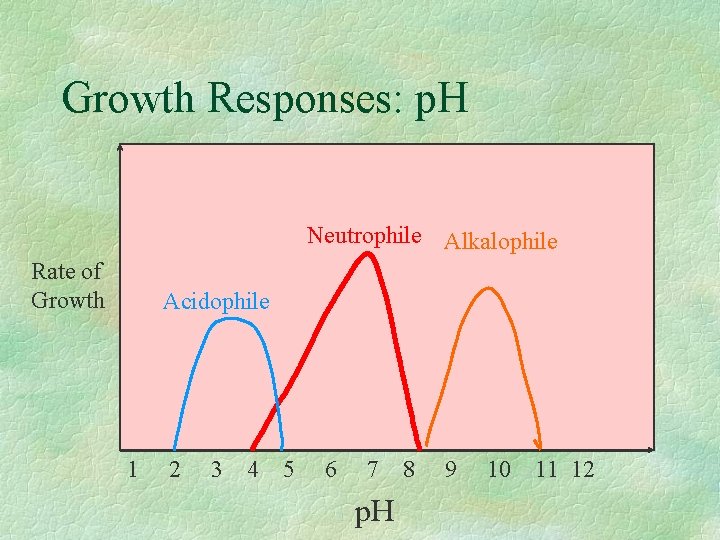
Growth Responses: p. H Neutrophile Alkalophile Rate of Growth Acidophile 1 2 3 4 5 6 7 p. H 8 9 10 11 12
Diauxic Growth § § § Growth on two carbon sources Mixed sugars Each sugar used separately Glucose ALWAYS used first Second sugar ONLY used when glucose GONE
![Diauxic Growth: 2 carbon sources Growth [Sugar] Arabinose Glucose Time (hr)](http://slidetodoc.com/presentation_image/50e161a9cf4bced631e150ec1bf80975/image-25.jpg "Diauxic Growth: 2 carbon sources Growth [Sugar] Arabinose Glucose Time (hr)")
Diauxic Growth: 2 carbon sources Growth [Sugar] Arabinose Glucose Time (hr)
Synchronous Growth § Filtration l l Smaller cells all same size § Temperature shock l Hot/cold brings cells to same metabolic state § Starvation l deplete medium of selected nutrient
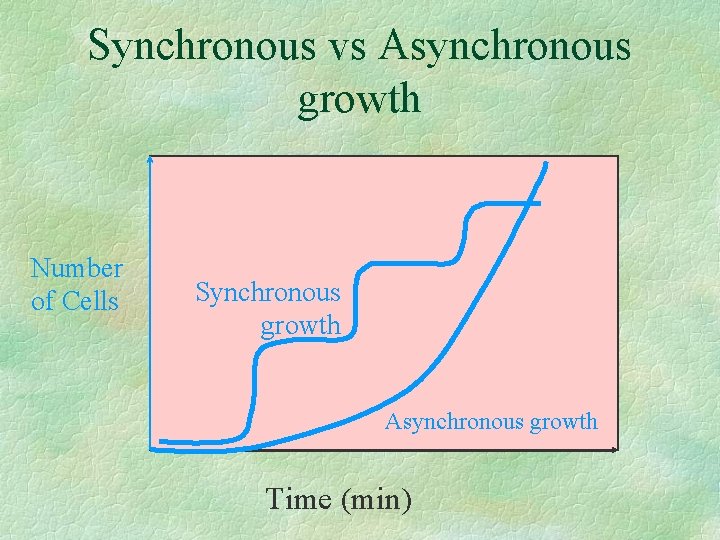
Synchronous vs Asynchronous growth Number of Cells Synchronous growth Asynchronous growth Time (min)

Growth in Limited Nutrients § § Limiting concentration of Required nutrient YIELD number of cells Linear increase yield with nutrient conc Yield = Mass of organisms formed Mass of nutrients used
![Growth in Limited Nutrients Growth Rate Total Growth [Nutrient]](http://slidetodoc.com/presentation_image/50e161a9cf4bced631e150ec1bf80975/image-29.jpg "Growth in Limited Nutrients Growth Rate Total Growth [Nutrient]")
Growth in Limited Nutrients Growth Rate Total Growth [Nutrient]
![Applications of Limiting [Nutrient] § Chemostat (continuous culture) § Bio-Assay](http://slidetodoc.com/presentation_image/50e161a9cf4bced631e150ec1bf80975/image-30.jpg "Applications of Limiting [Nutrient] § Chemostat (continuous culture) § Bio-Assay")
Applications of Limiting [Nutrient] § Chemostat (continuous culture) § Bio-Assay
Bio-Assay: Procedure § Bacterium: CANNOT synthesize nutrient § Medium: all growth requirements except nutrient to be assayed § Add l l l equal amounts of medium to each tube equal numbers of bacteria to each tube increasing amounts of the nutrient to be assayed § [Unknown] § Incubate § Measure growth (turbidity or viable count)
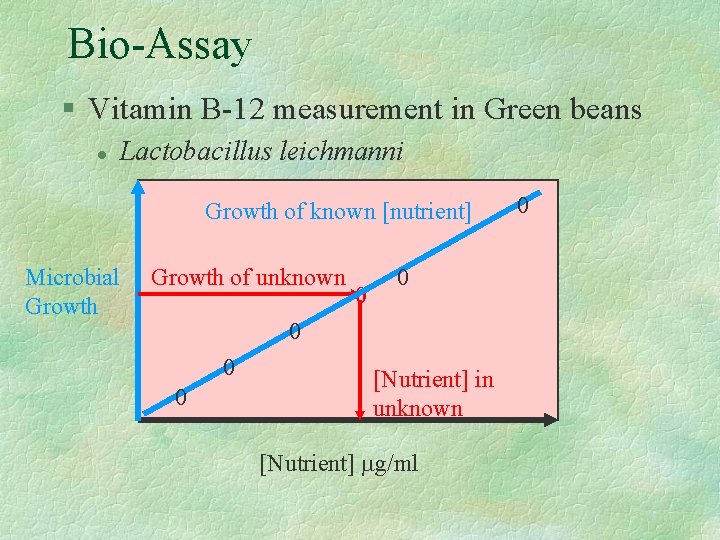
Bio-Assay § Vitamin B-12 measurement in Green beans l Lactobacillus leichmanni Growth of known [nutrient] Microbial Growth of unknown 0 0 0 [Nutrient] in unknown [Nutrient] mg/ml 0
Chemostat § § § Description of Instrument Principle Steady State Sample Results Application
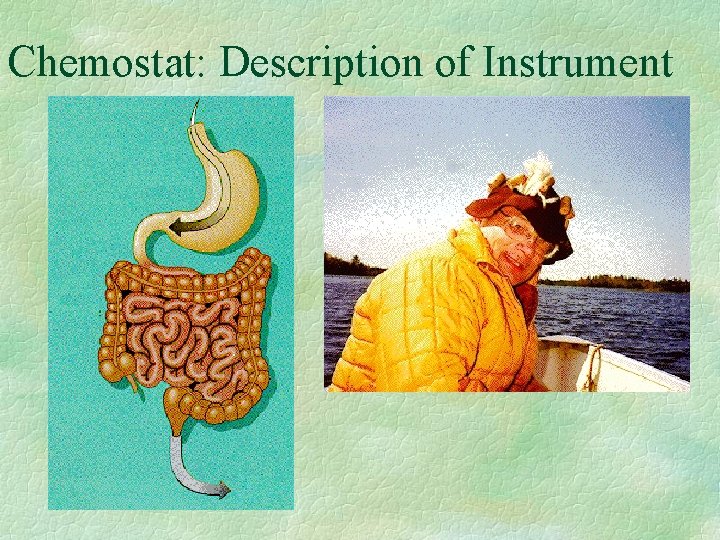
Chemostat: Description of Instrument
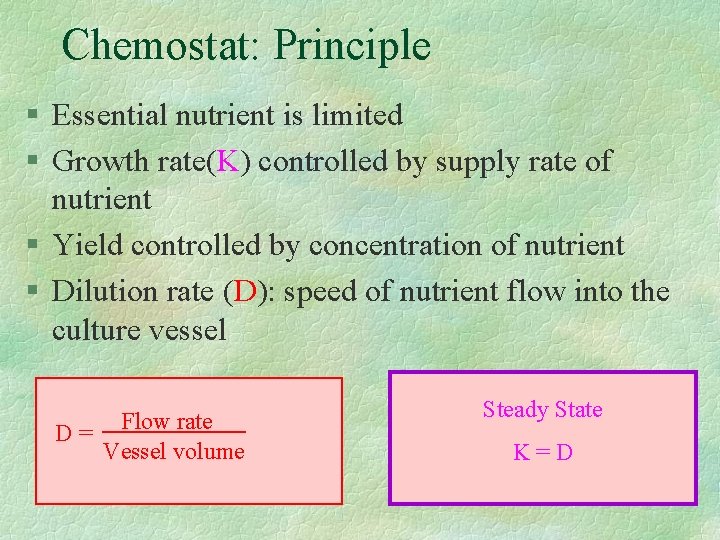
Chemostat: Principle § Essential nutrient is limited § Growth rate(K) controlled by supply rate of nutrient § Yield controlled by concentration of nutrient § Dilution rate (D): speed of nutrient flow into the culture vessel D = Flow rate Vessel volume Steady State K=D
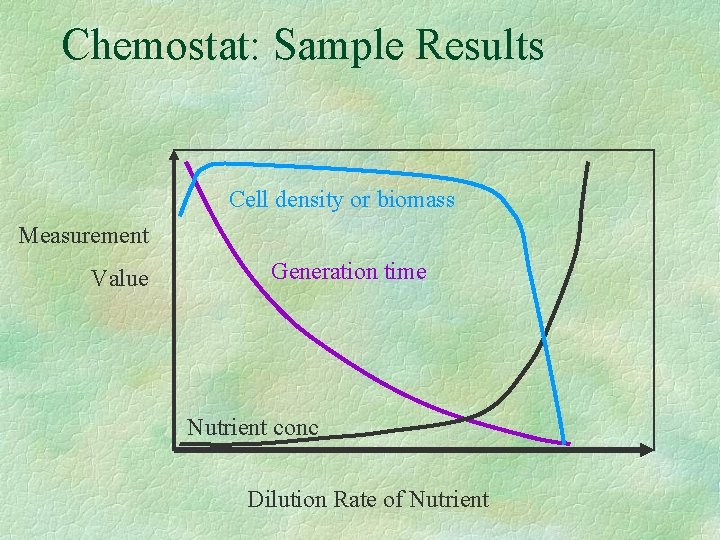
Chemostat: Sample Results Cell density or biomass Measurement Value Generation time Nutrient conc Dilution Rate of Nutrient
Chemostat: Applications § Growing large amounts of cells § Industrial production l l l vaccines pharmaceuticals hormones § Long term studies of specific growth phase § Selecting for specific mutants § Aquatic systems
Bacterial Growth in Natural Environments § Natural Environments l l Animal Tissues Soil Water- freshwater- marine Plants
Bacterial Growth in Natural Environments § Active l l Short bursts of growth & metabolism usually low rates of growth § Quiescent l Viable cannot culture § Stressed l starvation semi viable
Biofilms: Body § Catheter l Foley: • latex silicone l Intravenous: • polyurethane S. epidermidis § Prostheses l l l Hip joints Dental implants voicebox § Tampons § IUD
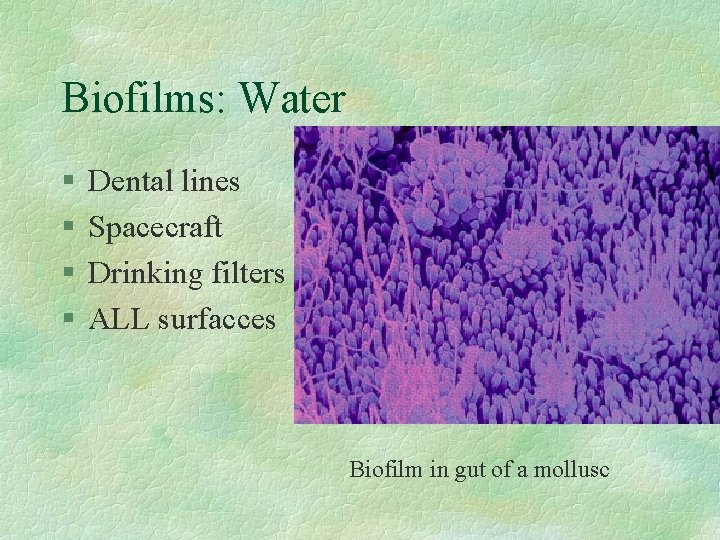
Biofilms: Water § § Dental lines Spacecraft Drinking filters ALL surfacces Biofilm in gut of a mollusc
Biofilms: Disease § Cystic fibrosis l lung-alveolar surface § Ulcers l Helicobacter jejuni § Dental caries l Streptococccus spp
- Slides: 42