
Growth and Development Development of a Child Child
- Slides: 17
Growth and Development
Development of a Child • Child Development – The study of a child from conception to age 18. • The five stages of development are: – Infancy: Birth to 12 months – Toddler: 12 months to 3 years – Preschool: 3 years to 6 years – School age: 6 years to 12 years – Adolescents: 13 years to 18 years
Definitions • Growth – A child’s physical increase in size or amount that is easily observed. • Development – The ability of a child to do things that are complex and difficult.
Laws of Growth & Development • Growth proceeds from head to foot – The infant needs to hold their head up before they can crawl • Growth proceeds from near to far – The infant needs to move their arm before they can move fingers. • Growth proceeds from simple to complex – The infant holds their head up, rolls over, crawls, walks
Laws of Growth & Development • • • Similar for everyone Builds on earlier learning Proceeds at an individual rate and time Is all interrelated Is continual throughout life
Physical Development • Children develop most rapidly during the first three years of life. • Motor skills are the coordinated movements of body parts. • There are two types of motor skills: – Fine or small muscles (hands and fingers) – Gross or large muscles (legs and arms)
Physical Development • Most children follow a natural physical development sequence: – Lift their head – Roll over – Creep (baby pushes around on stomach) – Crawl (some children skip this step) – Cruise (walk while holding onto objects for support) – Walk
Social Development • Socialization is the process of: – Learning self-expression – To get along and interact with others – Moving from being self-centered to relating with others
Emotional Development • Learning to recognize and express feelings. • Learning to establish a unique personal identity. • Begins at birth • Erikson was the main theorist
Cognitive Development • Intellectual skills – How one learns – Gains information – Understands the world around them • Positive feedback for accomplishments encourages children to continue trying, learning, and achieving
Cognitive Development • Children learn: – Through everyday experiences that surround them – About the world around them through play • A sensory stimulating environment: – Promotes brain development and learning – Critical for brain development in ages 0 -3
Cognitive Development • Language development is a cognitive task. • Speaking correctly (modeling) to the child will help them learn correct speech patterns. • Jean Piaget was the main theorist
Moral Development • The process of learning right from wrong. • Being a good example (modeling) is the best way to teach moral development to children.
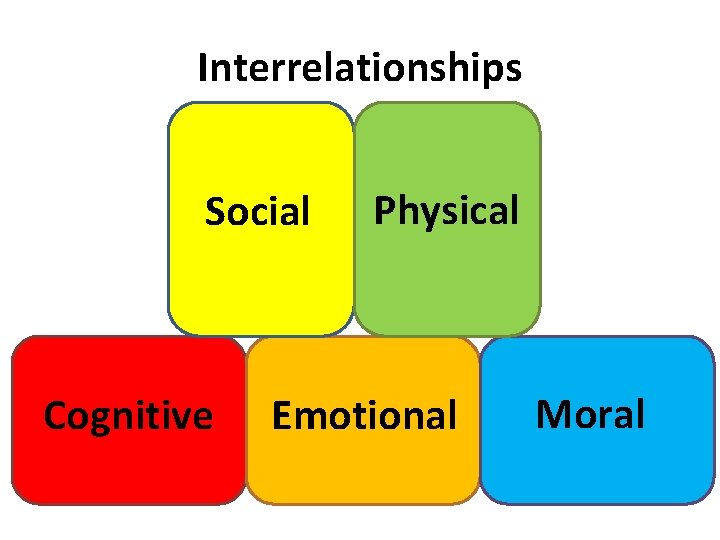
Interrelationships • All of these areas of development have their unique traits, but they are all dependent of each other to function. • Each area provides a foundation for the next.
Interrelationships Social Cognitive Physical Emotional Moral
Game Observation • Split into groups of four and choose a child’s game to play • At the conclusion of play, describe how the game would help a child in each area of development: – Physical – Social – Cognitive – Emotional – Moral
Summary • Five areas of development: – Physical – Muscle coordination and control – Cognitive – Processing of information – Social – Interacting with others – Emotional – Understanding feelings – Moral – Identifying personal values • Encourage a child’s development in every area so that they can grow to be healthy, happy, and productive individuals.