
Growing Rods in Cerebral Palsy Justin Yang BS
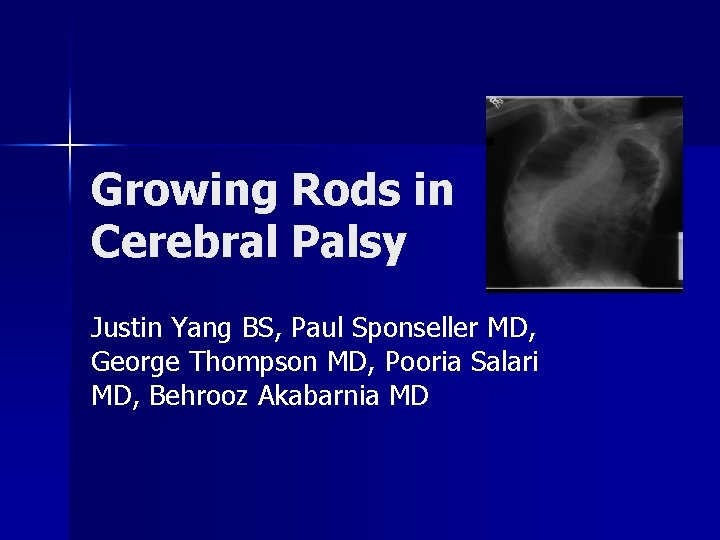
Growing Rods in Cerebral Palsy Justin Yang BS, Paul Sponseller MD, George Thompson MD, Pooria Salari MD, Behrooz Akabarnia MD

Disclosures Justin Yang- None n Co-Authors: (a, b) De. Puy Spine n a. b. c. d. e. Grants/Research Support Consultant Stock/Shareholder Speakers’ Bureau Other Financial Support
Background Information n Severe scoliosis often develops at an early age in Cerebral Palsy and is not well-controlled by orthoses n This project examines the deformities, techniques, surgical outcomes and complications of GR in CP.
Hypothesis n Growing rods can successfully improve scoliosis and pelvic obliquity in patients with cerebral palsy
Methods n 20 CP patients with from 6 centers n Variables: – – – Age Balance Major Cobb Construct type Gain in T 1 -S 1 Complication rate.
Methods n Mean age at initial insertion 7. 5± 2. 7 years (range 4. 25 -11) – Average follow-up: 26 months n Mean pre-operative Cobb 83± 19° – – Average Pre-Op Cobb for other GSSG diagnoses: 72°± 18 P=0. 01 n Pre-operative coronal imbalance 7 cm n Pre-operative pelvic obliquity was 31± 10°
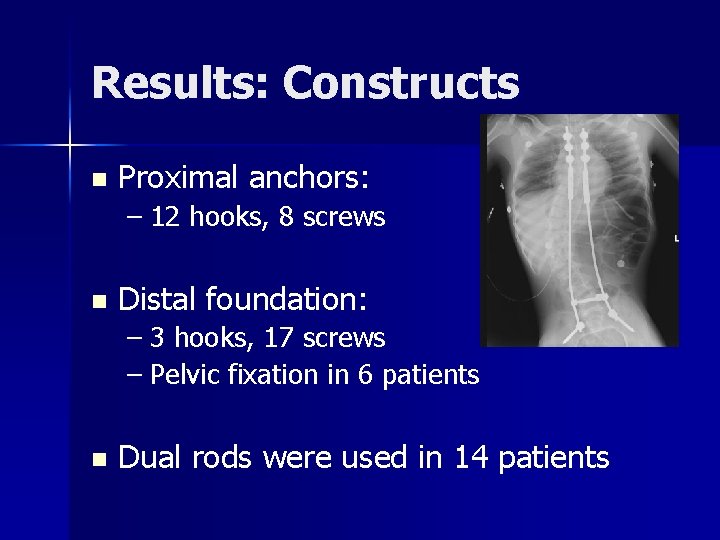
Results: Constructs n Proximal anchors: – 12 hooks, 8 screws n Distal foundation: – 3 hooks, 17 screws – Pelvic fixation in 6 patients n Dual rods were used in 14 patients
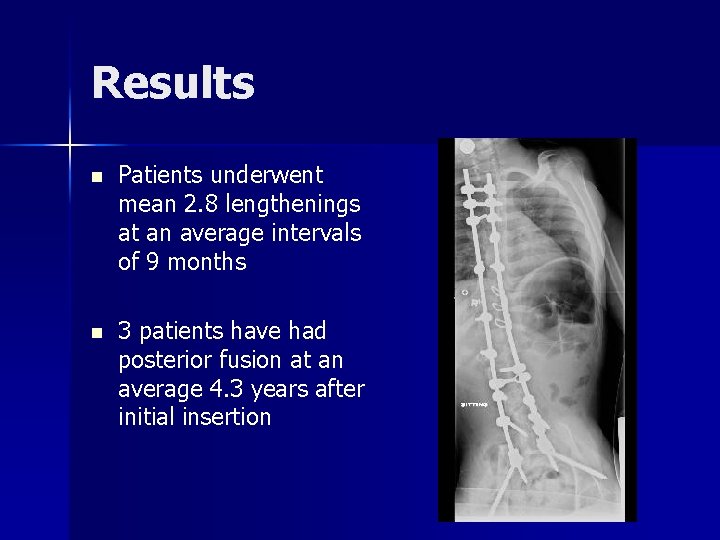
Results n Patients underwent mean 2. 8 lengthenings at an average intervals of 9 months n 3 patients have had posterior fusion at an average 4. 3 years after initial insertion
Results: Latest Follow-up n Major curve improved from 83° to 51± 18° – All other diagnoses: 72° to 43± 16° – Avg % correction: 38% vs. 43%, P=0. 84 n Coronal imbalance improved from 7 cm to 4. 7 cm
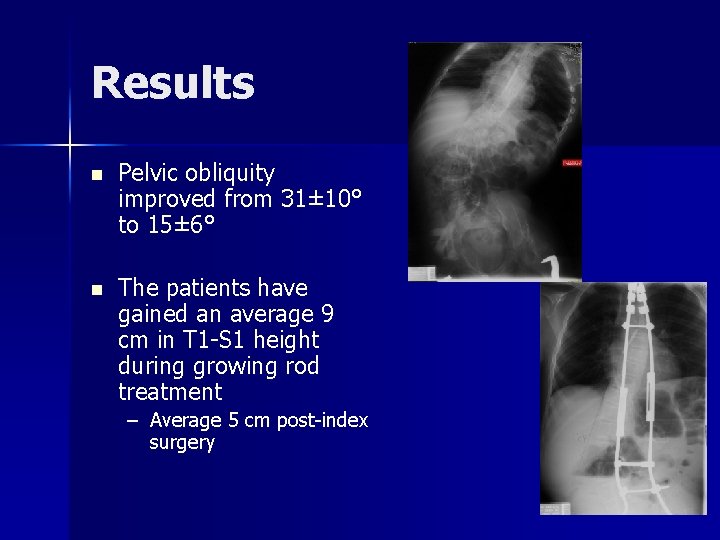
Results n Pelvic obliquity improved from 31± 10° to 15± 6° n The patients have gained an average 9 cm in T 1 -S 1 height during growing rod treatment – Average 5 cm post-index surgery
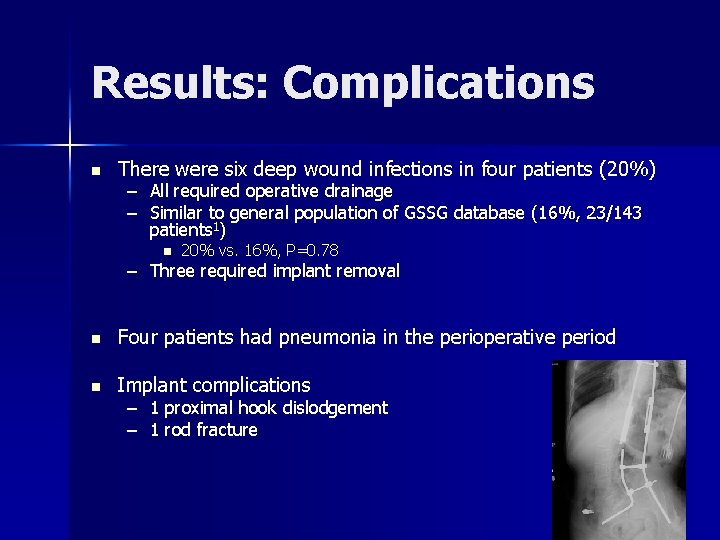
Results: Complications n There were six deep wound infections in four patients (20%) – All required operative drainage – Similar to general population of GSSG database (16%, 23/143 patients 1) n 20% vs. 16%, P=0. 78 – Three required implant removal n Four patients had pneumonia in the perioperative period n Implant complications – 1 proximal hook dislodgement – 1 rod fracture
Conclusions n Growing rods can be used for correction of severe scoliosis curve in cerebral palsy – Present with larger curves – Pelvic obliquity not completely corrected n n Due to medical complexity of patients with CP, treatment burden greater Costs and benefits must be weighed to maximize quality of life

Future Directions n Longitudinal function/outcome assessments n Pulmonary questionnaires
Thank You
- Slides: 14