
Growing Rods for Scoliosis in Spinal Muscular Atrophy
- Slides: 13
Growing Rods for Scoliosis in Spinal Muscular Atrophy: Structural Effects and Use of Hospital Care Mark J. Mc. Elroy, MS Paul D. Sponseller, MD George H. Thompson, MD Adam Shaner, BS Thomas O. Crawford, MD Rishi V. Kadakia, BS Behrooz A. Akbarnia, MD Growing Spine Study Group
Growing Rods for Scoliosis in Spinal Muscular Atrophy Disclosures Presenter: Paul Sponseller MD De. Puy Spine (a, e); Globus(e) Mark J Mc. Elroy, MS Adam Shaner George H. Thompson, MD Thomas O. Crawford, MD Rishi V. Kadakia, BS Behrooz A. Akbarnia Growing Spine Study Group None None Nuvasive (a, b, c), K 2 M (a, b), De. Puy Spine (a, b), Ellipse (b) Stryker (a) Growing Spine Foundation (a) a. b. c. d. e. Grants/Research Support Consultant Stock/Shareholder Speakers’ Bureau Other Financial Support
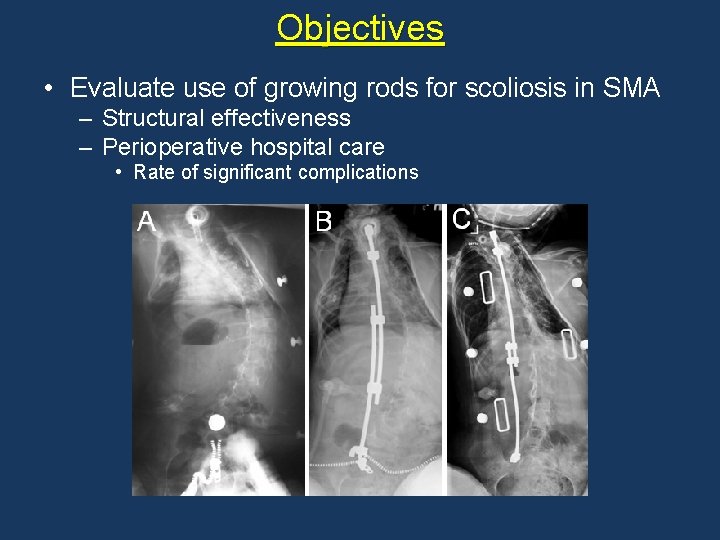
Objectives • Evaluate use of growing rods for scoliosis in SMA – Structural effectiveness – Perioperative hospital care • Rate of significant complications
Materials and Methods Patient Population • 15 SMA patients treated with GRs – Age at insertion 8. 0 ± 2. 1 years (range, 3. 5 -10. 8) – Follow-up 54 ± 33 months – 6 single rods, 9 dual rods – Levels spanned 16 ± 1. 7 – Instrumentation to pelvis in 10 patients • SMA patients compared to 80 early onset idiopathic scoliosis patients treated with GRs • All patients from GSSG database
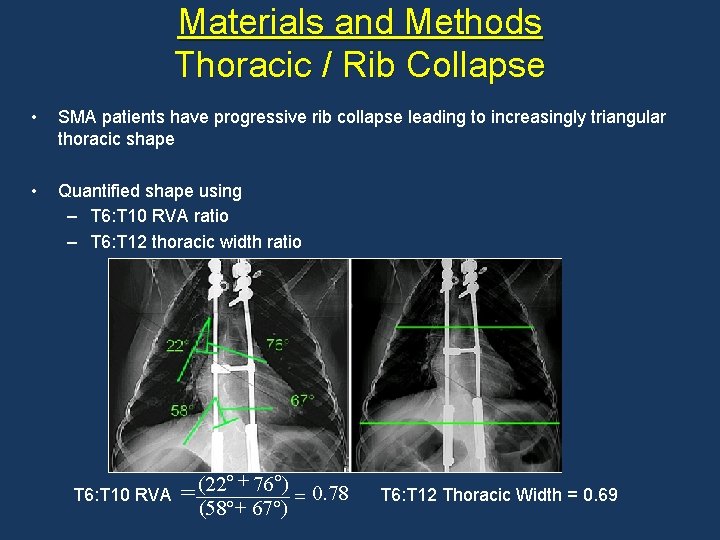
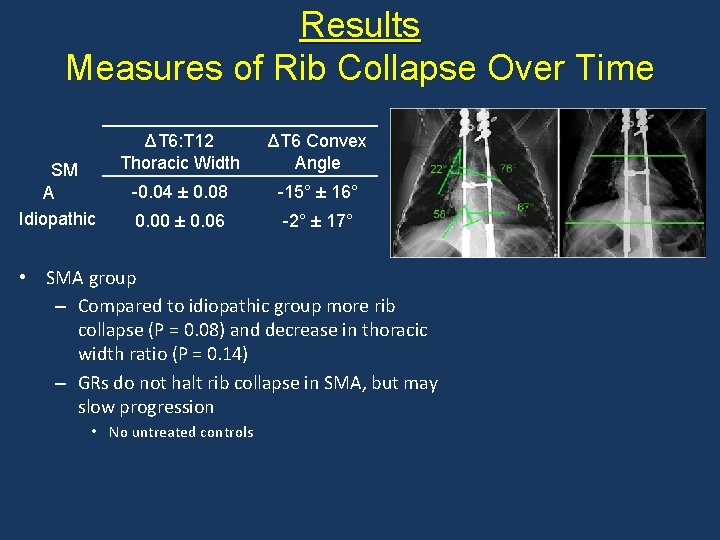
Materials and Methods Thoracic / Rib Collapse • SMA patients have progressive rib collapse leading to increasingly triangular thoracic shape • Quantified shape using – T 6: T 10 RVA ratio – T 6: T 12 thoracic width ratio T 6: T 10 RVA + = (22 76 ) = 0. 78 (58 + 67 ) T 6: T 12 Thoracic Width = 0. 69
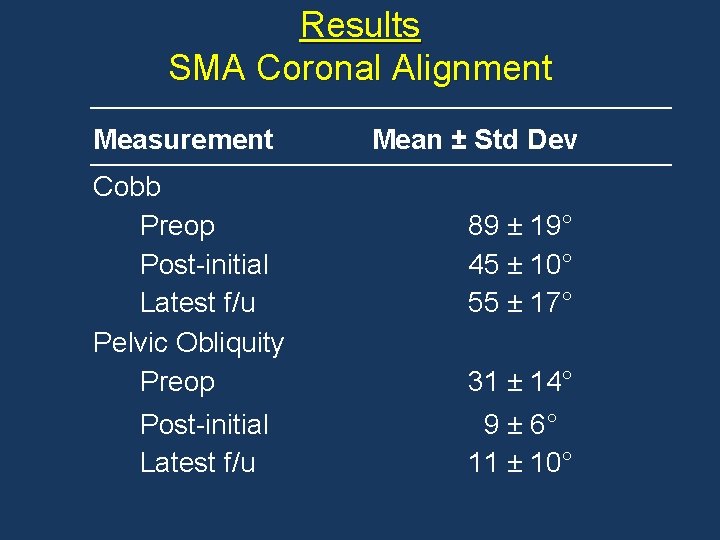
Results SMA Coronal Alignment Measurement Cobb Preop Post-initial Latest f/u Pelvic Obliquity Preop Post-initial Latest f/u Mean ± Std Dev 89 ± 19° 45 ± 10° 55 ± 17° 31 ± 14° 9 ± 6° 11 ± 10°
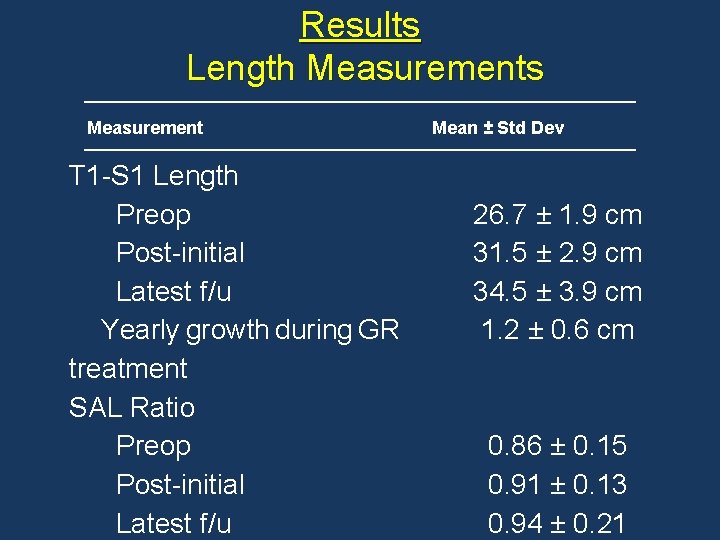
Results Length Measurements Measurement T 1 -S 1 Length Preop Post-initial Latest f/u Yearly growth during GR treatment SAL Ratio Preop Post-initial Latest f/u Mean ± Std Dev 26. 7 ± 1. 9 cm 31. 5 ± 2. 9 cm 34. 5 ± 3. 9 cm 1. 2 ± 0. 6 cm 0. 86 ± 0. 15 0. 91 ± 0. 13 0. 94 ± 0. 21
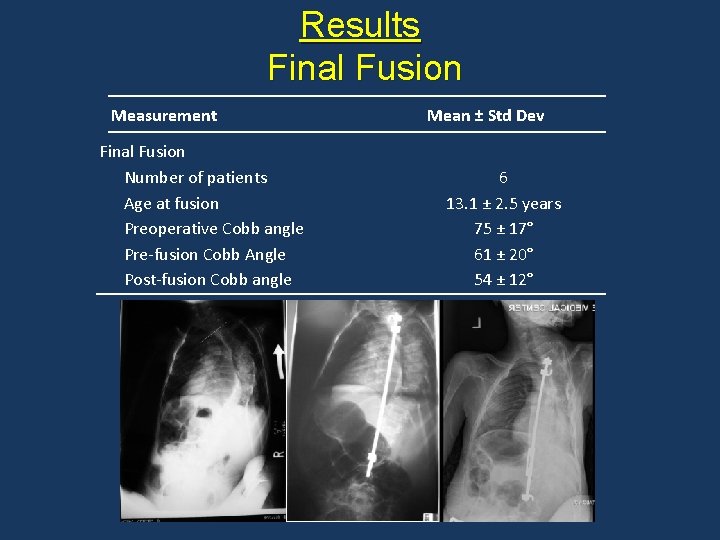
Results Final Fusion Measurement Final Fusion Number of patients Age at fusion Preoperative Cobb angle Pre-fusion Cobb Angle Post-fusion Cobb angle Mean ± Std Dev 6 13. 1 ± 2. 5 years 75 ± 17° 61 ± 20° 54 ± 12°
Results Measures of Rib Collapse Over Time SM A Idiopathic ΔT 6: T 12 Thoracic Width ΔT 6 Convex Angle -0. 04 ± 0. 08 -15° ± 16° 0. 00 ± 0. 06 -2° ± 17° • SMA group – Compared to idiopathic group more rib collapse (P = 0. 08) and decrease in thoracic width ratio (P = 0. 14) – GRs do not halt rib collapse in SMA, but may slow progression • No untreated controls
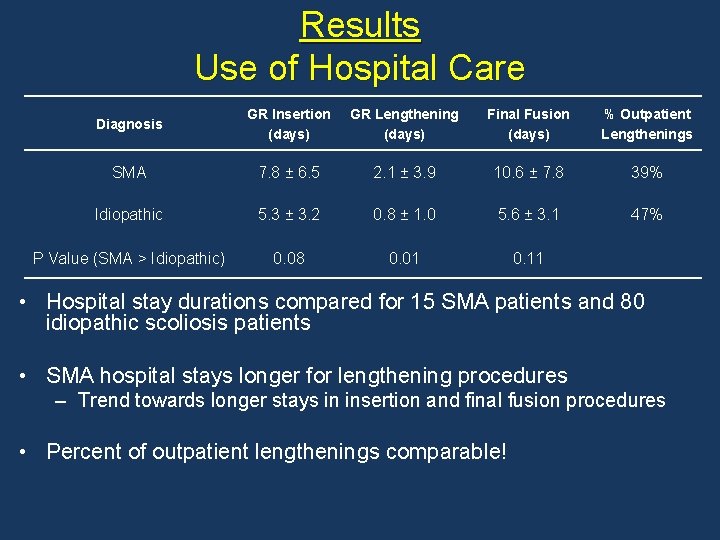
Results Use of Hospital Care Diagnosis GR Insertion (days) GR Lengthening (days) Final Fusion (days) % Outpatient Lengthenings SMA 7. 8 ± 6. 5 2. 1 ± 3. 9 10. 6 ± 7. 8 39% Idiopathic 5. 3 ± 3. 2 0. 8 ± 1. 0 5. 6 ± 3. 1 47% P Value (SMA > Idiopathic) 0. 08 0. 01 0. 11 • Hospital stay durations compared for 15 SMA patients and 80 idiopathic scoliosis patients • SMA hospital stays longer for lengthening procedures – Trend towards longer stays in insertion and final fusion procedures • Percent of outpatient lengthenings comparable!
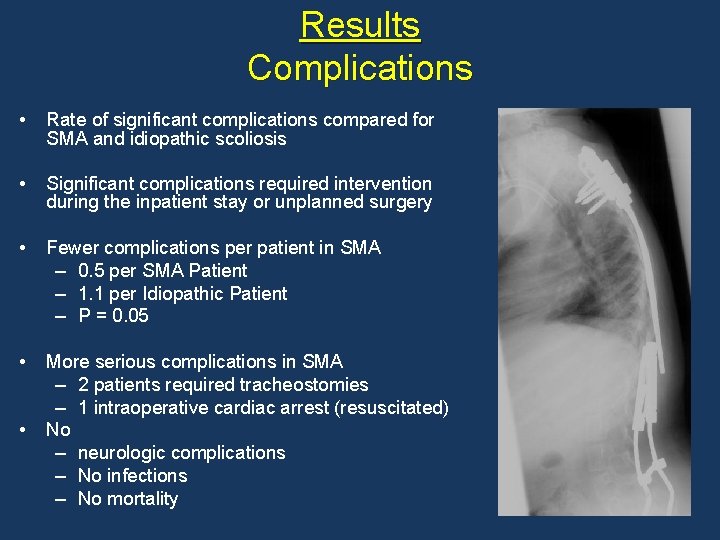
Results Complications • Rate of significant complications compared for SMA and idiopathic scoliosis • Significant complications required intervention during the inpatient stay or unplanned surgery • Fewer complications per patient in SMA – 0. 5 per SMA Patient – 1. 1 per Idiopathic Patient – P = 0. 05 • More serious complications in SMA – 2 patients required tracheostomies – 1 intraoperative cardiac arrest (resuscitated) No – neurologic complications – No infections – No mortality •
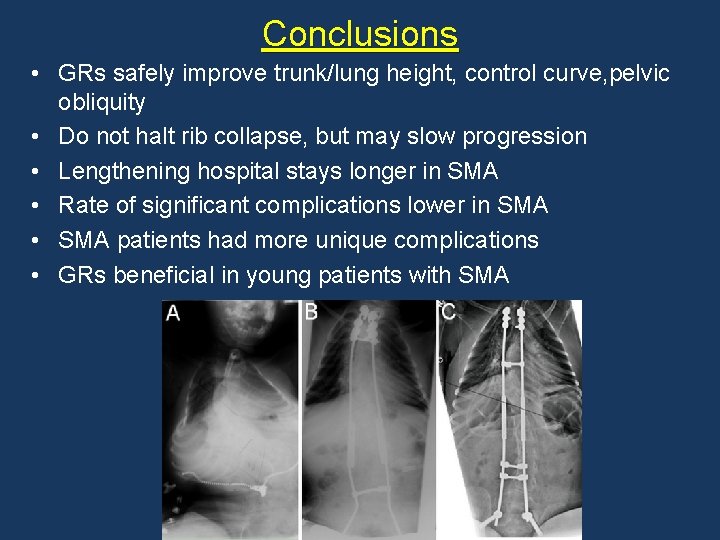
Conclusions • GRs safely improve trunk/lung height, control curve, pelvic obliquity • Do not halt rib collapse, but may slow progression • Lengthening hospital stays longer in SMA • Rate of significant complications lower in SMA • SMA patients had more unique complications • GRs beneficial in young patients with SMA
The Growing Spine Foundation is supported by donations from: Surgeon Members also unrestricted grants received directly or through OREF by K 2 M De. Puy Spine Stryker Spine Globus Medical Scoliosis Association of San Diego. The Growing Spine Foundation thanks all donors who supported its cause.