
Growing a Coop building the cooperative economy Objectives
Growing a Co-op ~ building the co-operative economy
Objectives of the Session n To give you some basic knowledge of the co-op model n To outline the benefits of the co-op model n To stimulate your thinking of how you might apply the coop model n To outline some steps for co-op development n To provide some examples of co-ops n To give you an opportunity to ask questions about coops ~ building the co-operative economy
What is a co-op? n A co-operative is any enterprise which is collectively owned and democratically controlled by its users for their mutual benefit ~ building the co-operative economy
The Co-operative Principles Seven Principles of Co-operatives Worldwide 1 - Voluntary and open membership 2 - Democratic Member Control 3 - Member Economic Participation 4 - Autonomy and Independence 5 - Education, Training and Information 6 - Co-operation among Co-operatives 7 - Concern for Community ~ building the co-operative economy
The Co-operative Difference n A different purpose – n n A different set of values – n n based on self-help, self-responsibility, democracy, equality, equity & solidarity A different control structure – n n co-ops care about members’ needs each member has only one vote A different allocation of profit – n non-profit co-ops use surplus to increase or improve services to clients ~ building the co-operative economy
Types of co-ops n n n Financial co-ops Producer co-ops Consumer co-ops Worker co-ops Service co-ops Multi-stakeholder co-ops ~ building the co-operative economy

Local Food Co-ops — Opportunities – 3 considerations 1. 2. 3. Type of co-op (producer, consumer, etc) Point on the value chain (production, distribution, value-added, retail) Social issues (poverty, malnourishment, peak oil, food safety, farm income crisis, high cost of agricultural land, barriers to food distribution, working conditions/wages) ~ building the co-operative economy
Local Food Co-ops — Issues n n n n What does local meant? Perhaps regional is a better concept? Value chain issues – scale, commercially operated/managed Industry knowledge e. g. , labeling laws, traceability regulations, food safety, grading standards, etc. Legislated marketing Red tape e. g. , packaging Infrastructure Access to financing ~ building the co-operative economy
Local Food Co-ops — Key Ingredients (Source: ACENet) n n n n Food & farm entrepreneurs Infrastructure (land, processing facilities, farmers’ markets, distribution hubs, co-packers) Local & independent retail Engaged consumers Civic investment/community pride Leaders & champions Policy commitment & change Network weaving & collaboration ~ building the co-operative economy
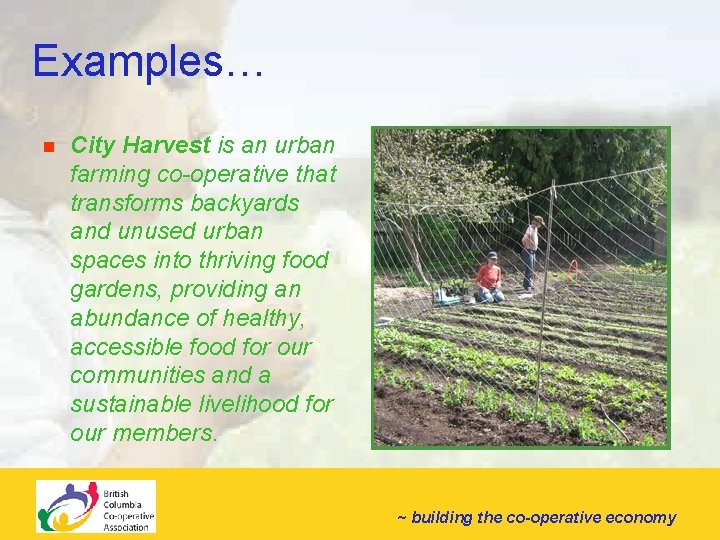
Examples… n City Harvest is an urban farming co-operative that transforms backyards and unused urban spaces into thriving food gardens, providing an abundance of healthy, accessible food for our communities and a sustainable livelihood for our members. ~ building the co-operative economy
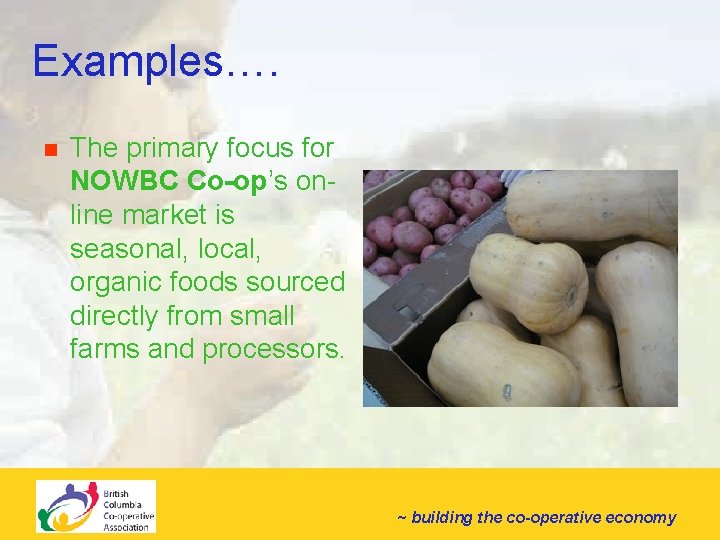
Examples…. n The primary focus for NOWBC Co-op’s online market is seasonal, local, organic foods sourced directly from small farms and processors. ~ building the co-operative economy
Examples… n Welcome to the Kettle Valley Food Coop’s online shopping system! Producers and Shoppers come together here on a weekly basis to buy and sell local products. ~ building the co-operative economy
Examples… n The purpose of the Vancouver Island Heritage Foodservice Coop is to mobilize partners to rebuild local food systems in the Island Coastal region. The co-op’s business plan includes providing distribution, warehousing, co-packing services aimed at the ‘foodservice’ market channel. n n Contending with the Local Food Access Puzzle – report http: //www. heritagefo odservice. coop/Final Report_BCMSF. pdf ~ building the co-operative economy
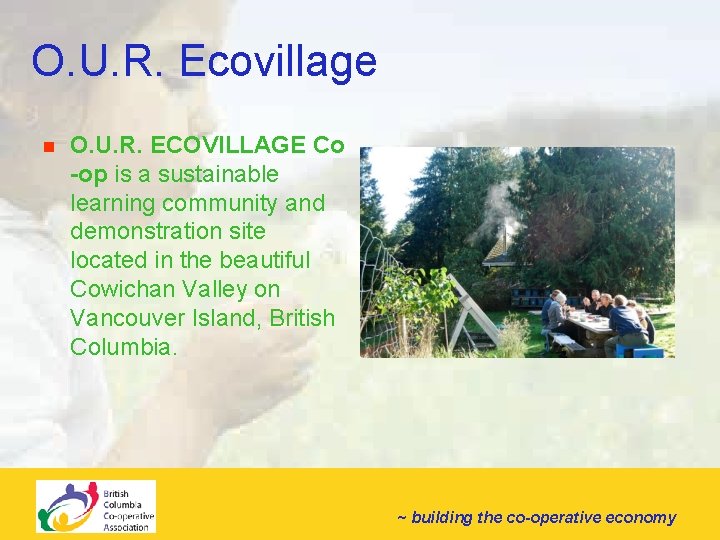
O. U. R. Ecovillage n O. U. R. ECOVILLAGE Co -op is a sustainable learning community and demonstration site located in the beautiful Cowichan Valley on Vancouver Island, British Columbia. ~ building the co-operative economy
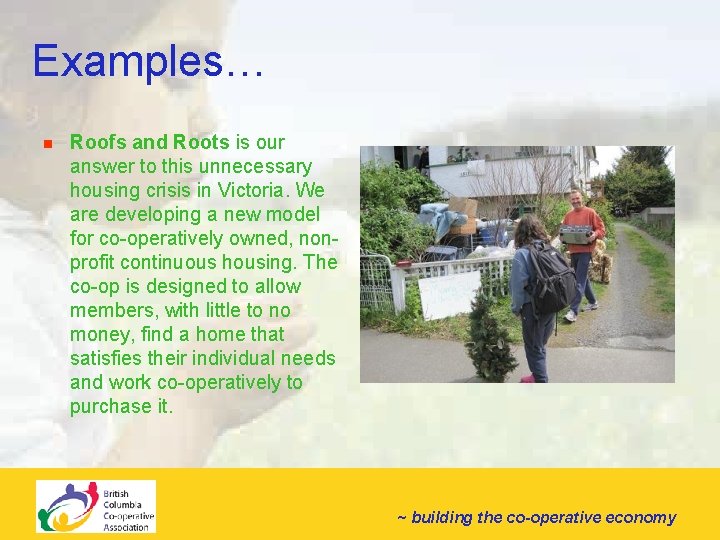
Examples… n Roofs and Roots is our answer to this unnecessary housing crisis in Victoria. We are developing a new model for co-operatively owned, nonprofit continuous housing. The co-op is designed to allow members, with little to no money, find a home that satisfies their individual needs and work co-operatively to purchase it. ~ building the co-operative economy
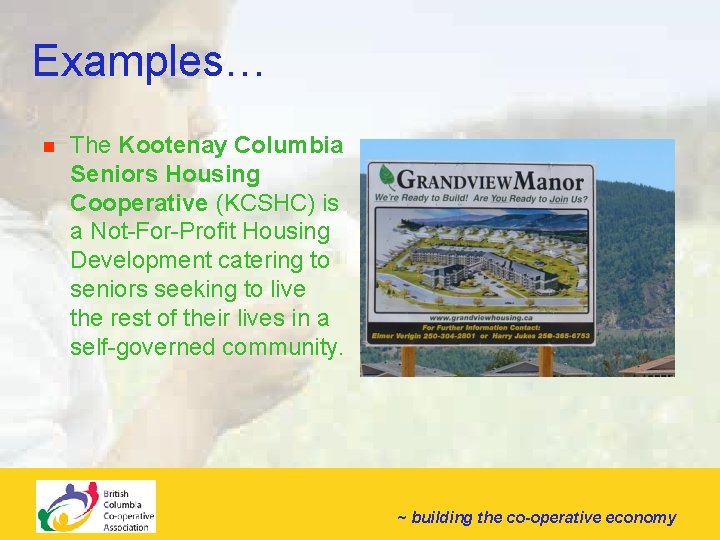
Examples… n The Kootenay Columbia Seniors Housing Cooperative (KCSHC) is a Not-For-Profit Housing Development catering to seniors seeking to live the rest of their lives in a self-governed community. ~ building the co-operative economy
Setting up your co-op The BIG Three 1. Do you have your Steering Committee together? 2. Who are your members? 3. How will your co-op make money? ~ building the co-operative economy
Steps to Co-op Development 1. 2. 3. 4. 5. 6. 7. 8. 9. Group Development Needs & Opportunities Co-op Suitability Development of your Idea or Concept Determining the Co-op Structure Feasibility Study/Business Plan Incorporating your Co-op Internal Structure & Roles Maintenance, Aftercare & Growth ~ building the co-operative economy
The Co-op Advantages for Members n Address a common need that individuals cannot meet alone n All members own and control the enterprise n Members benefit in proportion to their use of the co-operative ~ building the co-operative economy
The Co-op Advantages for Communities n Provides local goods & services, stable jobs and economic opportunities n Retains wealth and control in the community n Builds local leadership & business skills n Builds communities through providing services ~ building the co-operative economy
Thank You! For more information, visit: www. bcca. coop www. coopscanada. coop ~ building the co-operative economy
- Slides: 21