
Grow NCERL A Digital Library of Interactive Collections
Grow –NCERL: A Digital Library of Interactive Collections in Soils, Rock and Water Resources Engineering Muniram Budhu, Professor, Department of Civil Engineering & Engineering Mechanics, University of Arizona, Tucson, Arizona, 85721 Guest Professor, Swiss Federal Institute of Technology (ETH), 8046 -Zurich, Switzerland (until Oct. 1, 2002)
Topics 1. Context and Background – What is Civil Engineering? 2. NSDL & GROW Overview 3. Technical Background 4. Demonstration
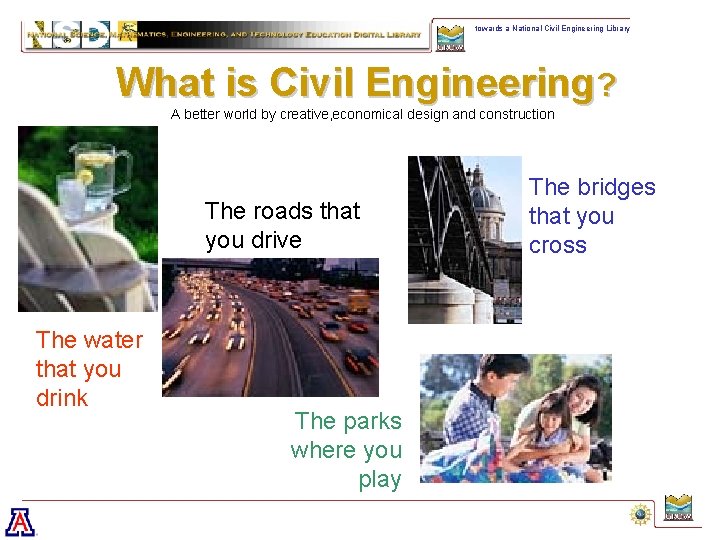
towards a National Civil Engineering Library What is Civil Engineering? A better world by creative, economical design and construction The roads that you drive The water that you drink The parks where you play The bridges that you cross
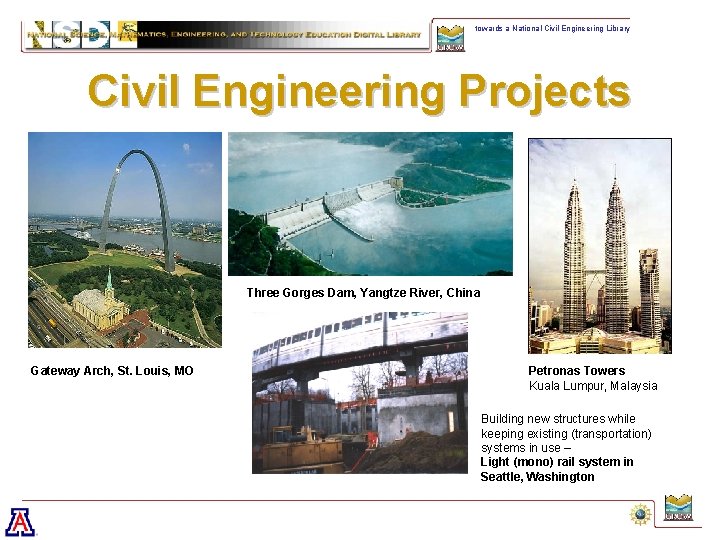
towards a National Civil Engineering Library Civil Engineering Projects Three Gorges Dam, Yangtze River, China Gateway Arch, St. Louis, MO Petronas Towers Kuala Lumpur, Malaysia Building new structures while keeping existing (transportation) systems in use – Light (mono) rail system in Seattle, Washington
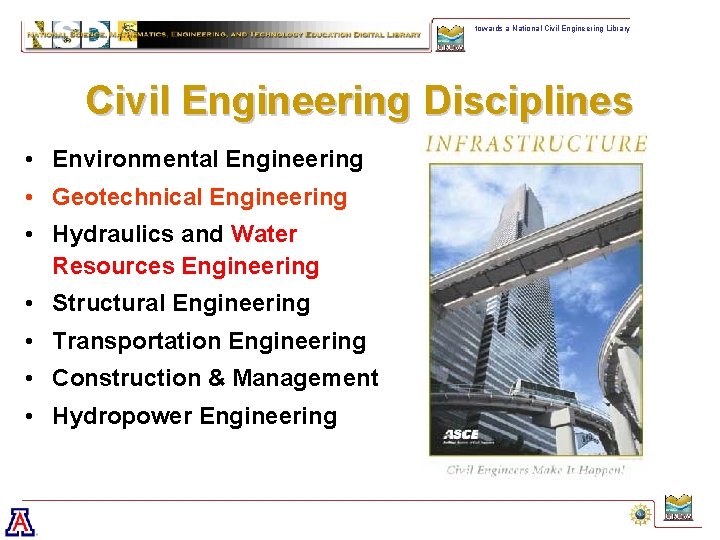
towards a National Civil Engineering Library Civil Engineering Disciplines • Environmental Engineering • Geotechnical Engineering • Hydraulics and Water Resources Engineering • Structural Engineering • Transportation Engineering • Construction & Management • Hydropower Engineering
National Science, Mathematics, Engineering and Technology Digital Library Sponsored by the NSF to create a digital learning place for science, mathematics, engineering & technology teaching and learning that encourages and supports users to discover, explore, create & interact with digital resources anyplace- anytime.
National Civil Engineering Resource Library MISSION: To encourage and promote interest, exploration and learning in Civil Engineering through the development, collection, and dissemination of reviewed and ranked interactive learning resources continuously enhanced by new technological innovations.
MISSION: To make DL not only to access resources and information services but as a anytime-anyplace source of instruction.
DL Impact on Education • Anytime-Anywhere Learning Environments • Customizable/Personalizable Spaces • User-Centric Learning Environments • Technologically Enhanced Learning Environments • Dynamic learning objects – repackage and reused.
Accomplishment of Mission This mission will be accomplished by: • Demonstrating the impact that civil engineering has on daily activities through context and demonstration • Providing free, high-quality, reviewed and ranked interactive digital learning objects that can be used for self-study or repurposed for instructional needs.
Central Idea Geotechnical, Rock and Water Resources Digital Library We can meet the educational needs of a wide cross section of learners (K-12, undergraduates, graduates & professional engineers) by repackaging and repurposing basic digital educational materials. toward a National Civil Engineering Resource Library
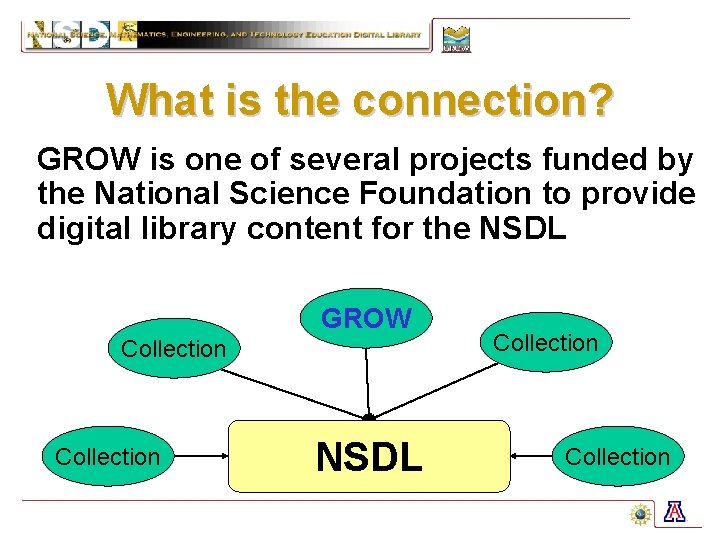
What is the connection? GROW is one of several projects funded by the National Science Foundation to provide digital library content for the NSDL GROW Collection NSDL Collection
Collaboration • Interdisciplinary Collaboration • Team Collaboration • NSDL Project collaboration
Who is involved • Muniram Budhu, Project Director - Professor, Department of Civil Engineering • John Kemeny, Professor, Department of Mining and Geological Engineering • William Rasmussen, Professor, Department of Agric. & Biosystems Engineering • Maliaca Oxnam, Engineering Librarian, University of Arizona Library • Paul Bracke, Systems Librarian, University of Arizona Library • Jeremy Frumkin, Systems Librarian, University of Arizona Library • Wayne Brent, Instructional Applications Manager, CCIT • Ronan Dempsey, Project Manager, Department of Civil Engineering • Leo Przybylski, Systems Developer, Department of Civil Engineering • Elena Berman, Assessment Specialist, Assessment & Enrollment Research • Anita Coleman, Professor, School of Information Resources & Library Science
What is unique about GROW? Most projects are collecting quality content in specific areas For GROW, we are not only collecting but also creating quality content
Focus • Interactive, multimedia, educational resources • “Story-booked” to emphasize active learning • Flexibility - content re-purposed to create new resources • Educational outcomes
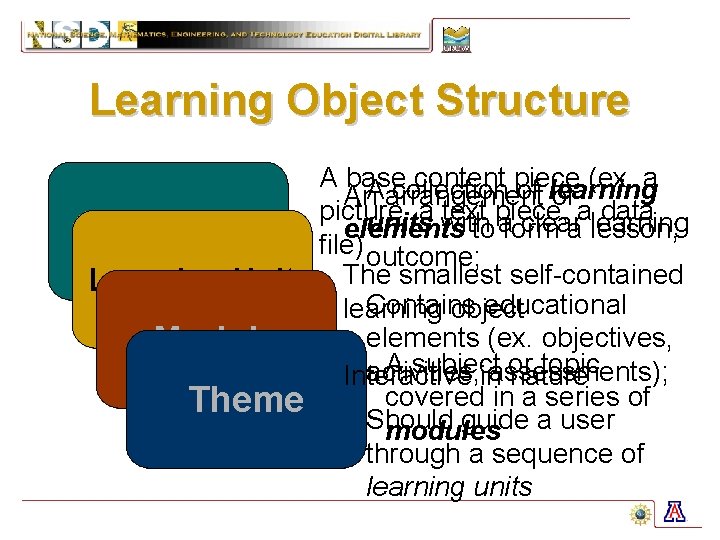
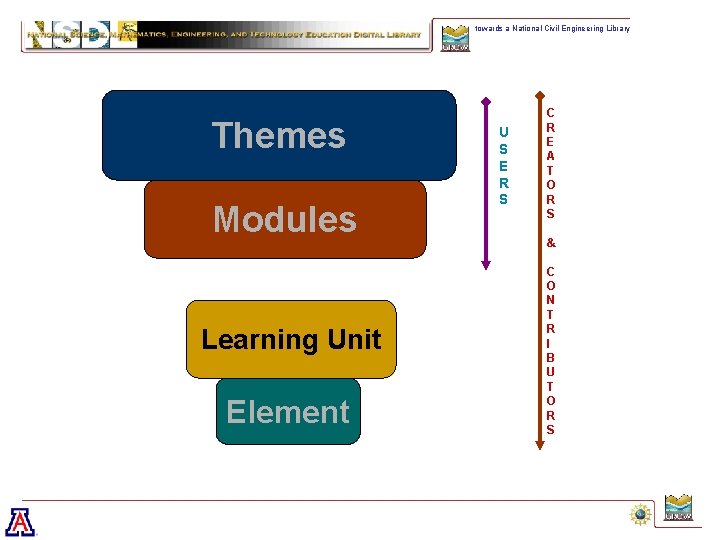
Learning Object Structure A base content piece (ex. a A collection of learning An arrangement of picture, a with text piece, alearning data units a clear elements to form a lesson; Element file) outcome; The smallest self-contained Learning Unit Contains educational learning object elements (ex. objectives, Module A subject or topic activities, Interactive inassessments); nature covered in a series of Theme Should guide a user modules through a sequence of learning units
towards a National Civil Engineering Library Themes Modules Learning Unit Element U S E R S C R E A T O R S & C O N T R I B U T O R S
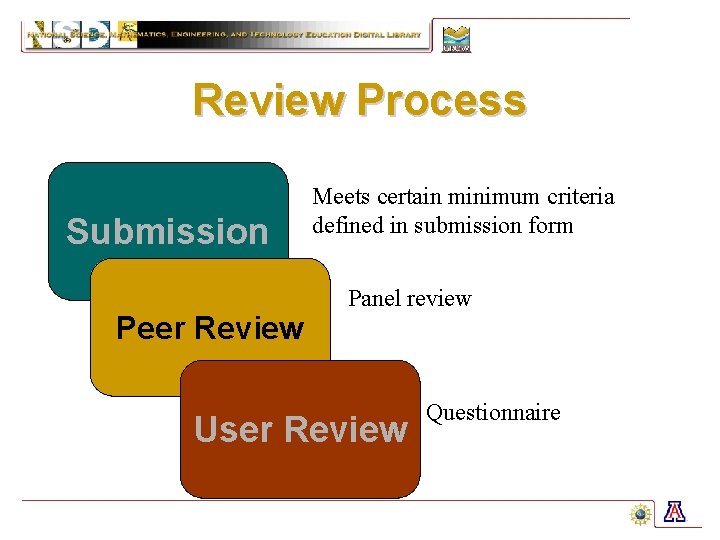
Review Process Submission Peer Review Meets certain minimum criteria defined in submission form Panel review User Review Questionnaire
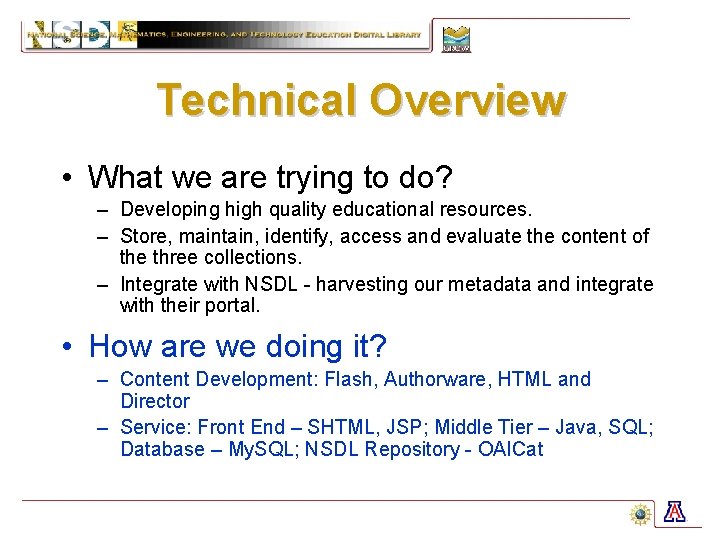
Technical Overview • What we are trying to do? – Developing high quality educational resources. – Store, maintain, identify, access and evaluate the content of the three collections. – Integrate with NSDL - harvesting our metadata and integrate with their portal. • How are we doing it? – Content Development: Flash, Authorware, HTML and Director – Service: Front End – SHTML, JSP; Middle Tier – Java, SQL; Database – My. SQL; NSDL Repository - OAICat
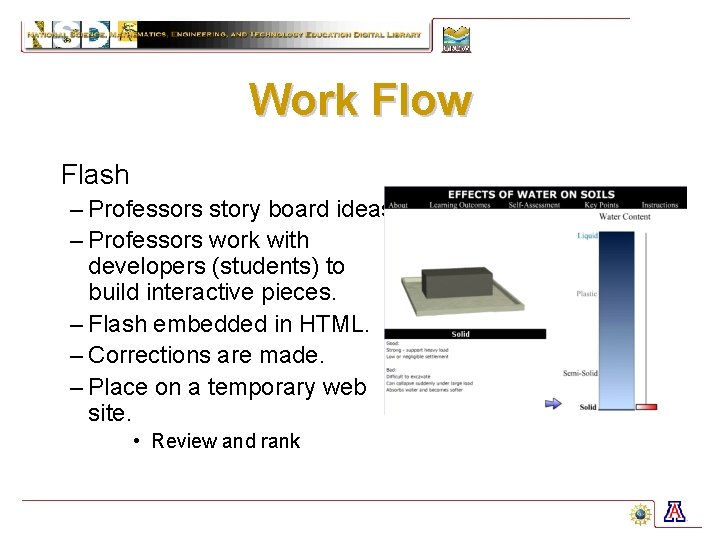
Work Flow Flash – Professors story board ideas. – Professors work with developers (students) to build interactive pieces. – Flash embedded in HTML. – Corrections are made. – Place on a temporary web site. • Review and rank
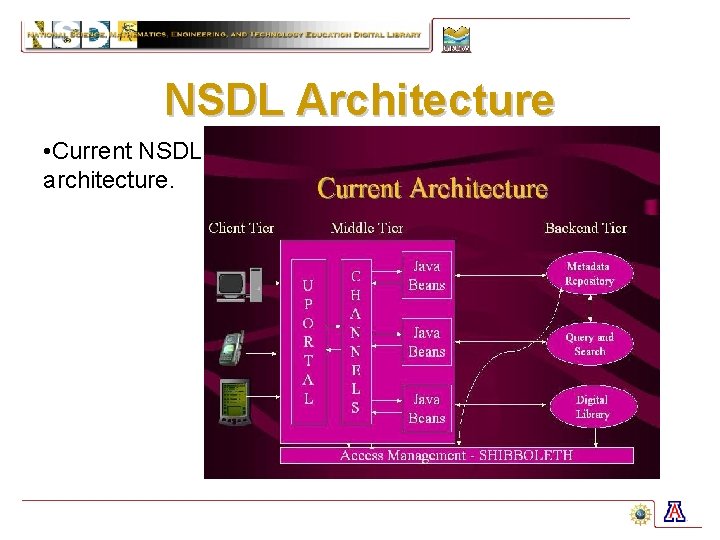
NSDL Architecture • Current NSDL architecture.
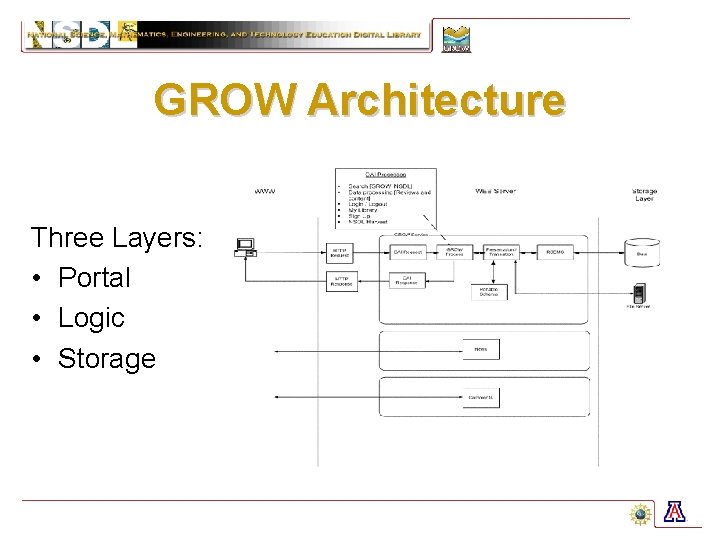
GROW Architecture Three Layers: • Portal • Logic • Storage
Code Issues • Interoperable – Reuse code for other NSDL projects. – OAIcat – Allow other groups in future to reuse our code. • Open Source – – – Ant, java based build tool. Tomcat, servlet engine for JSPs. Apache, web server. My. SQL, our database. All free software and available online.
Metadata • Metadata – (DC, DC+ed, 3 IEEE, GROW) – For Example: Title, Subject, Description, Creator, Contributor • Fitting in with NSDL – Metadata Repository • OAI Harvest, OAI Service – OAI - Open Archives Initiative develops and promotes interoperability standards that aim to facilitate the efficient dissemination of content. – Portals: NSDL has gone with UPortal initiative. We are currently evaluating this.
Demonstration • • • Change of Phase Mudslides Virtual Lab Rock Water Functionality (Search, Contribute, Review)
Current Status • Moving into testing phase - Prototyped the Search, Contribute and Public Review. • OAI service is in testing phase • Content development is moving along and we hope to have a public site available soon.
Partnerships • Macromedia • John Wiley & Sons • Geo-Institute (ASCE) • American Rock Mechanics Association (ARMA) • Sustainability of Semi-Arid Hydrology and Riparian Areas (SAHRA) • Corbett Elementary School • Catalina High School
Comments • How will the resources be used? • Would faculty, students, engineers and the public use the resources? • Will the resources enhance learning? • How will the resources be sustained beyond NSF funding?
For Information: Muniram Budhu Project Director budhu@u. arizona. edu or Ronan Dempsey Project Manager dempseyr@engr. arizona. edu
- Slides: 30